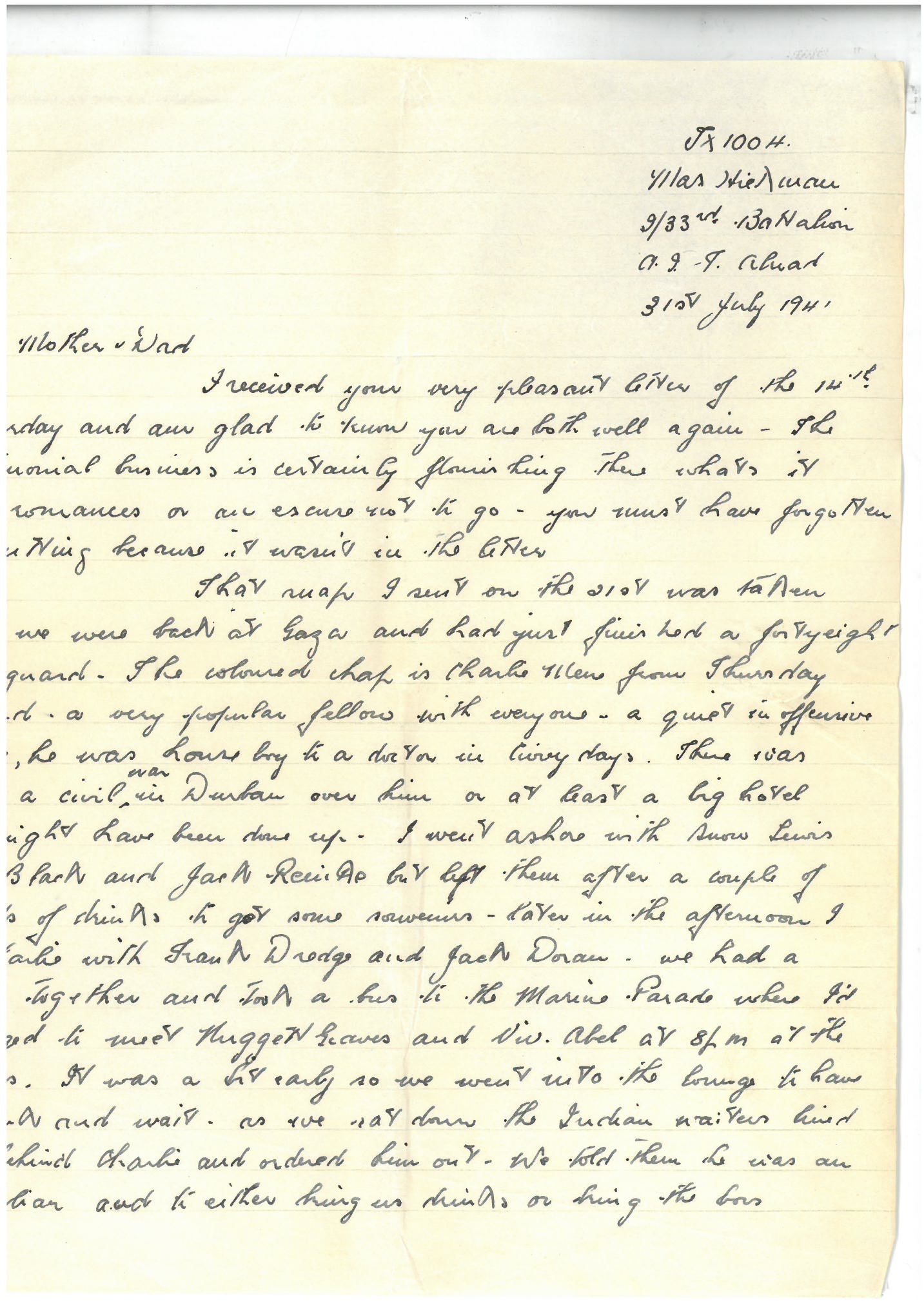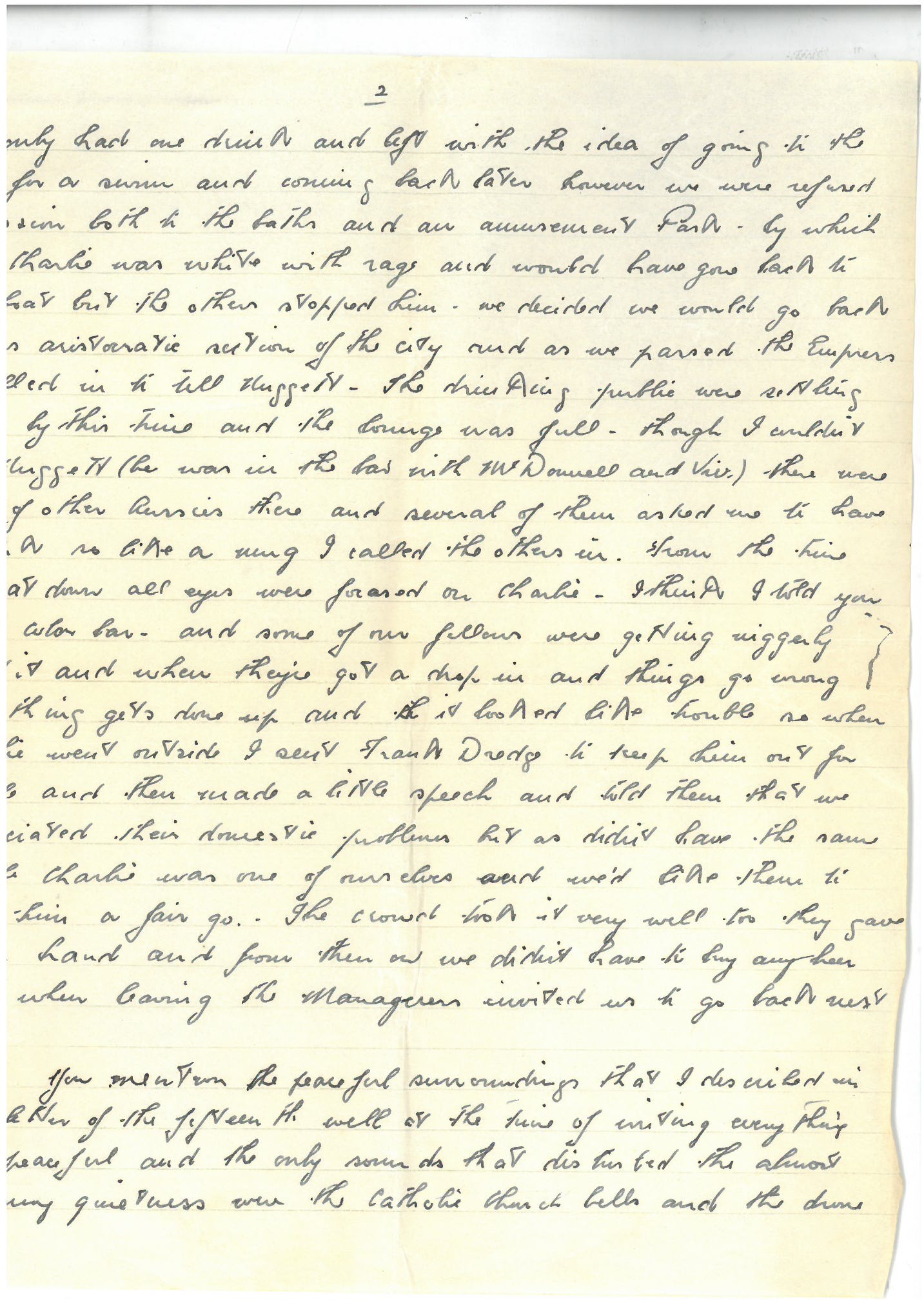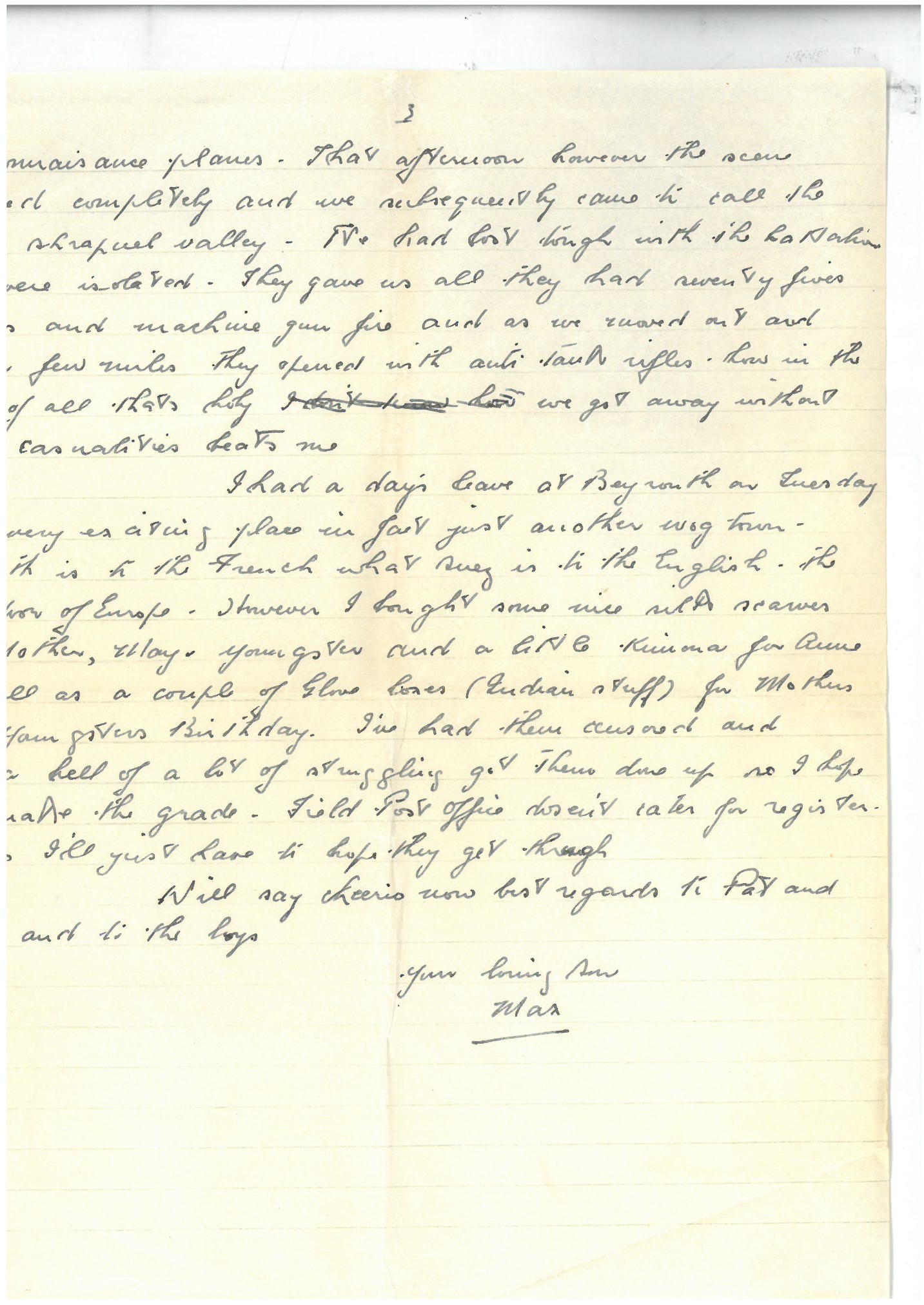
Plenty of mail, regimental hooey, dangerous drinks and instruction in the use of pick and shovel !!

24 sept 41 p1_0001

24 sept 41 p2_0001

24 sept 41 p3_0001

TX 1004

Max Hickman

2/33rd Battalion

AIF Abroad

24th Sept 1941

Dear Mother & Dad

Your welcome letters of the 18th August and sixth of September came in today.  The 18th August had evidently been held up.  In addition to your two interesting epistles there was one each from May, Youngster, Jack Chandler, Mae Menzie and Daisy Gourlay so I guess my spare time during the next few days will be well taken up.  Very sorry to hear of the deaths of Aunt Min and Aunt Sylvia – I must write to Tom & Dorrie.

The other letters were very interesting too, covering as you may well imagine a wide field of ideas and news.  I had quite given up expecting a letter from the Menzie’s.  It’s so long since I heard from them – in fact nearly four months (1st June).  The youngster’s letter and May’s were very newsy and Jack of course was his usual cheerful self.

On our side we have settled into barrack room like again and the barrack square has become the scene of regimental parades, guard mountings and piquets – all a lot of hooey but very nice to watch.  The many bugle calls sounded during the day together with the hoisting of the Battalion flag at reveille and the lowering at retreat are integral parts of Barrack life.  Even as I write the bull-like roars of the various CSM’s rend the air.  Most of the work – cleaning up and digging – was under the supervision of the headquarters Company CSM so our barracks has been named Haigh’s concentration camp.

There’s been another wine party.  This time in our barrack room.  The wine was brought here in kerosene tins and the soaks lapped it up by the pot or mug.  I was away from the room at the time, being on piquet duty in the town – others out of our platoon were reinforcements and when we got home they made enough noise scrounging for something to eat that they would have wakened the dead.  Ordinarily the slightest noise produces a torrent of abuse next morning but on this occasion the noise was the lamentations of twenty suffering men.  Near my bed some wine had been spilled and had eaten holes into the concrete.  I believe when the party started they called the wine ‘Petain’s Pilsener’ but next morning it was ‘Petain’s poison’.

A rather humorous aspect of army life happened last Tuesday when armed with picks and shovels we were marched a mile or so from the barracks to an olive grove where we were given a lecture by an officer in all seriousness on the elementary use of the pick and shovel and the methods of using same and digging various types of defences.  This is after we’d dug half of England up, undermined the desert and dug thousands of defensive pits in Syria – and when he called on me to give a demonstration well that was the last straw.  Last week I sent you a few snaps of Syria.   In this letter I am enclosing a few taken during the last few days of our sojourn in England.  Except for the one taken in the cabin of the Nea Hellas (the advance party had made ourselves at home in a good cabin but our occupancy was short lived for on the morrow we were transferred to the bowels of the ship).  To get back to the story – I was going to say that I’m not in any of the other snaps, they having been taken whilst we were in Scotland with the advance party.  Incidentally I’ve had another letter from the Lairds – they still want us to go back there for another Hogmanay, though I guess it won’t be this one.  Although we don’t know the minds of the mighty it looks as if we’ll be here for the winter and make a move somewhere in the spring.

Must say cheerio now.  Best regards to all the old Brigade and of course the boys.

Your loving son

Max

Deaths in the family

Aunt Min was Minnie Bealey who was married to Dad’s great uncle Tom.  She was 63 when she died.   Their daughter Dorrie  lived with them, and never married.  I have been unable to trace Aunt Sylvia.

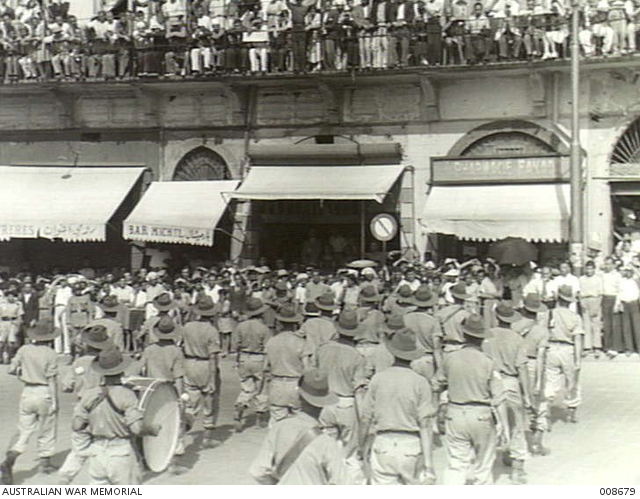
Regimental Parades
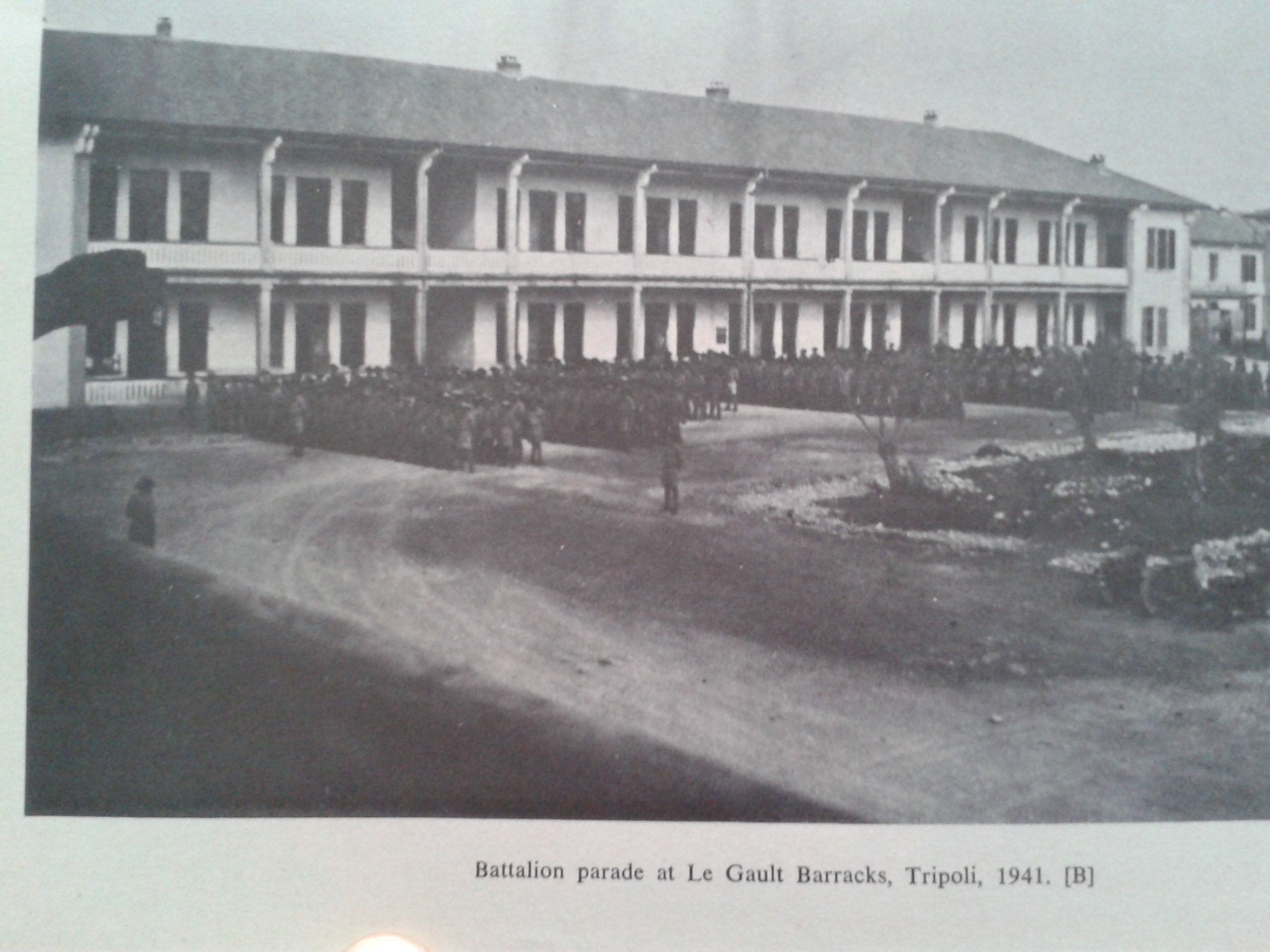
Legault BarracksPhoto – Battalion parade at Le Gaault Barracks – from The Footsoldiers


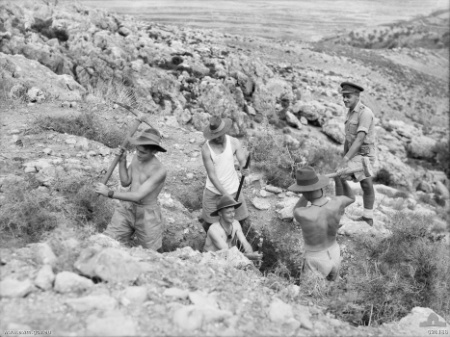
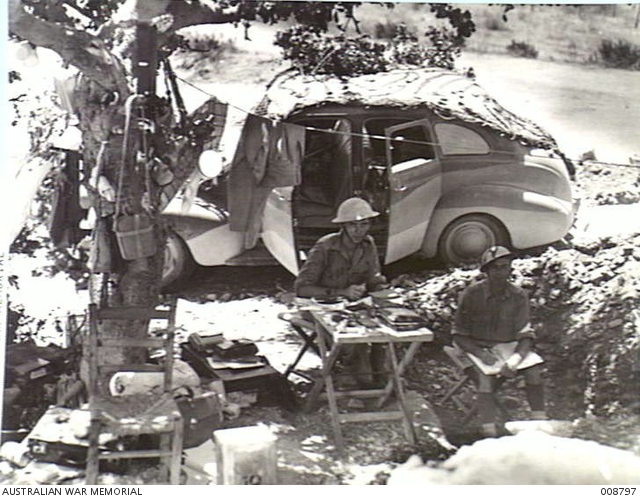
Instruction in use of pick and shovel
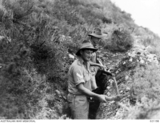
021198Photo –  AWM 021198

Shows men of the 2/31st Bn who were operating in the same area as the 2/33rd (Both Bns part of the 25th Brigade)


Reply to Daisy Gourlay

(only pages 1-3 of this letter exist)
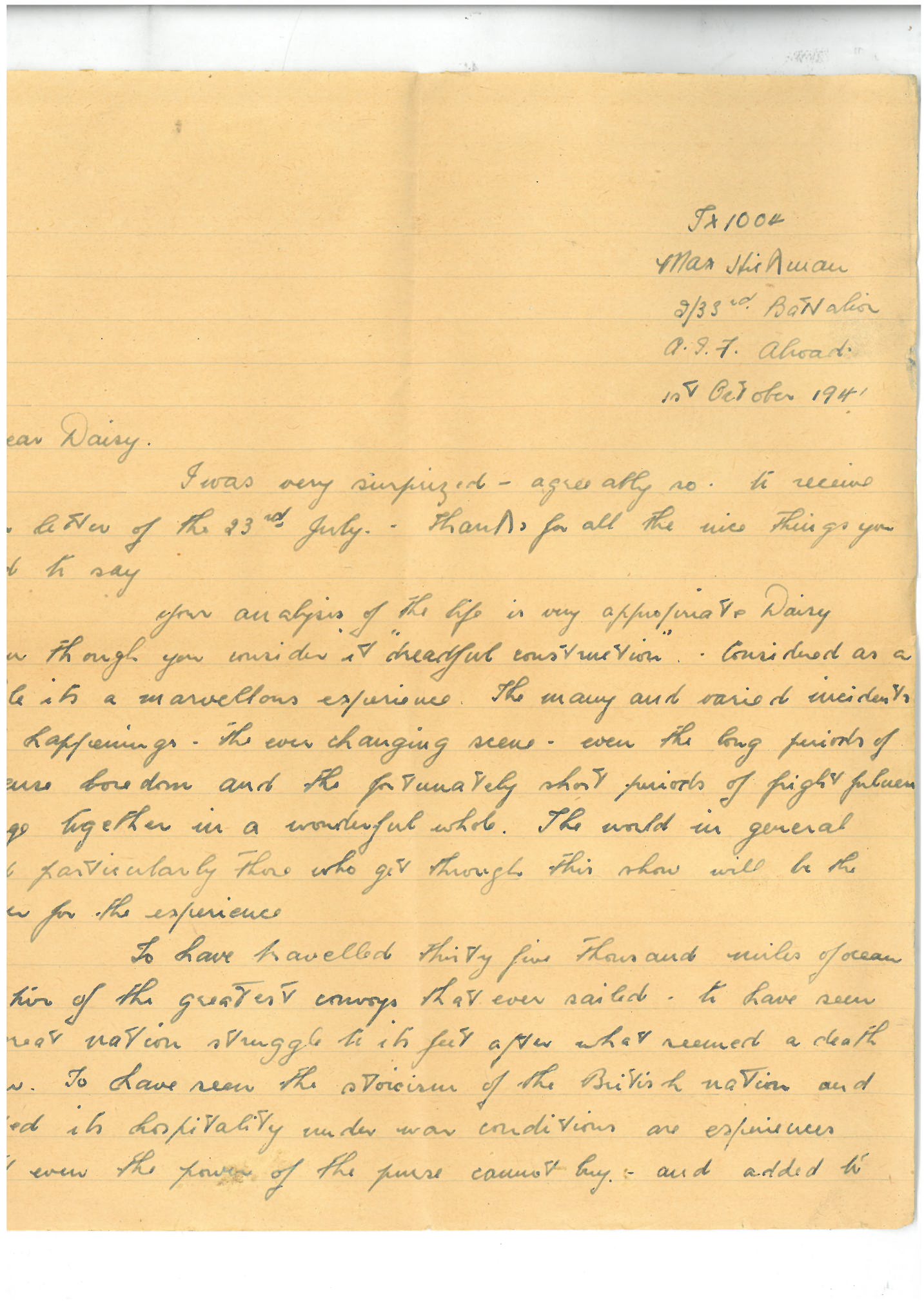
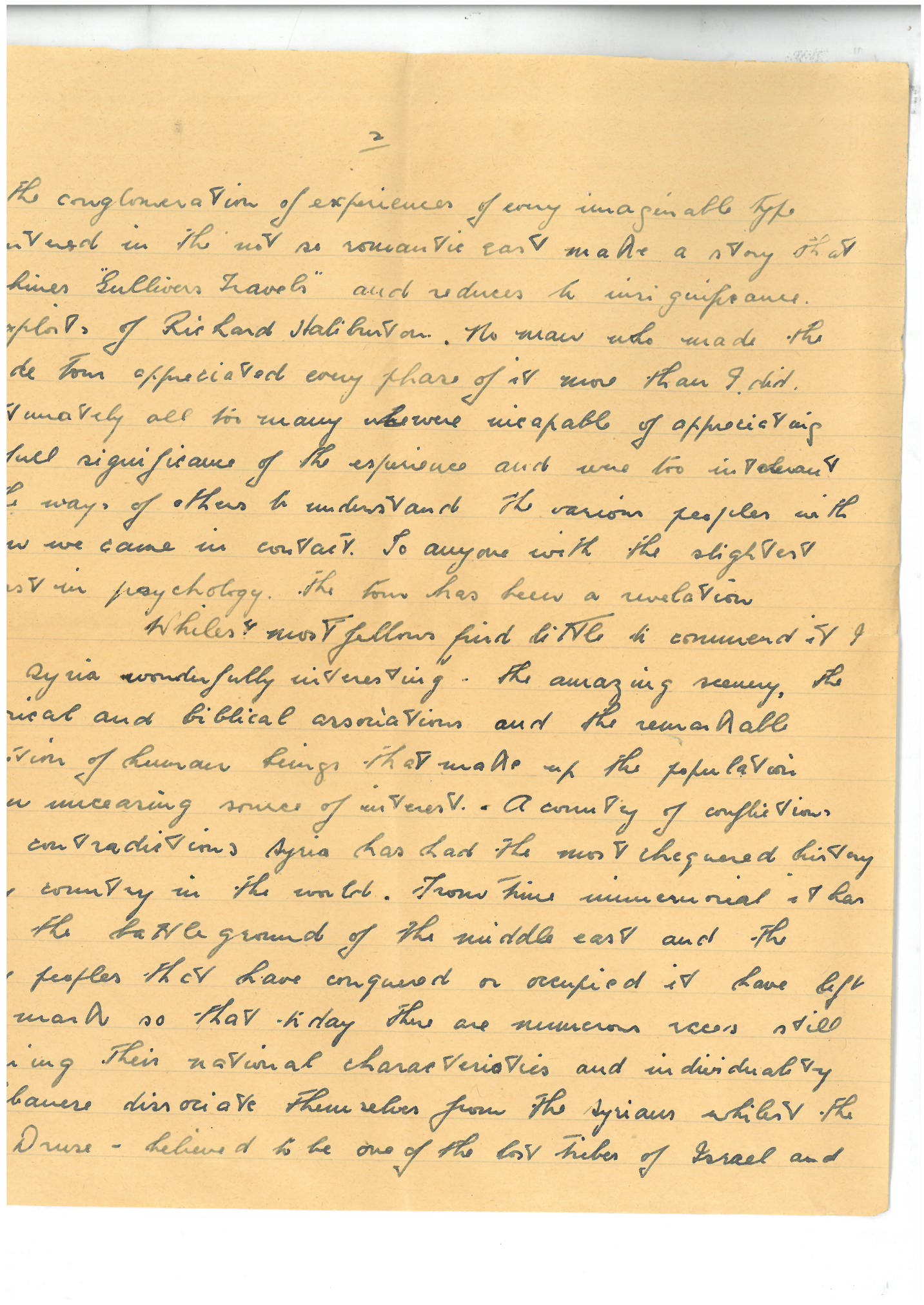
daisy oct 41 p1_0001

daisy oct 41 p2_0001daisy oct 41 p3_0001


Dear Daisy

I was very surprised – agreeably so – to receive your letter of 23rd July.  Thanks for all the nice things you had to say.

Your analysis of the life is very appropriate Daisy even though you consider it ‘dreadful construction’.  Considered as a whole it is a marvellous experience.  The many and varied incidents and happenings, the ever changing scene, even the long periods of intense boredom and the fortunately short periods of frightfulness merge together in a wonderful whole.  The world in general and particularly those who get through this show will be the better for the experience.

To have travelled thirty five thousand miles of ocean in two of the greatest convoys that ever sailed, to have seen a great nation struggle to its feet after what seemed a death blow, to have seen the stoicism of the British nation and tasted its hospitality under war conditions are experiences that even the power of the purse cannot buy, and added to this the conglomeration of experiences of every imaginable type encountered in the not so romantic east make a story that outshines ‘Gulliver’s Travels’ and reduces to insignificance the exploits of Richard Haliburton.  No man who made the grande tour appreciated every phase of it more than I did.  Unfortunately all too many were incapable of appreciating the full significance of the experience and were too intolerant of the ways of others to understand the various peoples with whom we came in contact.  To anyone with the slightest interest in psychology the tour has been a revelation.

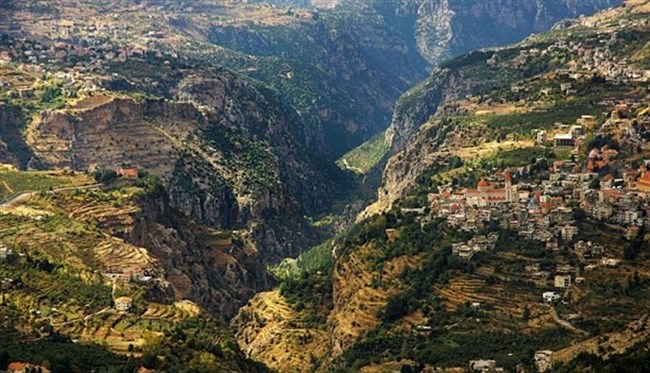
Whilest most fellows find little to commend it I find Syria wonderfully interesting – the amazing scenery, the historical and biblical associations and the remarkable collection of human beings that make up then population are an unceasing source of interest.  A country of conflictions and contradictions, Syria has had the most chequered history of any country in the world.  From time immemorial it has been the battleground of the middle wast and the many peoples that have conquered or occupied it have left their mark so that today there are numerous races still retaining their national characteristics and individuality.  The Lebanese dissociate themselves froth Syrians whilst the Jebel Druse – believed to be one of the lost tribes of Israel and the original worshippers of the golden calf – dissociate themselves from both Syria and the Lebanon.  Some of the mountain scenery is the best I’ve ever seen and I really think the best in the world.  Around the Jezzine area where we were fighting the rugged mountains, some of them ten thousand feet high, made a picture of unbelievable grandeur.  The terraced foothills and unbelievably crazy patterns made by the multicoloured rock formations were beyond the description of pen or paint.

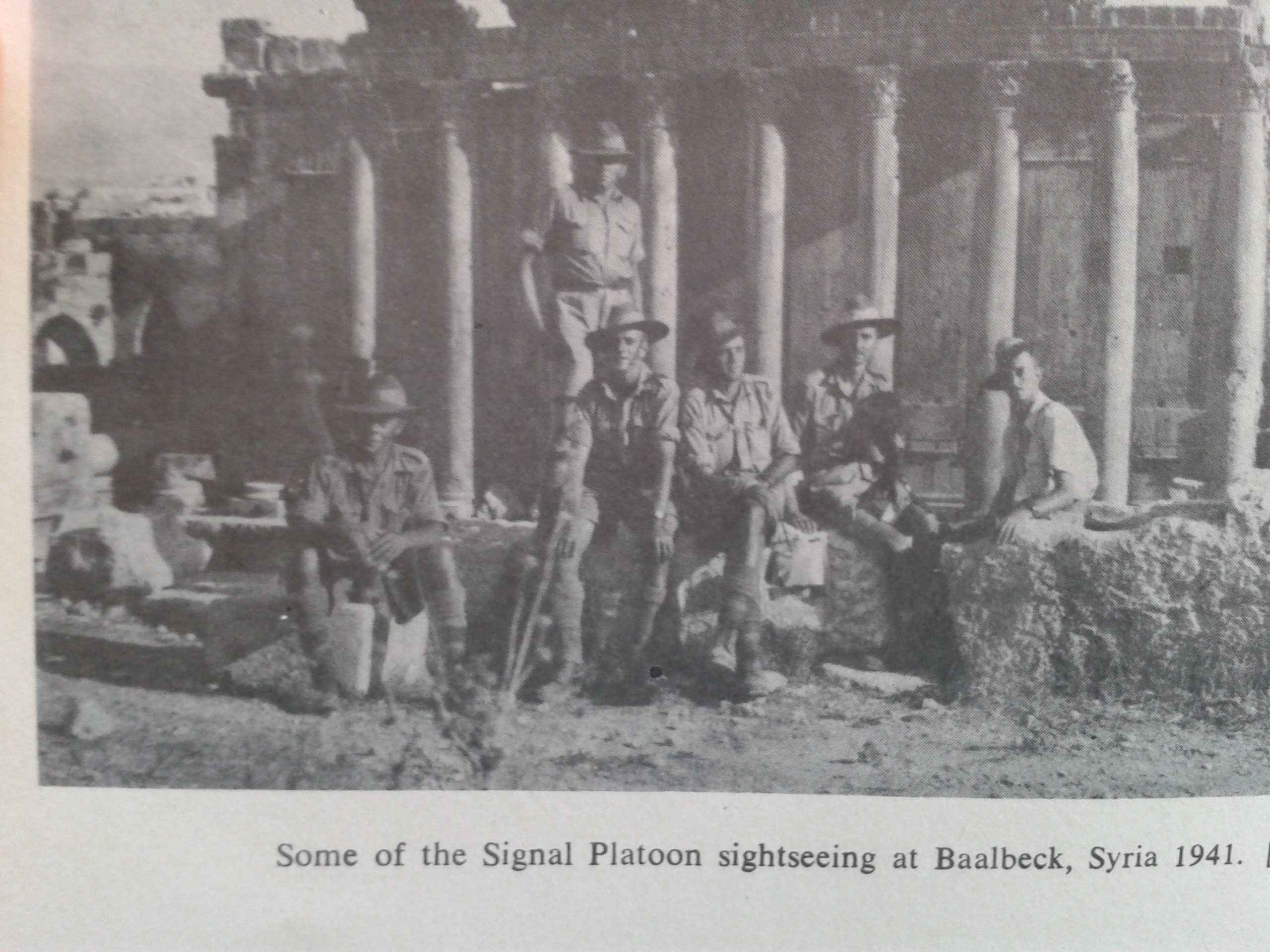
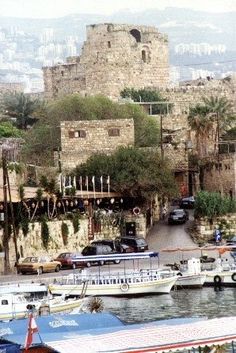
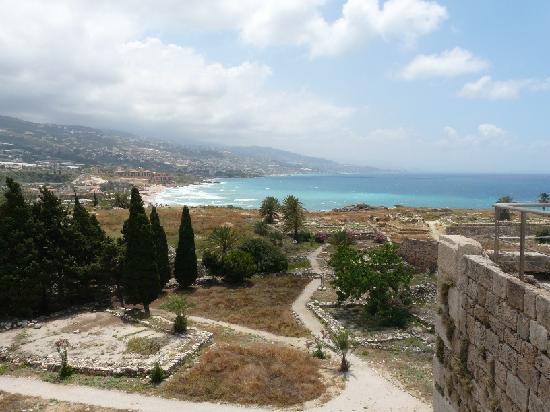
The ruins of ancient empires – Phoenician, Roman, Greek and of Crusading days are also very interesting.  At Ball-beck (where the Anti-Tank – Agle(?) Gourlay’s crowd) were stationed after the armistice, there are the ruins of five famous temples.  Some of the granite columns and stone work still stand as a monument to the workmanship of five thousand years ago.  One of the things that confounds everyone is how they got the huge cut stones into place.  In one of the temples there’s a stone sixteen feet long and ten feet square on the section.  It would probably weigh eighty to a hundred tons.  At Byblos just north of where we were stationed for eight weeks after the armistice are the ruins of another Phoenician city – most of the royal tombs have been dug up by French archaeologists for the gold and jewels they contained – here also are the remains fo a Roman amphitheatre and still standing a Crusaders Castle.

(remainder of letter is missing)

Terraced foothills
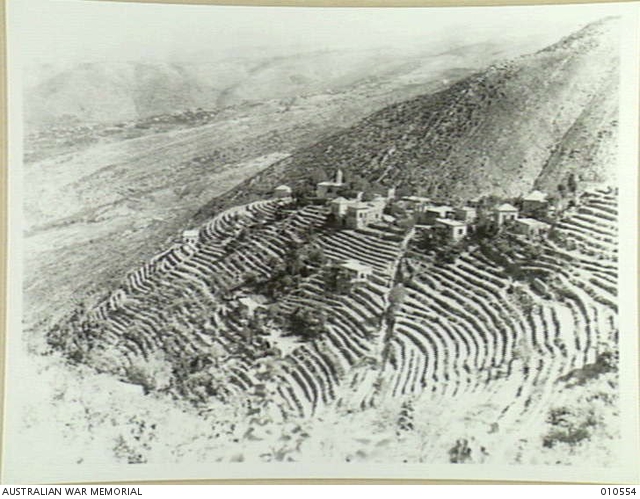
010554Photo – AWM 010554`


Byblos – Roman amphitheater
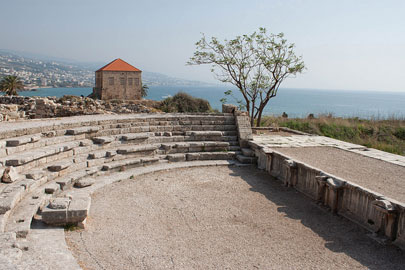
0511110233-byblos-14(the-roman-theater)– from lebanoneguide.net
Posted in Camps and Barracks, gambling and drinking, Letters to/ from others, Middle East, organisation, training, Uncategorized | Tagged , | Leave a comment

Moving north, into French Barracks outside Tripoli

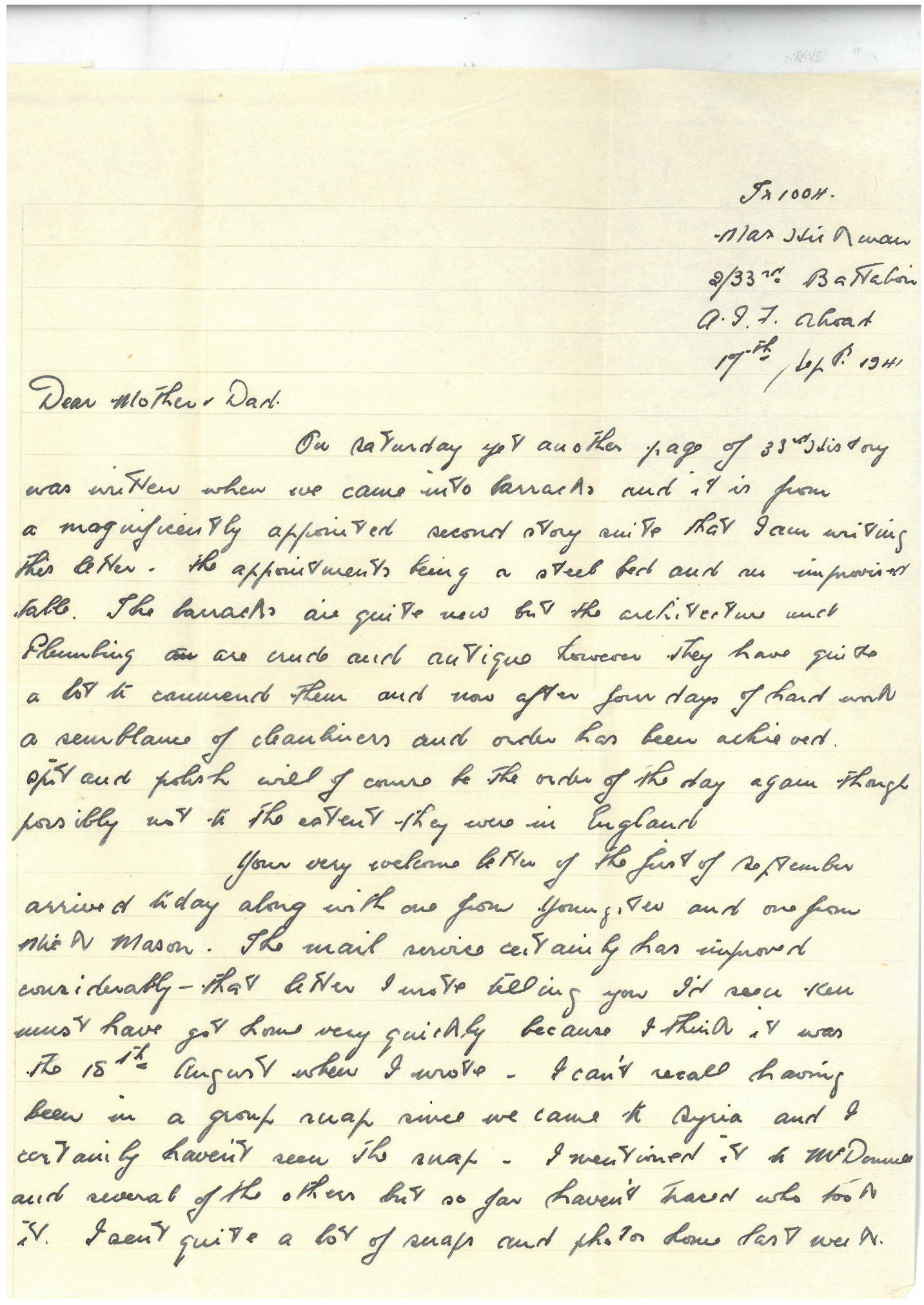
17 sept 41 p1_0001

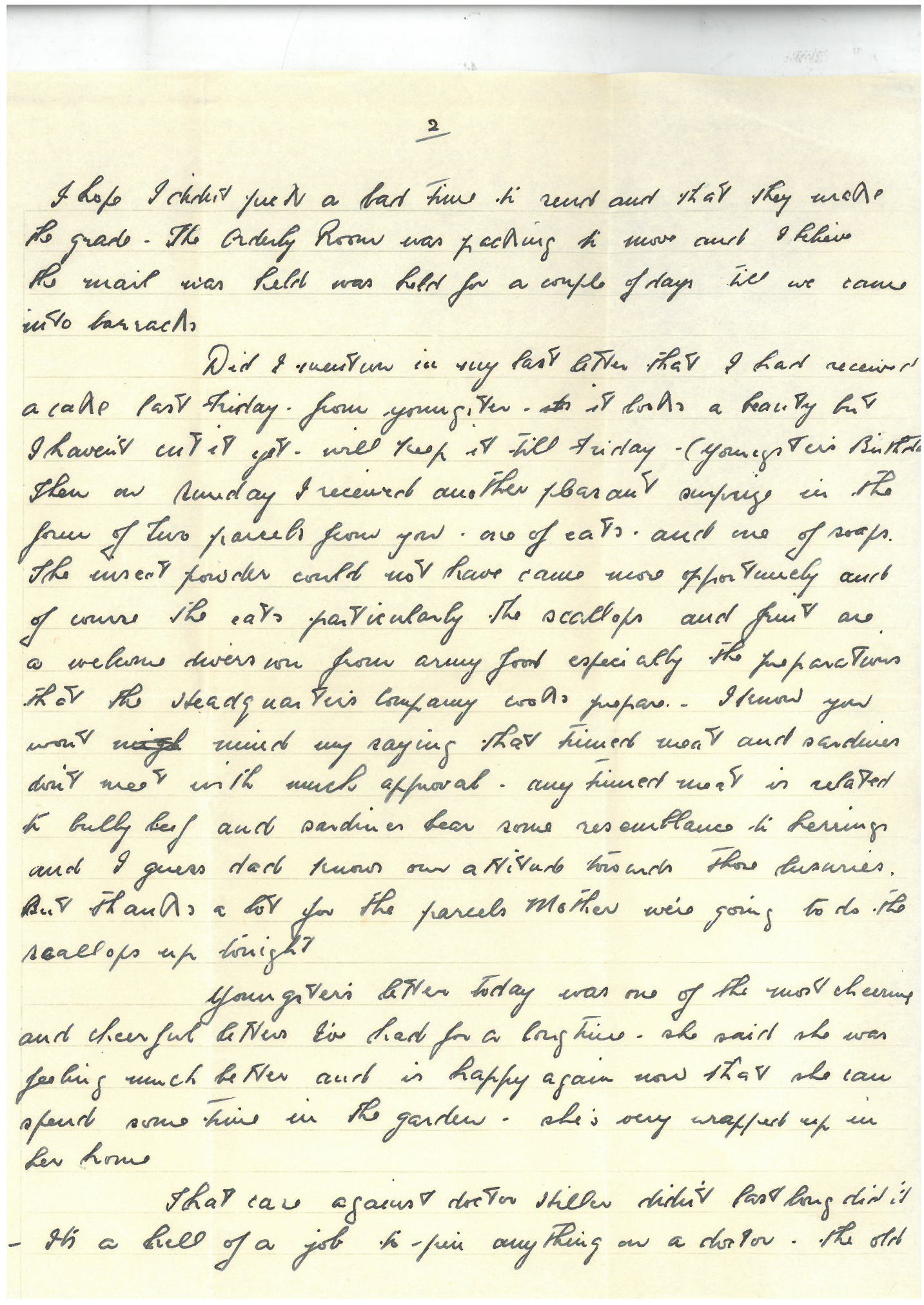
17 sept 41 p2_0001

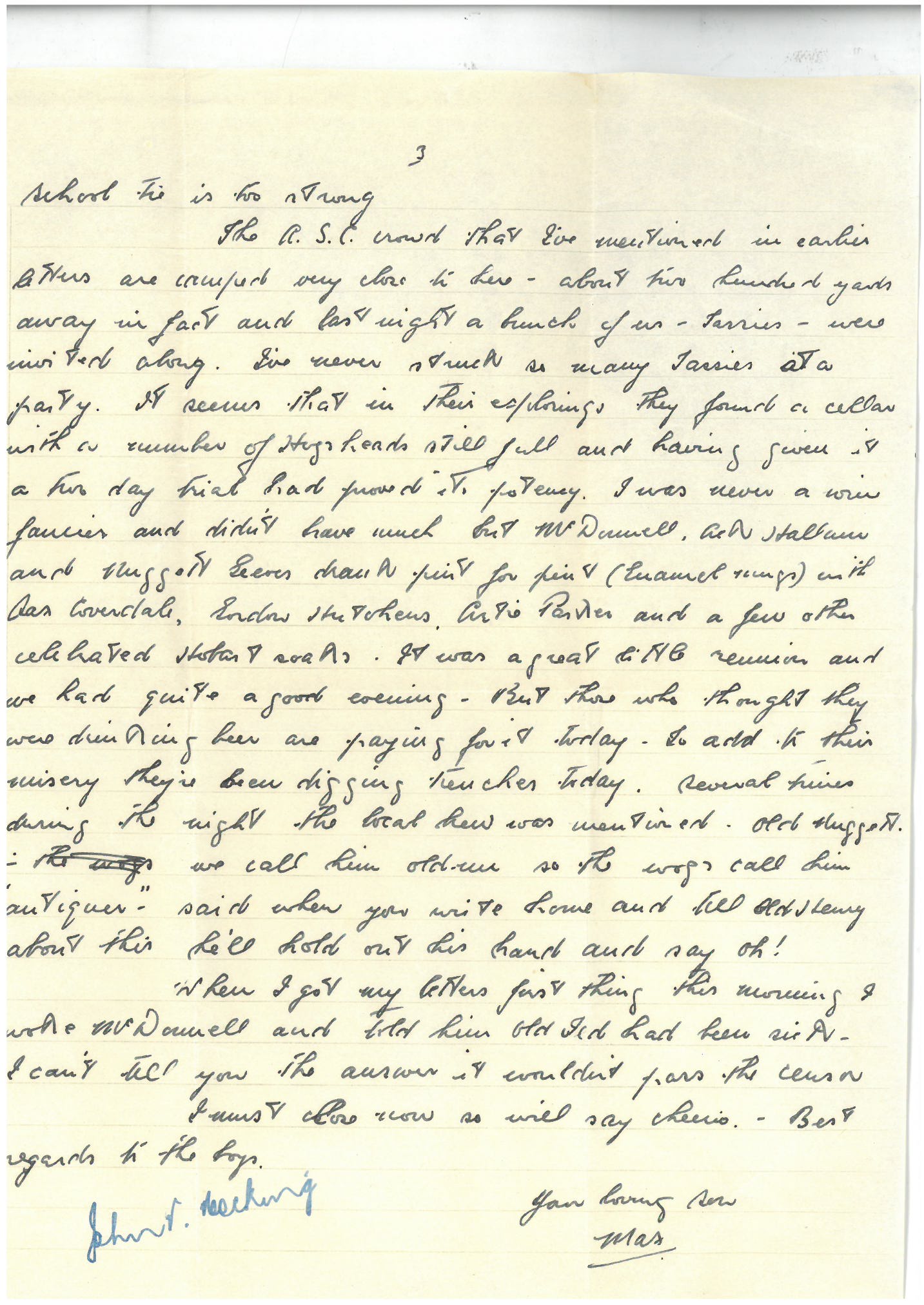
17 sept 41 p3_0001

TX 1004

Max Hickman

2/33rd Battalion

AIF Abroad

17th Sept 1941

Dear Mother & Dad

On Saturday yet another page of 33rd history was written when we came into barracks and it is from a magnificently appointed second storey suite that I am writing this letter.  The appointments being a steel bed and an improvised table.  The barracks are quite new but the architecture and plumbing are crude and antique.  However they have quite a lot to commend them and now after four days of hard work a semblance of cleanliness and order has been achieved.  Spit and polish will of course be the order of the day again though possibly not to the extent they were in England.

Your very welcome letter of the first of September arrived today along with one from Youngster and one from Mick Mason.  The mail service certainly has improved considerably.  That letter I wrote telling you I’d seen Ken must have got home very quickly because I think it was 18th August when I wrote – I can’t recall having been in a group snap since we came to Syria and I certainly haven’t seen the snap.  I mentioned it to McDonnell and several of the others but so far haven’t traced who took it.  I sent quite a lot of snaps and photos home last week.  I hope I didn’t pick a bad time to send and that they make the grade.  The Orderly Room was packing to move and I believe the mail was held for a couple of days till we came into barracks.

Did I mention in my last letter that I had received a cake last Friday?  From Youngster – it looks a beauty but I haven’t cut it yet – will keep it till Friday (Youngster’s birthday).  Then on Sunday I received another pleasant surprise in the form of two parcels from you – one of eats, and one of soaps.  The insect powder could not have come more opportunely and of course the eats particularly the scallops and fruit are a welcome diversion from army food, especially the preparations that the Headquarters Company cooks prepare.  I know you won’t mind my saying that tinned meat and sardines don’t meet with much approval – any tinned meat is related to bully beef and sardines bear some resemblance to herrings and I guess Dad knows our attitude towards those luxuries.  But thanks a lot for the parcels Mother – we’re going to do the scallops up tonight.

Youngster’s letter today was one of the most cheering and cheerful letters I’ve and in a long time.  She said she was feeling much better and is happy again now that she can spend some time in the garden.  She’s very wrapped up in her home.

That case against Doctor Hiller didn’t last long did it?  It’s a hell of a job to pin anything on a doctor – the old school tie is too strong.

The ASC crowd that I’ve mentioned in earlier letters are camped very close to here – about two hundred yards away in fact and last night a bunch of us – Tassies – were invited along.  I’ve never struck so many Tassies at a party.  It seems that in their explorings they found a cellar with a number of hogs heads still full and having given it a two day trial had proved its potency.  I was never a wine fancier and didn’t have much but McDonnell, Ack Hallam and Nuggett Geeves drank pint for pint (enamel mugs) with Sam (?) Coverdale, Gordon Hutchens, Artie Parker and a few other celebrated Hobart soaks.  It was a great little reunion and we had quite a good evening.  But those who thought they were drinking beer are paying for it today.  To add to their misery they’ve been digging trenches today.  Several times during the night the local brew was mentioned – Old Nuggett – we call him old-un so the wogs call him ‘antiquer’ – said when you write home and tell old Henry about this he’ll hold out his hand and say Oh!

When I got my letters first thing this morning I woke McDonnell and told him old Ted had been sick – I can’t tell you the answer – it wouldn’t pass the censor.

I must close now so will say cheerio.  Best regards to the boys.

Your loving son

Max

On the move
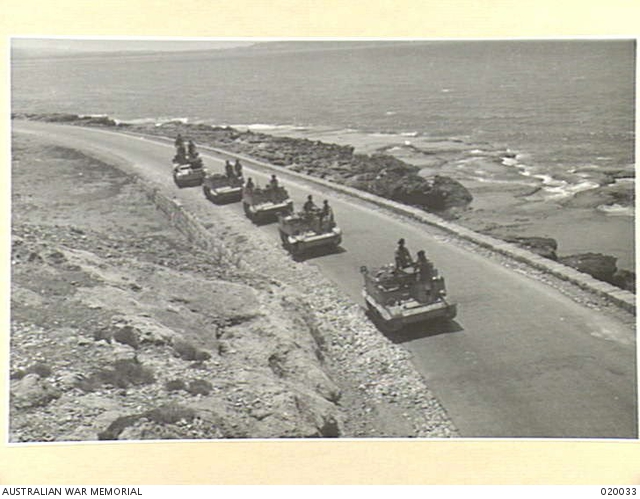
020033

photo : mechanised Australian cavalry (i.e.  Carriers) on the coast road between Beirut and Tripoli  AWM 020033


The Barracks:  From The Footsoldiers

At 0600 hours, 13 September, the  battalion moved in convoy along the north road, arriving at the sea port of Tripoli at 1600 hours the same day.  Here, just two miles above this pleasant and ancient fishing town, we occupied the French Legault Barracks.  Built just ten years before, it consisted of three vast, two-storied concrete barracks surrounding a parade ground square.  Walled around and gated, complete with guardhouse and cell block, it fronted the main road which ran down to the town 600 feet below.  Much of 14/15 September was used in settling in and cleaning the place up.  Both the 2/25th and 2/31st Battalions were also barracked in this sprawling garrison site.  With one platoon to a room, and each man with an iron bed, it was reminiscent of our barrack days in England.  Although the use of the toilets with a hole flush with the floor, water washing underneath, and two non slip grooves beside the hole made us wonder.  The place, nevertheless, was agreeably comfortable.   (pp 125-26)

The mail service

Ref: Battalion diary https://static.awm.gov.au/images/collection/bundled/RCDIG1027235.pdf

From Routine Orders August 21 –

AIR MAIL: Airmail is now received once weekly from Australia until further notice

From Routine Orders August 23 – Abundant writing materials are always available with the Padre and tps are advised to avail themselves of this offer.

Spit and polish will be the order of the day

Extract from Battalion diary https://static.awm.gov.au/images/collection/bundled/RCDIG1027235.pdf  –

Extract from Routine Orders (Sept 13)

2. BOUNDS   Tripoli is OUT OF BOUNDS to all ranks until further notice

3. ROUTINE   The following daily Routine will be strictly adhered to

Reveille 0600 hrs/  Adm Parade 0630 hrs/  Breakfast 0730 hrs/  Parade 0800 hrs/ Stand Down 1215 hrs/  Midday Meal 1230 hrs/  Parade 1500 hrs/  Stand Down 1700 hrs/  Evening Meal 1730 hrs/  Duty Mounting 1750 hrs/  Retreat 1800 hrs/  First Post 2130 hrs/  Last Post 2200 hrs/  Tattoo 2200 hrs/  Lights Out 2215 hrs

4. BLACK OUT PRECAUTIONS  Strict Blackout precautions must be observed.  All lights burning at night must be carefully blacked out.

5. LEAVE  No leave will be granted out of the Barracks area until further notice.  NO person or vehicle will leave Barracks without written authority from this Office.


Dr Hiller and the ‘old school tie’ – a most peculiar trial!

‘Unusual development brings trial to abrupt end’  http://trove.nla.gov.au/ndp/del/article/25878663

Trench digging duty

Australian_2_31st_Battalion_Syria_1941Photo : AWM 021188   Men of the 2/31st Bn constructing a section post.  Jebel Tourbel, Syria October 1941 .  It was part of the second defence line in the area.


Posted in Camps and Barracks, gambling and drinking, parcels, Posts and telegraph, unit and personal diaries | Tagged , , , | Leave a comment

Events on the various fronts…almost too good to be true

10 sept 41 p1_0001

10 sept41 p2_0001


TX 1004

ML Hickman

2/33rd Battn

AIF Abroad

10th Sept 1941

Dear Mother & Dad

Your welcome letter of 24th August arrived today.  I’m glad to know you’re both fit and well.  The last letter I had was written in a handwriting I didn’t recognise and then when there was no letter at all last week I thought the pater mist be sick so that your letter today was very reassuring.

Quite a lot of things seem to be happening around home.  Is Alec Worby getting married or just buying a block to hold?  Jack Lewis(?) seems to have gone back to his old job rather well – it’s quite up to his standard sending young Pringle to you although the security might be alright.  As you say old Nev is getting on. I guess he’d like to have the money he’s spent in whisky now.

There’s no doubt about it the people at home are only half hearted about the war – even as things are, the political crowds wrangle over the spoils.  It’ll be interesting to see whether Fadden can make a job of things.  Our ideas of democracy need a big overhaul.  Politically they’re a farce, socially they’re childish and commercially piratical.

Events on the various fronts have been much more interesting lately – almost too good to be true.  The news tonight is most encouraging.  The Russians seem to be holding the Germans well and at sea and in the air England is doing good work.  If they can keep it up till Christmas we might be home for Easter.  We’re moving into barracks in the weekend so we look like staying here for the winter.

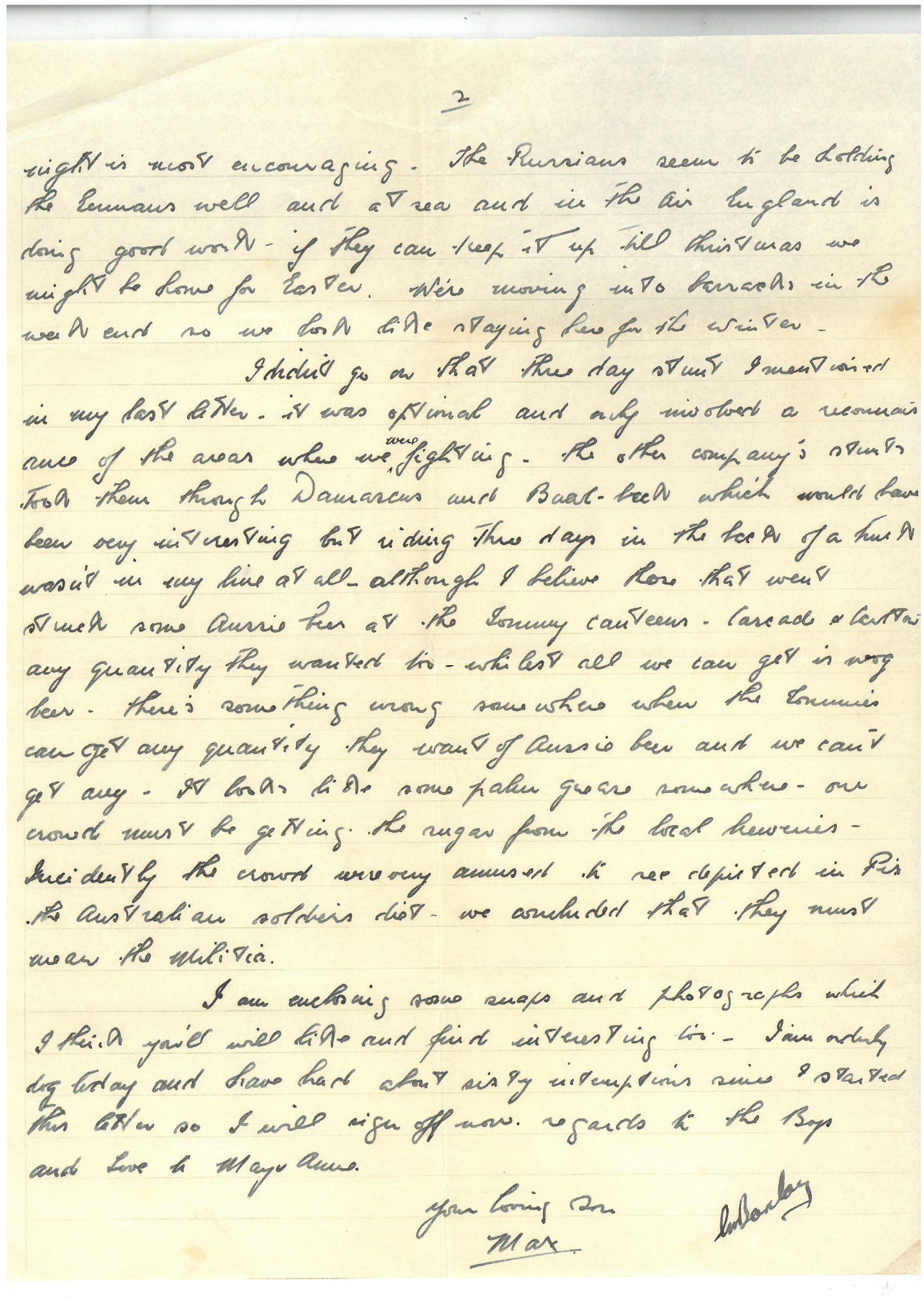
I didn’t go on that three day stunt I mentioned in my last letter – it was optional and only involved a reconnaissance of the areas where we were fighting.  The other company’s stunts took them through Damascus and Baal-bek which would have been very interesting but riding three days in the back of a truck wasn’t in my line at all – although I believe those that went struck some Aussie beer at the Tommy canteens – Cascade and Carlton – any quantity they wanted too – whilst all we can get is wog beer.  There’s something wrong somewhere when the Tommies can get any quantity they want of Aussie beer and we can’t get any – It looks like some palm grease somewhere – our crowd must be getting the sugar from the local heavies.  Incidentally the crowd were very amused to see depicted in Pix the Australian soldier’s diet – we concluded that they must mean the Militia.

I am enclosing some snaps and photographs which I think you will like and find interesting too.  I’m orderly dog today and have had about sixty interruptions since I started this letter so I will sign off now.  Regards to the boys and love to May & Anne.

Your loving son

Max

Arthur Fadden becomes Prime Minister

from the National Museum website – http://www.nma.gov.au/primeministers/arthur_fadden

Australia entered into the Second World War on 3 September 1939, and the period from 1939-1941 was one of instability in federal government. It was marked by conflict between the United Australia Party (UAP) and Country Party coalition partners, and by power struggles within each party, with the leadership of each changing several times.

In October 1940, when AG Cameron quit leadership of the Country Party, Earle Page and John McEwen contested the leadership, resulting in a tied vote. Fadden, as Deputy Leader, was appointed ‘Acting Leader’ to break the deadlock. He was confirmed as party leader on 21 March 1941, and retained the position for the next 17 years.

Fadden served as Minister Assisting the Treasurer and Minister for Supply and Development in Robert Menzies’ United Australia Party-Country Party coalition from March-August 1940, then as Minister for Air and Minister for Civil Aviation from August-October 1940, and finally as Treasurer from October 1940-August 1941. He was a member of the war cabinet from 1940 to 1941.  In January 1941 Fadden became Acting Prime Minister for four months while Menzies was overseas. After increasing dissension within the UAP-CP coalition, Menzies resigned as Prime Minister on 28 August 1941 in favour of Fadden.
The news tonight is most encouraging…we might be home for Easter

http://trove.nla.gov.au/ndp/del/article/52462844

The front page of the Launceston Examiner on September 2, 1941 has articles regarding the many fronts on which Allied forces were fighting – including Russia. I assume radio reports were more selective in focussing on the positives for the Allies, rather than including reports from Germany itself.   There is also an extract from a letter written by Robert Menzies for London’s Daily Mail in which he predicts Victory in 1942, and an article headlined ‘Signs that Axis May Attack Turkey’.  No doubt this concern played a part in the decision to hold Australians in northern Lebanon/ Syria over the winter.

http://trove.nla.gov.au/ndp/del/page/1858611?zoomLevel=3

The Hobart Mercury on Saturday 6th September also makes fascinating reading.  Claims and counter-claims from German and Russian sources in particular must have reminded Dad of those German broadcasts that they used to hear in England – of half the British navy being sunk on a daily basis.

Others went sight-seeing

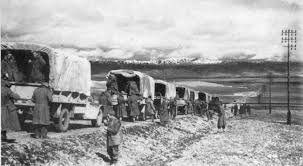
Travelling in trucks….

ourstorydotinfo


photo from http://www.ourstory.info

(A British convoy in Syria )


to see the sights…

2015-07-23 09.36.16


Battalion members at Baal-bek  (from The Footsoldiers)


The Australian Soldier’s diet
I’ve been unable to locate the actual Pix article referred to, but here is one from Brisbane’s Courier Mail in September 1941 that seems to be of a similar tone, and may have arisen from the same press release:  http://trove.nla.gov.au/ndp/del/article/41941795
Headlined ‘Australia’s New Army Cooks Earn New Dignity’ it describes how scientifically balanced the soldier’s diet is, how much attention is paid to providing fresh fruit and vegetables, milk (generally powdered) and cheese, what cooking methods are used to ensure maximum benefit to the soldiers.  A few quotes…There are two objectives in Army feeding – first, to satisfy the soldiers’ idea of ‘good tucker’ and second to apply modern knowledge of nutrition so that the soldier will be built up in health, fitness, stamina and vigour and withstand the strain of total war and the risk of epidemic disease. …..Australian soldiers are provided with three times the quantity of fruit and vegetables eaten by the average civilian….And if our testing time does come, well, V stands for Vitamins, Vitality and Victory.

The article does speak about camps in Darwin and North Queensland, so could – as Dad suggests- relate mainly to the Militia, but it does also mention the availability of oranges and grapefruit in Palestine, carrots and cabbages in Cairo and in Tobruk – vitamin C tablets.  No doubt, as with the constant invocation to troops to ‘write home first’, the Army’s PR machine was focussed on providing families with a positive picture of the provisions being offered to their boys.

Posted in Australian, gambling and drinking, organisation, The course of the war | Tagged , , | Leave a comment

A parcel with scallops – hoping they’ll go the rounds


2 sept 41 p1_0001


2 sept 41 p2_0001

2 sept 41 p3_0001

TX 1004

Max Hickman

2/33rd Battalion

AIF Abroad

2nd Sept 1941

Dear Mother & Dad

Once again I write hoping to find you happy and well as I am at present.  I am writing a little earlier than usual this week because I’ll probably be away on a three day stunt when the mail comes in.

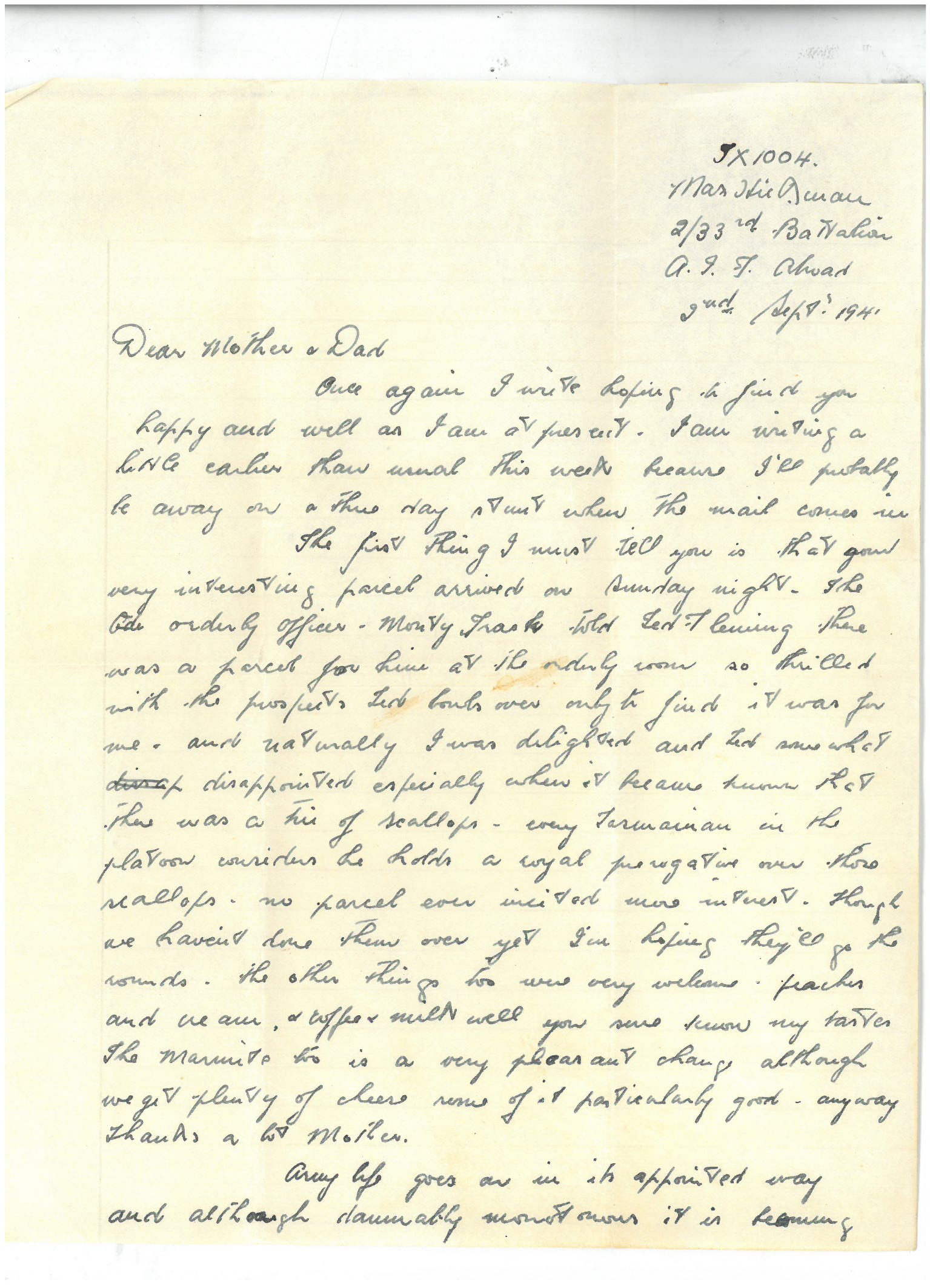
The first thing I must tell you is that your very interesting parcel arrived on Sunday night.  The orderly officer Monty Trask told Ted Fleming there was a parcel for him at the orderly room so thrilled with the prospects Ted bowls over only to find it was for me – and naturally I was delighted and Ted somewhat disappointed especially when it became known that there was a tin of scallops – every Tasmanian in the platoon considers he holds a royal prerogative over those scallops – no parcel ever incited such interest.  Though we haven’t done them over yet I’m hoping they’ll go the rounds.  The other things too were very welcome – peaches and cream, coffee & milk – well you sure know my tastes. The marmite too is a very pleasant change although we get plenty of cheese some of it particularly good – anyway thanks a lot Mother.

Army life goes on in its appointed way and although damnably monotonous it is becoming much more tolerable now that the weather has started to cool off and cards are becoming more and more sought after and when not on duty we spend the long evenings playing bridge or crib.

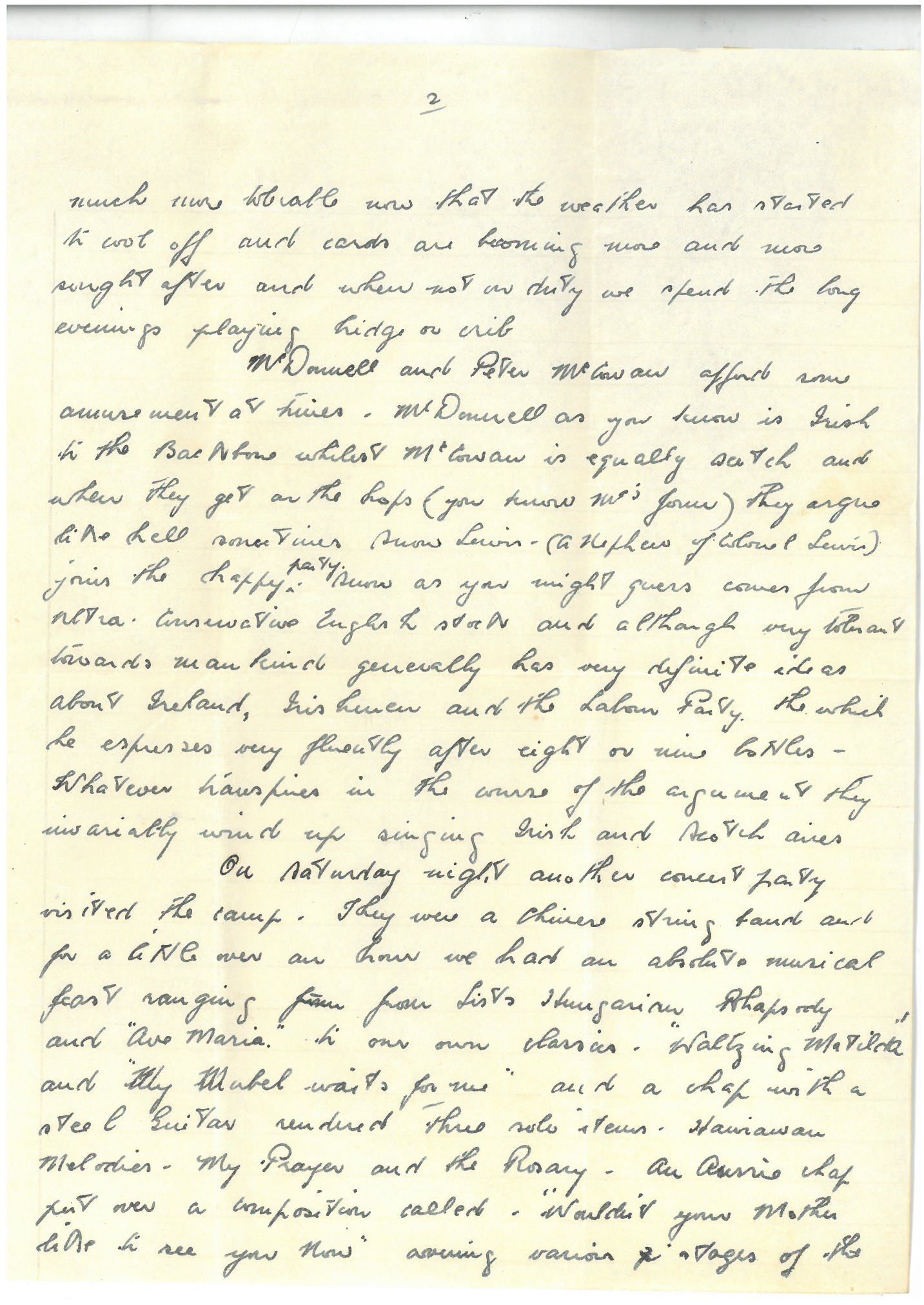
McDonnell and Peter McCowan afford some amusement at times.  McDonnell as you know is Irish to the backbone whilst McCowan is equally Scotch and when they get on the hops (you know Mc’s form) they argue like hell.  Sometimes Snow Lewis (a nephew of Colonel Lewis) joins the happy party.  Snow as you might guess comes from ultra-conservative English stock and although very tolerant towards mankind generally has very definite ideas about Ireland, Irishmen and the Labour Party, which he expresses very fluently after eight or nine bottles.  Whatever transpires in the course of the argument they invariably wind up singing Irish and Scotch airs.

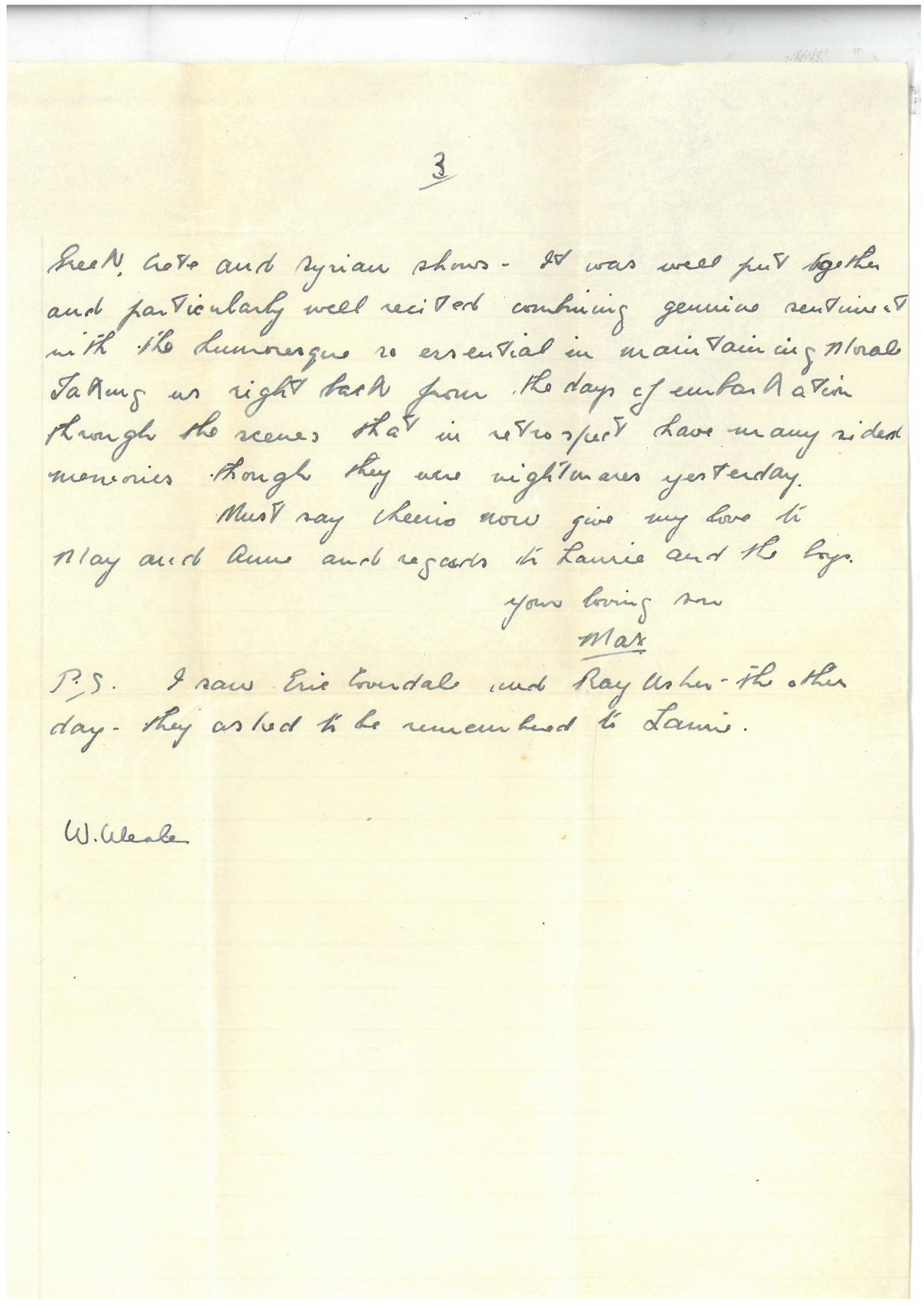
On Saturday night another concert party visited the camp.  They were a Chinese string band and for a little over an hour we had an absolute musical feast ranging from Liszt’s Hungarian Rhapsody and ‘Ave Maria’ to our own classics – ‘Waltzing Matilda’ and ‘My Mabel waits for me’ and a chap with a steel guitar rendered three solo items – Hawaiian melodies, My Prayer and The Rosary – an Aussie chap put over a composition called ‘Wouldn’t your mother like to see you now’ covering various stages of the Greek, Crete and Syrian shows – it was well put together and particularly well recited combining genuine sentiment with the humoresque so essential in maintaining morale – taking us right back from the days of embarkation through the scenes that in retrospect have many sided memories though they were nightmares yesterday.

Must say cheerio now.  Give my love to May and Anne and regards to Laurie and the boys.

Your loving son

Max

PS I saw Eric Coverdale and Ray Usher the other day.  They asked to be remembered to Laurie.

Collecting the mail

Although not of this Battalion, this photo by Frank Hurley makes clear that ‘orderly room’ is a generic term, not requiring there to be an actual room:

008797

AWM 008797   Field Orderly Room of the 2/6th Field Ambulance, near Adloun Lebanon, June 1941


Delicacies in Tins

In researching the Tasmanian scallop industry, I had formed the view that due to its fledgling nature in the 1930’s and early 40’s the scallops in the parcel were probably from another state. However  according to this article from the Melbourne Argus (June  26 1940), “Henry Jones & Co at its Hobart factory have been canning scallops, tuna and other fish for some time.” http://trove.nla.gov.au/ndp/del/article/12477010       I do still believe that scallop canning would have been on a very small scale.  In terms of the ‘Tasmania’s war effort’, the only fish mentioned in the booklet of that name (see Sources) as having been canned in any quantity by Jones & Co during the war, is whitebait.

The importance of the mail

Wonderful article from the Barrier Miner about the importance of continuing to write letters and send parcels and newspapers to the troops – and emphasising their conscientious approach to responding.  It still amazes me, that they had to buy stamps from the canteen and relied on ‘comfort fund’ provisions for paper.  http://trove.nla.gov.au/ndp/del/article/48375626

Air Mail, Palestine 

This poem by Australian David McNicoll was written during the war – presumably during 1941/42.  McNicoll went to the Middle East as a trooper with the 7th Division Cavalry. In 1942 he was commissioned and attached to the Military History and Information Section, Head-Quarters, AIF (Middle East). He became officer-in-charge of No. 2 Field Unit…in 1954 he became editor in chief of Australian Consolidated Press

“Praise God, from whom all blessings flow,”

The padre said; and row on row

The rustling hymn books, in the sun,

Flickered, were folded. Then as one

A thousand voices stirred the air –

Were silent. Heads were bent in prayer.

Above the Padre’s voice we heard

An engine drone; then like a bird

With silvered wings, we saw the plane

Above the sandhills, out to sea,

Heading, with mail, to Galilee.

And in the clouds we saw again

Our homes; the noonday shimmering sun

On farm, and beach, and station run;

The stock knee-high in summer grass,

The shearers nodding as we pass,

Each stand; the silos crammed with wheat,

The sheepdogs panting in the heat;

The breakers’ curl, the lash of foam.

The aching, taunting thoughts of home.

“Praise God, from whom…”, and each man bends

His head, to thank his God who sends

Halfway across the world, the mail:

Who deems those engines shall not fail,

But that they bring across the sea

The mail, to His own Galilee.

Posted in escapades, relaxation, fun and games, gambling and drinking, parcels | Tagged , , , , , , | Leave a comment

The comfort of a Chev sedan on race day in Beirut


27 august 41 p1_0001

27 august 41 p2_0001

27 august 41 p3_0001

27 august 41 p4_0001

TX 1004

Max Hickman

2/33rd Battalion

AIF Abroad

27th August 1941

Dear Mother & Dad

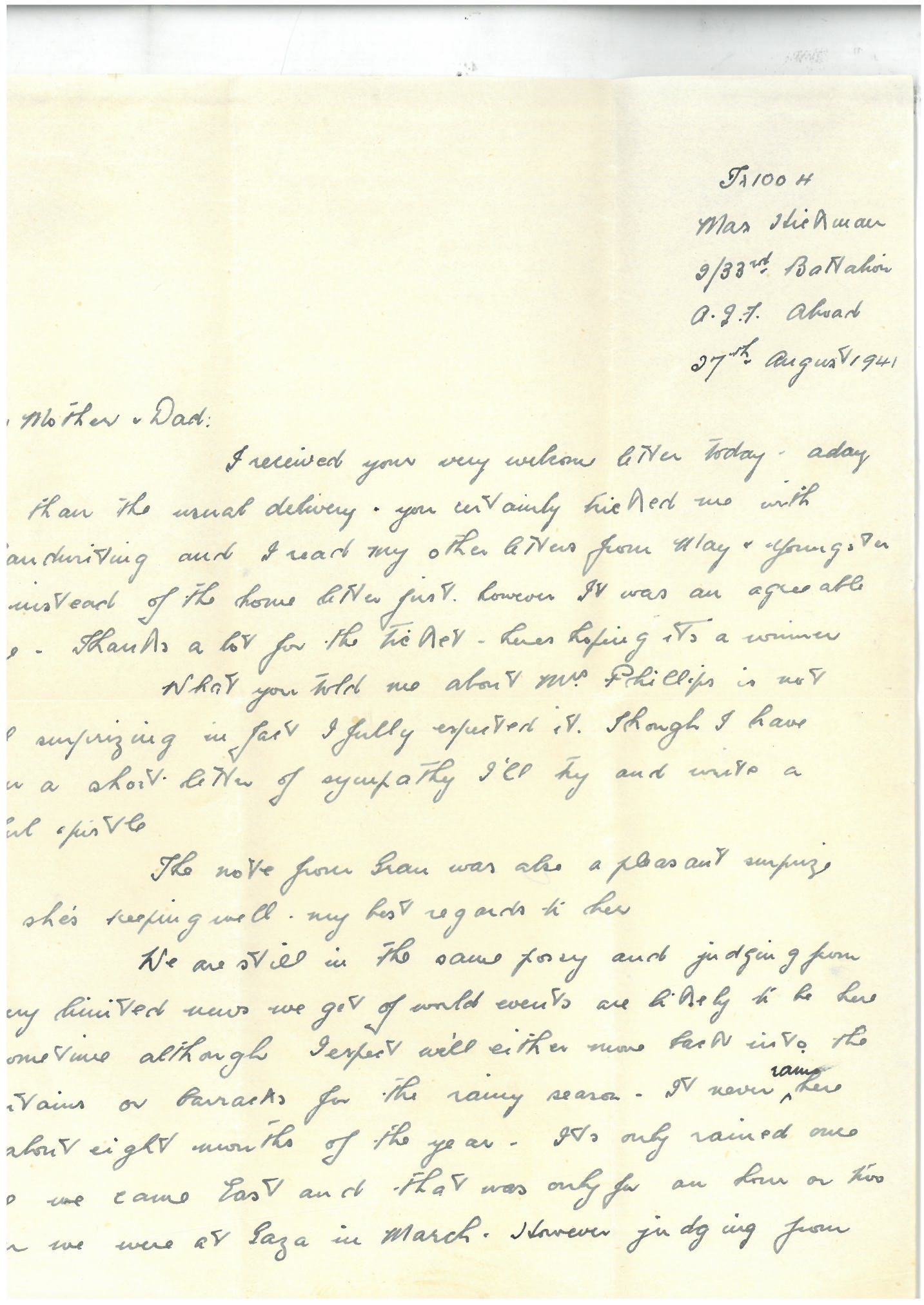
I received your very welcome letter today – a day earlier than the usual delivery & you certainly tricked me with the handwriting and I read my other letters from May & Youngster first instead of the home letter first.  However it was an agreeable surprise.  Thanks a lot for the ticket – here’s hoping it’s a winner.

What you told me about Mrs Phillips is not at all surprising in fact I fully expected it.  Though I have written a short letter of sympathy I’ll try and write a cheerful epistle.

The note from Gran was also a pleasant surprise.  I hope she’s keeping well – my best regards to her.

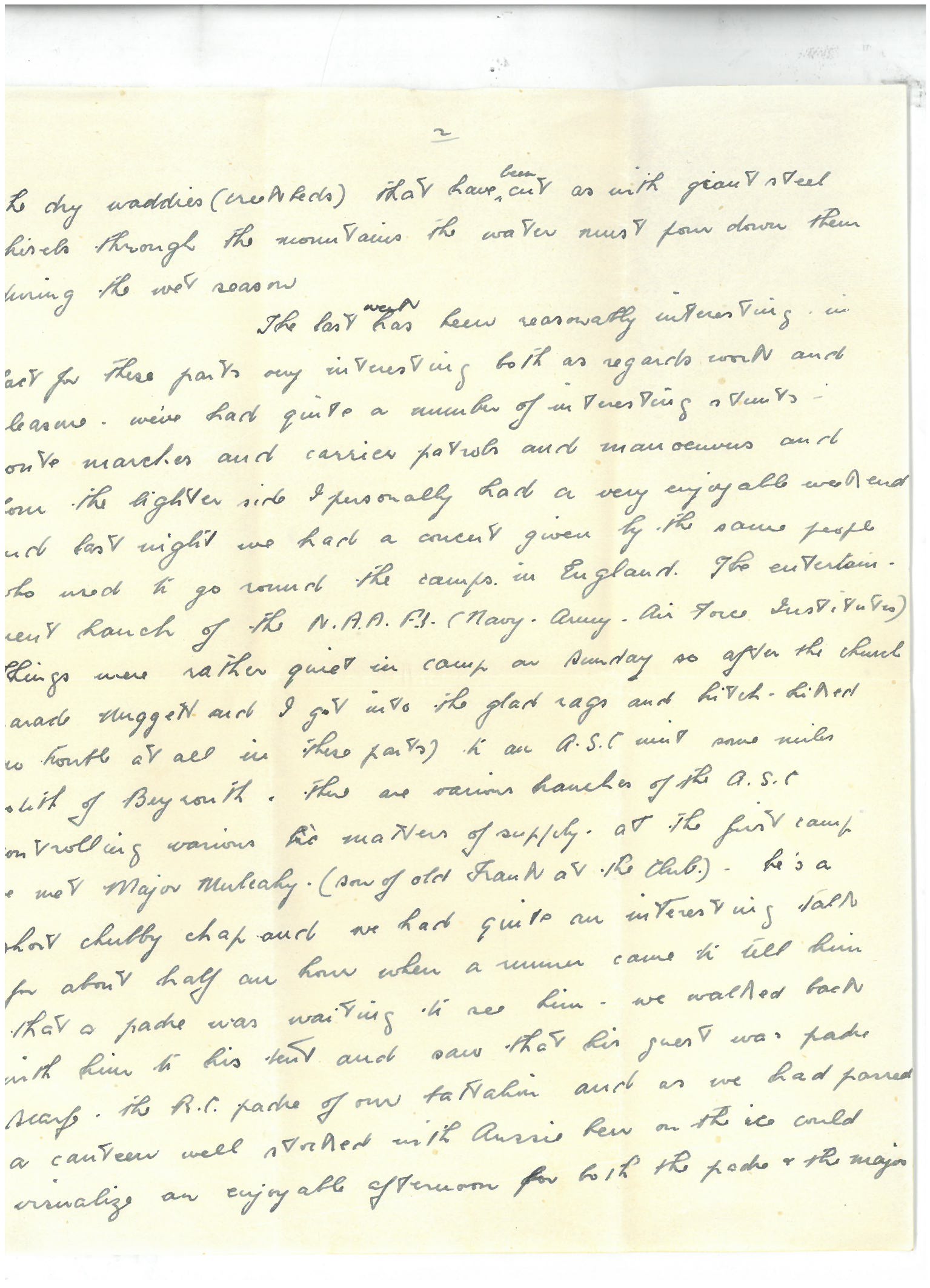
We are still in the same possy and judging from the very limited news we get of world events are likely to be here for some time although I expect we’ll either move back into the mountains or barracks for the rainy season.  It never rains here for about eight months of the year – It’s only rained once since we came east and that was only for an hour or two when we were at Gaza in March.  However judging from the dry waddies (creek beds) that have been cut as with giant steel chisels through the mountains the water must pour down them during the wet season.

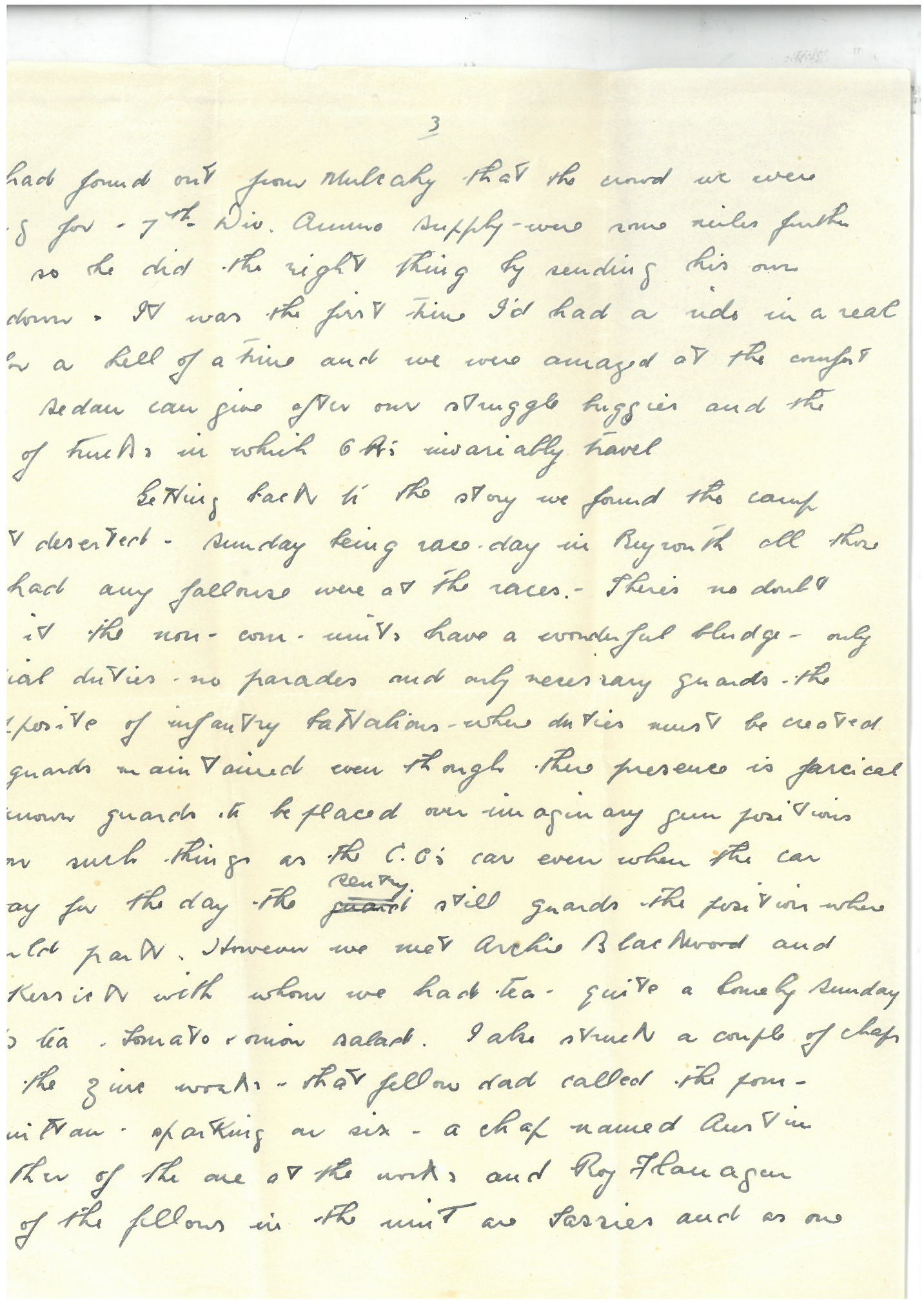
The last week has been reasonably interesting in fact for these parts very interesting both as regards work and pleasure.  We’ve had quite a number of interesting stunts – route marches and carrier patrols and manoeuvres and from the lighter side I personally had a very enjoyable weekend and last might we had  a concert given by the same people who used to go round the camps in England.  The entertainment branch of the NAAFI (Navy-Army-Air Force Institutes).  Things were rather quiet in camp on Sunday so after the church parade Nuggett and I got into the glad rags and hitch-hiked (no trouble at all in these parts) to an ASC unit some miles south of Beyrouth.  There are various branches of the ASC controlling various matters of supply.  At the first camp we met Major Mulcahy (son of old Frank at the Club).  He’s a short chubby chap and we had quite an interesting talk for about half an hour when a runner came to tell him that a padre was waiting to see him.  We walked back with him to his tent and saw that his guest was Padre Scarfe – the RC padre of our Battalion and as we had passed a canteen well stocked with Aussie beer on the ice could visualise an enjoyable afternoon for both the padre & the major.  We had found out from Mulcahy that the crowd we were looking for – 7th Div Ammo Supply – were some miles further down so he did the right thing by sending his own car down.  It was the first time I’d had a ride in a real car for a hell of a time and we were amazed at the comfort a Chev sedan can give after our struggle buggies and the backs of trucks in which O R’s invariably travel.

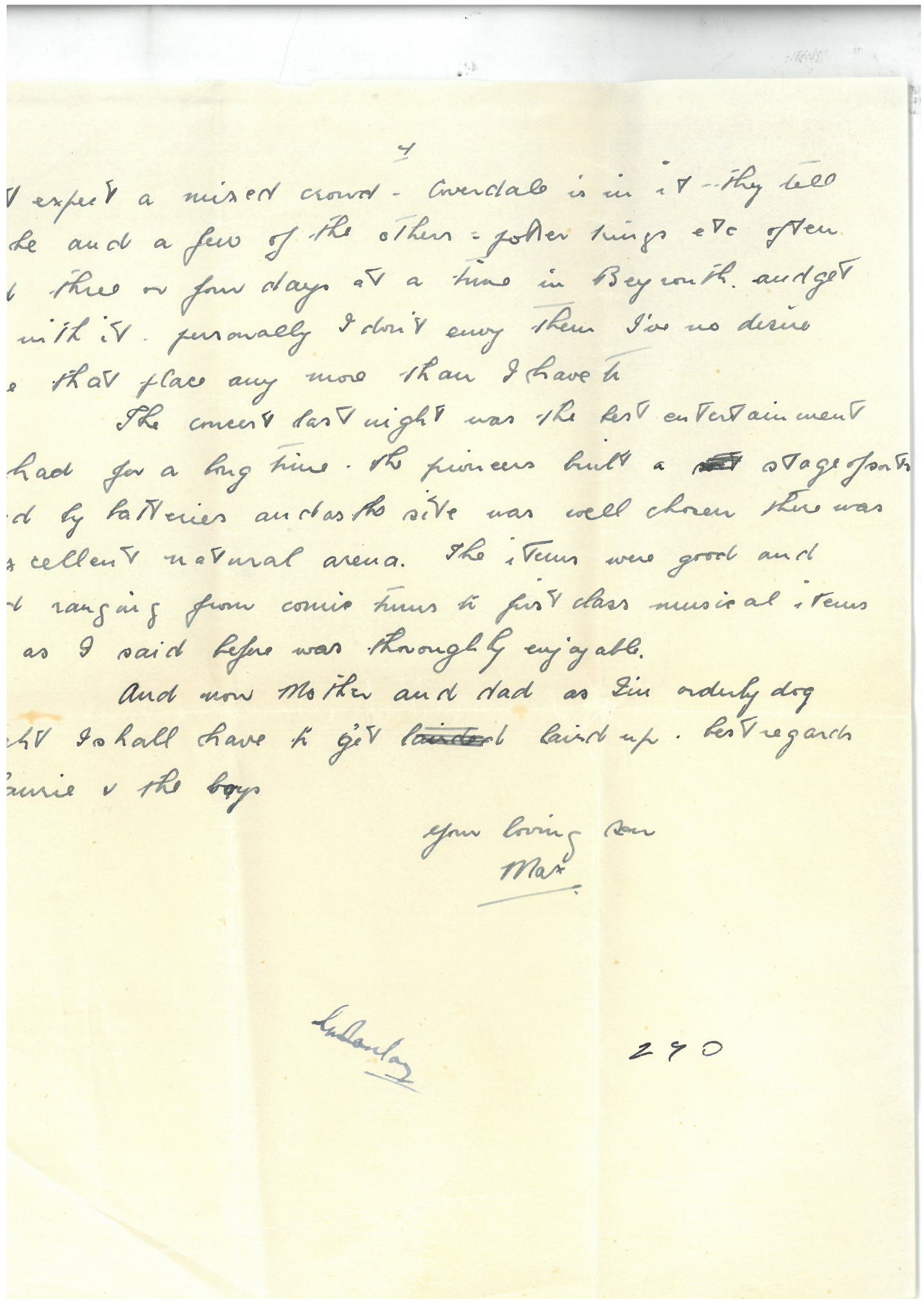
Getting back to the story we found the camp almost deserted – Sunday being race day in Beyrouth all those who had any fallouse were at the races.  There’s no doubt about it the non-com units have a wonderful budge – only essential duties, no parades and only necessary guards – the very opposite of infantry battalions where duties must be created and guards maintained even though their presence is farcical.  I’ve known guards to be placed over imaginary gun positions and on such things as the CO’s car even when the car is away for the day – the sentry still guards the position where it would park.  However we met Archie Blackwood and Don Kessick with whom we had tea – quite a homely Sunday night’s tea – Tomato & onion salad.  I also struck a couple of chaps from the Zinc Works – that fellow Dad called the Pom – McQuiltan – sparking on six – a chap named Austin – a brother of the one at the works and Roy Flanagan.  Most of the fellows in the unit are Tassies and as one might expect, a mixed crowd – Coverdale is in it – they tell me he and a few of the others – Joker Kings etc – often spend three or four days at a time in Beyrouth and get away with it.  Personally I don’t envy them.  I’ve no desire to see that place any more than I have to.

The concert last night was the best entertainment we’ve had for a long time.  The pioneers built a stage of sorts lighted by batteries and as the site was well chosen there was an excellent natural arena.  The items were good and varied, raining from comic turns to first class musical items and as I said before was thoroughly enjoyable.

And now Mother & Dad as I’m orderly dog tonight I shall have to get laired up.  Best regards to Laurie & the boys.

Your loving son

Max


The letter from home

There are very few letters from his parents among the collection – but there is a single page from the letter referred to above:

from home August 41

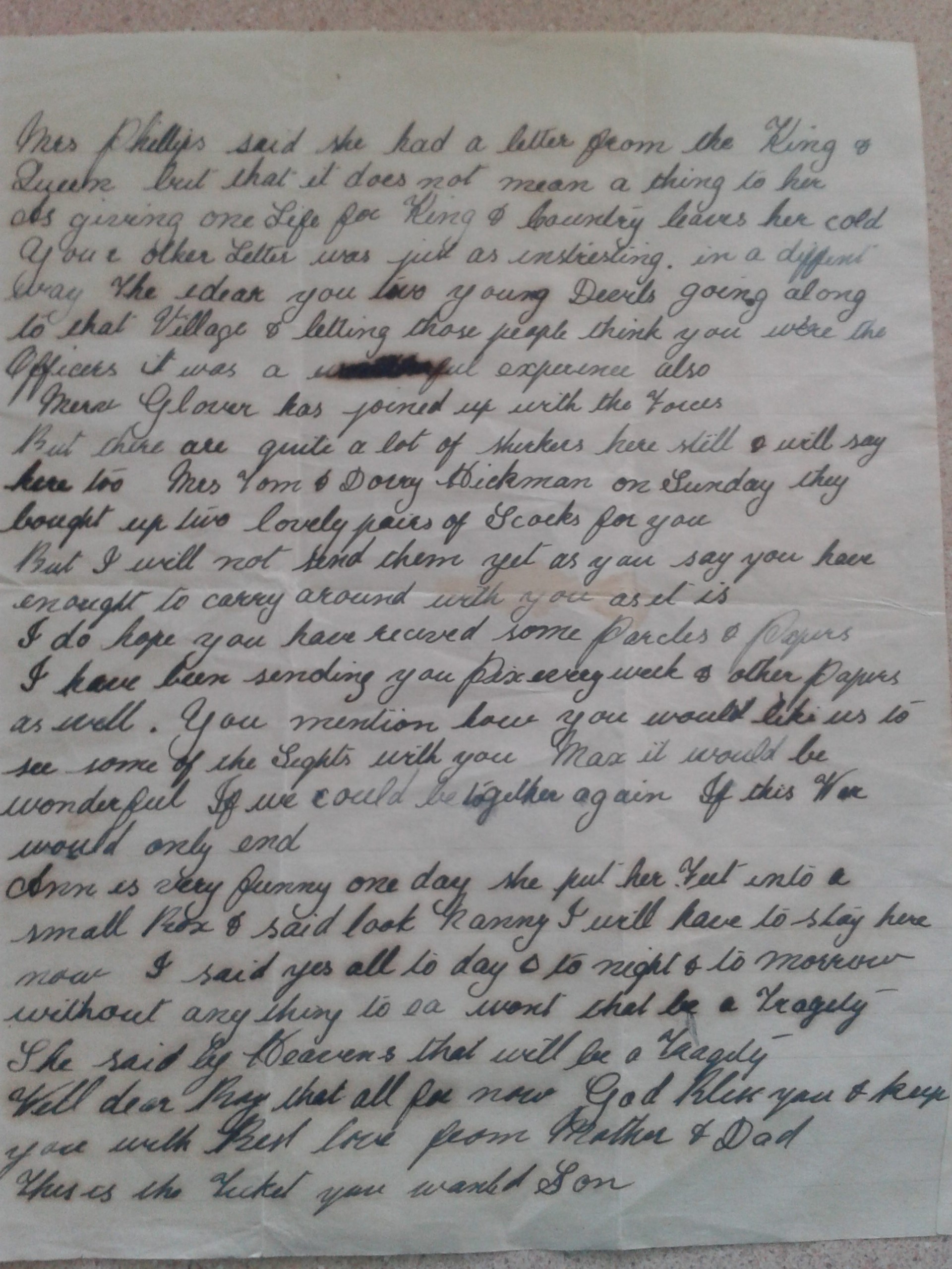
Mrs Phillips said she had a letter from the King & queen but it does not mean a thing to her as giving one life for King & Country leaves her cold.  Your other letter was just as interesting in a different way.  The idea of you two young devils going along to that village & letting this people think you were the officers –  it was a wonderful experience also.

Merv Glover has joined up with the Forces but there are quite a lot of shirkers here still & will stay here too.  Mrs Tom & Dorry Hickman on Sunday they brought up two lovely pairs of socks for you but I will not send them yet as you say you have enough to carry around with you as it is.

I do hope you have received some parcels & papers.  I have been sending you Pix every week & other papers as well.  You mention how you would like us to see some of the sights with you.  Max it would be wonderful if we could be together again.  If this war would only end.

Ann is very funny.  One day she put her feet into a small box & said look Nanny I will have to stay here now.  I said yes – all today & tonight & tomorrow without anything to eat – won’t that be a tragedy.  She said by Heavens that will be a tragedy.

Well dear boy that’s all for now.  God bless you & keep you with best love from Mother & Dad.

This is the ticket you wanted son.


A ticket in Tatts

George Adams moved to Tasmania in the 1890’s after being prevented from running public lotteries in NSW and Queensland.  With the support of the Tasmanian Government, he operated a thriving lottery business – Tattersalls – which has continued to thrive in the 110 years since his death.  A ticket in Tatts was always a source of delight in birthday cards etc in our family – feeding the well known Australian addiction to gambling!

The wadis : great gullies carved by the rain

destinationlebanon

eg – photo  from www.destinationlebanon.gov.lb


Got into the glad rags

The standing orders about being properly dressed – wearing felt hats, clean shaven, etc…were apparently strictly enforced.   So although Sundays were ‘free days’ the men still had to wear their ‘Sunday best’ (uniform).  There were also rules about which cafes, hotels and clubs the men were permitted to visit in Beirut.  Some units had by this time been banned from entering Damascus at all….presumably for misbehaviour such as ‘accosting civilians for money’ as this was specifically mentioned as an offence that would be severely dealt with in the same routine orders where the ‘out of bounds’ decree was made.

Chev sedan

1941Chevroletcopy_zpsc7838041

Possibly one like this…from the Braille Scale Discussion Group      http://www.network54.com


The Zinc Works

See previous post dated March 20 1941.

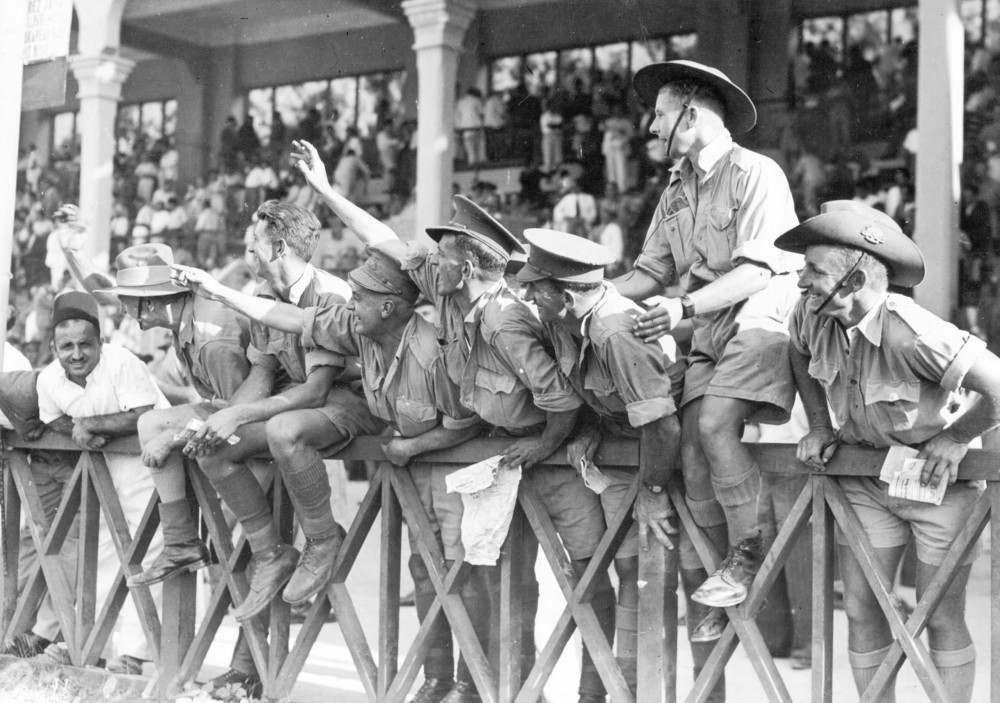
The races at Beirut

SLVH99.202:3049

Photo – state library of Victoria image H99.202/3049


Also see – silent movie https://www.awm.gov.au/collection/F07004/  8 mins silent – titled Christmas 1941 – includes footage of horse racing in Beirut

A concert for the troops

https://www.awm.gov.au/collection/F01142/

Not the one Dad would have been speaking of, but this one was in the same general area – i.e., Syria 1941.  It’s a delightful 8 minute clip of footage filmed by Frank Hurley and includes some sound.

Posted in escapades, relaxation, fun and games, Geography and Culture, Letters to/ from others, Middle East, organisation, training | Tagged , , , , , , | Leave a comment

Every day we read the Germans are using their last reserves

21 august 41 p1_0001

21 august 41 p2_0001

21 august 41 p3_0001

21 august 41 p4_0001

TX 1004

Max Hickman

2/33rd Battalion

AIF Abroad

21st August 1941

Dear Mother & dad

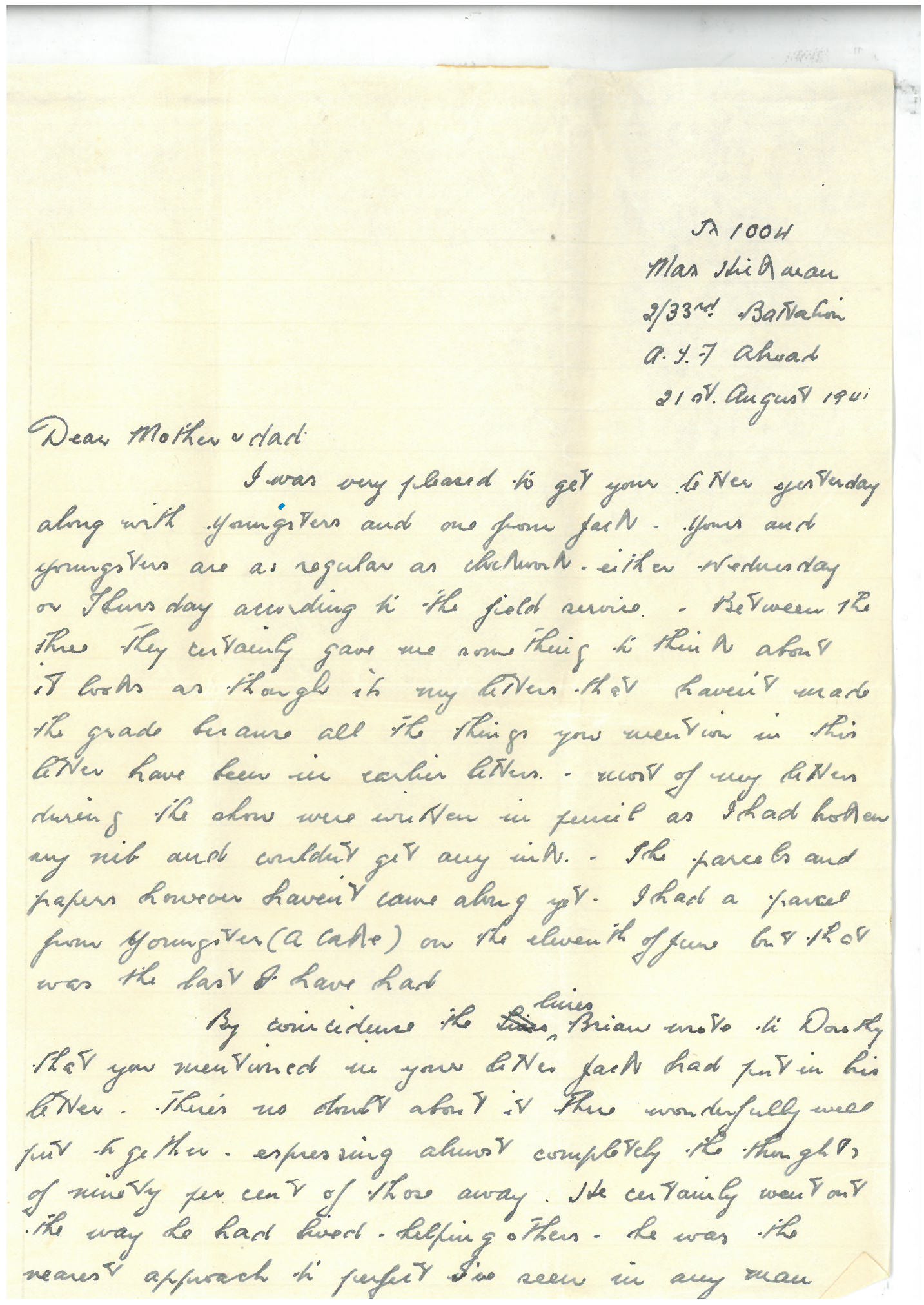
I was very pleased to get your letter yesterday along with Youngster’s and one from Jack.  Yours and Youngster’s are as regular as clockwork – either Wednesday or Thursday according to the field service.  Between the three they certainly gave me something to think about.  It looks as though it’s my letters that haven’t made the grade because all the things you mention in this letter have been in earlier letters.  Most of my letters during the show were written in pencil as I had broken my nib and couldn’t get any ink.  The parcels and papers however haven’t come along yet.  I had a parcel from youngster (a cake) on the eleventh of June but that was the last I have had.

By coincidence the lines Brian wrote to Dorothy that you mentioned in your letter, Jack had put in his letter.  There’s no doubt about it there [sic] wonderfully well put together – expressing almost completely the thoughts of ninety percent of those away.  He certainly went out the way he had lived – helping others – he was the nearest approach to perfect I’ve seen in any man.  I’m afraid I made a bit of a faux pas when I wrote to Mrs Phillips – I sent my sympathy to Joan and when I got your letter I remembered that Joan was his earlier friend.

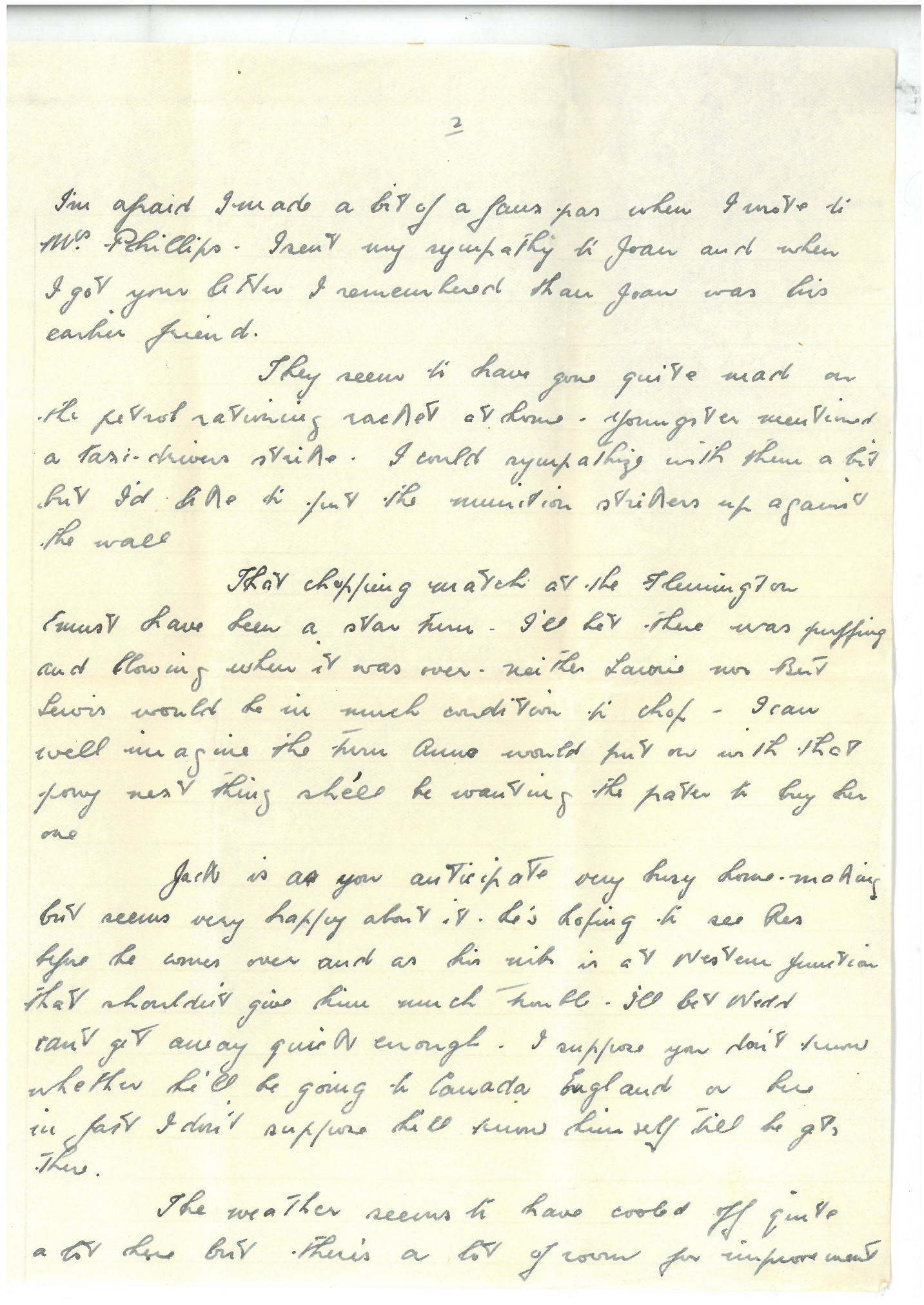
They seem to have gone quite mad on the petrol rationing racket at home – Youngster mentioned a taxi drivers’ strike.  I could sympathise with them a bit but I’d like to put the munition strikers up against the wall.

That chopping match at the Flemington must have been a star turn.  I’ll bet there was puffing and blowing when it was over – neither Laurie nor Bert Lewis would be in much condition to chop.  I can well imagine the turn Anne would put on with that pony – next thing she’ll be wanting the pater to buy her one.

Jack is as you anticipate very busy home-making but seems very happy about it .  He’s hoping to see Rex before he comes over and as his nibs is at Western Junction that shouldn’t give him much trouble.  I’ll bet Wedd can’t get away quick enough.  I suppose you don’t know whether he’ll be going to Canada, England or here – in fact I don’t suppose he’ll know himself till he gets there.

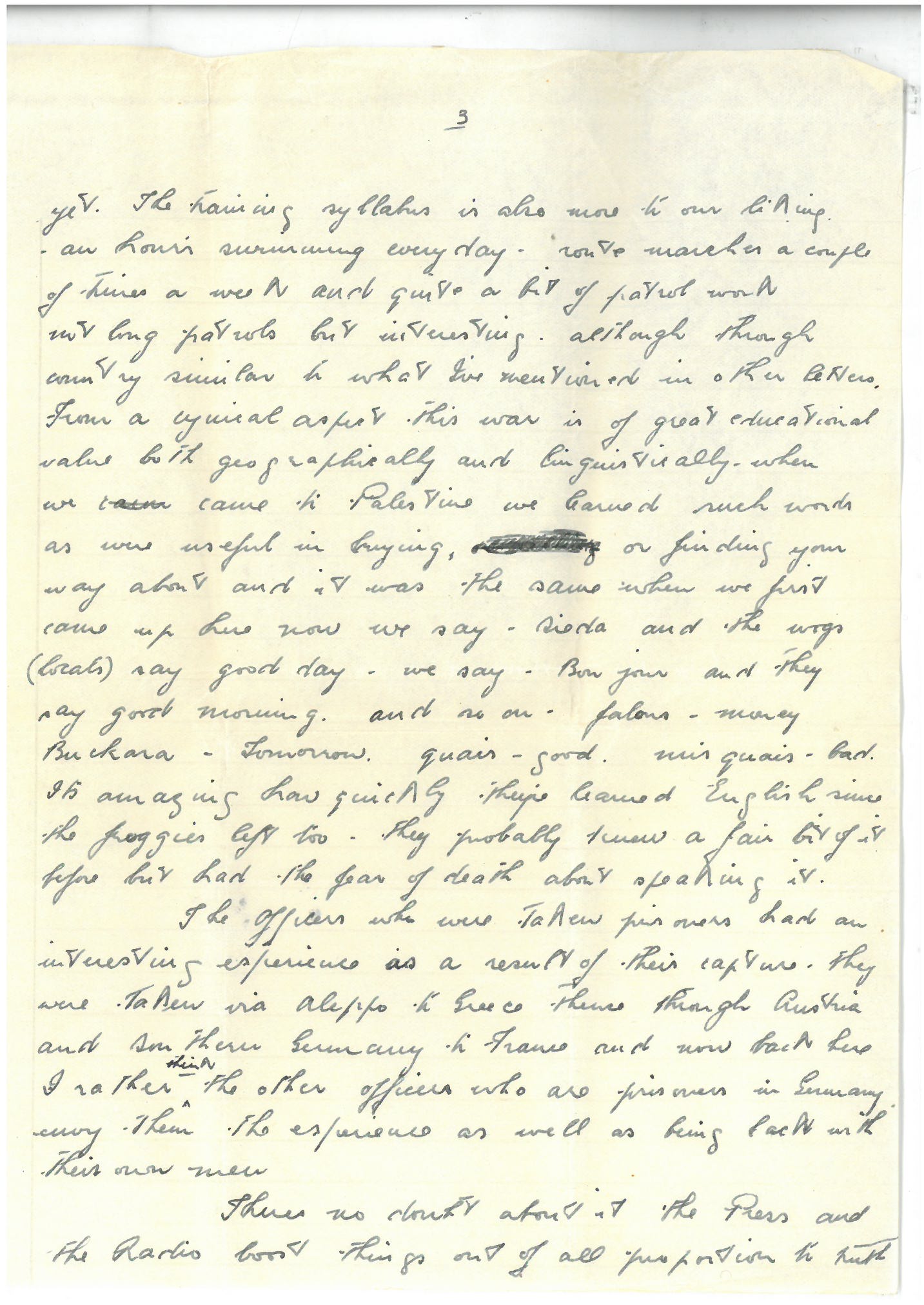
The weather seems to have cooled off quite a lot here but there’s a lot of room for improvement yet.  The training syllabus is also more to our liking – an hour’s swimming every day, route marches a couple of times a week and quite a bit of patrol work – not long patrols but interesting – although through country similar to what I’ve mentioned in other letters.  From a cynical aspect this war is of great educational value both geographically and linguistically – when we came to Palestine we learned such words as were useful in buying, …[blacked out] or finding your way about and it was the same when we first came up here: now we say Seida and the wogs (locals) say good day – we say Bon jour and they say good morning…and so on – falons – money, buckara- tomorrow, quais- good, misquais – bad.  It’s amazing how quickly they’ve learned English since the froggies left too.  They probably knew a fair bit of it before but had the fear of death about speaking it.

The officers who were taken prisoner had an interesting experience as a result of their capture.  They were taken via Aleppo to Greece thence through Austria and southern Germany to France and now back here.  I rather think the other officers who are prisoners in Germany envy them the experience as well as being back with their own men.

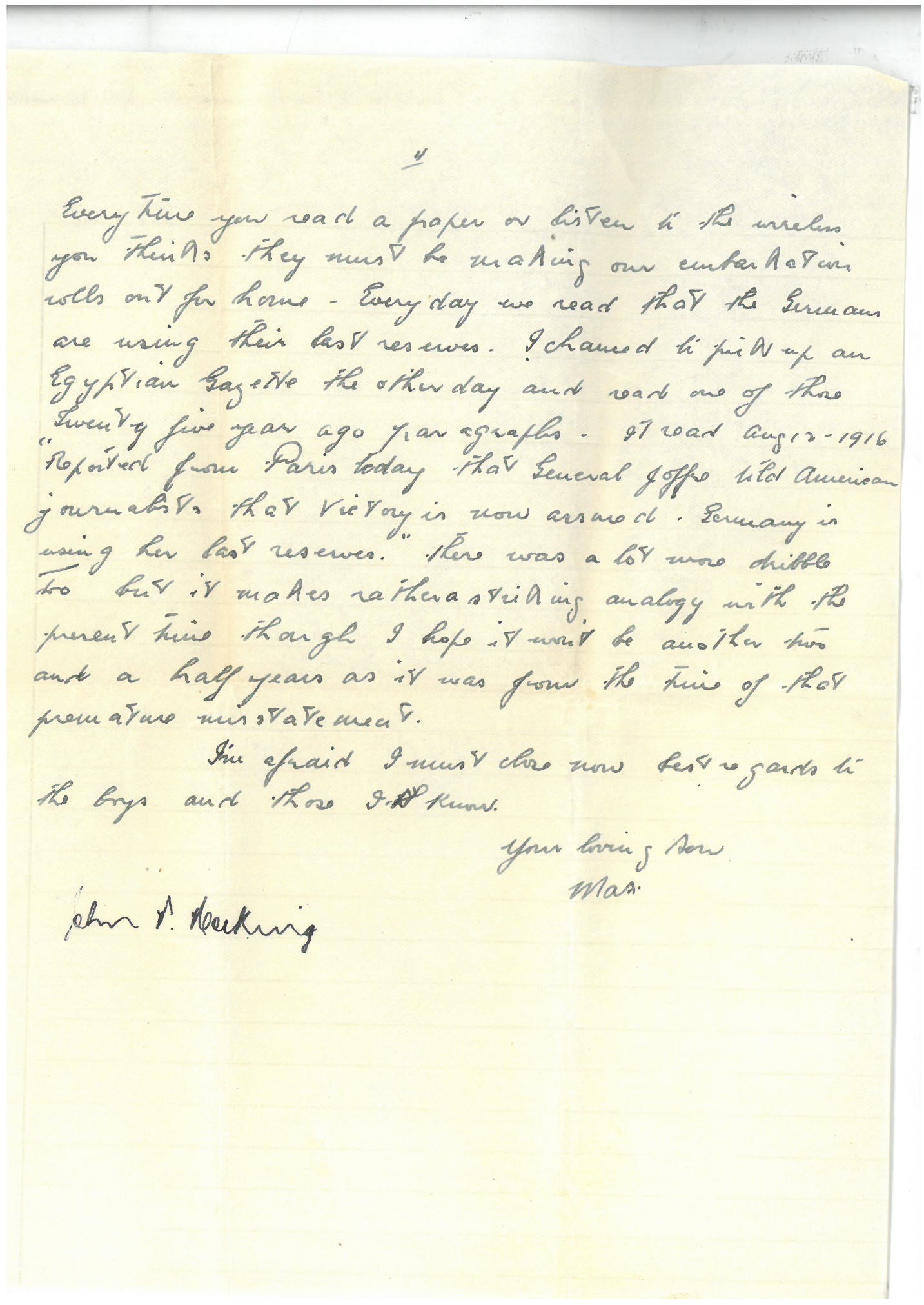
There’s no doubt about it the Press and the Radio boost things out of all proportion to truth.  Every time you read a paper or listen to the wireless you think they must be making our embarkation rolls out for home.  Every day we read that the Germans are using their last reserves.  I chanced to pick up an Egyptian Gazette the other day and read one of these twenty five years ago paragraphs – It read Aug 12 1916 “Reported from Paris today that General Joffre told American journalists that Victory is now assured.  Germany is using her last reserves”.  There was a lot more dribble too but it makes rather a striking analogy with the present time though I hope it won’t be another two and a half years as it was from the time of that premature mis-statement.

I’m afraid I must close now.  Best regards to the boys and those I know.

Your loving son

Max


The petrol rationing racket

New restrictions came into force on August 1.  See   https://www.awm.gov.au/journal/j36/petrol.asp

Woodchopping at The Flemington

Woodchopping had been a competitive sport in Tasmania from the late 19th century.  It seems there were small scale competitions in hotel yards – The Flemington was a hotel in Argyle St, Hobart.  Dad’s brother in law Laurie was a leatherworker by trade.

Rex Wedd and Jack Chandler

Rex Wedd – ‘his nibs’ – was about to join the Air Force.  He was first going to see Jack Chandler in Deloraine – not far (about 55km) from Western Junction, and on the train line to the north west – hence the comment ‘that shouldn’t give him much trouble’.

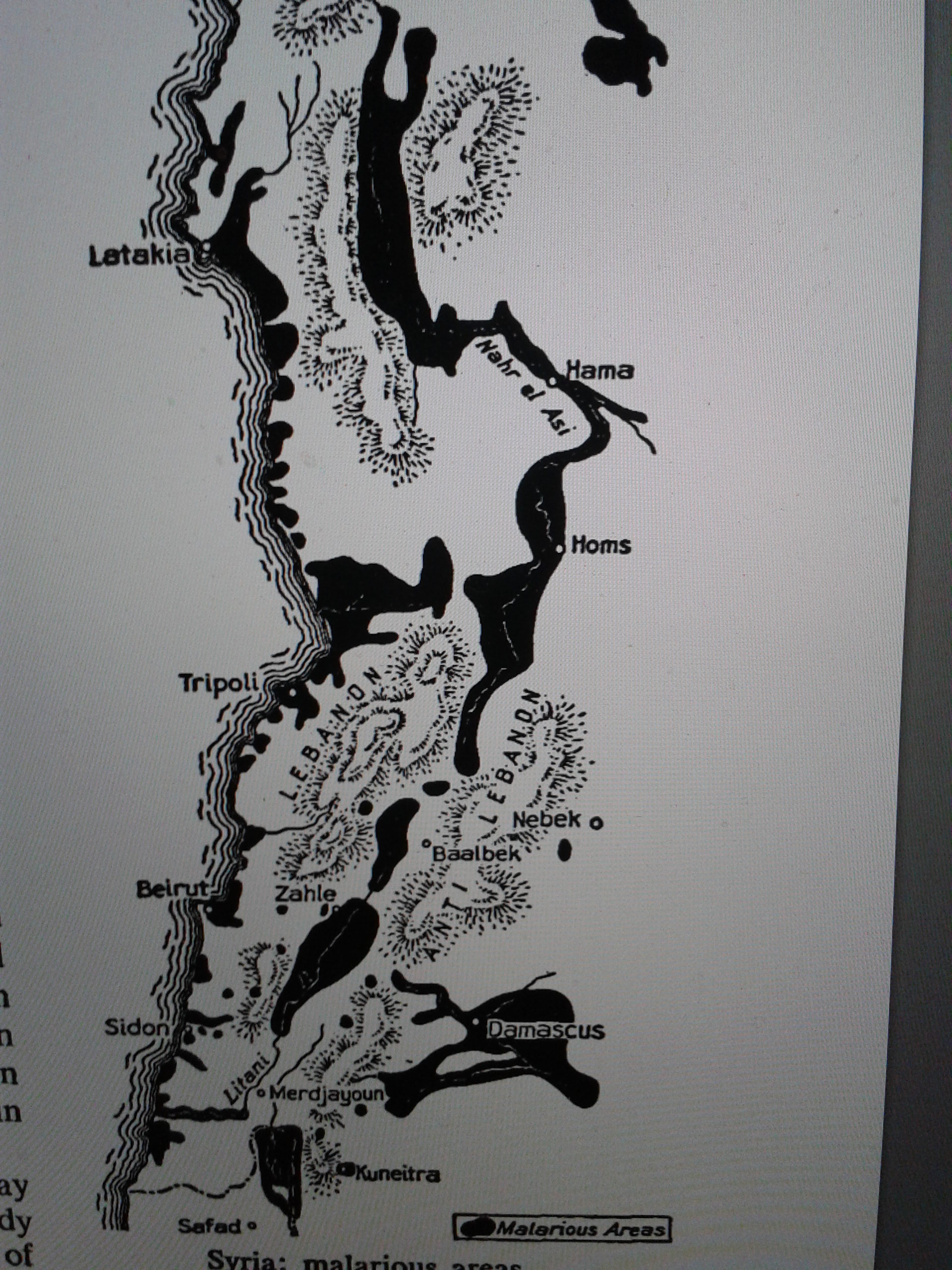
Cooler weather – concern about malaria?

As a Tasmanian, Dad would certainly have been pleased if the summer temperatures became more moderate.  Although he doesn’t say so, this comment could also have related to concerns about malaria.  Up until the late 1930’s malaria had been endemic in Palestine.    Some fascinating information can be found at http://www.eradication-of-malaria.com, including:   Eradication of malaria was made the top priority by the Jewish settlers in the 1920’s, as malaria had made the creation of settlement in many places, especially those with the most fertile soil, difficult if not impossible….From 1922 onwards, engineers and scientists relentlessly undertook drainage of marshland and swamps….In the early 1920’s the Haifa Malaria Research Unit under the control of Dr Israel Kligler was formed. The main idea of the MRU was to establish malaria control on an extensive scale at low cost.…. Dr Kligler recognised that drainage alone could never succeed in eliminating malaria and instituted a widespread anti-larval campaign alongside population-wide detection and education programs.

And from the document http://static.awm.gov.au/images/collection/pdf/RCDIG1070420–1-.pdf  comes the following:

malarious areas

In May 1941, immediately prior to the Syria campaign, a special conference on malaria was held in Jerusalem.  It was attended by malariologists and directors of British and Australian Medical units….   It was agreed that the whole of Syria must be regarded as highly malarious and that firm anti-malarial measures must be adopted at once.  Personal prophylaxis was essential, using nets, protective clothing, repellant cream; destruction of mosquitoes and larvae was also necessary so far as campaign conditions allowed and suppressive quinine would be needed later….However, there was difficulty in the actual supply of repellent in the field, and also in getting nets for the men coming north.  Protective clothing was not yet to hand, though ordnance services promised that long trousers would be supplied later.  The shorts supplied to British troops which could be converted to long trousers by turning down ‘flaps’ were unpopular, at least with Australians whose usual reaction to them was cutting off the flaps…

…Malaria was the dominating medical factor.  As already pointed out, the medical aspects of the projected campaign were not considered seriously during the early stages of planning, and though experts of the highest calibre were of great assistance later, the most essential links of the chain were defective.  These were the unfailing provision to the troops of the necessary wherewithal for protection , and its unfailing use by them….Sometimes material was available, and not faithfully used.  Sometimes the commanders wished to enforce its use but had no material…..The 25th Brigade was exposed to risk of infection at Merdjayoun, and the fruits of this exposure were evident later after the fighting was over when 300 men contracted malaria….nevertheless…there is no doubt that a definite degree of success attended anti-malarial work during June and July in Syria; it was during the later periods that the full significance of the sins of omission were realised.

Concern regarding malaria is evident in the Battalion’s ‘Routine Orders’  (see AWM – 2/33 Battalion Diary for August – December 1941 – item no. 8/3/33/5): Anti-malarial measures are repeated at least once a week – e.g:

15 August – Anti-malarial measures – All personnel must wear trousers KD [khaki drill] and long sleeved shirts from sunset to sunrise at all times except when under nets.  Two tablets of quinine MUST be taken daily.

21 August – ….the idea that leave is an opportunity to relax anti-malarial measures must be countered.  There must be NO laxity.  Trousers KD and shirts with long sleeves MUST be worn from sunset to sunrise where NOT under nets.  Nets MUST be used.  Quinine MUST be taken.  The ideal camping area is as a rule the worst malaria area.  The following rules must be regarded in selecting bivouac sites – (a) at least one and a half miles from water in swamps, waterways, irrigated areas, open reservoirs or irrigation channels; (b) the windward side of a village or such water; (c) tops of hills are usually preferable….Only if these directions are rigidly carried out will tours continue.

23 August : Coys are reminded that it is compulsory for all personnel to wear trousers KD and long shirts from sunset to sunrise.  It is apparent that this order is NOT being rigidly enforced, and any laxity allowed is against the personal interest of the soldier.

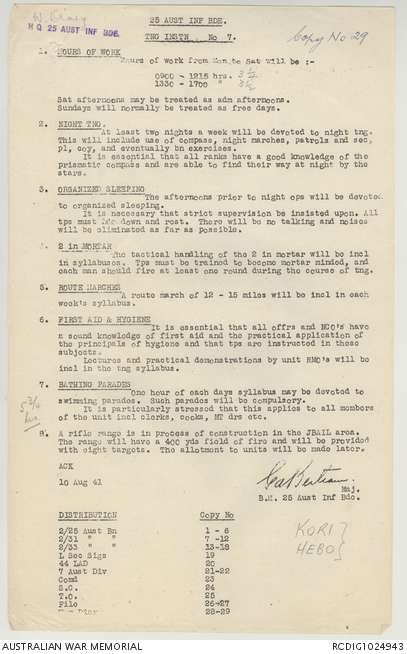
The training syllabus

The 25th Australian Infantry Brigade’s Training Instruction no. 7, issued on 10 August gives more details about route marches, night training and bathing parades:

RCDIG1024943--118-


source : AWM item no. RCDIG1024943  (25th Brigade diary July/ August 1941)


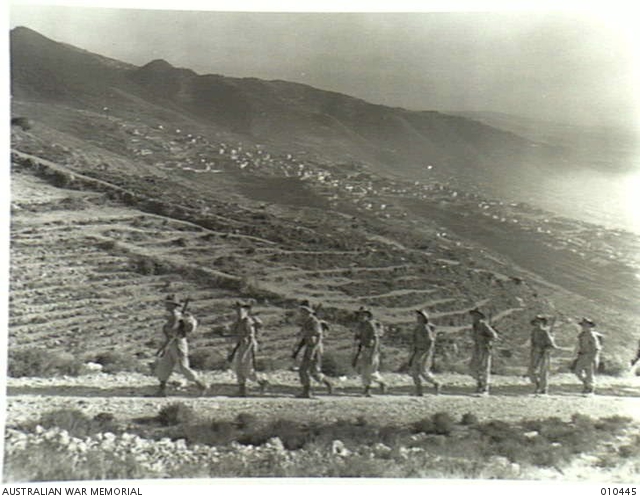
25Bn Lebanon


Photo : AWM 010445

Shows men of the 2/25 Bn on manoeuvres in Lebanon: presumably the 2/33Bn  route marches were in similar territory.  (Both Bn’s were part of the 25th Brigade)


Every day we read that the Germans are using their last reserves.

As the saying goes – the first casualty of war, is truth….

Faint Hope

I hope it won’t be another two and a half years as it was from the time of that premature mis-statement.  How could Dad have imagined that he would in fact be actively serving for another 4 years?


Posted in Australian, Censorship, Middle East, The course of the war, training, Uncategorized, unit and personal diaries | Tagged , , , , , | Leave a comment

At last – a visit to Ken, post amputation – and news of Japanese aggression

15 august 41 p1_0001

15 august 41 p2_0001

15 august 41 p3_0001


15 august 41 p4_0001

15 august 41 p5_0001

TX 1004

Max Hickman

2/33rd Battalion

AIF Abroad

15th August 1941

Dear Mother & Dad

I think I’ve told you in several letters that I’ve been trying to get down to see Ken.  My numerous efforts having been unavailing, I’d practically given up the idea when Lieut. Weale the sig officer sent for me on Tuesday afternoon and told me that an officer would be going to Dimra in Palestine and I could go with him.

We left camp about half past five and made Haifa about half past nine – you remember my little lapse with Wattsie at Haifa – anyway we had a meal there about the best I’ve had since I was there last – and slept in the back of the truck.  We were away again at daybreak and I was at the seventh AGH at half past eight.  I found out where Ken was and the officer said he would pick me up on his way back about two o’clock.  In spite of being practically tied to his bed he literally jumped out when he saw me.  He was as pleased as punch.  I was lucky to get there in time because he was being moved to another hospital – much farther away – next morning.

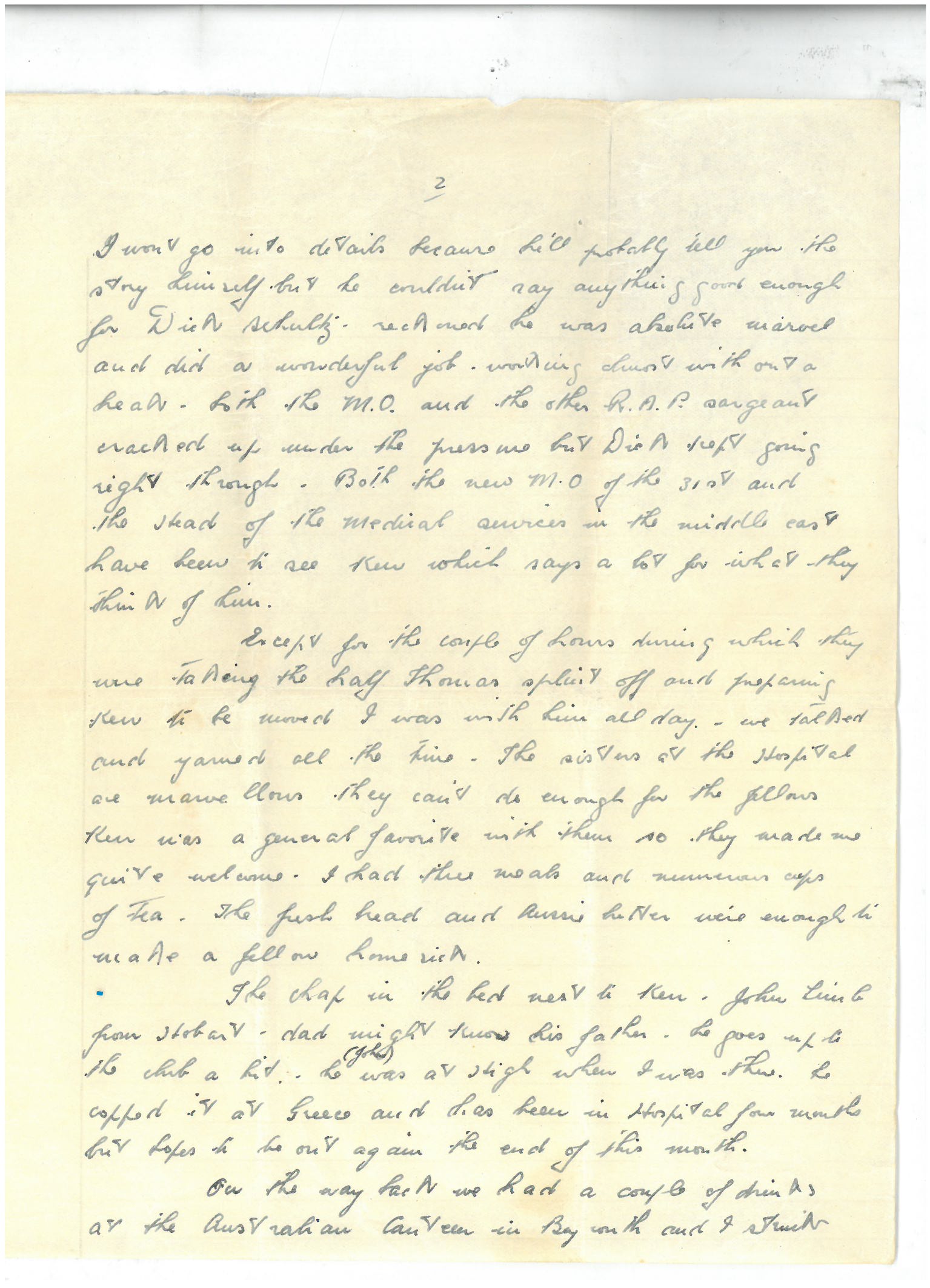
Ken was very thin and pale but quite cheerful.  He’s had a hell of a tough trot and it’s only been his knowledge of anatomy and guts that have kept him alive.  I won’t go into the details because he’ll probably tell you the story himself but he couldn’t say anything good enough for Dick Schultz – reckoned he was an absolute marvel and did a wonderful job, working almost without a break.  Both the MO and the other RAP sergeant cracked up under the pressure but Dick kept going right through.  Both the new MO of the 31st and the Head of the Medical services in the Middle East have been to see Ken which says a lot for what they think of him.

Except for the couple of hours during which they were taking the half Thomas splint off and preparing Ken to be moved, I was with him all day.  We talked and yarned all the time.  The sisters at the Hospital are marvellous – they can’t do enough for the fellows.  Ken was a general favourite with them so they made me quite welcome.  I had three meals and numerous cups of tea.  The fresh bread and Aussie butter were enough to make a fellow homesick.

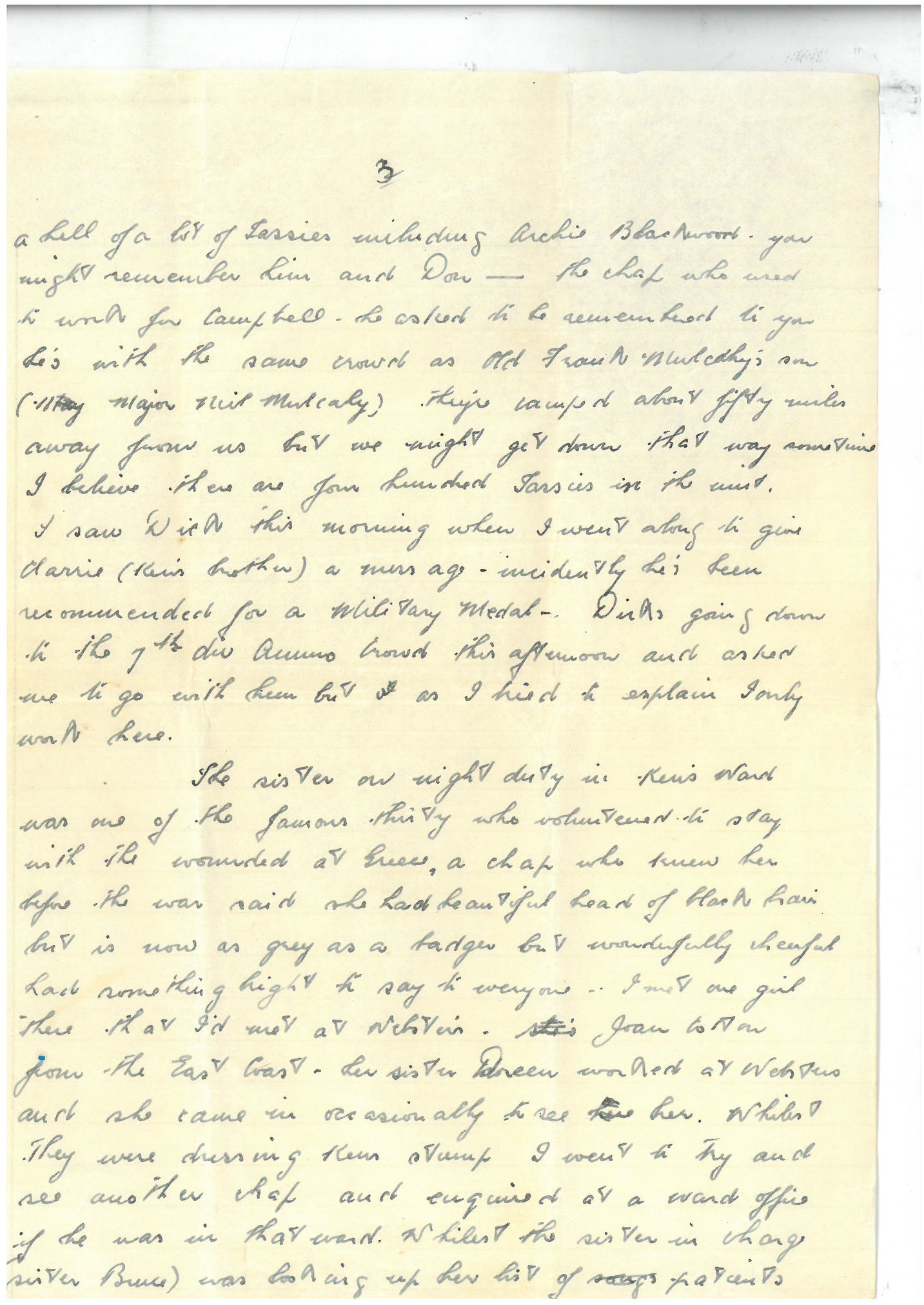
The chap in the bed next to Ken – John Limb from Hobart – dad might know his father – he goes up to the club a bit – he was at High when I was there.  He copped it at Greece and had been in Hospital four months but hopes to be out again at the end of this month.  On the way back we had a couple of drinks at the Australian canteen in Beyrouth and I struck a hell of a lot of Tassies including Archie Blackwood – you might remember him and Don….- the chap who used to work for Campbell.  He asked to be remembered to you.  He’s with the same crowd as old Frank Mulcahy’s son (Major Neil Mulcahy).  They’re camped about fifty miles away from us but we might get down that way sometime.  I believe there are four hundred Tassies in the unit.

I saw Dick this morning when I went along to give Clarrie (Ken’s brother) a message – incidentally he’s been recommended for a Military Medal – Dick’s going down to the 7th div Ammo crowd this afternoon and asked me to go with him but as I tried to explain I only work here.

The sister on night duty in Ken’s ward was one of the famous thirty who volunteered to stay with the wounded at Greece.  A chap who knew her before the war said she had a beautiful head of black hair but is now as grey as a badger but wonderfully cheerful – had something bright to say to everyone.  I met one girl there that I’d met at Websters – Joan Cotton from the east coast – her sister Doreen worked at Websters and (Joan) came in occasionally to see her.  Whilst they were dressing Ken’s stump I went to try and see another chap and enquired at a ward office if he was in that ward.  Whilst the sister in charge (Sister Bruce) was looking up her list of patients, this other girl came in.  She looked at me and said Max Hickman from Websters – I said well yes but a long time ago.  She made herself known and we had quite a yarn together.  It was a real kick to meet a girl from home – a real human being who spoke your own language.  The last time I spoke to a girl who spoke English was when we were at Durban.  The only women we see are the locals who do our washing.

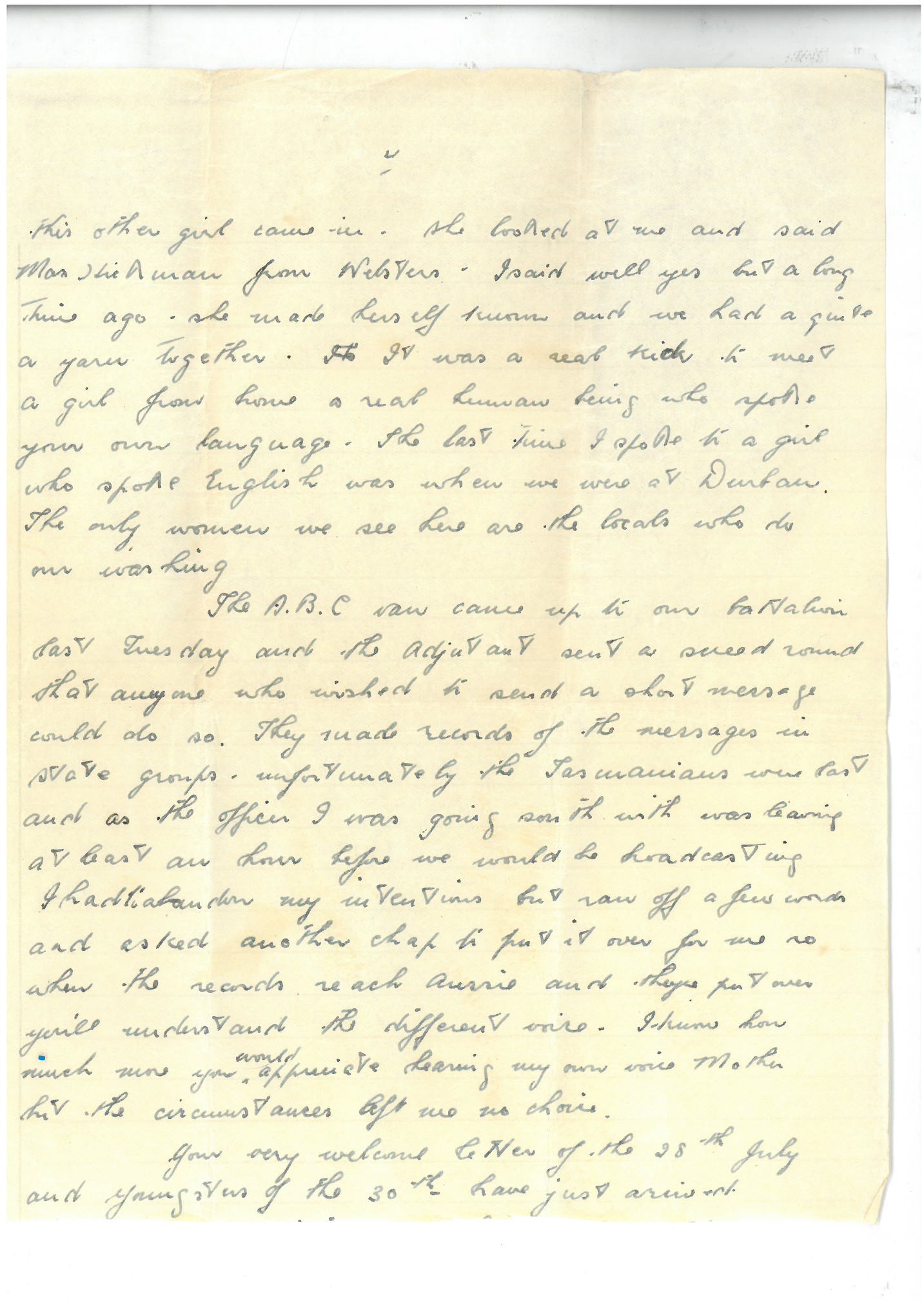
The ABC van came up to our battalion last Tuesday and the Adjutant sent a screed round that anyone who wished to send a short message could do so.  They made records of the messages in state groups.  Unfortunately the Tasmanians were last and as the officer I was going south with was leaving at least an hour before we would be broadcasting I had to abandon my intentions but ran off a few words and asked another chap to put it over for me so when the records reach Aussie and they’re put over you’ll understand the different voice.  I know how much more you would appreciate hearing my own voice Mother but the circumstances left me no choice.

Your very welcome letter of the 28th July and youngsters of the 30th have just arrived. [  bottom of page cut off….ie 2-3 lines of text censored]

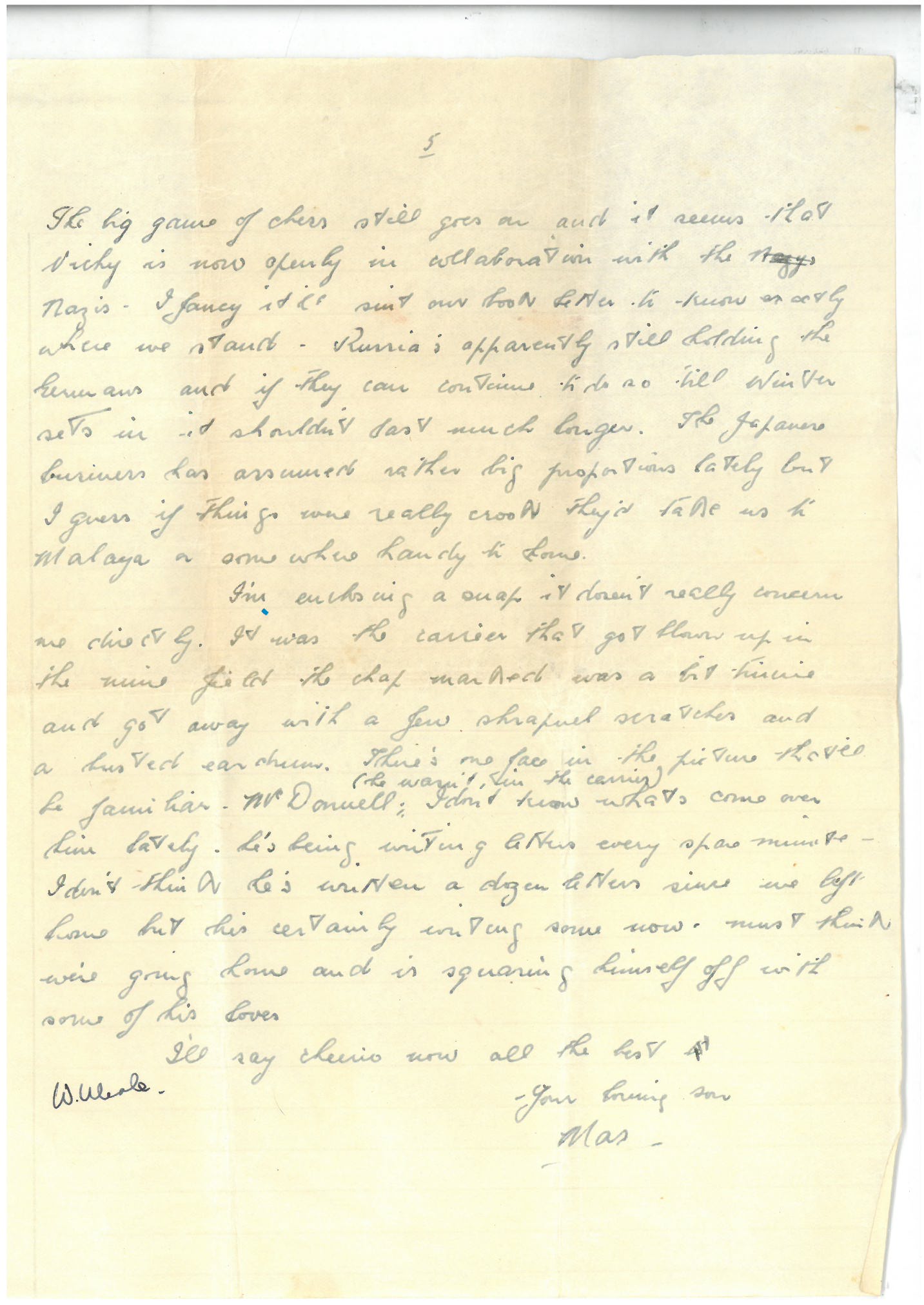
The big game of chess still goes on and it seems that Vichy is now openly in collaboration with the Nazis.  I fancy it’ll suit our lot better to know exactly where we stand.  Russia’s apparently still holding the Germans and if they can continue to do so till Winter sets in it shouldn’t last much longer.  The Japanese business has assumed rather big proportions lately but I guess if things were really crook they’d take us to Malaya or somewhere handy to home.

I’m enclosing a snap – it doesn’t really concern me directly.  It was the carrier that got blown up in the mine field.  The chap marked was a bit tinnie and got away with a few shrapnel scratches and a busted eardrum.  There’s one face in the picture that’ll be familiar – McDonnell (he wasn’t in the carrier).  I don’t know what’s come over him lately – he’s been writing letters every spare minute.  I don’t think he’s written a dozen letters since we left home but he’s certainly writing some now – must think we’re going home and is squaring himself off with some of his loves.

I’ll say cheerio now – all the best

Your loving son

Max


A note sent home with Ken

note with ken_0001

Dear Mother & Dad

I’m with Ken at the moment but expect to have to leave very shortly now.  Ken will be leaving for home tonight or tomorrow morning and asked me if I had any message.  There’s one message I would wish to send – my fondest love.  Keep your chin up – seeing Ken and knowing the suffering he’s had is an inspiration to carry on.  It makes one realise how small are his own troubles.

Ken knows as much of my doings almost as I know myself and will tell you of our life abroad.  Give my love to May & Anne and best regards to the boys.  We all hope to be home soon.


Travelling south

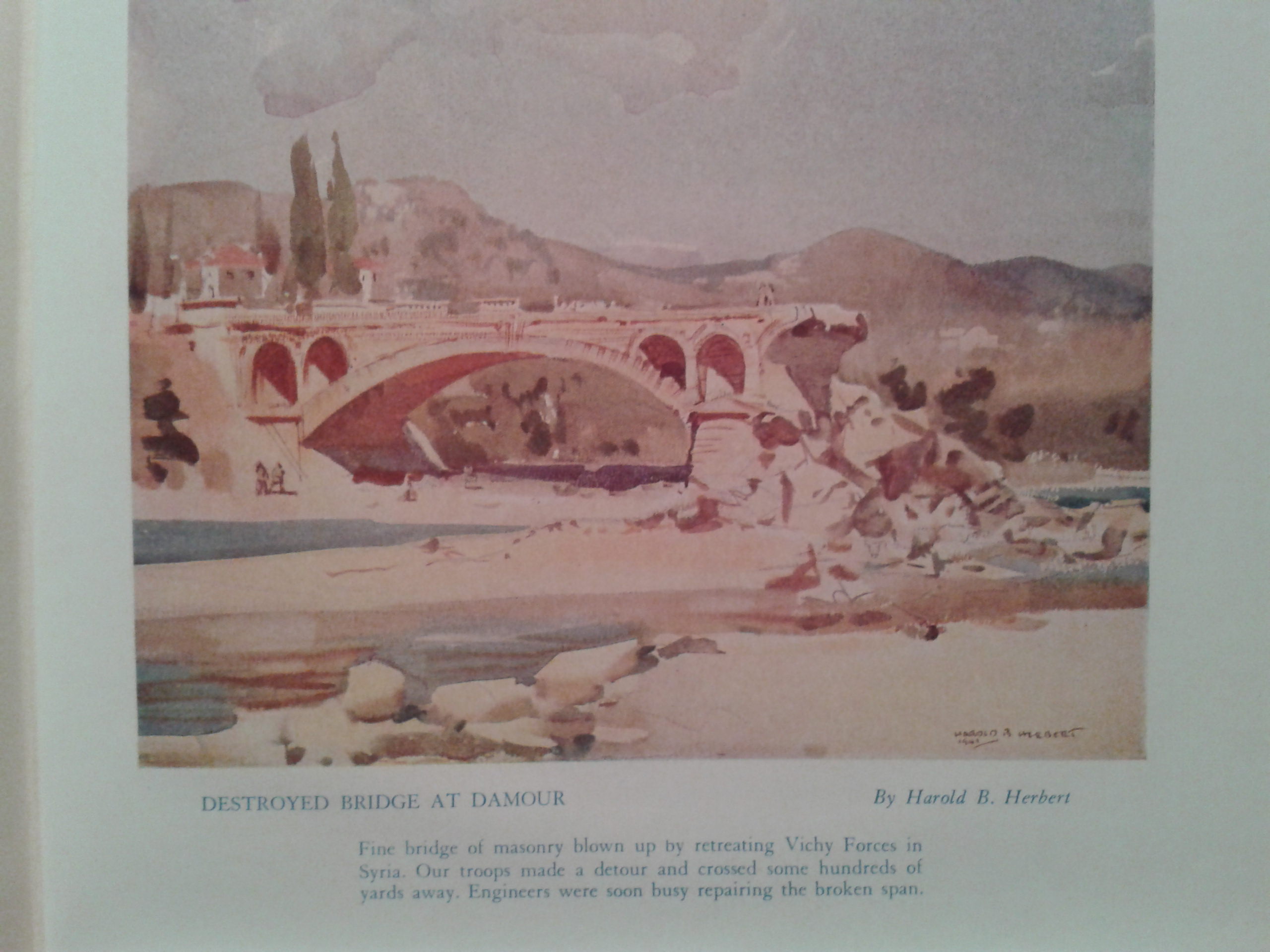
bridge at Damour

Four hours to travel around 130km from the camp to Haifa is probably explained by the condition of the roads which had been extensively damaged during the campaign – e.g. this painting by Harold Herbert of the bridge at Damour on the coast road (source: Active Service).

The second leg, of only a slightly longer distance (around 120km) seems to have been accomplished in much less time.


7th AGH at Rehovot  

Photos are hard to come by.  There is a ‘panorama from the top of the tank stand’, showing the tents and buildings of the 2/7 AGH at https://www.awm.gov.au/collection/P01641.009/

The Thomas splint

From Wikipedia:  The first widely used model of traction splint was introduced by Hugh Owen Thomas, a Welsh surgeon, considered by many to be the father of modern orthopaedic surgery. Prior to the introduction of the Thomas splint around 1916, mortality from femur fractures ran as high as 80%. Use of this splint reduced the death rate to less than 8%.


Mentioned in Despatches

John Limb: a bit of a mystery – the online WW2 nominal roll shows him not enlisting until 1942, but gives two service numbers – the first TX 642 which suggests he enlisted before Dad (ie before March 1940), and the second T 45009.  This latter is the only one listed in the National Archives record, which gives date of enlistment as July 1942.  I assume he was given a medical discharge after his hospitalisation, and that he subsequently re-enlisted in a support role.

Campbell – Charles Campbell was known to everyone in Lenah Valley, as he had opened a ‘corner store’ in 1914 – which moved to the corner of Augusta Rd and Giblin St in 1919.  At that time, the family lived in the house at the rear of the shop.  Charles’ son Colin continued to run the business until 1974 with his son John (who was a classmate of Anne Fisher – Dad’s niece, regularly mentioned in his letters), and the shop still exists though with different management.

Neil Mulcahy – at the time of his discharge in 1945, Major Mulcahy had risen to the rank of Lieutenant Colonel.  It seems from his service record and that of Archie Blackwood, that they were in the AASC (Australian Army Service Corps).

Joan and Doreen Cotton – ‘from the east coast’ – Tasmanians will recognise the Cotton name, as it has in recent years been connected with quite a controversy surrounding the so-called ‘Cotton papers’ which, it is claimed, provided accounts of local Aboriginal customs, beliefs and practices from the early days of white settlement. The actual papers were lost in a fire but have been reconstructed and published by Jane Cooper (nee Cotton) in the book Land of the Sleeping Gods.   Francis Cotton, a Quaker, arrived in Tasmania (then Van Diemens Land) in 1829 and settled near what is now Swansea. He was the father of ten children.  His property Kelvedon is now a vineyard.

Max Hickman from Websters

Militia documents from 1930 and 1937 show Dad’s occupation as firstly a clerk and second a salesman.  Either of these could have been at AG Webster and sons, a long established Hobart firm.  however, as he says ‘a long time ago’ we might assume that the clerk was at Websters but the salesman was not.  By the time he enlisted for the AIF he was a ‘contractor’ (builder).  We know that after he left school he spent some time working as a labourer on the Shrine of Remembrance in Melbourne  – that could have been in 1928/29.  For more on Websters, see http://www.utas.edu.au/library/companion_to_tasmanian_history/W/Webster.htm


The famous thirty (nurses)

From the Australian War Memorial website:  In early April 1941, as the fighting in Greece intensified, the matrons of 2/5th and 2/6th AGH were ordered to prepare for immediate evacuation. Transport was limited, so not everyone could go. Matron Best of 2/5th AGH asked her nurses to write their names and either “stay” or “go” on a slip of paper. Although staying meant possible capture, “not one Sister wrote ‘go’ on the paper. I then selected 39 sisters to remain [with me].”  With the railway line destroyed, the departing nurses headed south in trucks. They sheltered in a cemetery during an air raid, and arrived at Navplion only to discover several ships on fire. Fishing boats ferried them to a waiting ship: “We … had to judge the gap, and leap to the destroyer, equipped with tin hat, respirator, great coat and a very tight mid-length skirt.”   Despite attacks from enemy bombers, the nurses arrived on Crete and set to work at a British tent hospital as wounded troops flooded in. Meanwhile, the group left behind in Greece struggled on despite the air raids. To make themselves easily recognisable as non-combatants, they wore their red capes and white caps. Finally, in the early hours of 26 April, they too were evacuated.   Three days later all the nurses left Crete for Alexandria.     https://www.awm.gov.au/exhibitions/nurses/ww2/


 I guess if things were really crook they’d take us to Malaya or somewhere handy to home.

It’s possible Dad had seen the front page headline from the Melbourne Argus of July 30: JAPANESE OCCUPATION OF INDO-CHINA IN FULL PROGRESS – Vichy hands over air and naval bases.  The article says that the Vichy government had signed a protocol ‘for the mutual defence of Indo China’.  It also reports that Japanese radio is launching a campaign against Thailand.  It claims the British troops are moving towards Thailand’s frontier and the British warships are patrolling the coast.  and that Lt-Gen Douglas MacArthur had been confirmed by the Senate as the C-in-C of US armed forces in the Far East.    See  http://trove.nla.gov.au/ndp/del/article/8195101

Recording messages to send home

Although this photo is not of the 2/33rd, it does show a soldier recording a greeting to be broadcast via the ABC.  (AWM 010443)

010443

Posted in Censorship, organisation, Tasmania, The course of the war | Tagged , , , , , , | Leave a comment

Goodwill tour, friendly locals, promotion to Acting Corporal

7 Aug 41 p1

7 Aug 41 p2

7 Aug 41 p3


TX 1004

Max Hickman

2/33rd Battalion

AIF Abroad

7th August 1941

Dear Mother & Dad

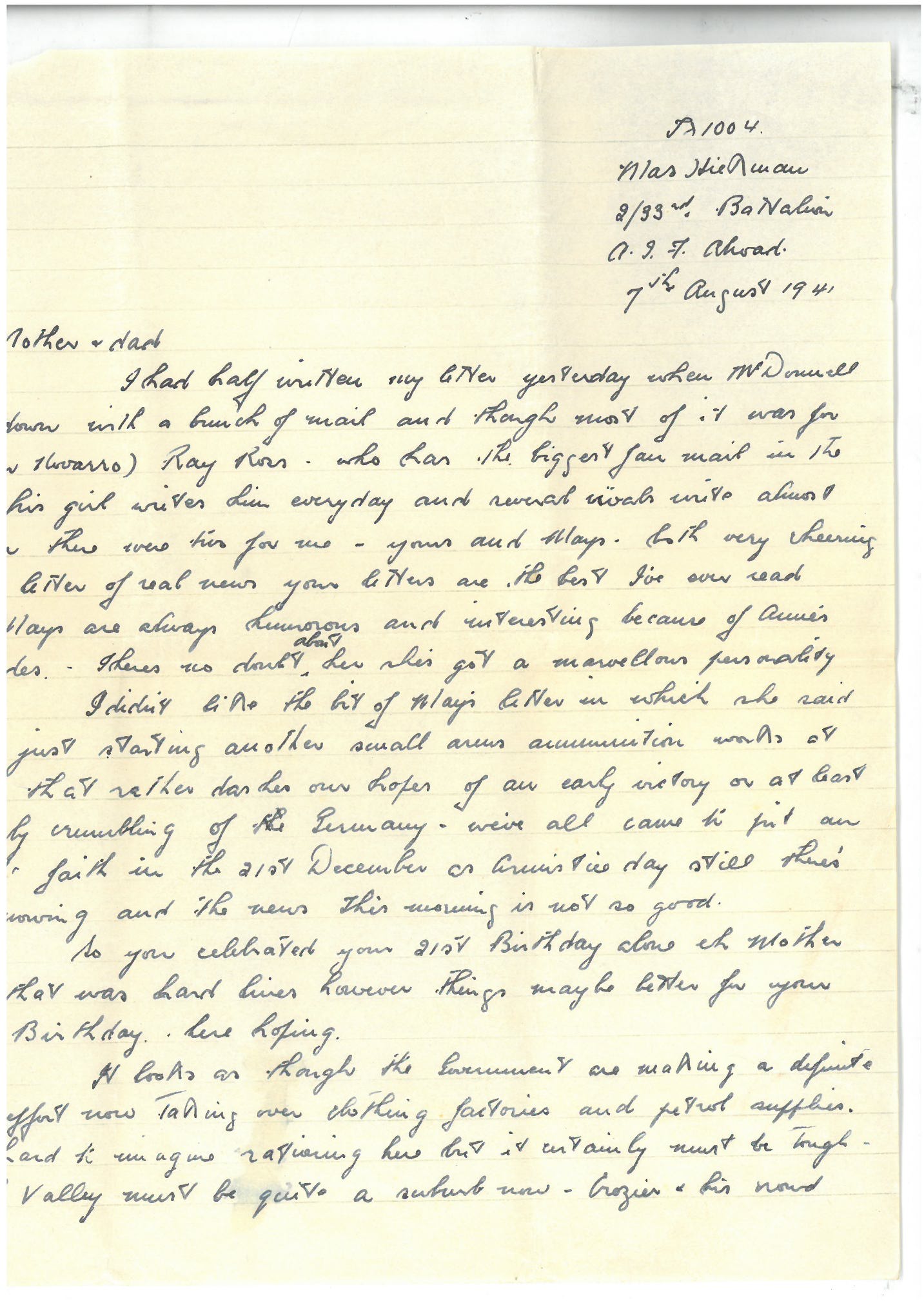
I had half written my letter yesterday when McDonnell came down with a bunch of mail and though most of it was for (Ramon Navarro) Ray Ross who has the biggest fan mail in the unit – his girl writes him every day and several rivals write almost as often – there were two for me – yours and May’s – both very cheering.  For a letter of real news your letters are the best I’ve ever read and May’s are always humorous and interesting because of Anne’s escapades.  There’s no doubt about her she’s got a marvellous personality.

I didn’t like the bit in May’s letter in which she said their (sic) just starting another small arms ammunition works at Hobart  – that rather dashes our hopes of an early victory or at least an early crumbling of Germany – we’ve all come to put an absolute faith in the 21st December as Armistice Day.  Still there’s no knowing and the news this morning is not so good.

So you celebrated your 21st birthday alone, eh Mother?  Well, that was hard lines however things may be better for your 22nd birthday.  Here’s hoping.

It looks as though the Government are making a definite war effort now, taking over clothing factories and petrol supplies.  It’s hard to imagine rationing here but it certainly must be tough .  Lenah Valley must be quite a suburb now – Crozier & his crowd will certainly get a poultice out of Little’s place and I suppose Harold Cato’s would be worth some money too now.

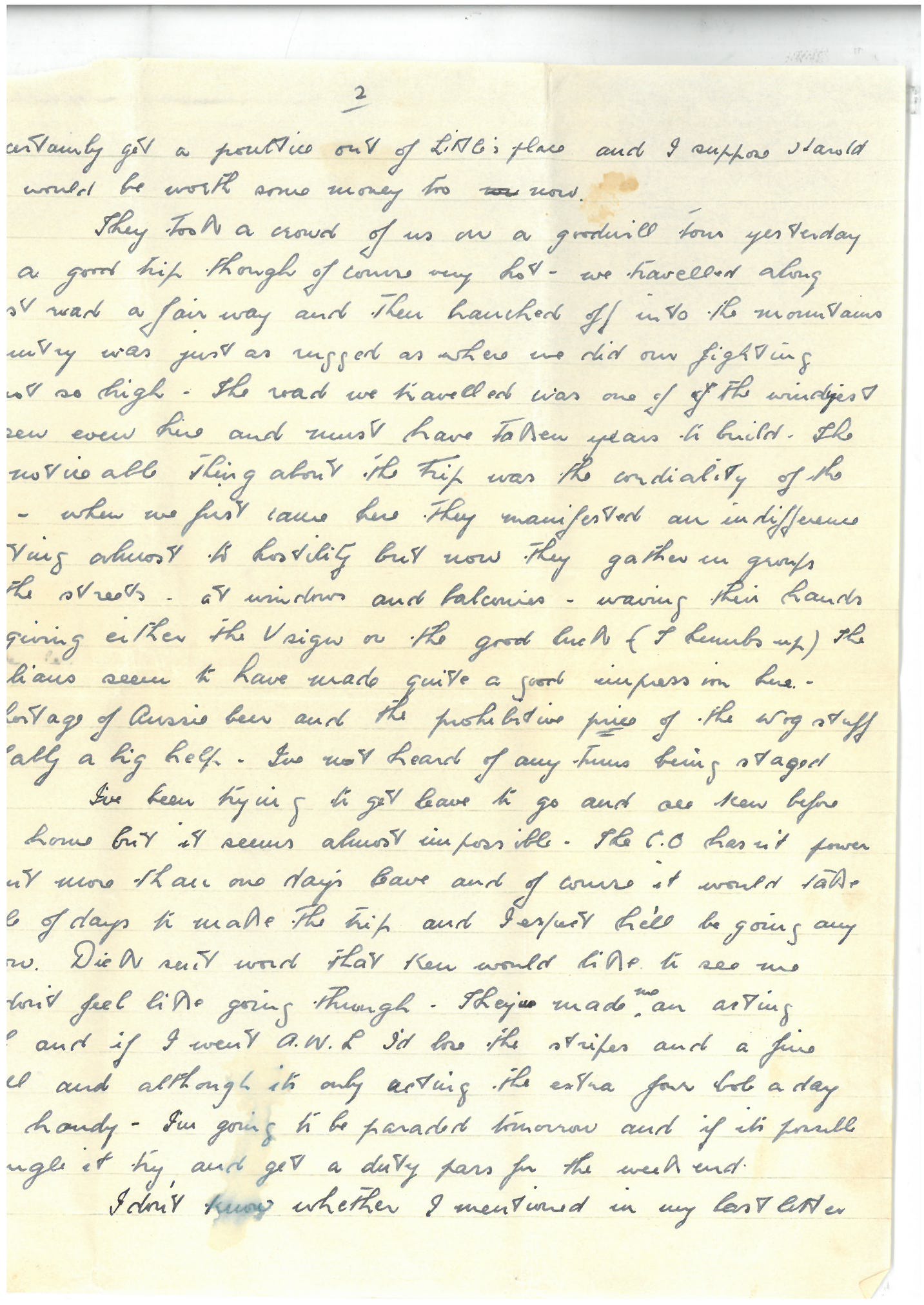
They took a crowd of us on a goodwill tour yesterday.  Quite a good trip though of course very hot.  We travelled along the coast road a fair way and then launched off into the mountains.  The country was just as rugged as where we did our fighting but not so high.  The road we travelled was one of the windiest I’ve seen even here and must have taken years to build.  The most noticeable thing about the trip was the cordiality of the people – when we first came here they manifested an indifference amounting almost to hostility but now they gather in groups along the streets, at windows and balconies, waving their hands and giving either the V sign or the good luck (thumbs up).  The Australians seem to have made quite a good impression here.  The shortage of Aussie beer and the prohibitive price of the wog stuff is probably a big help.  I’ve not heard of any turns being staged.

I’ve been trying to get leave to go and see Ken before he goes home but it seems almost impossible.  The CO hasn’t power to grant more than one day’s leave and of course it would take a couple of days to make the trip and I expect he’ll be going any day now.  Dick sent word that Ken would like to see me but I don’t feel like going through though.  They’ve made me an acting Corporal and if I went AWL I’d lose the stripes and a fine as well and although it’s only acting the extra four bob a day is very handy.  I’m going to be paraded tomorrow and if it’s possible to wangle it, try and get a duty pass for the weekend.

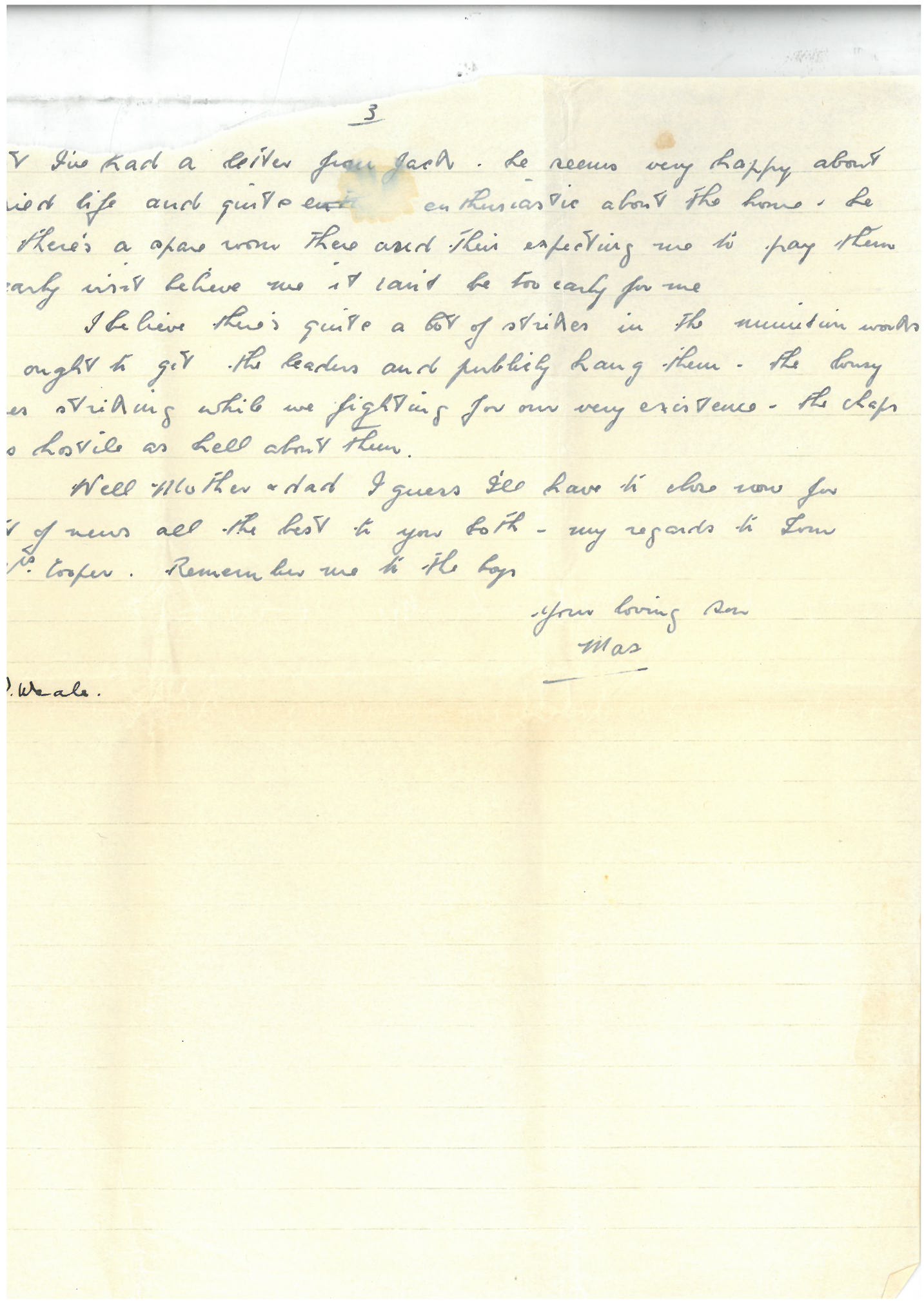
I don’t know whether I mentioned in my last letter that I’d had a letter from Jack.  He seems very happy about married life and quite enthusiastic about the home.  He said there’s a spare room there and their (sic) expecting me to pay them an early visit.  Believe me, it can’t be too early for me.

I believe there’s quite a lot of strikes in the munition works.  They ought to get the leaders and publicly hang them.  The lousy swines striking while we’re fighting for our very existence – the chaps are as hostile as hell about them.

Well Mother & dad I guess I’ll have to close now for want of news.  All the best to you both – my regards to Tom & Mrs Cooper.  Remember me to the boys.

Your loving son

Max

Ramon Navarro

Ray Ross was presumably a handsome man – at least in the eyes of the ladies!  Ramon Navarro was the successor to Rudolph Valentino as the leading male ‘sex symbol’ of silent and early talking films in the 1920’s and 30’s.

Munitions factory in Hobart

I assume the factory May referred to would have been the one described here –  from the booklet Tasmania’s War Effort 1939 – 45 (Examiner Press, 1946):

Early in 1940, the Premier of Tasmania (Robert Cosgrove) realised that Tasmanians were leaving the state to do munitions work and other war work in factories in other states, chiefly in Melbourne.  Representations were made in an endeavour to secure some of this work for Tasmania….Tasmanian members of the Federal Parliament met with relevant Commonwealth ministers to press the state’s claims….The Commonwealth Government despatched several expert and technical officers to Tasmania to examine in detail the possibility of placing orders and of developing resources.  The first tangible result….was that, following upon their conference with members of the Waterworth family and officers of the Department of Agriculture, the first steps were taken towards the establishment of the Optical Annexe…..However, the drift to mainland factories continued…..and following further representations a decision was made to erect a case ammunition factory in Tasmania.  The first manager was appointed on July 1st 1941.  A site was selected int he old Ascot Racecourse at Derwent Park.  The state government bought thirty three acres of land (at a cost of just under four thousand pounds) for the factory…tenders were let…the annexe laid out in 37 buildings…and plant was installed.  The annexe was officially opened in December 1942.

Development of Lenah Valley

Crozier & Christie were ‘Auctioneers, Land and Estate Agents’. It is possible that the advert below which appeared in The Mercury on Saturday June 28 1941 might have referred to the Little’s house mentioned in Dad’s letter:

AUGUSTA RD – Gentleman’s Home.  Easy distance Main Rd. Attractive 2 storey Brick Residence containing large lounge with glass doors to hall, dining room and kitchen (numerous built-in cupboards, servery, stainless steel sink and all-electric appointments), cloak cupboard with wash basin on ground floor. Upstairs has 3 large bedrooms, sunroom, bathroom.  Internal W.C. etc., garage, and garden.  Tram stop at door and splendid views.  An excellent secluded home in picked position. £1,725.          source:  http://trove.nla.gov.au/ndp/del/article/25868573

Petrol rationing

The same edition of the Mercury (trove site  – link above) contains advertisements for cars, indicating the availability of small cars, cheap to run – Morris 8 tourers, sedans and roadsters were said to do from 35 to 45 miles per gallon.

Goodwill tour and local people’s response to the troops

Another very windy road : photo from The Footsoldiers – may or may not be the one referred to:

2015-06-25 16.15.17


William Crooks certainly recalled similar responses from the local people:  All along the route, the friendly and joyous Lebanese and Syrians laughed and shouted congratulations.  They climbed into the trucks, throwing flowers and fruit and offering iced drinks.  They were pleased at seeing us and glad the fighting was over.  Young and delightful girls, infected by the general air of gaiety, danced by the roadside…

Ken Jenkins: in hospital a long way from here.

My research suggests the 2/7 Australian General Hospital (where Ken’s record shows his leg amputation was undertaken) was in Rehovot in Palestine,  20 km south of Tel Aviv  – i.e. some 260km from where the battalion was camped.  No wonder working out how to visit Ken without ‘going through’ (ie going AWL) was a bit daunting.

Strikes in the Munitions works

There were a number of strikes threatened and undertaken by workers in Sydney munitions factories during 1941.  The one which might have been referred to in this letter was reported by the Hobart Mercury on July 11 : http://trove.nla.gov.au/ndp/del/article/25870732


Posted in leave, Middle East, pay and conditions, Tasmania, Tasmanian, The course of the war | Tagged , , , , , | Leave a comment

Durban… Shrapnel Valley…. Beirut

31 july 41 p1

31 July 41 p2


31 july 41 p3

TX1004

Max Hickman

2/33rd Battalion

AIF Abroad

31st July 1941

Dear Mother & Dad

I received your very pleasant letter of the 14th yesterday and am glad to know you are both well again.  the matrimonial business is certainly flourishing there – what is it – war romances or an excuse not to go?  You must have forgotten the cutting because it wasn’t in the letter.

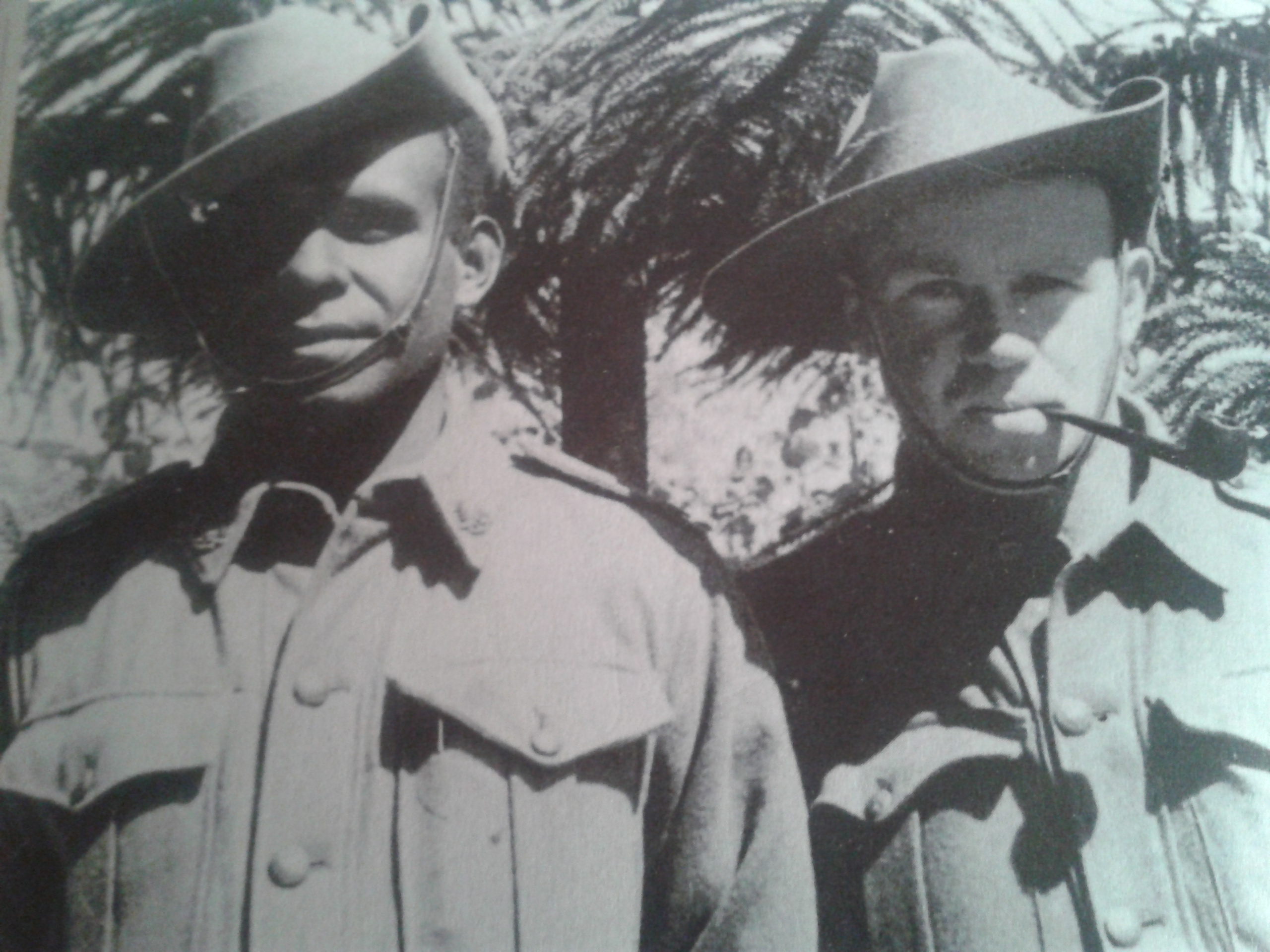
That snap I sent on the 21st was taken when we were back at Gaza and had just finished a forty eight hour guard.  The coloured chap is Charlie Mene from Thursday Island – a very popular fellow with everyone – quiet, inoffensive fellow, he was a house boy to a doctor in civvy days.  There was nearly a civil war in Durban over him, or at least a big hotel might have been done up.  I went ashore with Snow Lewis, John Black and Jack Reinke but left them after a couple of rounds of drinks to get some souvenirs.  Later in the afternoon I met Charlie with Frank Dredge and Jack Doran.  We had a snack together and took a but to the Marine Parade where I’d arranged to meet Nuggett Geeves and Viv Abel at 8pm at the Empress.  It was a bit early so we went into the lounge to have a drink and wait.  As we sat down the Indian waiters lined up behind Charlie and ordered him out.  We told them he was an Australian and to either bring us the drinks or bring the boss.  We only had one drink and left with the idea of going to the baths for a swim and coming back later however we were refused admission both to the baths and an amusement park – by which time Charlie was white with rage and would have gone back to the boat but the others stopped him.  We decided we would go back to a less aristocratic section of the city and as we passed the Empress I called in to tell Nuggett.  The drinking public were settling down by this time and the lounge was full.  Though I couldn’t see Nuggettt (he was in the bar with McDonnell and Viv) there were a lot of other Aussies there and several of them asked me to have a drink so like a mug I called the others in.  From the time we sat down all eyes were focussed on Charlie.  I think I told you of the colour bar – and some of our fellows were getting niggerly about it and when they’ve got a drop in and things go wrong something gets done up and it looked like trouble so when Charlie went outside I send Frank Dredge to keep him out for a while and then made a little speech and told them that we appreciated their domestic problems  but as we didn’t have the same trouble Charlie was one of ourselves and we’d like them to give him a fair go.  The crowd took it very well too – they gave me a hand and from then on we didn’t have to buy any beer and when leaving the manageress invited us to go back next day.

You mention the peaceful surroundings that I described in my letter of the fifteenth.  Well, at the time of writing everything was peaceful and the only sounds that disturbed the almost uncanny quietness were the Catholic church bells and the drone of reconnaissance planes.  That afternoon however the scene changed completely and we subsequently came to call the place Shrapnel Valley.  We had lost touch with the Battalion and were isolated.  They gave us all they had – seventy fives, mortars and machine gun fire and as we moved out and back a few miles they opened with anti tank rifles – how in the name of all that’s holy we got away without serious casualties beats me.

I had a day’s leave at Beyrouth(sic)  on Tuesday.  Not a very exciting place in fact just another wog town – Beyrouth is to the French what Suez is to the English – the back door to Europe.  However I bought some nice silk scarves for Mother, May & Youngster and a little kimono for Anne as well as a couple of glove boxes (Indian stuff) for Mother’s and Youngster’s birthday.  I’ve had them censored and after a hell of a lot of struggling got them done up so I hope they make the grade.  Field Post Office doesn’t cater for registering, so I’ll just have to hope they get through.

Will say cheerio now.  Best regards to Pat and Molly and to the boys.

Your loving son

Max


In memory of Durban incident – the photo with Charlie Mene

Dad and Charlie Mene

The story had been told in previous letters, but as the photo was included this time, it was probably important to re-tell it.


Leave in Beirut

William Crooks’ description of leave in Beirut (in The Footsoldiers) was somewhat different from Dad’s:

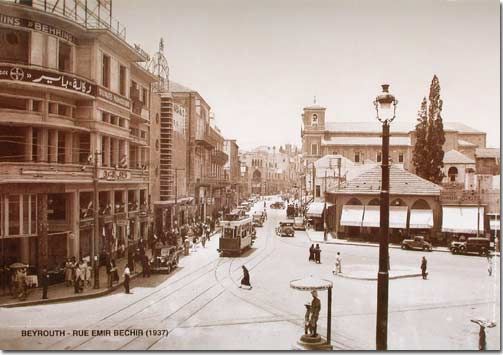
Leave in Beirut was a memorable and long talked-about occasion.  Very modern, and with a population of 500,000 French-speaking citizens, this splendid city had scores of open air cafes, trams and trains, and offered the nearest thing to normal life that can come the way of the soldier.

lebanonpostcard com


Photo: Beirut in 1937 – from lebanonpostcard.com


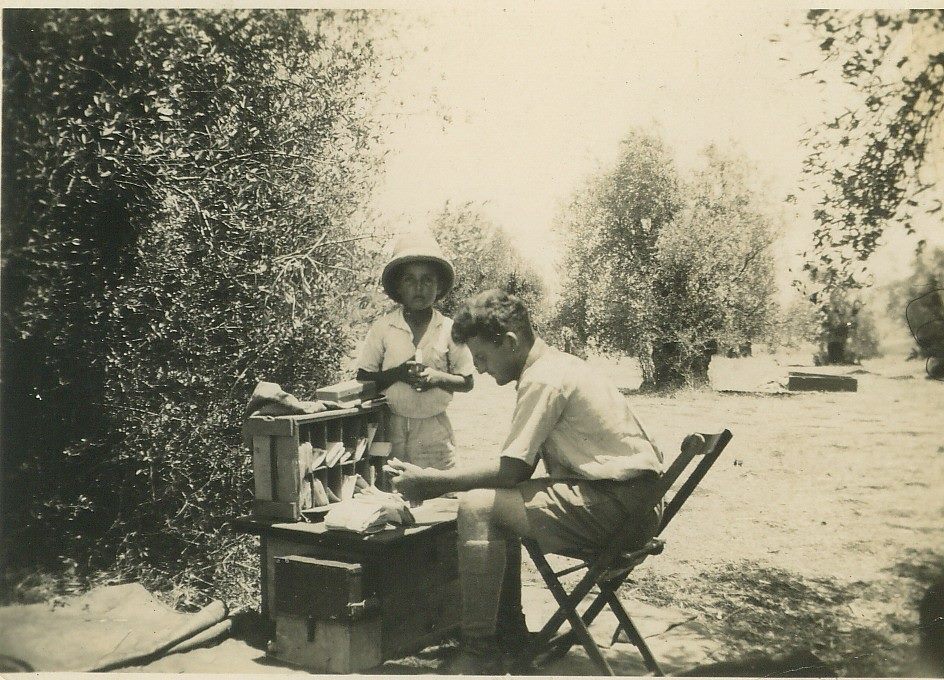
The field Post Office

Bn postman Middle East Charlie McGinnes

Charlie McGinnes (NX 6513) running one of the ‘Field Post Offices’ in the Middle East – 1941.  Photo courtesy of Charlie’s son Peter – via the 2/33 Bn Facebook page.


Posted in Africa, gambling and drinking, leave, Middle East, parcels, The course of the war | Tagged , , , , | Leave a comment

Hitler apparently doesn’t share his confidences….

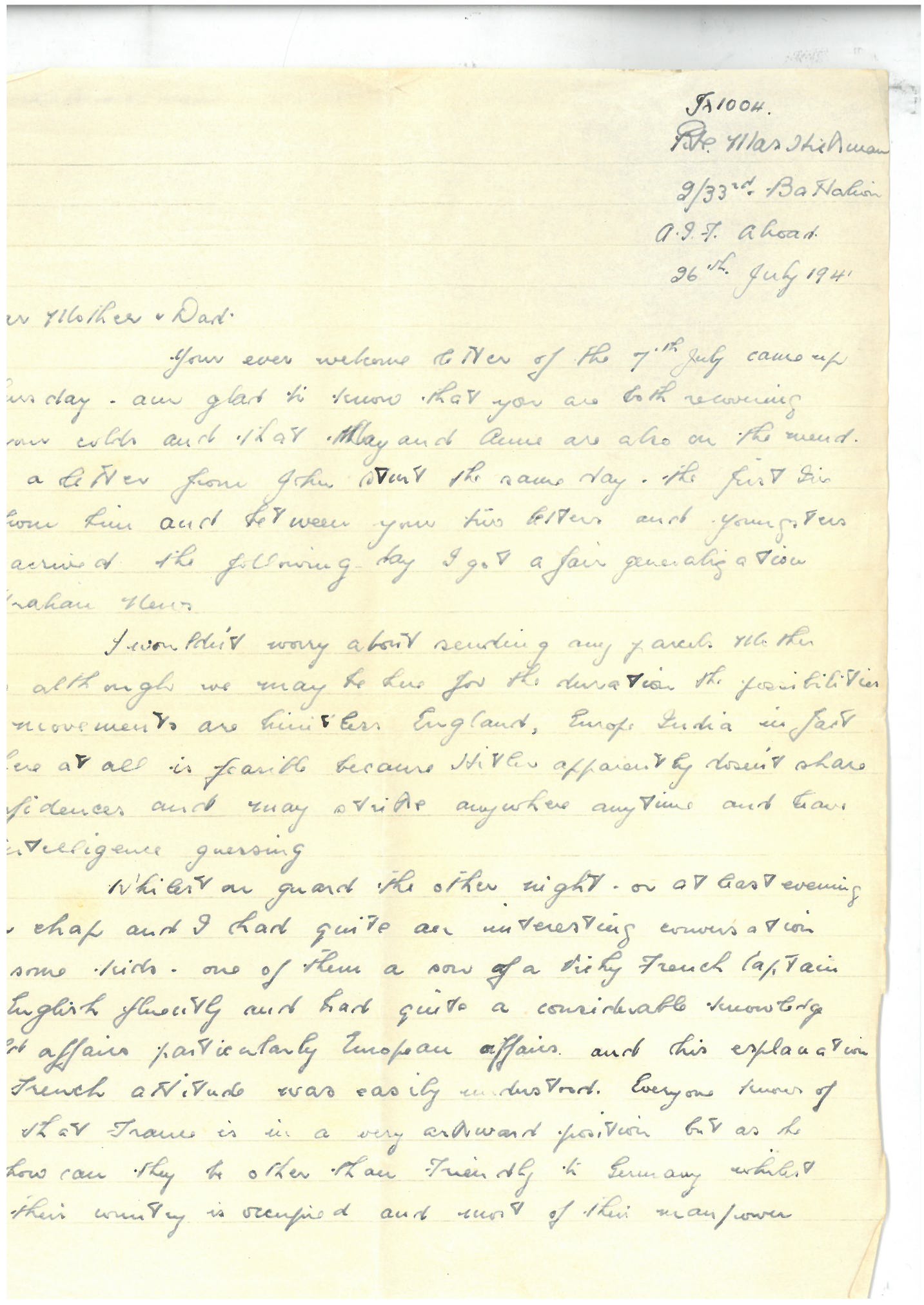
26 July 41 p1

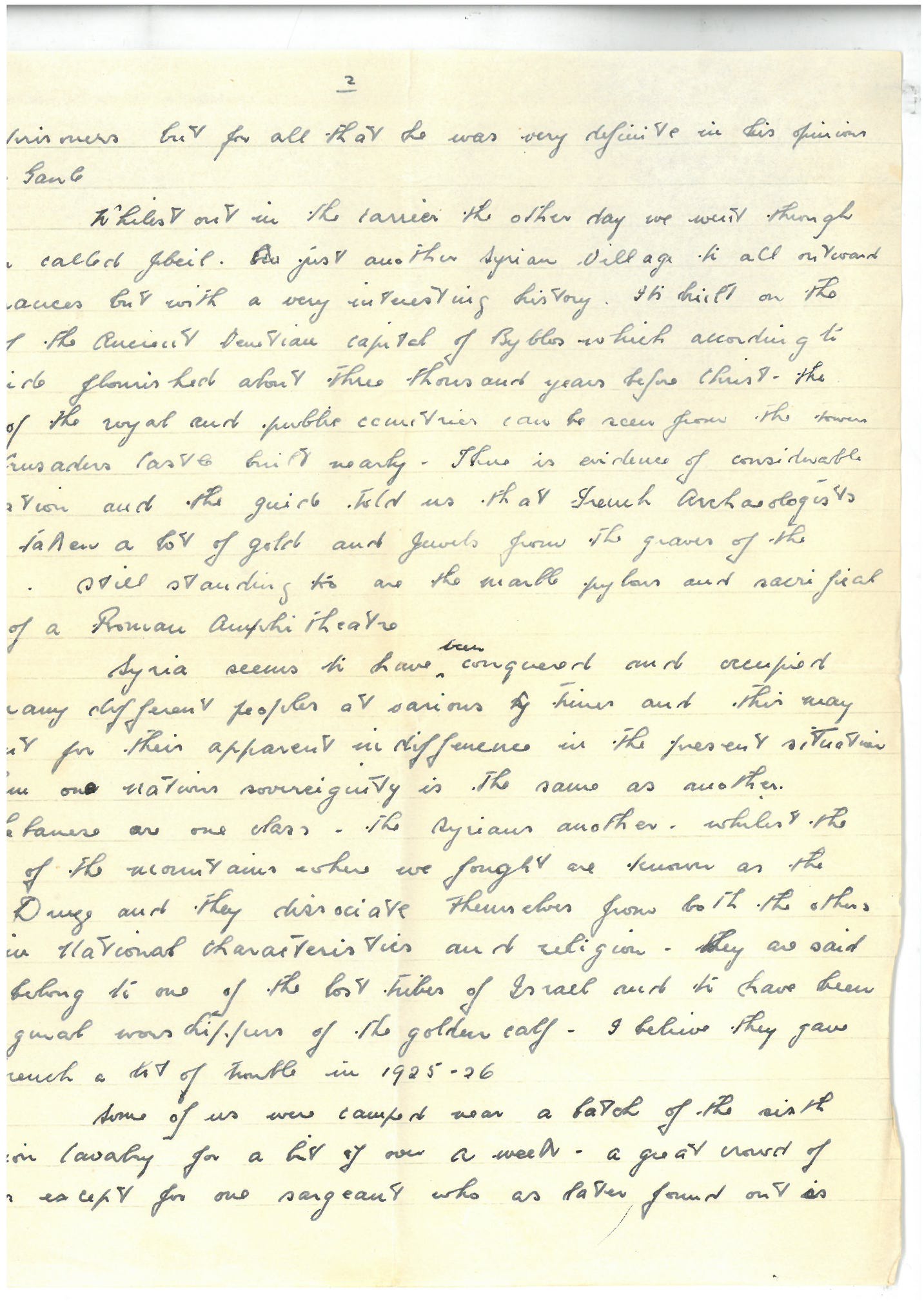
26 July 41 p2

26 July 41 p3

TX 1004

Pte Max Hickman

2/33rd Battalion

AIF Abroad

26th July 1941

Dear Mother & Dad

Your ever welcome letter of the 7th July came up on Thursday – am glad to know that you are both recovering from your colds and that May and Anne are also on the mend.  I had a letter from John sent the same day – the first I’ve had from him and between your two letters and Youngster’s which arrived the following day I got a fair generalisation of Australian news.

I wouldn’t worry about sending any parcels Mother because although we may be here for the duration the possibilities of our movements are limitless – England, Europe, India – in fact anywhere at all is feasible because Hitler apparently doesn’t share his confidences and may strike anywhere, anytime and leaves our intelligence guessing.

Whilst on guard the other night – or at least evening – another chap and I had quite an interesting conversation with some kids – one of them a son of a Vichy French Captain spoke English fluently and had quite a considerable knowledge of world affairs particularly European affairs and his explanation of the French attitude was easily understood.  Everyone knows of course that France is in a very awkward position but as he said how can they be other than friendly to Germany whilst half their country is occupied and most of their manpower are prisoners.  But for all that he was very definite in his opinions of De Gaulle.

Whilst out in the carrier the other day we went through a town called Jbeil – just another Syrian village to all outward appearances but with a very interesting history.  It’s built on the site of the ancient Venetian (sic – in fact Phoenician) capital of Byblos which according to the guide flourished about three thousand years before Christ.  The ruins of the royal and public cemeteries can be seen from the towers of a Crusader castle built nearby.  There is evidence of considerable excavation and the guide told us that French archaeologists had taken a lot of gold and jewels from the graves of the Kings.  Still standing too are the marble pylons and sacrificial stone of a Roman amphitheatre.

Syria seems to have ben conquered and occupied by many different people at various times and this may account for their apparent indifference in the present situation.  To them one nation’s sovereignty is the same as another.  The Lebanese are one class – the Syrians another – whilst the people of the mountains where we fought are known as the Jebel Druze and they dissociate themselves from both the others both in national characteristics and religion.  They are said to belong to one of the lost tribes of Israel and to have been the original worshippers of the golden calf.  I believe they gave the French a lot of trouble in 1925-26.

Some of us were camped near a batch of the sixth division cavalry for a bit over a week – a great crowd of fellows except for one sergeant who as I later found out is a country youth from a small outback town and saturated with two ideas – his own importance to the world and a dislike amounting almost to an obsession for what is now the seventh division – that is those who had the trip to England.  You’ve no idea the feeling there is on this matter – though most fellows just envy us some are very hostile which of course is quite natural.  Anyway the night before we left them they put on a bit of a show.  Their canteen came up and between us we got a fair quantity of beer and had a little open air party reminiscent of the club socials.  We had a couple of good singers – Eric Batchelor of the Cav – I mentioned him in another letter (a nephew of Mrs Lew Abbery)  and our own Aggy Lloyd who sang over the BBC in a diggers broadcast- and between their solo and duet items and community singing we spent a very pleasant evening which attracted the attention of quite a number of locals.  There was an old lady living nearby who was evidently something of a boss in the district.  We watched her making cotton thread, baking Mungaree (Arab bread) and in other ways she was a continuous interest.  She’d jabber away about two thousand words a second and be quite annoyed when you couldn’t understand her.

Viv Abel and Ray Ross – the chap who was in the carrier that got into a mine field and was blown up – have come back to the platoon and Nuggett Geeves  has transferred over to us.  Ack Hallam has been made a sergeant.  Must close now(these bloody flies have got fangs like tiger snakes).  Regards to all.  Your loving son

Max

Camping near Byblos

In his letter of July 16, Dad speaks of being camped in ‘ a pleasant but very quiet spot on the coast’. From The Footsoldiers we learn that this camp was in fact at El Fidar, just south of ancient Byblos which had been under excavation by the American University in Beirut since 1935.

Byblos by marcelfrederix

from Crusader Castle Jbeil trip advisor

Byblos: the port (photo by marcelfrederix on Pinterest) and view from the Crusader Castle (Crusader Castle Jbeil on trip advisor)

The possibilities of our movements are endless

In the following months, the Battalion moved north to Tripoli to defend its vital oil storage facility from potential attack, and later to the hills north-east of the port, as it was still thought that the Axis campaign would extend into the Middle East.  Dad’s comment was probably accurate on this occasion.

Two French regimes – Vichy and the Free French, and De Gaulle

According to Wikipedia, Vichy France…was the pro-Axis government headed by Marshal  Philippe Pétain from 1940 to 1944….From 1940 to 1942, while nominally the government of France as a whole, Vichy only fully controlled the zone in southern France not occupied by German military forces, while Germany occupied northern France…. Germany kept two million French soldiers in Germany as prisoners doing forced labour as hostages to ensure Vichy would reduce its military forces and pay a heavy tribute in gold, food, and supplies to Germany….The greater part of the overseas French colonies were originally under Vichy control, but it lost one colony after another to Charles de Gaulle‘s Free France….Free France and its Free French Forces were the government-in-exile led by Charles de Gaulle … and its military forces that continued to fight against the Axis powers as an Ally of Great Britain after the fall of France. It was set up in London in June 1940 and also organised and supported the Resistance in occupied France.

De Gaulle, a French government minister who rejected the armistice concluded by Marshal Philippe Pétain and who had escaped to Britain, exhorted the French to resist in his BBC broadcast “Appeal of 18 June” 1940 which had a stirring effect on morale throughout France and its colonies, although initially relatively few French forces responded to de Gaulle’s call.

So – like Marshal Petain – perhaps the Vichy officer and his son thought De Gaulle was a traitor rather than a patriot.  They may have genuinely thought that appeasing Hitler was an appropriate strategy for France’s survival.  (De Gaulle was tried in absentia in Vichy and sentenced to death for treason).

The Silent Seventh…and the hostility of (some) other troops

From The Footsoldiers:  Some few days after we came to Fidar a general order from British Command was issued that we were not to mention the fighting in any of our letters home.  No mention of the French Foreign Legion, or of our losses were to be discussed whatsoever.  The Syrian campaign was in effect to be played down and given little or no after publicity.  Few at the time were upset by this, but it was the beginning of that playing-down of our efforts that in later years gave rise to the description of us as the ‘Silent Seventh’ and other such remarks that at times got quite ugly in gatherings with men of the 6th and 9th Divisions.  Later, when we were returned to Australia most people were aware of the activities of the 6th Division in the desert, Greece and Crete and the 9th Division at Tobruk.  Few had heard of the prolonged and bitter fighting of the 7th in Syria.

Explaining the silence…

This article indicates some of the political sensitivities and the difficulties at both command level and among the troops , which may have contributed to the virtual ignoring of the Lebanon-Syria campaign in the media and subsequently in post-war commemorations. It also provides a number of photos from the AWM collection.  https://www.awm.gov.au/sites/default/files/fightingagainstthefrench.pdf

A welcome victory – and the armistice agreement

There was very little ‘good news’ in Australian papers about the war in Europe and North Africa.  So although the troops themselves were forbidden to speak about the campaign, the news of the Allied victory in Syria was welcomed by the Australian High Command who had no problem endorsing reports such as the one that appeared in the Hobart Mercury on July 17, headlined ANZACS Enter Beirut – Crowds greet British forces with delight.     A statement from the War Office in London, detailing the terms of the armistice, was printed.  Those terms included –

With full honours of war the French forces will retire to selected areas with all arms. They will be permitted to retain individual arms but only sufficient ammunition in each unit for security purposes……The choice between rallying to the Allied cause and repatriation will be left to individuals, military or civil….French ships may repatriate French troops and subjects who desire to leave…

AWM 008679

AWM 008679

Australian Troops in Beirut July 1941

Posted in Camps and Barracks, Middle East, organisation, The course of the war, Uncategorized, world | Tagged , , , , | Leave a comment