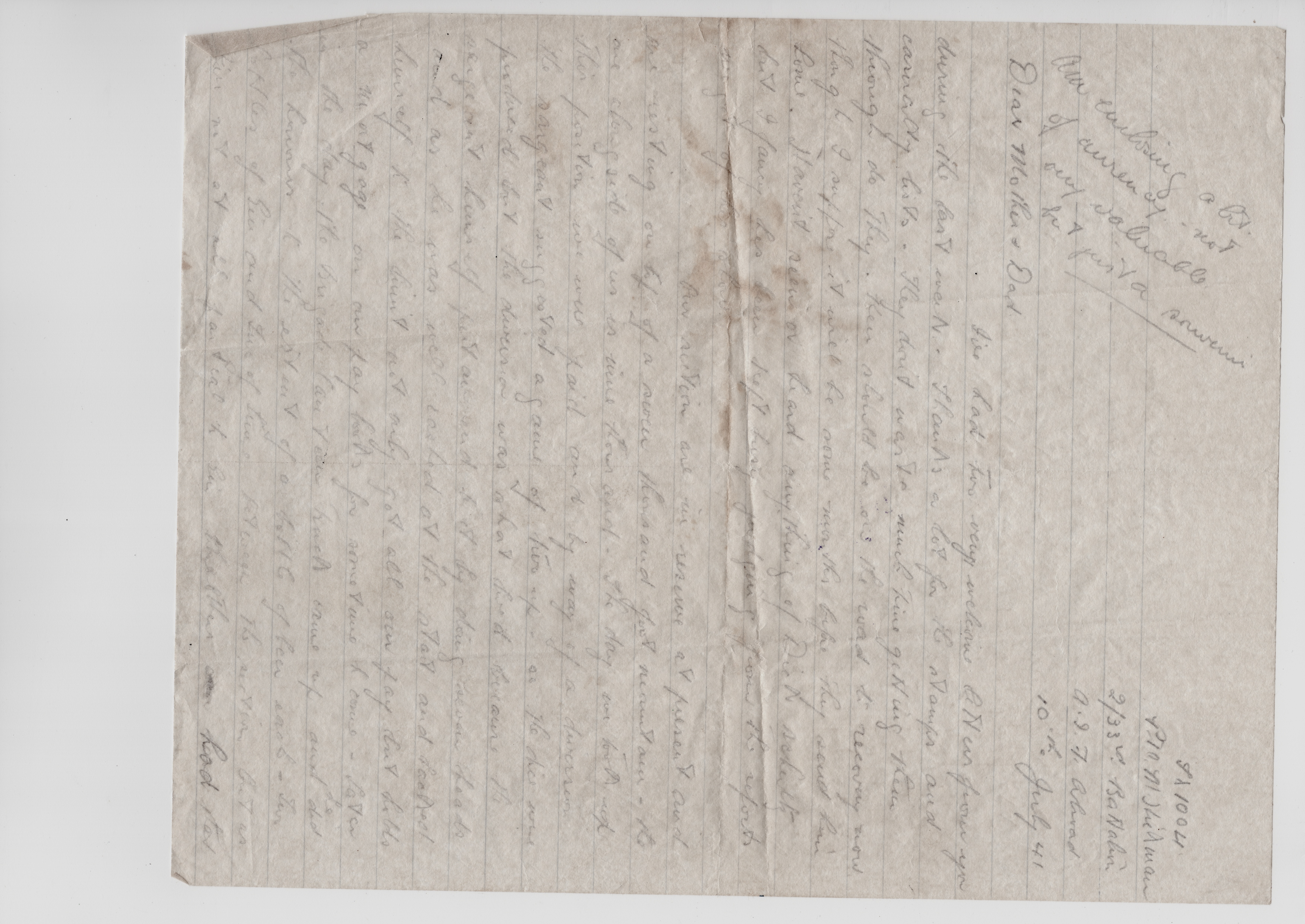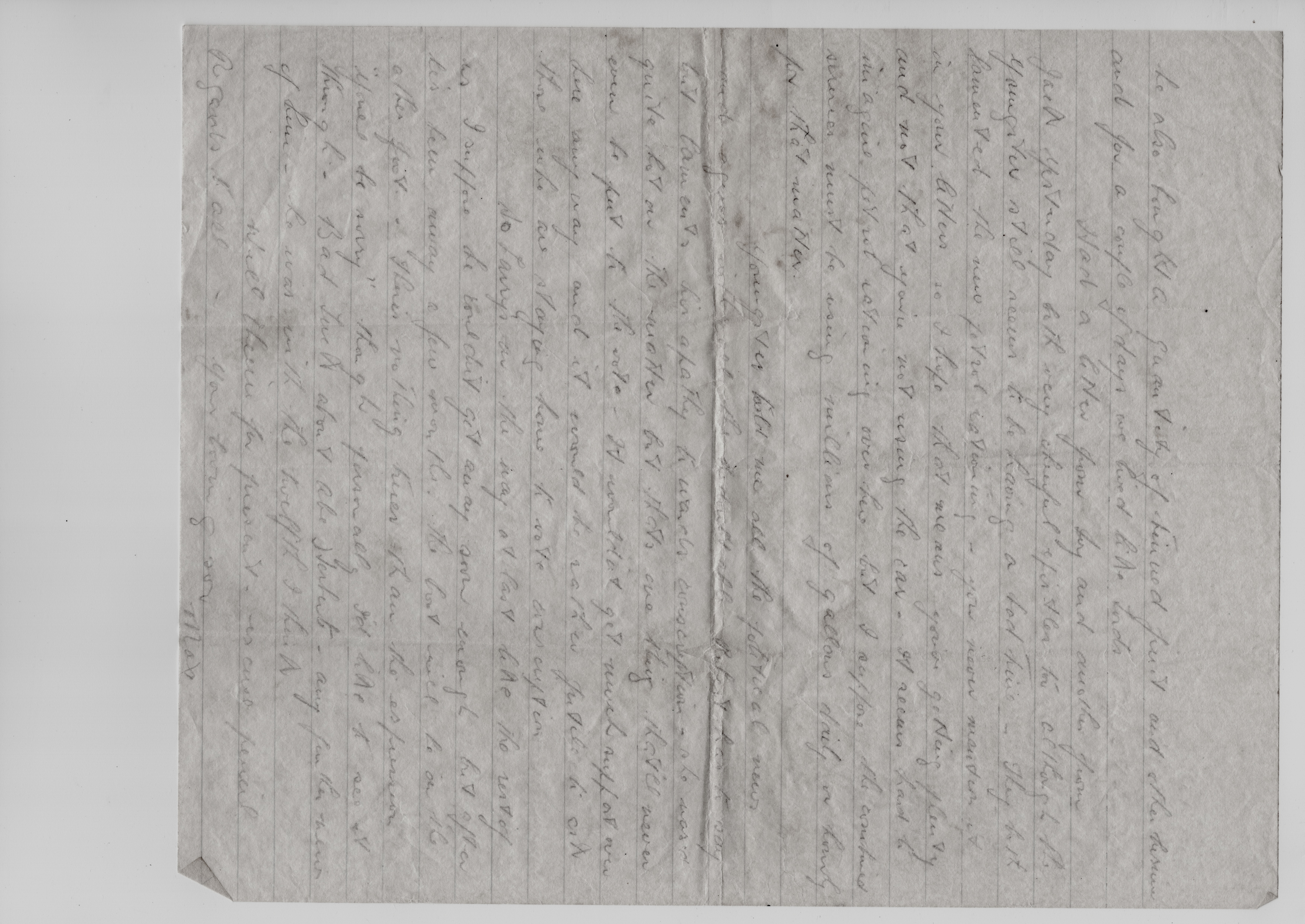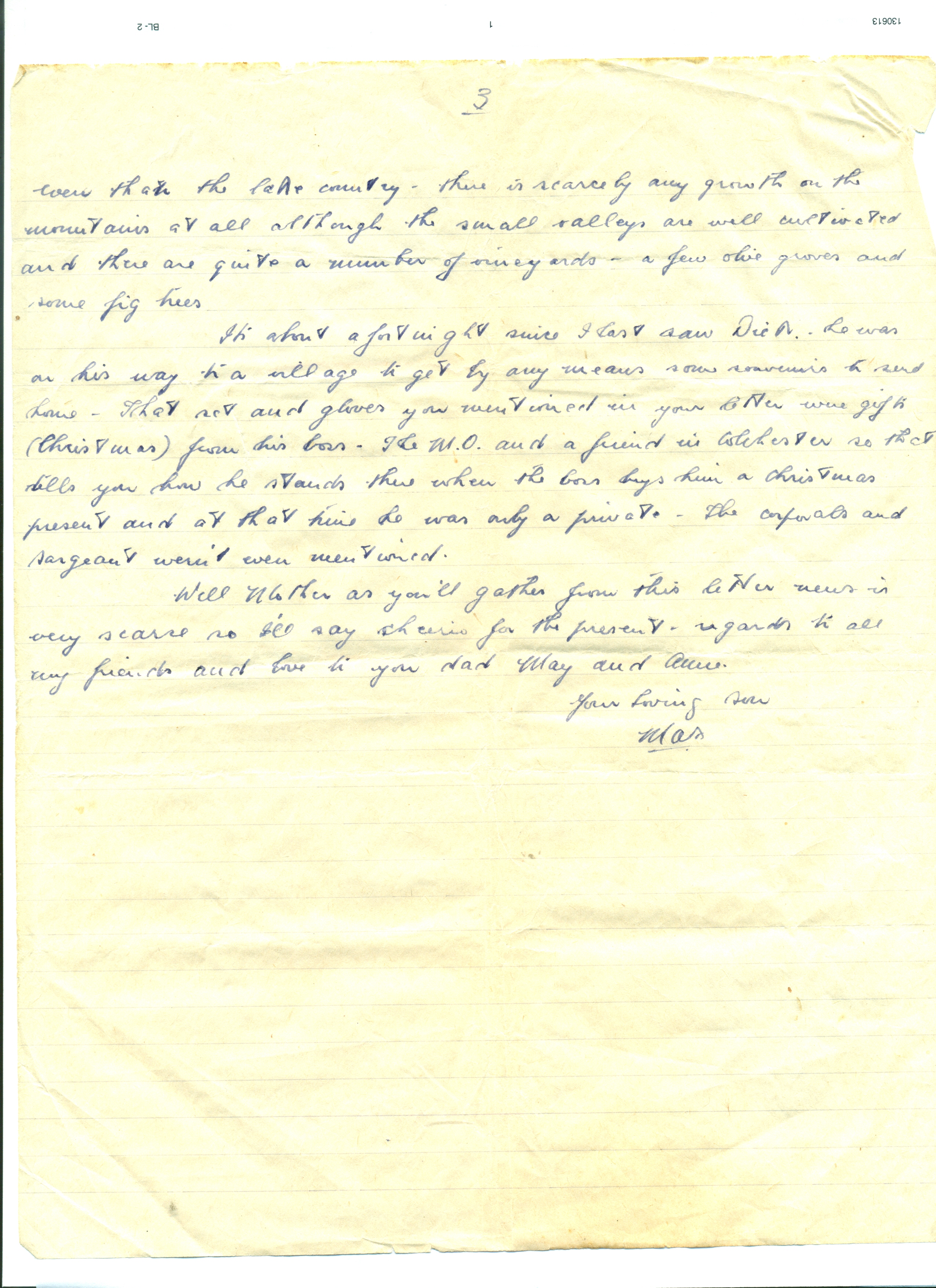
At last – a visit to Ken, post amputation – and news of Japanese aggression

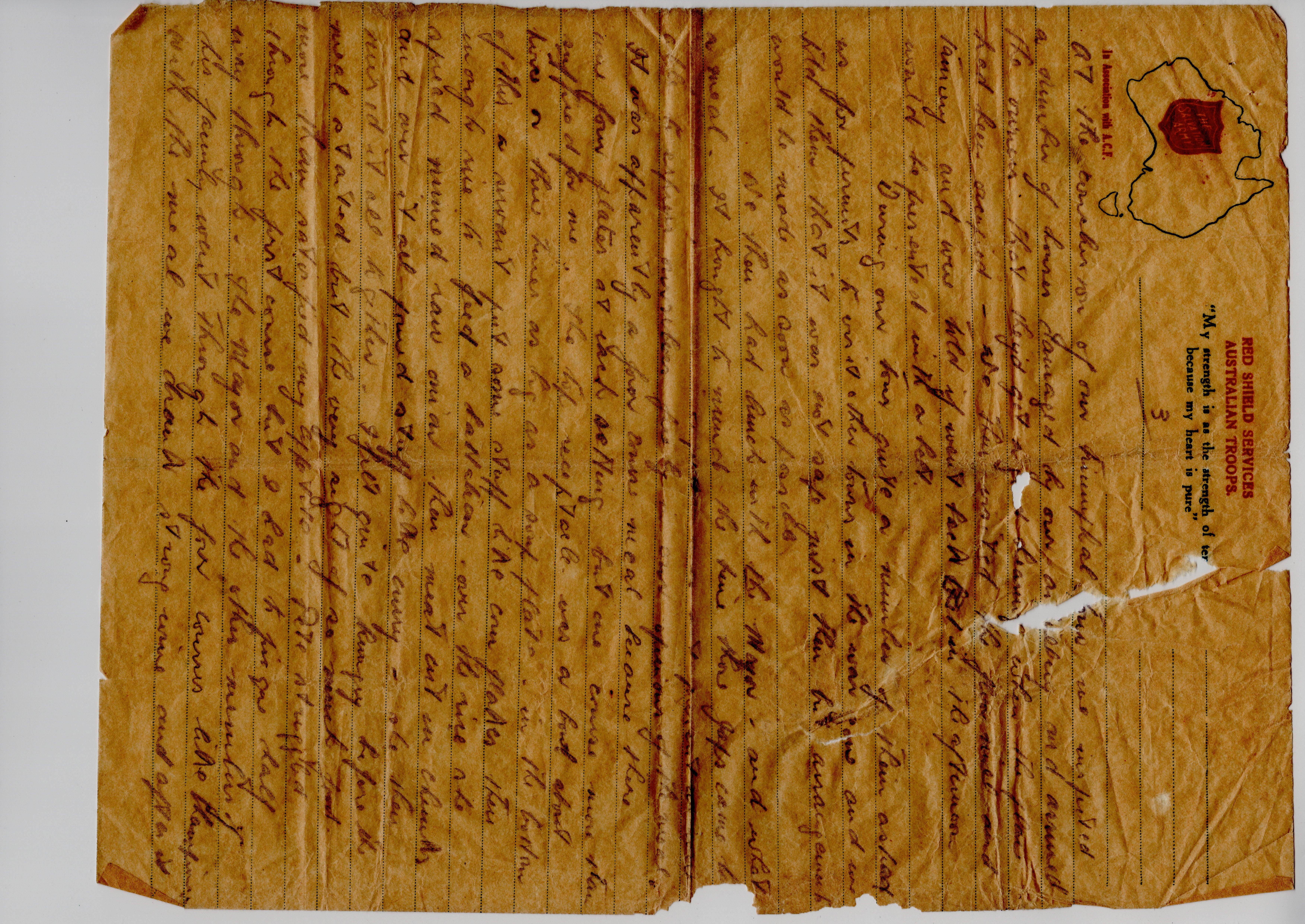
15 august 41 p1_0001

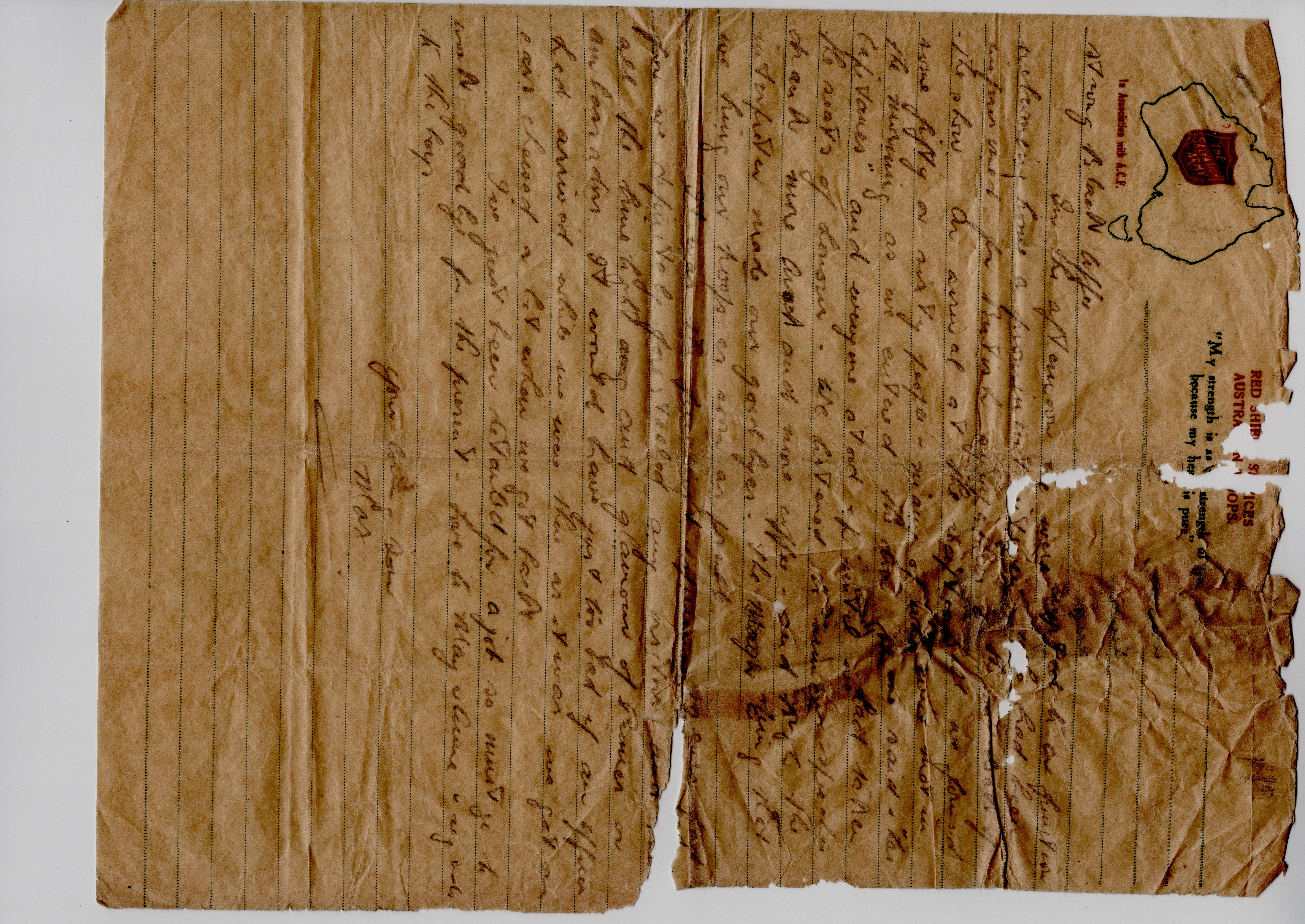
15 august 41 p2_0001

15 august 41 p3_0001


15 august 41 p4_0001

15 august 41 p5_0001

TX 1004

Max Hickman

2/33rd Battalion

AIF Abroad

15th August 1941

Dear Mother & Dad

I think I’ve told you in several letters that I’ve been trying to get down to see Ken.  My numerous efforts having been unavailing, I’d practically given up the idea when Lieut. Weale the sig officer sent for me on Tuesday afternoon and told me that an officer would be going to Dimra in Palestine and I could go with him.

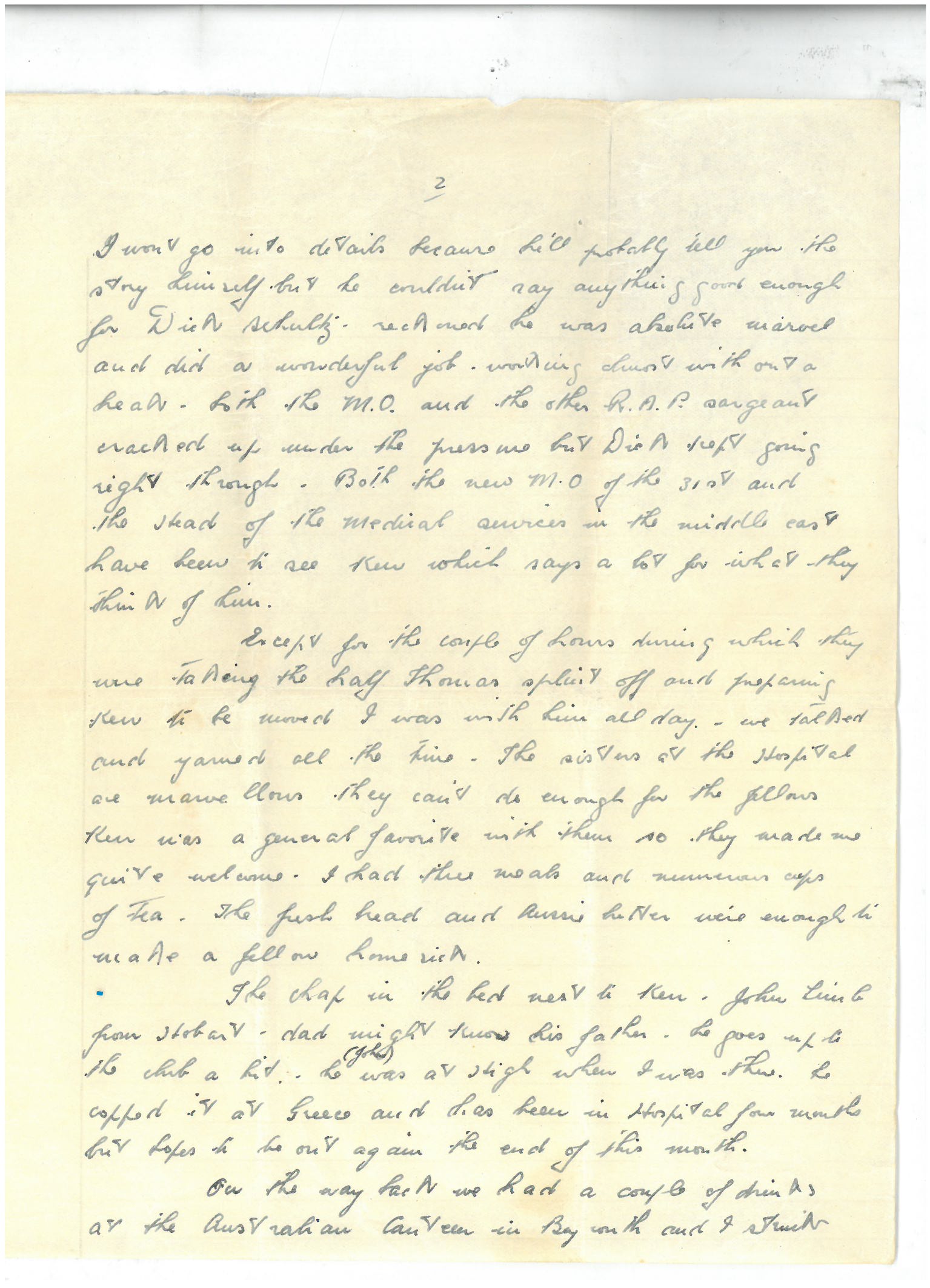
We left camp about half past five and made Haifa about half past nine – you remember my little lapse with Wattsie at Haifa – anyway we had a meal there about the best I’ve had since I was there last – and slept in the back of the truck.  We were away again at daybreak and I was at the seventh AGH at half past eight.  I found out where Ken was and the officer said he would pick me up on his way back about two o’clock.  In spite of being practically tied to his bed he literally jumped out when he saw me.  He was as pleased as punch.  I was lucky to get there in time because he was being moved to another hospital – much farther away – next morning.

Ken was very thin and pale but quite cheerful.  He’s had a hell of a tough trot and it’s only been his knowledge of anatomy and guts that have kept him alive.  I won’t go into the details because he’ll probably tell you the story himself but he couldn’t say anything good enough for Dick Schultz – reckoned he was an absolute marvel and did a wonderful job, working almost without a break.  Both the MO and the other RAP sergeant cracked up under the pressure but Dick kept going right through.  Both the new MO of the 31st and the Head of the Medical services in the Middle East have been to see Ken which says a lot for what they think of him.

Except for the couple of hours during which they were taking the half Thomas splint off and preparing Ken to be moved, I was with him all day.  We talked and yarned all the time.  The sisters at the Hospital are marvellous – they can’t do enough for the fellows.  Ken was a general favourite with them so they made me quite welcome.  I had three meals and numerous cups of tea.  The fresh bread and Aussie butter were enough to make a fellow homesick.

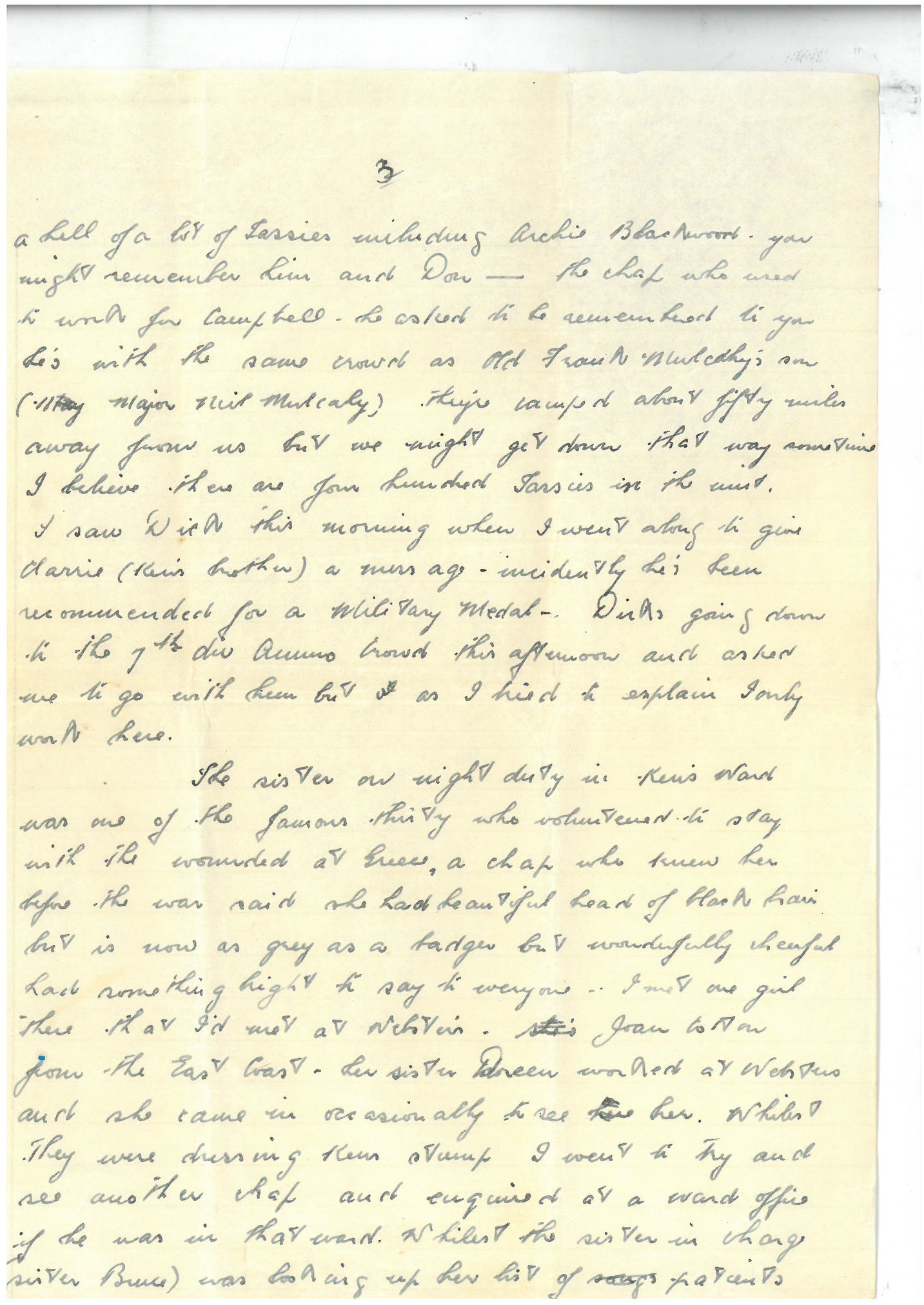
The chap in the bed next to Ken – John Limb from Hobart – dad might know his father – he goes up to the club a bit – he was at High when I was there.  He copped it at Greece and had been in Hospital four months but hopes to be out again at the end of this month.  On the way back we had a couple of drinks at the Australian canteen in Beyrouth and I struck a hell of a lot of Tassies including Archie Blackwood – you might remember him and Don….- the chap who used to work for Campbell.  He asked to be remembered to you.  He’s with the same crowd as old Frank Mulcahy’s son (Major Neil Mulcahy).  They’re camped about fifty miles away from us but we might get down that way sometime.  I believe there are four hundred Tassies in the unit.

I saw Dick this morning when I went along to give Clarrie (Ken’s brother) a message – incidentally he’s been recommended for a Military Medal – Dick’s going down to the 7th div Ammo crowd this afternoon and asked me to go with him but as I tried to explain I only work here.

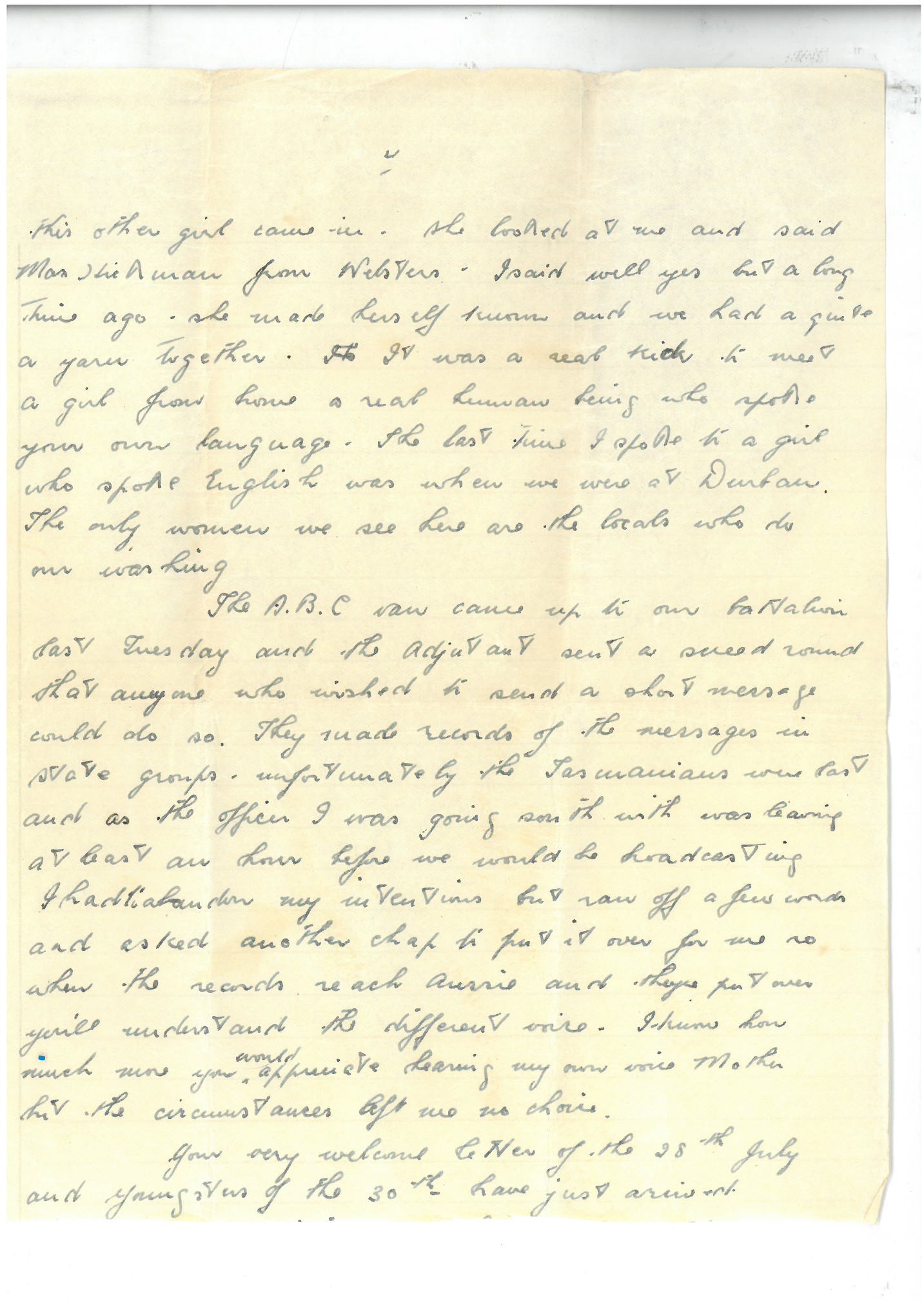
The sister on night duty in Ken’s ward was one of the famous thirty who volunteered to stay with the wounded at Greece.  A chap who knew her before the war said she had a beautiful head of black hair but is now as grey as a badger but wonderfully cheerful – had something bright to say to everyone.  I met one girl there that I’d met at Websters – Joan Cotton from the east coast – her sister Doreen worked at Websters and (Joan) came in occasionally to see her.  Whilst they were dressing Ken’s stump I went to try and see another chap and enquired at a ward office if he was in that ward.  Whilst the sister in charge (Sister Bruce) was looking up her list of patients, this other girl came in.  She looked at me and said Max Hickman from Websters – I said well yes but a long time ago.  She made herself known and we had quite a yarn together.  It was a real kick to meet a girl from home – a real human being who spoke your own language.  The last time I spoke to a girl who spoke English was when we were at Durban.  The only women we see are the locals who do our washing.

The ABC van came up to our battalion last Tuesday and the Adjutant sent a screed round that anyone who wished to send a short message could do so.  They made records of the messages in state groups.  Unfortunately the Tasmanians were last and as the officer I was going south with was leaving at least an hour before we would be broadcasting I had to abandon my intentions but ran off a few words and asked another chap to put it over for me so when the records reach Aussie and they’re put over you’ll understand the different voice.  I know how much more you would appreciate hearing my own voice Mother but the circumstances left me no choice.

Your very welcome letter of the 28th July and youngsters of the 30th have just arrived. [  bottom of page cut off….ie 2-3 lines of text censored]

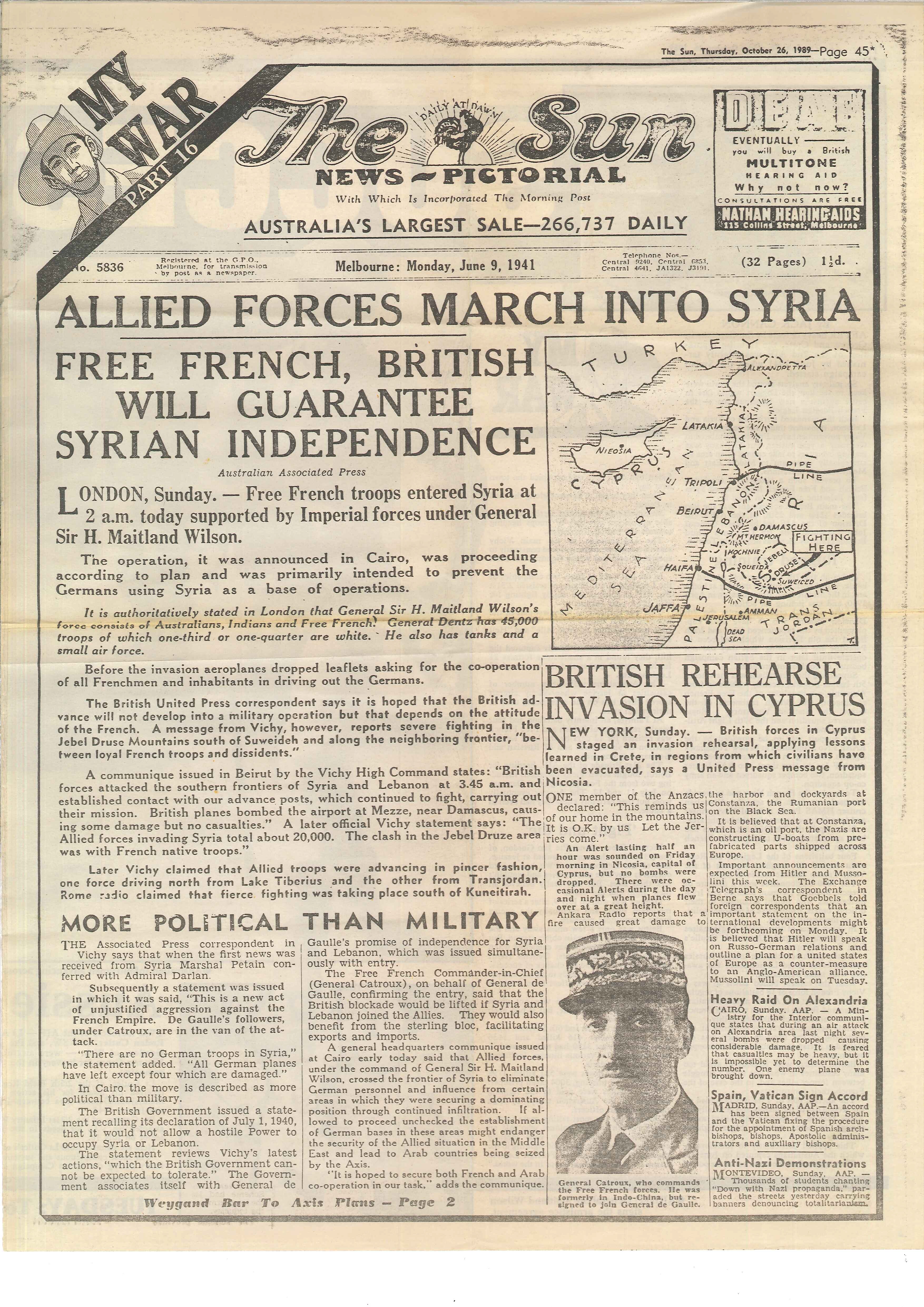
The big game of chess still goes on and it seems that Vichy is now openly in collaboration with the Nazis.  I fancy it’ll suit our lot better to know exactly where we stand.  Russia’s apparently still holding the Germans and if they can continue to do so till Winter sets in it shouldn’t last much longer.  The Japanese business has assumed rather big proportions lately but I guess if things were really crook they’d take us to Malaya or somewhere handy to home.

I’m enclosing a snap – it doesn’t really concern me directly.  It was the carrier that got blown up in the mine field.  The chap marked was a bit tinnie and got away with a few shrapnel scratches and a busted eardrum.  There’s one face in the picture that’ll be familiar – McDonnell (he wasn’t in the carrier).  I don’t know what’s come over him lately – he’s been writing letters every spare minute.  I don’t think he’s written a dozen letters since we left home but he’s certainly writing some now – must think we’re going home and is squaring himself off with some of his loves.

I’ll say cheerio now – all the best

Your loving son

Max


A note sent home with Ken

note with ken_0001

Dear Mother & Dad

I’m with Ken at the moment but expect to have to leave very shortly now.  Ken will be leaving for home tonight or tomorrow morning and asked me if I had any message.  There’s one message I would wish to send – my fondest love.  Keep your chin up – seeing Ken and knowing the suffering he’s had is an inspiration to carry on.  It makes one realise how small are his own troubles.

Ken knows as much of my doings almost as I know myself and will tell you of our life abroad.  Give my love to May & Anne and best regards to the boys.  We all hope to be home soon.


Travelling south
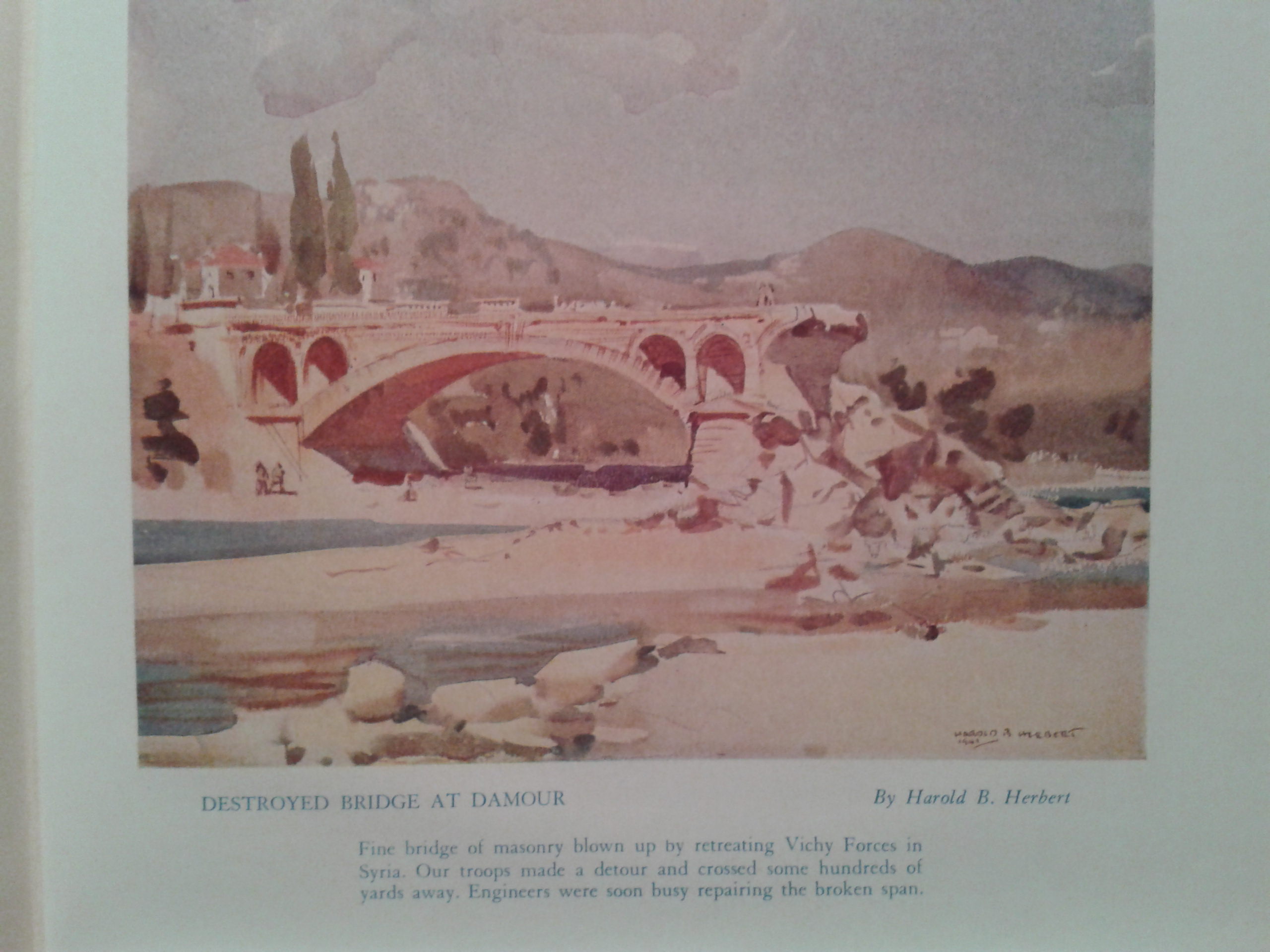
bridge at Damour

Four hours to travel around 130km from the camp to Haifa is probably explained by the condition of the roads which had been extensively damaged during the campaign – e.g. this painting by Harold Herbert of the bridge at Damour on the coast road (source: Active Service).

The second leg, of only a slightly longer distance (around 120km) seems to have been accomplished in much less time.


7th AGH at Rehovot  

Photos are hard to come by.  There is a ‘panorama from the top of the tank stand’, showing the tents and buildings of the 2/7 AGH at https://www.awm.gov.au/collection/P01641.009/

The Thomas splint

From Wikipedia:  The first widely used model of traction splint was introduced by Hugh Owen Thomas, a Welsh surgeon, considered by many to be the father of modern orthopaedic surgery. Prior to the introduction of the Thomas splint around 1916, mortality from femur fractures ran as high as 80%. Use of this splint reduced the death rate to less than 8%.


Mentioned in Despatches

John Limb: a bit of a mystery – the online WW2 nominal roll shows him not enlisting until 1942, but gives two service numbers – the first TX 642 which suggests he enlisted before Dad (ie before March 1940), and the second T 45009.  This latter is the only one listed in the National Archives record, which gives date of enlistment as July 1942.  I assume he was given a medical discharge after his hospitalisation, and that he subsequently re-enlisted in a support role.

Campbell – Charles Campbell was known to everyone in Lenah Valley, as he had opened a ‘corner store’ in 1914 – which moved to the corner of Augusta Rd and Giblin St in 1919.  At that time, the family lived in the house at the rear of the shop.  Charles’ son Colin continued to run the business until 1974 with his son John (who was a classmate of Anne Fisher – Dad’s niece, regularly mentioned in his letters), and the shop still exists though with different management.

Neil Mulcahy – at the time of his discharge in 1945, Major Mulcahy had risen to the rank of Lieutenant Colonel.  It seems from his service record and that of Archie Blackwood, that they were in the AASC (Australian Army Service Corps).

Joan and Doreen Cotton – ‘from the east coast’ – Tasmanians will recognise the Cotton name, as it has in recent years been connected with quite a controversy surrounding the so-called ‘Cotton papers’ which, it is claimed, provided accounts of local Aboriginal customs, beliefs and practices from the early days of white settlement. The actual papers were lost in a fire but have been reconstructed and published by Jane Cooper (nee Cotton) in the book Land of the Sleeping Gods.   Francis Cotton, a Quaker, arrived in Tasmania (then Van Diemens Land) in 1829 and settled near what is now Swansea. He was the father of ten children.  His property Kelvedon is now a vineyard.

Max Hickman from Websters

Militia documents from 1930 and 1937 show Dad’s occupation as firstly a clerk and second a salesman.  Either of these could have been at AG Webster and sons, a long established Hobart firm.  however, as he says ‘a long time ago’ we might assume that the clerk was at Websters but the salesman was not.  By the time he enlisted for the AIF he was a ‘contractor’ (builder).  We know that after he left school he spent some time working as a labourer on the Shrine of Remembrance in Melbourne  – that could have been in 1928/29.  For more on Websters, see http://www.utas.edu.au/library/companion_to_tasmanian_history/W/Webster.htm


The famous thirty (nurses)

From the Australian War Memorial website:  In early April 1941, as the fighting in Greece intensified, the matrons of 2/5th and 2/6th AGH were ordered to prepare for immediate evacuation. Transport was limited, so not everyone could go. Matron Best of 2/5th AGH asked her nurses to write their names and either “stay” or “go” on a slip of paper. Although staying meant possible capture, “not one Sister wrote ‘go’ on the paper. I then selected 39 sisters to remain [with me].”  With the railway line destroyed, the departing nurses headed south in trucks. They sheltered in a cemetery during an air raid, and arrived at Navplion only to discover several ships on fire. Fishing boats ferried them to a waiting ship: “We … had to judge the gap, and leap to the destroyer, equipped with tin hat, respirator, great coat and a very tight mid-length skirt.”   Despite attacks from enemy bombers, the nurses arrived on Crete and set to work at a British tent hospital as wounded troops flooded in. Meanwhile, the group left behind in Greece struggled on despite the air raids. To make themselves easily recognisable as non-combatants, they wore their red capes and white caps. Finally, in the early hours of 26 April, they too were evacuated.   Three days later all the nurses left Crete for Alexandria.     https://www.awm.gov.au/exhibitions/nurses/ww2/


 I guess if things were really crook they’d take us to Malaya or somewhere handy to home.

It’s possible Dad had seen the front page headline from the Melbourne Argus of July 30: JAPANESE OCCUPATION OF INDO-CHINA IN FULL PROGRESS – Vichy hands over air and naval bases.  The article says that the Vichy government had signed a protocol ‘for the mutual defence of Indo China’.  It also reports that Japanese radio is launching a campaign against Thailand.  It claims the British troops are moving towards Thailand’s frontier and the British warships are patrolling the coast.  and that Lt-Gen Douglas MacArthur had been confirmed by the Senate as the C-in-C of US armed forces in the Far East.    See  http://trove.nla.gov.au/ndp/del/article/8195101

Recording messages to send home

Although this photo is not of the 2/33rd, it does show a soldier recording a greeting to be broadcast via the ABC.  (AWM 010443)

010443

Posted in Censorship, organisation, Tasmania, The course of the war | Tagged , , , , , , | Leave a comment

Goodwill tour, friendly locals, promotion to Acting Corporal

7 Aug 41 p1

7 Aug 41 p2

7 Aug 41 p3


TX 1004

Max Hickman

2/33rd Battalion

AIF Abroad

7th August 1941

Dear Mother & Dad

I had half written my letter yesterday when McDonnell came down with a bunch of mail and though most of it was for (Ramon Navarro) Ray Ross who has the biggest fan mail in the unit – his girl writes him every day and several rivals write almost as often – there were two for me – yours and May’s – both very cheering.  For a letter of real news your letters are the best I’ve ever read and May’s are always humorous and interesting because of Anne’s escapades.  There’s no doubt about her she’s got a marvellous personality.

I didn’t like the bit in May’s letter in which she said their (sic) just starting another small arms ammunition works at Hobart  – that rather dashes our hopes of an early victory or at least an early crumbling of Germany – we’ve all come to put an absolute faith in the 21st December as Armistice Day.  Still there’s no knowing and the news this morning is not so good.

So you celebrated your 21st birthday alone, eh Mother?  Well, that was hard lines however things may be better for your 22nd birthday.  Here’s hoping.

It looks as though the Government are making a definite war effort now, taking over clothing factories and petrol supplies.  It’s hard to imagine rationing here but it certainly must be tough .  Lenah Valley must be quite a suburb now – Crozier & his crowd will certainly get a poultice out of Little’s place and I suppose Harold Cato’s would be worth some money too now.

They took a crowd of us on a goodwill tour yesterday.  Quite a good trip though of course very hot.  We travelled along the coast road a fair way and then launched off into the mountains.  The country was just as rugged as where we did our fighting but not so high.  The road we travelled was one of the windiest I’ve seen even here and must have taken years to build.  The most noticeable thing about the trip was the cordiality of the people – when we first came here they manifested an indifference amounting almost to hostility but now they gather in groups along the streets, at windows and balconies, waving their hands and giving either the V sign or the good luck (thumbs up).  The Australians seem to have made quite a good impression here.  The shortage of Aussie beer and the prohibitive price of the wog stuff is probably a big help.  I’ve not heard of any turns being staged.

I’ve been trying to get leave to go and see Ken before he goes home but it seems almost impossible.  The CO hasn’t power to grant more than one day’s leave and of course it would take a couple of days to make the trip and I expect he’ll be going any day now.  Dick sent word that Ken would like to see me but I don’t feel like going through though.  They’ve made me an acting Corporal and if I went AWL I’d lose the stripes and a fine as well and although it’s only acting the extra four bob a day is very handy.  I’m going to be paraded tomorrow and if it’s possible to wangle it, try and get a duty pass for the weekend.

I don’t know whether I mentioned in my last letter that I’d had a letter from Jack.  He seems very happy about married life and quite enthusiastic about the home.  He said there’s a spare room there and their (sic) expecting me to pay them an early visit.  Believe me, it can’t be too early for me.

I believe there’s quite a lot of strikes in the munition works.  They ought to get the leaders and publicly hang them.  The lousy swines striking while we’re fighting for our very existence – the chaps are as hostile as hell about them.

Well Mother & dad I guess I’ll have to close now for want of news.  All the best to you both – my regards to Tom & Mrs Cooper.  Remember me to the boys.

Your loving son

Max

Ramon Navarro

Ray Ross was presumably a handsome man – at least in the eyes of the ladies!  Ramon Navarro was the successor to Rudolph Valentino as the leading male ‘sex symbol’ of silent and early talking films in the 1920’s and 30’s.

Munitions factory in Hobart

I assume the factory May referred to would have been the one described here –  from the booklet Tasmania’s War Effort 1939 – 45 (Examiner Press, 1946):

Early in 1940, the Premier of Tasmania (Robert Cosgrove) realised that Tasmanians were leaving the state to do munitions work and other war work in factories in other states, chiefly in Melbourne.  Representations were made in an endeavour to secure some of this work for Tasmania….Tasmanian members of the Federal Parliament met with relevant Commonwealth ministers to press the state’s claims….The Commonwealth Government despatched several expert and technical officers to Tasmania to examine in detail the possibility of placing orders and of developing resources.  The first tangible result….was that, following upon their conference with members of the Waterworth family and officers of the Department of Agriculture, the first steps were taken towards the establishment of the Optical Annexe…..However, the drift to mainland factories continued…..and following further representations a decision was made to erect a case ammunition factory in Tasmania.  The first manager was appointed on July 1st 1941.  A site was selected int he old Ascot Racecourse at Derwent Park.  The state government bought thirty three acres of land (at a cost of just under four thousand pounds) for the factory…tenders were let…the annexe laid out in 37 buildings…and plant was installed.  The annexe was officially opened in December 1942.

Development of Lenah Valley

Crozier & Christie were ‘Auctioneers, Land and Estate Agents’. It is possible that the advert below which appeared in The Mercury on Saturday June 28 1941 might have referred to the Little’s house mentioned in Dad’s letter:

AUGUSTA RD – Gentleman’s Home.  Easy distance Main Rd. Attractive 2 storey Brick Residence containing large lounge with glass doors to hall, dining room and kitchen (numerous built-in cupboards, servery, stainless steel sink and all-electric appointments), cloak cupboard with wash basin on ground floor. Upstairs has 3 large bedrooms, sunroom, bathroom.  Internal W.C. etc., garage, and garden.  Tram stop at door and splendid views.  An excellent secluded home in picked position. £1,725.          source:  http://trove.nla.gov.au/ndp/del/article/25868573

Petrol rationing

The same edition of the Mercury (trove site  – link above) contains advertisements for cars, indicating the availability of small cars, cheap to run – Morris 8 tourers, sedans and roadsters were said to do from 35 to 45 miles per gallon.

Goodwill tour and local people’s response to the troops

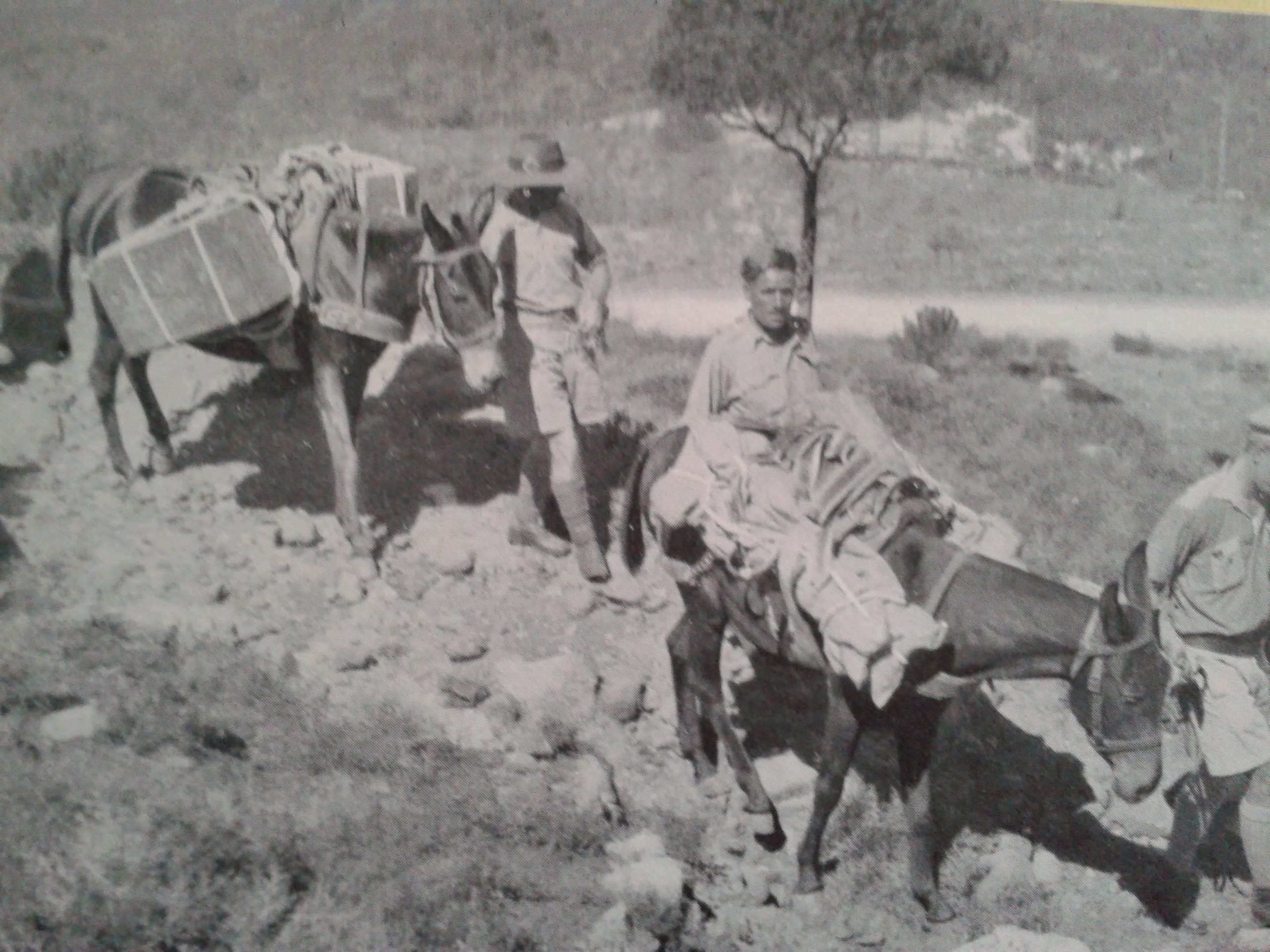
Another very windy road : photo from The Footsoldiers – may or may not be the one referred to:

2015-06-25 16.15.17


William Crooks certainly recalled similar responses from the local people:  All along the route, the friendly and joyous Lebanese and Syrians laughed and shouted congratulations.  They climbed into the trucks, throwing flowers and fruit and offering iced drinks.  They were pleased at seeing us and glad the fighting was over.  Young and delightful girls, infected by the general air of gaiety, danced by the roadside…

Ken Jenkins: in hospital a long way from here.

My research suggests the 2/7 Australian General Hospital (where Ken’s record shows his leg amputation was undertaken) was in Rehovot in Palestine,  20 km south of Tel Aviv  – i.e. some 260km from where the battalion was camped.  No wonder working out how to visit Ken without ‘going through’ (ie going AWL) was a bit daunting.

Strikes in the Munitions works

There were a number of strikes threatened and undertaken by workers in Sydney munitions factories during 1941.  The one which might have been referred to in this letter was reported by the Hobart Mercury on July 11 : http://trove.nla.gov.au/ndp/del/article/25870732


Posted in leave, Middle East, pay and conditions, Tasmania, Tasmanian, The course of the war | Tagged , , , , , | Leave a comment

Durban… Shrapnel Valley…. Beirut

31 july 41 p1

31 July 41 p2


31 july 41 p3

TX1004

Max Hickman

2/33rd Battalion

AIF Abroad

31st July 1941

Dear Mother & Dad

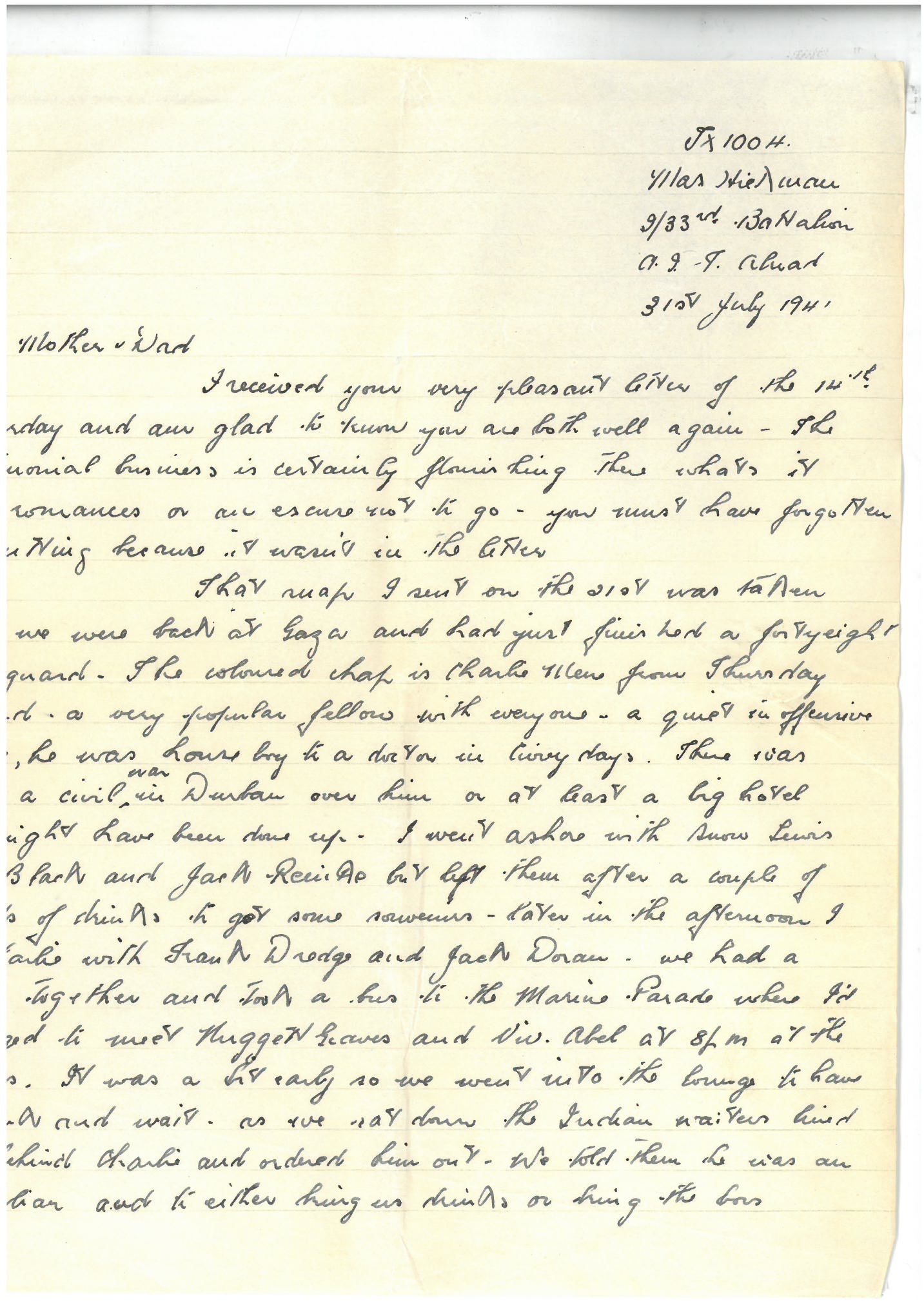
I received your very pleasant letter of the 14th yesterday and am glad to know you are both well again.  the matrimonial business is certainly flourishing there – what is it – war romances or an excuse not to go?  You must have forgotten the cutting because it wasn’t in the letter.

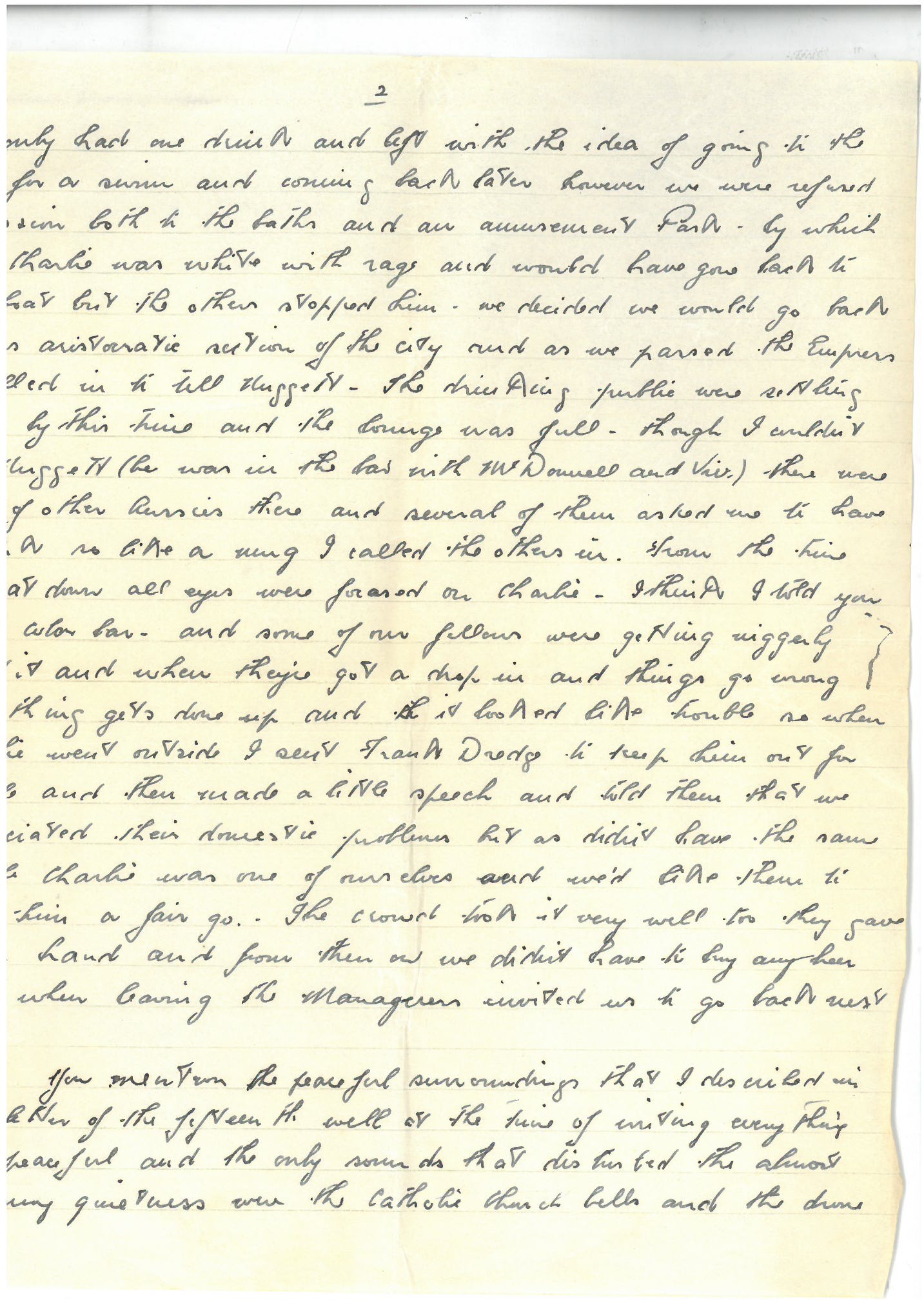
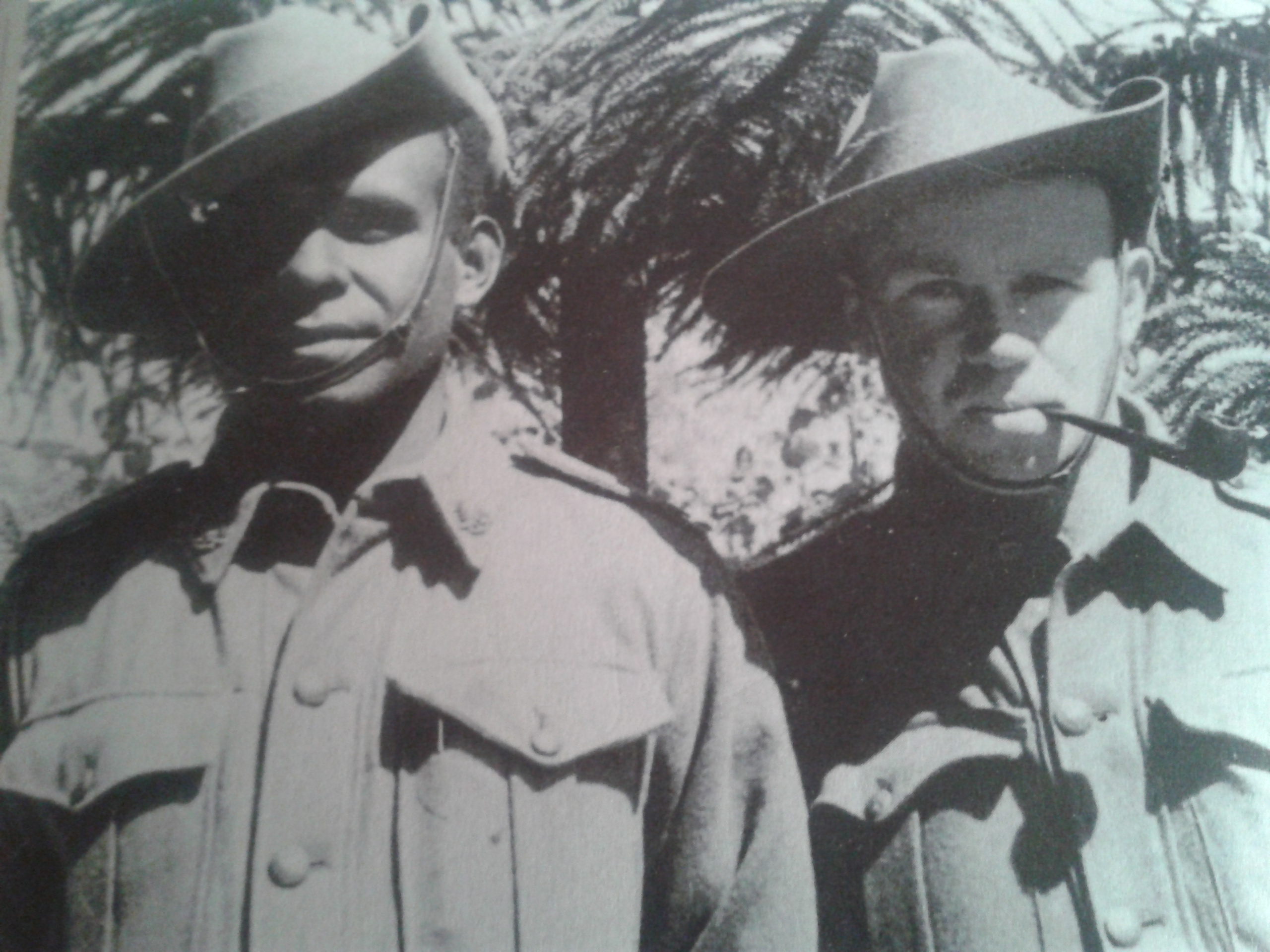
That snap I sent on the 21st was taken when we were back at Gaza and had just finished a forty eight hour guard.  The coloured chap is Charlie Mene from Thursday Island – a very popular fellow with everyone – quiet, inoffensive fellow, he was a house boy to a doctor in civvy days.  There was nearly a civil war in Durban over him, or at least a big hotel might have been done up.  I went ashore with Snow Lewis, John Black and Jack Reinke but left them after a couple of rounds of drinks to get some souvenirs.  Later in the afternoon I met Charlie with Frank Dredge and Jack Doran.  We had a snack together and took a but to the Marine Parade where I’d arranged to meet Nuggett Geeves and Viv Abel at 8pm at the Empress.  It was a bit early so we went into the lounge to have a drink and wait.  As we sat down the Indian waiters lined up behind Charlie and ordered him out.  We told them he was an Australian and to either bring us the drinks or bring the boss.  We only had one drink and left with the idea of going to the baths for a swim and coming back later however we were refused admission both to the baths and an amusement park – by which time Charlie was white with rage and would have gone back to the boat but the others stopped him.  We decided we would go back to a less aristocratic section of the city and as we passed the Empress I called in to tell Nuggett.  The drinking public were settling down by this time and the lounge was full.  Though I couldn’t see Nuggettt (he was in the bar with McDonnell and Viv) there were a lot of other Aussies there and several of them asked me to have a drink so like a mug I called the others in.  From the time we sat down all eyes were focussed on Charlie.  I think I told you of the colour bar – and some of our fellows were getting niggerly about it and when they’ve got a drop in and things go wrong something gets done up and it looked like trouble so when Charlie went outside I send Frank Dredge to keep him out for a while and then made a little speech and told them that we appreciated their domestic problems  but as we didn’t have the same trouble Charlie was one of ourselves and we’d like them to give him a fair go.  The crowd took it very well too – they gave me a hand and from then on we didn’t have to buy any beer and when leaving the manageress invited us to go back next day.

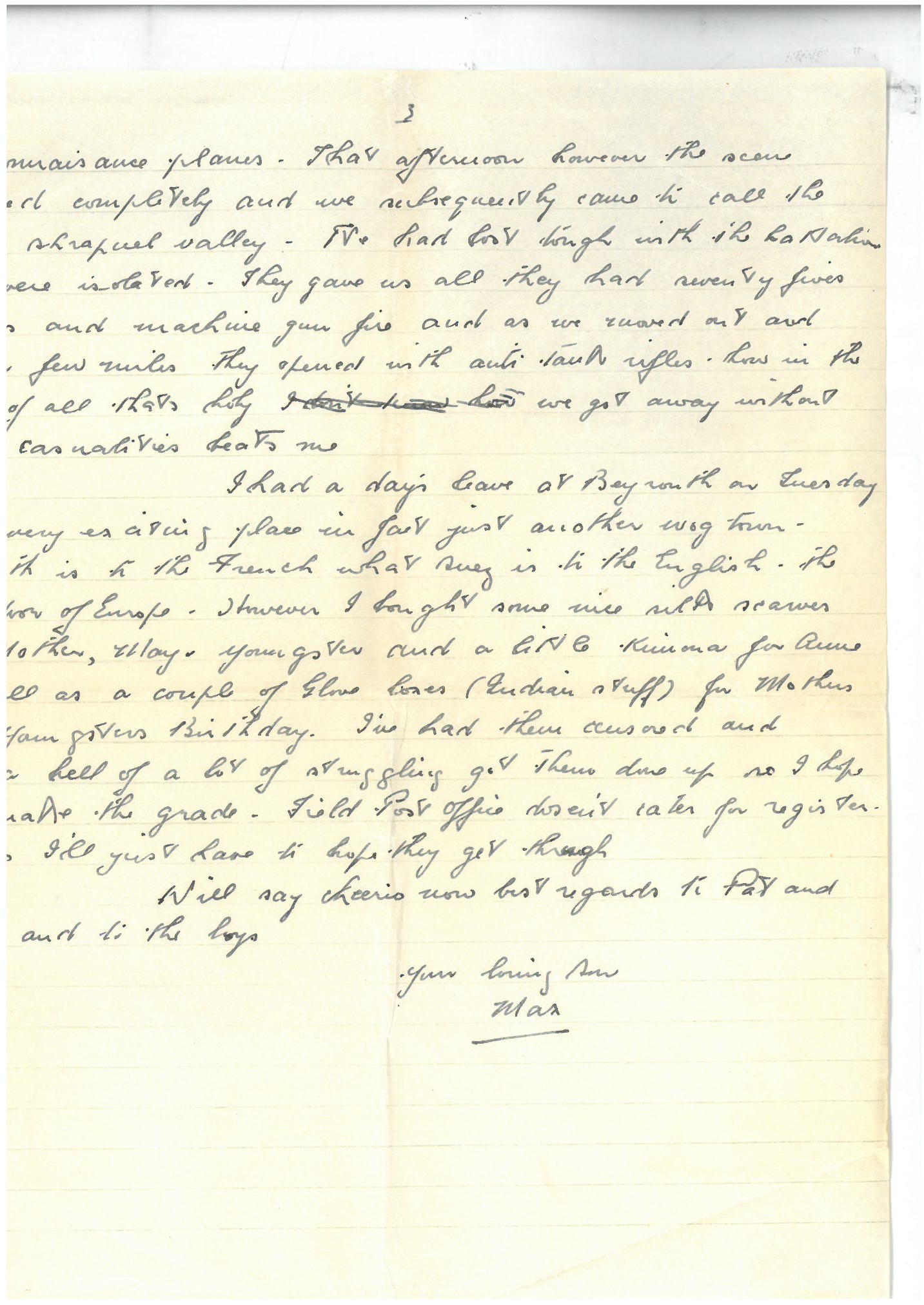
You mention the peaceful surroundings that I described in my letter of the fifteenth.  Well, at the time of writing everything was peaceful and the only sounds that disturbed the almost uncanny quietness were the Catholic church bells and the drone of reconnaissance planes.  That afternoon however the scene changed completely and we subsequently came to call the place Shrapnel Valley.  We had lost touch with the Battalion and were isolated.  They gave us all they had – seventy fives, mortars and machine gun fire and as we moved out and back a few miles they opened with anti tank rifles – how in the name of all that’s holy we got away without serious casualties beats me.

I had a day’s leave at Beyrouth(sic)  on Tuesday.  Not a very exciting place in fact just another wog town – Beyrouth is to the French what Suez is to the English – the back door to Europe.  However I bought some nice silk scarves for Mother, May & Youngster and a little kimono for Anne as well as a couple of glove boxes (Indian stuff) for Mother’s and Youngster’s birthday.  I’ve had them censored and after a hell of a lot of struggling got them done up so I hope they make the grade.  Field Post Office doesn’t cater for registering, so I’ll just have to hope they get through.

Will say cheerio now.  Best regards to Pat and Molly and to the boys.

Your loving son

Max


In memory of Durban incident – the photo with Charlie Mene

Dad and Charlie Mene

The story had been told in previous letters, but as the photo was included this time, it was probably important to re-tell it.


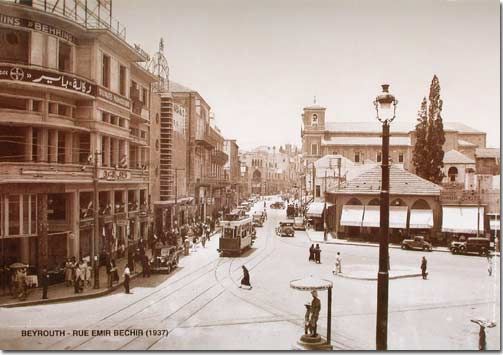
Leave in Beirut

William Crooks’ description of leave in Beirut (in The Footsoldiers) was somewhat different from Dad’s:

Leave in Beirut was a memorable and long talked-about occasion.  Very modern, and with a population of 500,000 French-speaking citizens, this splendid city had scores of open air cafes, trams and trains, and offered the nearest thing to normal life that can come the way of the soldier.

lebanonpostcard com


Photo: Beirut in 1937 – from lebanonpostcard.com


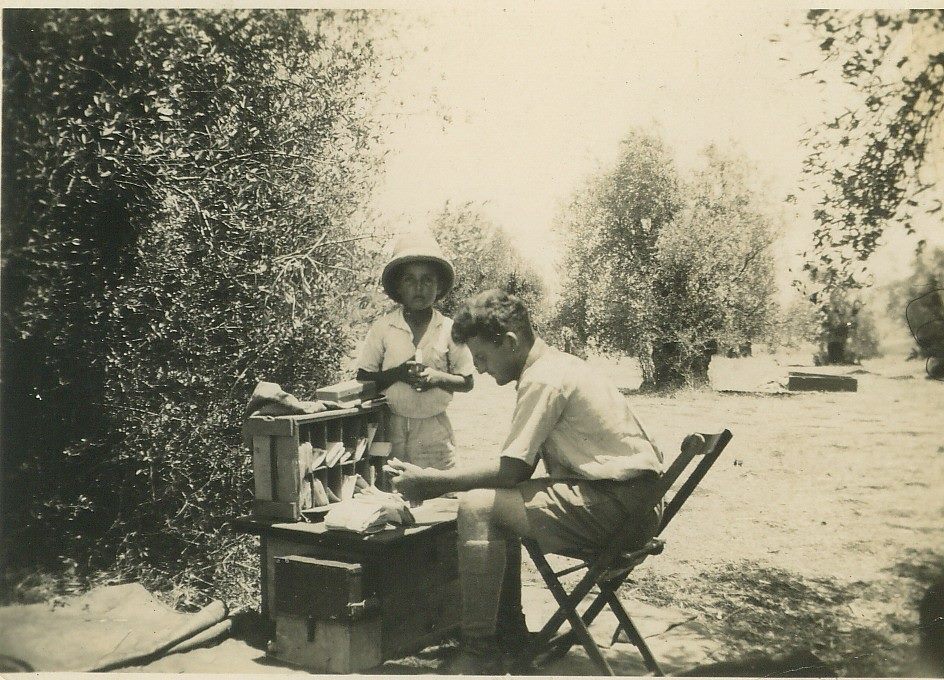
The field Post Office

Bn postman Middle East Charlie McGinnes

Charlie McGinnes (NX 6513) running one of the ‘Field Post Offices’ in the Middle East – 1941.  Photo courtesy of Charlie’s son Peter – via the 2/33 Bn Facebook page.


Posted in Africa, gambling and drinking, leave, Middle East, parcels, The course of the war | Tagged , , , , | Leave a comment

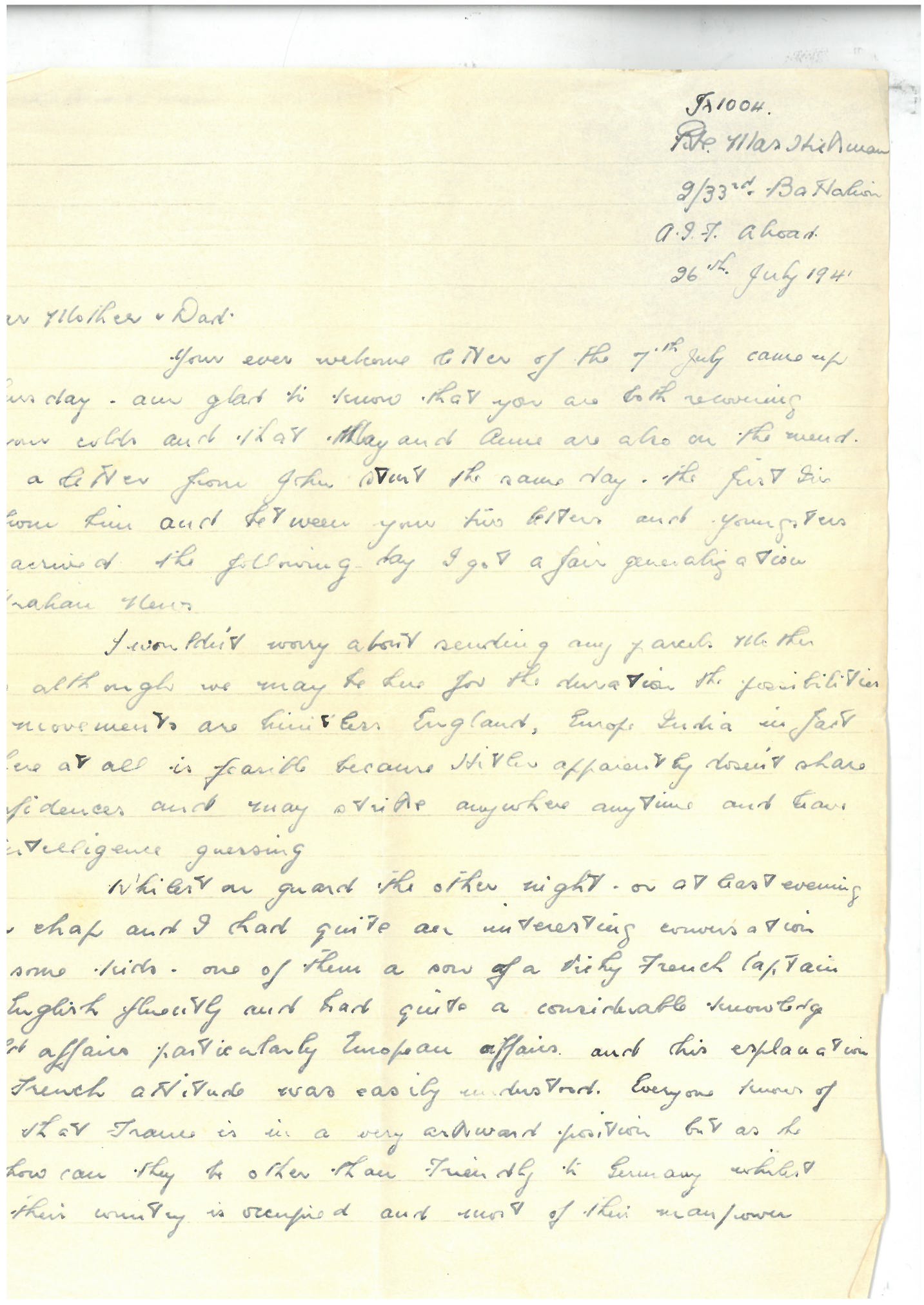
Hitler apparently doesn’t share his confidences….

26 July 41 p1

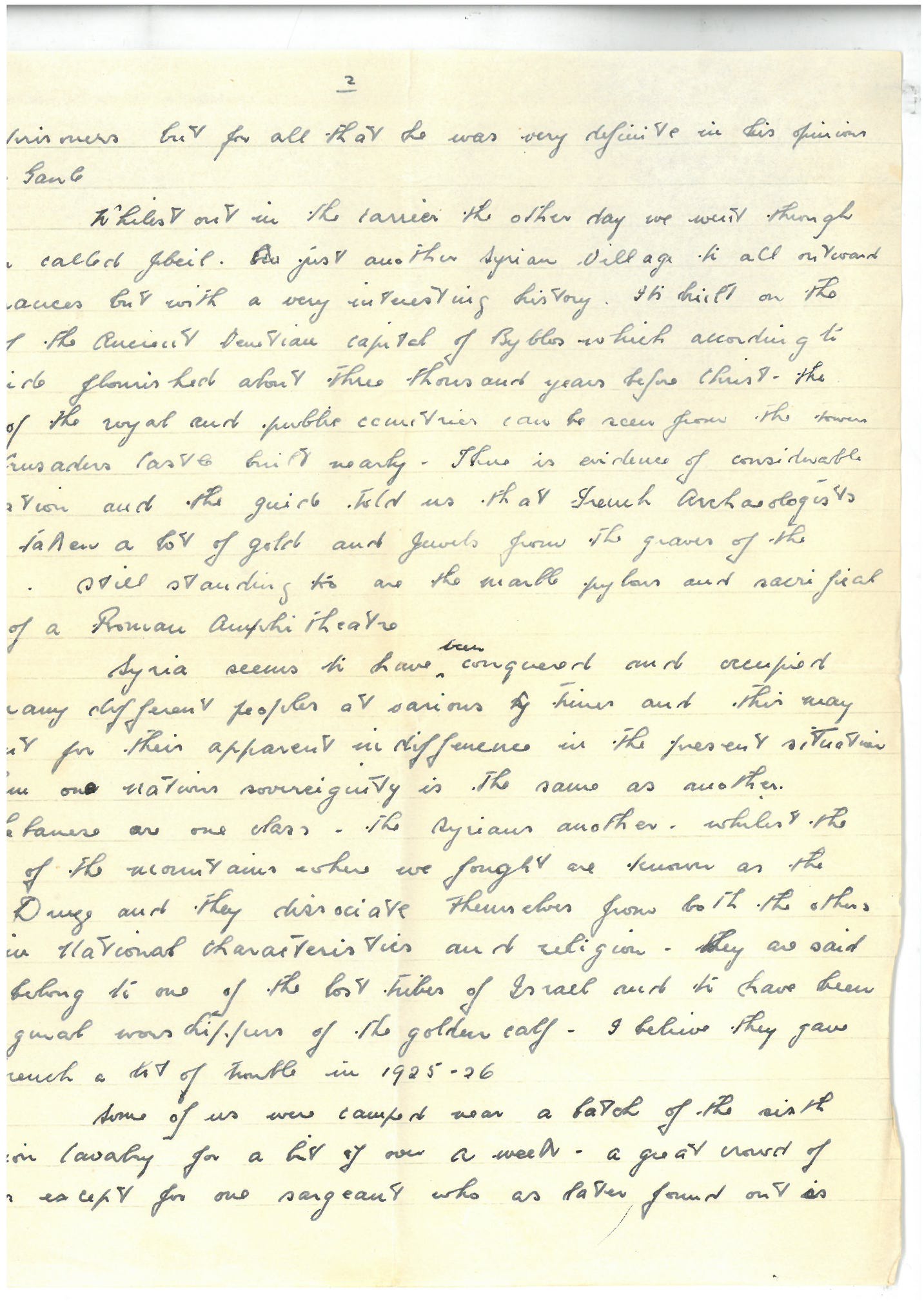
26 July 41 p2

26 July 41 p3

TX 1004

Pte Max Hickman

2/33rd Battalion

AIF Abroad

26th July 1941

Dear Mother & Dad

Your ever welcome letter of the 7th July came up on Thursday – am glad to know that you are both recovering from your colds and that May and Anne are also on the mend.  I had a letter from John sent the same day – the first I’ve had from him and between your two letters and Youngster’s which arrived the following day I got a fair generalisation of Australian news.

I wouldn’t worry about sending any parcels Mother because although we may be here for the duration the possibilities of our movements are limitless – England, Europe, India – in fact anywhere at all is feasible because Hitler apparently doesn’t share his confidences and may strike anywhere, anytime and leaves our intelligence guessing.

Whilst on guard the other night – or at least evening – another chap and I had quite an interesting conversation with some kids – one of them a son of a Vichy French Captain spoke English fluently and had quite a considerable knowledge of world affairs particularly European affairs and his explanation of the French attitude was easily understood.  Everyone knows of course that France is in a very awkward position but as he said how can they be other than friendly to Germany whilst half their country is occupied and most of their manpower are prisoners.  But for all that he was very definite in his opinions of De Gaulle.

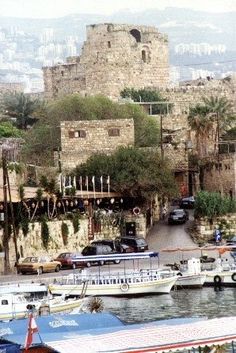
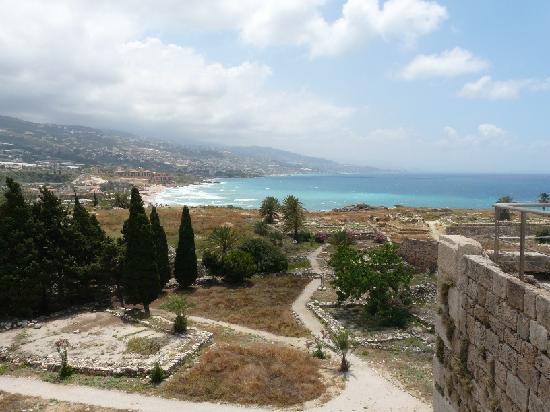
Whilst out in the carrier the other day we went through a town called Jbeil – just another Syrian village to all outward appearances but with a very interesting history.  It’s built on the site of the ancient Venetian (sic – in fact Phoenician) capital of Byblos which according to the guide flourished about three thousand years before Christ.  The ruins of the royal and public cemeteries can be seen from the towers of a Crusader castle built nearby.  There is evidence of considerable excavation and the guide told us that French archaeologists had taken a lot of gold and jewels from the graves of the Kings.  Still standing too are the marble pylons and sacrificial stone of a Roman amphitheatre.

Syria seems to have ben conquered and occupied by many different people at various times and this may account for their apparent indifference in the present situation.  To them one nation’s sovereignty is the same as another.  The Lebanese are one class – the Syrians another – whilst the people of the mountains where we fought are known as the Jebel Druze and they dissociate themselves from both the others both in national characteristics and religion.  They are said to belong to one of the lost tribes of Israel and to have been the original worshippers of the golden calf.  I believe they gave the French a lot of trouble in 1925-26.

Some of us were camped near a batch of the sixth division cavalry for a bit over a week – a great crowd of fellows except for one sergeant who as I later found out is a country youth from a small outback town and saturated with two ideas – his own importance to the world and a dislike amounting almost to an obsession for what is now the seventh division – that is those who had the trip to England.  You’ve no idea the feeling there is on this matter – though most fellows just envy us some are very hostile which of course is quite natural.  Anyway the night before we left them they put on a bit of a show.  Their canteen came up and between us we got a fair quantity of beer and had a little open air party reminiscent of the club socials.  We had a couple of good singers – Eric Batchelor of the Cav – I mentioned him in another letter (a nephew of Mrs Lew Abbery)  and our own Aggy Lloyd who sang over the BBC in a diggers broadcast- and between their solo and duet items and community singing we spent a very pleasant evening which attracted the attention of quite a number of locals.  There was an old lady living nearby who was evidently something of a boss in the district.  We watched her making cotton thread, baking Mungaree (Arab bread) and in other ways she was a continuous interest.  She’d jabber away about two thousand words a second and be quite annoyed when you couldn’t understand her.

Viv Abel and Ray Ross – the chap who was in the carrier that got into a mine field and was blown up – have come back to the platoon and Nuggett Geeves  has transferred over to us.  Ack Hallam has been made a sergeant.  Must close now(these bloody flies have got fangs like tiger snakes).  Regards to all.  Your loving son

Max

Camping near Byblos

In his letter of July 16, Dad speaks of being camped in ‘ a pleasant but very quiet spot on the coast’. From The Footsoldiers we learn that this camp was in fact at El Fidar, just south of ancient Byblos which had been under excavation by the American University in Beirut since 1935.

Byblos by marcelfrederix

from Crusader Castle Jbeil trip advisor

Byblos: the port (photo by marcelfrederix on Pinterest) and view from the Crusader Castle (Crusader Castle Jbeil on trip advisor)

The possibilities of our movements are endless

In the following months, the Battalion moved north to Tripoli to defend its vital oil storage facility from potential attack, and later to the hills north-east of the port, as it was still thought that the Axis campaign would extend into the Middle East.  Dad’s comment was probably accurate on this occasion.

Two French regimes – Vichy and the Free French, and De Gaulle

According to Wikipedia, Vichy France…was the pro-Axis government headed by Marshal  Philippe Pétain from 1940 to 1944….From 1940 to 1942, while nominally the government of France as a whole, Vichy only fully controlled the zone in southern France not occupied by German military forces, while Germany occupied northern France…. Germany kept two million French soldiers in Germany as prisoners doing forced labour as hostages to ensure Vichy would reduce its military forces and pay a heavy tribute in gold, food, and supplies to Germany….The greater part of the overseas French colonies were originally under Vichy control, but it lost one colony after another to Charles de Gaulle‘s Free France….Free France and its Free French Forces were the government-in-exile led by Charles de Gaulle … and its military forces that continued to fight against the Axis powers as an Ally of Great Britain after the fall of France. It was set up in London in June 1940 and also organised and supported the Resistance in occupied France.

De Gaulle, a French government minister who rejected the armistice concluded by Marshal Philippe Pétain and who had escaped to Britain, exhorted the French to resist in his BBC broadcast “Appeal of 18 June” 1940 which had a stirring effect on morale throughout France and its colonies, although initially relatively few French forces responded to de Gaulle’s call.

So – like Marshal Petain – perhaps the Vichy officer and his son thought De Gaulle was a traitor rather than a patriot.  They may have genuinely thought that appeasing Hitler was an appropriate strategy for France’s survival.  (De Gaulle was tried in absentia in Vichy and sentenced to death for treason).

The Silent Seventh…and the hostility of (some) other troops

From The Footsoldiers:  Some few days after we came to Fidar a general order from British Command was issued that we were not to mention the fighting in any of our letters home.  No mention of the French Foreign Legion, or of our losses were to be discussed whatsoever.  The Syrian campaign was in effect to be played down and given little or no after publicity.  Few at the time were upset by this, but it was the beginning of that playing-down of our efforts that in later years gave rise to the description of us as the ‘Silent Seventh’ and other such remarks that at times got quite ugly in gatherings with men of the 6th and 9th Divisions.  Later, when we were returned to Australia most people were aware of the activities of the 6th Division in the desert, Greece and Crete and the 9th Division at Tobruk.  Few had heard of the prolonged and bitter fighting of the 7th in Syria.

Explaining the silence…

This article indicates some of the political sensitivities and the difficulties at both command level and among the troops , which may have contributed to the virtual ignoring of the Lebanon-Syria campaign in the media and subsequently in post-war commemorations. It also provides a number of photos from the AWM collection.  https://www.awm.gov.au/sites/default/files/fightingagainstthefrench.pdf

A welcome victory – and the armistice agreement

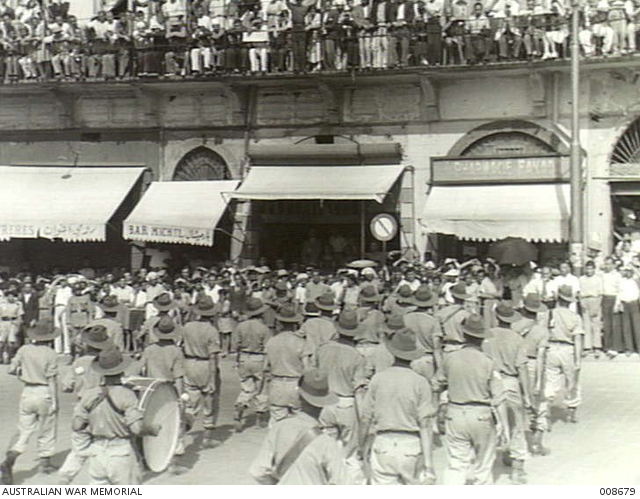
There was very little ‘good news’ in Australian papers about the war in Europe and North Africa.  So although the troops themselves were forbidden to speak about the campaign, the news of the Allied victory in Syria was welcomed by the Australian High Command who had no problem endorsing reports such as the one that appeared in the Hobart Mercury on July 17, headlined ANZACS Enter Beirut – Crowds greet British forces with delight.     A statement from the War Office in London, detailing the terms of the armistice, was printed.  Those terms included –

With full honours of war the French forces will retire to selected areas with all arms. They will be permitted to retain individual arms but only sufficient ammunition in each unit for security purposes……The choice between rallying to the Allied cause and repatriation will be left to individuals, military or civil….French ships may repatriate French troops and subjects who desire to leave…

AWM 008679

AWM 008679

Australian Troops in Beirut July 1941

Posted in Camps and Barracks, Middle East, organisation, The course of the war, Uncategorized, world | Tagged , , , , | Leave a comment

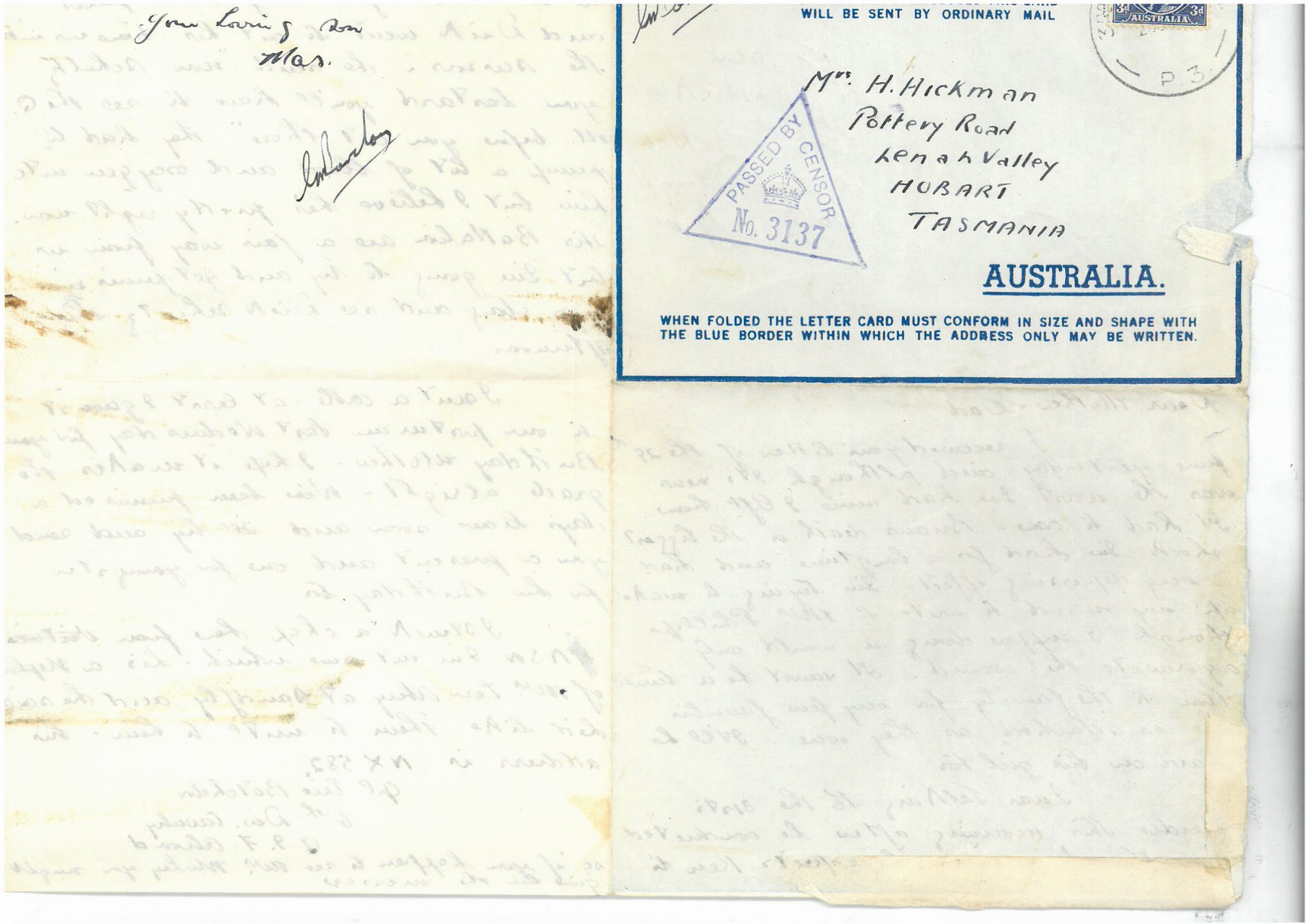
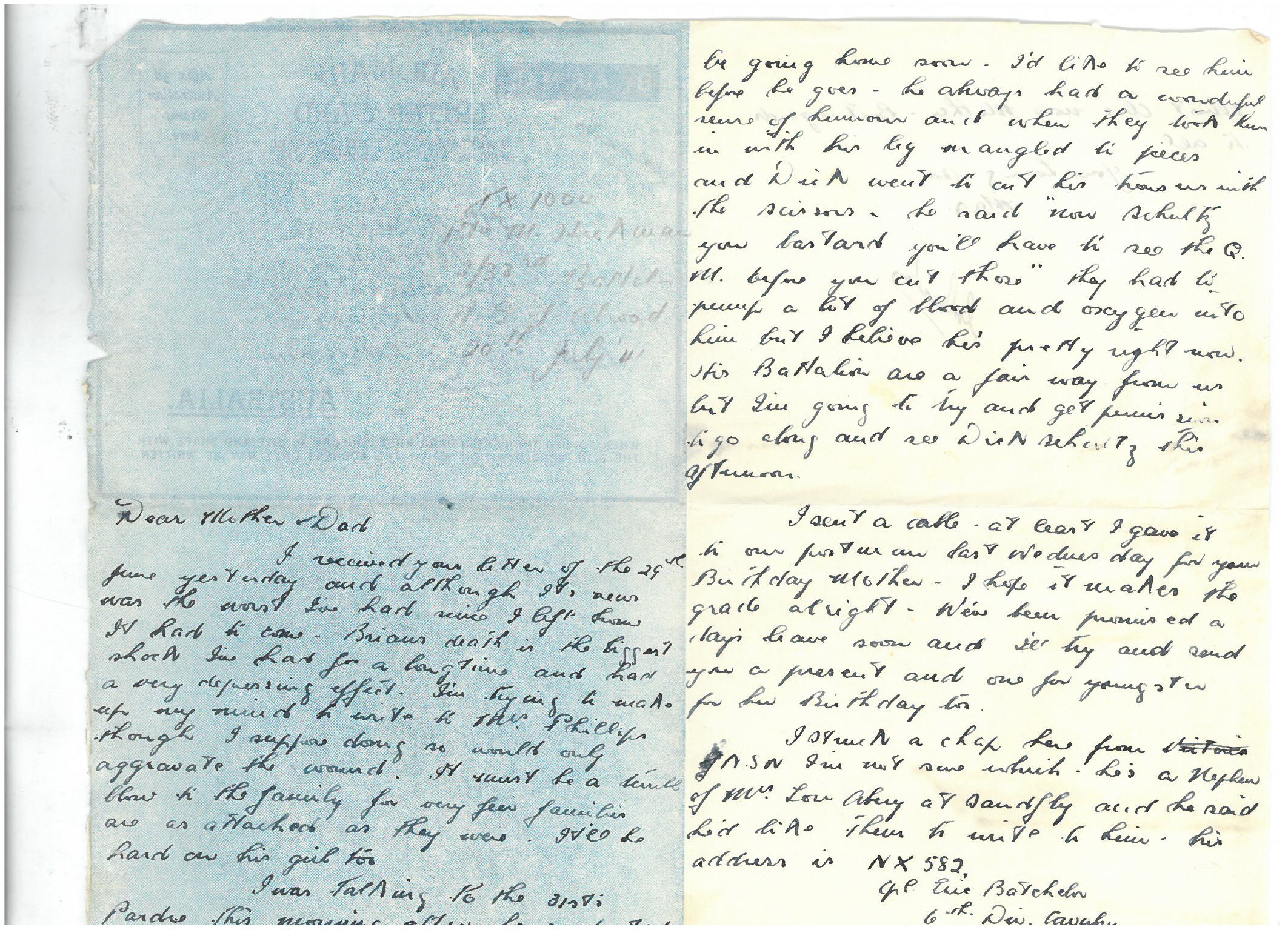
By airmail : two items of very bad news

airmail lettercard front 20 July 41


airmail lettercard 20 July 41


TX 1004

Pte M Hickman

2/33rd Battalion

AIF Abroad

20th July 41

Dear Mother & Dad

I received your letter of the 29th June yesterday and although its news was the worst I’ve had since I left home it had to come.  Brian’s death is the biggest shock I’ve had for a long time and had a very depressing effect.  I’m trying to make up my mind to write to Mrs Phillips though I suppose doing so would only aggravate the wound.  It must be a terrible blow to the family for very few families are as attached as they were.  It’ll be hard on his girl too.

I was talking to the 31st’s Padre this morning after he conducted our church service.  He expects Ken to be going home soon.  I’d like to see him before he goes – he always had a wonderful sense of humour and when they took him in with his leg mangled to pieces and Dick went to cut his trousers with the scissors, he said “now Schultz you bastard you’ll have to see the QM before you cut those”.  They had to pump a lot of blood and oxygen into him but I believe he’s pretty right now.  His Battalion are a fair way from us but I’m going to try and get permission to go along and see Dick Schultz this afternoon.

I sent a cable at least I gave it to our postman last Wednesday for your birthday Mother.  I hope it makes the grade alright.  We’ve been promised a day’s leave soon and I’ll try and send you a present and one for youngster for her birthday too.

I struck a chap here from Victoria or NSW – I’m not sure which – he’s a nephew of Mrs Len Abery (?) at Sandfly and he said he’s like them to write to him – his address is

NX 582

Cpl Eric Batchelor

6th Div Cavalry

AIF Abroad

so if you happen to see Mrs Morley you might give her the message.  Must close now Mother.  Best regards to all

Your loving son

Max

Brian Phillips was a signalman who at the time of his death was posted to HMAS Moreton Bay. His service record shows he died at Mearnskirk Hospital, Glasgow, on June 25th 1941.  The diagnosis was ‘cellulitis of the face’.

Ken Jenkins was a corporal in the RAP (Regimental Aid Post) or CCS (Casualty Clearing Station)      of the 2/31 Battalion – one of the three battalions in the 25th Brigade.  He lived with his wife in Glenorchy (at that time a northern suburb of Hobart – now designated a city).  Ken enlisted on the same day as Dad and had the next service number – TX1005.  In an earlier letter, Dad says he was a stretcher bearer.  He was clearly a close friend who knew Dad’s family well, as there are frequent references to his liking of ‘the pater’s wine’.   Ken’s service and casualty record shows that he was wounded in action on June 14 1941, suffering a compound fracture of the left femur, with severe shock.  This injury resulted in amputation of the leg above the knee at the 7th Australian General Hospital on July 4.

Posted in Uncategorized | Tagged , | Leave a comment

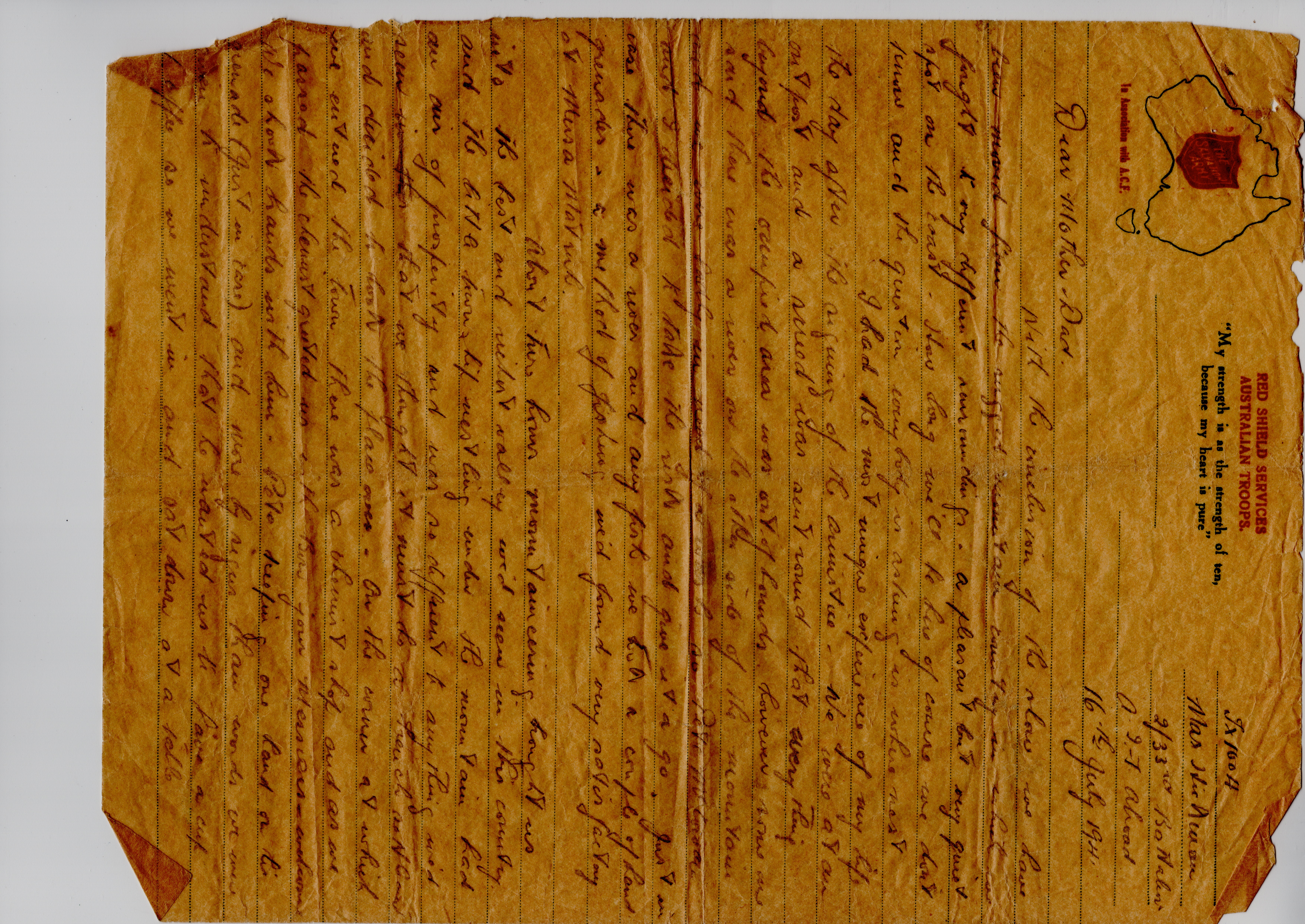
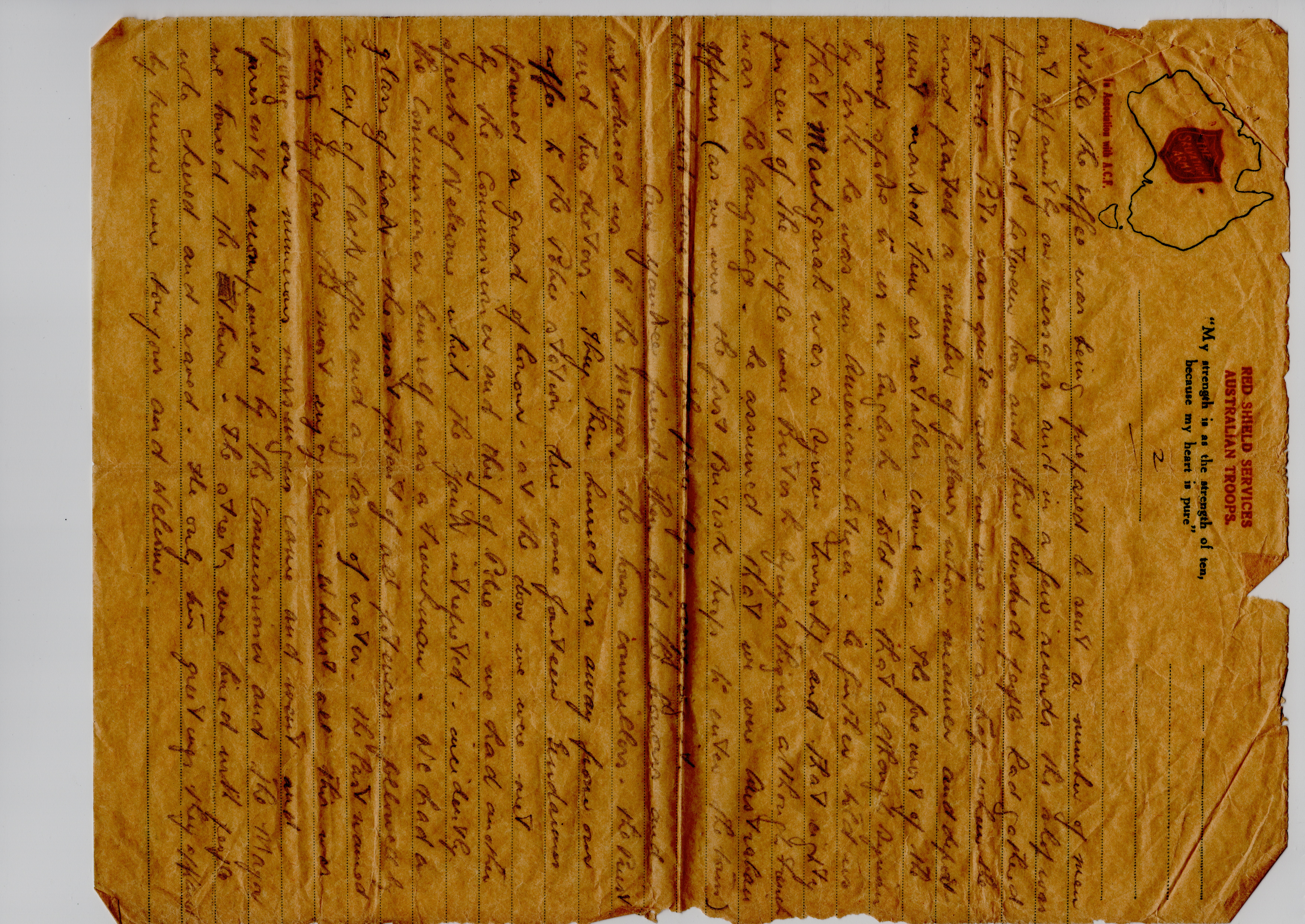
A town surrenders to a couple of privates

16 July 1941


16 July 1941 p2


16 July 1941 p3


16 July 1941 p4

Once again, written in pencil…  and once again, the ability to rotate the image was sacrificed in favour of ‘legibility’ – not sure if that was a sensible decision.


TX 1004

Max Hickman

2/33rd Battalion

AIF Abroad

16th July 1941

Dear Mother & Dad

With the conclusion of the show, we have been moved from the rugged mountain country in which we fought to very different surroundings – a pleasant but very quiet spot on the coast.  How long we’ll be here of course we don’t know and the the question everybody is asking, is – where next?

I had the most unique experience of my life, the day after the signing of the armistice.  We were at an outpost and a screed was sent round that everything beyond the occupied area was out of bounds.  However, someone said there was a river on the other side of the mountains – and we were badly in need of a wash so Pete McCowan and I decided to take the risk and give it a go.  Just in case there was a river and any fish we took a couple of hand grenades – a method of fishing we had found very satisfactory at Mersa Matruh.  About two hours mountaineering brought us into the best and richest valley we’d seen in this country – and the little township nestling under the mountain had an ajar of prosperity and was so different to anything we’d seen that we thought it must be a French settlement, and decided to look the place over.  On the corner at which we entered the town there was a chemist shop and as we passed the chemist greeted us with Bonjour Messieurs – welcome.  We shook hands with him – Pete keeping one hand on the grenade (just in case) and more by signs than words we were given to understand that he wanted us to have a cup of coffee so we went in and sat down at a table.

While the coffee was being prepared he sent a number of men out, apparently on messages and in a few seconds the shop was full and between two and three hundred people had gathered outside.  Peter was quite sure we were in a trap.  When the crowd parted, number of fellows whose manner and deportment marked them as notables came in.  The foremost of the group spoke to us in English – told us that although Syrian by birth he was an American citizen.  He further told us that Machgarah was a Syrian township and that eighty percent of the people were British sympathisers – although French was the language.  He assumed that we were Australian officers (as we were the first British troops to enter the town) and had come to see the place before occupying it.

Our Yankee friend then did the honours and introduced us to the Mayor, the town councillors, the priest and two doctors.  They then hurried us away from our coffee to the police station.  Here some fourteen Gendarmes formed a guard of honour.  At the door we were met by the Commissioner and the Chief of Police.  We had another speech of welcome, which the Yank interpreted – incidentally the Commissioner himself was also a Frenchman.  We had a glass of arak – the most potent of all potencies – followed by a cup of black coffee and a glass of water – the last named being by far the most enjoyable.  Whilst all this was going on numerous messengers came and went and presently accompanied by the commissioner we toured the town.  The streets were lined with people who cheered and waved.  The only two greetings they apparently knew were Bonjour and Welcome.

At the conclusion of our triumphal tour we inspected a number of houses damaged by our artillery and assured the owners that they’d get a good hearing when the place had been occupied.  We then visited the flour mill and tannery and were told if we went back in the afternoon we would be presented with a belt.  During our tour quite a number of them asked us for permits to visit other towns in the war zone and we told them that it was not safe just then but arrangements would be made as soon as possible.

We then had lunch with the mayor – and what a meal.  It brought to mind the time those Japs came down to dinner and as our interpreter was not present we were able to express ourselves freely in our opinions of the meal.  It was apparently a four course meal because there were four plates at each setting, but one course more than sufficed for me.  The top receptacle was a bowl about twice or three times as big as a soup plate.  In the bottom of this a servant put some stuff like cornflakes, then enough rice to feed a battalion.  Over the rice she spread minced raw onion then meat cut in chunks and over it all poured stuff like curry – she then mixed it all together.  I felt quite hungry before the meal started but the very sight of so much food more than satisfied my appetite.  Pete struggled through the first course but I had to pique halfway through.  The mayor and the other members of his family went through the four courses like champions.  With the meal we drank strong wine and after it strong black coffee.

In the afternoon we were invited to a function welcoming home a prominent citizen who had been imprisoned for British sympathies at the outbreak of the show.  On arrival at the reception hall we found som fifty or sixty people, many of whom we’d met in the morning.  As we entered the door someone said ‘Les Capitaines’ and everyone stood up until we had taken the seats of honour.  We listened to numerous speeches, drank more arak and more coffee, and through the interpreter made our goodbyes, the mayor asking that we bring our troops as soon as possible.

It was the funniest experience I’ve ever had for we definitely forestalled any visitors and had all the limelight and glamour of Princes or ambassadors.   It would have been just too bad if an officer had arrived while we were there – as it was we got our ears chewed a bit when we got back.

I’ve just been detailed for a job so must to to work.

Goodbye for the present – Love to May & Anne & regards to the boys

Your loving son

Max

We got our ears chewed

According to his diary, ‘The crowd were waiting for us to move out’ (see below – the move began at midday on the 15th).  So there would have been quite a bit of frustration around their absence, I imagine….quite apart from the fact that they were clearly in a ‘no go’ zone.

2015-06-05 16.28.56

The town : Machghara

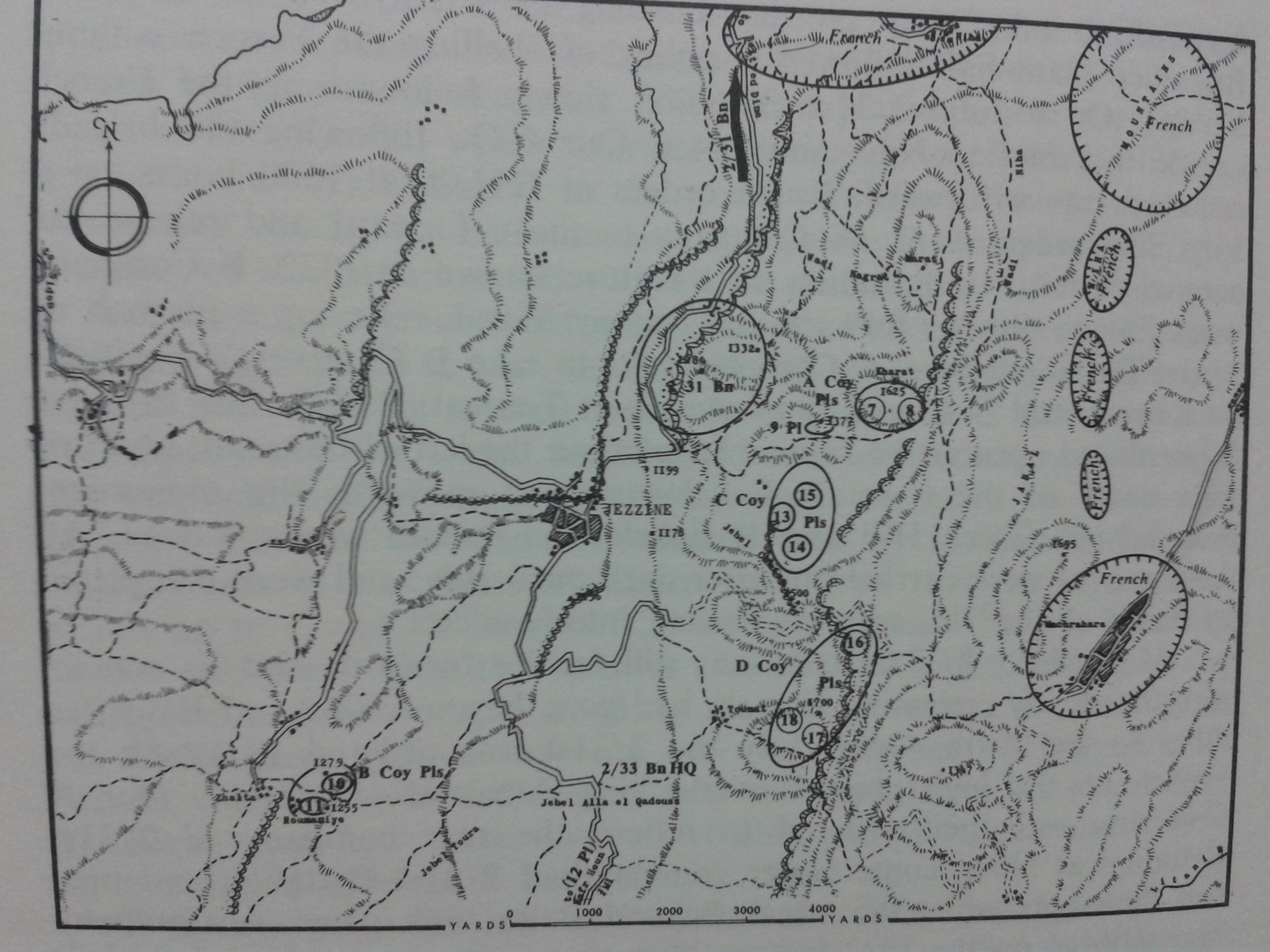
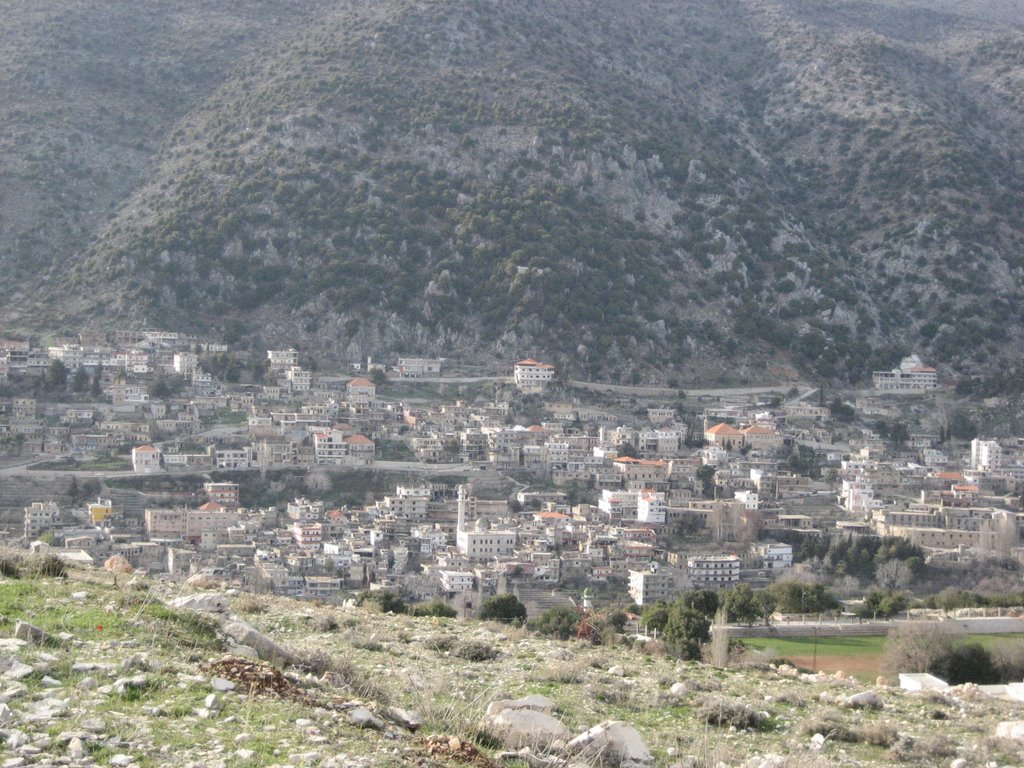
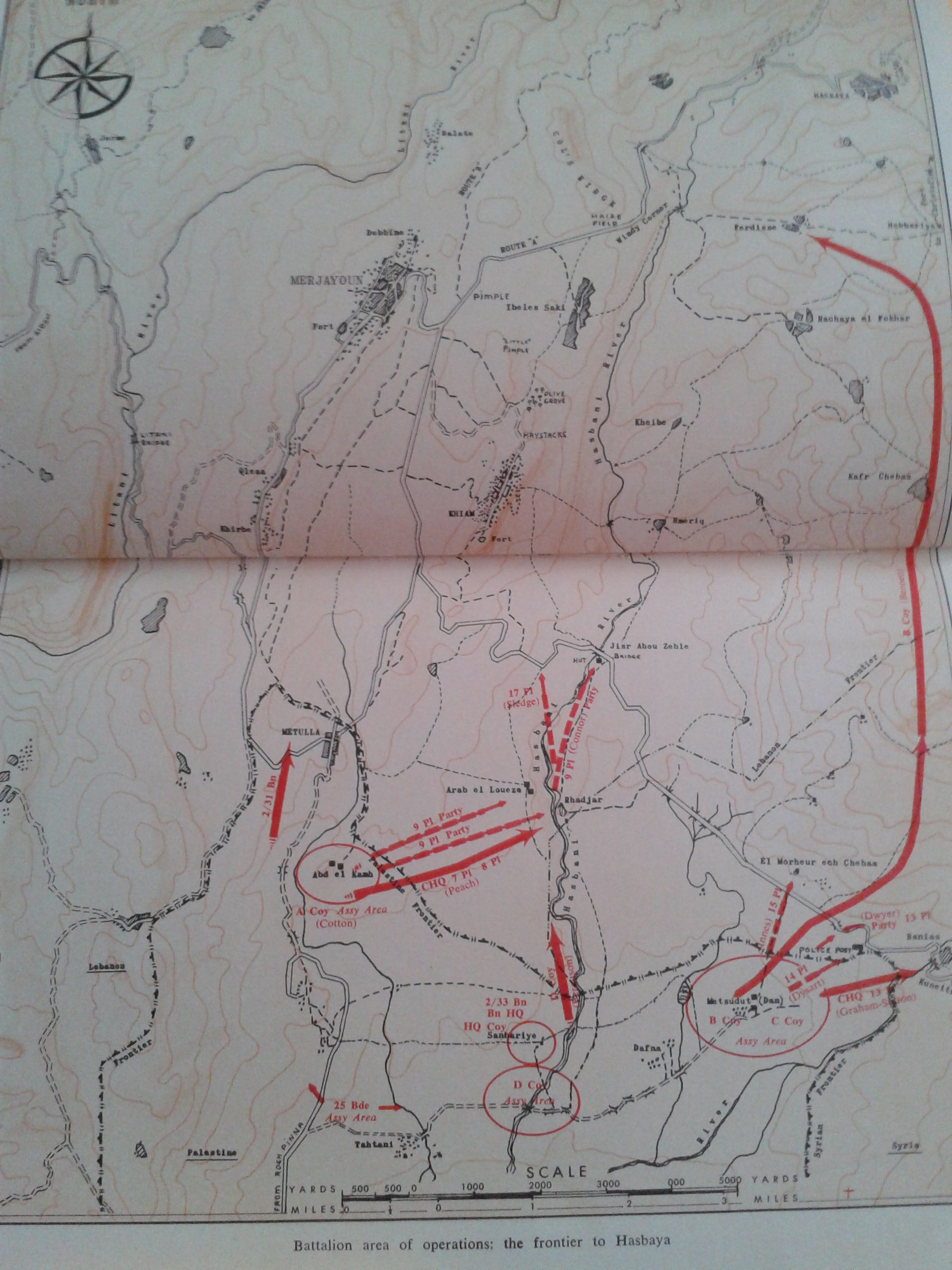
In his diary, Dad mentioned that on their way down the valley, he and Pete ‘passed several machine gun posts blown out by our artillery – bloody good shooting’.  This was where the artillery fire directed at D Company in the previous week had originated (see previous post – July 10 1941).  In his later recollections, Dad named the town concerned as Machghara.  The map (from The Footsoldiers) shows this town almost directly east of Jezzine, with D Company’s position between the two.   A recent photo (by hajj1st) gives some idea of the terrain –

photo by hajj1st


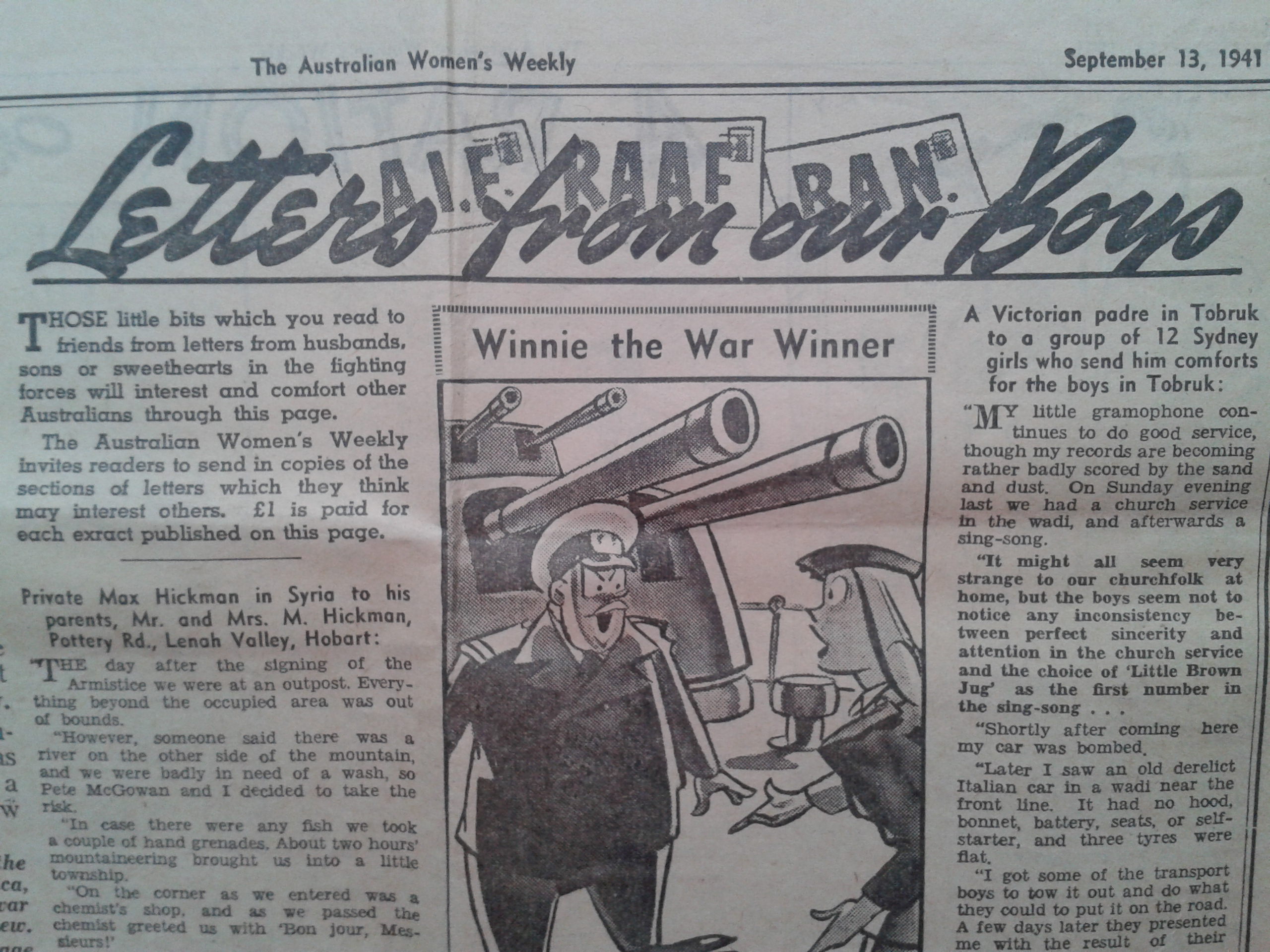
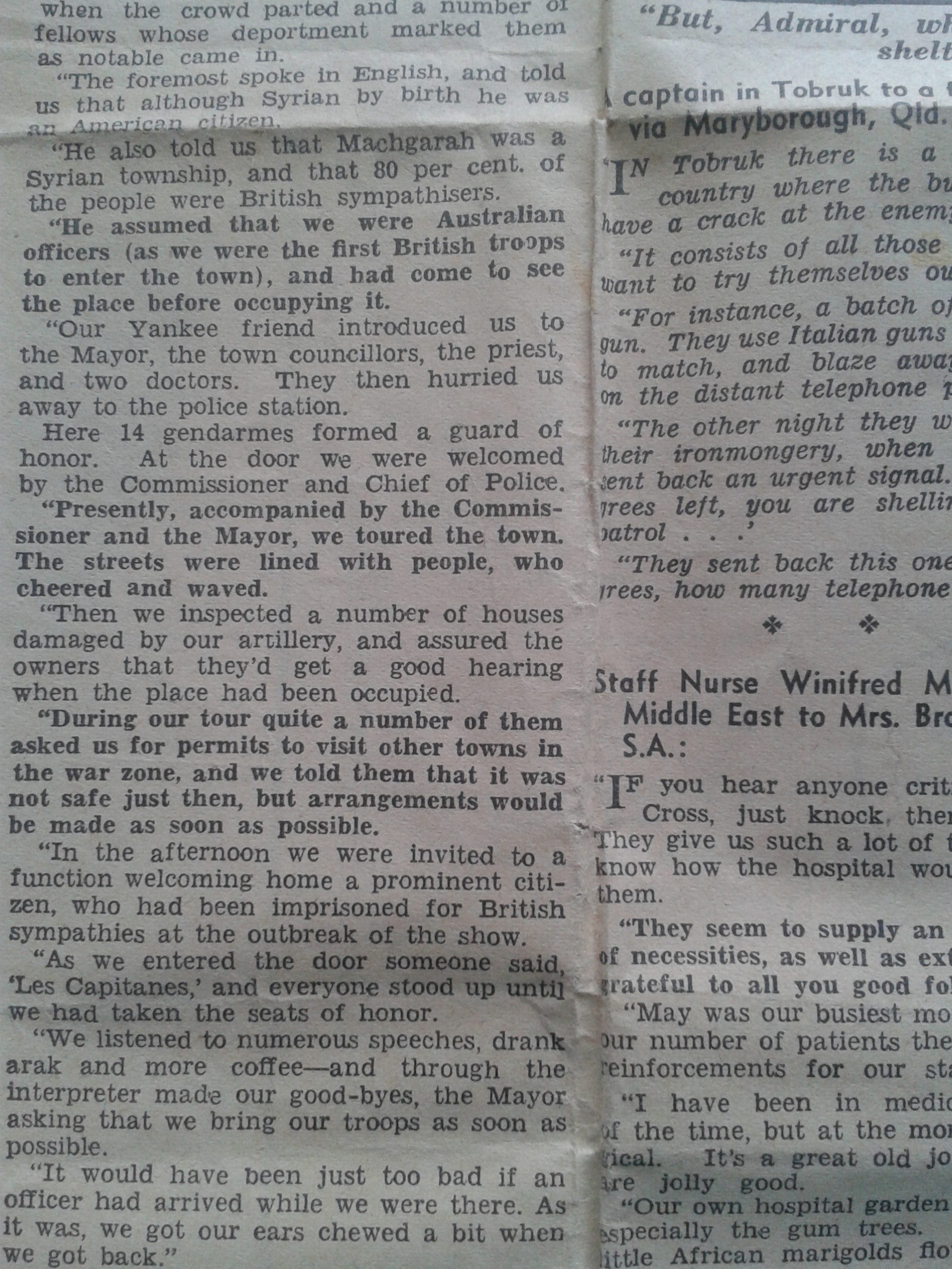
Publication of the story

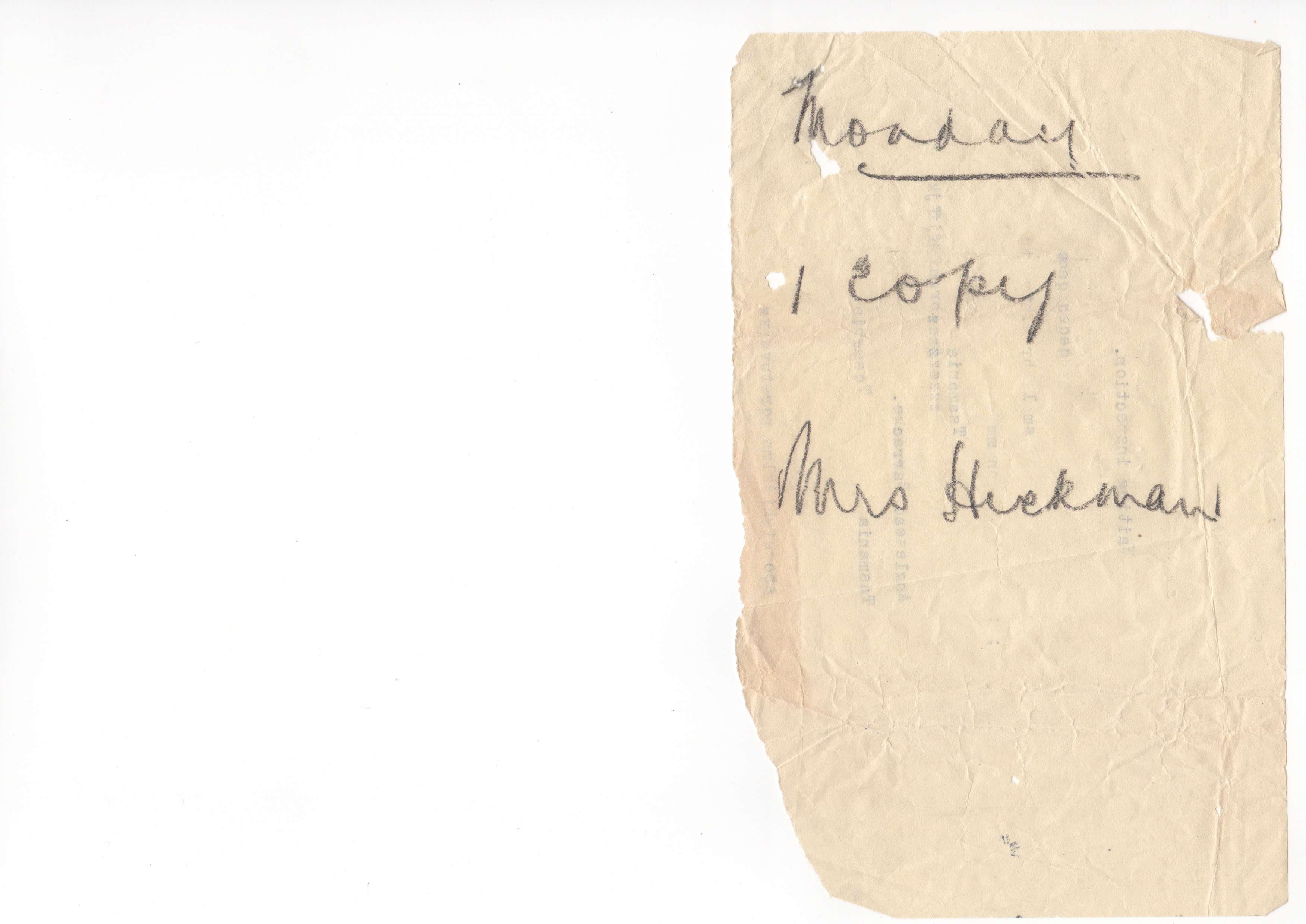
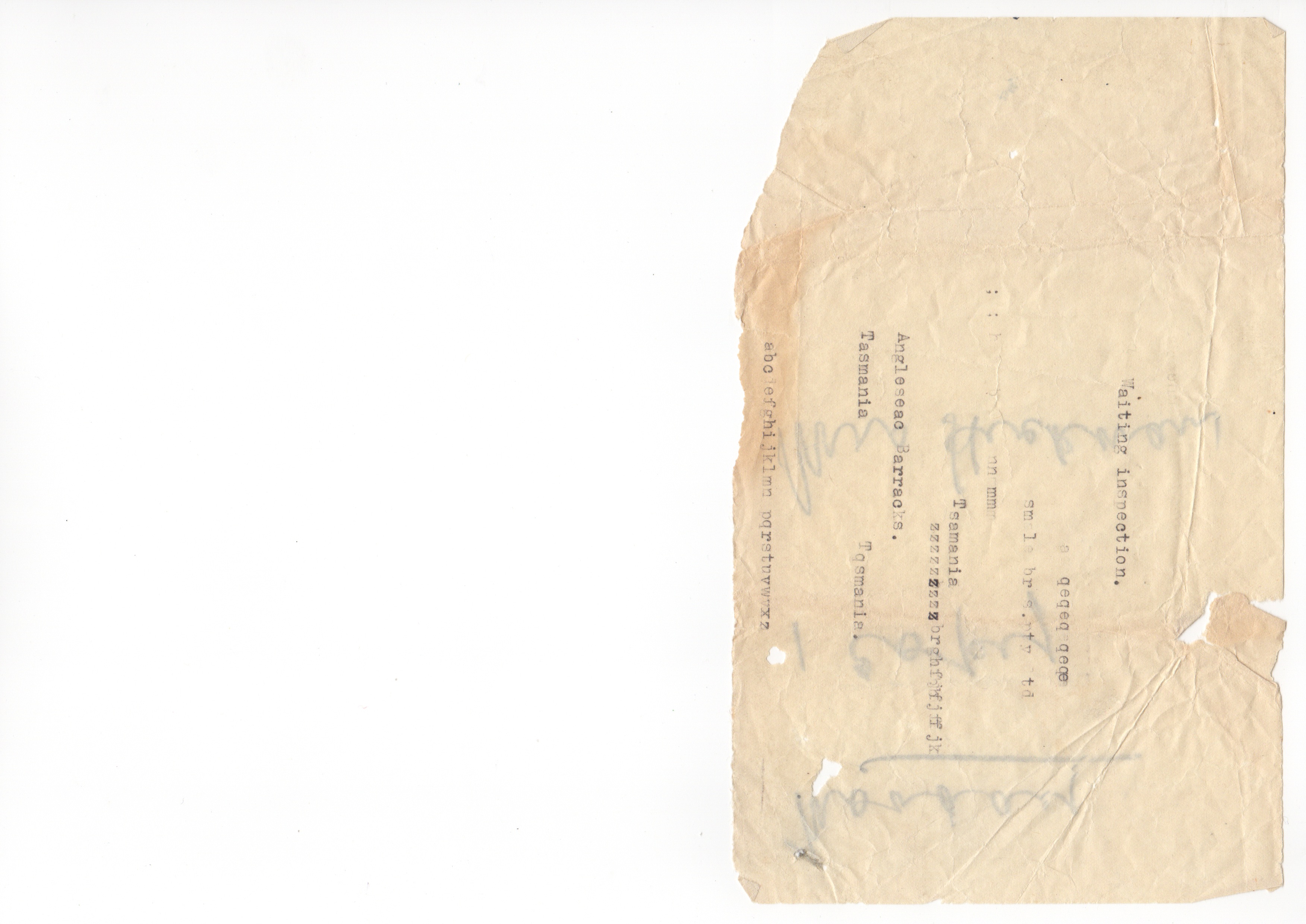
When his mother received this letter, she decided to submit it for publication in the Australian Womens Weekly – which was more of a newspaper than the glossy magazine of recent times.  There was a section called Letters From Our Boys where suitably edited items were shared.  It seems the procedure involved firstly getting official approval from the Army.  This letter is the most fragile int he collection, and had a slip pinned to it, indicating it had been left at the Barracks in Hobart –

barracks copy note


barracks copy note reverse


The edited letter was published in the Weekly’s edition of September 13.

2015-06-08 09.16.23


2015-06-10 14.20.17


Years later, the Weekly’s version was also published in the book Digger by John Laffin.

With the conclusion of the show…

Extracts from The Footsoldiers:

With the Australian 21st and 17th Brigades’ success at Damour (on the coast – where they had received great support from the British Navy) aided by pressure by the 23rd and 30th British Brigades at Merdjayoun, and the 16th British Brigade and Free French at Jebel Mazar west of Damascus, the Vichy forces gave in.  The British and Indian advances in the desert, the approach of the 4th British Cavalry Brigade to Homs, and the 20th and 21st Indian Army Brigades’ move on Aleppo helped persuade the enemy.  The French accepted the terms of surrender laid down by GOC 1st Australian Corps, Lieut-General Lavarack.  On the night of 11 July, orders were issued to cease fire…..The armistice was eventually signed at the ancient seaport of Acre …on 13 July.  The agreement provided for the occupation of Syria by the Allies, the granting of full military honours to the French, and allowing any French to return to Algeria if they did not elect to some over to the Free French.  The French were allowed to retain personal arms.  The area of the Australian occupation was : 17th Brigade, Latakia; 21st Brigade, Tripoli; 25th Brigade, Beirut; all on the coast, north from Beirut, and on the western slopes of the Lebanon.  At midday on 15 July, 7th Division units began moving forward to their positions for the occupation.


Posted in escapades, relaxation, fun and games, Middle East, organisation, The course of the war | Tagged , , , | Leave a comment

Surprising capture of a French sniper

10 July 41 10 July 1941 p2


Written in pencil – barely legible (scan is much clearer than the actual document) – was not able to rotate image before inserting.


TX 1004

Pte M Hickman

2/33rd battalion

AIF Abroad

10th July 41

Dear Mother & Dad

I’ve had two very welcome letters from you during the last week.  Thanks a lot for the stamps and casualty lists.  They don’t waste much time getting them through do they.  Ken should be on the road to recovery now though I suppose it will be some months before they send him home.  Haven’t seen or heard anything of Dick Schultz but I fancy he’s been kept busy judging by the reports of his show.  Our sections are in reserve at present and are resting on top of a seven thousand foot mountain – the one alongside us is nine thousand.  The day we took up these positions we were paid and by way of a diversion the sergeant suggested a game of two up – so the dice (dina?) were produced but the diversion was short lived because the sergeant himself put an end to it by doing seven heads – and as he was well cashed at the start and backed himself to the limit, not only got all our pay but holds a mortgage on our pay books for some time to come.  Later in the day the Brigade canteen truck came up and did the honours to the extent of a bottle of beer each – two bottles of gin and two of lime(?) between the section, but as I’m not at all partial to gin the others had that.  He also brought a quantity of tinned fruit and other luxuries and for a couple of days we lived like lords.

Had a letter from Ivy and another from Jack yesterday – both very cheery epistles too, although the youngster still seems to be having a bad time.  They both lamented the new petrol rationing.  You never mention it in your letters, so I hope that means you’re getting plenty and not that you’re not using the car.  It seems hard to imagine petrol rationing over there but I suppose the combined services must be using millions of gallons daily – or hourly for that matter.

Youngster told me all the political news and agrees with all the redoubtable Robert has to say but laments his apathy towards conscription – she was quite hot on the matter but that’s one thing that’ll never even be put to the vote.  It wouldn’t get much support over here anyway and it would be rather futile to ask those who are staying home to vote (for) conscription.

So Larry’s on the way at last like the rest of us.  I suppose he couldn’t get away soon enough but after he’s been away a few months the boot will be on the other foot.  There’s nothing truer than the expression ‘you’ll be sorry’ though personally I’d like to see it through. Bad luck about Abe Herbert – any further news of him – he was with the twelfth I think.

Well that’s all for the present – excuse pencil.

Regards to all

Your loving son

Max

Diary June 28 – July 11

Sunday 29th  [Footsoldiers account suggests this took place on Sat 28th]

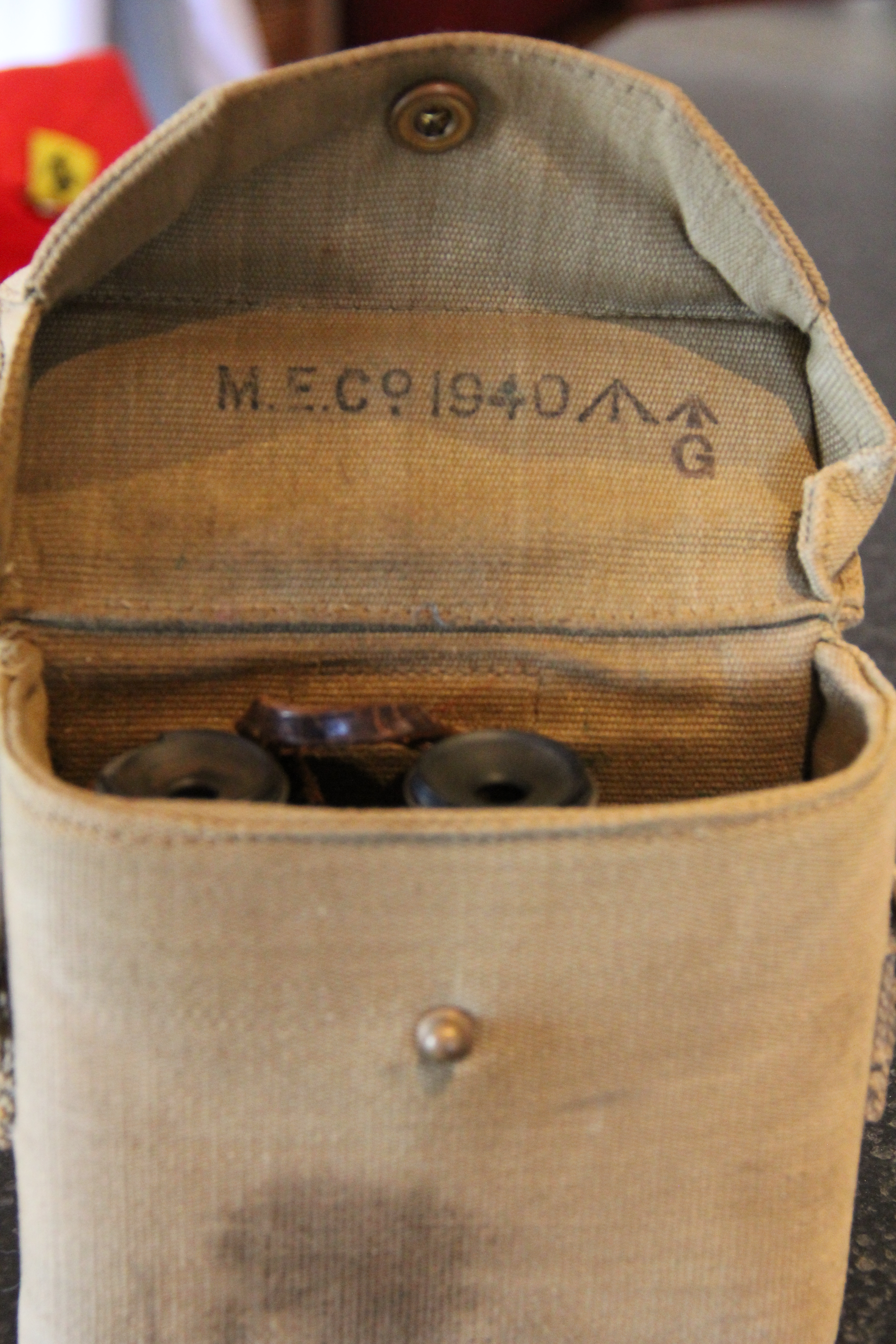
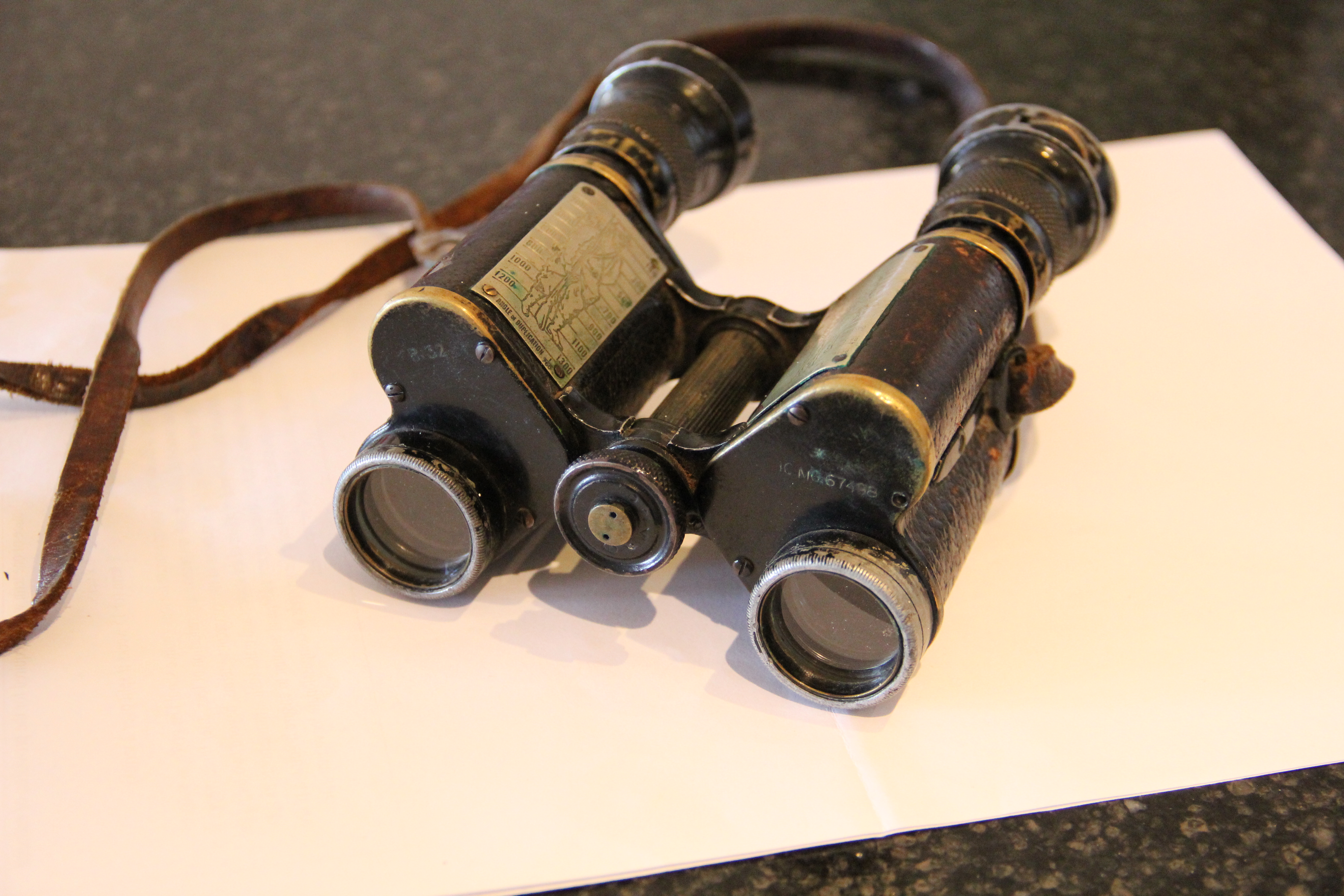
Mortar attack at midday – kerosene tin in which boiling tea smashed to bits – at 7 o’clock runner brought word that we were being relieved by Tommies at dusk – sent down valley to meet them – about 700 yards from Kirbi – about nine 30 heard heel click on stone – turned to see French soldier about ten yards away.  Started – called on him to stop.  Frenchman surprised – before recovered had snatched his rifle from him – took bayonet and binoculars and brought him back to Kirbi – French sniper – my lucky day – little short of miracle I wasn’t shot because I didn’t have a rifle – advantage of surprise – card in pocket drawing of swastika and Vive Hitler –

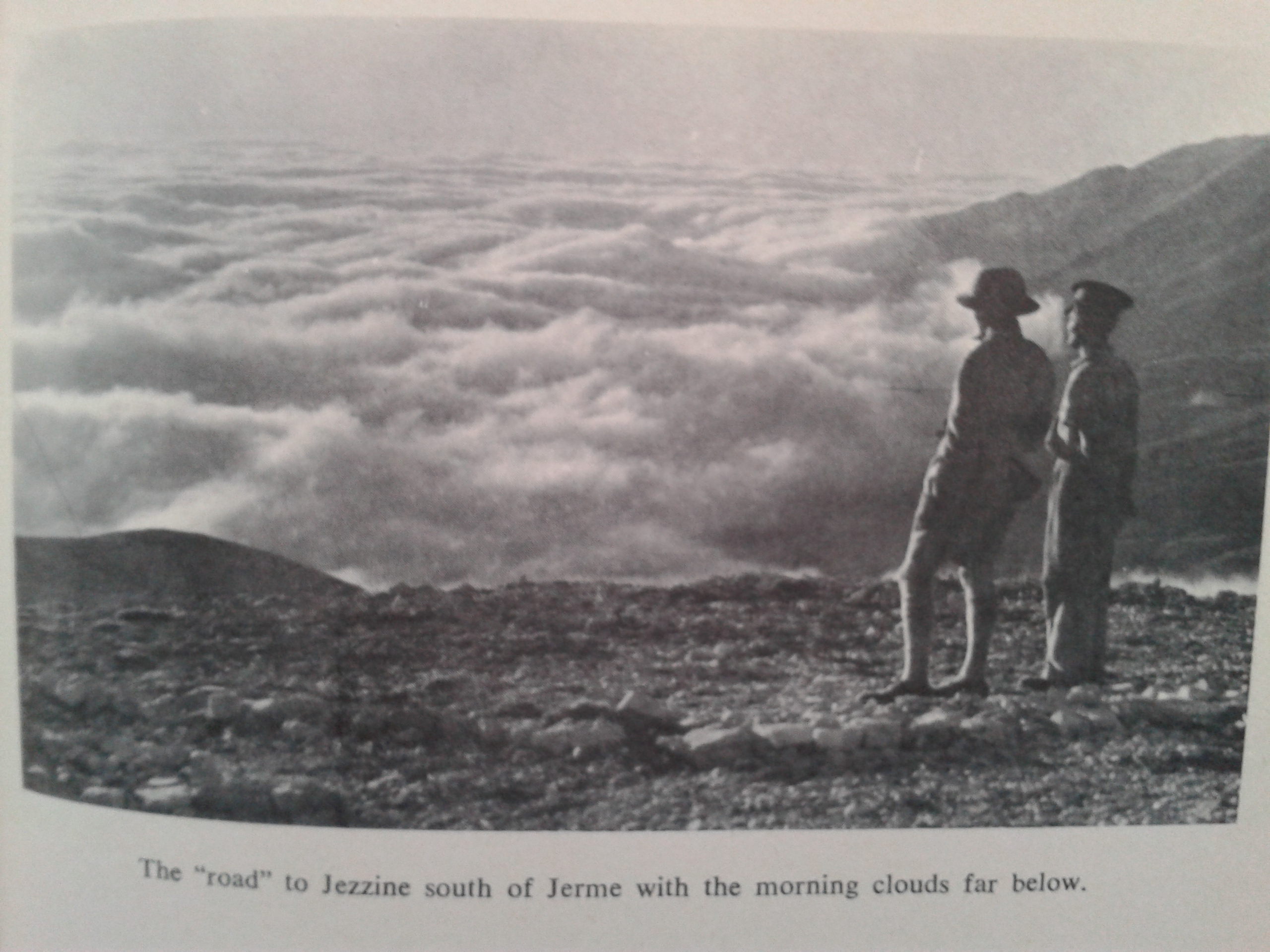
Left Kirbi 3am [June 30?]- rested all day out of range- 9pm moved in night convoy away over roughest, steepest and windiest road ever seen – every inch a hazard

Tuesday 2nd [July]…[If Tuesday, was 1st July]

In Jezzine section.  Most wonderful sight ever seen from 7000’ mountain – rugged country – small patches terraced and cultivated – many villages in distance – steam in valleys from coal seams – sea in distance – have never seen anything in any way comparable with this sight.

Wednesday 3rd [If Wed, was 2nd]

Major Wright OC Hqr Comp cancelled transfer to B Coy.  Recalled carriers.  Lieut Chapple takes over carriers – seems a decent fellow….  Section moves up to D Company – take up forward positions covering French positions – some good strafing by French 75’s.

Saturday & Sunday

Went back to Kafr Houn for two days patrol work.  Wog barber achieves miracle of parting my hair.

Monday [7th]

Back to D company.  Not much doing apart from artillery duels.  Stayed till show finished on Saturday. Leo Earea went back with malaria on Friday after breaking the mob at two up.


Dick Schultz…being kept busy

The 2/31st was indeed busy, meeting plenty of resistance in their march north along the coast, and sustaining plenty of casualties – so the RAP where Dick as based, would certainly have been a hive of activity.

A game of two up

These games clearly happened often – in camps, at sea and apparently while in  reserve.  Although Dick Lewis said he was unaware of any orders about this, the Battalion’s ‘Routine Orders’ do list prohibitions, from time to time.  This example is from 15 August 1941 …..Members of the AIF are forbidden to take part in any such game of ‘two up’.  Taking part in the game includes ‘keeping the ring’ or being present at a ‘two up school’.  Clearly, this order was not enforced.

The French sniper  (ref Diary entry)

According to Dick Lewis, Dad made a point of NOT disclosing to the company commander that the Frenchman was a sniper – Dick said that if that were known, the man would have been shot.

Like keeping diaries, the keeping of ‘enemy material’ was in fact forbidden.  The 25th Brigade Admin Instruction no.5 of 12 July 1941, advises – Kit inspections will be arranged by units and any articles of enemy material discovered will be passed on to salvage.  It will be an offence for personnel to hold enemy equipment or weapons.  (Brigade diary for July/ August 1941 – http://static.awm.gov.au/images/collection/bundled/RCDIG1024943.pdf)

Photos of the Frenchman’s binoculars : Now owned by one of Dad’s grandsons, my nephew Stephen Hickman

2014_05_08_0025

2014_05_08_0026


The move to the Jezzine sector

2015-06-05 16.28.56


According to The Footsoldiers, the night move began at 1830 hours on June 30….The column moved off, led by the CO’s vehicle, followed by the carriers.  All windscreens had long since been removed from the vehicles and all driving was to be without lights.  The column was slow and tight packed.  …So bad were the twists and U bends that even the 15-cwt Fords had to turn and back up to negotiate the turns.  At 0100 on 1 July just south of Rihane the column stopped for a rest and all fell on the roadside and went to sleep…..At dawn on 1 July we were off again.  It was a bright, clear day, and all enjoyed the exhilarating mountain air….so high up were we that the early morning clouds were 500 feet below us….At noon the convoy stopped a mile north of Kafr Houn (Brigade HQ) and the battalion debussed.  Throughout the afternoon, a few by marching, most by shuttle service of unit vehicles, the companies and platoons moved up into the localities of the 2/14th battalion……In D Company, the move from the road head in the rear of the company locality took five hours, climbing 3800 feet to reach their positions.  All arrived sweating and dog tired….

2015-06-05 16.21.06Image – from The Footsoldiers


However pleased we were that we were not taking part in any attacks, the days were dangerous and gruelling.  At dawn and dusk, patrols were continually going out…The nights were bitterly cold and the high mountain winds swept about us as we lay in the rock singers on the high mountain tops.  The French maintained a constant watch on movement and any at all would bring down a concentration of 100 shells or more.  At first light, noon, and at stand-to at dusk, all the company positions would be blasted with upwards of 250 shells.  We should set out watches by the bombardments….Throughout the period 1 July up until the orders to cease fire at midnight on 11 July, no great activity was undertaken by the battalion…..

Not much doing…apart from artillery duels

From The Footsoldiers:  D Company…did not move from its positions from 1 July until the surrender, and thus becalm a regular target for the French beyond Machrhara.  Upwards of 500 shells a day landed in and about this company’s locality.  After 7 July it became so accurate that the platoons were withdrawn to reverse slope positions….18 platoon was on the ester me right flank…sitting on Toumat and looking down and back to Jezzine or east to Machrhara….

road to Jezzine painting

‘The Mad Mile’, Jezzine, Lebanon 1941, William Dargie, 1970.
[Oil on canvas, AWM ART27683] – Vehicles had to run the gauntlet of French fire to maintain supplies to troops around Jezzine.


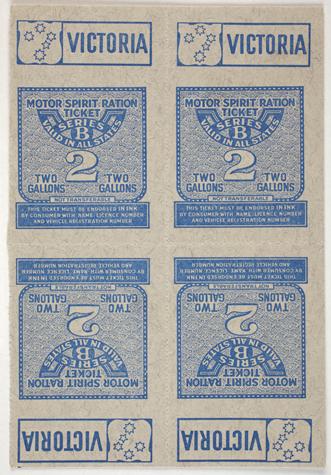
Petrol Rationing

A detailed description of the reasons for the rationing scheme and the government’s difficulties in implementing it can be found at  https://www.awm.gov.au/journal/j36/petrol.asp  According to this article, there were cuts to private motorists’ rations in April 1941, and again in June:   The position was so critical by 11 June 1941 that the Minister told Cabinet that it was now “open to question” whether petrol rationing should be placed under Army control. Cabinet rejected this drastic solution and the Prime Minister announced on 17 June 1941 that private motorists’ rations would be cut to 1,000 miles per year

379062_medium

Image : from the collection of Museum Victoria

Sheet of four Victorian Motor Spirit Ration Tickets, each for 2 gallons. Dimensions: 120mm (height) x 82mm (width). These may date to 1941 when 2 gallon tickets were printed in blue.  These tickets were produced by the Note Printing Branch of the Commonwealth Bank of Australia.  Conditions state: This ticket must be endorsed in ink by consumer with name, licence number and vehicle registration number.   Petrol ration tickets were first issued in October 1940.

(museumvictoria.com.au/collections/items/1328498)

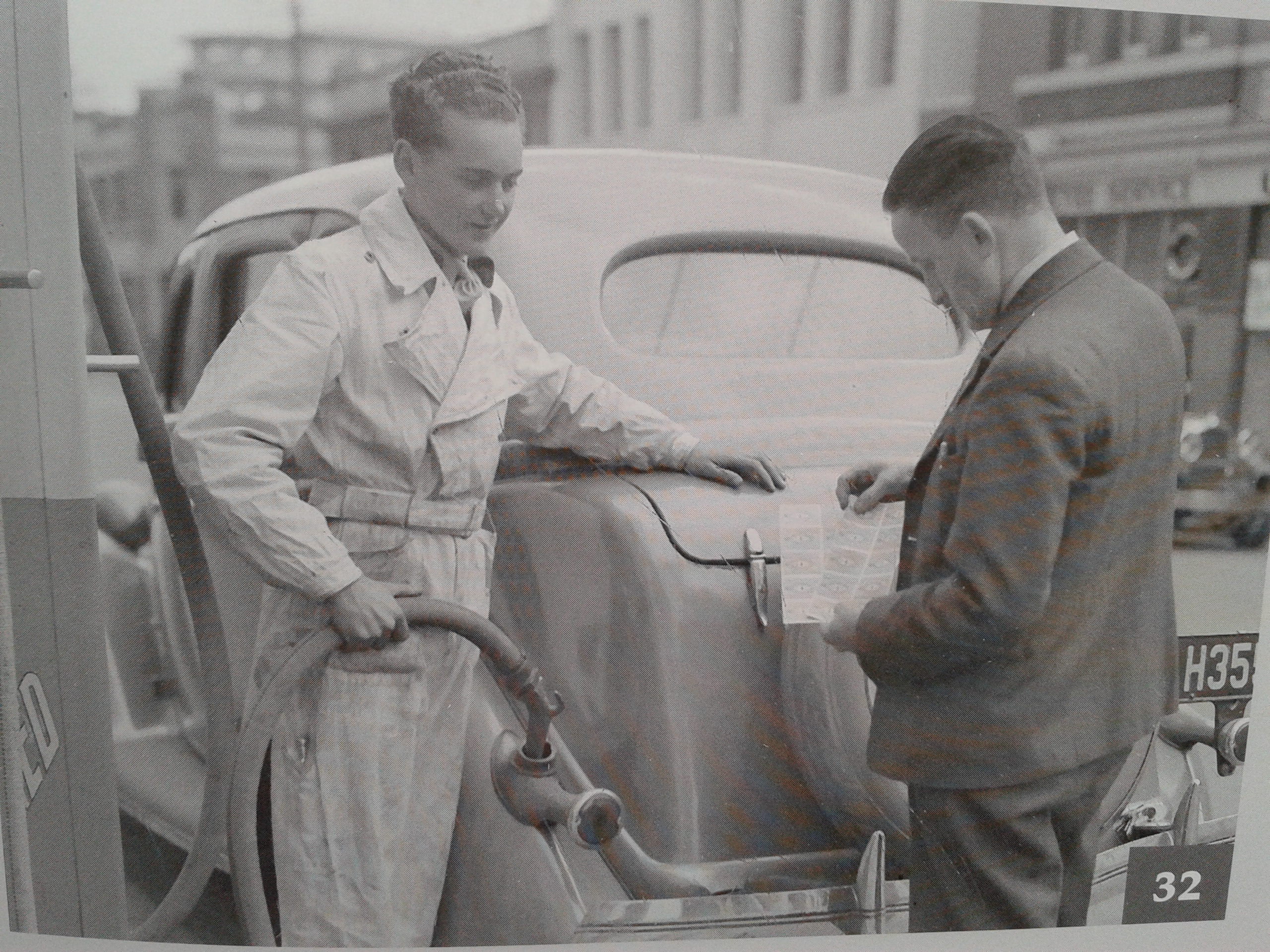
2015-06-05 14.53.29


Service for a lucky motorist with ration tickets


2015-06-05 14.54.22


But there weren’t too many of them in Hobart….


2015-06-05 14.55.23

However, some novel solutions were implemented:

In this case – Coal was loaded into the top and then a fire was started beneath it, producing coal gas which then powered the car.


All of the above three images are from the book – Hobart at War 1939 to 45 – Photographs from the archives of The Mercury annotated by C J Dennison

Conscription

A letter sent to the editors of the (Melbourne) Age, the (Brisbane) Courier Mail and the Sydney Morning Herald expresses the views of a member of the South Australian Legislative Council, in support of conscription:

http://www.samemory.sa.gov.au/site/page.cfm?c=4756&mode=singleImage

Posted in Australian, gambling and drinking, Middle East, Uncategorized | Tagged , , , , , | Leave a comment

The first important lesson-to keep the head down

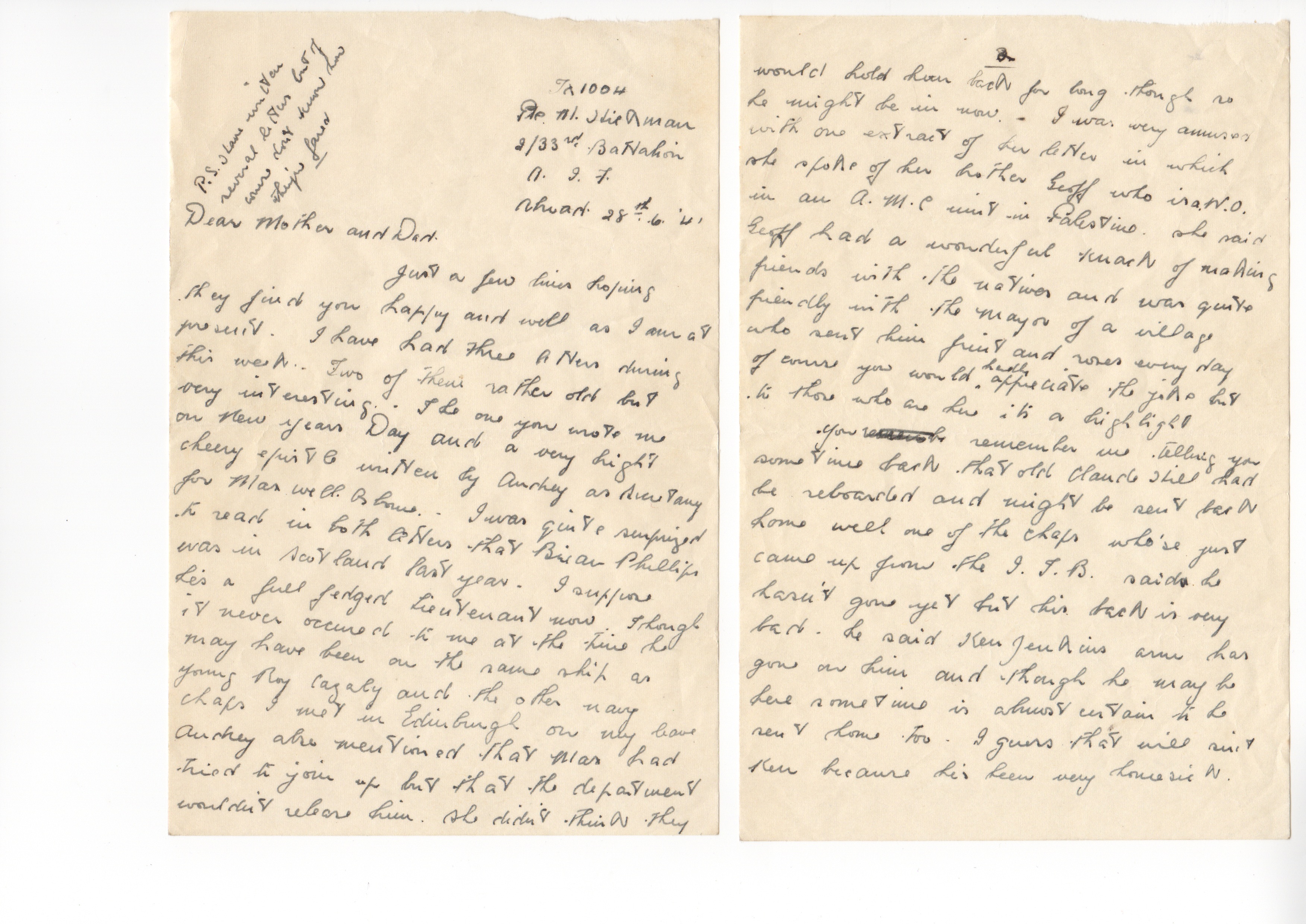
28th June 1941

28th June 1941 1


28th June 1941 2

TX 1004

Pte M Hickman

2/33rd Battalion

AIF

Abroad

28th. 6. 41

Dear Mother and Dad

Just a few lines hoping they find you happy and well as I am at present.  I have had three letters during this week.  Two of them rather old but very interesting.  The one you wrote me on New Years Day and a very bright cheery epistle written by Audrey as secretary for Maxwell Osborne.  I was quite surprised to read in both letters that Brian Phillips was in Scotland last year.  I suppose he’s a full fledged Lieutenant now.  Though it never occurred to me at the time he may have been on the same ship as young Roy Cazaly and the other navy chaps I met in Edinburgh on my leave.  Audrey also mentioned that Max had tried to join up but that the department wouldn’t release him.  She didn’t think they would hold back for long though, so he might be in now.  I was very amused with one extract of her letter in which she spoke of her brother Geoff who is a WO in an AMC unit in Palestine.  She said Geoff had a wonderful knack of making friends with the natives and was quite friendly with the mayor of a village who sent him fruit and roses every day.  Of course you would hardly appreciate the joke but to those who are here it’s a highlight.

You remember me telling you some time back that old Claude Hill had been reboarded and might be sent back home.  Well, one of the chaps who’s just come up from the ITB said he hasn’t gone yet but his back is very bad.  He said Ken Jenkins’ arm has gone on him and though he may be here some time is almost certain to be sent home too.   I guess that will suit Ken because he’s been very homesick.

I didn’t know till now that I’m allowed to tell you that I’ve been in action for three weeks.  We’ve been in training so long that when we struck the real thing it was just like a large scale manoeuvre, except that the bullets were lead and not wood and I think I can say I’ve learned the first important lesson – to keep the head down.  Have taken part both in reception committees and as guests of honour in the front seats on the platform.  I think most of the chaps have lost their enthusiasm for soldiering purely as an adventure and have now one desire – to get back home.  The symphony created by the many and varied projectiles had a far more pleasant sound through the radio or the talkies than in its actual presence and I’m not too proud to say I’ve acquired a new respect for mother earth and have even found a bush of thorns more comforting than a cushion.  It is hard to describe how keen one’s faculties become when the air rings with a variety of noises, each of which has a deadly intention.  The screech of bombs, the whistle of mortars, the swi-ish of shrapnel, the whirr of fighter aircraft and the drone of the bombers.  The Ha-Ha-Ha’s of the Vickers and the rat-tat-tat of the Bren and the chippity chop of the Hotchiss together with the ping of rifle fire combine to produce a keenness that would be beyond the imagination of any who had not been amongst it – and through it all there runs a vein of humour that is the mainstay of individual and collective endurance.  Its amazing the limits to which human endurance can reach.  Men who in England have piqued on a twenty five mile route march have under pressure of circumstances stood up to three weeks intense campaigning in some of the most rugged country of the world, often without food and with very little water.  Every Australian soldier can well be proud of the uniform they wear.  The officers almost to a man gave excellent account of themselves and the men have acquired a very wholesome respect for them.

In a week or so’s time we may get a little leave or at least be near a town and if so I’ll try and get you a birthday present Mother – It’ll be a little late but you’ll understand won’t you.  I’ve got a few bob in my pay book and may even be able to get Jack and Lil a belated wedding present.

The situation in Europe is clarifying itself somewhat and I think there’s every reason to hope that the war will be over by Christmas.  The Russian venture must surely end Hitler’s march and I don’t think the moneyed interests are strong enough to prolong this war once the peoples of the world decide to finish it.  What a chaos Europe will be when it’s all over and all because of one man.  If ever a man earned the torments of the damned it’s Hitler.

In the present Mother & Dad I’ll say cheerio.  My love to May & Anne & regards to the boys.

Your loving son

Max

PS (added at the top of page 1) – I have written several letters but of course don’t know how they’ve fared.

Censor : Gordon Bennett


Diary entries

Tuesday 24th

Attached B company – with them as flank support in taking Kirbi – later in day sent out on foot to bring in carrier – subjected to mortar and machine gun attack.  Three days just supporting rifle company.

Friday 27th

Transferred to B Coy 10 platoon.  Took over Kirbi position – subjected to worst shelling of campaign.  Two killed, one wounded in night bombardment

This entry does not correspond with any action or casualty description in The Footsoldiers, so the details will have to remain a mystery

Telling the family what they want to hear

Clearly, Audrey Phillips’ brother was also focussed on keeping his family’s spirits up – it would be wonderful for his sister to be told that the local head man was regularly sending him fruit and roses!

Later memories : A near death experience!

In a piece Dad wrote in the 1970’s he shares another incident from this time:

Another incident I recall occurred when the French forces mounted a counter offensive and regained some of the territory we and taken.  Our top echelon assumed they might try a further push.  Minefields were laid to impede any further advance.  I was sent with a Bren gun to take up a position forward of where the mines were being laid.  When the engineer officer and his assistant had laid all the mines they had, the officer said “We will look after the Bren.  You go back down to the depot and tell the sergeant to send up more mines”.  I don’t know why he didn’t send his assistant.  Anyway, without questioning the order, I went along the road toward the depot and had nearly reached it when I stopped to light a cigarette,  A voice yelled ‘Keep coming’ and I found myself looking into four loaded rifles.   I said ‘What the hell’s wrong with you lot?’  They said ‘Who are you?’.  Of course, when I told them everything was alright, but as one of them said, when you have pushed twice in as many days you get a bit trigger happy, and as no-one knew me, I was probably a bit lucky.

From The Footsoldiers : B Company’s activities

The operational order for the attack on Ibeles Saki was issued at 1910 hours on 22 June…..Once there, command of the roads and surrounds should ensure the capture of Merdjayoun. The Little Pimple, C Company’s objective, was an essential preliminary….As a feint to attract the enemy’s attention away from the Pimple fighting, B company was ordered to capture Kheibe.  At 0600 hours [on June 23] Lieutenant Marshall’s 10 platoon supported by two carriers advanced….succeeding in entering Kheibe without a shot being fired by either side.  It appeared the French had withdrawn from the area.  However, while 10 platoon was preparing its defence position, mortars and MG’s suddenly opened fire from then direction of Ibeles Saki, but caused no casualties….From the morning of 25 June until the relief of the battalion on the night of 28/29, A, D and B companies remained in contact with the French…..10 platoon remained at Kheibe, actively patrolling north and  getting fired on from French positions about Rachaya al Fokhar.

Note – In some accounts, the town name Kheibe is spelled Khirbe.  (closer to Dad’s Kirbi)

Gordon Bennett

Captain Bennett (WX335) was at this time CO of B Company.  He served with the unit throughout the war and was awarded the MC.  On two occasions he assumed administrative command of the battalion.

Weapons

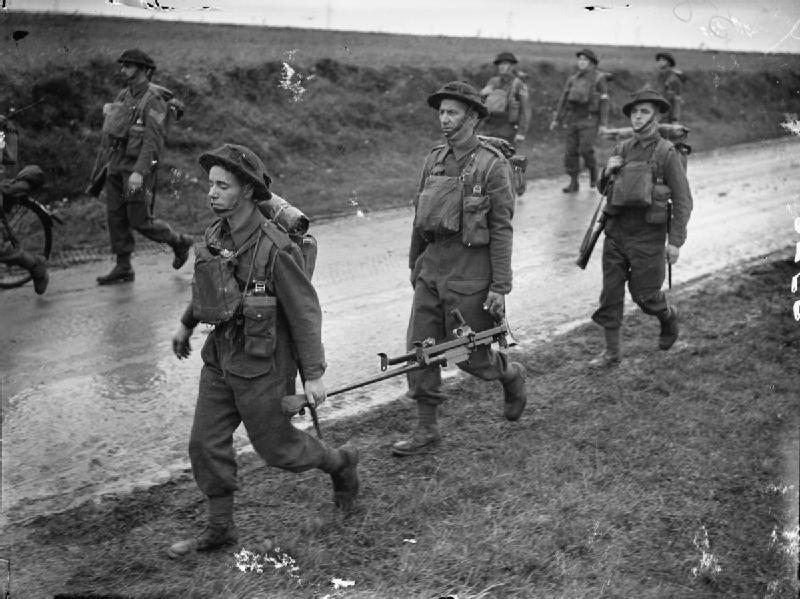
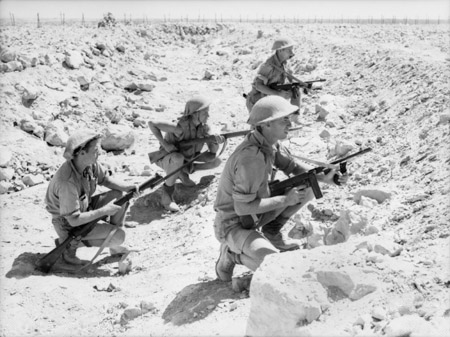
According to The Footsoldiers, the battalion had four rifle companies each with three sections.  The section leader carried a Thompson sub-machine gun, with a member with a Bren LMG (light machine gun), with a no.2 to help carry magazines……At platoon HQ’s was a five-foot long Boyes anti-tank rifle…..Also at platoon HQ were two men, no. 1 and 2, who carried and fired the 500 yard range two-inch mortar and carried twelve bombs….As part of BHQ there was also an Ack Ack (anti-aircraft) platoon…..No. 3 Mortar Platoon, the CO’s immediate close support ‘guns’ consisted of two sections each of two three-inch mortars, each mortar named as a detachment.  It fired a 10lb bomb with a range of 1100 yards…..

There is no mention here of Vickers or ‘Hotchiss’ guns.  However, as the Battalion was fighting alongside British Rifle companies, it seems possible that Dad would be familiar with their weapons.

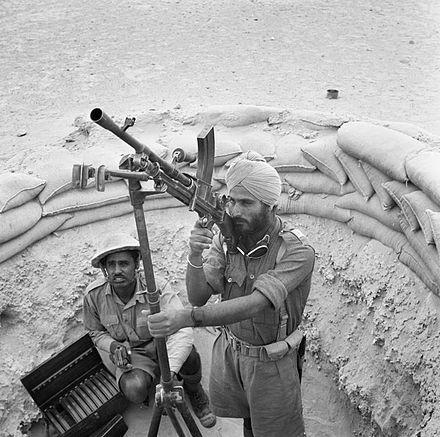
Bren  (LMG)

The Bren Gun, usually called simply the Bren, was a series of light machine guns adopted by Britain in the 1930s and used in various roles until 1992. … best known for its role as the British and Commonwealth forces’ primary infantry light machine gun (LMG) in World War II….Although fitted with a bipod, it could also be mounted on a tripod or vehicle-mounted.

The Bren was a modified version of Czechoslovak-designed light machine guns, the ZB vz. 26 and its descendants, which British Army officials had tested during a firearms service competition in the 1930s. The later Bren featured a distinctive top-mounted curved box magazine, conical flash hider and quick change barrel. The name Bren was derived from Brno, Moravia, the Czechoslovak city where the Zb vz. 26 was originally designed and Enfield, site of the British Royal Small Arms Factory. (ref Wikipedia)

Anti-aircraft_BrenGunPhoto :

Indian troops manning a Bren light machine gun in an anti-aircraft mount in 1941.

Vanderson W G (Lt), No. 1 Army Film & Photographic Unit – This is photograph E 2502 from the collections of the Imperial War Museums.


Vickers (MMG)

The Vickers medium machine gun (MMG) or Vickers gun is a name primarily used to refer to the water-cooled .303 British (7.7 mm) machine gun produced by Vickers Limited, originally for the British Army. The machine gun typically required a six to eight-man team to operate: one fired, one fed the ammunition, the rest helped to carry the weapon, its ammunition and spare parts.[1] It was in service from before the First World War until the 1960s (ref Wikipedia)

Vickers_machine-guns_fire_in_support_of_troops_crossing_the_Maas-Schelde_Canal

Photo info:

Laing (Sgt), No 5 Army Film & Photographic Unit Post-Work: User:W.wolny – This is photograph B 10144 from the collections of the Imperial War Museums (collection no. 4700-29)

Vickers machine-guns of 2nd Middlesex Regiment, 3rd Division, fire in support of troops crossing the Maas-Schelde Canal at Lille-St. Hubert (St Huilbrechts), 20 September 1944. Two interesting features are that the troops are wearing MK III British “Turtle” helmets, which were introduced shortly before D-Day. Additionally, the gunners are firing at long-range targets, as shown by the extreme elevation of the barrels

Boys anti-tank rifle (mentioned in The Footsoldiers)

The Rifle, Anti-Tank, .55in, Boys commonly known as the “Boys Anti-tank Rifle” (or incorrectly “Boyes”), was a British anti-tank rifle in use during World War II. It was often nicknamed the “elephant gun” by its users due to its size and large bore.  (ref Wikipedia)

Boys rifle photo

Photo info :

The British Army in France 1939-40 Men of the Royal Irish Fusiliers on the march at Gavrelle, near Arras, 17 October 1939. The two men in the foreground are carrying a Boys anti-tank rifle.

Keating G (Lt), War Office official photographer – http://media.iwm.org.uk/iwm/mediaLib//48/media-48013/large.jpg This is photograph O 758 from the collections of the Imperial War Museums.

Thompson sub-machine gun

The Thompson submachine gun (nicknamed the Thompson) is an American submachine gun, invented by John T. Thompson in 1918….The Thompson was used in World War II in the hands of Allied troops as a weapon for scouts, non-commissioned officers (corporal, sergeant, and higher ranking), and patrol leaders as well as commissioned officers, tank crewmen, and soldiers performing raids on German positions. (ref Wikipedia)

9_Div_Tobruk(AWM_020779)

Photo – AAWM 020779 – 9th Div soldiers at Tobruk using Thompson sub-machine guns


Hotchkiss  guns

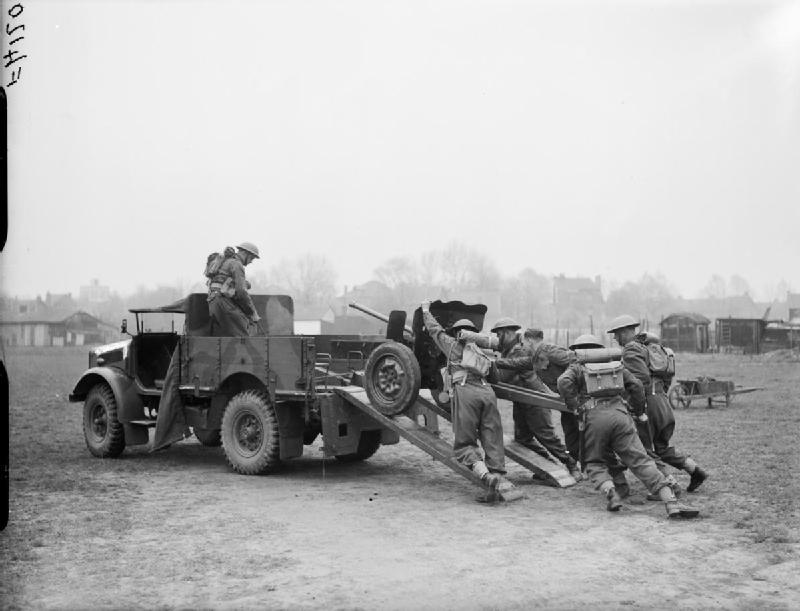
The 25 mm Hotchkiss anti-tank gun was a French anti-tank gun that saw service in the first years of the Second World War….When the British Expeditionary Force landed in France in 1939 it had insufficient numbers of anti-tank weapons such as the Ordnance QF 2 pounder. They were issued canons de 25 which became known as Anti-Tank Gun, 25 mm. Hotchkiss, Mark I on 25 mm. Carriage, Mark I in British service. The BEF was fully mechanised and attempted to tow the weapon behind their vehicles, but quickly found that it was not robust enough, having been designed to be towed by horses. The solution was to use the gun as a portee, that is, carried in the back of a truck. It was the first artillery piece to be used in this way.  (ref Wikipedia)

Hotchkiss anti-tank gun

The British Army in France 1940 Men of 2nd Battalion Essex Regiment load a Hotchkiss 25mm SA 34 anti-tank gun onto the back of a Bedford MWG Portee, Meurchin, 27 April 1940.  Malindine E G (Lt), Taylor E A (Lt), War Office official photographer – http://media.iwm.org.uk/iwm/mediaLib//47/media-47888/large.jpg This is photograph F 4120 from the collections of the Imperial War Museums.

Hotchkiss .303 LMG

Since first publishing this entry, I have discovered that there was in fact also a Hotchkiss .303 LMG in use by Australian troops, and this seems the most likely one for Dad to have been referring to.  (It seems unlikely that the anti-tank gun would have produced a chippity-chop sound).  According to the book – 100 years of Australian Service Machine Guns (Ian Skennerton, 1989) – the Hotchkiss .303 LMG remained in limited service until the 2nd World War; it was declared obsolescent and obsolete at the same time as the Lewis (April 1945).  Its main issue was to the Light Horse and after their disbandment it was relegated to the 2nd line and Home Defence use.

Posted in organisation, The course of the war, Uncategorized | Tagged , , , , , , , , , , | Leave a comment

We’ve been busy lately but are having a bludge today


June 2121st June 1941


TX 1004

Priv M Hickman

2/33rd Battalion

AIF Abroad

21st June 1941

Dear Mother & Dad

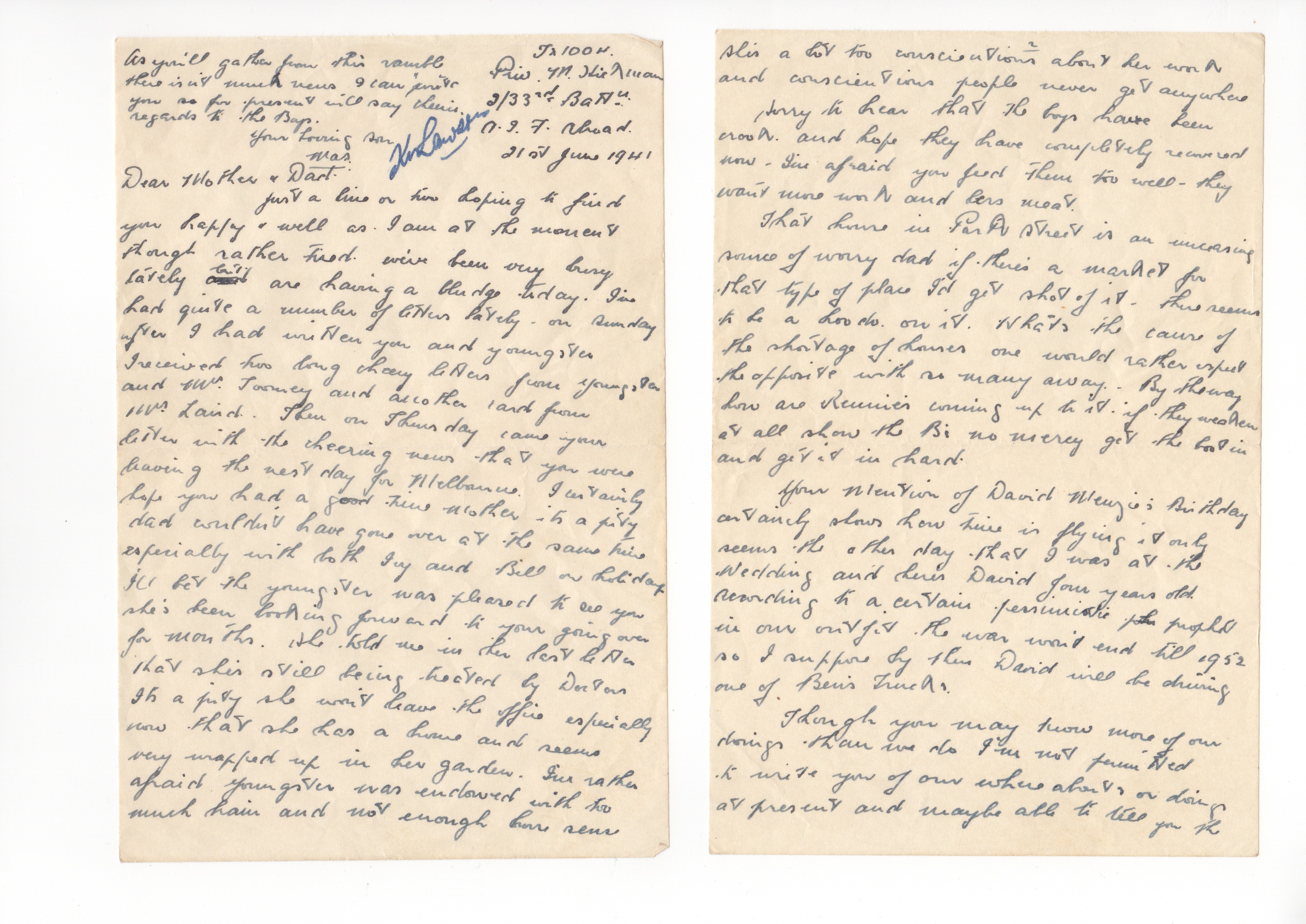
Just a line or two hoping to find you happy and well as I am at the moment though rather tired.  We’ve been very busy lately but are having a bludge today.  I’ve had quite a number of letters lately – on Sunday after I had written you and Youngster I received two long cheery letters from Youngster and Mrs Toomey and another card from Mrs Laird.  Then on Thursday came your letter with the cheering news that you were leaving the next day for Melbourne.  I certainly hope you had a good time mother – it’s a pity dad couldn’t have gone over at the same time, especially with both Ivy and Bill on holiday.  I’ll bet the youngster was pleased to see you- she’s been looking forward to your going over for months.  She told me in her last letter that she’s still being treated by doctors.  It’s a pity she won’t leave the office especially now she has a house and seems very wrapped up in her garden.  I’m rather afraid Youngster was endowed with too much brain and not enough horse sense.  She’s a lot too conscientious about her work and conscientious people never get anywhere.

Sorry to hear that the boys have been crook and hope they have completely recovered now.  I’m afraid you feed them too well – they want more work and less meat.

That house in Park Street is an increasing source of worry dad.  If there’s a market for that type of place I’d get shot of it.  There seems to be a hoodoo on it.  What’s the cause of the shortage of houses?  One would rather expect the opposite with so many away.  By the way how are Rennies coming up to it?  If they weaken at all show the B’s no mercy – get the boot in and get it in hard.

Your mention of David Menzie’s birthday certainly shows how time is flying.  It only seems the other day that I was at the wedding and here’s David four years old.  According to a certain pessimistic prophet in our outfit the war won’t end till 1952 so I suppose by then David will be driving one of Ben’s trucks.

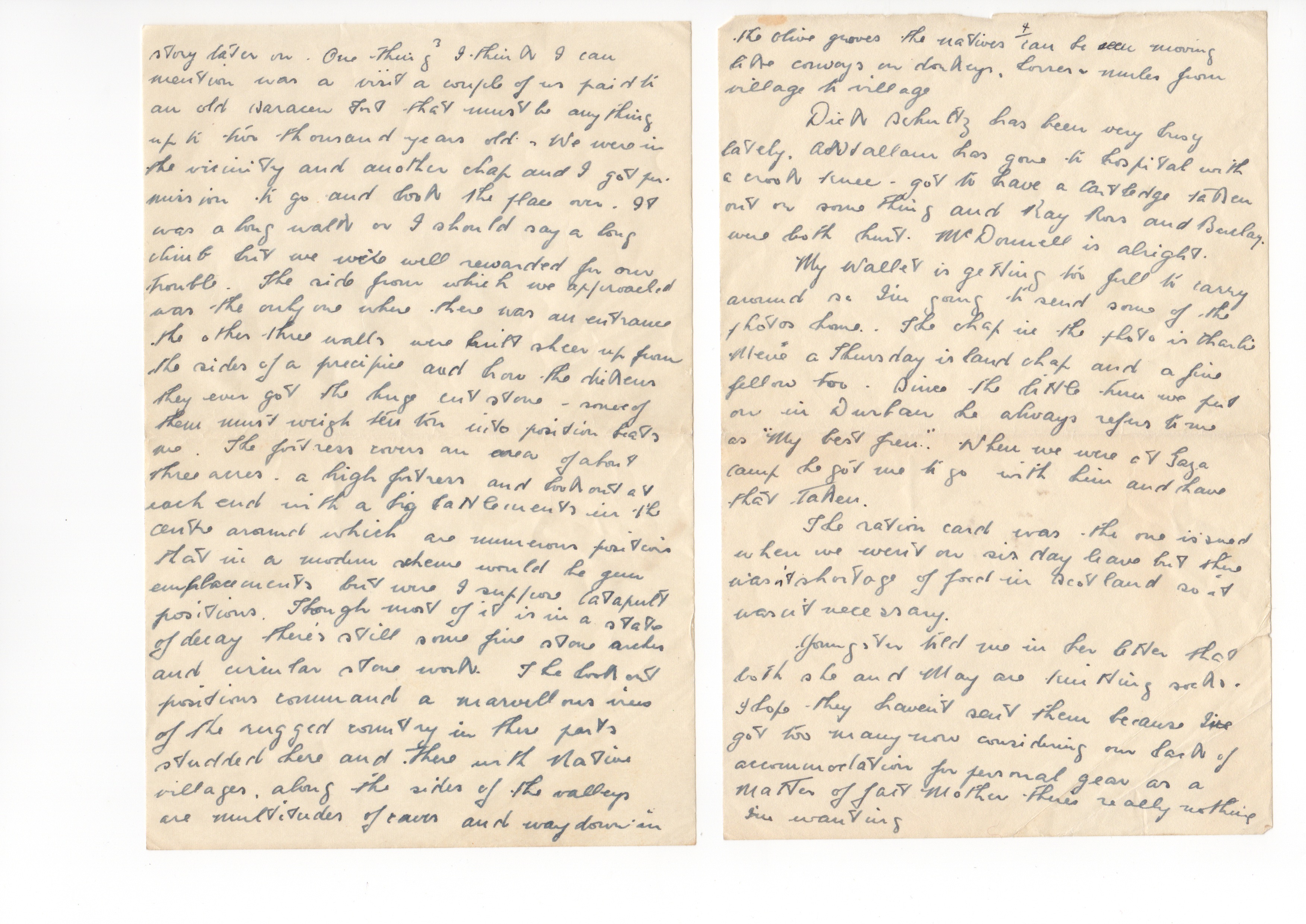
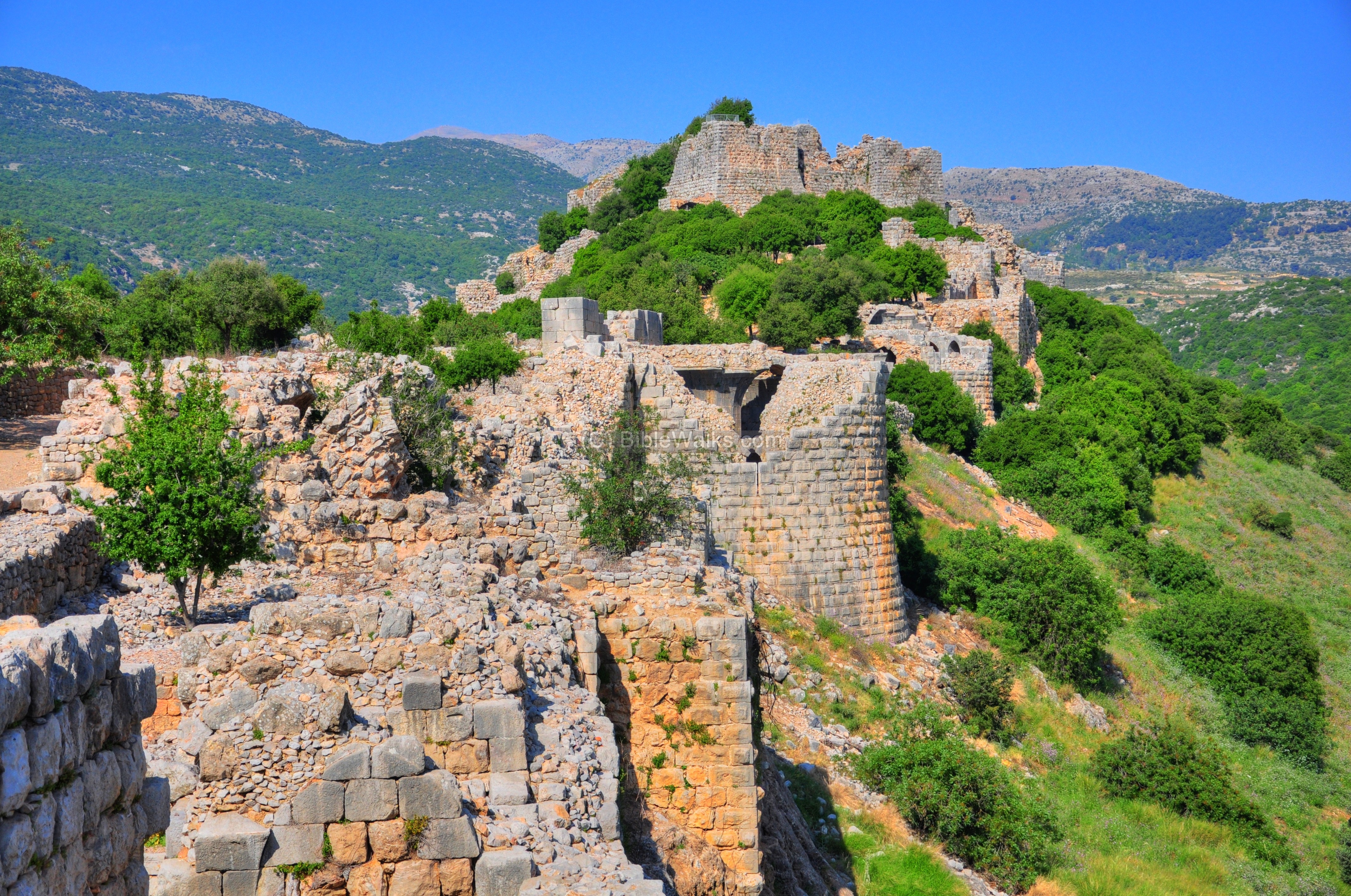
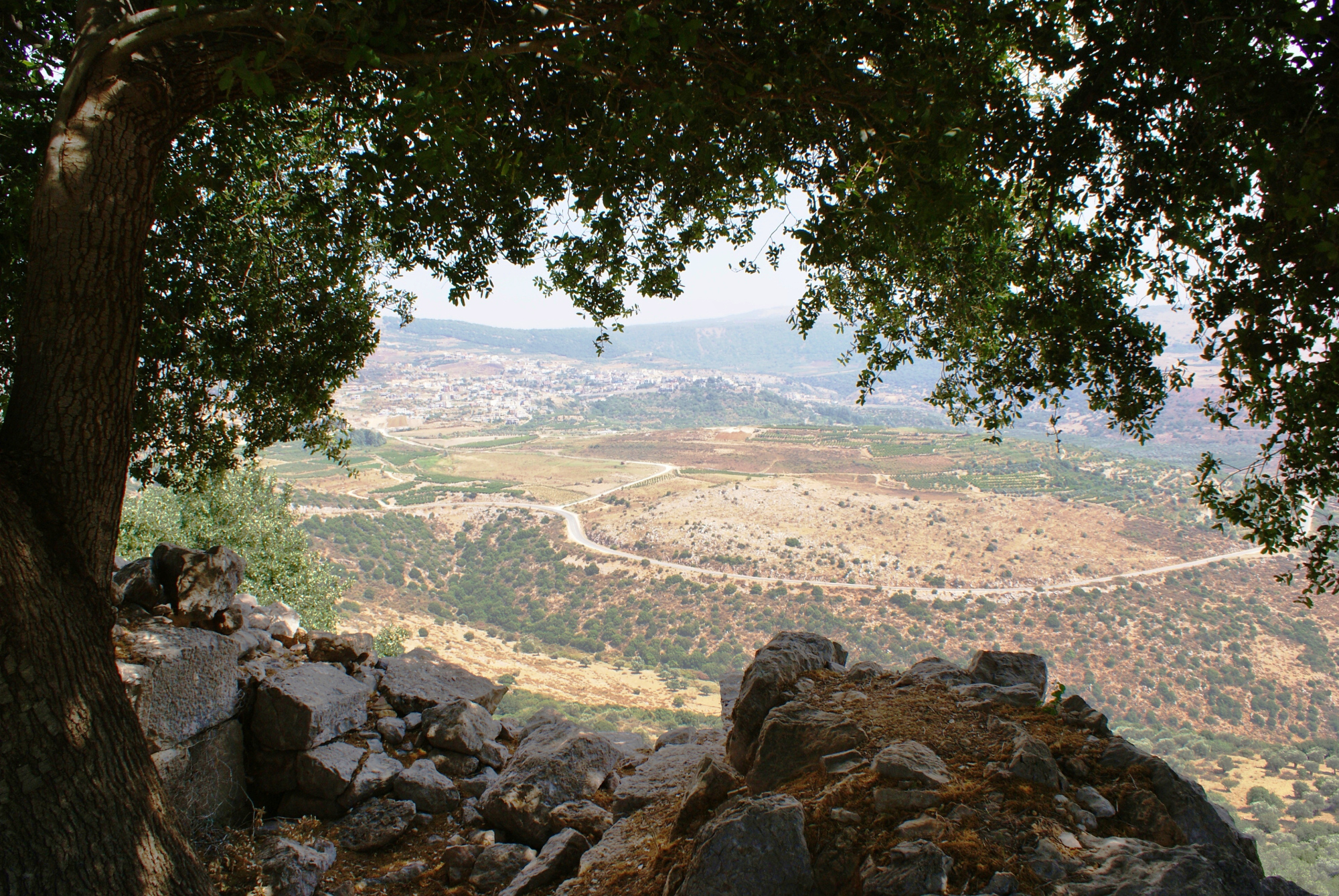
Though you may know more of our doings than we do, I’m not permitted to write you of our whereabouts or doings at present and may be able to tell you the story later on.  One thing I think I can mention was a visit a couple of us paid to an old Saracen fort that must be anything up to two thousand years old.  We were in the vicinity and another chap and I got permission to go and look the place over.  It was a long walk or should I say a long climb but we were well rewarded for our trouble.  The side from which we approached was the only one where there was an entrance.  The other three walls were built sheer up from the sides of a precipice and how the dickens they ever got the huge cut stone – some of them must weigh ten tons – into position, beats me.  The fortress covers an area of about three acres – a high fortress and lookout at each end with a big battlements in the centre around which are numerous positions that in a modern scheme would be gun emplacements but were I suppose catapult positions.  Though most of it is in a state of decay there’s still some fine stone arches and circular stone work.  The lookout positions command a marvellous view of the rugged country in these parts studded here and there with native villages, along the sides of the valleys are multitudes of caves and way down in the olive groves the natives can be seen moving like convoys on donkeys, horses & mules from village to village.

Dick Schultz has been very busy lately.  Ack Hallam has gone to hospital with a crook knee – got to have a cartilage taken out or something and Ray Ross and Barclay were both hurt.  McDonnell is alright.

My wallet is getting too full to carry around so I’m going to send some of the photos home.  The chap in the photo is Charlie Mene a Thursday Island chap and a fine fellow too.  Since the little turn we put on in Durban he always refers to me as ‘my best fren’.  When we were at Gaza camp he got me to go with him and have that taken.

The ration card was the one issued when we went on six day leave but there wasn’t a shortage of food in Scotland so it wasn’t necessary.

Youngster told me in her letter that both she and May are knitting socks.  I hope they haven’t sent them because I’ve got too many now considering our lack of accommodation for personal gear.  As a matter of fact Mother there’s really nothing I’m wanting.

(final para written on page 1) – As you’ll gather from this ramble there isn’t much news I can write you so for present will say cheerio.  Regards to the Boys.

Your loving son

Max

Censor – K Lawson


Diary June 16 – 21

Tuesday 17th

Leo’s section again attached C Coy. at Banias expecting attack. Fusiliers surrounded & captured. I was sent on reconnaissance to Saracen fortress – two miles inside enemy territory – very interesting.  Attached to Engineers at night.  Ack Hallam & Graham Watts do tricky job with Cavalry

20th

Leo’s section attached to Hqrs for four days – nothing very interesting though bombs dropped very close.  New CO takes over from Killer Monaghan – Corby – Victorian – seems business man type – came and made himself known – asked our names in business man style.

Making sense of the diary entries (italics from The Footsoldiers)

Tuesday 17th 

Leo Earea’s section was indeed attached to C Company: they were not at Banias.  But it’s possible that Dad’s diary entry referred to his being one of the carriers sent back to Banias with Captain Cotton’s A company ‘to watch the rear and the road to Kuneitra’….  Both A and D companies occupied the hills just forward of Banias for the period June 18-23 and carried out patrols into the hills to the north.  The account below (‘more on the Saracen fort’) certainly indicates that he was with Captain Cotton at this time.

The incident with the Fusiliers took place on June 15:

The French attack on the Merdjayoun sector had been part of a co-ordinated attack on two of the main Allied axes of advance, with a subsidiary attack at Jezzine.  On our right sector the French had defeated the British and Free French, capturing nearly all the Royal Fusiliers, and had approached the Palestinian border thirty miles to our rear….

Tricky job with the Cavalry

Following the ‘rout’ of French cavalry on June 16 (described in the previous post), about sixty of the French Foreign Legion’s Arab horses were rounded up and handed over to the 6th Cavalry who later used them ‘for patrols on the right flank, ranging far and wide up into the low foothills of Mt Hermon and the eastern approaches.  They were code-named The Kelly Gang.’  I wonder if Ack Hallam and Graham Watts might have been involved in one of these patrols.

2015-05-26 17.29.02


Members of the French Foreign Legion’s Spahi cavalry (photo from The Footsoldiers)


Friday 20th : A New CO

Lt-Col Monaghan had been with the battalion for a very short time, but his methods were causing concern:  On 19 June Lt-Col Monaghan was transferred …to his old regiment the 2/2nd Anti Tank.  The new CO (was) Lt-Col J A Corby, a Victorian…Although Colonel Monaghan’s methods of commanding the battalion from the sharp end were admired by those that saw him, most agreed that perhaps there would be less worry at BHQ.  Lt-Col MOnaghan’s bold methods of distributing the battalion far and wide, beyond its communication and supplies, no doubt kept the French guessing but also had caused much war and tear on the unit.  His disconcerting habit of breathing down the necks of platoon officers and Bren gunners when in action certainly kept all on their toes but many the worry the adjutant had when he could not find the CO.  (from The Footsoldiers)


More on the Saracen fort : as per diary – sent on reconnaissance, rather than being ‘given permission to look the place over’!

Nimrod63

http://www.biblewalks.com/Sites/Nimrod.html

The Nimrod Fortress is located on a cliff, high above Banias.  The frontier fortress guarded the main road from Damascus to Tyre and Tiberias during the Crusades.  In fact it was built around 1228 by the nephew of Salah ad Din [Saladdin]– Al Aziz Uthman – in order to guard the route to Damascus and prevent the advancement of the Crusader army led by Friedrich II.

In a piece written during the early 1970’s, Dad wrote of this incident –

…the group to which I belonged was attached to A Company at that time commanded by Captain T W Cotton who was later to become the commanding officer of the battalion and was awarded the Distinguished Service Order and the Military Cross.  Captain Cotton instructed our platoon commander to send two men to reconnoitre the high ground immediately in front of our position.   This involved climbing a hill – I suppose a small mountain would be more correct – that overlooked a wide area of countryside.  The prospect looked exciting.  I volunteered and suggested that a chap named Wally Sonntag, a West Australian who in civilian life was a school teacher, might care to join us.  We were given a very pistol and cartridges or different colours which were to be fired under varying circumstances.  We did not carry rifles or any means of offence or defence.

After somewhat more than an hour’s climb, we reached the summit of the hill and to our wonder and amazement found it surmounted by a fortress built in ancient times.  The manner in which it had been constructed was fascinating, reflecting remarkable engineering skills.  Huge blocks of stone, some of which must have weighed at least a tonne, were bonded together.  On three sides of the fortress the blocks of stone were bonded in such a way as to be practically perpendicular to a height of fifteen metres.  The fourth side was constructed in such a way as to give limited access whilst still retaining a defensive role.  At the top of these constructions there was a reasonably level area surrounded by a parapet wall.  We could well imagine the area being used to hurl stones or other deterrents at attacking forces.

It was a really fascinating experience.  We probably spent more time exploring the fortress than we should have done, but we did note for the purpose of the exercise the possible positions of enemy forces in the immediate and more distant olive groves and also the continuous stream of local people moving away from the area when we got back to the campsite and relayed the information we’d been sent to obtain.  I don’t know whether it affected the course of the campaign.   

SONY DSC

SONY DSC

This photo gives an idea of the commanding view of the surroundings that Dad and Wally must have had.

Photo source:

http://ukmediawatch.org/2012/06/22/postcard-from-israel-kalat-nimrod/

Posted in Hierarchy, Middle East, organisation, Uncategorized | Tagged , , , , , , , , , | Leave a comment

Peaceful prelude to dramatic evacuation

scan0007


scan0008

scan0009

TX 1004

Pte M L Hickman

2/33 Battn AIF

Sunday 15th June 41

Dear Mother

Just a few lines from the shade of a fig tree hoping to find you, dad and the boys as happy and well as I am at present.  It is a typical Sunday morning and a cloak of peace masks the valley where for the moment we have come to camp.  In the distance the church bells of the Catholic churches can be heard and but for the unceasing attacks of flies it would be a delightful spot.  Like Queensland this is the land of pests – for fleas and flies one never rests.

Your letter of the 28th April came up on Tuesday night along with a parcel from Youngster.  The circumstances of their arrival were really melodramatic and that made them all the more appreciated.  We were near the top of a rugged mountain almost dwarfed by giant boulders when the ration truck with its cargo of bully beef and concrete biscuits arrived and with it the postman.  Everyone was amazed when with our box of rations came a bag of mail – mostly papers but very welcome just the same.  The cake the youngster had sent for my birthday would have found favour at any time but after living for days on Bully – well it was wonderful, and to the tune of a 1941 dinner music programme we went to work on it.  The letter must have been held up somewhere but it made good reading for all that and explained how young Trevor came by his accident.

Three or four days earlier I had a small parcel – a neat little packet containing a piece of Jack and Lil’s wedding cake.  Though the cake had become hard through long travel – nearly five months – I enjoyed every crumb of it and appreciated the sentiment with it – arriving when it did I took it as a particularly good omen.  There’s no doubt about old skin, he’s the best fellow I’ve ever known and I’ve wished a thousand times that he and Weddy had been here or at least with me when in England.  I’m rather surprised at Rex joining a non-combatant unit – just what do they do – I’m sure there’s none of them over here – I’ve heard of them but that’s about as far as we know them.

There’s been quite a chapter of accidents this week – one of our carriers got smashed up and the officer got hurt – nothing serious but there it is.  There’s been quite a series of accidents throughout the battalion too.

Since I last wrote you we’ve travelled still further afield and added a variety of new pages to the history of the battalion.  To the cavalcade of unforgettable scenes is a road considered to be one of the seven wonders of the world.  The thrills of Mount Wellington and the Gormanston- Queenstown road fade to insignificance beside this masterpiece of civil engineering.  Climbing an incline almost as sheer as the organ pipes it banks at the corners like a speedway.  As it was dark when we did the trip we were unable to appreciate fully the wonders of this unique enterprise but the light and shade effects of the moon and clouds in the clefts and ridges added mystery to the charm and sensation of the crossing – at times the carrier appeared to be hanging in space as we negotiated bends banked at angles of sixty degrees – at such times looking down over the sheerness the road resembled cotton on a reel and both above and below us the other units of the convoy were like knots in the thread.  I don’t think I’ve ever seen anything quite so magnificent and I should like to see it sometime in the daylight though I doubt very much if we shall pass that way again  The countryside in which we are now living is the most rugged I’ve ever seen – more so even than the lake country – there is scarcely any growth on the mountains at all although the small valleys are well cultivated and there are quite a number of vineyards – a few olive groves and some fig trees.

It’s about a fortnight since I last saw Dick.  He was on his way to a village to get by any means some souvenirs to send home.  That set and gloves you mentioned in your letter were gifts (Christmas) from his boss -the MO and a friend in Colchester – so that tells you how he stands there, when the boss buys him a Christmas present- and at that time he was only a private.  The corporals and sergeant weren’t even mentioned.

Well Mother as you’ll gather from this letter news is very scarce so I’ll say cheerio for the present – regards to all my friends and love to you, dad, May and Anne.

Your loving son

Max

…..No censor signature (likewise, June 5)

Diary entry – June 15 – Contrast with the letter!

Take up positions in support Greys.”Ibeles-saki”.  Intense bombardment 75’s & mortars. Had evacuate in evening under machine gun fire and anti tank fire.  Ned left.  two gunners V Abel & Ted Fleming got out in Artillery truck.  Dredge showed up bad at time but has been alright at others.

Map – same as in last post….

June 8-9 1941


From The Footsoldiers – movements shown for June 8/9, but map repeated here so place names can be identified.


Jack and Lil’s wedding cake – a good omen

This arrived on the day the Battalion began its move towards the border…so the feeling of its arrival being auspicious is understandable.

Letters and parcel arrive in ‘melodramatic’ circumstances

Dad says he was ‘near the top of a rugged mountain’: his diary and The Footsoldiers combine to suggest this was somewhere near Khiam/ Fort Khiam. It’s interesting that the supply truck could reach them, but D company (which was not far away waiting for enemy fire from Ibeles Saki to be neutralised by that of the 2/25th Battalion) had to wait until midday on Wednesday June 11th for a donkey train to bring them rations, water and ammunition.

I don’t understand the reference to ‘a 1941 dinner music programme’. Readers’ thoughts most welcome!

mule train

Photo – donkey train (from The Footsoldiers)


Quite a series of accidents throughout the battalion

The previous post refers to some of these – the battalion was involved in fierce fighting and men were being killed and wounded on a daily basis, culminating in a day of intense fighting on June 15 – suggesting Dad’s diary entry was more accurate than his letter.  The OC of the carrier platoon, Lieut Barclay had even been accidentally shot in the arm by one of his own men.

Dad mentions in his diary on June 12, being attached to the engineers – which quite possibly means he was on that day involved in supporting those who were re-building a bridge across the Litani River, south-west of Merjayoun – a vital link to Jezzine.

2015-05-23 19.11.42

Photo – replacing the bridge across the Litani River – from Active Service


It is clear from Bill Crooks’ account in The Footsoldiers that the Carriers were deployed in many reconnaissance and other support roles, so Dad could have been involved peripherally in any of the actions described there.  However, assuming he was with the bridge builders and that he was then by June 15 supporting ‘the (Scots) Greys’, he would have spent that Sunday moving towards and then retreating ahead of the Vichy forces’ counter-attack.  This was a many-pronged action, and resulted in the Battalion becoming quite dispersed.  Communication difficulties continued, so in some cases small sections rather than whole companies faced the enemy. There were a number of situations that would have matched his diary entry – of intense bombardment and an evacuation under machine gun and anti tank fire.

It is hard to imagine how the scene described in his letter could have been experienced on the same day – I can only imagine that he was writing his letter very early in the morning!  (This was indeed the case – refer to letter of July 31)

The next day –  June 16 – the dramatic encounter depicted on the cover of The Footsoldiers (below) took place.  Vichy forces – a squadron of French cavalry who had dismounted – were attacking the 2/33rd’s C company, dug in on high ground below the town of Rachaya el Fokhar.  B Company, fortunately passing en route to Bmeriq, approached unseen from behind the French forces. In summary, as reported in The Footsoldiers – ‘it was a rout’.

2015-05-23 08.59.44


newspaper

As this replica newspaper front page demonstrates, the Australian public knew the AIF was involved in the Syria campaign, but just as with the troops themselves, the public were being told that there was ‘hope that the British advance will not develop into a military operation’.  As indicated in the previous post (start of the Syria campaign) this hope was ill-founded.


The road to Rosh Pinna

From The Footsoldiers:  The main approach to the frontier from Er Rama was by road, a distance of thirty five miles.  The road rose 1400 feet in sharp curves first, then after three miles, dropped 1300 feet in two miles to Rosh Pinna.  From Rosh Pinna the road followed the western edge of the malarial-infested Hula marshes.  During daylight and at night if vehicles used lights the whole approaches through this salient would be observed from the frontier foothills of Syria.  That was why the movement to the frontier had to be done by night without lights….

Photos online don’t suggest a road that’s any more hair-pinned than the notorious ’99 bends’ of the road between Gormanston and Queenstown on Tasmania’s west coast, or even the road up Mount Wellington on the outskirts of Hobart – but of course Dad would never have travelled those roads in a carrier, at night, without any lights!

Posted in Middle East, parcels, The course of the war, Uncategorized | Tagged , , , , , , , | Leave a comment