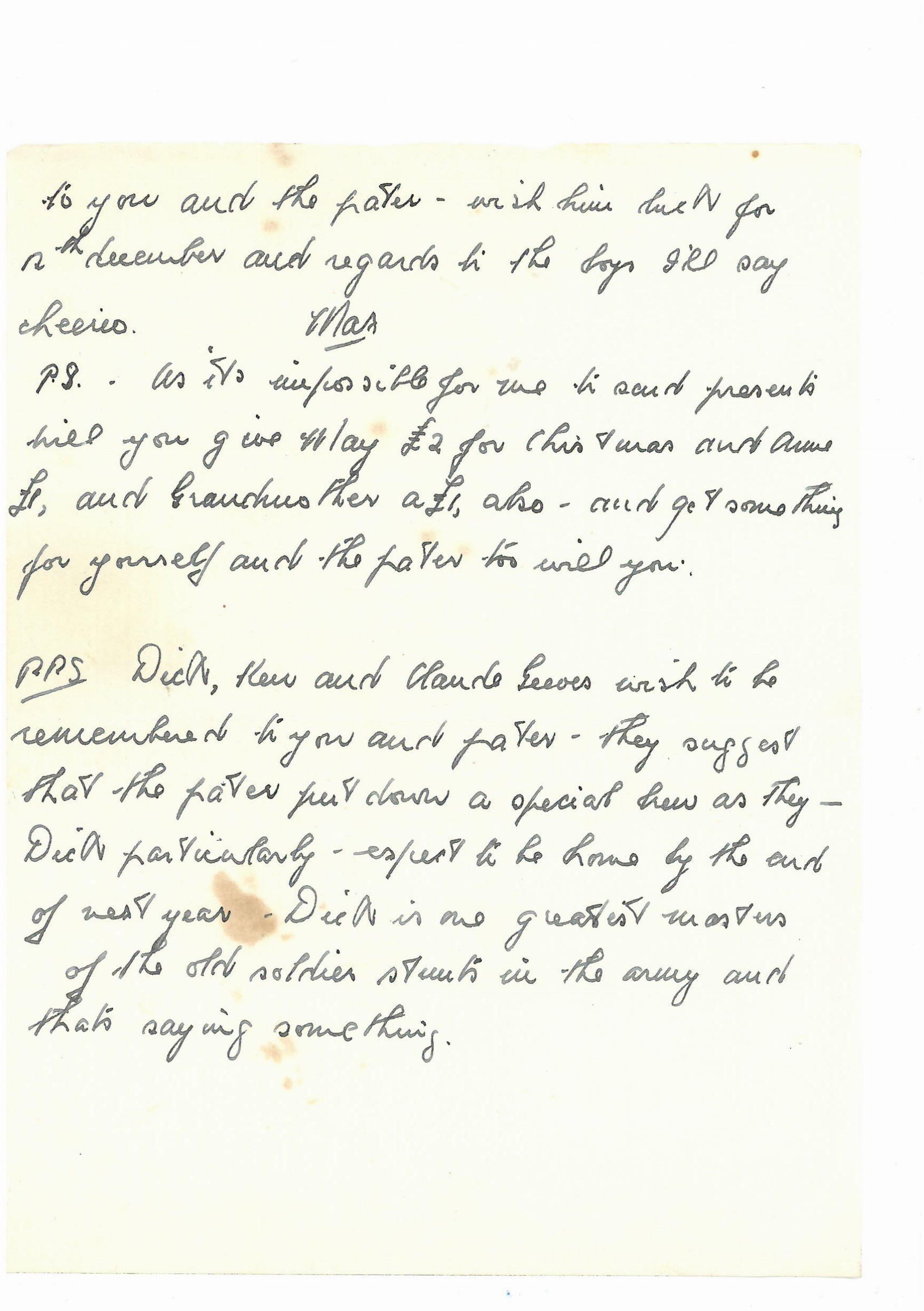
Moving north to winter barracks

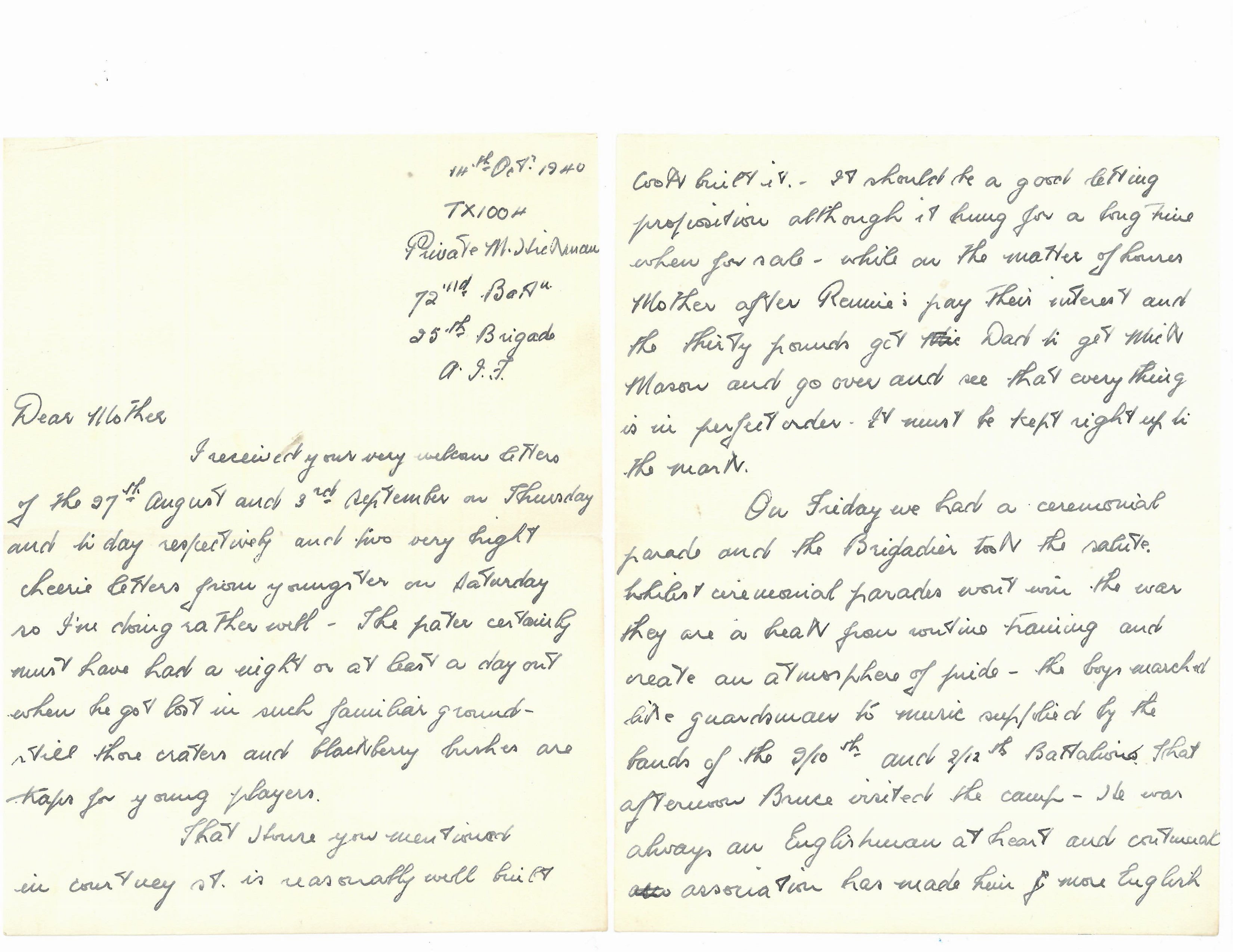
14 Oct 1940 p 1 2

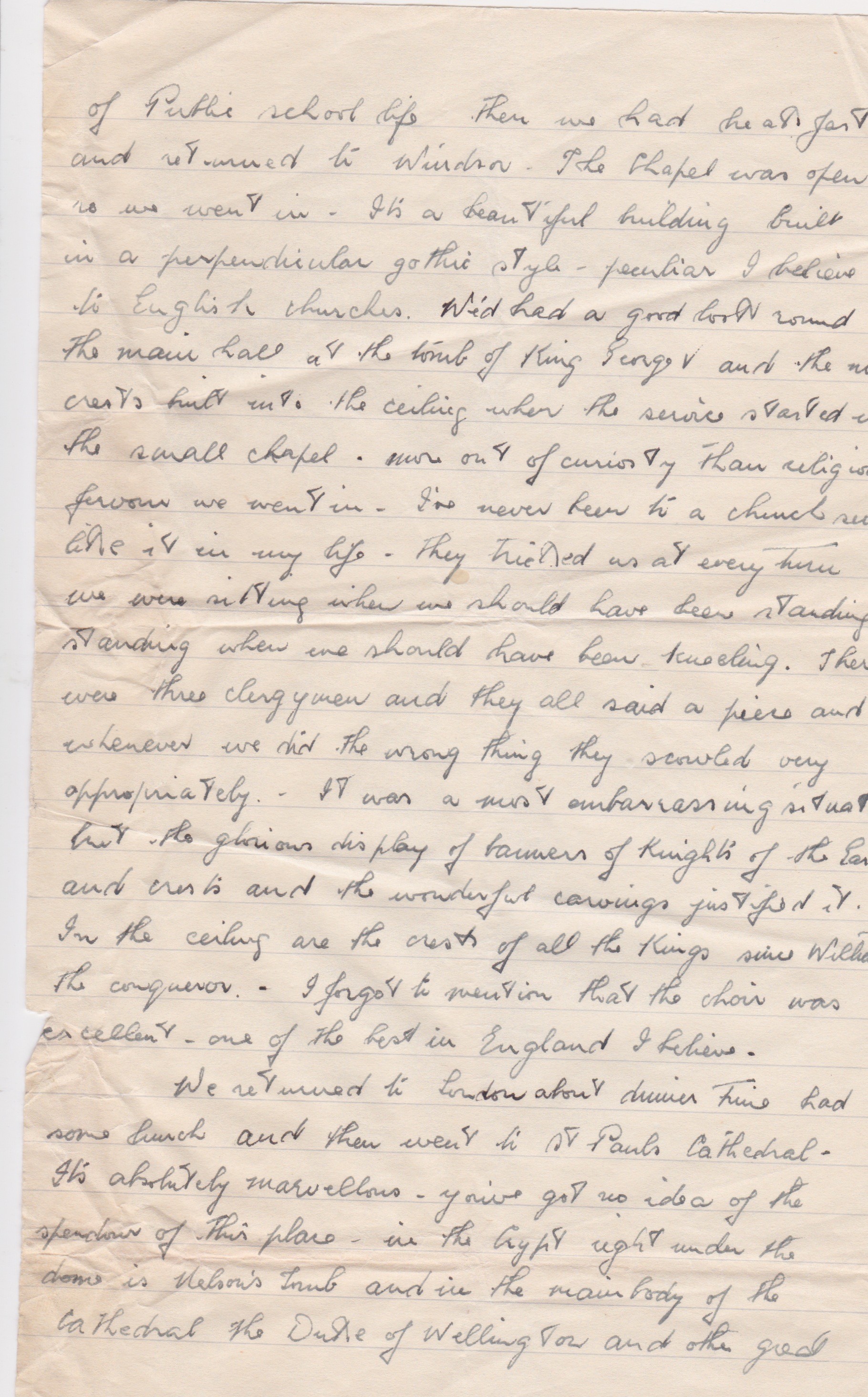
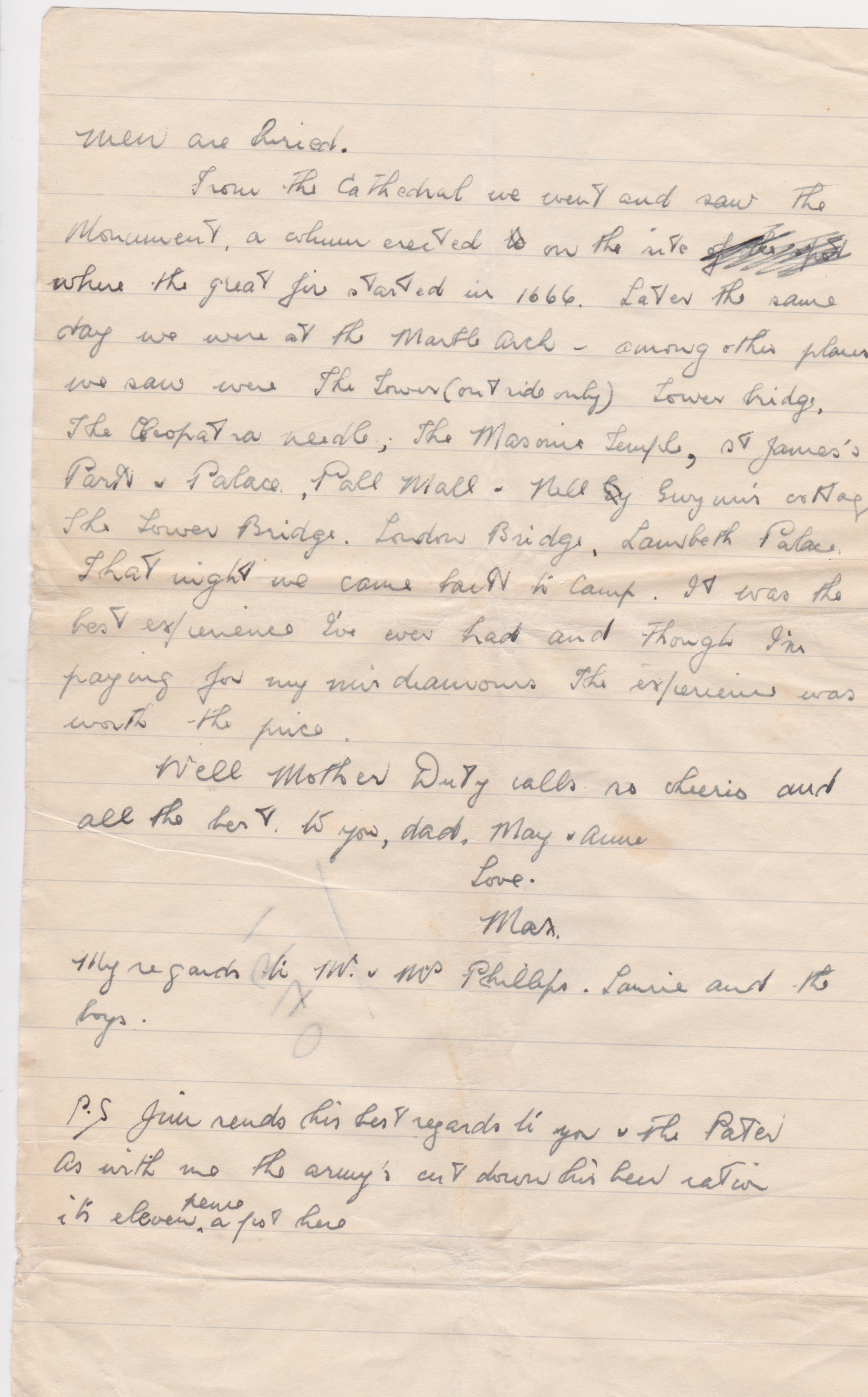
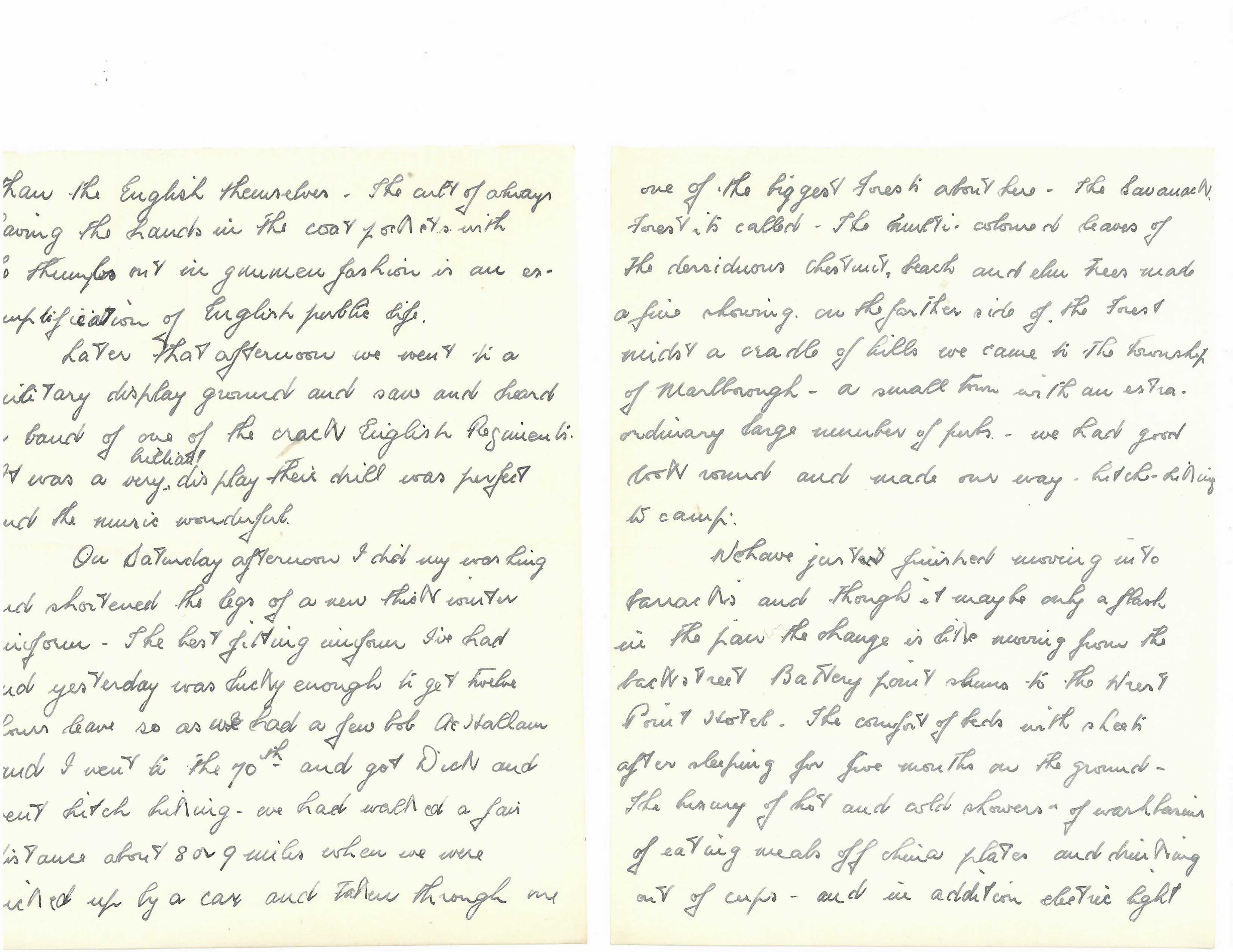
14 Oct 1940 p 3 4

14 Oct 1940 p5

14th Oct 1940

TX1004

Private M Hickman

72nd Battn

25th Brigade

AIF


Dear Mother

I received your very welcome letters of the 27th August and 3rd September on Thursday and today respectively and two very bright cheerie letters from youngster on Saturday so I’m doing rather well.  The pater certainly must have had a night or at least a day out when he got lost in such familiar ground – still those craters and blackberry bushes are traps for young players.

That house you mentioned in Courtney St is reasonably well built.  Cook built it.  It should be a good letting proposition although it hung for a long time when for sale – while on the matter of houses Mother after Rennies pay their interest and the thirty pounds get Dad to get Mick Mason and go over and see that everything is in perfect order.  It must be kept right up to the mark.

On Friday we had a ceremonial parade and the Brigadier took the salute.  Whilest ceremonial parades won’t win the war they are a break from routine training and create an atmosphere of pride – the boys marched like guardsmen to music supplied by the bands of the 2/10th and 2/12th Battalions.  That afternoon Bruce visited the camp.  He was always an Englishman at heart and continual association has made him more English than the English themselves.  The cult of always having hands in the coat pockets with the thumbs out in gunmen fashion is an exemplification of English public life.

Later that afternoon we went to a military display ground and saw and heard a band of one of the crack English regiments.  It was a very brilliant display as their drill was perfect and the music wonderful.

On Saturday afternoon I did my washing and shortened the legs of a new thick winter uniform – the best fitting uniform I’ve had and yesterday was lucky enough to get twelve hours leave so as we had a few bob Ac Hallam and I went to the 70th and got Dick and went hitch hiking.  We had walked a fair distance about 8 or 9 miles when we were picked up by a car and taken through one of the biggest forests about here – the Savanack [Savernake] Forest it’s called.  The multi-coloured leaves of the deciduous chestnut, beech and elm trees made a fine showing on the farther side of the Forest midst a cradle of hills we came to the township of Marlborough – a small town with an extra-ordinary large number of pubs.  We had a good look round and made our way hitch hiking to camp.

We have just finished moving into barracks and though it may be only a flash in the pan the change is like moving from the back streets of Battery Point to the Wrest Point Hotel.  The comfort of beds with sheets after sleeping for five months on the ground – the luxury of hot and cold showers & of washbasins, of eating meals off china plates and drinking out of cups – and in addition electric light, facilities for drying clothes and an asphalt parade ground are like the fulfilment of H G Wells’ dreams.

The change has also taken us from the wide open spaces to the proximity of quite large towns and as leave may be granted I’m going to try and transfer some money through the Commonealth Bank here to my pay book so that I’ll be able to make the best of the stay here.

With best regards to the boys.

Love to you & pater

I’ll say cheerio Mother

Max

PS Dick &Ken send their best regards


The house in Courtney Street

I assume the house Dad mentions here was 17 Courtney Street (Lenah Valley), and that my grandparents bought it as an ‘investment property’ during the war.  This is the house they lived in for all the time I knew them – I only found out they had at one time lived in Pottery Road when their old family home burned down in the devastating fires of February 1967.

The visit by Stanley Bruce

Stanley Bruce  was the Prime Minister of Australia from 1923-29, and High Commissioner to the United Kingdom from 1933-45.  His entry in Wikipedia includes the following, which tends to correspond with Dad’s views:   He was…the first prime minister to head a cabinet consisting entirely of Australian-born ministers.[59] Yet Bruce himself was frequently caricatured in public as “an Englishman who happened to have been born in Australia”.[17] He drove a Rolls-Royce, wore white spats, and was often seen as distant and lacking the common touch: characteristics that did little to personally endear him to the Australian public.

For more information on Bruce:  http://primeministers.naa.gov.au/primeministers/bruce/

Savernake Forest

According to the BBC (www.bbc.co.uk/wiltshire/moonraking/landscape_savernake.shtml), Savernake is a surviving remnant of one of Wiltshire’s ancient ‘Royal Forests’ much beloved by Norman kings.  It is the only privately owned forest int he UK and is leased to the Forestry Commission on a 999 year lease. Savernake is famous for the Big Belly Oak, a 1000 year old oak tree close to the A345 on the western edge of the forest. Legend has it that the devil can be summoned by anyone dancing naked round the tree.

Moving to Winter Barracks

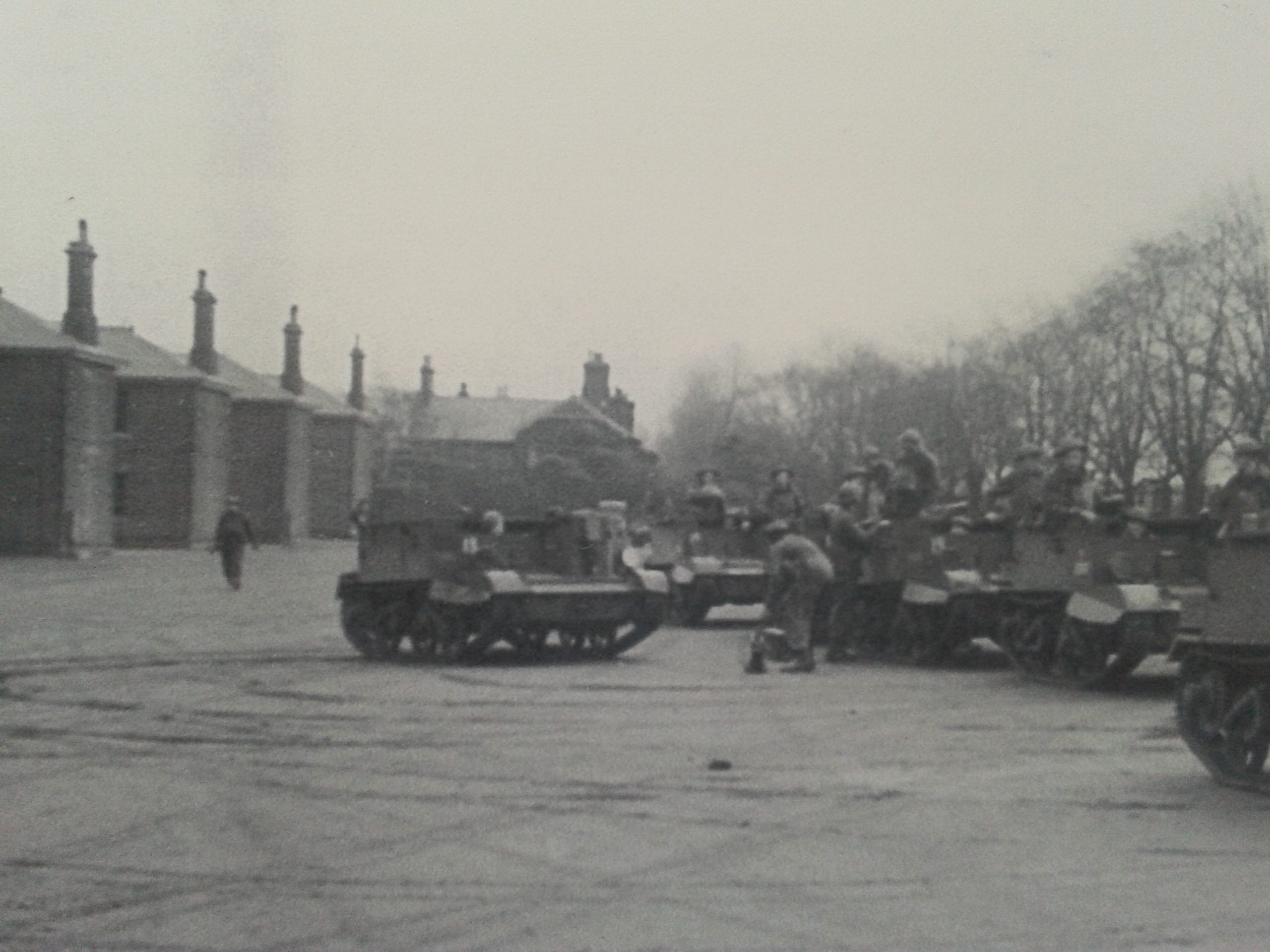
It seems Dad might have written this letter over several days -because he’s clearly at the barracks already, and according to The Footsoldiers (p17)  On October 16 the battalion moved out, all the transport was brigaded and moved by road.  On arrival at our new quarters at Colchester, 39 miles north-east of London and only 15 miles from the coast, we all were agreeably surprised to find our new home Cherry Tree Barracks modern and comfortable.   There was a vast hall to seat the whole battalion, a large main kitchen, with all modern facilities and we had the use of hot and cold showers.  However few of us were happy to see the asphalt parade ground…

It’s interesting for me to reflect on how ‘the back streets of Battery Point’ have changed over the years – from what was clearly, for Dad in 1940, an ‘undesirable’ address, to one that is now highly sought-after.

Carriers on the asphalt parade ground (photo – Dick Lewis)
2014-10-16 14.44.11

Posted in Australian, Britain, Camps and Barracks, pay and conditions, Uncategorized, unit parades and church parades | Tagged , , , , , | Leave a comment

Soaked to the skin and cold as frogs : first issue of rum.

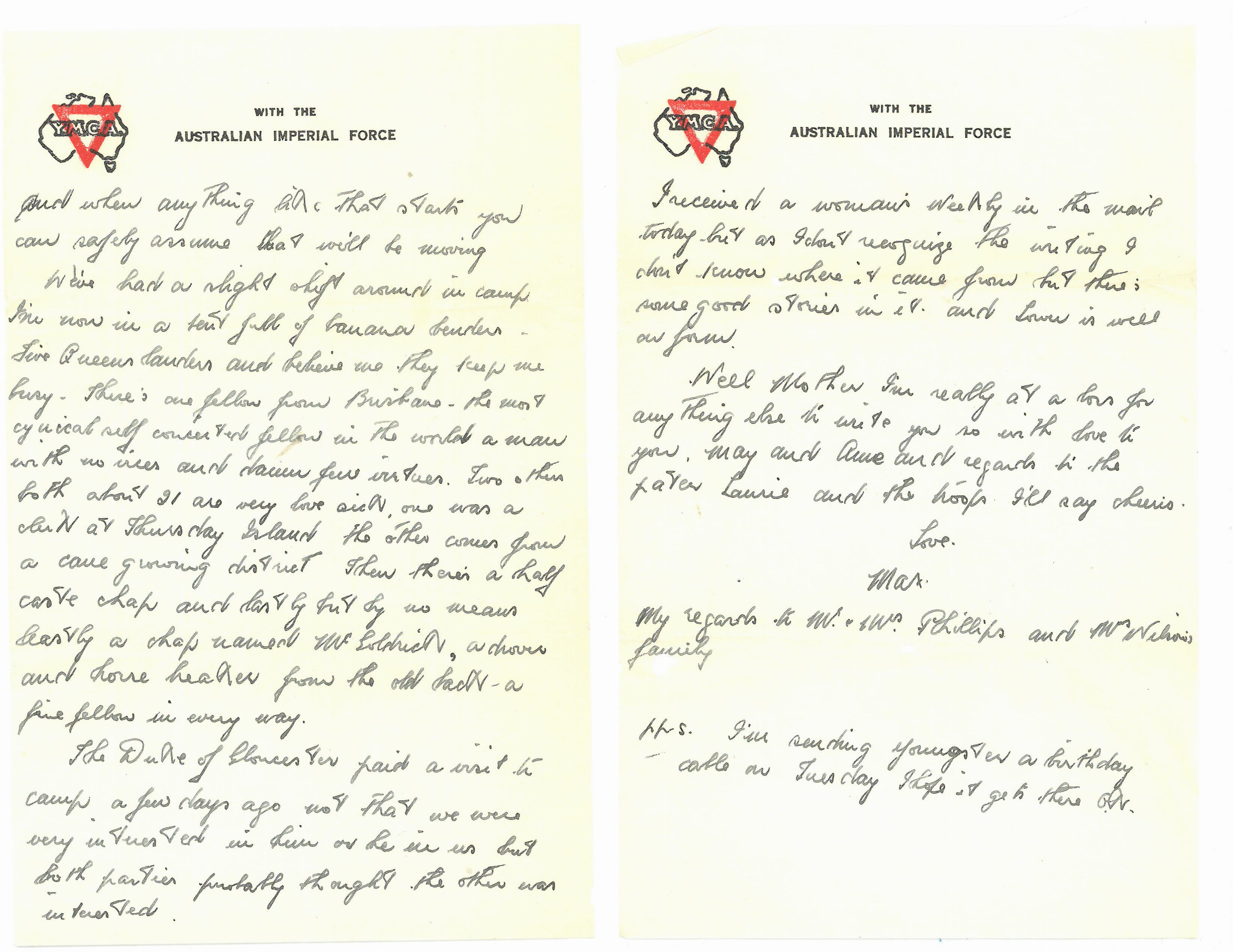
6 Oct 1940 p 1 2

6 Oct 1940 p 3 4

6 Oct 1940 p 5

6th Oct 1940

TX1004

Priv M Hickman

72nd Battalion

25th Brigade

AIF


Dear Mother

After what seemed almost an age without mail the weekend brought forth seven letters – six and a cable – two ordinary mail posted on or about the fourteenth of August reached here exactly the same time 4th Oct as air mail written a week previously.  The ordinary mail always gets here the same time as air mail and it’s heart breaking to see 1/6 stamps on letters when half our time we haven’t the price of a box of matches.

Included in my mail were two from you, two from youngster, one from May and one from Jack – your cable sent on the 26th Sept reached here on the morning of the fifth of October and I replied the same day.  I did not ask you to send any money because unless I get leave – there’s talk of six days leave for those who haven’t had it – but I’ll believe it when it’s actually started – I can manage to exist and if I do get leave will be able to draw on the Commonwealth Bank in London.

It looks as though the Scottie rig for Anne that Ac Hallam was getting for me through friends in Scotland has definitely been lost in the post between Edinburgh and here – very disappointing and annoying because two pounds is nearly a month’s wages for me, but I’ll have to try and get something else for her and as time is flying will have to do something soon.

I’ve sent Christmas cards this morning.  It seems rather stupid sending cards now but as there’s no knowing when we may be moved to a different part of the country or even out of the country I thought it better to send the cards now especially as there is sure to be a tremendous amount of Christmas mail this year.

On Friday night we had our first issue of rum.  I don’t think it’s going to be regular but it was very welcome at the time.  We had been out on manoeuvres from four in the morning till between six and seven at night in cold driving sleet all day and as we were soaked to the skin and cold as frogs turned in soon after tea.  About half past nine the tent flaps were opened and a sargent came in with a big bucket – and a small glass.  As I was sleeping nearest the door I got first issue – when I had consumed it a voice said – ‘How is it Hick’ I said ‘It’s bloody good mate’ then I saw it was the skipper.  It had no sooner passed the palate than I felt it tingle right down to my toes and I slept like a ton of little bricks till reveille.

I’m very glad mother to know that your feeling the benefits of your trip and glad too that the pater is also well.  May’s letter was very cheerful and though she said Anne was a very well didn’t mention how she was herself.

The youngster seems to be up to her neck in work poor kid.  It’s a pity she has to work so hard – her boss’ sympathy is no good: he should find a way to distribute her work more equitably.

Well mother I’m afraid there’s little else of which I may write so with lots of love to you and the pater – wish him luck for 12th December – and regards to the boys – I’ll say cheerio.

Max

PS As it’s impossible for me to send presents will you give May 2 pounds for Christmas and Anne a pound, and Grandmother a pound also – and get something for yourself and the pater too will you.

PPS Dick, Ken and Claude Geeves wish to be remembered to you and the pater – they suggest that the pater put down a special brew as they – Dick particularly – expect to be home by the end of next year.  Dick is one [of the] greatest masters of the old soldier stunts in the army and that’s saying something.


Comments

The mail service, and costs

Frustration with the irregular mail service was clearly felt ‘on all fronts’.  Dad’s mother obviously had the same experience as he had – waiting and wondering, then getting a number of letters all at once – but having to put up with seeing neighbours and friends receiving their mail while nothing came to her.   The parcel from Scotland did eventually arrive, but considering the short distance it had to travel, Dad’s frustration and declaration that it had clearly been ‘lost’ is understandable.

The prices quoted really are extraordinary.  Even if their full pay were 7/- per day, 1/6 for an airmail stamp would represent more than 20% of that amount: and who would spend 20% of a day’s pay on a stamp (or an hour’s internet connection) these days??

Family

It’s clear the melancholy streak ran through the family….Ivy (the youngster) seems to be always having a ‘hard time’ one way or another, Grandmother is still alive despite a previous pronouncement from his mother that she was dying.  When he says that May doesn’t mention how she is, it seems he’s assuming she is not completely well.

The Geeves family had a strong connection with the Hickmans over several generations.  The families had migrated on the same ship the Appoline in 1842.  Hickman patriarch, Richard and his wife Phyllis had three sons of whom Dad’s great grandfather Henry (or Leonard) was the eldest and four daughters.  Geeves family patriarch William and his wife Mary had at least three sons with them on that voyage. Subsequently Stephen Geeves married Lois Hickman and Osborne Geeves married Eliza Hickman.  The Geeves family name continues to be well known as the area in which they settled, ten years after arrival in Tasmania, originally known as Lightwood Bottom, soon had a new name – Geeves Town (Geeveston).  Claude Geeves may or may not have been a relative – possibly ‘thirty third cousin, twice removed’!

Censorship

Dad says there is ‘little else of which I may write’ which I take to mean ‘don’t mention the War’.  Clearly – as quoted previously from the Footsoldiers and dad’s later writing, the Battle of Britain continued, and the area where he was stationed was within sight and sound of those bombing raids.


Posted in Posts and telegraph, training, Uncategorized | Tagged , , | Leave a comment

With the Rough Carpenters…in the comfort of the YMCA Marquee

29 Sept 1940 p 1 2

29 Sept 1940 p 3 4

29 Sept 1940

TX1004

Private M Hickman

72nd Battalion

25th Brigade

AIF

Dear Mother

We have just been dismissed for the day.  This morning for the first time in my life I attended a Roman Catholic church service.  There are only two recognised services in the army.  The Church of England and the RC. or as the skipper calls them the ‘rough carpenters’.  Assuming that either service would do me as much good spiritually I went to the Roman Catholic service because of its greater physical comfort. The Church of England service is held in a clearing in the scrub – quite pleasant on a good day but on raw mornings like this morning what with cold showers from the trees and lazy winds cutting through you the service becomes a penitence [penance?] whereas the Roman Catholics have their service in the comfort of the YMCA Marquee.

Life in camp still maintains its interest.  The carrier work offers more and better thrills as our training becomes more advanced and with manoeuvres, stunts, route marches and various phases of field craft we’re kept interested.

I haven’t had a letter from home for quite some time now.  The last one I had from you was written from Melbourne on the 26th July, from Youngster on the 28th and from May, Jack and Mrs Toomey on the 8th July.  You’ve no idea how we look forward to mail – a letter from home is the best possible tonic.  It’s easy to understand Haig’s slogan – mail before bullets.  The papers here are so small that their entire space is taken up with local news – even the Sunday papers though bigger contain very little Australian news and no Tasmanian news at all – so that anything at all that happens over there is news.

Later

In one of their spasms of generosity the bureaucracy of this battalion gave twelve hours leave today – I went to another Australian camp where Dick and Ken Jenkins are.  The entire personnel of the RAP – Dudley Raynor (the Sargent), Dick and Ken – all Tasmanians – were in a very happy mood.  Both Dick and Ken’s stripes have been confirmed.  They turned on hospitality in a big way – made possible by the fact that Dick had been loaned by the Medical Officer as barman for the Officers Mess for the day.  He’s awake up to Dick all the same – When he asked him to go he said I hope you’ll be able to control your scrounging nature and not line your pockets.  However we had an enjoyable afternoon tea – a marvellous cup of coffee – the best I’ve had since I left home – some cake and biscuits and after a few rubbers of crib partook of a real Sunday night’s tea – a plate of cold ham and pickles with bread and butter and more coffee.  Later in the evening the sargent ordered a car and drove me back to camp – a fitting finish to a pleasant afternoon in most congenial company.

Well Mother I guess I’ve said my say, so with love to you and the pater and best regards to the troops I’ll say cheerio.

Love

Max

Comments

Writing paper

No mention of having run out of the Army/ YMCA letterhead, which I had previously assumed was compulsory.

Haig’s slogan

I assume this is a reference to Field Marshal Douglas Haig , a British commander in World War I but can find no reference to the ‘slogan’ Dad mentions.  Haig did however place great emphasis on undermining the enemy’s confidence so maybe there is a connection with that.

Posted in Britain, training, Uncategorized, unit parades and church parades | Tagged , , , , , | Leave a comment

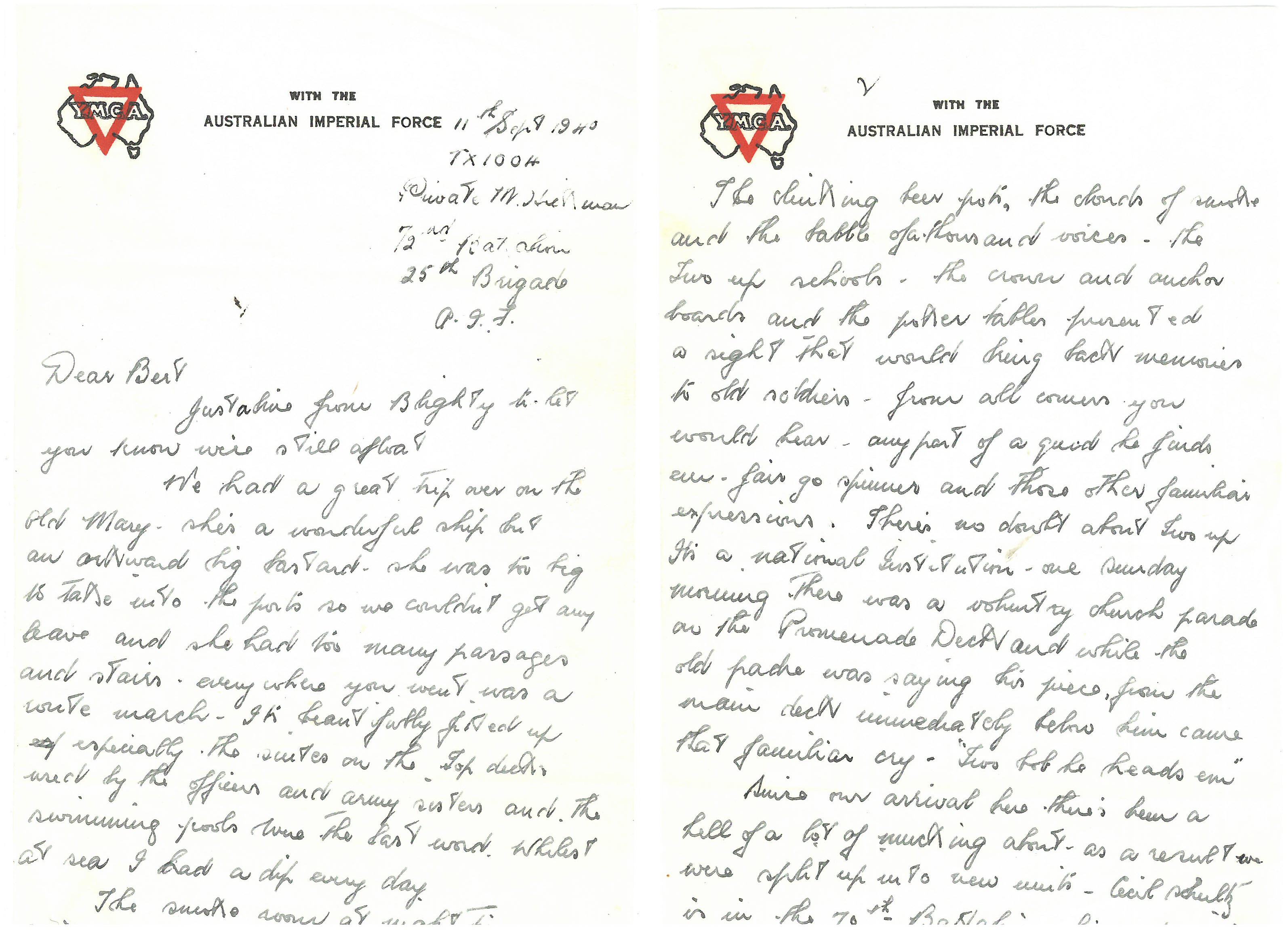
No such luck as a show…15 September 1940

15 Sept 1940 p1 2

15 Sept 1940 p 3 4

15th Sept

TX1004

Private M Hickman

72nd Battalion

25th Brigade

AIF

Dear Mother

Being the Sabbath and having a little time to myself I cannot better employ it than in writing you and the youngster.  I wrote to May a few days ago.

There is however little of which I can write you for by(?) and camp routine our activities are decidedly limited.  As I told you in an earlier letter the six days leave didn’t get as far as me and although we’re told it’s only been suspended one would certainly be an optimist to put any faith in army promises beside which the promises of politicians are most modest.

The people Ac Hallam writes to in Scotland wrote back for detailed information regarding the Scottie Rig for Anne – but it should be here next week probably about the 24th.  Anyway as soon as it comes I’ll get the censors to look it over and forward it straight on.  I hope you’ll all like it.  I guess Anne will preen herself to some order and will probably assume a Scotch title in keeping.

I had a letter from Mrs Toomey on Saturday.  It was written on the 8th of July – nearly ten weeks ago however the mails should be in regular order soon as it will be addressed to the right units and not through the old units.  She gave me the address of a Mr Lauder (Lander?) in Gloucestershire but as I don’t anticipate ever being in Gloucestershire it won’t be of much use to me.

Although I’m pretty sure there’s a move on foot it’ll probably only be to barracks – no such luck as a show.  They’ve started work putting in hot showers and sewerage and when anything like that starts you can safely assume that we’ll be moving.

We’ve had a slight shift around in camp.  I’m now in a tent full of banana benders.  Five Queenslanders and believe me they keep me busy.  There’s one fellow from Brisbane – the most cynical self conceited fellow in the world – a man with no vices and damn few virtues.  Two others both about 21 are very love sick, one was a clerk on Thursday Island the other comes from a cane growing district.  Then there’s a half caste chap and lastly but by no means least a chap named McGoldrick, a drover and horse breaker from the old back [presumably outback] – a fine fellow in every way.

The Duke of Gloucester paid a visit to camp a few days ago not that we were very interested in him or he in us but both parties probably thought the other was interested.

I received a Womans Weekly in the mail today but as I didn’t recognise the writing I don’t know where it came from but there’s some good stories in it and Lower(?) is well on form.

Well Mother I’m really at a loss for anything else to write you so with love to you, May and Anne and regards to the pater, Laurie and the troops I’ll say cheerio.

Love

Max

My regards to Mr & Mrs Phillips and Mrs Wilson’s family

PPS I’m sending youngster a birthday cable on Tuesday.  I hope it gets there OK.

Comments

Numbering of letters

Dad had suggested that he would number his letters so his mother could tell when one was missing – and he could potentially fill in the gaps later, using his diary, but after numbering the letter of 15th August as 2, and the one of 5th September , as 4…there was no further numbering of letters.

Those Queenslanders

Although we would no longer use the term, there was no malice as far as Dad was concerned in using the term ‘a half caste chap’ .  I assume this was Charlie Mene – who was certainly a member of the Carrier Platoon, and who appreciated Dad’s support on at least one occasion in the following year.  There is an interesting chapter on Charlie who had been a ‘house boy’ for a doctor before the war and continued his professional Army career after it – in the book Fighters From the Fringe by Robert Hall (Aboriginal Studies Press 1995 Canberra).

The Battle of Britain

From the time of their arrival on Salisbury Plain, the Australian troops were aware of the Luftwaffes’s constant attacks on English cities and ports, factories and aerodromes.

The increasing tempo of the air war, and warnings that Germany might attempt beach landings…created as sense of urgency in the every day training of the battalion…Each day, a rifle company acted as defence company on third minutes’ notice and of the company, one platoon was to be in battle order, with ammunition issued, at immediate notice….Tidworth Park was only fourteen miles front he series of airfields and airstrips in and around Andover from which the RAF fighters operated.  These fields were now becoming the target for enemy aircraft in the area….  (The Footsoldiers p 11)

On 8 September a general alert warning was issued to the battalion to be on three hours’ notice.  It was known if the Germans were to attack at all they must act by September, or e too late, before the weather set in.  During 5/6 September, the Luftwaffe transferred its attacks from the widespread targets to London and the docks and railway yards of the capital…..Not until 23 September was the battalion ordered to stand down from alert. (The Footsoldiers pp16-17)

Coincidentally, given the date of this letter, Battle of Britain Day is commemorated on 15 September each year.    According to the site – http://www.bbc.co.uk/history/events/battle_of_britain_day   the most decisive confrontation of the Battle of Britain took place in the skies above London on 15 September.

In a typed piece (possibly a ‘letter to the editor’ commemorating Battle of Britain Day) dated 23rd September 1949, Dad writes – By day, we saw the progress of air battles, the roar of machines, the crackle of machine gun fire, the whine of crashing planes, and by night the air-raid warnings, the sickening drone of bombers, and the crumbling of buildings….

Posted in Camps and Barracks, pay and conditions, Posts and telegraph, Uncategorized | Tagged , , , , , , | Leave a comment

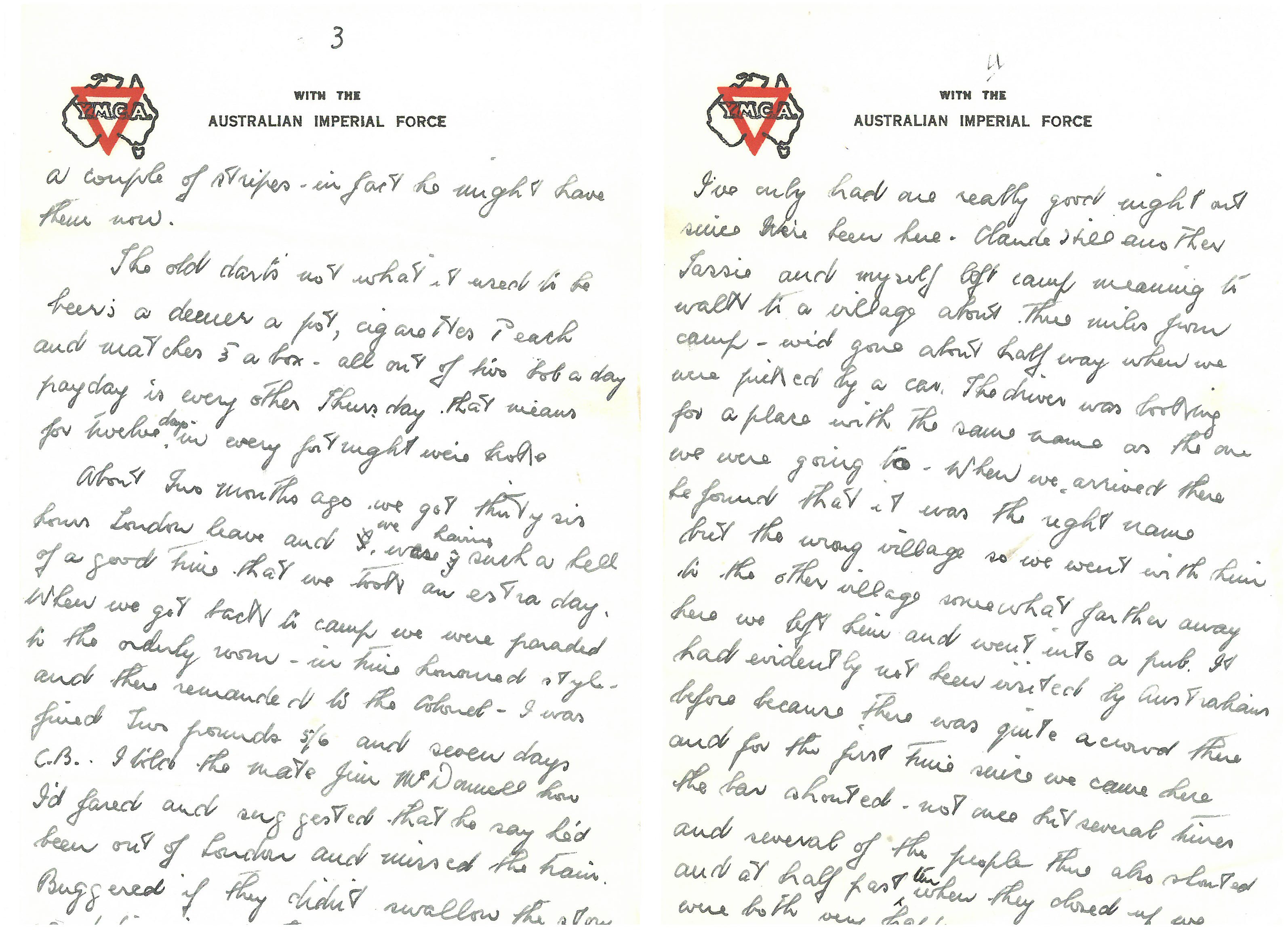
You blokes were only soldiers….letter to ‘Bert’

Dear Bert pp 1 2

Dear Bert pp 3 4

Dear Bert pp 5 6Dear Bert p7

11th Sept 1940

TX1004

Private M Hickman

72nd Battalion

25th Brigade

AIF

Dear Bert

Just a line from Blighty to let you know we’re still afloat.

We had a great trip over on the Old Mary – she’s a wonderful ship but an awkward big bastard.  She was too big to take into the ports so we couldn’t get any leave and she had too many passages and stairs – everywhere you went was a route march.  It’s beautifully fitted up especially the suites on the top decks used by the officers and army sisters and the swimming pools were the last word.  Whilest at sea I had a dip every day.

The smoke room at night time was like the bar of a mining town pub.  The clinking of beer pots, the clouds of smoke and the babble of a thousand voices – the Two up schools – the crown and anchor boards and the poker tables presented a sight that would bring back memories to old soldiers.  From all corners you would hear – any part of a quid he finds em – fair go spinner and those other familiar expressions.  There’s no doubt about Two up – it’s a national institution.  One Sunday morning there was a voluntary church parade on the Promenade Deck and while the old padre was saying his piece, from the main deck immediately below him came that familiar cry – ‘Two bob he heads em’.

Since our arrival here there’s been a hell of a lot of mucking about – as a result we were split up into new units – Cecil Schultz is in the 70th Battalion – he’s got quite a good job in the RAP and expects to get a couple of stripes – in fact he might have them now.

The old dart’s not what it used to be – beer’s a deemer a pot, cigarettes 1d each and matches 3d a box – all out of two bob a day.  Payday is every other Thursday that means for twelve days in every fortnight we’re broke.

About two months ago we got thirty six hours’ London leave and we were having such a hell of a good time that we took an extra day.  When we got back to camp we were paraded to the orderly room – in time honoured style and there remanded to the Colonel.  I was fined two pounds 5/6 and seven days CB [Confined to Barracks].  I told Jim McDonnell how I’d fared and suggested that he day he’s been out of London and missed the train.  Buggered if they didn’t swallow the story and dismissed the case.

I’ve only had one really good night out since we’ve been here.  Claude Hill another Tassie and myself left camp meaning to walk to a village about three miles from camp.  We’d gone about half way when we were picked up by a car.  The driver was looking for a place with the same name as the one we were going to.  When we arrived there he found out it was the right name but the wrong village so we went with him to the other village somewhat farther away.  Here we left him and went into a pub.  It had evidently not been visited by Australians before because there was quite a crowd there and for the first time since we came here the bar shouted – not once but several times – and several of the people there also shouted and at half past ten when they closed up we were both very happy.

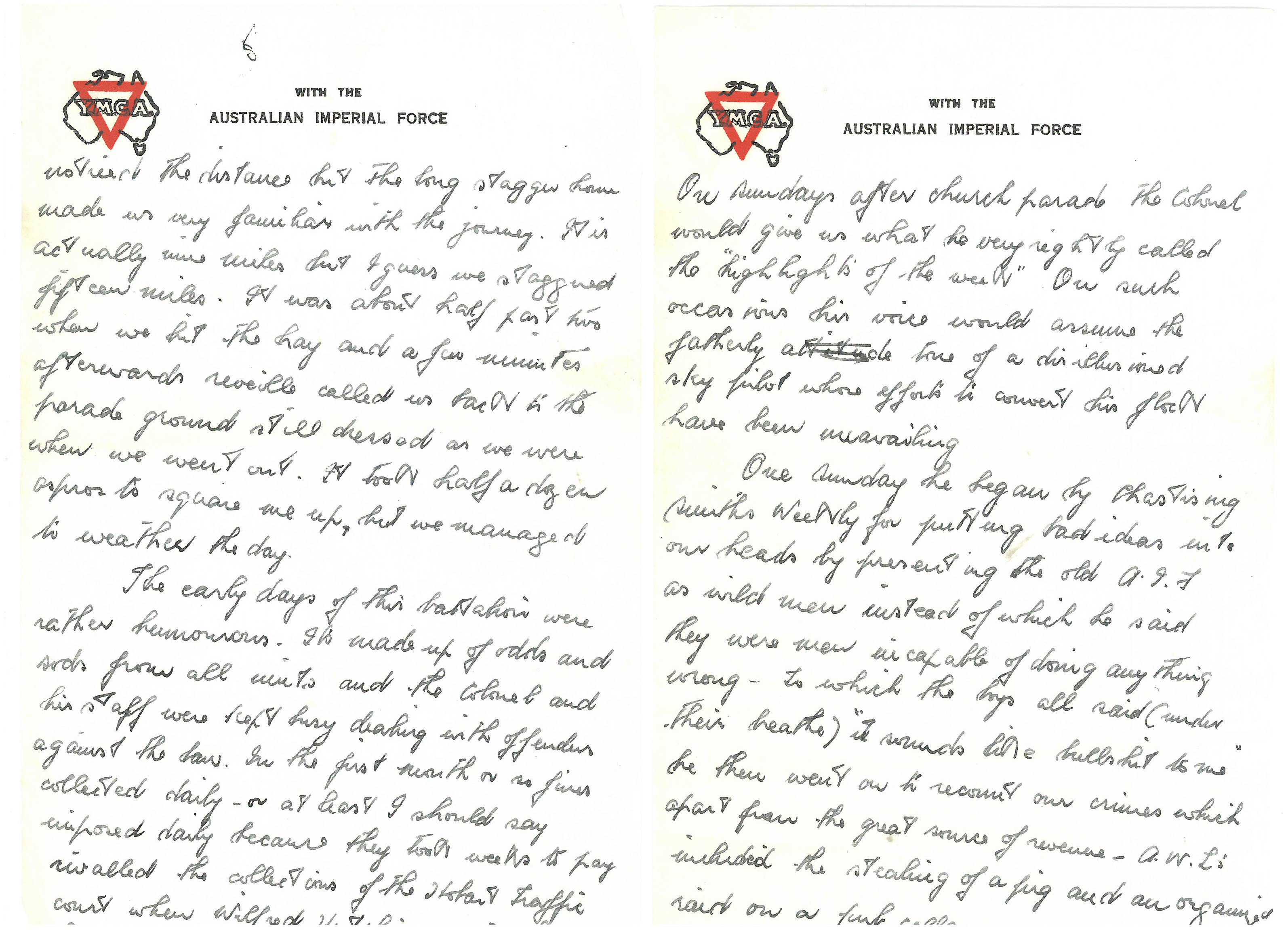
When travelling in the car we hadn’t noticed the distance but the long stagger home made us very familiar with the journey.  It is actually nine miles but I guess we staggered fifteen miles.  It was about half past two when we hit the hay and a few minutes afterwards reveille called us back to the parade ground still dressed as we were when we went out.  It took half a dozen a pros to square me up, but we managed to weather the day.

The early days of this battalion were rather humorous.  It’s made up of odds and sods from all units and the Colonel and his staff were kept busy dealing with offenders against the law.  In the first month or so, fines collected daily – or at least I should say imposed daily because they took weeks to pay – rivalled the collections of the Hobart Traffic Court when Wilfred Hutchins was in his heyday.  On Sundays after church parade the Colonel would give us what he very rightly called the ‘highlights of the week’.  On such occasions his voice would assume the fatherly tone of a disillusioned sky pilot whose efforts to convert his flock have been unavailing.

One Sunday he began by chastising Smiths Weekly for putting bad ideas into our heads by presenting the old AIF as wild men instead of which he said they were men incapable of doing anything wrong – to which the boys all said (under their breaths) ‘it sounds like bullshit to me’.  He then went on to recount our crimes which apart from the great source of revenue – AWL’s – included the stealing of a pig and an organised raid on a pub cellar.

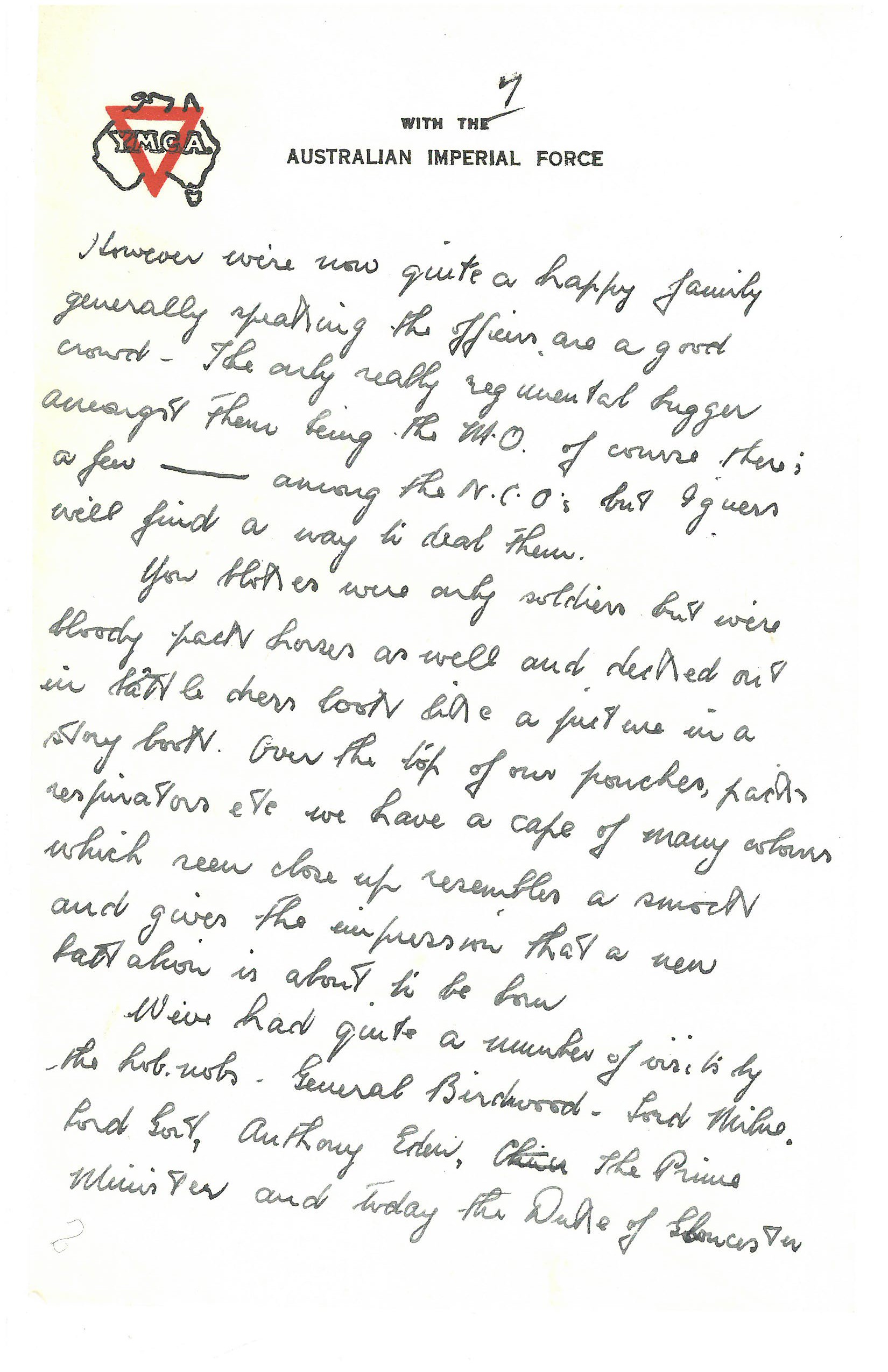
However we’re quite a happy family generally speaking the officers are a good crowd – the only really regimental bugger being the MO.  Of course there’s a few _____ among the NCO’s but I guess we’ll find a way to deal with them.

You blokes were only soldiers but we’re bloody packhorses as well and decked out in battle dress look like a picture in a story book.  Over the top of our pouches, packs, respirators, etc we have a cape of many colours which seen close up resembles a smock and gives the impression that a new battalion is about to be born.

We’ve had quite a number of visits by the hob nobs – General Birdwood, Lord Milne, Lord Gort (?), Anthony Eden, the Prime Minister and today the Duke of Gloucester.

…..further page/s missing……

Comments and Questions

Who was Bert?  

This is the only letter in the collection that was written to ‘Bert’.  It’s clear he was an older man – presumably a veteran of WWI.  The only relative I can find with a name approximating ‘Bert’ is his uncle Robert – but he was known as Bob.  Bob Hickman is described in Robert Kellett’s book about the Hickman family (The Descendants of Richard and Phyllis Hickman, 2002) as ‘a rather shy gentleman’ who purchased the Hickman home ‘Normanville’ from his uncle Richard’s estate and later moved to a property in Florence St Moonah where he conducted a very successful orcharding business until his death in 1960, aged 89.

Leave during transit on the Queen Mary

Dad reports they were not able to take any shore leave.  According to the account in The Footsoldiers (p6), this was true for Fremantle – when the inability of the ship to dock had ’caused the troops aboard her to be the only ones not to get a last leave in Australia.  This had created some ugly scenes on board’ – but not for Capetown where shore leave was ‘gained precariously by those on board the Queen Mary…There was a tremendous swell …and troops had to jump – singly – on to weaving and bobbing tugs.  But it was accomplished.’  Presumably, Dad didn’t fancy taking that leap of faith!

The journey to the village pub

It’s a mystery to me why, in the letter to his mother about the same event, he said the car was driven by a woman – but on this occasion, it’s a man.

The Battalion’s early days

Dad says the early days of the battalion were ‘rather humourous’.    The Footsoldiers account (p8) describes those early days thus:

Although most of the officers and NCO’s of the 17th and 19th Brigade reinforcements had been transferred with the groups, virtually no NCO’s had been transferred front he support and technical units, and, until some equipment was forthcoming not a great deal of worthwhile training could be done.  All the men could march, salute, carry out rifle drill after a fashion, but the specialist drills and minor tactics of the platoons of an infantry battalion had yet to be learned. But with a lamentable lack of equipment and too few NCO instructors, the immediate road ahead appeared a bit rugged.

Later, describing the first CO’s shield (shared in the previous post on this blog), author Bill Crooks again makes reference to the difficulties of those early days:

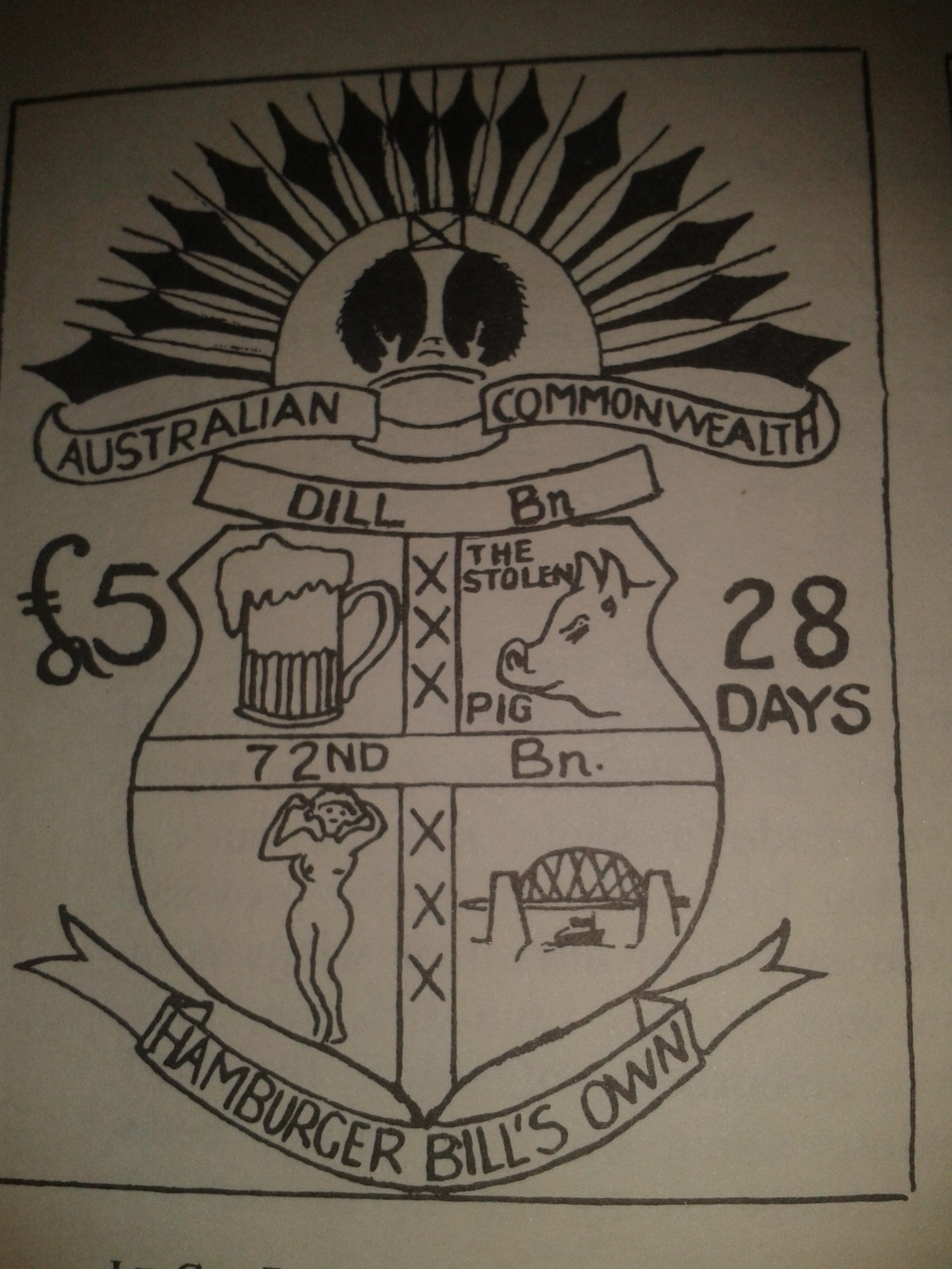
The ‘Dill Battalion’ appearing on the crest is a point appreciated by those who knew the unit in its infancy, when the troops – all from the 6th Division AASC [Australian Army Service Corps], Ammunition Sub-Park, 2/3rd Field Regiment, 2/1st Anti-Tank Regiment, and others – were struggling gallantly to master the intricacies of the PBI [Poor Bloody Infantry] weapons.       (The Footsoldiers p 443)


Posted in at sea, Britain, escapades, relaxation, fun and games, Letters to/ from others, pay and conditions, Uncategorized | Tagged , | Leave a comment

The importance of diplomacy and a visit from Winston Churchill

5 Sept 1940 pp 1 2

5 Sept 1940 pp 3 4

5 Sept 1940 pp 5 6

5 Sept 1940 p 75th Sept 1940

TX1004

Private M Hickman

72nd Battalion

25th Brigade

AIF

4

Dear Mother

It seems that Thursday is ‘the day’ for us or at least for me – nearly all my mail has arrived on a Thursday and every alternate Thursday is pay day.  Today was exceptionally good – after returning from a day at the rifle range I found four letters.  One – that saucy Scotty card from you, one – airmail from youngster and one each from May and Jack.  It was the first I’ve had from Jack since the one I received at Fremantle.  Youngster said you’d had a good holiday and seemed refreshed with the change – that’s excellent news Mother.  Keep yourself fit and enjoy life to the most. I trust the pater is also well.  Youngster seems to be even more than usually immersed in work and from the tone of her letter seemed rather tired and out of sorts.  I hope the rush is over now and she can take things easier.  Jack seems rather disappointed that he’s been unable to enlist.

May mentioned in her letter two matters that occasion some concern.  Firstly the claim Harry Hope is making on Mrs Stevens for that plan.  I’m sure I paid for the plan and although plans even when used remain the property of the architect I never anticipated any trouble there because he’s never asked for any other plans back and I think he’s just being bloody lousy – he always was a hungry cow but I think that’s the limit wanting two fees for one plan especially when it’s only being used once.  In the second matter, that of the path at Vernons.  If I remember correctly I agreed to put a path two feet wide from the kitchen door to the laundry door but last time I was over there a builder was excavating at the back and I think that would release me from any obligation there but ask dad to go to Tregears and have a look at the contract and if I’ve undertaken to pay or do work to any specified amount then pay them.  May also mentioned that Anne has a pair of gum boots and has elevated herself to the rank of Sargent Major.  If she knew what we think of our Sargent Major she would choose a different rank.

Some time ago six days’ leave was granted by GHQ but when about half the battalion had had their leave it was suspended.  I had hoped to go to Scotland because unlike the occasion of the London leave when we had to pay our own fares and they were stiff too – this time rail warrants were issued entitling the holders to travel as far north as Glasgow or Edinburgh but as I was not one of the lucky ones I didn’t get away.  MacDonnell went. I was going to buy Anne a Scotty rig however Ac Hallam – I’ve mentioned him in other letters – met some people up there so I got him to write them asking them to get an outfit for me.  I sent two pounds but as the letter was only posted yesterday it may be some time before I get the parcel.  You’d better not tell Anne anything about it because should Fritz or Mussa run amock it would be hard to explain to her.

I was at Dick Schultz’ camp on Sunday afternoon.  Dick was in bed suffering rather a heavy recovery after his leave.  Last time I was there both he and Ken Jenkins were to get two stripes but now only one of them will get them and although Ken can lose Dick on actual knowledge, ten years’ tuition in diplomacy under old Ted will pull Dick through and the diplomat will as usual (in the Army) win the day.  Despite a somewhat strained atmosphere they both wished to be remembered to you.

Last night the camp was visited by the Prime Minister.  It was just after tea and we were having a kick of a football on the parade ground before going on duty again but when he arrived we went up to the microphone and for an impromptu turn out the boys put on a good show.  They sang several of the songs familiar to the old AIF and some new ones too.  The old man true to his photo is the embodiment of all that is best in England.  His face combines the brow of a philosopher with the jowl of a brute or perhaps it would be better described as representing a real bulldog displaying that docile friendship peculiar to a bulldog until roused and then that iron jaw and chin leave no doubt as to what is to be expected.  After nearly two generations of public life he is still the most virile force in this country.  The few words he spoke were genuine and sincere – He said that he was very pleased to see us here at this critical time and that in spite of the fact the England stands alone in Europe our friends in America and Europe were standing firm and after all we’ll be playing the final on our own ground so that should give us an advantage.

Well  mother I must sign off now so with love to you, May & Anne and regards to the Pater, Laurie, Mr & Mrs Phillips and the boys I’ll say cheerio.

Max

Training the Carrier platoon

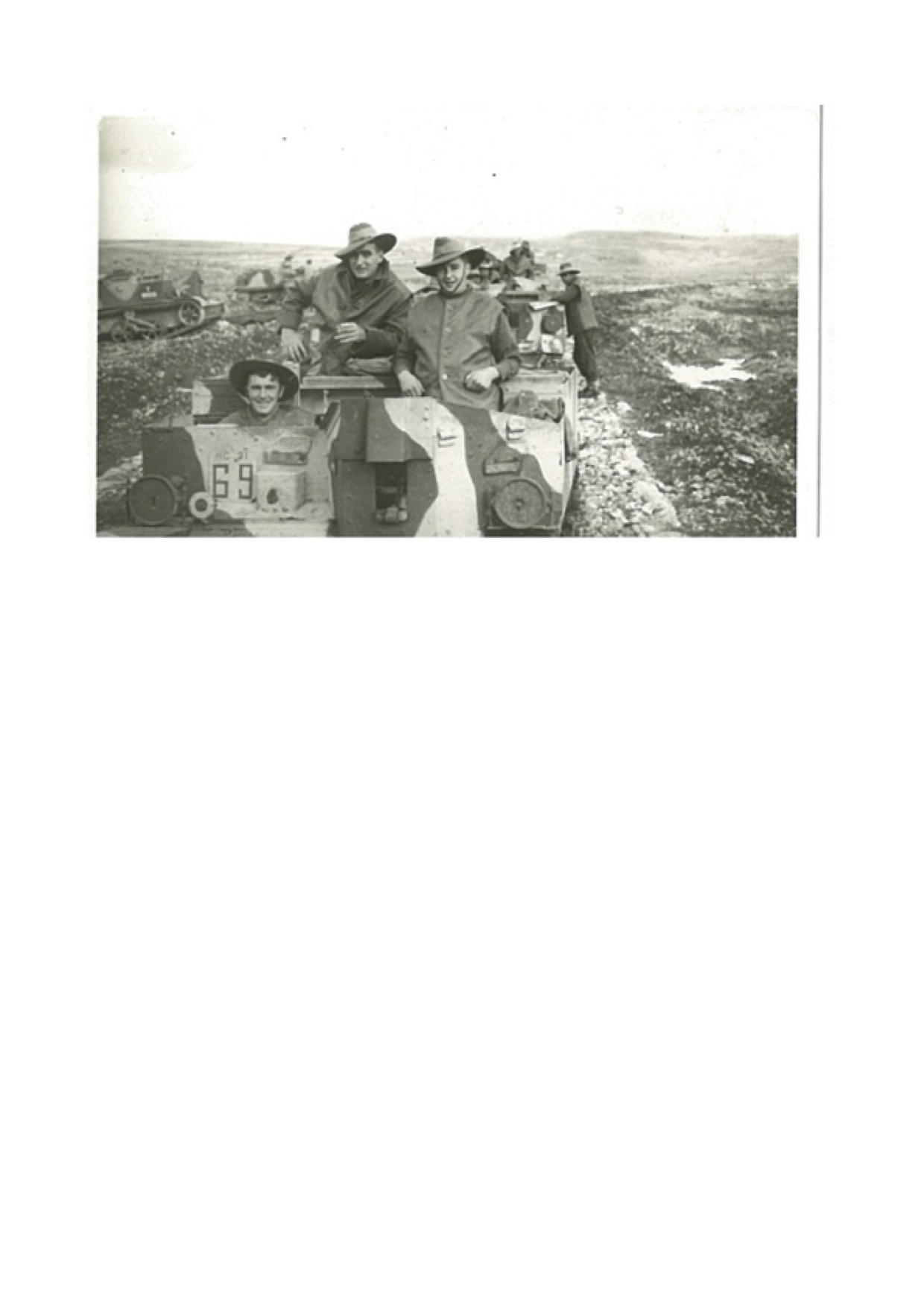
carriers training in England


Carriers in training England 1940 (Photo Dick Lewis)
some of the carrier platoon England


Some members of the Carrier Platoon

(Photo Dick Lewis)


Building works

On his enlistment documents, Dad’s occupation is shown simply as ‘contractor’, but in The Footsoldiers, the remark is made that he was ‘a builder from way back’ (p 256).

He certainly built the house we grew up in (21 Pottery Rd, Lenah Valley) and a number of others in the area.  During the Depression, he worked as a builders labourer on the Shrine of Remembrance in Melbourne.

Jack…unable to enlist

Jack Chandler was a teacher who had been posted to the Ashley Boys’ Home at Deloraine.  The home was both a detention and a training facility – see excerpt below.

Until the establishment of the Boys’ Training School in 1869, delinquents as young as eight or nine commonly went to gaol. The School housed approximately fifty inmates who were committed to the institution by court order, although a gaol sentence was not precluded. The boys attended night school after seven hours of manual and agricultural labour each day, gaining the institution a certain renown for its prize-winning pigs. In 1922, the School moved to Deloraine (renamed Ashley Boys’ Home) to improve farm training and remove the decadent city taint. (ref Children’s Homes in Tasmania www.utas.edu.au/library/companion )

‘Our friends in America…standing firm’?

I wonder what this refers to, as America had not yet entered the war.

Posted in Britain, world | Tagged , , , , , , | Leave a comment

Sending a wire June – August 1940

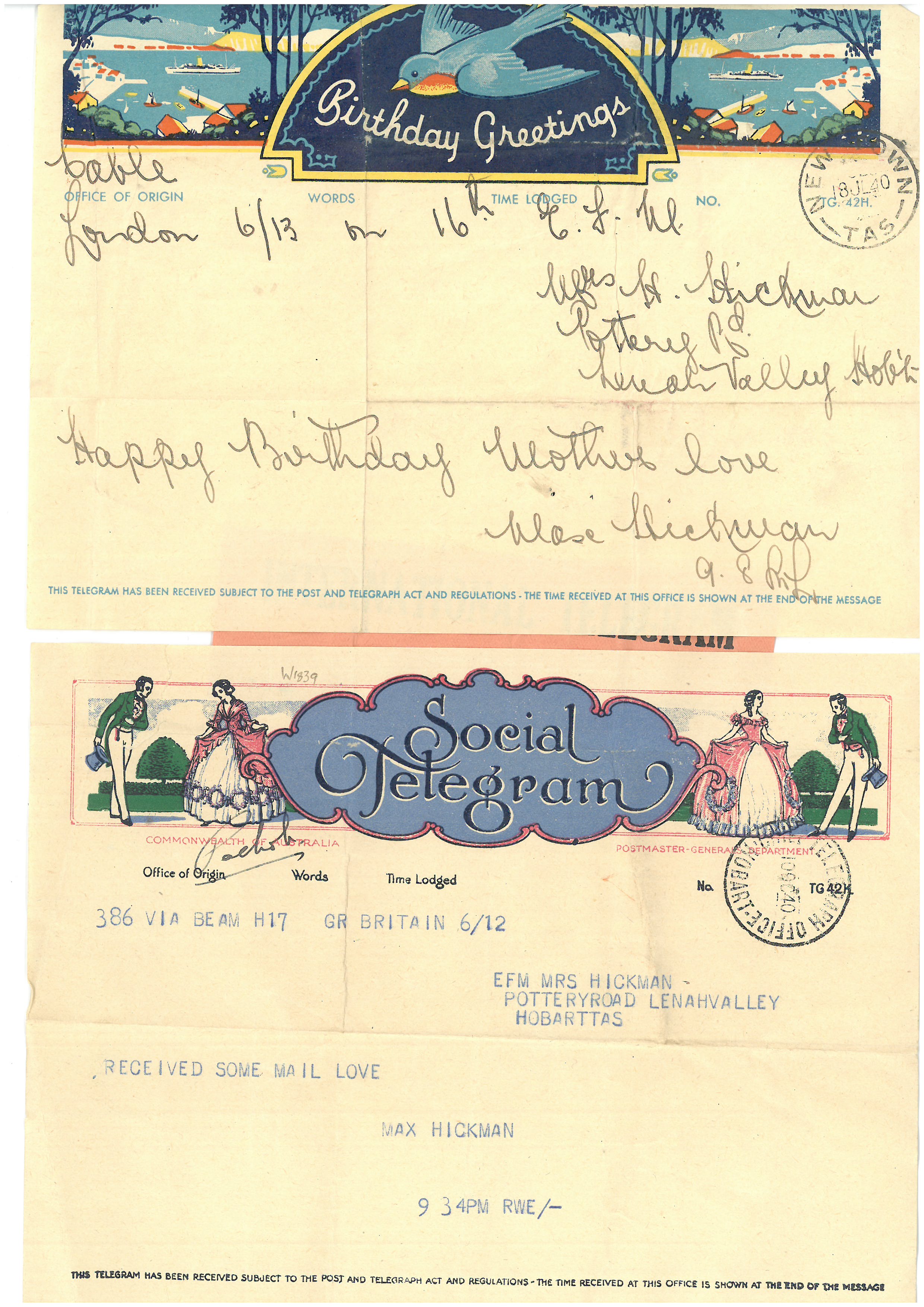
greetings from the shipEngland safe and wellbirthday and social telegram

Four  telegrams

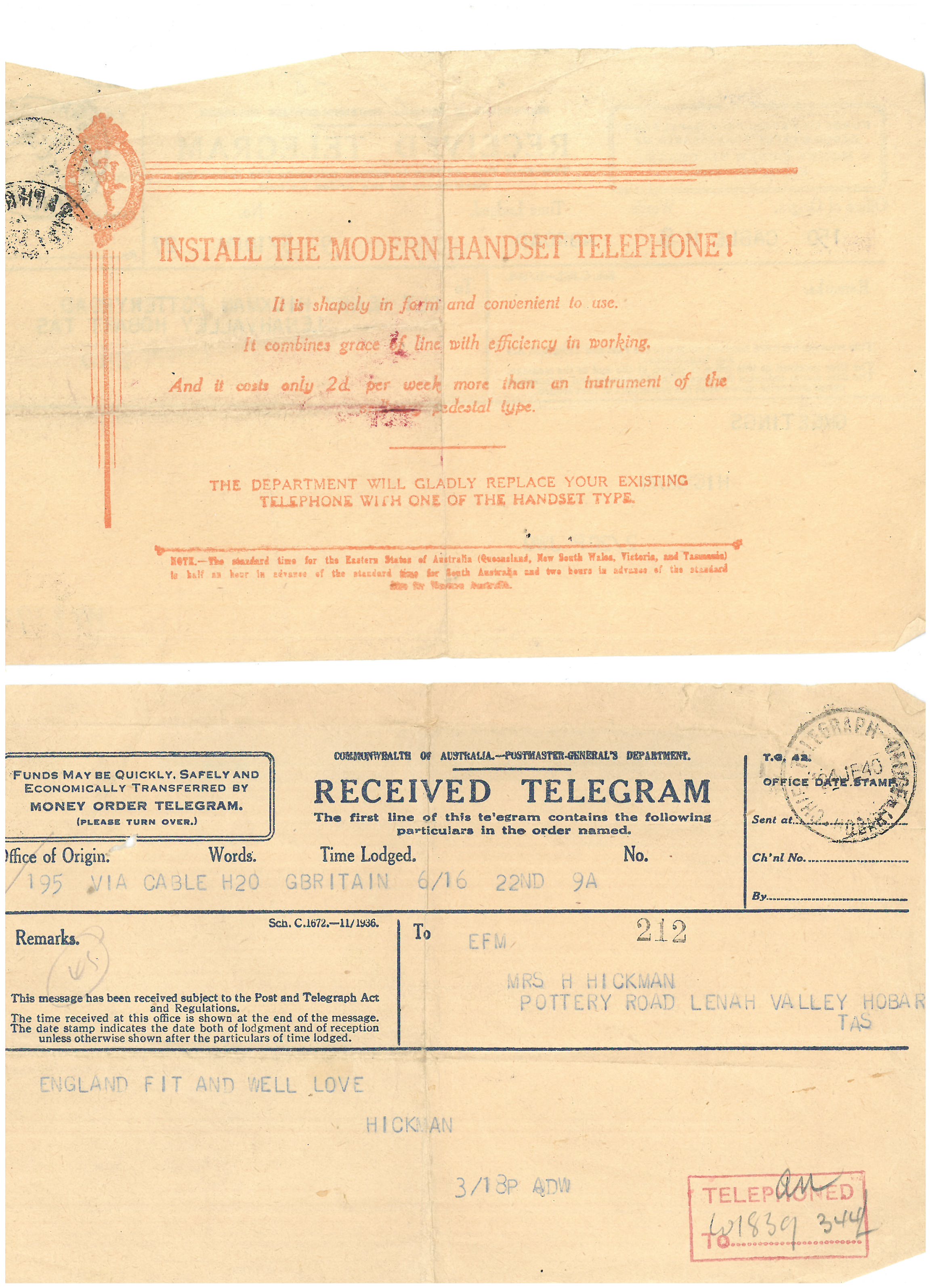
1.  I assume this one was sent from the ship.  It is sent via ‘GLT’ rather than ‘EFT’ which is the method for all others.   The Hobart date stamp shows 15 June 40.  The lodgement advice shows it originated ‘abroad’ (whereas the next one says Gt Britain) and I assume the time is 5.10pm on the 9th….though why they would use a 12 hour clock on board ship is a bit of a mystery!

Unlike all others, it is addressed to Dad’s father not his mother, and is a single word – Greetings – followed by his surname (Hickman) rather than Max or Max Hickman.  I assume one of these was sent on behalf of each man on the ship, before making landfall.  As a later letter comments with concern on his mother’s report that she has received no mail, I am sure she must have welcomed even this one word notification confirming that he was at least still alive after a much longer than expected voyage.

I am intrigued by the fact that it was telephoned through to my grandparents at W1839.  For all their married life, my parents lived in Pottery Rd – as my grandparents had done previously.  Nan and Pop moved to Courtney Street before I was born, but although we didn’t live in the house they had left, it seems we managed to inherit their phone number….since the one I committed to memory as a child was first of all 81839 then 281839, which finally became 62281839.

2.  Although this one is also from ‘Hickman’ rather than Max, it has a more personal tone – England fit and well Love...  It appears to have been sent (via Cable/ EFM) on the 22nd June and received on the 24th.

I love the advertisements on the back of these first two telegrams:

*****

CONSIDER THE ADVANTAGES OF A TELEPHONE IN THE HOME!

It contributes much to the security, happiness and efficiency of the household

As a rule, the rental is less than 2/- per week (even lower in the Country)

APPLY FOR A SERVICE TODAY – THERE IS NO INSTALLATION FEE

*****

INSTALL THE MODERN HANDSET TELEPHONE!

It is shapely in form and convenient to use

It combines grace of line with efficiency in working

And it costs only 2d per week more than an instrument of the  (–??) pedestal type

THE DEPARTMENT WILL GLADLY REPLACE YOUR EXISTING TELEPHONE WITH ONE OF THE HANDSET TYPE

*****

3.  Hand written Birthday Greetings

This cable was sent (via Cable/ EFM) from London on July 16 – Happy Birthday Mother love Max Hickman

It appears to have come through to and been delivered by the New Town Post Office (I assume there wasn’t one in Lenah Valley at that time): there is no stamp confirming that the the message was phoned through.  The numbers at the end may indicate a time of delivery (9.8)

The back of the telegram is blank.

4. Social Telegram: Mail from home

Like his mother, Dad was desperate for news of family and friends.  Finally in early August he received his first letters and telegrams – some of which arrived after very convoluted journeys. The message here is of relief – Received some mail love Max Hickman.

I can’t decipher the date on the stamp.  It could be 109040 Which would be a strange way of saying September 10 – though that’s possible.  Unlike the others it was sent ‘via Beam’.

This one is also blank on the back.  The  numbers at the bottom may once again indicate a time of delivery (9.34pm).

Posted in at sea, Britain, Posts and telegraph, Uncategorized | Tagged | Leave a comment

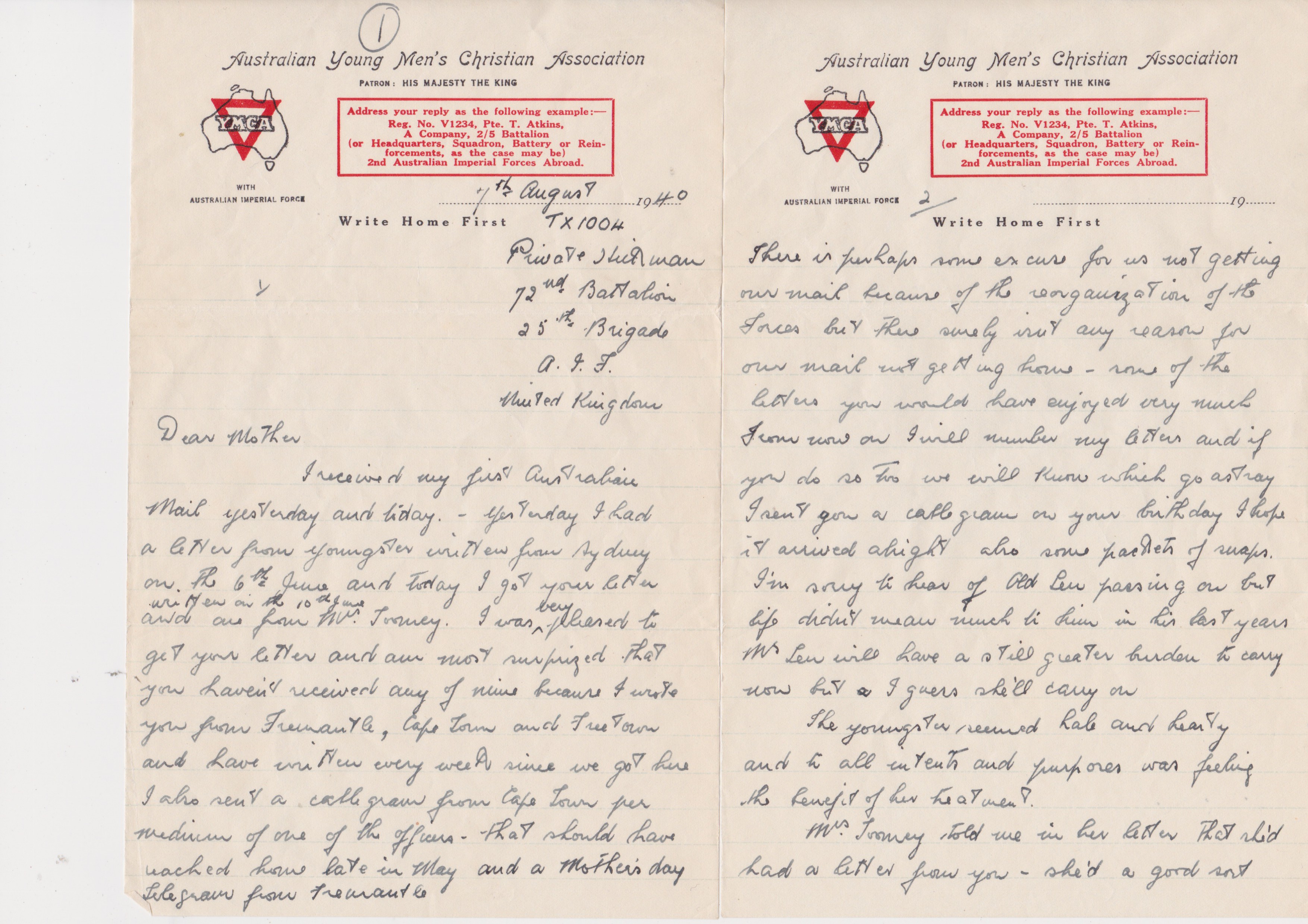
Mail, Misdemeanours and English hospitality August 1940

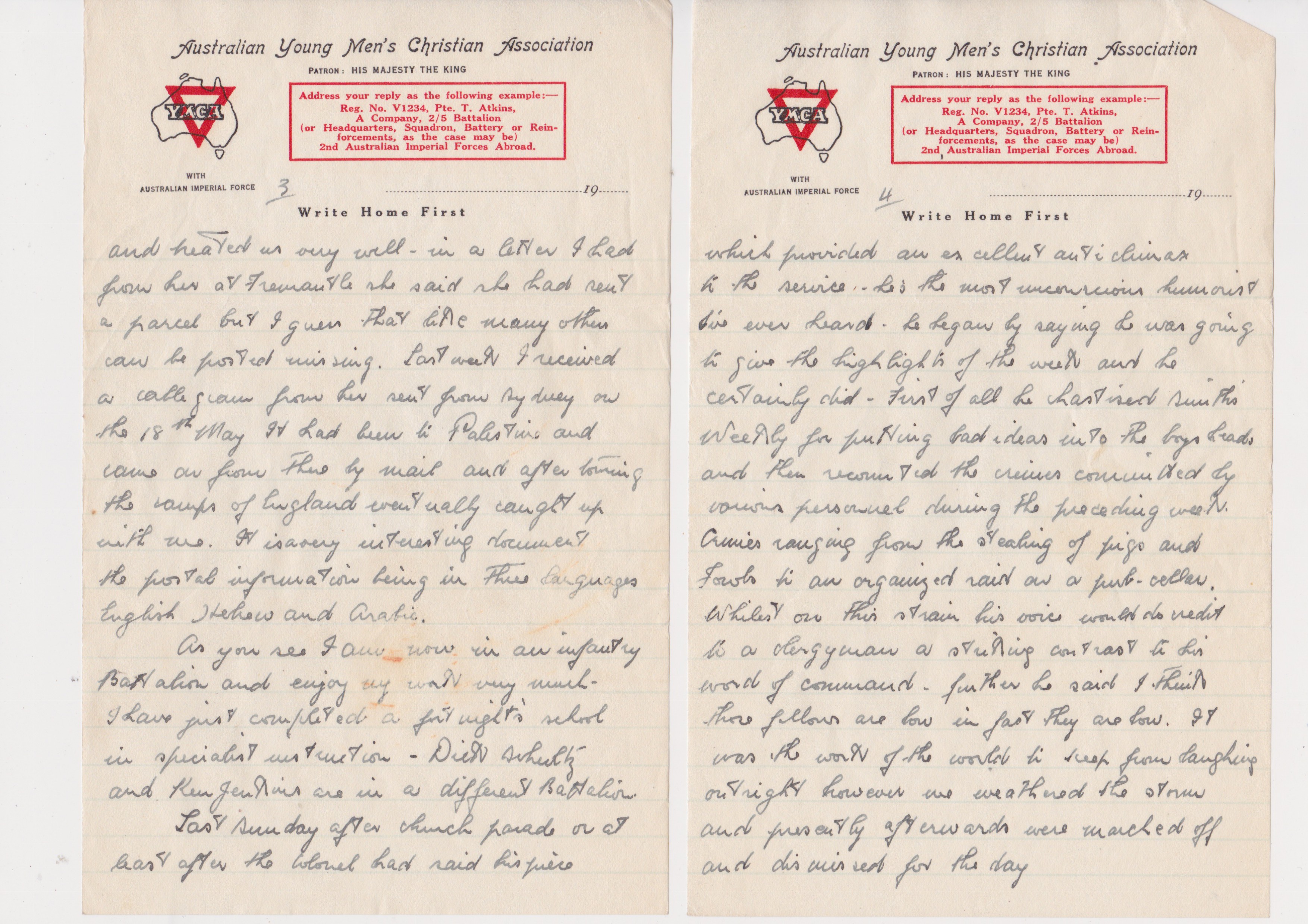
7 August 1940 pp1 2 7 August 1940 pp3 4

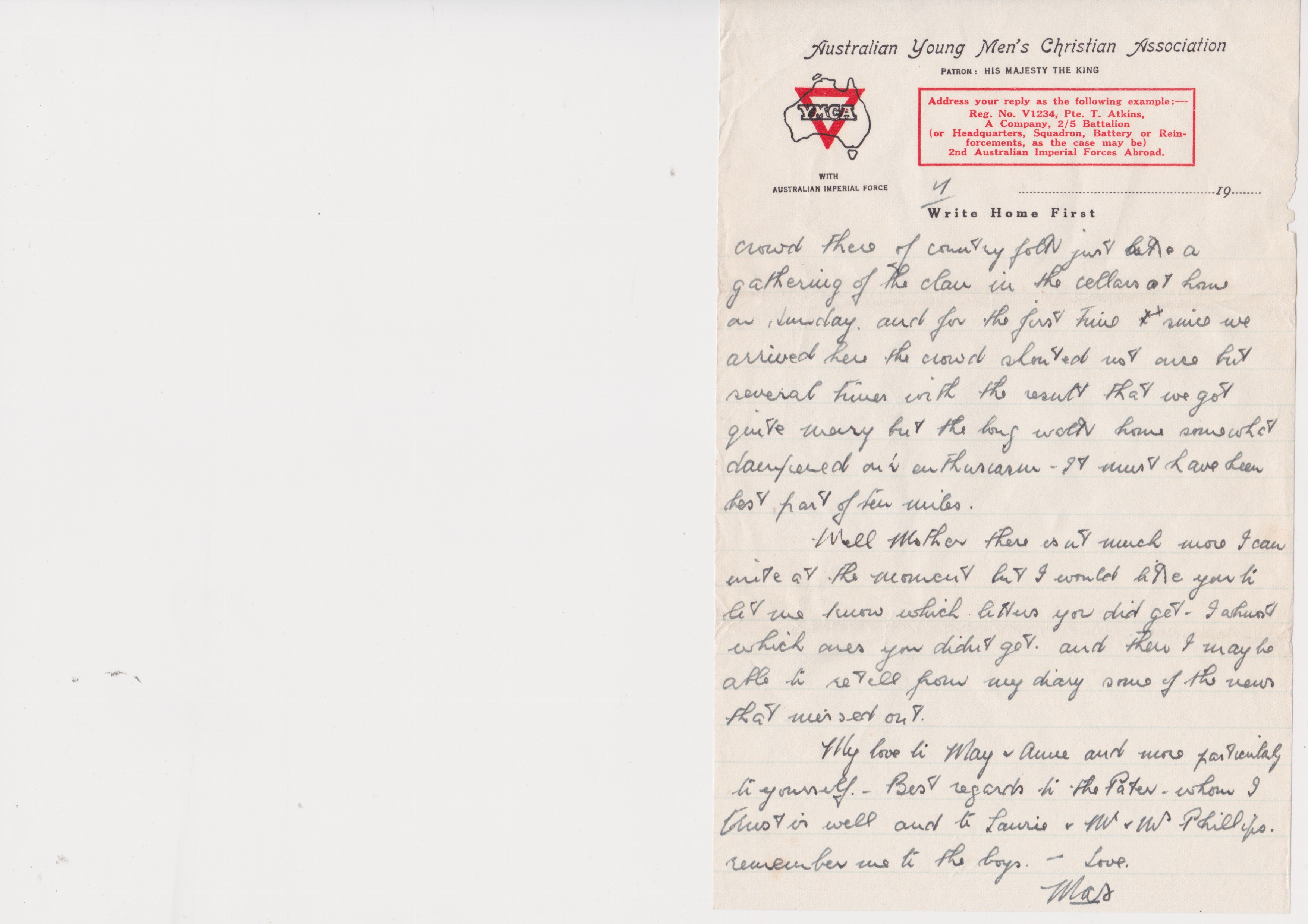
7 August 1940 pp5 6

7 August 1940 p77th August 1940

TX1004

Private Hickman

72nd Battalion

25th Brigade

AIF

United Kingdom

Dear Mother

I received my first Australian mail yesterday and today.  Yesterday I had a letter from youngster written from Sydney on the 6th June and today I got your letter written on 10th June and one from Mrs Toomey.  I was very pleased to get your letter and am most surprized that you haven’t received any of mine because I wrote you from Fremantle, Cape Town and Freetown and have written every week since we got here.  I also sent a cablegram from Cape Town per medium of one of the officers – that should have reached home late in May and a Mothers Day cablegram from Fremantle.

There is perhaps some excuse for us not getting our mail because of the reorganization of the Forces but there surely isn’t any reason for our mail not getting home – some of the letters you would have enjoyed very much.  From now on I will number my letters and if you do so too we will know which go astray.   I sent you a cablegram on your birthday.  I hope it arrived alright also some packets of snaps.  I’m sorry to hear of Old Len passing on but life didn’t mean much to him in his last years.  Mrs Len will have a still greater burden to carry now but I guess she’ll carry on.

The youngster seemed hale and hearty and to all intents and purposes was feeling the benefit of her treatment.

Mrs Toomey told me in her letter that she’d had a letter from you – she’s a good sort and treated us very well – in a letter I had from her at Fremantle she said she had sent a parcel but I guess that like many others can be posted missing.  Last week I received a cablegram from her sent from Sydney on the 18th May.  It had been to Palestine and came on from there by mail and after touring the camps of England eventually caught up with me.  It is a very interesting document the postal information being in three languages – English, Hebrew and Arabic.

As you see I am now in an infantry Battalion and enjoy my work very much.  I have just completed a fortnight’s school in specialist instruction.  Dick Schultz and Ken Jenkins are in a different Battalion.

Last Sunday after church parade or at least after the Colonel had said his piece which provided and excellent anticlimax to the service – he’s the most unconscious humorist I’ve ever heard – he began by saying he was going to give the highlights of the week and he certainly did.  First of all he chastised Smith’s Weekly for putting bad ideas into the boys’ heads and then recounted the crimes committed by various personnel during the preceding week.  Crimes ranging from the stealing of pigs and fowls to an organised raid on a pub cellar.  Whilest on this strain his voice would do credit to a clergyman a striking contrast to his word of command – further he said I think those fellows are low in fact they are low.  It was the work of the world to keep from laughing  outright however we weathered the storm and presently afterwards were marched off and dismissed for the day.

I went to the camp where Dick and Ken are stationed.  They’ve both got good jobs in the RAP – Dick is Battalion masseur and Ken an MO’s assistant.

Dick had just returned to camp – he went on leave on Saturday and was due back to camp at ten that night but went with another chap (whose birthday it was) to a town that’s out of bounds at present and got gloriously sizzled – at eleven o’clock he reported to the police that he’d been to a town near camp and had caught the wrong bus.  The Police took them to a military barracks where they were given a bed, a good breakfast, and a rail pass back to camp in addition a letter to the Colonel explaining the circumstances – That’s about the best I’ve ever heard – instead of being fined two pounds and seven days they got bed, breakfast and free transport.  Dick’s looking particularly fit and asked to be remembered to you and the pater.  Ken was away at the time so I didn’t see him however I had tea with Dick and Dudley Raynor, played a few games of crib and returned to camp.

One night last week I had leave till midnight and went with Claude Hill to a small village about three miles from camp.  Just before reaching our destination we were picked up by a lady in a car and she took us to a village of the same name but considerably further away.  Claude had the price of a couple of drinks – I was broke, still paying off a fine incurred for overstaying my London leave – so we went into the local pub.  It was a tumbledown shanty but there was a congenial crowd there of country folk just like a gathering of the clan in the cellars at home on Sunday, and for the first time since we arrived here the crowd shouted not once but several times with the result that we got quite merry but the long walk home somewhat dampened our enthusiasm – It must have been the best part of ten miles.

Well mother there isn’t much more I can write at the moment but I would like you to let me know which letters you did get.  I almost said which ones you didn’t get – and then I may be able to retell from my diary some of the news that missed out.

My love to May and Anne and more particularly to yourself.  Best regards to the Pater – whom I trust is well and to Laurie and Mr and Mrs Phillips.  Remember me to the boys.  Love  – Max


Comments : Family matters

‘The youngster’ was Dad’s younger sister Ivy Drysdale.  She was an accountant who lived on the mainland – in Sydney then in Melbourne.  Her husband Bill was a navy officer.

May was his older sister who like his parents lived in Lenah Valley – probably also in Pottery Road.  While I was growing up, we lived at no. 21 and Auntie May and her family lived at no. 23 – but I don’t believe either of these houses was built until after the war. May was married to Laurie and Anne was her daughter.

‘The boys’ who are usually mentioned at the end of dad’s letters, were the family dogs.

‘Old Len’ was one of Dad’s great uncles – one of his father’s many brothers.  My grandpop  (‘the pater’) was one of 14 children, 12 of whom reached adulthood – 10 men and 2 women.  Six of dad’s great uncles and both great aunts were alive at the start of the war.  Old Len and his wife Elizabeth (‘Mrs Len’) lived on a property called Lenfern in Lenah Valley Road.  According to Hickman descendant Robert Kellett (in The Descendants of Richard and Phyllis Hickman, 2002) Len passed away suddenly at home whilst sitting at the table.  ‘Mrs Len’ was known as a very hard working lady who worked in their extensive orchard, raised pigs and made many varieties of wine.

Crimes, ranging from the stealing of pigs….

As the War progressed, members of the Battalion created an heraldic shield for each of its Commanding Officers.  The first of these – Lt-Col R W Bierworth’s shield – depicts in one quarter ‘the stolen pig’ whose story is recounted in The Footsoldiers (p443):

The stolen pig records the exploit of one Private Denton (thereafter known as ‘Piggy’).  On a particularly black night in England this character decided to eke out the meat ration by bayonetting a young pig and lugging ti home to camp in his universal kit-bag – this at a time when near was severely rationed in England and the farmer was not permitted to kill any pigs himself without Government authority!  Unfortunately for the pig-snatcher, her was passed en route (complete with pig) by one Alfie Buttrose, then commanding C company.  The shrewd Alfie found the RSM doing the rounds of the guard on reaching camp and promptly passed the buck to him.  The sequel may have been more drastic for the pork-lover had not the Officer’s Mess (including the CO) enjoyed fried pork chops next morning, unaware of the source of supply. The rest of the pig?  Ask the ‘Snake Pit’!

CO Shield 1

Posted in Britain, escapades, relaxation, fun and games, pay and conditions, Posts and telegraph, unit parades and church parades | Tagged , , , , , | Leave a comment

London leave extends to AWL

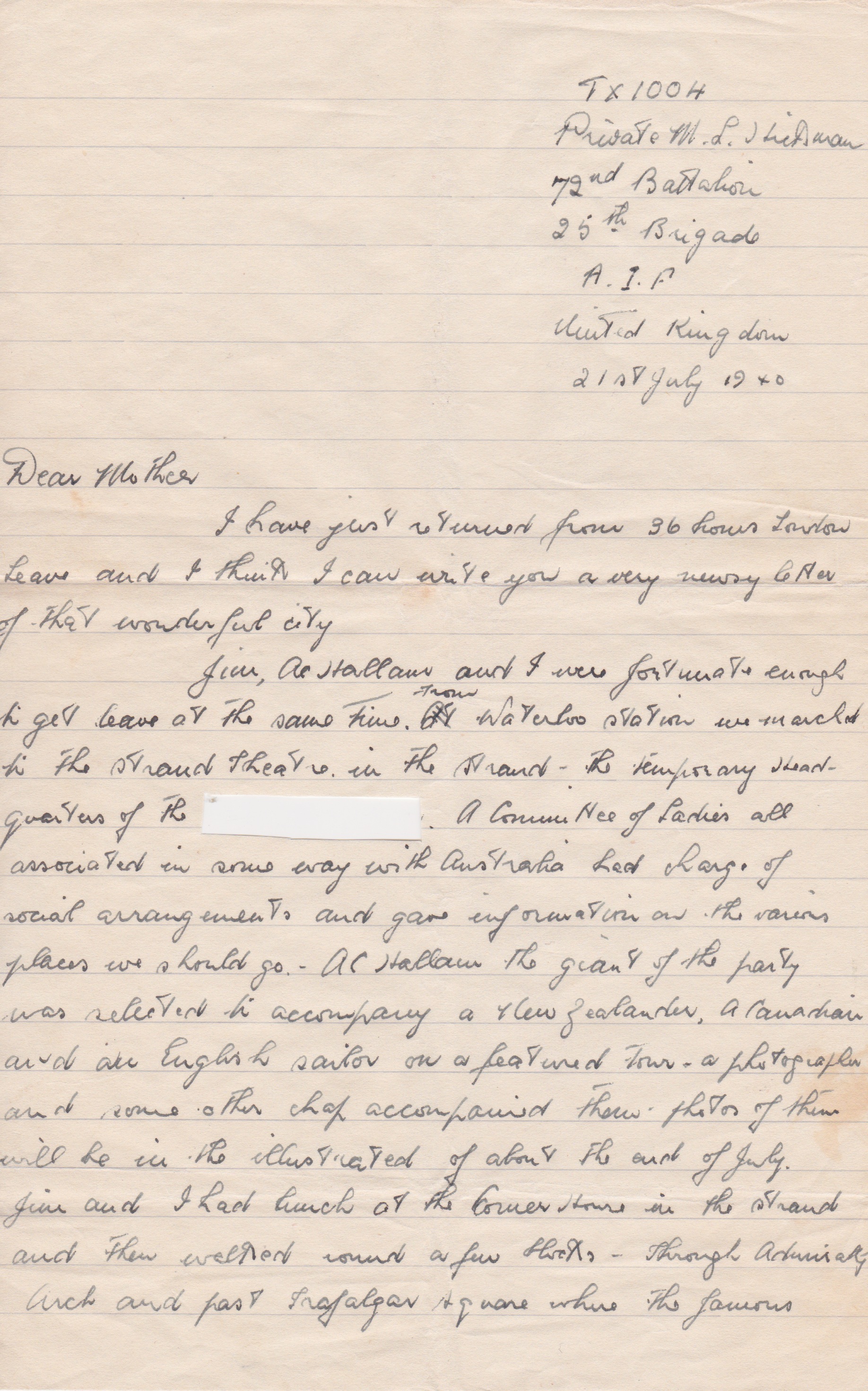
21 July 1940 p1

21 July 1940 p2

21 July 1940 p3

21 July 1940 p4

21 July 1940 p5

21 July 1940 p6

21 July 1940 p7TX 1004

Private ML Hickman

72nd Battalion

25th Brigade

AIF

United Kingdom

21st July 1940

Dear Mother

I have just returned from 36 hours London leave and I think I can write you a very newsy letter of that wonderful city.

Jim [McDonnell], Ac Hallam and I were fortunate enough to get leave at the same time.  From Waterloo Station we marched to the Strand Theatre in the Strand – the temporary headquarters of the ………[carefully cut out by the censor].  A committee of ladies all associated in some way with Australia had charge of social arrangements and gave information on the various places we should go.  Ac Hallam the giant of the party was selected to accompany a New Zealander, a Canadian and an English sailor on a featured tour – a photographer and some other chap accompanied them – photos of them will be in the illustrated of about the end of July.  Jim and I had lunch in the Corner House in the Strand and then walked around a few blocks – through Admiralty Arch and past Trafalgar Square where the famous Nelson Column stands.  (inserted above: When the Armistice was signed in 1918 the Aussies lit a fire at the base of the monument and cracked a big piece of the stone.)  There are thousands of pigeons in the square.  People go there and buy a packet of feed for the birds.  They are very tame and jump on to your hands, arms and head.

We walked back to the Strand where we joined a small party and were taken by a car driven by a Ladies Auxiliary driver to Parliament House as guests of Lord Denman – a former Governor General of Australia and the Duke of Devonshire.  We were taken into the House of Lords.  There was a debate on but it was not very interesting.  From there we went to the House of Lords Library – a series of magnificent rooms containing nearly 100,000 volumes.  There was a facsimile of the Charter signed by the members of parliament for the execution of Charles the First – the librarian told us that nearly all of them came to a sticky end.  There was not much chance to scrounge anything because we were accompanied by a CID man.  However I got some cards – one of which I am enclosing.  As we walked back along the corridor I was talking to Lord Denman and Jim walking behind with the car driver.  His nibs was telling me of a fishing trip he had at Lake Leake in 1912, and in the midst of it I heard Jim ask the lady if the old joker was the caretaker – Denman turned round and looked at him and grinned.  It was about the best I’ve ever heard.

We had afternoon tea – including strawberries and cream – and then went into the gallery of the House of Commons for a while.  It was then about five o’clock and Jim and I leaving the rest of the party went to the Charing Cross station and went by the tube train to Baker St Station from here we went to Madame Tussauds Wax works. This is the most incredible show imaginable – most of the works you would swear were human, every expression is there – perhaps the best of all is Roosevelt.  There must be a thousand representations and the guide booklet is in itself a most complete history.  All the Kings of England, the great figures of sport, statesmen, soldiers, sailors, scholars – a most amazing array that it would be impossible to describe.  It was about half past nine when we left there and went by bus to Highgate where we saw the spot marked by a stone where Dick Whittington first turned back to London and at the Dick Whittington Hotel partook of a couple of beers.  Had an excellent supper of steak and eggs and came back to the city and booked in at St Stephens Club – a tock (?) show for troops.

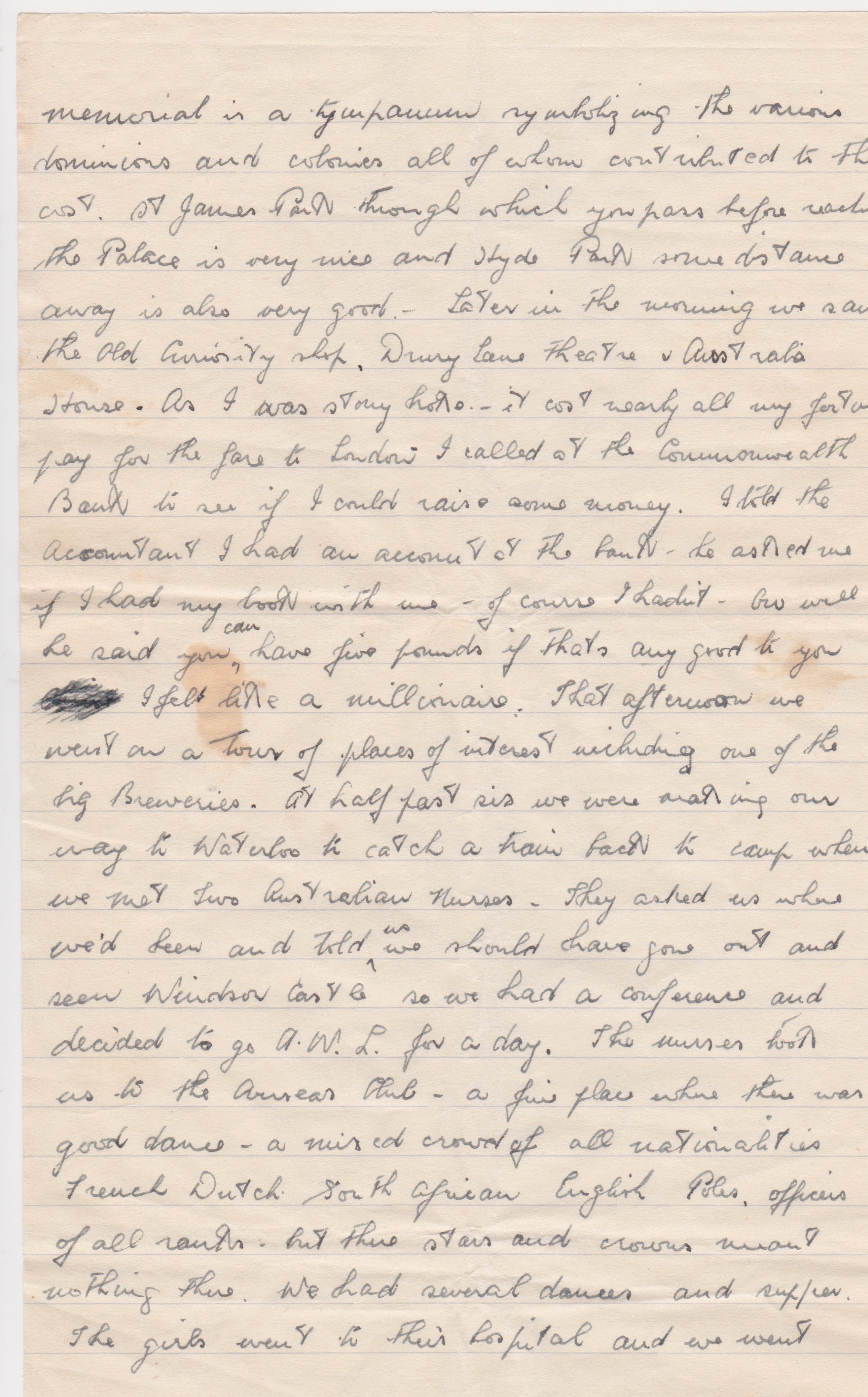
Up at six next morning we walked to Westminster Cathedral and from there to Buckingham Palace.  The Palace is very disappointing from the front – we saw the changing of the guards.  In front of the Palace is a memorial to Queen Victoria. The base of the main body of the memorial is very similar to the base of the shrine in Melbourne.  On top of the various columns that form part of the memorial is a tympanum symbolising the various dominions and colonies all of whom contributed to the cost.  St James Park through which you pass before reaching the Palace is very nice and Hyde Park some distance away is also vey good.  Later in the morning we saw the Old Curiosity Shop, Drury Lane Theatre and Australia House.  As I was stony broke – it cost nearly all my fortnights pay for the fare to London – I called at the Commonwealth Bank to see if I could raise some money.  I told the accountant I had an account at the bank – he asked me if I had my book with me – of course I didn’t – oh well he said you can have five pounds if that’s any good to you.  I felt like a millionaire.  That afternoon we went on a tour of places of interest including one of the big breweries.

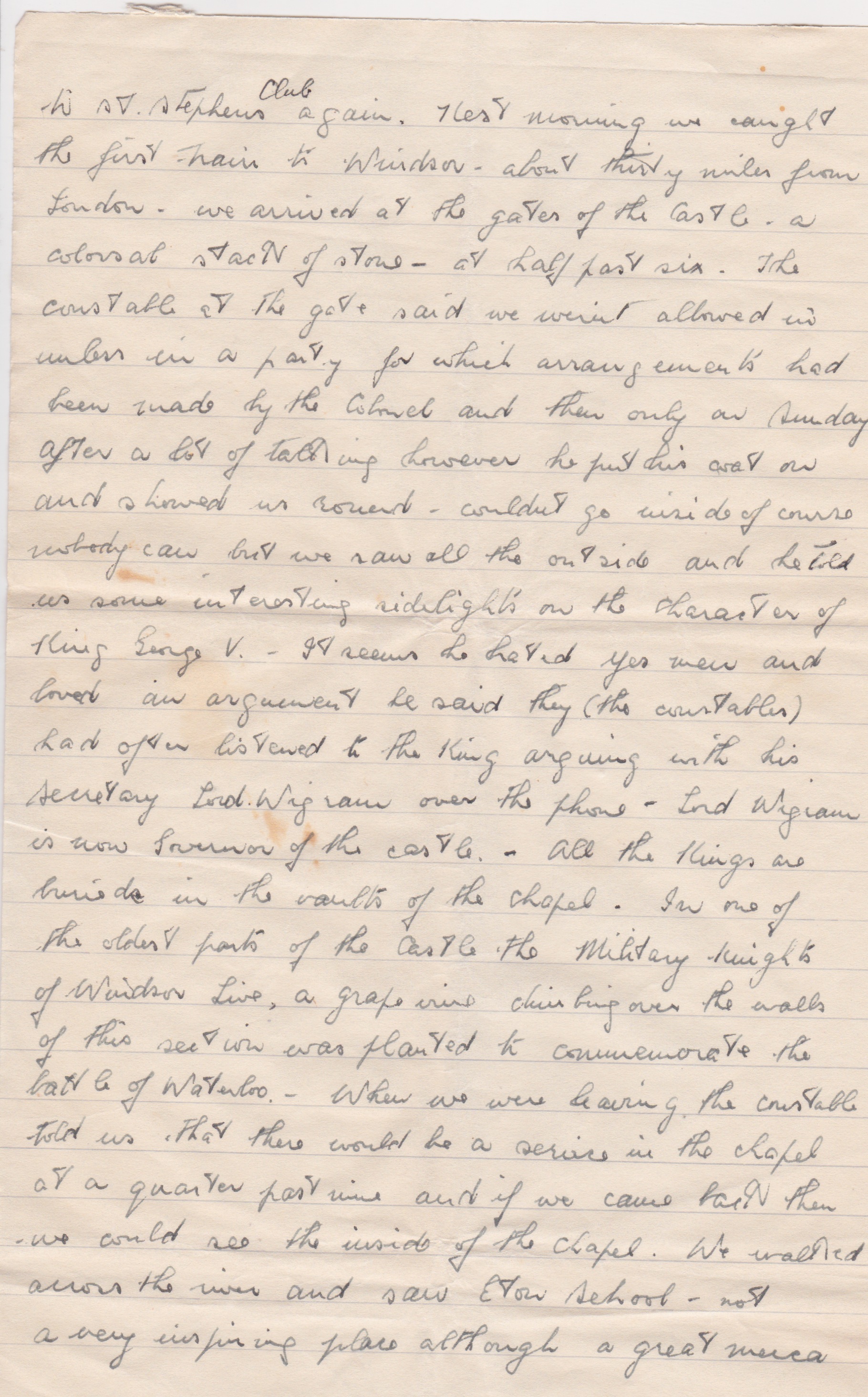
At half past six we were making our way to Waterloo to catch a train back to camp when we met two Australian nurses.  They asked us where we’d been and told us we should have gone out and seen Windsor Castle so we had a conference and decided to go AWL for a day.  The nurses took us to the Overseas Club – a fine place where there was a good dance – a mixed crowd of all nationalities – French, Dutch, South African, English, Poles, officers of all ranks – but their stars and crowns meant nothing there.  We had several dances and supper.  The girls went to their hospital and we went to St Stephens Club again.  Next morning we caught then first train to Windsor – about thirty miles from London.  We arrived at the gates of the Castle – a colossal stack of stone – at half past six.  The constable at the gate said we weren’t allowed in unless in a party for which arrangements had been made by the Colonel and then only on Sunday.  After a lot of talking however he put his coat on and showed us round – couldn’t go inside of course nobody can but we saw all the outside and he told us some interesting sidelights on the character of King George V.  It seems he hated yes men and loved an argument.  He said they (the constables) had often listened to the King arguing with his Secretary Lord Wigram over the phone.  Lord Wigram is now Governor of the Castle.  All the Kings are buried in the vaults of the chapel.  In one of the oldest parts of the Castle the Military Knights of Windsor live.  A grapevine climbing over the walls of this section was planted to commemorate the Battle of Waterloo.  When we were leaving the constable told us that there would be a service in the chapel at a quarter past nine and if we came back then we could see inside the chapel.  We walked a cross the river and saw Eton School – not a very inspiring place although a great mecca of Public school life.  Then we had breakfast and returned to Windsor.

The Chapel was open so we went in.  It’s a beautiful building built in a perpendicular Gothic style, peculiar I believe to English churches.  We’d had a good look round the main hall at the tomb of King George V and the many crests built ;into the ceiling when the service started int he small chapel.  More out of curiosity than religious fervour we went in.  I’ve never been to a church service like it in my life.  They tricked us at every turn – we were sitting when we should have been standing, standing when we should have been kneeling.  There were three clergymen and they all said a piece and whenever we did the wrong thing they scowled very appropriately.  It was a most embarrassing situation. but the glorious display of banners of Knights of the Garter and crests and the wonderful carvings justified it.  In the ceiling are the crests of all the Kings since William the conqueror.  I forgot to mention that the choir was excellent – one of the best in England I believe.

We returned to London about dinner time, had some lunch and then went to St Pauls Cathedral.  It’s absolutely marvellous – you’ve got no idea of the splendour of this place – in the crypt right under the dome is Nelson’s tomb and in the main body of the Cathedral the Duke of Wellington and other great men are buried.

From the Cathedral we went and saw The Monument – a column erected on then site where the great fire started in 1666.  Later the same day we were at the Marble Arch – among other places we saw were The Tower (outside only), Tower Bridge, the Cleopatra needle, the Masonic Temple, St James’ Park and Palace, Pall Mall, Nell Gwynn’s cottage, the Tower Bridge, London Bridge, Lambeth Palace.  That night we came back to camp.  It was the best experience I’ve ever had and though I’m paying for my misdemeanours the experience was worth the price.

Well Mother, Duty calls so cheerio and all the best to you, dad, May and Anne

Love

Max

My regards to Mr and Mrs Phillips, Laurie and the boys

PS Jim sends his best regards to you and the Pater.  As with me, the army’s cut down his beer ration – it’s eleven pence a pint here.


Comments and Questions

Army Pay

...’ it cost nearly all my fortnights pay for the fare to London’

According to Wikipedia (entry on Second Australian Imperial Force) an unmarried private in the AIF was paid 5s per day in Australia, with an extra 2s per day after embarkation for overseas.  Dad often spoke of being on ‘two bob a day’ so I wonder if he had signed over the other five bob to his parents (or his own account in Hobart) rather than having it entered in his Army pay book.  The fare would certainly have been exorbitant if it had really been nearly a fortnight’s pay at 7/- a day!

…’the army’s cut down his beer ration – it’s eleven pence a pint here.’

Even if they were receiving their full 7/- a day, eleven pence would be astronomical: they would only be able to buy 7 pints from a full day’s pay.  Imagine if that were the benchmark for the basic wage today!

Opening Hours

I’m amazed at how far they walked and rode around London, and the time they were able to spend in tourist attractions.  They left Madame Tussaud’s at around 9.30pm and caught a bus…and were still able to get a substantial meal in a hotel.

Money from the Commonwealth Bank

Dad did acknowledge in later years that the teller had recorded his army service number, so they would have been able to pursue him if his claim to having an account in Hobart had turned out to be false.

Nicknames

There are many nicknames in Dad’s letters.  I have no idea how ‘Alfred’ became ‘Ac’ Hallam.  In The Footsoldiers he’s referred to as ‘Hack’.  At least two different men were referred to as ‘Snow’ and two others as ‘Nugget’.

AWL

The penalty for the extended time spent in London is detailed in later letters, but he never changed his view that the experience was worth the penalty.

Posted in Britain, escapades, relaxation, fun and games, pay and conditions | Tagged , , , , | Leave a comment

Birth of the 72nd Battalion Carrier Platoon 27th June 1940

birth of the battalion

The first of many re-0rganisations

From The Footsoldiers (p7):

…”The last of the British troops were evacuated (from Dunkirk) on 18 June.  Most brought their rifles and personal equipment but transport and guns and tanks were lost.  This was the situation on the morning of 18 June, when the 18th Brigade began making its camps.  The artillery had no guns and little transport; the infantry had only rifles and a few Lewis and Vickers machine guns.  The large number of troops, all lacking necessary equipment, and divorced from the units – mainly the 6th Division – which they were intended to support – made it imperative that the force now in England be re-organised…..It was decided by Major-General Wynter, the GOC, to form another infantry brigade…on the morning of 26th June, it was simply a matter of a list of names being read out; selecting the essential gun crews to remain ; then splitting the remainder in two.  The right half were told to pack their gear and assemble on the main road….for the men who had joined together and in most cases had been together for nearly eight months this was indeed a depressing day…..Most of the men slept the first night in then open, having had a cup of tea instead of a meal and only groundsheets and greatcoats as beds.”

The Carrier Platoon

Dad didn’t comment on the specifics of the Battalion’s formation until many years after the war, when he wrote

Soon after our arrival at Salisbury Plains we were made aware of the gravity of the war situation.  The fall of France and the evacuation of Dunkirk with the consequent loss of equipment made it necessary for those in authority to re-organise the Australian contingent.  In the process several units were partially disbanded.  The Anti Tank Regiment was one such unit and after a short period of training in the use of Vickers machine guns, the group was split up into three platoons, one platoon being assigned to each of three new battalions being formed from the disbanded units.  These three battalions were designated 70th, 71st and 72nd battalions under British command.  The platoon to which I belonged was integrated into the 72nd Battalion. 

The letter above (as picture, and below as transcript) from Doug Cullen (VX11589) to ‘Bert’ was in Dad’s collection of papers…with no note as to how it came to be there – but it describes one small part of the story of the forming of the Battalion: specifically that of the Carrier platoon to which Dad belonged : it  was part of Headquarters Company.

Dear Bert

Just came a cross a list of original TX’s who joined the Battalion at Tidworth Park and thought you might like to have it.  All came over with Capt Larry Miller’s troop of 1st Anti Tank Regt, and marched into the then 72 Bn on 27th June, the day after the Bn was formed, and formed the Carrier Platoon.

Capt L Miller 2/1 A/T Sgt TX2007

Pte V T Abel TX 797

Sgt G Barclay TX 417

Pte T D Brereton TX 819

Pte P Barr SX 3763

Cpl R J Cole TX286

Pte A R Erp TX 751

Pte E G J Fleming TX351

Cpl J M Fletcher TX280

Cpl A E Hallam TX1003

Pte M L Hickman TX1004

Pte R E Lewis TX599

Pte B M Lloyd TX531

Pte C St L Lewis TX1158

Pte J J McDonnell TX1024

Pte R H Robinson TX 919

Cpl C L Williams TX549

All the rest were QX’s – a total of 58 in all 

Regards Doug Cullen

The Carriers

The following excerpts come from Wikipedia’s entry on Australian Armoured Units of World War II:

During the early years of the war all Australian infantry battalions were authorised a platoon of Universal Carriers. The Carrier Platoon’s main roles were to transport the Battalion’s crew served weapons and conduct reconnaissance. The carriers were also occasionally used to transport infantry.

The Universal Carrier, also known …as the Bren Gun Carrier is a common name describing a family of light armoured tracked vehicles built by Vickers-Armstrong. Produced between 1934 and 1960, the vehicle was used widely by British Commonwealth forces during the Second World War. Universal Carriers were usually used for transporting personnel and equipment, mostly support weapons, or as machine gun platforms. With some 113,000 built in the United Kingdom and abroad, it is the most produced armoured fighting vehicle in history….

The carrier put the driver and commander at the front sitting side-by-side; the driver to the right….The hull in front of the commander’s position jutted forward to give room for the Bren gun (or other armament) to fire through a simple slit. To either side of the engine were two areas in which passengers could ride or stores be carried.


FS p78 and AWM 008210

A photo of carriers in action in Syria from the Australian War Memorial : accession no. 008210.

Posted in Carrier platoon, Letters to/ from others, organisation, training, Uncategorized, weapons, armaments, equipment | Tagged , | Leave a comment