War Diary: Durban to the Red Sea Feb 1941

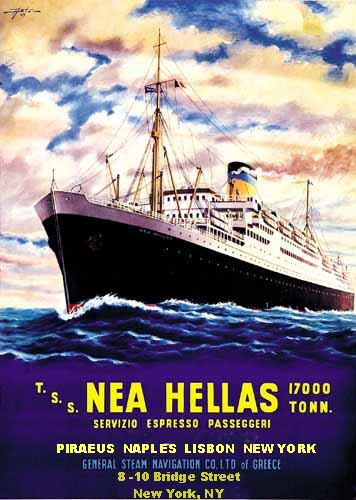
Nea Hellas - once again a passenger liner - 1949

Nea Hellas – once again a passenger liner – 1949


16th Feb

At sea again. Picked up rest of convoy from Cape Town.  Two ships – Highland Chieftain and Highland Princess – stayed at Durban.  Two others joined us (Orbita & Nieu Holland).  Had haircut and got head shave.  Len Woodlock when shaving back where it was a bit thick observed ought to be extra – not in contract – when shaving top said this is where a man makes the money.

Monday 17th

6.30 parade – usual 9.00 parade close order drill – guard at 4.30 again – wrote Flora Hirst

Tuesday 18th

Guard all day – pictures at night – “I am a Criminal”, “O’Reilly to McNab” – good show

Wednesday 19th

Usual parades – Bren and Mortar lecture by Mr Mills – interesting change – Mr Mills observing bald head observed I must feel as weak as a kitten – who was the Delilah in the story – slept on deck.

Thursday 20th

Woke at 10 to 7 – beautiful morning.  Washing parade in afternoon – cards in evening – Ray Ross and self caned Gary and Claude Geeves (Pl ….Cpls)  Pte Weir.  Sleep on deck.

Friday 21st

Miss early parade – vague threats from Miss Trenow.  More Bren instruction in morning – Boxing in the afternoon.  Four ships – E of J, E of A, Ormonde & Windsor Castle – leave convoy – believe going to Mombassa – cards again in the evening. We win again – sleep on deck (concert on stairs)

Saturday 22nd

Back to Ac Ac duty – guns got out of armoury & cleaned and mounted – Day shift with GW – Hot as hell after nearly fortnight below decks – right on Equator.  Colic sweeps the ship.  Stomach in grip of electric shovel – agony for twenty four hours – PT up and down stairs between cabin and latrines.

Sunday 23rd

Early shift on guns – clean guns.  Boxing in the afternoon – couple of good fights – Treen (?) shows promise – nice left.  Write letters to Home.

Monday 24th

Second shift on gun – warned of danger area – subs, mines, aircraft – play cards in evening – with C Hill, Jim McDonnell & G Watts – have a pot – just beer.

Tuesday 25th

Early shift on gun – clean guns – sunbaked – tried to write letters – couldn’t concentrate.  In the evening sighted Arab Dhow – went to pictures – not a boar show – played rubber of crib.

Wed 26th

Woke 7.30 – Breakfast – shaved head again – bloody dry – all water on boat (for men) salt pinched(?)- two bottles of Castle Lager on its way to the Officers Mess – very nice – low cut fast looking destroyer sighted on port bow – couple of tramps also seen – lovely drop of sun.  Boxing – couple good fights.  Nurse asleep on deck chair, hat over one eye – 6 empty beer bottles beside her – played crib in evening

Thursday 27th

New roster – GW & Self second shift 8 – 10.  R R relived me at 9am – went down and joined in with working party – got a case of ale – followed the other chaps as far as main staircase – came back along other passage and down to cabin – boys emptied case – took empty case back to deck – lovely beer – pay parade about 1pm.  Blenheim Bomber flew over – 2pm sighted the islands known as 12 apostles.  Four large ships & cruiser loom on horizon – later join convoy – several patrol boats snooping around.  Officers and nurses have fancy dress ball etc.  Played 500 with Frank Dredge, Ac Hallam, Nuggett Geeves – cake walk.  Through Hells Gates during night – sleep on deck.

Friday 28th Feb

Early shift 6 – 8.  Clean guns shave head and massage with olive oil – good days sunshine – not nearly as severe as expected in Red Sea.  Boys got stuck into the hops in the evening.  Gary as full as a boot.  Drunken singsong on stairs.  Played 1d blind with JR, JF, FD and Len Earea – did the roll.  Stubbed toe on steel plate – broke toenail halfway down.

‘Got a case of ale’ (Feb 27)

Clearly more fun and games, commandeering (stealing!) what should have been purchased – or perhaps what was meant for the officers?

Islands known as the 12 Apostles

I assume these are the Zubair group, formed by the Hanish volcano which lies beneath the Red Sea between Yemen and Eritrea. Recent volcanic activity saw a new island formed in the chain in December 2011.  In June 1940, a Walrus aircraft from HMAS Hobart carried out a bombing attack on the Italian wireless station on Centre Peak Island in this group.

Officers and Nurses

Friday 21st – I assume Miss Trenow was an officer (As a nursing sister she would most likely have been have been a Lieutenant).

Photos from shipboard life are hard to come by – but there are some in the AWM collection – such as http://www.awm.gov.au/collection/050245A/  nurses playing deck tennis on Nieu Amsterdam…not in 1941 but could have been!

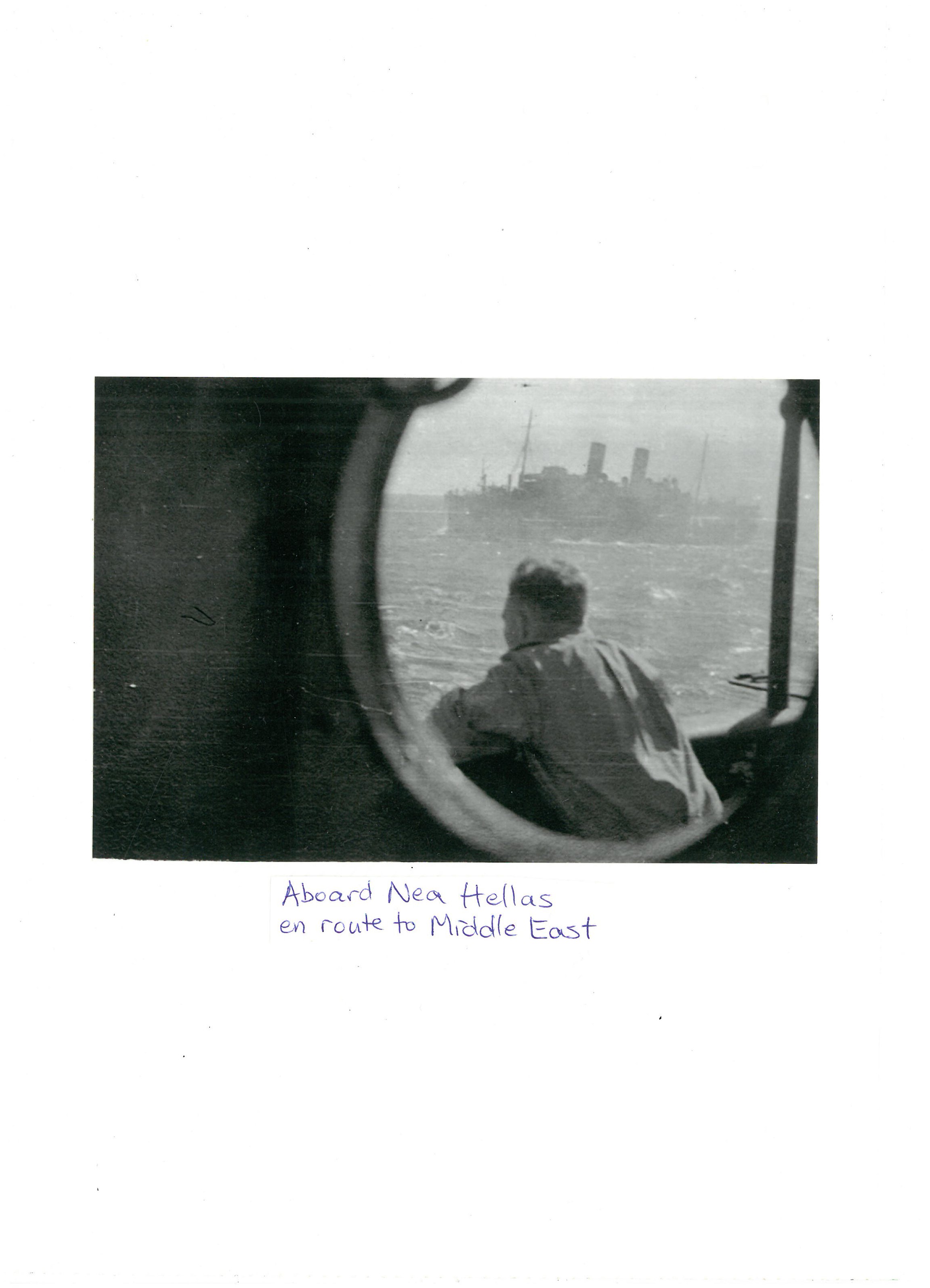
Nea Hellas

This vessel, like many others was commandeered for war service then returned to ‘civilian life’ after the war:

http://home.comcast.net/~idreos/PHOTOHIS.htm

A Photohistory of the Passenger Ship That Had Three Incarnations

During her service to the Allies the Nea Hellas was designated HR-190 and became affectionately called the “Nellie Wallace” by the soldiers she transported. She carried over 60,000 troops during her wartime service! Despite the fact she was targeted by torpedo twice by an Italian submarine, and attacked three times by Nazi aircraft in the Mediterranean, she completed her wartime service without the loss of a single life!

Posted in at sea, gambling and drinking, guard/ picket/ orderly room duty, training, Uncategorized, unit and personal diaries | Tagged , , , , | Leave a comment

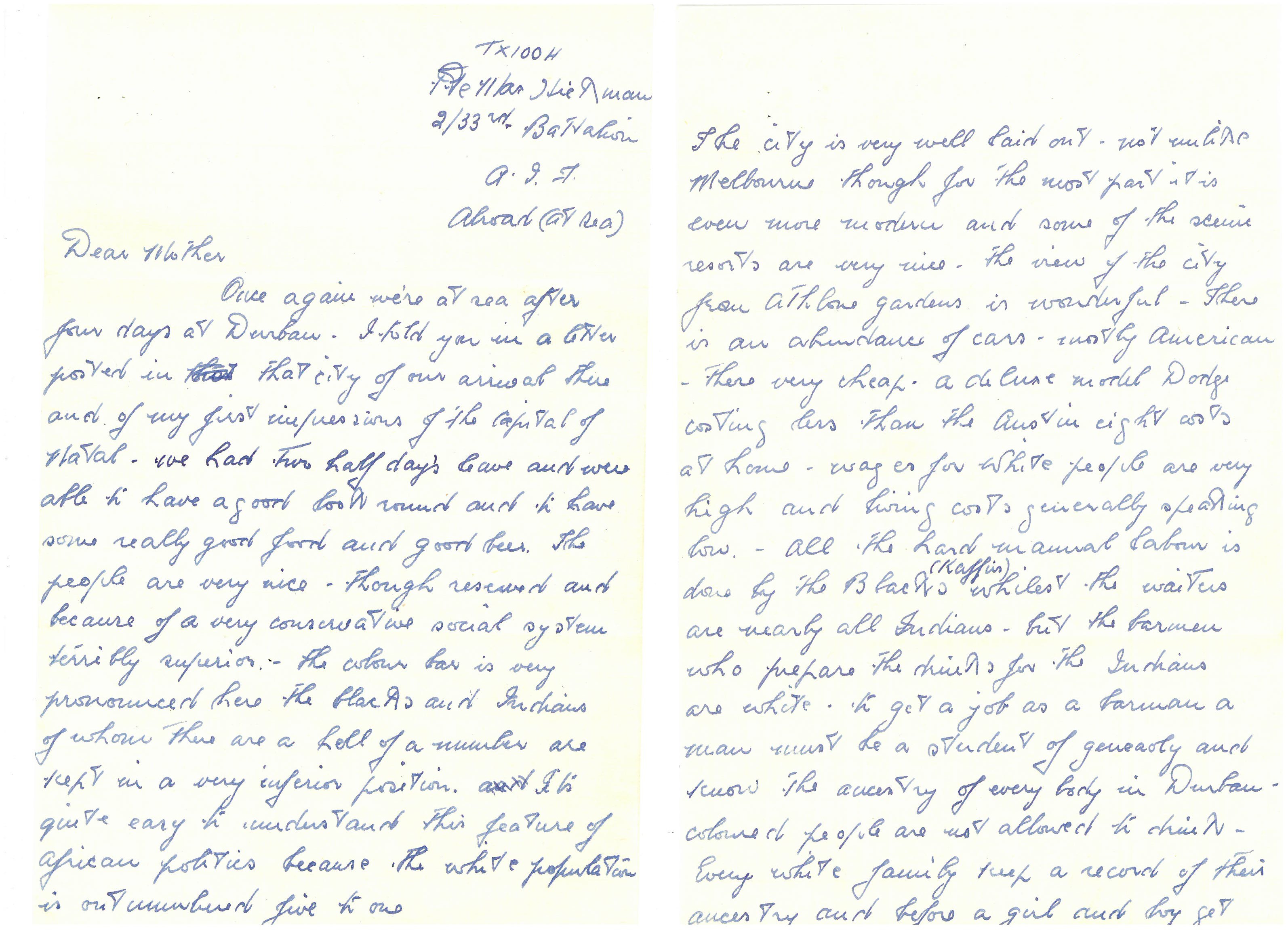
at sea post Durban: the crime of baldness

at sea post Durban pp 1 2

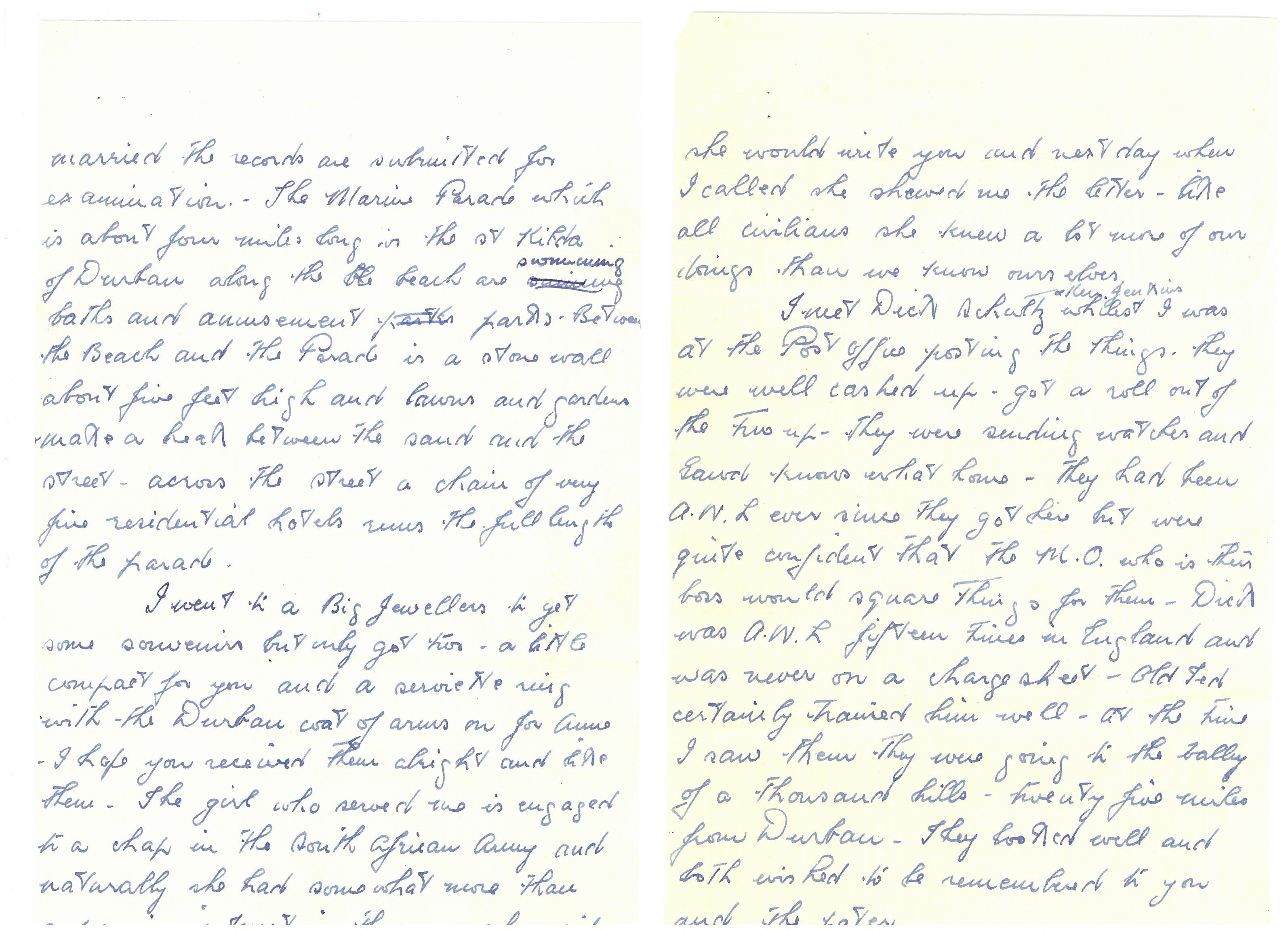
at sea post Durban pp 3 4

at sea post Durban pp 5 6

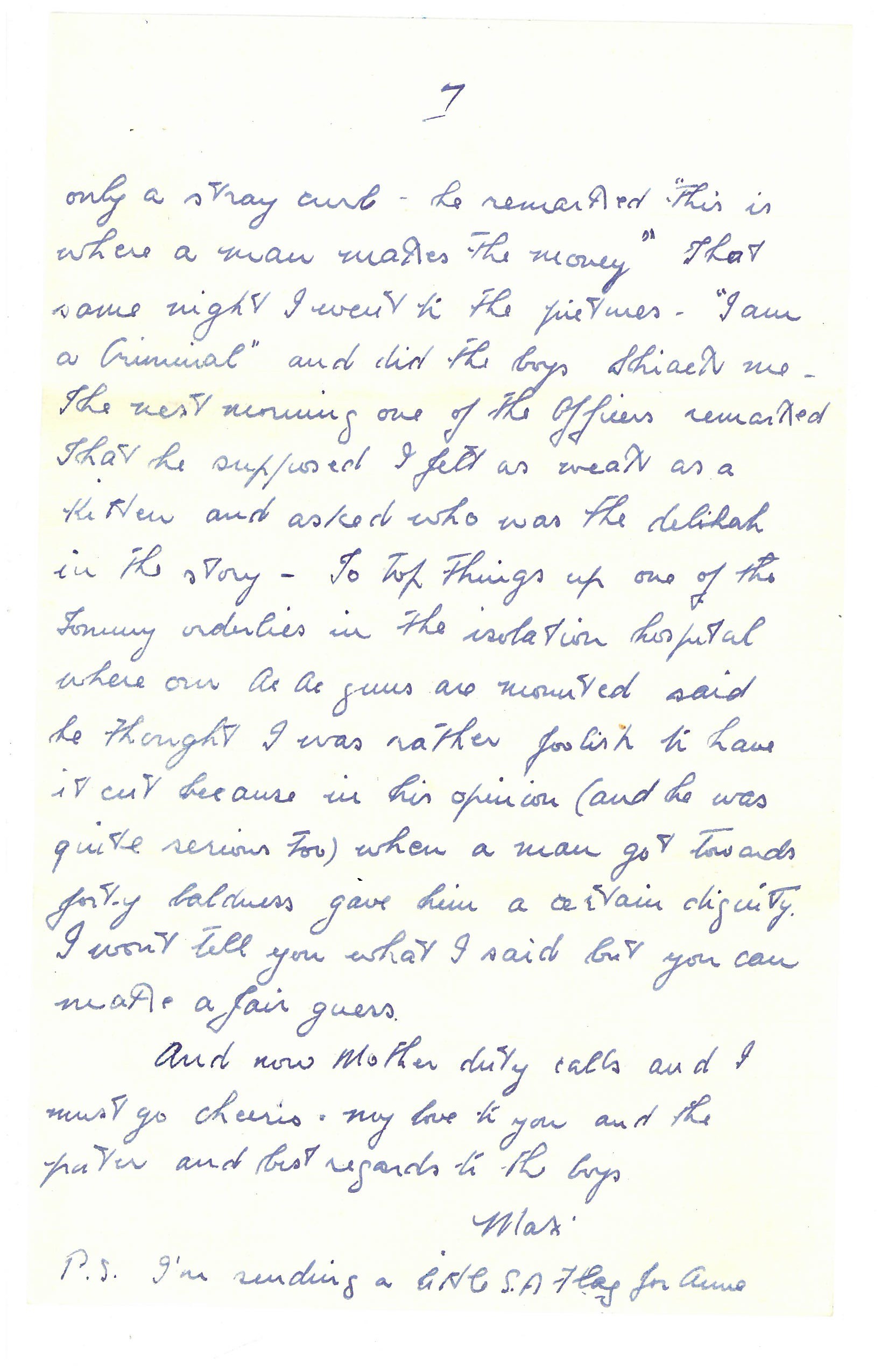
at sea post Durban p7

TX 1004

Pte Max Hickman

2/33rd Battalion

AIF

Abroad (at sea)

Dear Mother

Once again we’re at sea after four days at Durban.  I told you in a letter posted in that city of our arrival there and of my first impressions of the capital of Natal – we had two half days’ leave and were able to have a good look round and to have some really good food and good beer.  The people are very nice – though reserved and because of a very conservative social system terribly superior – the colour ban is very pronounced here the blacks and Indians of whom there are a hell of a number are kept in a very inferior position.  It’s quite easy to understand this feature of African politics because the white population is outnumbered five to one.

The city is very well laid out – not unlike Melbourne though for the most part it is even more modern and some of the scenic resorts are very nice – the view of the city from Athlone Gardens is wonderful.  There is an abundance of cars – mostly American – they’re very cheap – a deluxe model Dodge costing less than the Austin eight costs at home – wages for white people are very high and living costs generally speaking low.  All the hard manual labour is done by the blacks (Kaffirs) whilst the waiters are nearly all Indians – but the barmen who prepare the drinks for the Indians are white.  To get a job as a barman a man must be a student of genealogy and know the ancestry of everybody in Durban – coloured people are not allowed to drink. Every white family keeps a record of their ancestry and before a girl and boy get married the records are submitted for examination.  The Marine Parade which is about four miles long is the St Kilda of Durban – along the beach are swimming baths and amusement parks – between the Beach and the Parade is a stone wall about five feet high and lawns and gardens make a break between the sand and the street – across the street a chain of very fine residential hotels runs the full length of the parade.

I went to a big jewellers to get some souvenirs but only got two – a little compact for you and a serviette ring with the Durban coat of arms on for Anne – I hope you received them alright and like them.  The girl who served me is engaged to a chap in the South African Army and naturally she had somewhat more than a passing interest in the war – she said she would write you and next day when I called she showed me the letter – like all civilians she knew a lot more of our doings than we know ourselves.

I met Dick Schultz and Ken Jenkins whilst I was at the Post Office posting the things.  They were well cashed up – got a roll out of two up – they were sending watches and Gawd knows what home – they had been AWL ever since they got here but were quite confident that the MO who is their boss would square things for them.  Dick was AWL fifteen times in England and was never on a charge sheet – Old Ted certainly trained him well – at the time I saw them they were going to the Valley of a thousand hills – twenty five miles from Durban.  They looked well and both wished to be remembered to you and the pater.

I’m sending a little pamphlet given us by the padre.  I don’t know whether the censor will let it through or not.  The signaller  whom I understand is responsible for writing most of it is a woman and as we cleared the harbour she was standing at the signal station flashing messages of Goodwill.

We were told there was no airmail from Durban to Australia and it was not till the second time I was on leave that I found they’d thrown sand in our eyes.  I wrote a letter and gave it to one of the pickets who went ashore to collect those who hadn’t got back to schedule on the Saturday morning but as he didn’t go near the post office was unable to post it for me.  We’re back to the old routine mother but it took some time to recover from Durban.  It was so like the towns and cities at home that it made everybody homesick.

A couple of nights back there was an impromptu sing song on the stairs leading down to our sleeping quarters.  There were some good songs.  Arthur Midson – you may remember the Midson family – they lived for awhile on top of Pottery Road – had a hell of a run of bad luck – sang a couple of songs he’s no harm (?) either.

I had my hair cut and my head shaved the other day trying to encourage a little more to grow – I never realised what it meant to be bald till I joined the army but since then five hundred men have let me know what a terrible crime it is to be bald.  One of the chaps out of the platoon shaved it and when he was shaving round the sides where it was a bit thick he observed – this’ll be extra it wasn’t in the contract price – but when he got up to the top where there was only a stray curl he remarked “this is where a man makes the money”.  That same night I went to the pictures – “I am a Criminal” – and did the boys shiack me.  The next morning one of the officers remarked that he supposed I felt as weak as a kitten and asked who was the delilah in the story.  To top things up one of the Tommy orderlies in the isolation hospital where our Ac Ac guns are mounted said he thought I was rather foolish to have it cut because in his opinion (and he was quite serious too) when a man got towards forty baldness gave him a certain dignity.  I won’t tell you what I said but you can make a fair guess.

And now Mother duty calls and I must go.  Cheerio – my love to you and the pater and best regards to the boys.

Max

PS I’m sending a little SA flag for Anne.


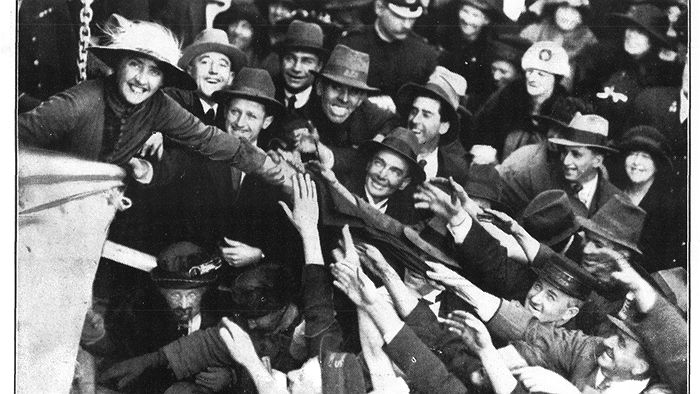
The Durban Signaller

The pamphlet mentioned is a collection of verses written by a woman who lost the love of her life in World War I.  I will share the whole pamphlet in my next post.  The signaller’s name was Miss Ethel Campbell – See photo below of the greeting she received when she visited Australia in 1923.  ABC local radio in Albany WA did a story on her last year :

http://www.abc.net.au/local/audio/2014/05/08/4000851.htm

Miss Ethel Campbell the Durban signaller

Posted in Africa, at sea, Posts and telegraph, Uncategorized | Tagged , , , , , , , , , | Leave a comment

A good look round Durban


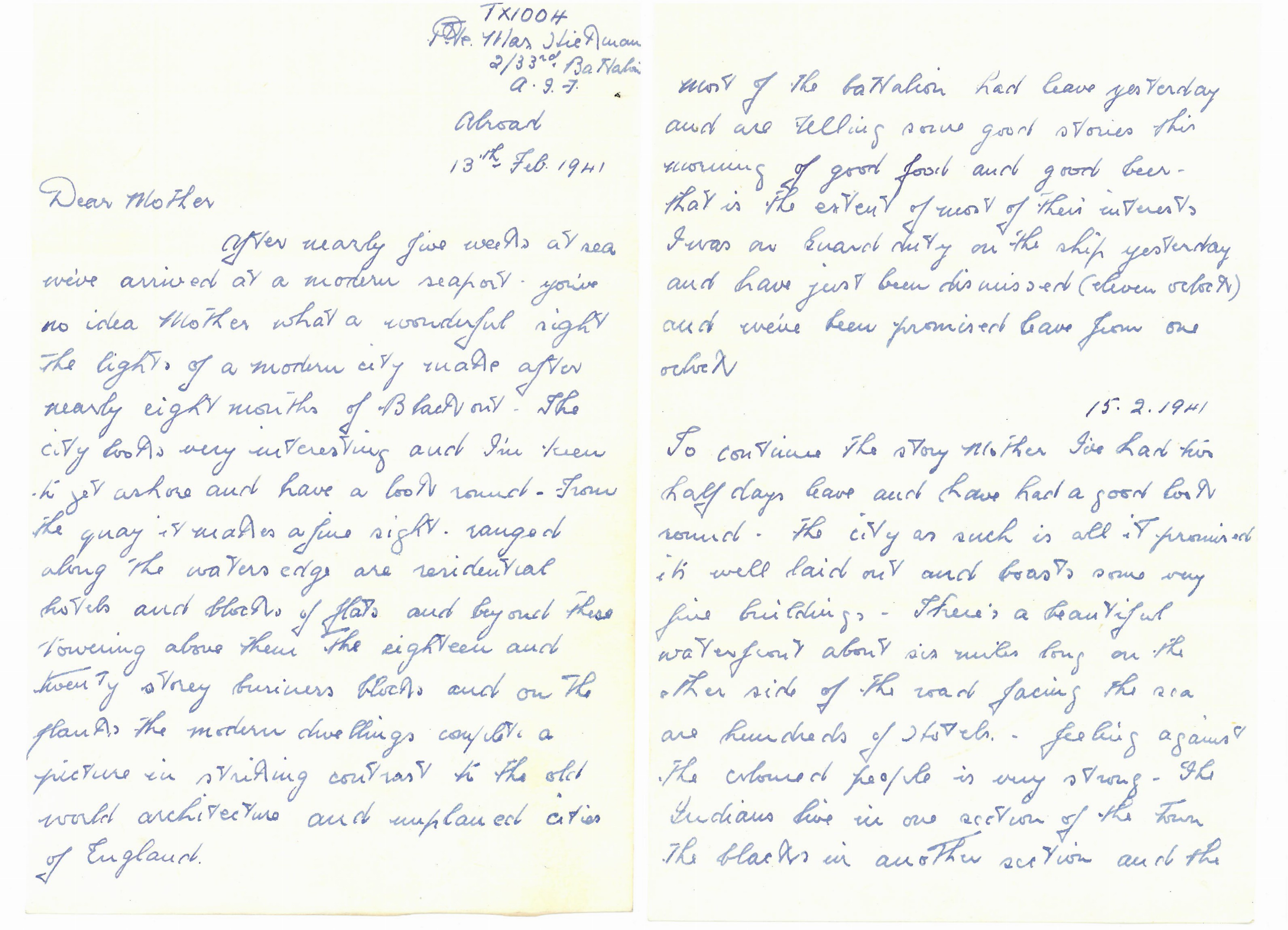
Durban Feb 1941 pp 1 2


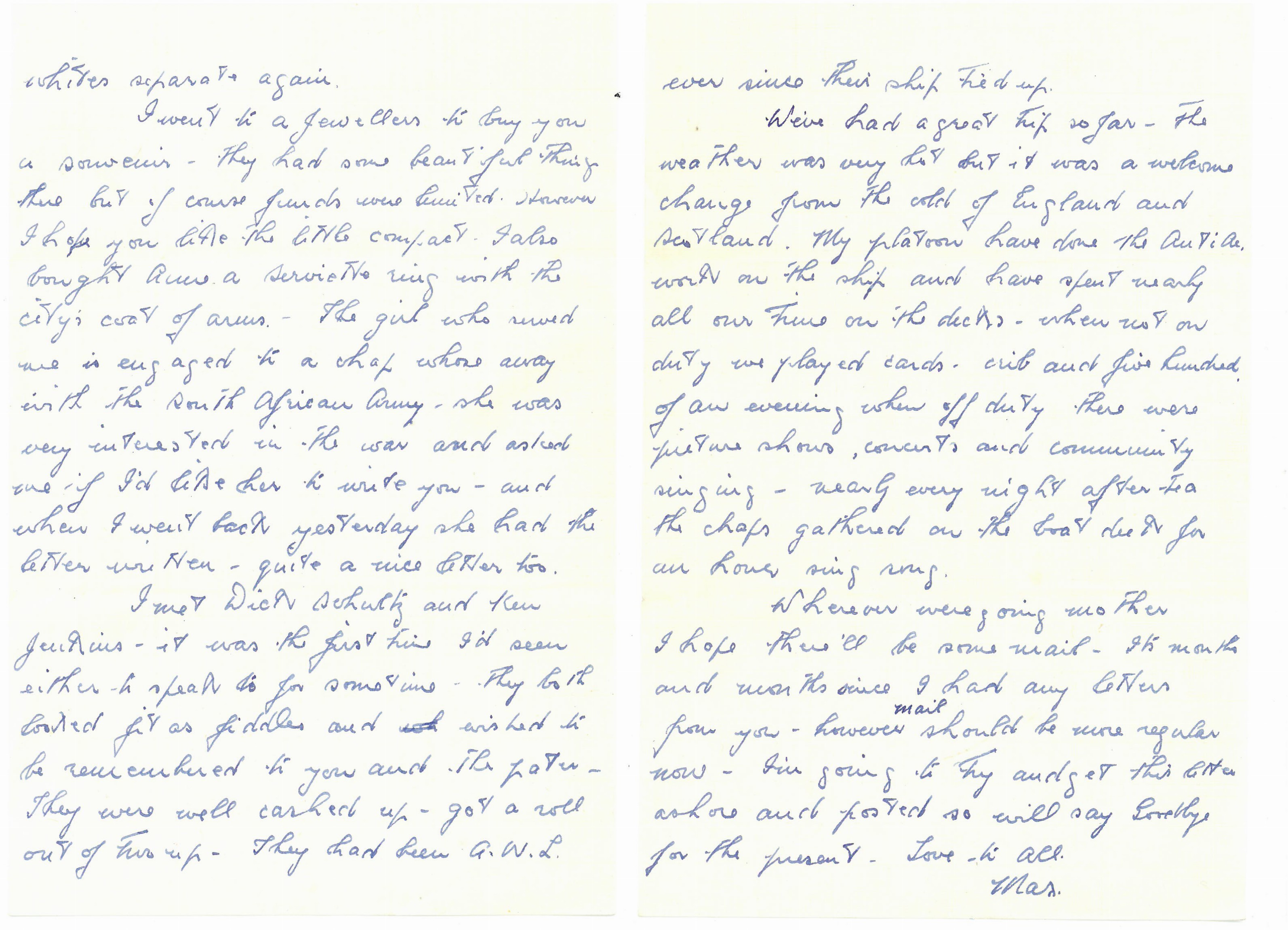
Durban Feb 1941 pp 3 4


TX 1004

Pte Max Hickman

2/33rd Battalion

AIF

Abroad

13th Feb 1941

Dear Mother

After nearly five weeks at sea we’ve arrived at a modern seaport- you’ve no idea mother what a wonderful sight the lights of a modern city make after nearly eight months of Blackout.  The city looks very interesting and I’m keen to get ashore and have a look round.  From the quay it makes a fine sight – ranged along the waters edge are residential hotels and blocks of flats and beyond these towering above them the eighteen and twenty storey business blocks and on the flanks the modern dwellings complete a picture in striking contrast to the old world architecture and unplanned cities of England.

Most of the Battalion had leave yesterday and are telling some good stories this morning of good food and good beer – that is the extent of most of their interests.  I was on guard duty on the ship yesterday and have just been dismissed (eleven o’clock) and we’ve been promised leave from one o’clock.

15.2.1941

To continue the story Mother I’ve had two half days leave and have had a good look round.  The city as such is all it promised it’s well laid out and boasts some very fine buildings.  There’s a beautiful waterfront about six miles long on the other side of the road facing the sea are hundreds of hotels.  Feeling against the coloured people is very strong.  The Indians live in one section of the town the blacks in another section and the whites separate again.

I went to a jewellers to buy you a souvenir – they had some beautiful things there but of course funds were limited.  I hope you like the little compact.  I also bought Anne a serviette ring with the city’s coat of arms.  The girl who served me is engaged to a chap whose [sic] away with the South African Army – she was very interested in the war and asked me if I’d like her to write you – and when I went back yesterday she had the letter written – quite a nice letter too.

I met Dick Schultz and Ken Jenkins – it was the first time I’d seen either to speak to for some time.  They both looked fit as fiddles and wished to be remembered to you and the pater.  They were well cashed up – got a roll out of two up.  They had been AWL ever since the ship tied up.

We’ve had a great trip so far – the weather was very hot but it was a welcome change from the cold of England and Scotland.  My platoon have done the Anti Ac work on the ship and have spent nearly all our time on the decks – when not on duty we played cards – crib and five hundred.  Of an evening when off duty there were picture shows, concerts and community singing – nearly every night after tea the chaps gathered on the boat deck for an hour sing song.

Wherever we’re going mother I hope there’ll be some mail – Its months and months since I had any letters from you – however mail should be more regular now.  I’m going to try and get this letter ashore and posted so will say goodbye for the present.

Love to all

Max


W Crooks on Durban

It is interesting that the official Battalion history speaks of a ‘carefree populace’ and makes no reference to racial tension (p22):

During the five day stay in Durban, prolonged due to necessary boiler repairs on some of the older ships, the battalion had leave nearly every day, half the battalion getting leave at a time.  This very hospitable and delightful city, which had no blackout, was a memorable interlude.  With delightful spring weather, a friendly and at that time carefree populace, (the city’s) large parks, gardens, open air hotels and cafes together with no blackout or rationing, combined to provide a unique experience the battalion had not experienced since leaving Australia the previous May.

The South African Army

The jewellery shop assistant’s fiancé would have been a member of the 2nd infantry division of the South African Army.  According to Wikipedia:

The South African 2nd Infantry Division was an infantry division of the armyof the Union of South Africa during World War II. The Division was formed on 23 October 1940 and served in the Western Desert Campaign and was captured (save for one brigade) by German and Italian forces at Tobruk on 21 June 1942. The remaining brigade was re-allocated to the South African 1st Infantry Division.

In The Footsoldiers, W Crooks describes the embarkation onto the Nieuw Amsterdam (a ship in their convoy) of a Transvaal Scottish battalion of the South Africa Second Division :

Marching in threes, from the city and down the street to the wharf, at the slope, with their pipes and drums at the head, this battalion halted as one on the command from their CO at the stairway of the gangplank…They then ordered arms and, at the ‘short trail, quick march’, filed up the gangplank in single file by platoons, to the accompanying music of their pipes and drums, completing their embarkation in twenty five minutes.  Such efficiency was not lost on the watching Tommies and Aussies who applauded the effort.

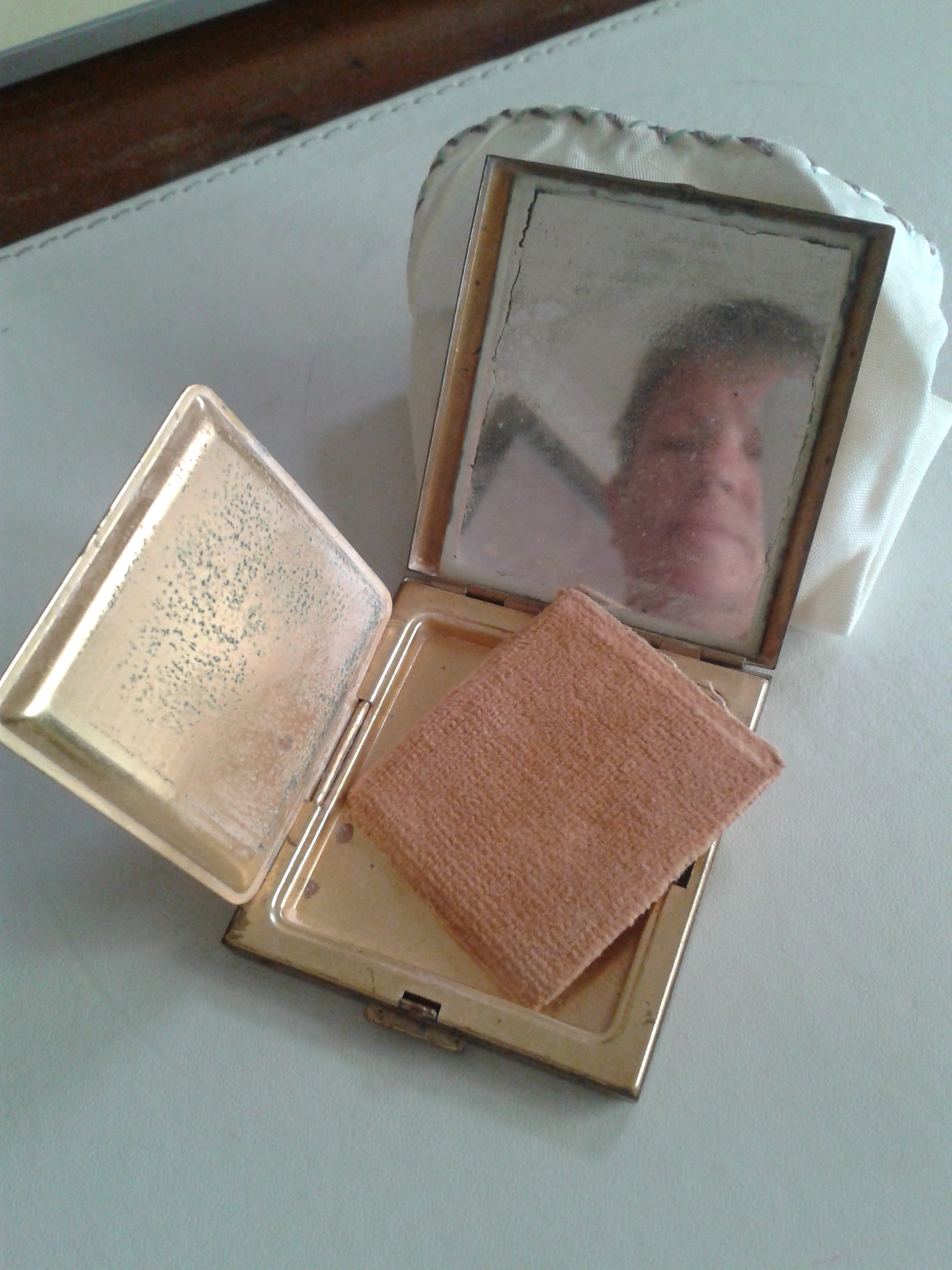
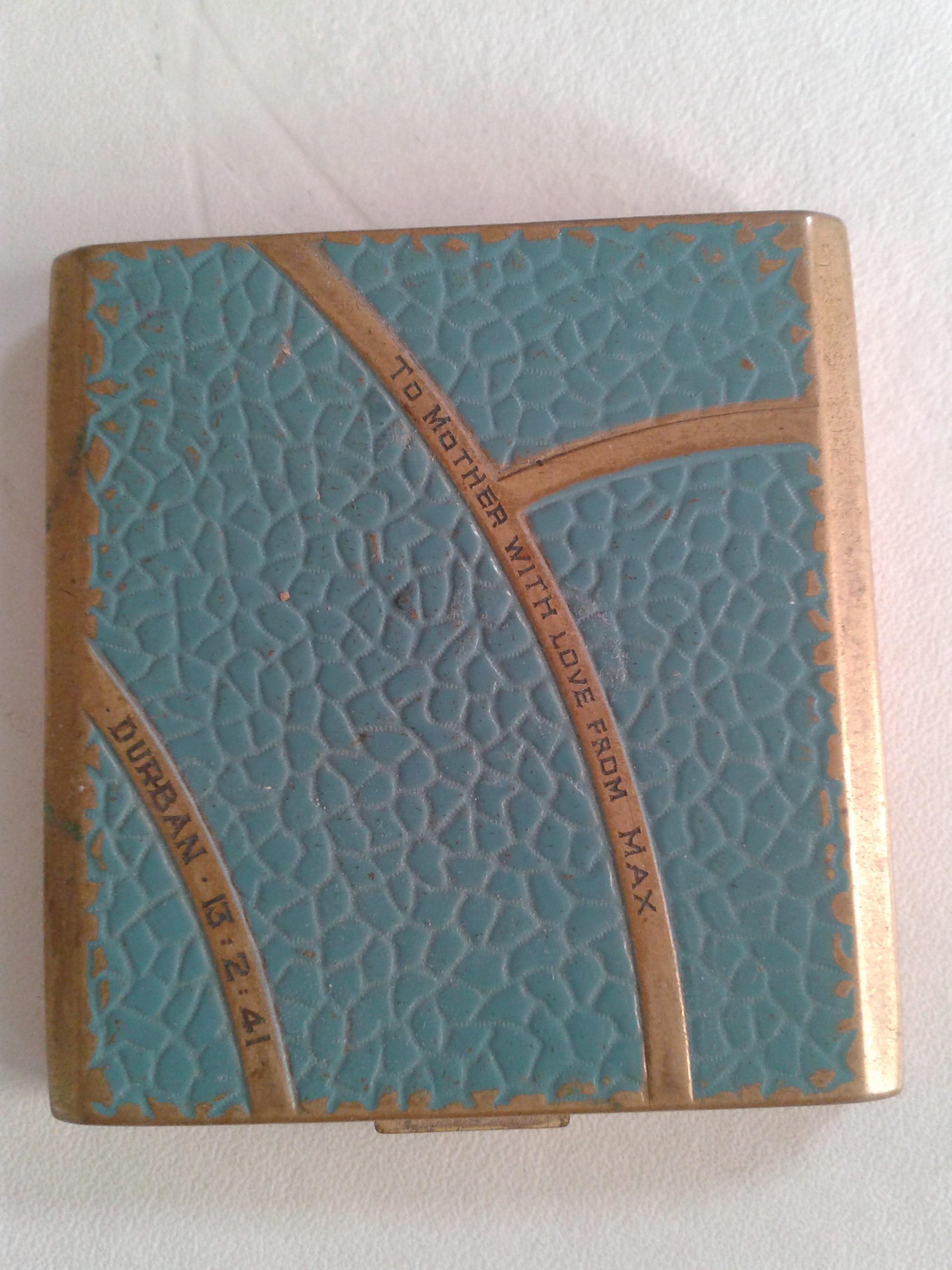
The little compact

I inherited the little compact.  It is 5cm (2″) square and still has its powder puff and mirror:compact open

compact for mother


Posted in Africa, leave, Uncategorized | Tagged , , , , , , , , , , , | Leave a comment

Durban Diary: apartheid, mate-ship and a rifle as big as a daisy air gun

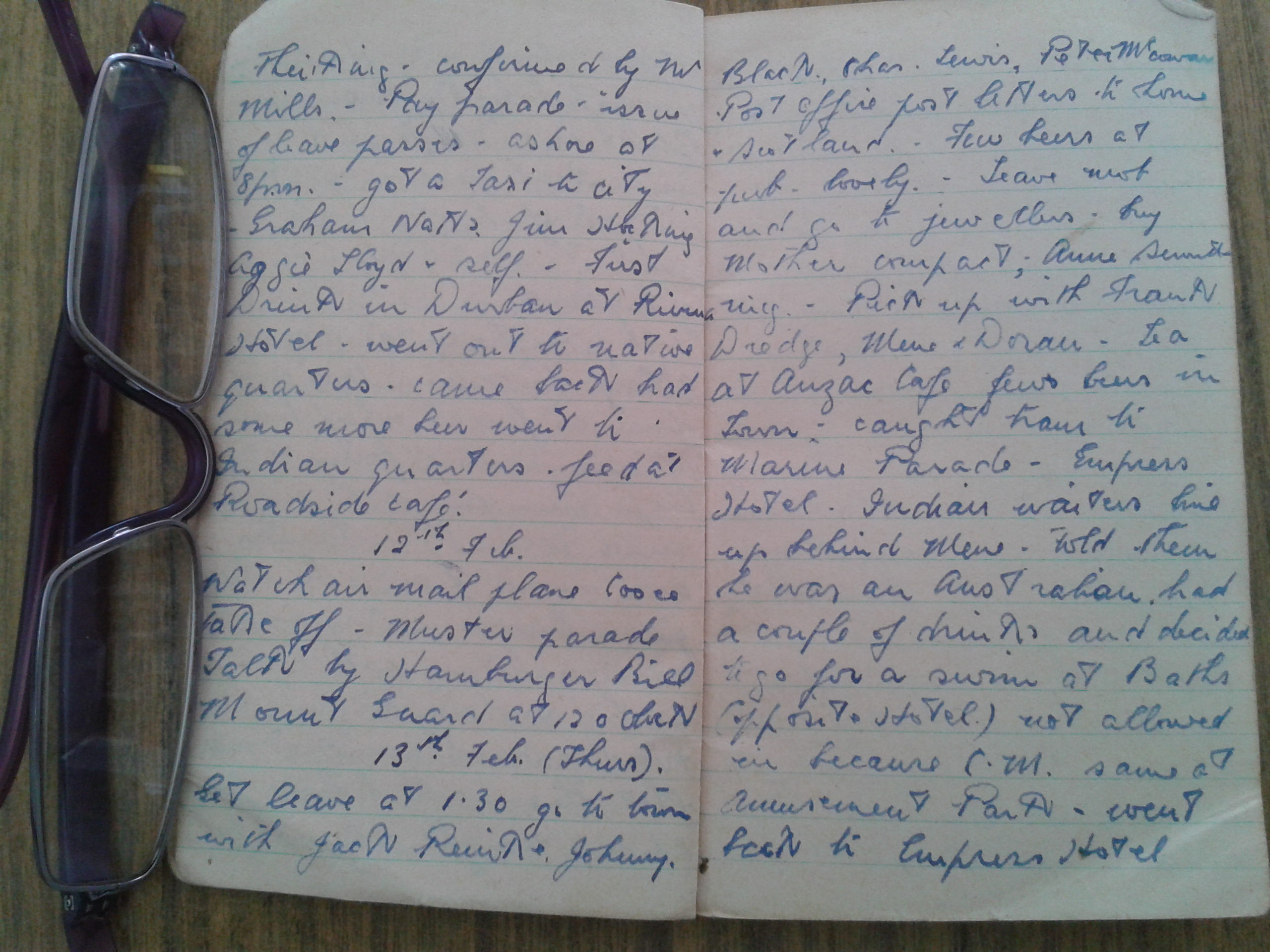
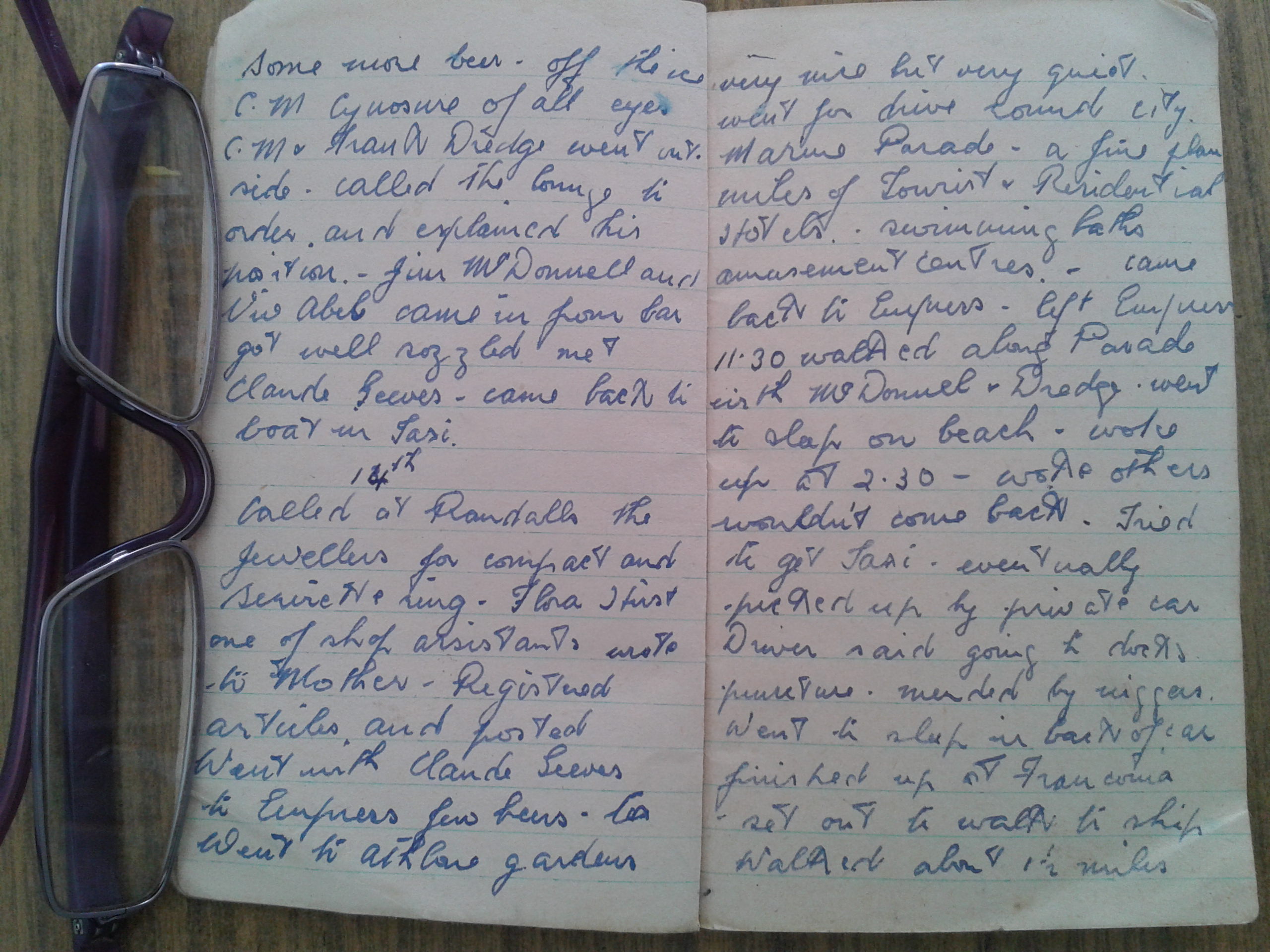
diary 11 12 13 Feb 41


diary 13 14 Feb 41


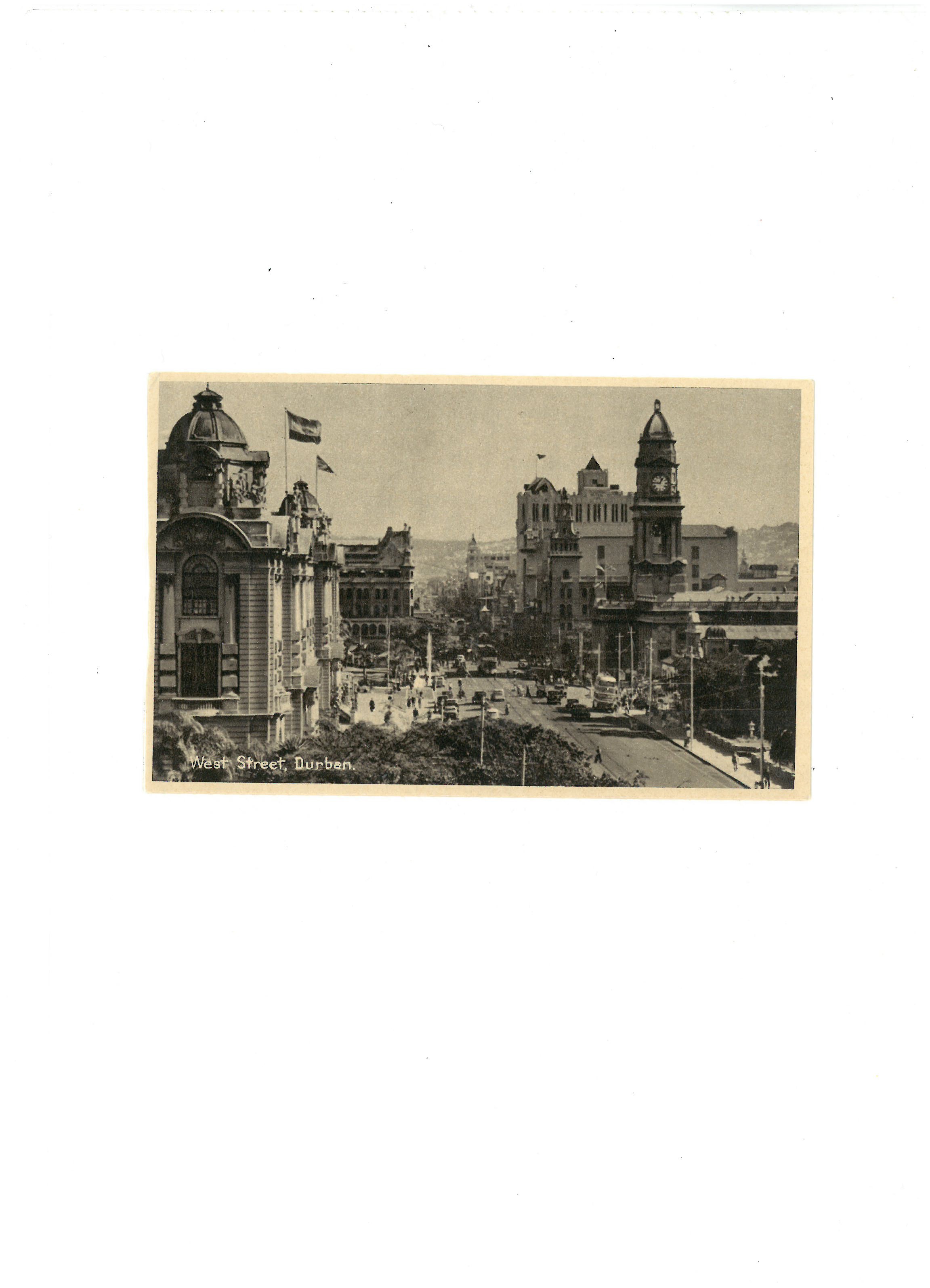
Durban postcard

Durban postcard


Tues 11th

Planes from Durban fly over convoy – sun shines hot and early – sea more blue than ever – land sighted – binoculars focus on Durban.  Steam slowly into Harbour.  Wonderful sight.  Business blocks and hotels and residential areas in striking contrast to old world architecture and city engineering of England.

1.30pm.  Tie up at Maydon Wharf – Congenni (?) – Cars come down as far as wharf barrier – S African guards at barrier.  Chaps throw pennies to niggers – mad scramble – Tommies and nurses from other ships go on leave – sentry does some saluting with rifle as big as daisy air gun.  Word passed around at mess that there would be leave from 6pm – thought only wishful thinking – confirmed by Mr Mills – pay parade – issue of leave passes – ashore at 8pm – got a taxi to city – Graham Watts, Jim Hocking, Aggie Lloyd & self – First drink in Durban at River Hotel – went out to native quarters – came back had some more beer – went to Indian quarters – feed at roadside cafe.

12th Feb

Watch airmail plane Cooee take off – muster parade.  Talk by Hamburger Bill.  Mount guard at 12 o’clock.

13th Feb (Thurs)

Get leave at 1.30 to to town with Jack Reinke & Johnny Black, Chas Lewis, Pete McCowan.  Post office post letters to home & Scotland.  Few beers at pub – lovely.  Leave mob and go to jewellers – buy mother compact, Anne serviette ring  Pick up with Frank Dredge, Mene & Doran.  Tea at Anzac Cafe few beers in town.  caught tram to Marine Parade – Empress Hotel.  Indian waiters line up behind Mene – told them he was Australian.  had a couple of drinks and decided to go for a swim at Baths (opposite hotel) not allowed in because CM – same at amusement park – went back to Empress Hotel – some more beer off the ice – CM cynosure of all eyes – CM & Frank Dredge went outside – called the lounge to order and explained his position – Jim McDonnell and Viv Abel came in from bar – got well sozzled – met Claude Geeves – came back to boat in taxi.

14th

Called at Randalls the Jewellers for compact and serviette ring.  Flora Hirst one of the shop assistants wrote to mother – Registered articles and posted.  Went with Claude Geeves to Empress – few beers – tea (?).  Went to Anthlone Gardens – very nice but very quiet – went for drive round city.  Marine Parade – a fine plan – miles of tourist & residential hotels, swimming baths, amusement centres – came back to Empress – left Empress 11.30 – walked along Parade with McDonnell & Dredge – went to sleep on beach – woke up at 2.30 – woke others – wouldn’t come back.  Tried to get taxi – eventually picked up by private car.  Driver said going to docks – puncture – mended by niggers.  Went to sleep in back of car – finished up at Franconia – set out to walk to ship.  Walked about 1 1/2 miles

15th Feb

finished the journey.  Ricksha – arrived back at Nea Hellas at 6.30 just in time for muster parade.  Ship sailing.  Pickets went ashore to pick up AWL’s – Jim McDonnell & Frank Dredge picked up where I left them – held temporarily in gaol on land – brought aboard about midday and put in detention room.  I suffered a bad day recovering from beer and home sickness.  At two thirty tugs took us into the stream – watched the city fade behind – as we passed signal station a woman signaller flashed messages of goodwill.

Few observations on SA.  Colour line very strict but within their own communities Blacks and Indians every bit as well off as people in slums of England and Australia.  Before anyone can get a job in Hotel must know the history of everyone in the city – no coloureds allowed to drink.  Wonderful place for whites – SA the brightest future of any of Dominions.


The Diary pages

I’m not scanning every page, due to technical issues, but thought use of glasses for scale might emphasise the fact that it was a memo book.  Later, the writing gets minuscule – I’ll certainly share some of that.

Rifle as big as daisy air gun

I’ve searched in vain to find details about a large gun called a daisy air gun – those I can find seem to be a pretty standard size, and of American manufacture which is another reason I seem to be on the wrong track – I can’t imagine Dad would have had anything to do with Amercian weapons at this point in the War.  Any ideas, readers?

Airmail plane Cooee

For an interesting article about the flying boats’ war service, consult this article by David Levell: http://travelinsider.qantas.com.au/features/interesting-things/75th-anniversary-of-the-empire-s23-c-class-planes   It must have been quite a sight – many of the servicemen would presumably not have seen a flying boat before.

This is an extract from the article :

Unfortunately, with war looming, the flying boats’ triumph was destined to be brief. With WWII declared just 14 months into the service, Corio and Coorong were requisitioned, and the airmail reduced to twice-weekly. In June 1940, Italy’s entry to the war cut off the UK-Egypt sector.
Releasing Coolangatta and Coogee to the RAAF, Qantas put Carpentaria and Cooee on an arduous alternative route – Sydney to Durban via Singapore and Cairo.   Flown to South Africa, the mail could then proceed by sea to the UK. The aircrew switch was modified, with Qantas now piloting all the way to Karachi. Called the “horseshoe route” (from its shape on a map), this solution lasted until Singapore fell to Japan in February 1942, severing the UK air link altogether.

Athlone Gardens

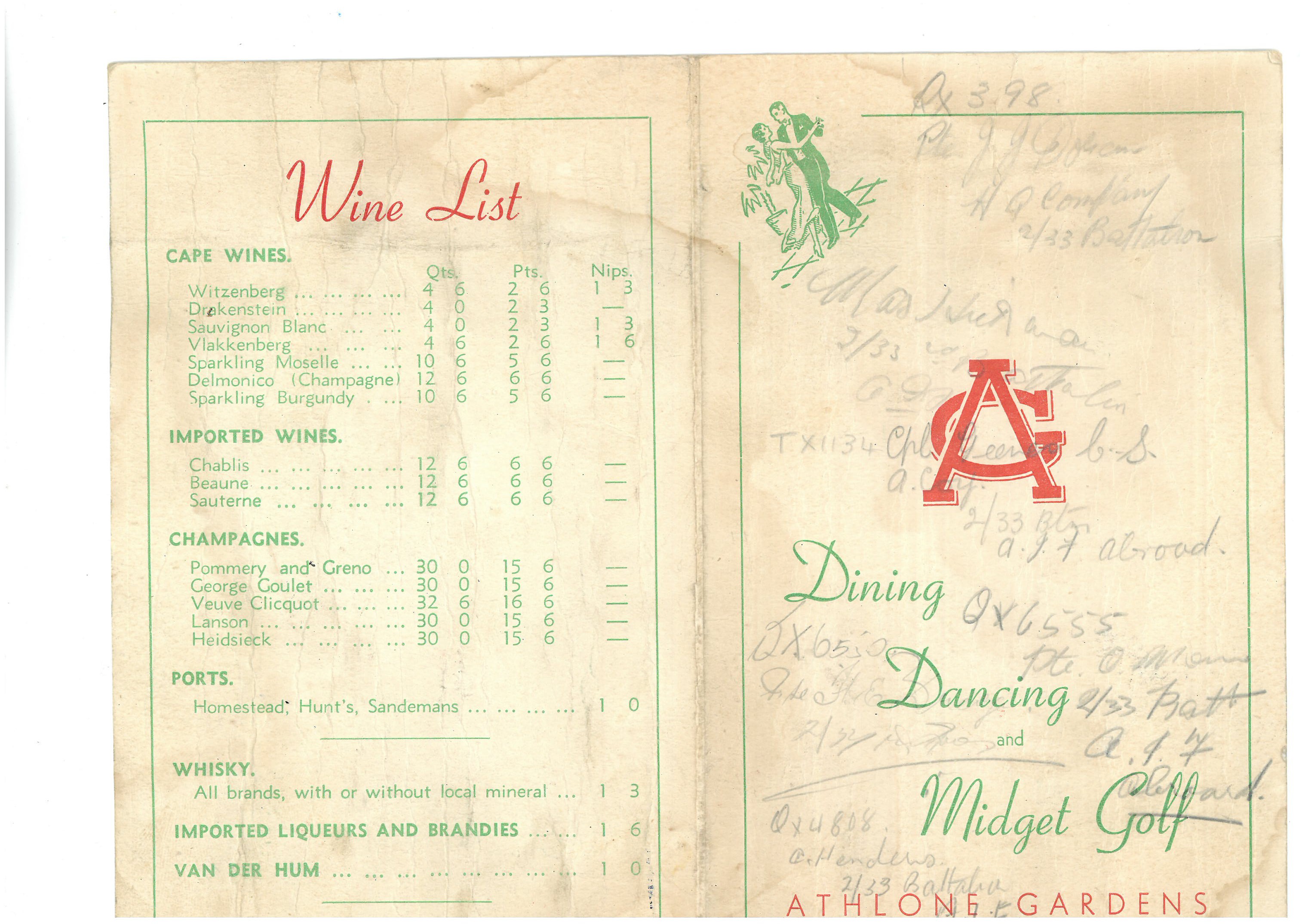
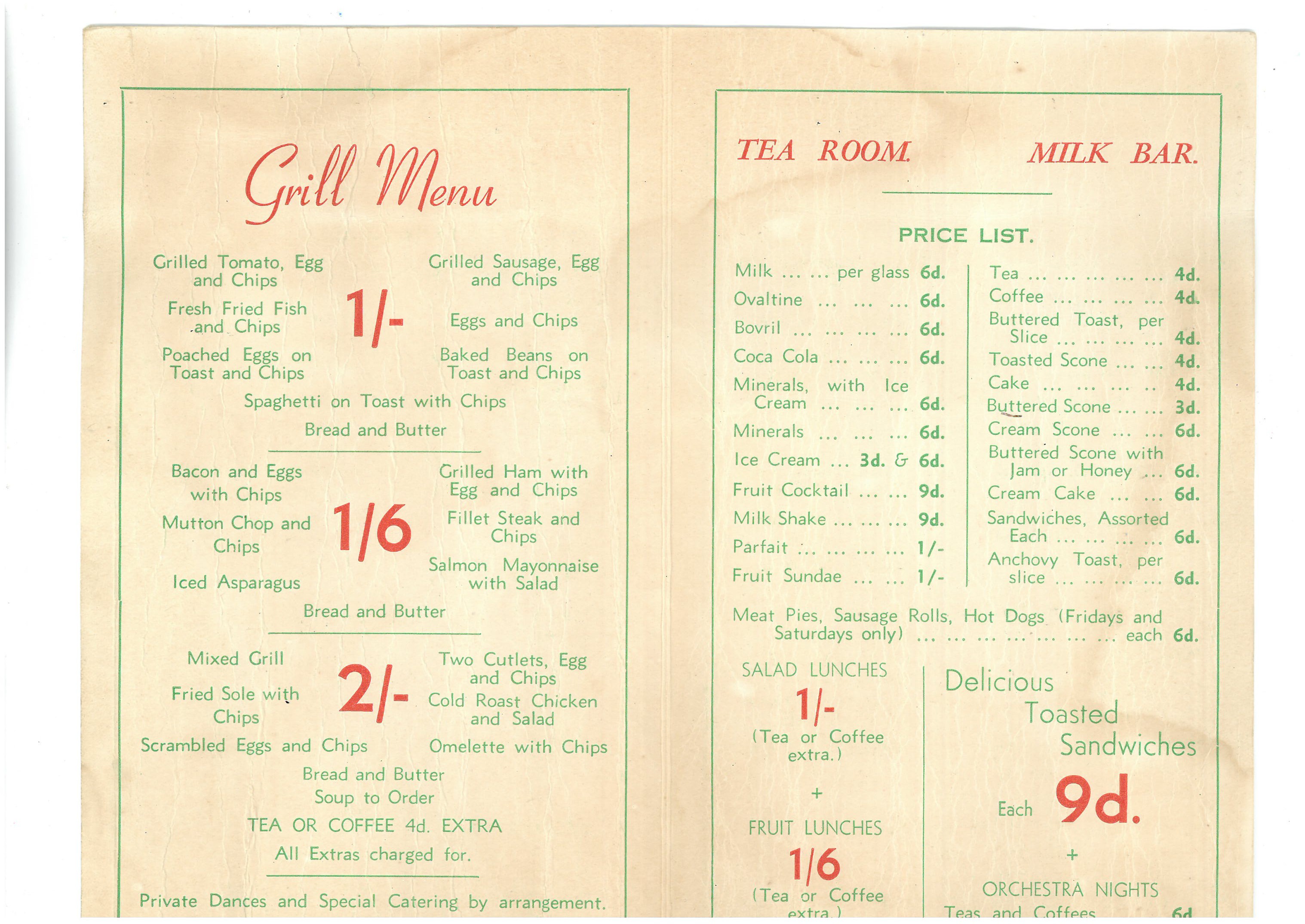
Athlone dining card outer

Dining card, complete with several signatures..

J J Doran QX 398

CS Geeves TX 1134

C Mene  QX 6555

F Dredge QX 6550

Athlone dining card inner

C Henders QX 4808


Some of those who signed the card were not listed in the group – maybe they were all there, maybe not!

At the Jewellers

The letter written by the shop assistant and the compact Dad bought for his mother will be shared in my next blog entry.

No Coloureds allowed to drink

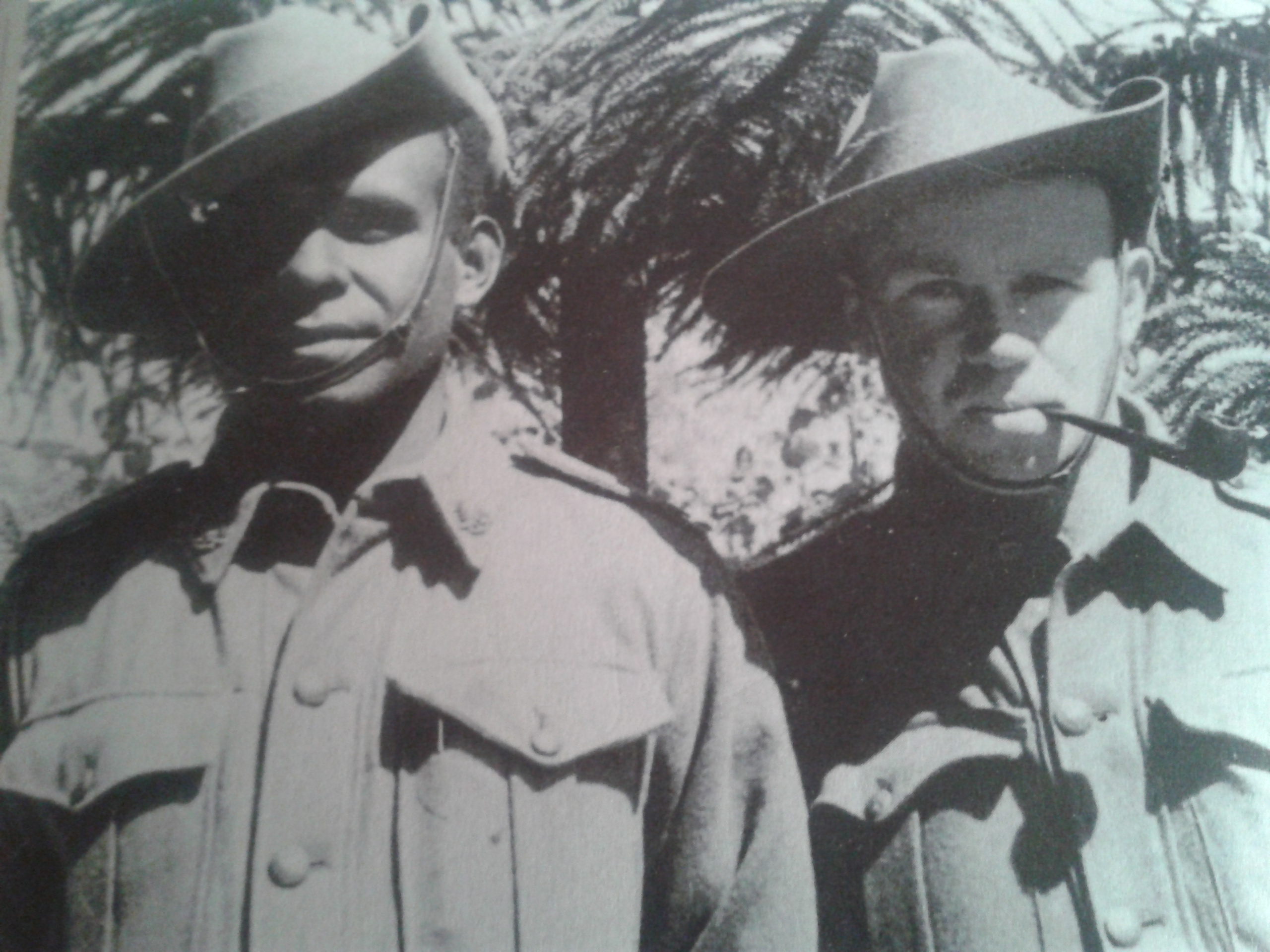
Charlie Mene, a Torres Strait Islander, was a member of Dad’s platoon.  He is referred to in these entries as Mene or CM.  The incidents referred to in these diary entries are described more colourfully in later letters, but according to Dick Lewis, Dad didn’t just ‘call the lounge to order’- he stood on a table and left the patrons and staff in no doubt as to the possible consequences of not treating Charlie in the same way as the rest of the Australian soldiers. ( Dick was not present at the time, so the story he heard could certainly have been embellished.)  Later that year, in Gaza, Charlie asked Dad to have a photo taken with him.  This is that photo:

Dad and Charlie Mene

Posted in Africa, leave, Uncategorized, unit and personal diaries | Tagged , , , , , | 2 Comments

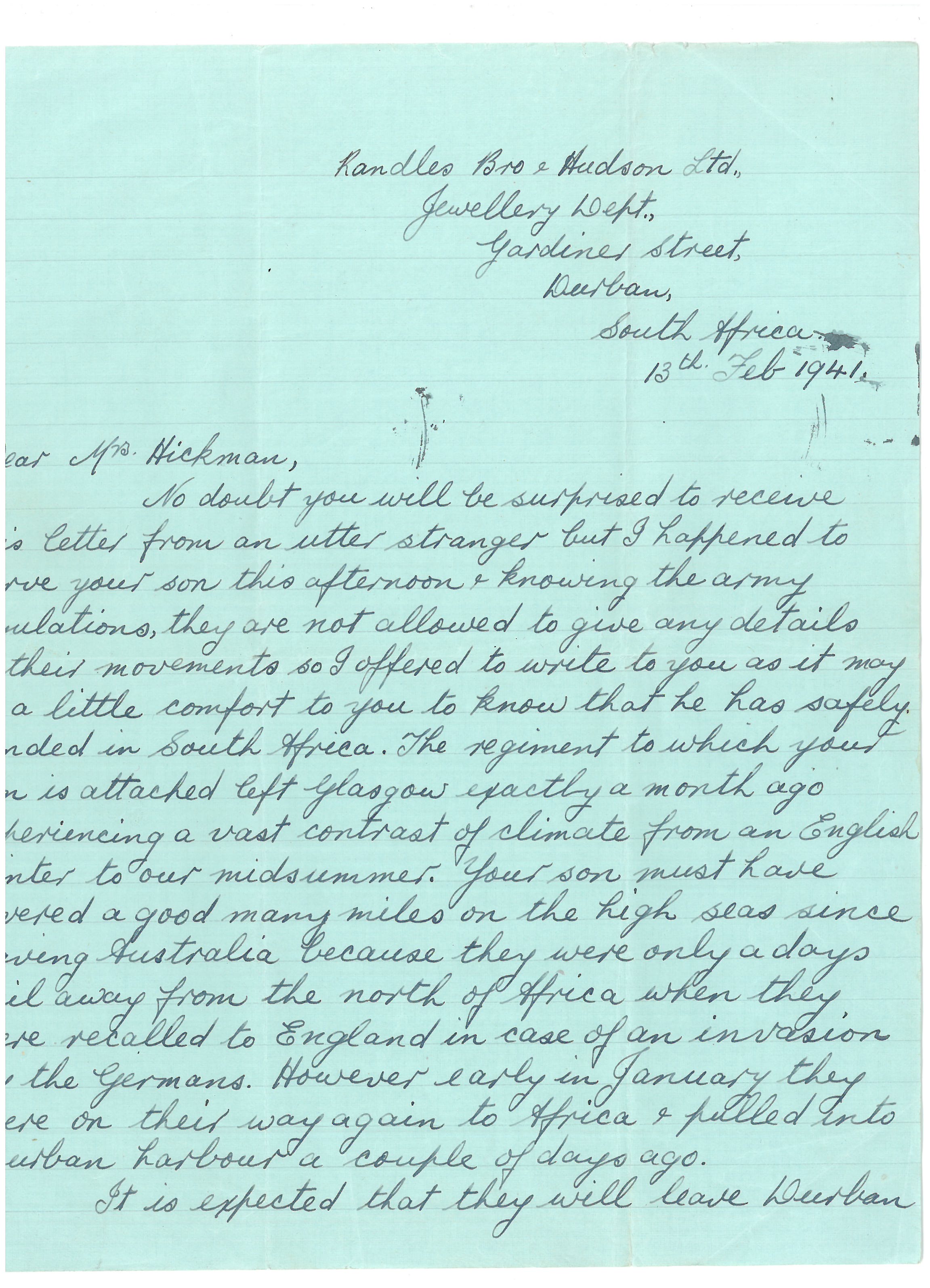
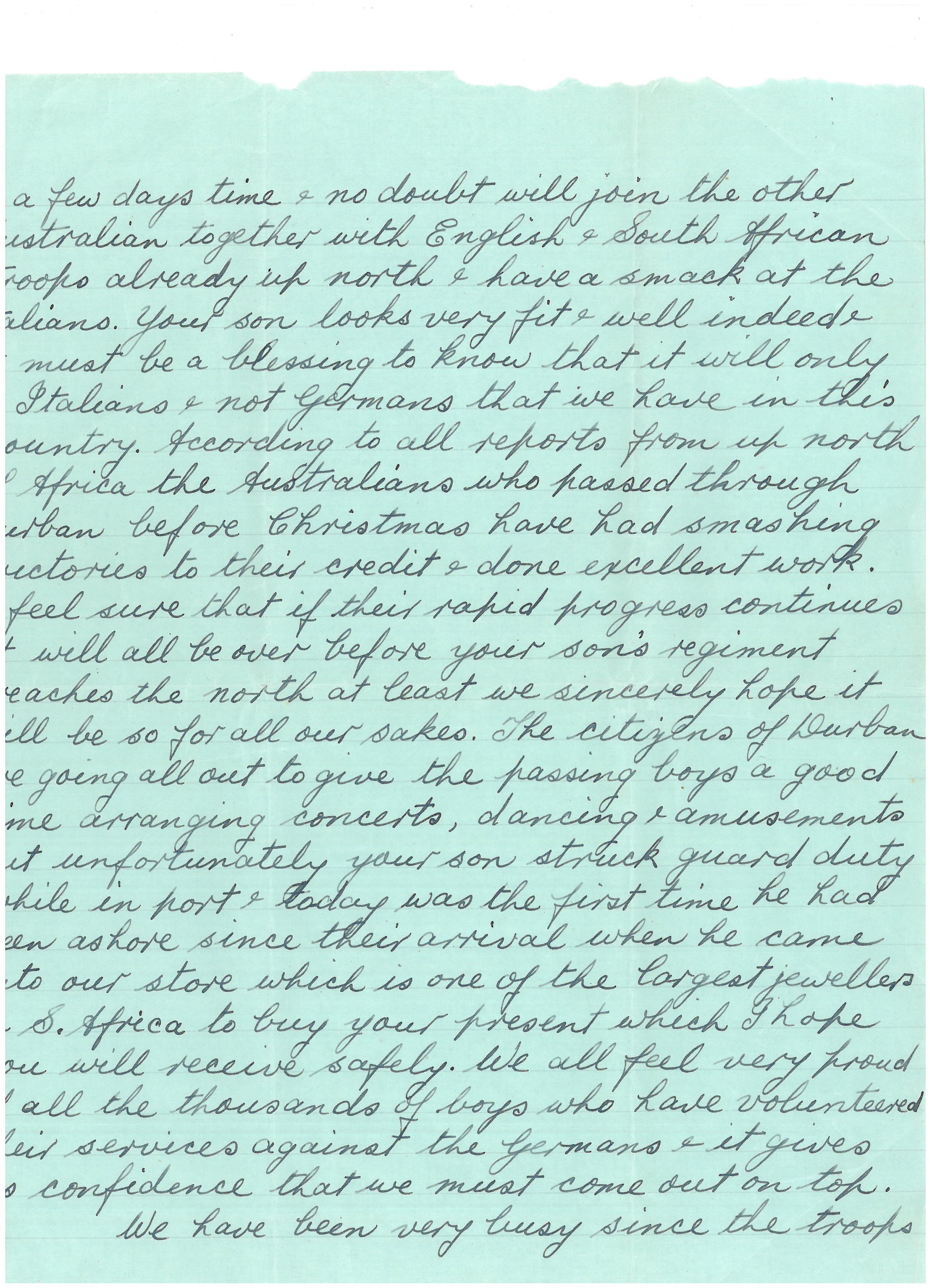
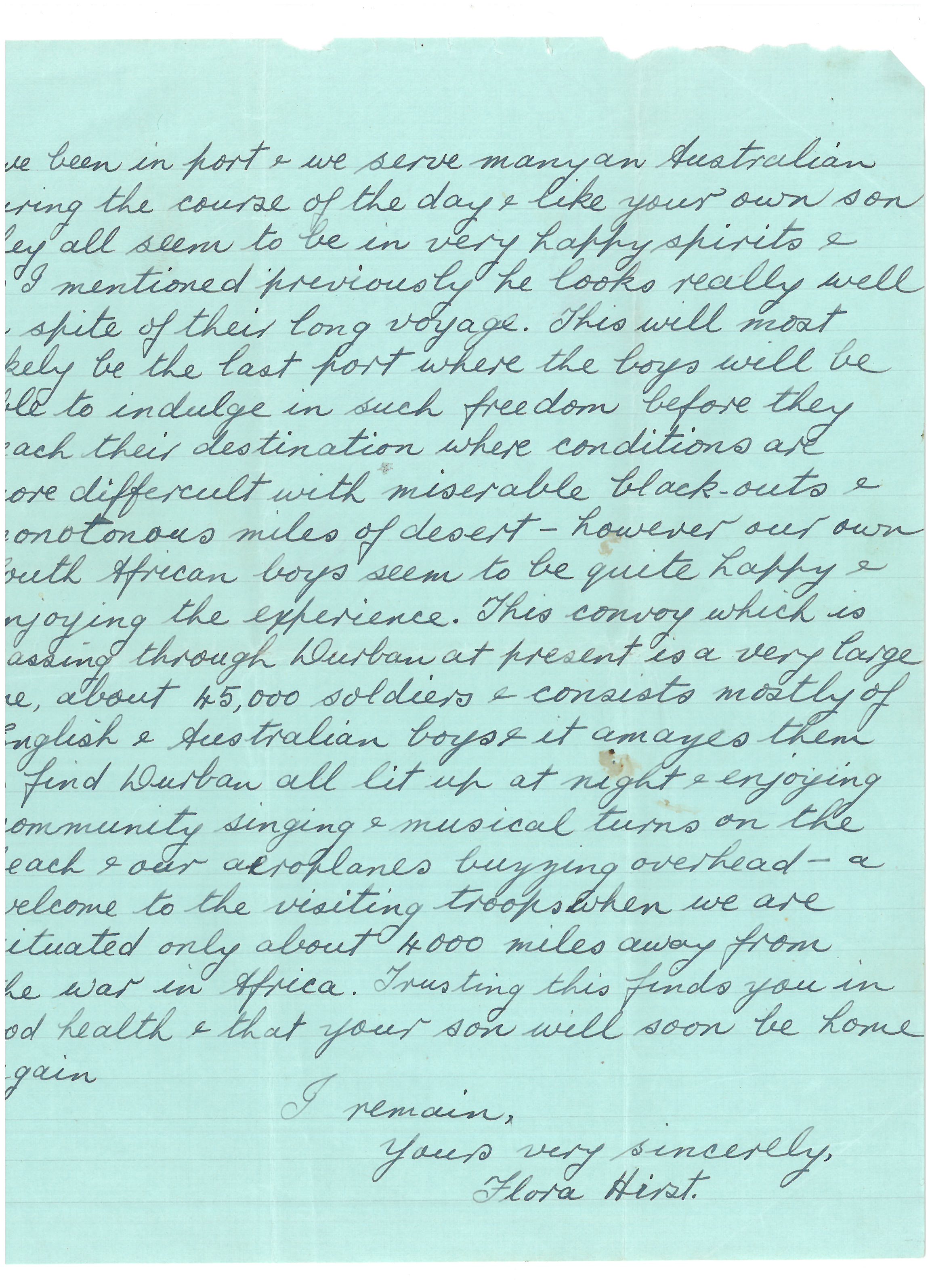
A letter from an utter stranger: Flora the jeweller’s assistant

Flora p1

Flora p2

Flora p3

Randles Bro & Hudson Ltd.

Jewellery Dept

Gardiner Street

Durban

South Africa

13th Feb 1941


Dear Mrs Hickman

No doubt you will be surprised to receive this letter from an utter stranger but I happened to serve your son this afternoon and knowing the army regulations, they are not allowed to give any details of their movements so I offered to write to you as it may be a little comfort to you to know that he has safely landed in South Africa.  The regiment to which your son is attached left Glasgow exactly a month ago experiencing a vast contrast of climate from an English winter to our midsummer.  Your son must have covered a good many miles on the high seas since leaving Australia because they were only a day’s sail away from the north of Africa when they were recalled to England in case of an invasion by the Germans.  However early in January they were on their way again to Africa and pulled into Durban harbour a couple of days ago.

It is expected that they will leave Durban in a few days’ time and no doubt will join the other Australians together with English and South African troops already up north and have a smack at the Italians.  Your son looks very fit and well indeed and it must be a blessing to know that it will only be Italians and not Germans that we have in this country.  According to all reports from up north of Africa the Australians who passed through Durban before Christmas have had smashing victories to their credit and done excellent work.  I feel sure that if their rapid progress continues it will all be over before your son’s regiment reaches the north at least we sincerely hope it will be so for all our sakes.

The citizens of Durban are going all out to give the passing boys a good time arranging concerts, dancing and amusements but unfortunately your son struck guard duty while in port and today was the first time he had been ashore since their arrival when he came into our store which is one of the largest jewellers in South Africa to buy your present which I hope you will receive safely.  We all feel very proud of all the thousands of boys who have volunteered their services against the Germans and it gives us confidence that we must come out on top.

We have been very busy since the troops have been in port and we serve many an Australian during the course of the day and like your own son they all seem to be in very happy spirits and as I mentioned previously he looks really well in spite of their long voyage.  This will most likely be the last port where the boys will be able to indulge in such freedom before they reach their destination where conditions are more difficult with miserable black-outs and monotonous miles of desert – however our own South African boys seem to be quite happy and enjoying the experience.

This convoy which is passing through Durban at present is a very large one, about 45,000 soldiers and consists mostly of English and Australian boys and it amazes them to find Durban all lit up at night and enjoying community singing and musical turns on the beach and our aeroplanes buzzing overhead – a welcome to the visiting troops when we are situated only about 4000 miles away from the war in Africa.  Trusting this finds you in good health and that your son will soon be home again.

I remain

Yours very sincerely

Flora Hirst

Dad’s accompanying note

insert with Flora's

Just a line in haste mother.  This letter will be a very pleasant surprise.  The lass who wrote it supplied the compact which I hope you will like and the serviette ring for Anne – these should have a better chance of getting home than those I sent from England and Scotland – am having a marvellous time here – it’s a fine town not unlike Melbourne in layout although very much smaller.  The chaps I’m with are getting a bit worried so I’ll go now.

Lots of love to you and the pater.

I saw Ken Jenkins and Dick Schultz yesterday and they had been AWL since Monday.  They were sparking on six – made a roll at two up I believe  Both wished to be remembered to you.

All the best

Max


 “It may be a little comfort to you”

This letter clearly arrived, but appears to have taken a long time – so it is likely his parents were well aware of his movements from the newspapers.  The presents were commented on in a letter Dad received from home in May.

“This Country”

It’s interesting that Flora refers to Africa as if it were one country: it must be a blessing to know that it will only be Italians and not Germans that we have in this country

“Smashing victories”

It is true that the North Africa Campaign began with some ‘smashing victories’ (Australian efforts were lauded in the Scottish press – see January letter from Glasgow), but by the time this letter was written, Rommel and the North Afrika Corps had arrived – and the tide would soon turn.

“the thousands who have volunteered…”

At the outbreak of War in September 1939, there was quite a debate in South Africa about joining the War.  The Prime Minister of the day, Herzog, was an Afrikaner who wanted the country to remain neutral.  His view was opposed by Jan Smuts who won the argument in the caucus, becoming Prime Minister in the process.  He was later made a Field Marshall in the British Army, but after the war his pro-British, anti-Afrikaner stance led to his political downfall.

…”happy and enjoying the experience”

It would seem that the South African troops wrote in cheerful tones to their loved ones, just as Dad and his mates did – regardless of the situations in which they found themselves.  Letters written by Dad later, under considerable duress, were apparently designed to buoy the spirits of those at home – not to give any insight into the actual experience.

Posted in Letters to/ from others, organisation, The course of the war, Uncategorized | Tagged , , , , , | Leave a comment

Glasgow to Durban aboard the Nea Hellas

January 12 – February 10 1941

There are no letters from this period, although Dad mentions writing them many times in his diary.  Diary entries for this period are as follows:

12th January

Sailed with the tide at dawn.  Land in sight all day.  At Ac Ac post.  Twenty two ships in convoy.  Number destroyers and cruisers – plenty of planes – ours – about.  Interesting day – smooth sea.  Played cards in evening.

13th

Sick Parade.  Capt Cobb treated [me] for bronchitis – still on duty preferring to be on deck than in cabin – played cards.

14th

Cloudy, cool & windy.  The sea a bit wild – a great sight – Turn south.

15th

Warmer weather, play cards at Isolation deck where our Ac Ac guns mounted.  Bright starlit night.

16th

Still under MO – pay day – Two up schools everywhere – poker, banker, crown and anchor.  Troops buy out canteen stock of tobacco.  Capstan 8/- lb (England 2/- oz) write some letters – Take over night duty on Ac Ac – glorious night – striking sunset.

17th

Letter writing – cards – lazy day.

18th

Same as 17th

19th

Weather warming up.  RO shorts and shirts – a week earlier were wearing the whole wardrobe.

20th

Cards & Reading

21st

Get sunburnt – Glorious weather on deck but hot as hell in cabin – sleep on deck.  Troops find hold where officers beer stored – get 14 barrels out with rope at midnight – everyone happy next morning – Thick heads the order of the day but it was lovely beer.  Acting CO & acting 2 IC wild as hell but other officers seemed a bit pleased.

Jan 22

Back on day shift – Crib, 500 all day – Community singing on deck in the evening.

23rd

similar to 22nd

24th

Sea like a mill pond – intensely hot – played cards between shifts

25th

Hot as hell – reach Freetown.  Enemy plane flies over.  Ac Ac fire from shore batteries – Junkers prevented from coming low – evidently on reconnaissance work – yarns on deck – no blackout – niggers come round boat selling and bartering fruit for shirts and other articles of clothing.  Beer party in cabin.

26th

Niggers about all day.  Hamburger Bill comes over from Franconia to give talk – returns to his ship.  Sleep on deck as usual.

27th

Excellent sunrise but hot as hell again – not a breath of air especially below decks.  Tommies and Scotties in English AMC unit have argument.

28th

1500 cigarettes stolen – muster parade – kit inspection.  News – German radio claims sinking Empress of Australia – E of A lying serenely at anchor about a mile from us.

29th

Left F’town at 8am this morning.  Hot lazy uneventful day – cards at night.  Sleep on deck – rain – scramble for cover.

Jan 30th

Payday – hot as hell – beer party to drink beer lost and won in 500 tournament – 10 gallons between six of us

Jan 31st

Wattsie and J Hocking wrestle on deck – impromptu PT – hot day – cards and reading as usual.  Crossed the line at 230 [1430?]  Father Neptune celebrations – several officers and nurses initiated.  Interesting for a while but later just a show.

Feb 1st

Two of escorting destroyers leave us & pass tramp going the other way – see Southern Cross at 2.30am – Evening yarning and drinking beer – strain the hops out of beer through teeth.

2nd Feb

Cruisers doing manoeuvres and target practice cause some excitement and rumours.

3rd

PT parade at 9.30 – TAB innocuolation at 2.30 – Cards – discussion on deck with RR JR (Jock & Tommy) JN and self – Tucker rotten – pigs better fed at home.

4th

Just routine day

5th

Wrote letters.  read & played cards between shifts

6th

As on the fifth

7th

Wakened by planes from Cape Town flying overhead – some ships leave convoy and go Cape Town – rest of convoy take up formation and move on – choppy sea – cold wind a change after the hear and monotonous calm of the tropics.

8th Feb (Sat)

On deck most of day as usual.  Sun comes out again – convoy only eleven ships now.  Wrote a couple of letters.

9th Feb

Pass two tramps – muster parade – lecture by CO – Pictures in evening – Dr Syn

10th Mon

Getting nearer Durban.  Everyone keyed up for new sights etc.


aboard Nea Hellas Jan41

The Convoy

The Convoy’s designation was WS 5B.  There’s a useful map, a photo of one of the ships, an outline of the comings and goings of the various ships  and for those who understand such things, a table representing the formation of the convoy at this website : http://www.naval-history.net/xAH-WSConvoys04-1941A.htm

Photo shown here – taken by Dick Lewis

Alcohol and Tobacco

Jan 16 – cost of tobacco.  In England 2/- per oz : this would equate to 32/- per pound, so getting it for 8/- was certainly a bargain by comparison.  Jan 21 – re the officers’ beer.  I assume there was a CO designated for each ship, since the Battalion CO (‘Hamburger Bill’) is mentioned later (Jan 26) as coming over from the Franconia to give a lecture.  Further thieving on Jan 28 (1500 cigarettes) – interesting there is no comment re culprits. Jan 30 – How could 6 men drink 10 gallons of beer?  that’s 80 pints!!

German Propaganda

Jan 28 re Empress of Australia: Just as earlier in the war (refer early letters from England), German broadcasts were conveying information that was clearly false!

Tucker rotten

He does comment further on the food situation in later diary entries and letters.  Dick Lewis confirms that there was a very definite class system on  board – the officers and nurses were the first class passengers, everyone else second or even third class.

Posted in at sea, escapades, relaxation, fun and games, gambling and drinking, organisation, pay and conditions, Uncategorized, unit and personal diaries | Tagged , , , , , | 1 Comment

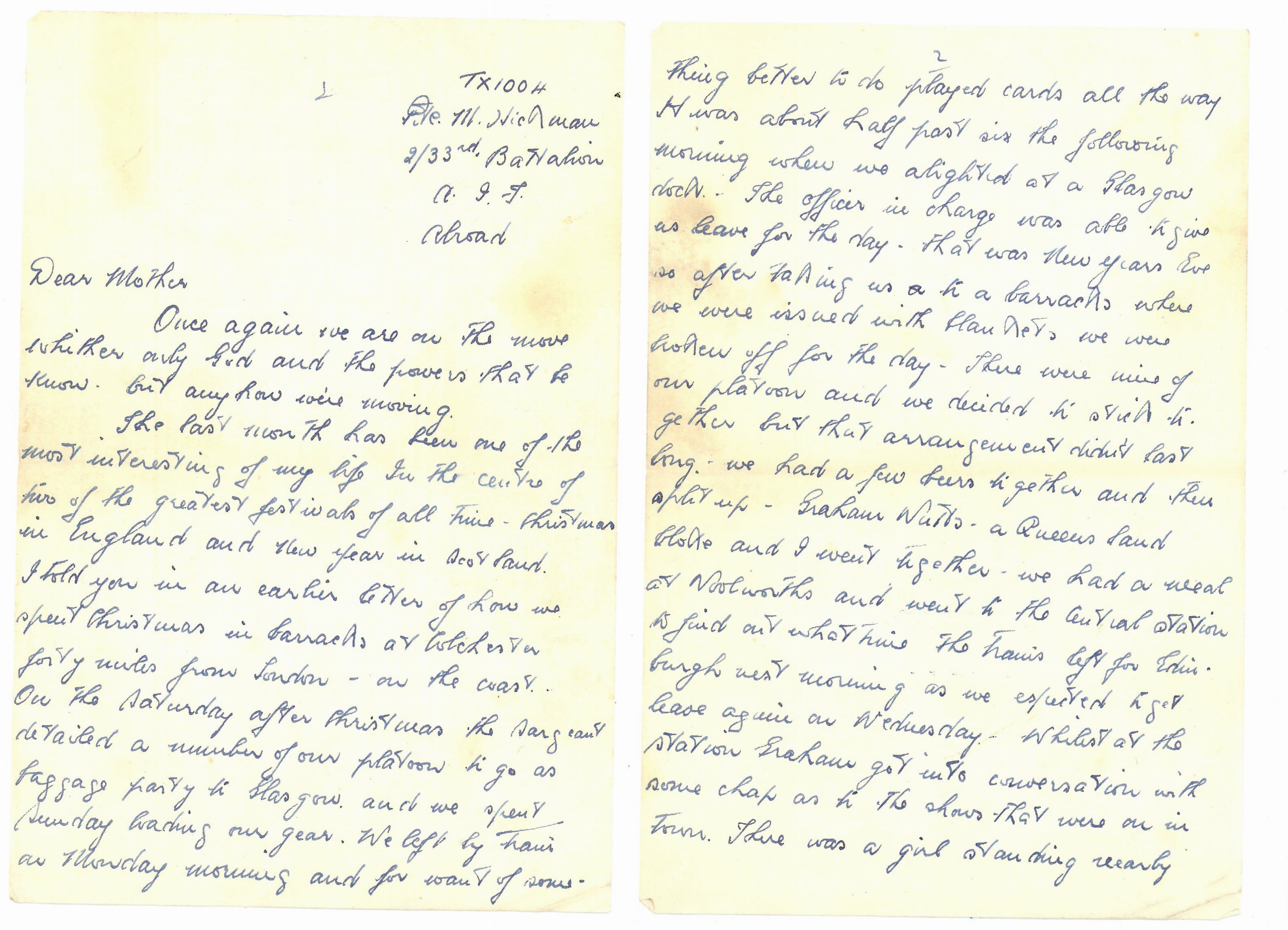
Adventures in Glasgow January 1941

Glasgow Jan 1941 pp 1 2

Glasgow Jan 1941 pp 3 4

Glasgow Jan 1941 pp 5 6

Glasgow Jan 1941 p7

TX 1004

Pte M Hickman

2/33rd Battalion

AIF

Abroad

Dear Mother

Once again we are on the move whither only God and the powers that be know – but anyhow we’re moving.

The last month has been one of the most interesting of my life.  In the centre of two of the greatest festivals of all time – Christmas in England and New Year in Scotland.  I told you in an earlier letter of how we spent Christmas in barracks at Colchester forty miles from London – on the coast.  On the Saturday after Christmas the sergeant detailed a number of our platoon to go as baggage party to Glasgow and we spent Sunday loading our gear.  We left by train on Monday morning and for want of something better to do played cards all the way.

It was about half past six the following morning when we alighted at a Glasgow dock. The officer in charge was able to give us leave for the day.  That was New Year’s Eve so after taking us to a barracks where we were issued with blankets we were broken off for the day.  There were nine of our platoon and we decided to stick together but that arrangement didn’t last long.  We had a few beers together and then split up – Graham Watts – a Queensland bloke – and I went together.  We had a meal at Woolworths and went to the Central Station to find out what time trains left for Edinburgh next morning as we expected to get leave again on Wednesday.

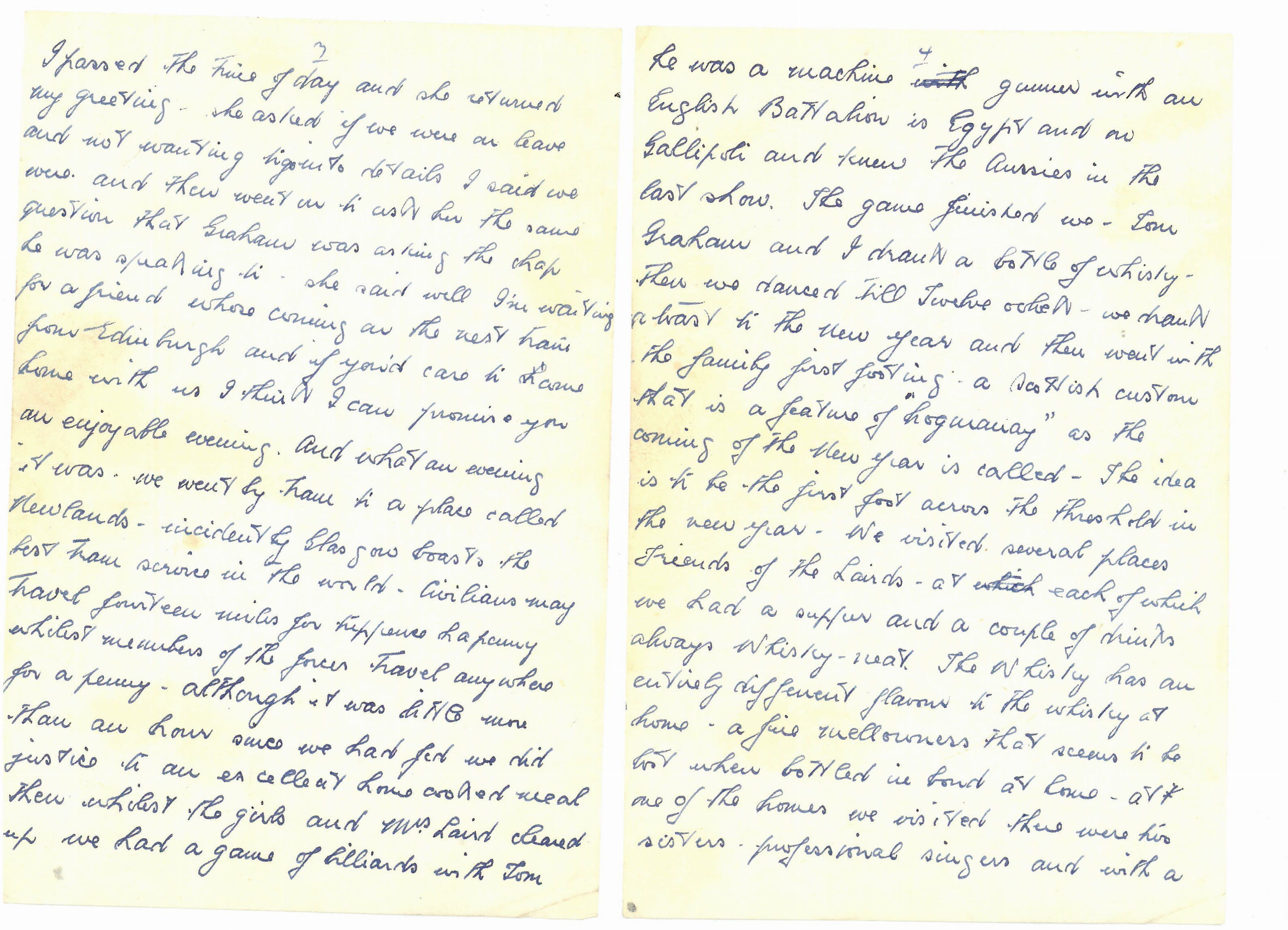
Whilest at the station Graham got into conversation with some chap as to the shows that were on in town.  There was a girl standing nearby.  I passed the time of day and she returned my greeting.  She asked if we were on leave and not wanting to go into details I said we were and then went on to ask her the same question that Graham was asking the chap he was speaking to.  She said well I’m waiting for a friend whose coming on the next train from Edinburgh and if you’d care to come home with us I think I can promise you an enjoyable evening.  And what an evening it was.  We went by tram to a place called Newlands – incidentally Glasgow boasts the best tram service in the world – civilians may travel fourteen miles for tuppence ha’penny whilst members of the forces travel anywhere for a penny.

Although it was little more than an hour since we had fed we did justice to an excellent home cooked meal then whilst the girls and Mrs Laird cleared up we had a game of billiards with Tom.  He was a machine gunner with an English Battalion in Egypt and on Gallipoli and knew the Aussies in the last show.  The game finished, Tom, Graham and I drank a bottle of whisky then we danced till twelve o’clock and then went with the family first footing – a Scottish custom that is a feature of ‘Hogmanay’ as the coming of the New Year is called.  The idea is to be the first foot across the threshold in the New Year.  We visited several places – friends of the Lairds – at each of which we had a supper and a couple of drinks – always whisky – neat.  The Whisky has an entirely different flavour to the whisky at home.  At one of the homes we visited there were two sisters and with a piano playing they treated us to some really good singing.

It was half past six the following morning when we arrived back at barracks.  We had a clean up, saw the officer who gave us leave for the day and set out for Edinburgh.  We were not disposed to shave ourselves so went to a barber – like everybody else in Scotland he was suffering from the effects of an all night celebration – before shaving us he gave us each a glass of Whisky and then a glass of beer as a chaser and as our shave only cost 3d we got good value for our money.  Whatever other celebrations I have the fortune to attend I’ll never forget Hogmanay – most people were just arriving home or making their way home when we reached the station.  There was a heavy snowfall on New Year’s Day and in Edinburgh gangs of workmen were kept busy cleaning the snow from the tramlines.

Both Thursday evening and Friday evening we spent with the Lairds – the most charmingly hospitable family I’ve ever met.  There was Tom (the husband), Mrs Laird who comes from the far north and three daughters – Billie the eldest is I think the prettiest girl I ever saw.  Before leaving them on Wednesday morning we suggested taking them to a show and when we arrived on Thursday night they were all set to go but we were broke – the officer had told us that if we had any credit in our paybooks we could draw it on the Friday so I took Tom aside and explained the situation to him and without a question he gave me a pound and when I gave it back on the Friday he didn’t want to take it.

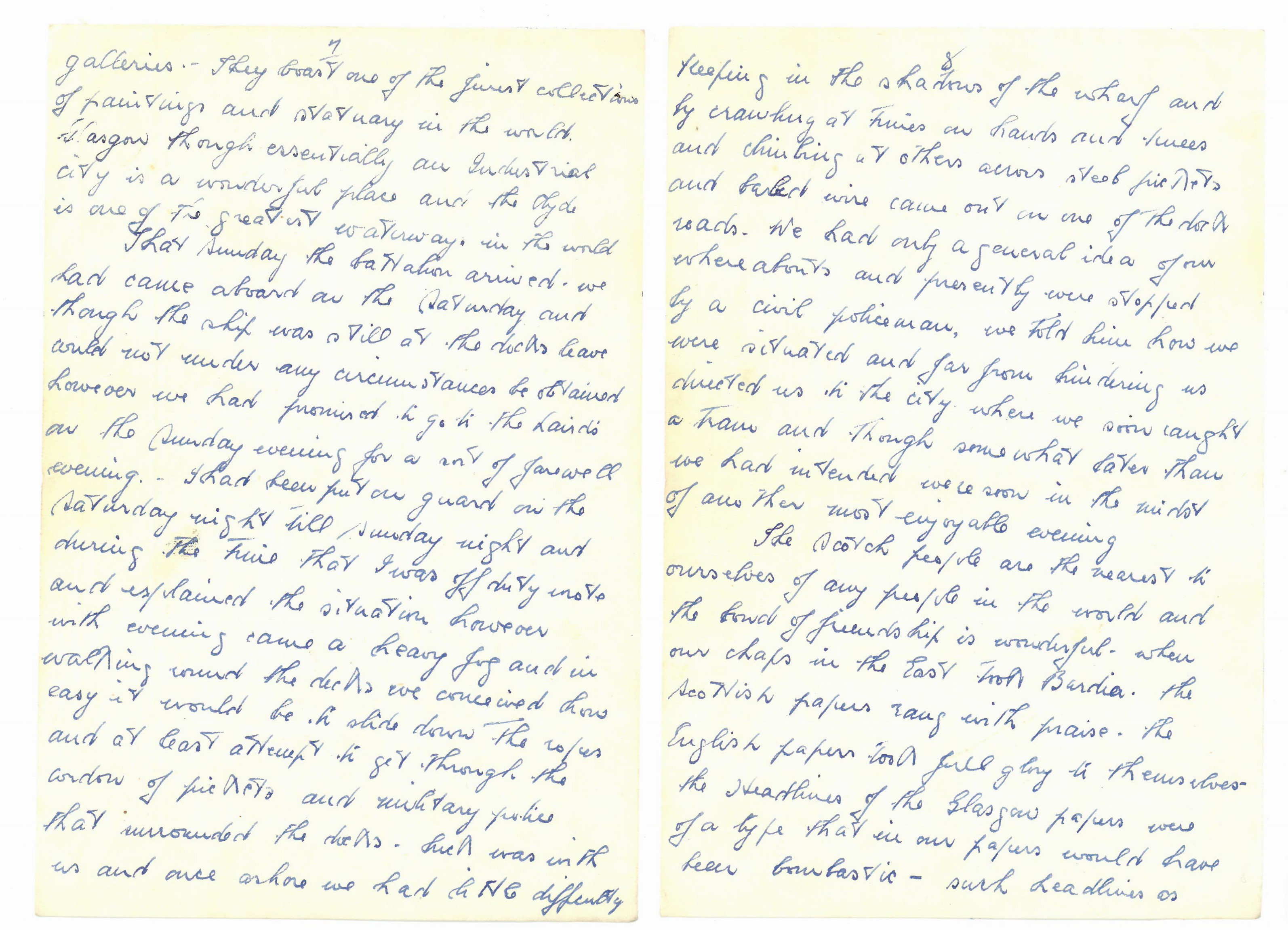
On the Friday afternoon we saw the most colourful pantomime imaginable.  I always thought pantomimes were for kids but almost the entire audience were adults.  On another day we went to the Art galleries.  They boast one of the finest collections of paintings and statuary in the world.  Glasgow though essentially an industrial city is a wonderful place and the Clyde is one of the greatest waterways in the world.

That Sunday the Battalion arrived.  We had come aboard on the Saturday and though the ship was still at the docks leave could not under any circumstances be obtained however we had promised to go back to the Lairds on the Sunday evening for a sort of farewell evening.  I had been put on guard on the Saturday night till Sunday night and during the time that I was off duty wrote and explained the situation however with evening came a heavy fog and in walking round the decks we conceived how easy it would be to slide down the ropes and at least attempt to get through the cordon of pickets and military police that surrounded the docks.

Luck was with us and once ashore we had little difficulty keeping in the shadows of the wharf and by crawling at times on hands and knees and climbing at others across steel pickets and barbed wire came out on one of the dock roads.  We had only a general idea of our whereabouts and presently were stopped by a civil policeman.  We told him how we were situated and far from hindering us he directed us to the city where we soon caught a tram and though somewhat later than we had intended were soon in the midst of another most enjoyable evening.

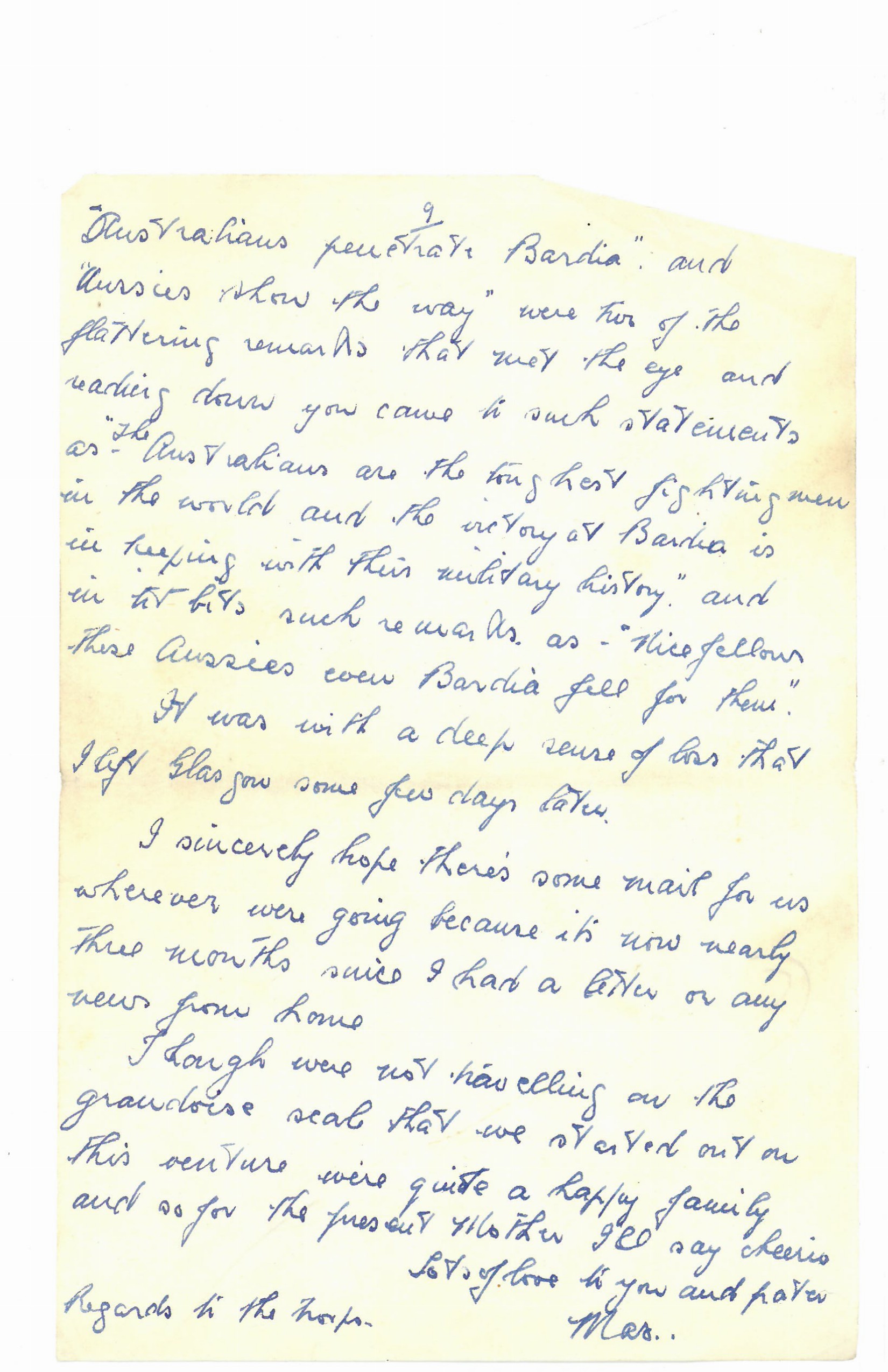
The Scotch people are the nearest to ourselves of any people int he world and the bond of friendship is wonderful – when our chaps in the East took Bardia the Scottish papers rang with praise.  The English papers took full glory to themselves.  The headlines of the Glasgow papers were of a type that in our papers would have been bombastic – such headlines as “Australians penetrate Bardia” and “Aussies show the way” were two of the flattering remarks that met the eye and reading down you came to such statements as “The Australians are the toughest fighting men in the world and the victory at Bardia is in keeping with their military history” and in titbits such remarks as – “Nice fellows these Aussies – even Bardia fell for them”.

It was with a deep sense of loss that I left Glasgow some few days later.

I sincerely hope there’s some mail for us wherever we’re going because it’s now nearly three months since I had a letter or any news from home. **

Though we’re not travelling on the grandiose scale that we started out on this venture we’re quite a happy family and so for the present Mother I’ll say cheerio.

Lots of love to you and the pater.  Regards to the troops.

Max

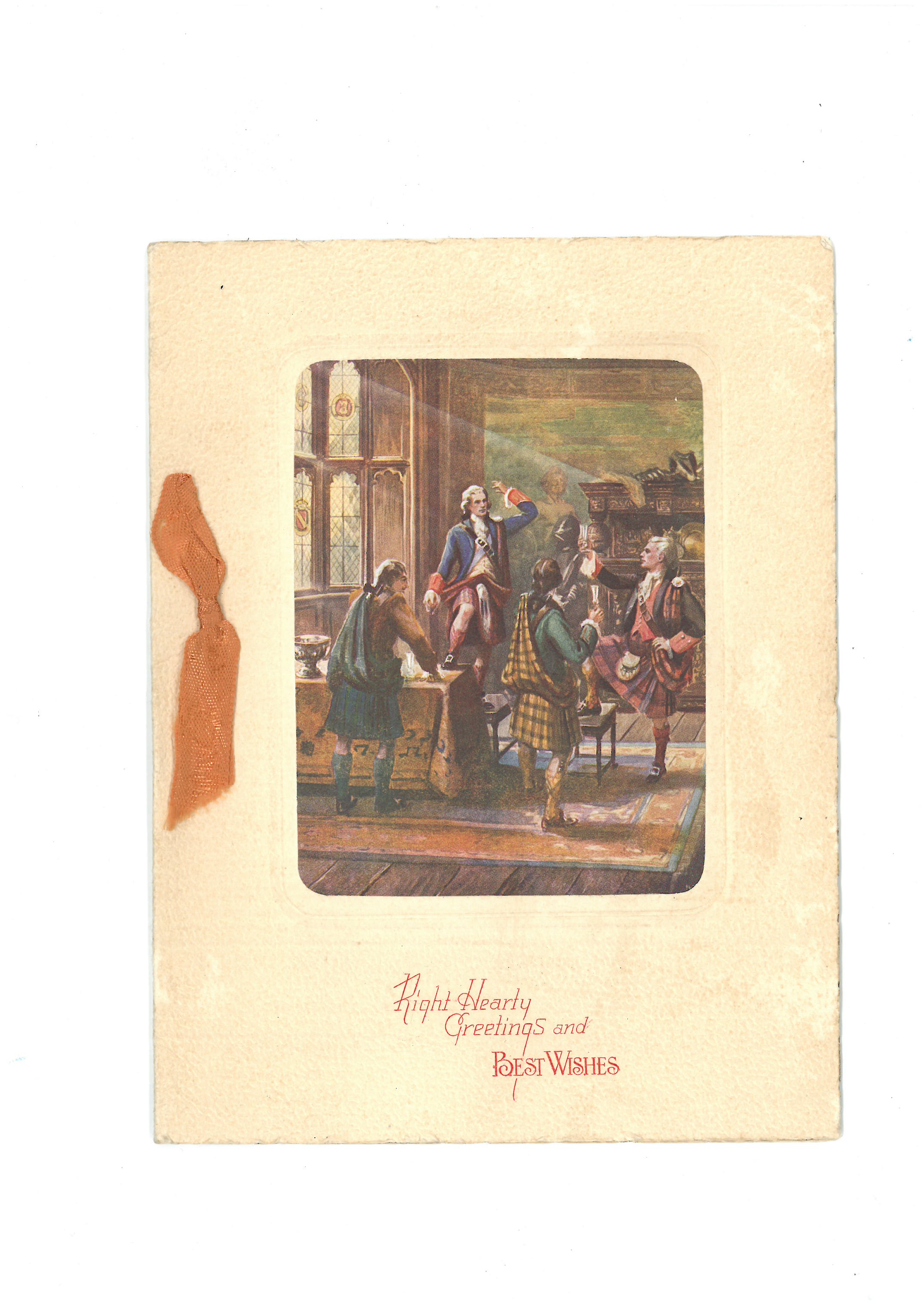
Christmas letter

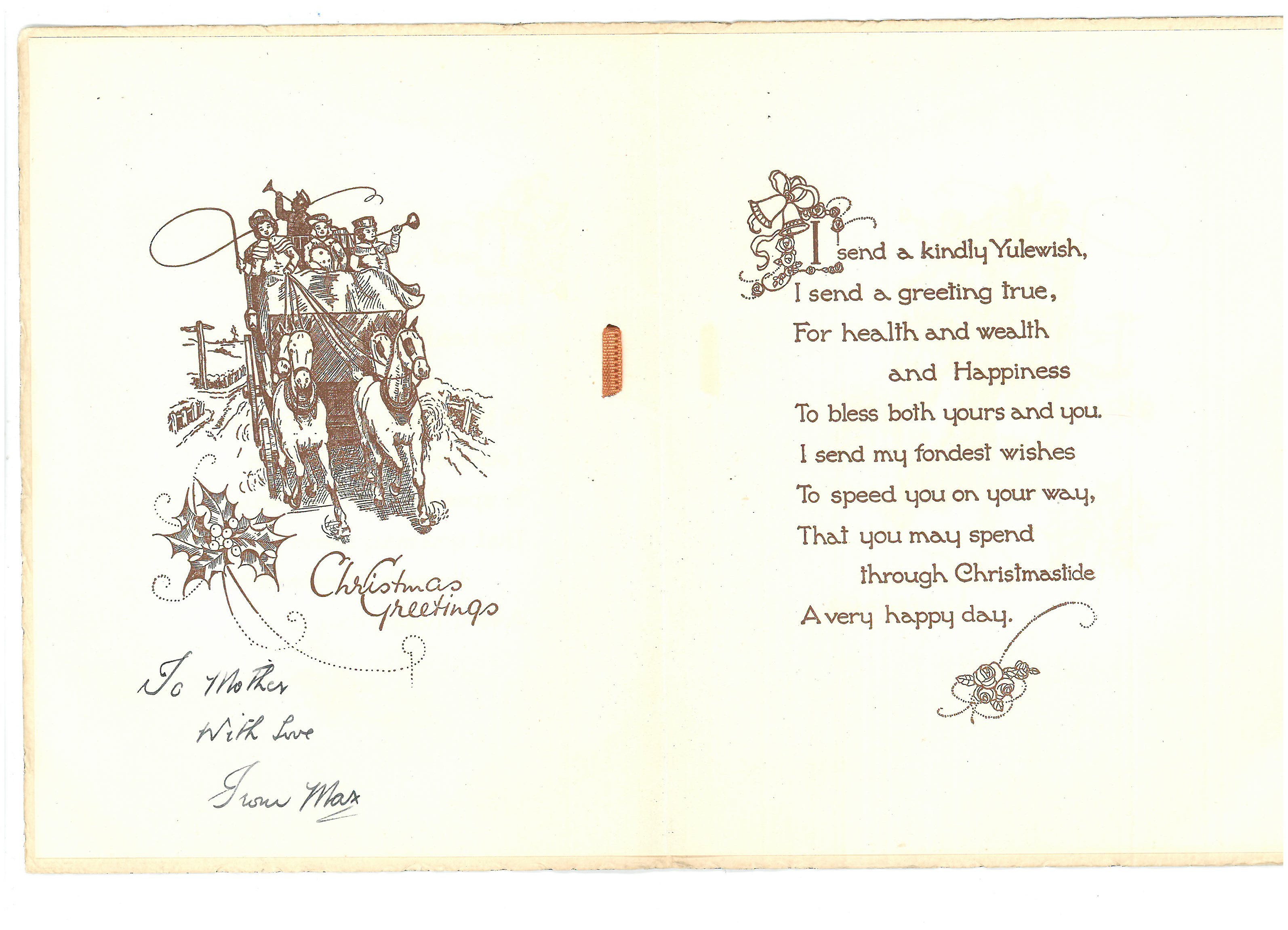
Dad’s Christmas letter is not in my collection, but there is a description of the Christmas dinner mentioned in a later letter. However I do have a Christmas card sent from Scotland:
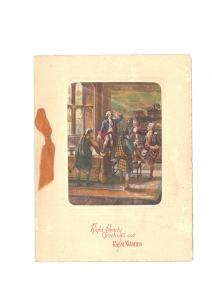
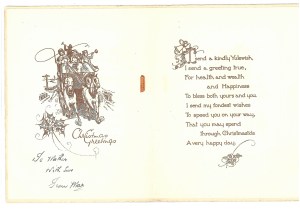
Scottish Christmas card


Christmas card from Scotland inner


News from Home!?

Once again, Dad speaks of it being months since he had any news from home, but his letter of Dec 8 he mentions receiving letters from his mother – admittedly written in September – so maybe this is what he means by the three months mentioned (i.e. that the latest news he had received was from 3 months ago).  On 16th Dec he says his last letter from Youngster was on October 24th – and again, it’s not clear if this is the date of the letter (more likely) or the date of receipt.

On November 17 he says An old letter of May’s written on the 29th of May turned up last week. So again, he might mean – no recent news, rather than no recent letters.

Alcohol consumption

The diary entry below speaks of drinking a bottle of Black & White (it sounds as though he was the only one drinking – but maybe not), and the letter above of three men consuming a bottle of whisky between them.  This seems an awful lot to me…especially as there was a lot more alcohol consumed on New Year’s Eve!

Diary entries

In packing to move house, I have uncovered one of Dad’s wartime diaries.  It is a memo book and covers the period from December 31 1940 – July 16 1941.  For December 31 and the first part of January entries are as follows:

(Note – according to Dick Lewis they were discouraged from keeping diaries – but clearly many did – as William Crooks says that when writing The Footsoldiers he relied on them)

December 31

Arrived Glasgow from Colchester at 6.30am – taken to York Hill Barracks – dismissed at two o’clock.  Courtesy call Buchanan’s Warehouse drank bottle of Black & White.  Went on pub crawl tea at Woolworths – walked to Railway station – met Billie Laird – pretty as a picture – took Graham Watts and self home – Tom, Mrs Laird, Sally, Margaret and Hazel – Whisky – another tea – Billiards, Whisky & Cocktails – Toast New Year.

1st January 1941

One minute past twelve went first footing – hell of a good night.  Whisky, Beer – fatted calf.  Back to Barracks – had a clean up – went to Edinburgh – North British Hotel – Daisy Aird – Snow storm – back to barracks 1am.

2nd January

drank some beer.  lunch at YMCA met sailor from Empress of Britain – Head bandage and leg in a mess – told us the story of the sinking – Bombed with HE  (?) then with incendiaries then torpedoed by submarine – Went to Lairds in afternoon – went to a show in the evening

3rd January

Went to pantomime with Wattsie Billie & Margaret…. colourful show – tea and ….at Lairds (Mrs Soldier…cabbage – leaves a ….wherever he goes)

4th January

Went aboard ship – New Hellas – put on guard duty

5th January

Guard all day – dismissed 5pm.  Battalion came on board went AWL that night – went out to Lairds – once clear of ship kept in shadows of Railway trucks – crawled through barbed wire – round docks – directed by civvy police – Had a couple of drinks at a big hotel – Adelphi – and went out to Newlands again.  Farewell evening.

6th January

Shifted out of cabin to make room for postal staff.  Loaded mags for Bren – Tucker light on – sleep on floor.

7th January

Fix Ac Ac ports.  very cold.  Heavy fog.  Boat drill.  Ac Ac lecture

8th January

Route march in afternoon – round Glasgow along Great Western Road.  sleep on floor

9th January

Route march again.  bought shop out of milk & cakes

10th

Fog bound still.  move into cabin P46 – Ray Ross, Viv Abel, Tom Brereton, Graham Watts, Jack Doran.  all afternoon settling in.  Helped by Capt Miller got to wharf and rang Mrs Laird and Billie.  Promised to see Billie that night – got sick.  Bloody sick at tea time – vomited blood.  Couldn’t get ashore – wrote Billie a note.

11th January

sick parade – temp 102 Tugs took ship into stream – down the Clyde – passed big dockyards to Greenock.  Hills very bare and barren in contrast to when we came in in June ’40.

Posted in Britain, escapades, relaxation, fun and games, leave, The course of the war, Uncategorized, unit and personal diaries | Tagged , , , , , , , | Leave a comment

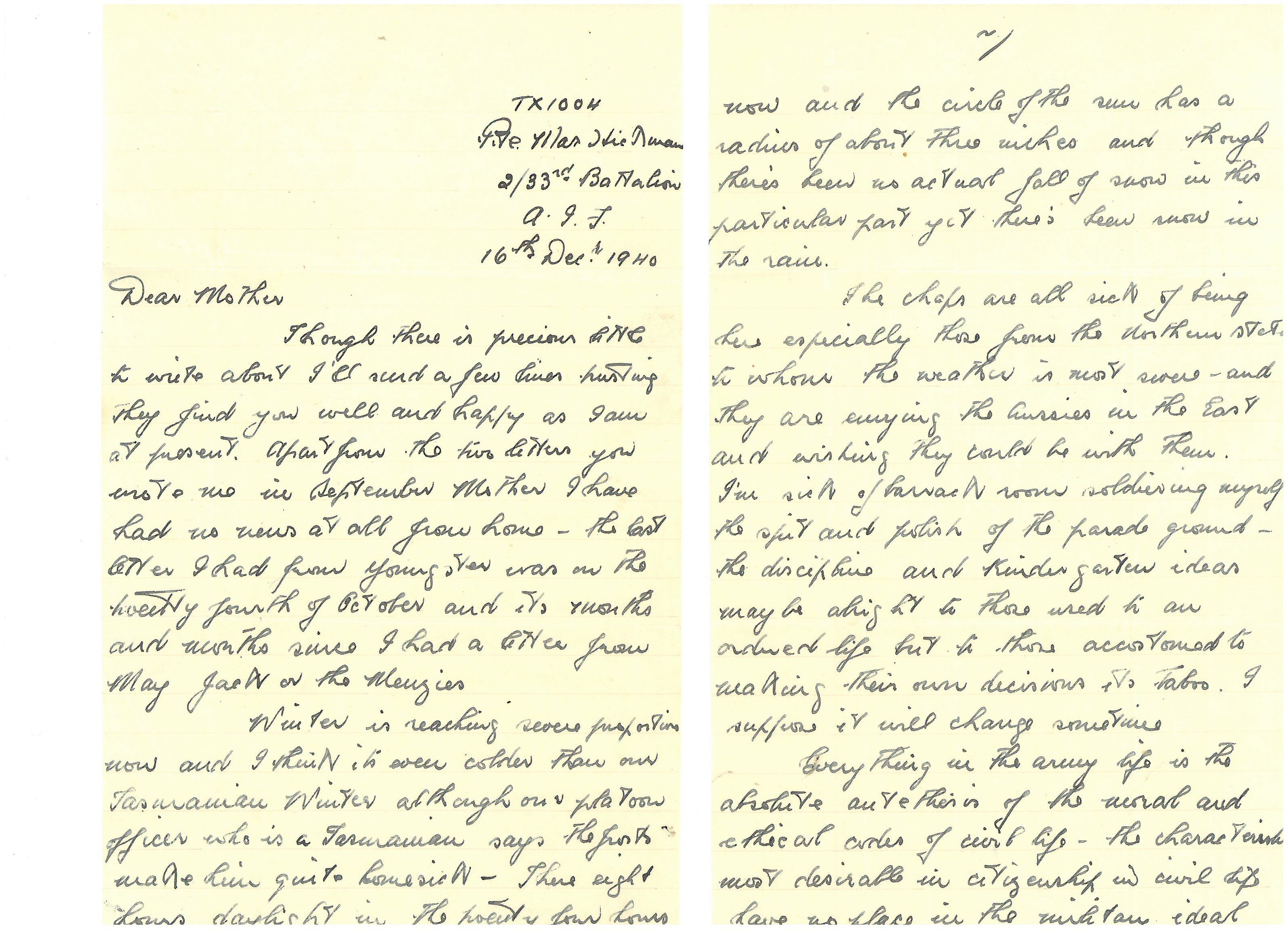
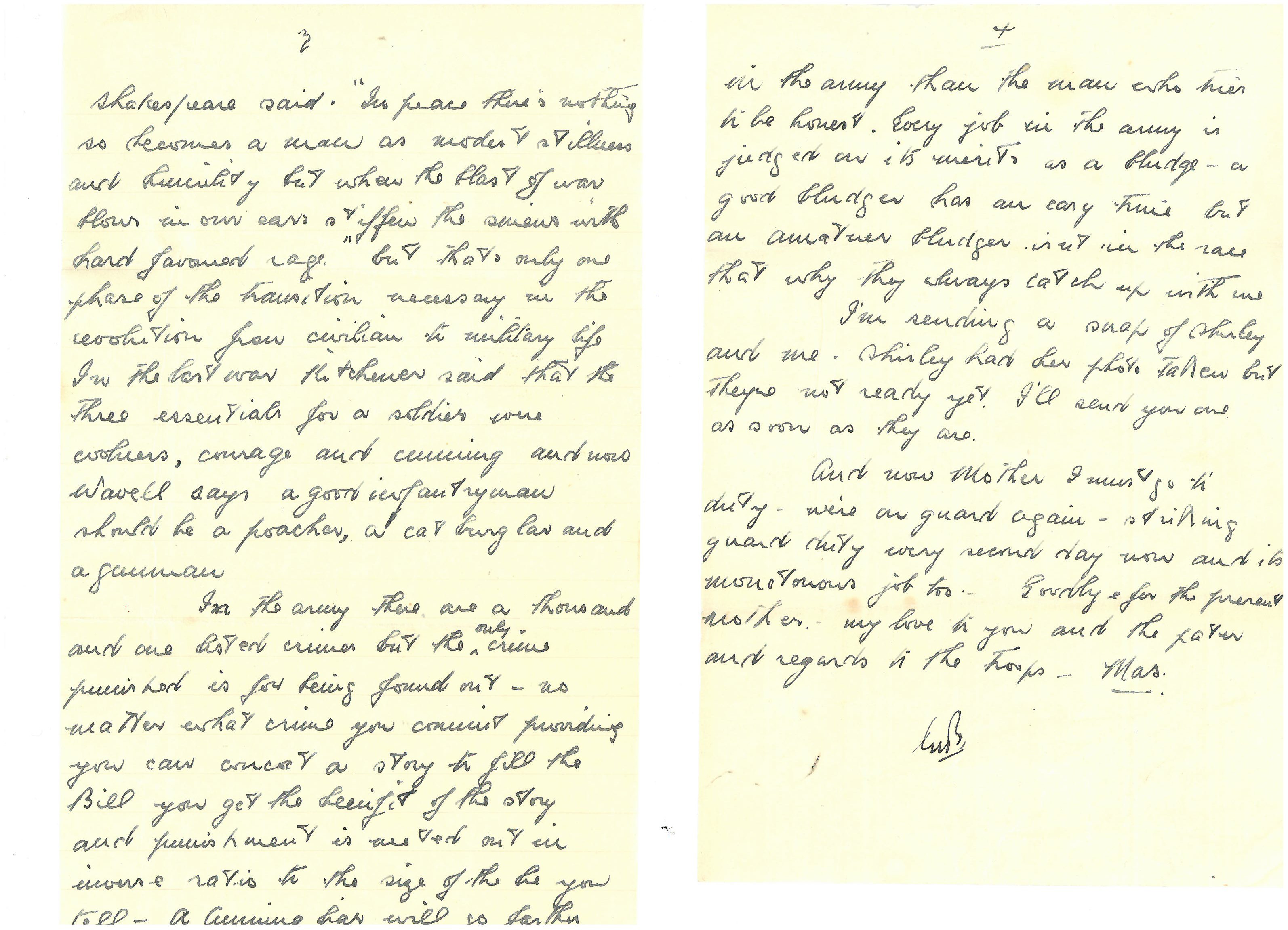
Winter and the boredom of barrack room soldiering

16 Dec 1940 pp 1 2

16 Dec 1940 pp 3 4TX 1004

Pte Max Hickman

2/33rd Battalion

AIF

16th Dec 1940

Dear Mother

Though there is precious little to write about I’ll send a few lines trusting they find you well and happy as I am at present.  Apart from the two letters you wrote me in September Mother I have had no news at all from home – the last letter I had from Youngster was on the twenty fourth of October and its months and months since I had a letter from May, Jack or the Menzies.

Winter is reaching severe proportions now and I think it’s even colder than our Tasmanian Winter although our platoon officer who is a Tasmanian says the frosts make him quite homesick.  There’s eight hours daylight in the twenty four hours now and the circle of the sun has a radius of about three inches and though there’s been no actual fall of snow in this particular part yet there’s been snow in the rain.

The chaps are all sick of being here especially those from the northern states to whom the weather is worst ever – and they are envying the Aussies in the East and wishing they could be with them.  I’m sick of barrack room soldiering myself the spit and polish of the parade ground – the discipline and Kindergarten ideas may be alright to those used to an ordered life but to those accustomed to making their own decisions it’s taboo.  I suppose it will change sometime.

Everything in the army life is the absolute antithesis of the moral and ethical codes of civil life – the characteristics most desirable in citizenship in civil life have no place in the military ideal.  Shakespeare said ‘In peace there’s nothing so becomes a man as modest stillness and humility but when the blast of war blows in our ears stiffen the sinews with hard favoured rage” but that’s only one phase of the transition necessary in the evolution from civilian to military life.  In the last war Kitchener said that the three essentials for a soldier were coolness, courage and cunning and now Wavell says a good infantryman should be a poacher, a cat burglar and a gunman.

In the army there are a thousand and one listed crimes but the only crime punished is for being found out – no matter what crime you commit providing you can concoct a story to fit the bill you get the benefit of the story and punishment is meted out in inverse ratio to the size of the lie you tell – a cunning liar will go farther in the army than the man who tries to be honest.  Every job in the army is judged on its merits as a bludge – a good bludger has an easy time but an amateur bludger isn’t in the race.  That’s why they always catch up with me.

I’m sending a snap of Shirley and me.  Shirley had her photo taken but they’re not ready yet.  I’ll send you one as soon as they are.

And now Mother I must go to duty – we’re on guard again – striking guard duty every second day now and it’s a monotonous job too.  Goodbye for the present Mother.  My love to you and the pater and regards to the troops

Max

The only crime punished…

Dad often speaks with envy and dismay about the fact that he wasn’t as good a storyteller as some others.  He took bad luck very personally!

Photograph of Shirley

As mentioned in a previous post, I have never seen a photo of Shirley.

Posted in Britain, Camps and Barracks, organisation, Uncategorized | Tagged , , , , , , , | Leave a comment

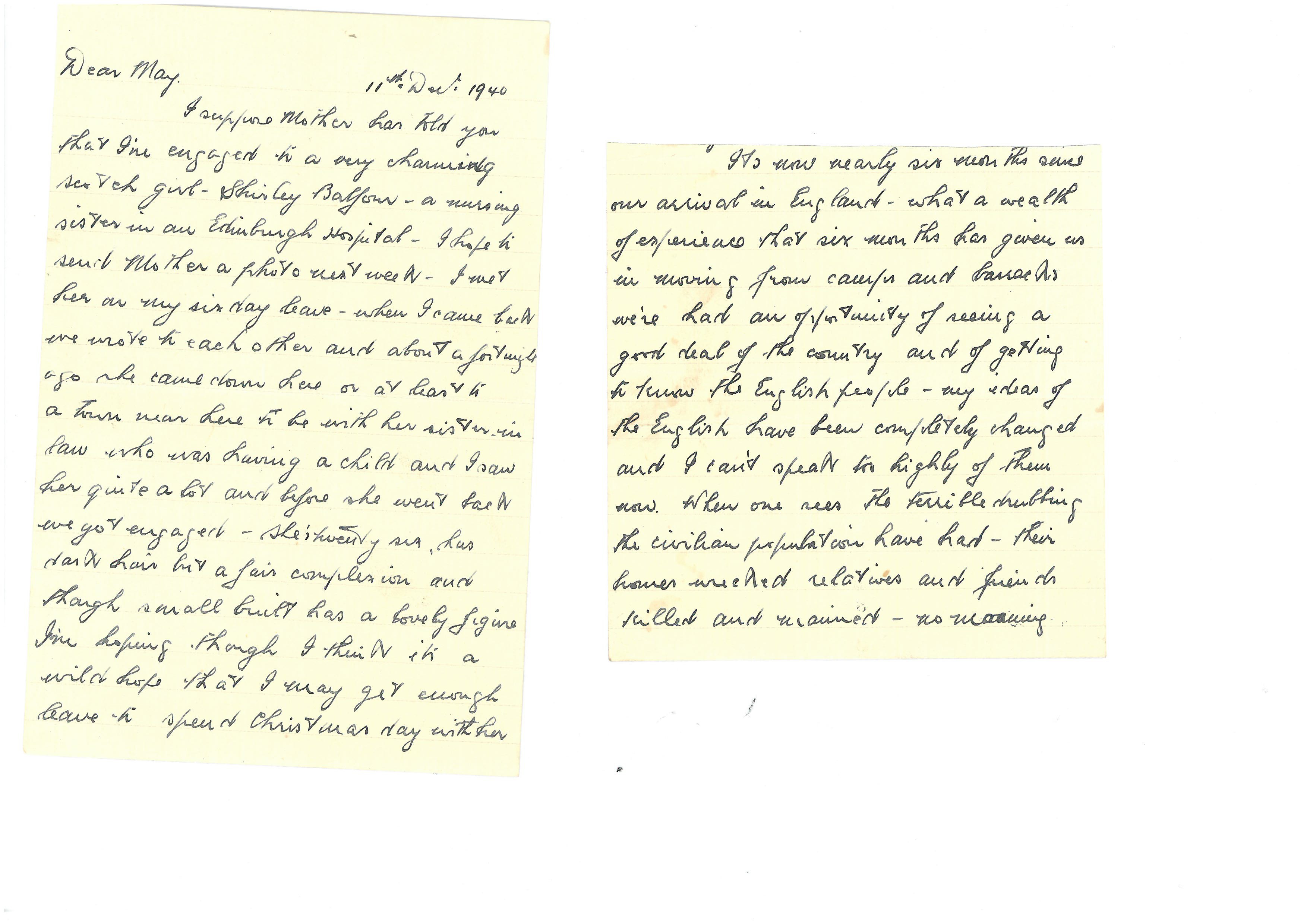
I’m engaged: a letter to May

to May Dec 1940 pp 1 2         to May Dec 1940 pp 3 4             to May Dec 1940 pp 5 6


to May Dec 1940 p7

11th Dec 1940

Dear May

I suppose Mother has told you that I’m engaged to a very charming Scotch girl – Shirley Balfour – a nursing sister in an Edinburgh hospital.  I hope to send Mother a photo next week – I met her on my six day leave.  When I came back we wrote to each other and about a fortnight ago she came down here or at least to a town near here to be with her sister in law who was having a child and I saw her quite a lot and before she went back we got engaged – She’s twenty six, has dark brown hair but a fair complexion and though small built has a lovely figure.  I’m hoping though I think it’s a wild hope that I may get enough leave to spend Christmas Day with her….

(top of next page cut off)

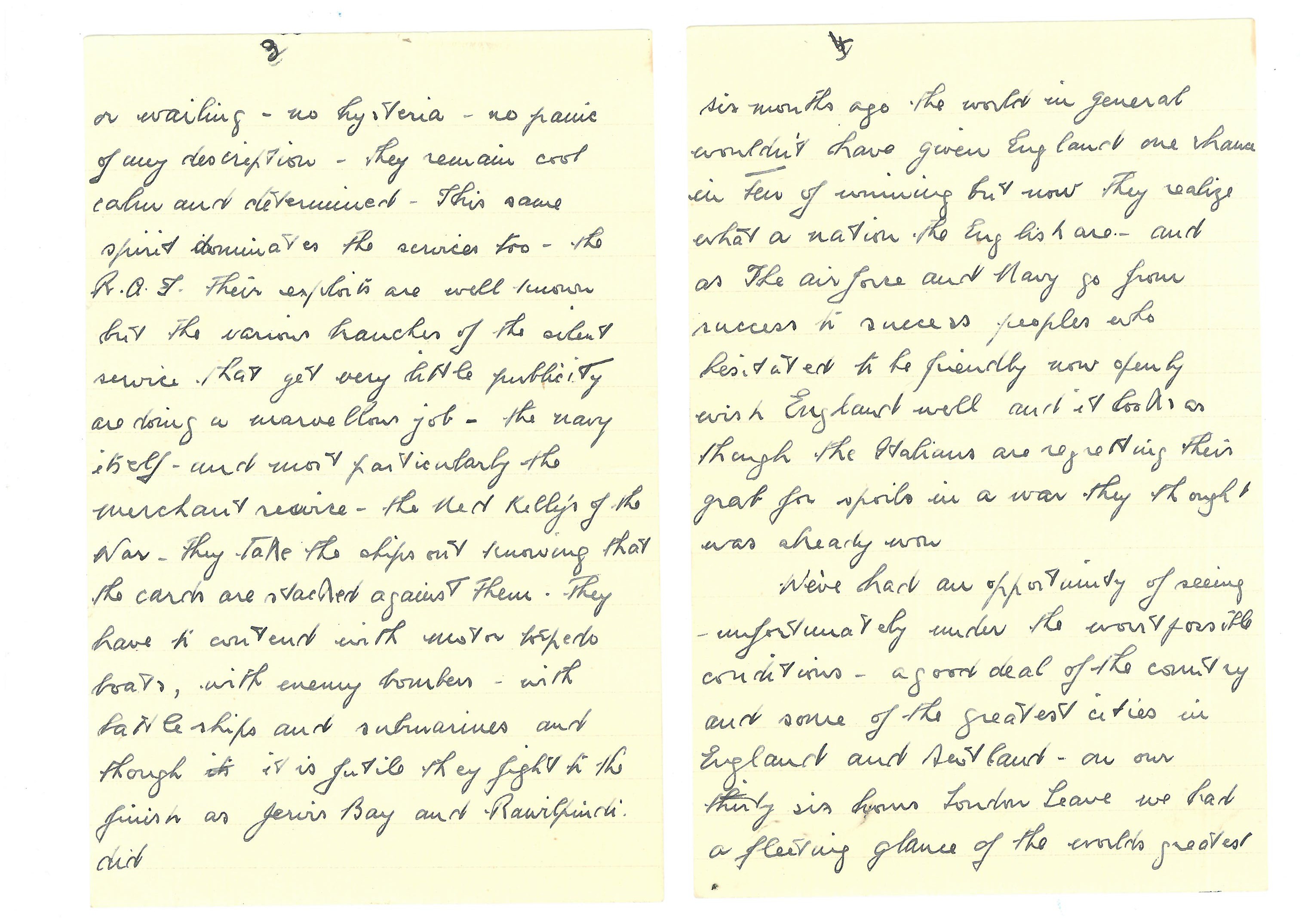
It’s now nearly six months since our arrival in England.  What a wealth of experience that six months has given us: in moving from camps and barracks we’ve had an opportunity of seeing a good deal of the country and of getting to know the English people.  My ideas of the English have been completely changed and I can’t speak too highly of them now.  When one sees the terrible drubbing the civilian population have had – their homes wrecked, relatives and friends killed and maimed – no moaning or wailing – no hysteria – no panic of any description – they remain cool, calm and determined.  This same spirit dominates the services too – the RAF – their exploits are well known but the various branches of the silent service that get very little publicity are doing a marvellous job – the navy itself – and most particularly the merchant service – the Ned Kelly’s of the war – they take the ships out knowing that the cards are stacked against them – they have to contend with motor torpedo boats, with enemy bombers, with battleships and submarines and though it is futile they fight to the finish as Jervis Bay and Rawalpindi did.

Six months ago the world wouldn’t have given England one chance in ten of winning but now they realise what a nation the English are – and the airforce and Navy go from success to success.  Peoples who hesitated to be friendly now wish England well and it looks as though the Italians are regretting their grab for spoils in a war they thought was already won. We’ve had an opportunity of seeing – unfortunately under the worst possible conditions – a good deal of the country and some of the greatest cities in England and Scotland.  On our thirty six hours London leave we had a fleeting glance of the world’s greatest city.  Whilest in camp on the plains we saw the city of Salisbury – a city of about a quarter of a million people and centre of Britain’s military training grounds.  We also saw Winchester – the ancient capital of England with its very old and interesting Cathedral its interesting architecture and statue of King Alfred.  We saw Marlborough, Andover, Tidworth …and many small towns and we travelled down the west coast by train right through the midlands, and on six day leave both up and down the east coast – through York, Hull and Newcastle.  In Scotland I had a good look round the wonderful city of Edinburgh – was through Dunfermline, Alloa, Stirling, Helensburgh and Glasgow.

Though at times we’ve moaned and whinged about our own personal grievances it’s been a wonderful education and I hope someday to come back and see it all in its peacetime setting.

Our Colonel has been promoted to acting Brigadier and we don’t know whether he’ll come back to us or not.  We’ve lost a good CO – because although he was very irregular in dealing with offenders he had the interests of the battalion at heart and was a vey able officer.

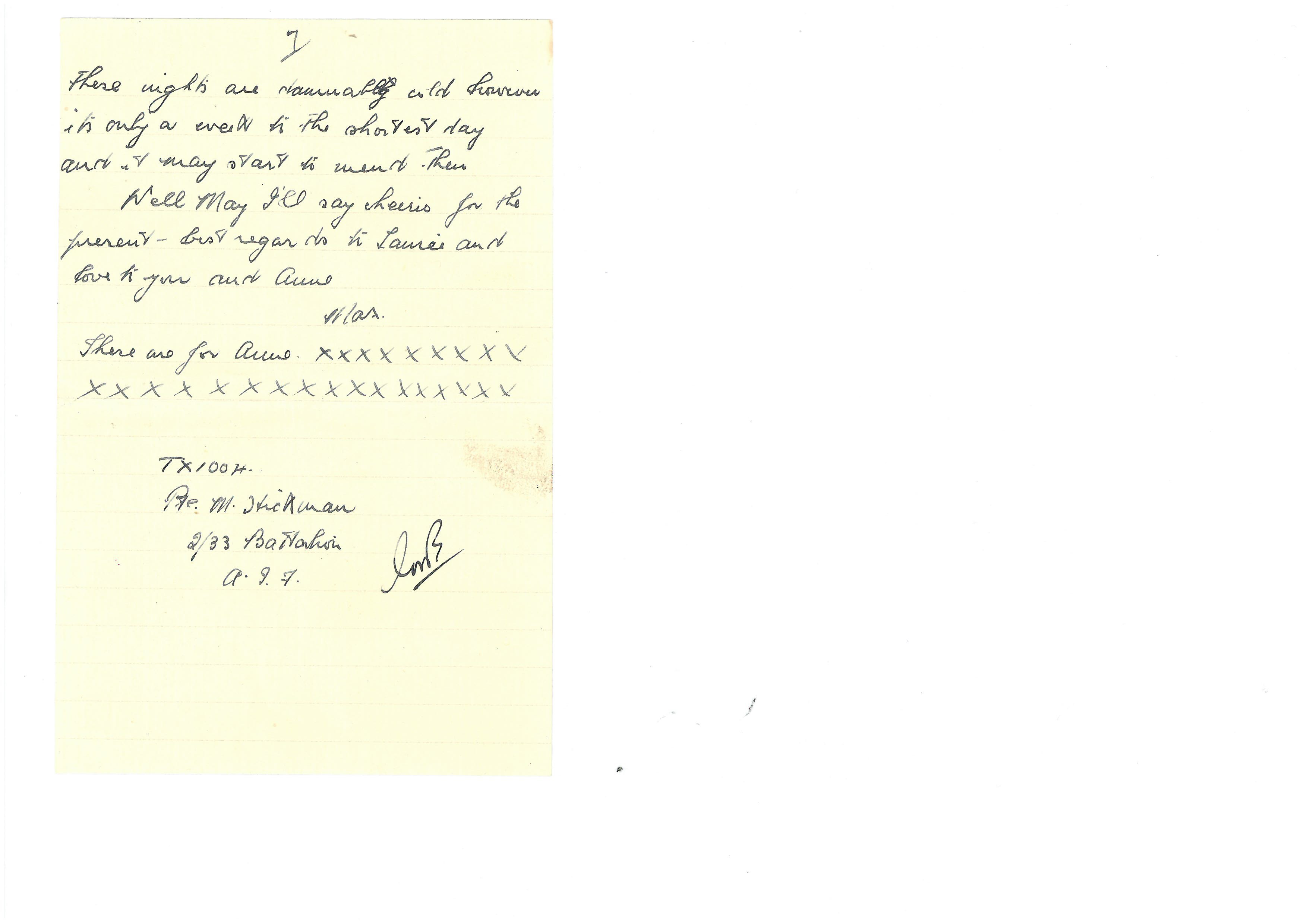
The weather is terribly cold here now and the days have less than eight hours of daylight – guard duties these nights are damnably cold however it’s only a week to the shortest day and it may start to mend then. Well May I’ll say cheerio for the present – best regards to Laurie and love to you and Anne

Max

These are for Anne xxxxxxxxxxxxxxxxxxxxxxxxxxxxxxx

TX 1004

Pte M Hickman

2/33 Battalion AIF


Shirley Balfour

The engagement was doomed not to last – it’s not clear from subsequent letters, just how long it was in place, but certainly  within a couple of years Shirley had married someone else.  There is no photo of her in Dad’s papers, although at least one of his non-family correspondents comments favourably on her appearance so I assume he shared copies of her photo fairly widely.  I suspect Dad’s mother did not respond favourably to the news: she would have been anxious about the prospect of ‘losing’ her only son to someone on the other side of the world – but there were probably many complex reasons for the eventual outcome.

The Jervis Bay and Rawalpindi

Both ships were converted merchant vessels that were sunk by German battleships.  The captain of the Jervis Bay received a posthumous Victoria Cross.  The story of both encounters can be found in Wikipedia. The hope to visit again in peacetime Sadly, Dad never had the chance to return to the UK in peacetime.


Posted in Britain, organisation, The course of the war, Uncategorized | Tagged , , , | Leave a comment

Guard duty on pay day, chocolates in the mail, snooker on picket duty

8 Dec 1940 pp 1 2

8 Dec 1940 pp 3 4

8 Dec 1940 pp 5 6

8 Dec 1940 p7TX 1004

Pte M Hickman

2/33rd Battalion

AIF

8th Dec 1940

Dear Mother

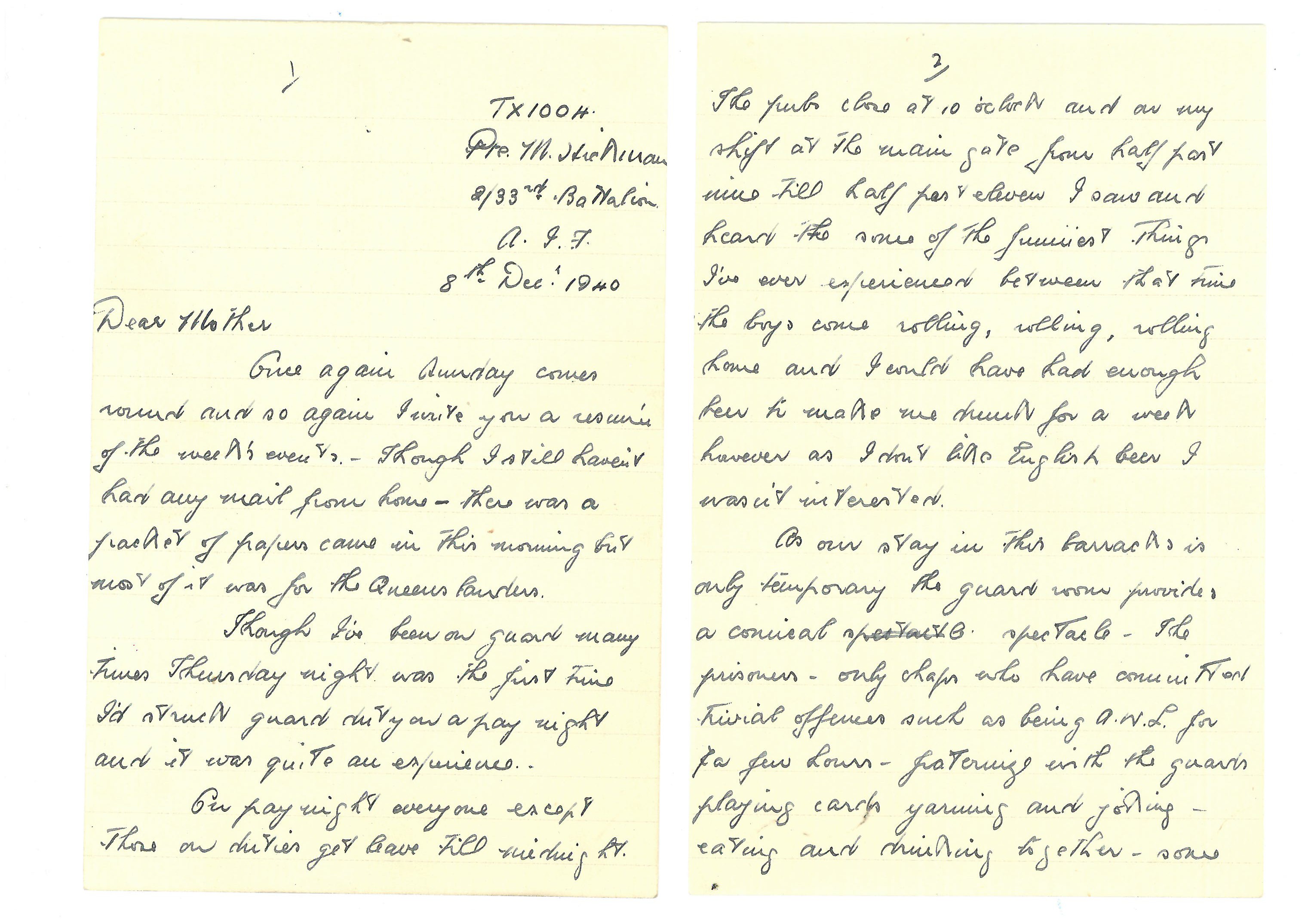
Once again Sunday comes round and so again I write you a resume of the week’s events.  Though I still haven’t had any mail from home – there was a packet of papers came in this morning but most of it was for the Queenslanders.

Though I’ve been on guard duty many times Thursday night was the first time I’d struck guard duty on a pay night and it was quite an experience.

On pay night everyone except those on duties get leave till midnight.  The pubs close at 10 o’clock and on my shift at the main gate from half past nine till half past eleven I saw and heard some of the funniest things I’ve ever experienced: between that time the boys came rolling, rolling, rolling home and I could have had enough beer to make me drunk for a week however as I don’t like English beer I wasn’t interested.

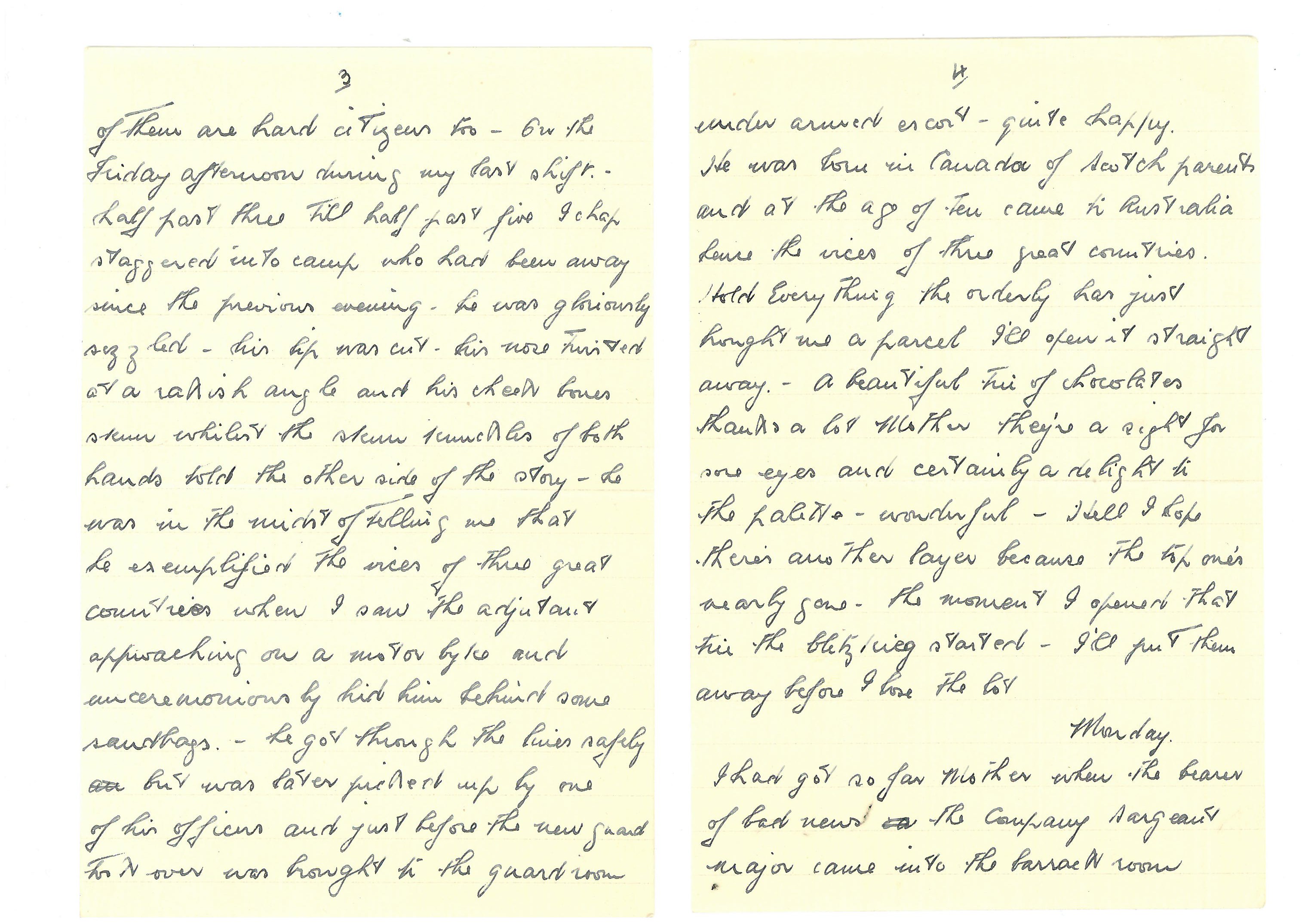
As our stay in this barracks is only temporary the guard room provides a comical spectacle.  The prisoners – only chaps who have committed trivial offences  such as being AWL for a few hours – fraternize with the guards playing cards, yarning and joking – eating and drinking together – some of them are hard citizens too.  On the Friday afternoon during my last shift – half past three till half past five – one chap staggered into camp who had been away since the previous evening.  He was gloriously sozzled – his lip was cut – his nose twisted at a rakish angle and his cheek bones skun whilst the skun knuckles of both hands told the other side of the story – he was in the midst of telling me that he exemplified the vices of three great countries when I saw the adjutant approaching on a motor byke (sic) and unceremoniously hid him behind some sandbags.  He got through the lines safely but was later picked up by one of his officers and just before the new guard took over was brought to the guard room under armed escort – quite happy.  He was born in Canada of Scotch parents and at the age of ten came to Australia hence the vices of three great countries.  Hold everything the orderly has just brought me a parcel.  I’ll open it straight away.  A beautiful tin of chocolates.  Thanks a lot Mother – they’re a sight for sore eyes and certainly a delight to the palette – wonderful – Hell I hope there’s another layer because the top one’s nearly gone.  The moment I opened that tin the blitzkrieg started – I’ll put them away before I lose the lot.

Monday

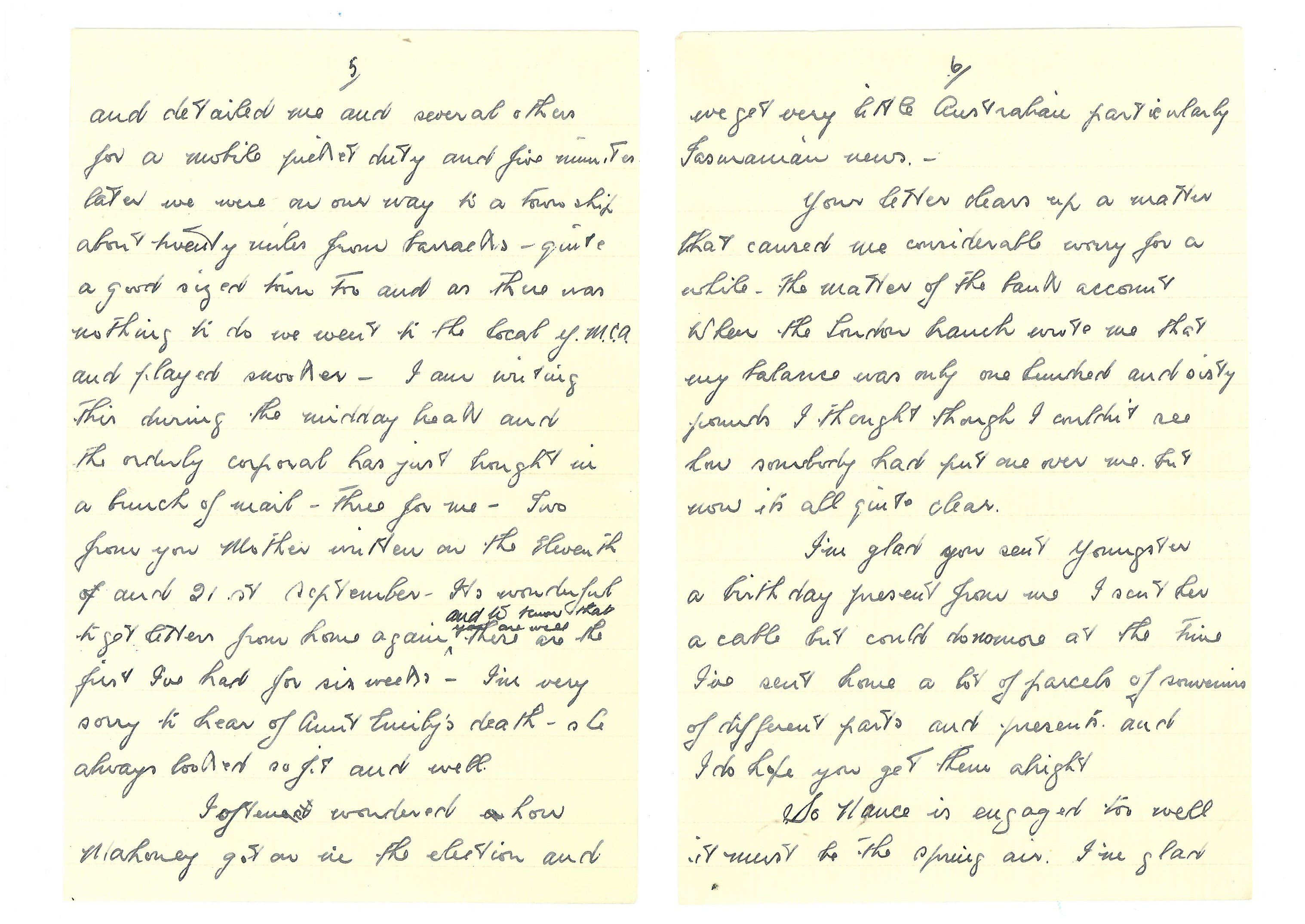
I had got so far Mother when the bearer of bad news the Company Sergeant Major came into the barrack room and detailed me and several others for a mobile picket duty and five minutes later we were on our way to a township about twenty miles from barracks – quite a good sized town too and as there was nothing to do we went to the local YMCA and played snooker – I am writing this during the midday break and the orderly corporal has just brought in a bunch of mail – three for me – two from you Mother written on the eleventh and 21st September.  It’s wonderful to get letters from home again and to know that you are well.  These are the first I’ve had for six weeks.  I’m very sorry to hear of Aunt Emily’s death – she always looked so fit and well.

I often wondered how Mahoney got on in the election – we get very little Australian particularly Tasmanian news.

Your letter clears up a matter that caused me considerable worry for a while – the matter of the bank account.  When the London branch wrote me that my balance was only one hundred and sixty pounds I thought though I couldn’t see how somebody had put one over me but now it’s all quite clear.

I’m glad you sent youngster a birthday present from me.  I sent her a cable but I could do no more at the time.  I’ve sent home a lot of parcels of souvenirs of different parts and presents and I do hope you get them alright.

So Nance is engaged too well it must be the spring air.  I’m glad to hear that Jack and Lil are still getting married at Christmas.  I didn’t know whether the war had caused any change of plans or not and of course didn’t know whether to send them a cable or not but now I will send one on payday.

I hope you got my last letter mother it was very important.  I’ll send you a photo of Shirley next week if I can.

My best regards to the boys.  I’m glad their standing up to it alright.

And now mother with love to you and dad I’ll say cheerio for present.

Love Max

PS Dick and Ken send their best regards to you both.


That Important Letter

For reasons best known to his mother, neither the ‘important letter’ nor the photograph mentioned here are part of the collection of letters on which this blog is based.

Australian Politics

As mentioned in a previous post, the Federal election in September 1940 resulted in Robert Menzies (leading a United Australia Party/ Country Party coalition) continuing as Prime Minister with the support of two independents.  Prior to this election, the member for Denison in the House of Representatives was Gerald Mahoney – a Labor man.  Despite a national swing away from the Government, Mahoney lost his seat.  The following is from Wikipedia:

Gerald William Mahoney (24 May 1892 – 16 September 1955) was an Australianpolitician. Born in Tasmania, he was educated in that state at Latrobe, becoming a painter and an official of the Painters’ Union. In 1931 he was elected to the Tasmanian House of Assembly as a Labor member for Denison. In 1934, he transferred to federal politics, defeating United Australia Party MP Arthur Hutchin for the federal seat of Denison. He held the seat until his defeat by UAP candidate Arthur Beck in 1940.
Putting his money where his mouth was

Dad had in fact stood against Mahoney in the 1937 Federal election.  He is described in the record as ‘Independent Labor’.   The final results on that occasion were (party/ candidate/ number of votes/ percentage of the total)

Labor Gerald Mahoney 11,652  47.5%   United Australia  John McPhee 10,123  41.3% Independent Labor Maxwell Hickman 2,159  8.8%  Social Credit Athol Smith 600 2.4% Total formal votes  24,534    Informal votes   1,067   Turnout  25,601

Two-party-preferred result  Labor  Gerald Mahoney  13,218   53.9%   United Australia  John McPhee  11,316   46.1%  Labor hold   Swing+3.6


Posted in guard/ picket/ orderly room duty, Posts and telegraph, Tasmanian, Uncategorized | Tagged , , , , , , , | Leave a comment