The Fuzzy Wuzzy Angels

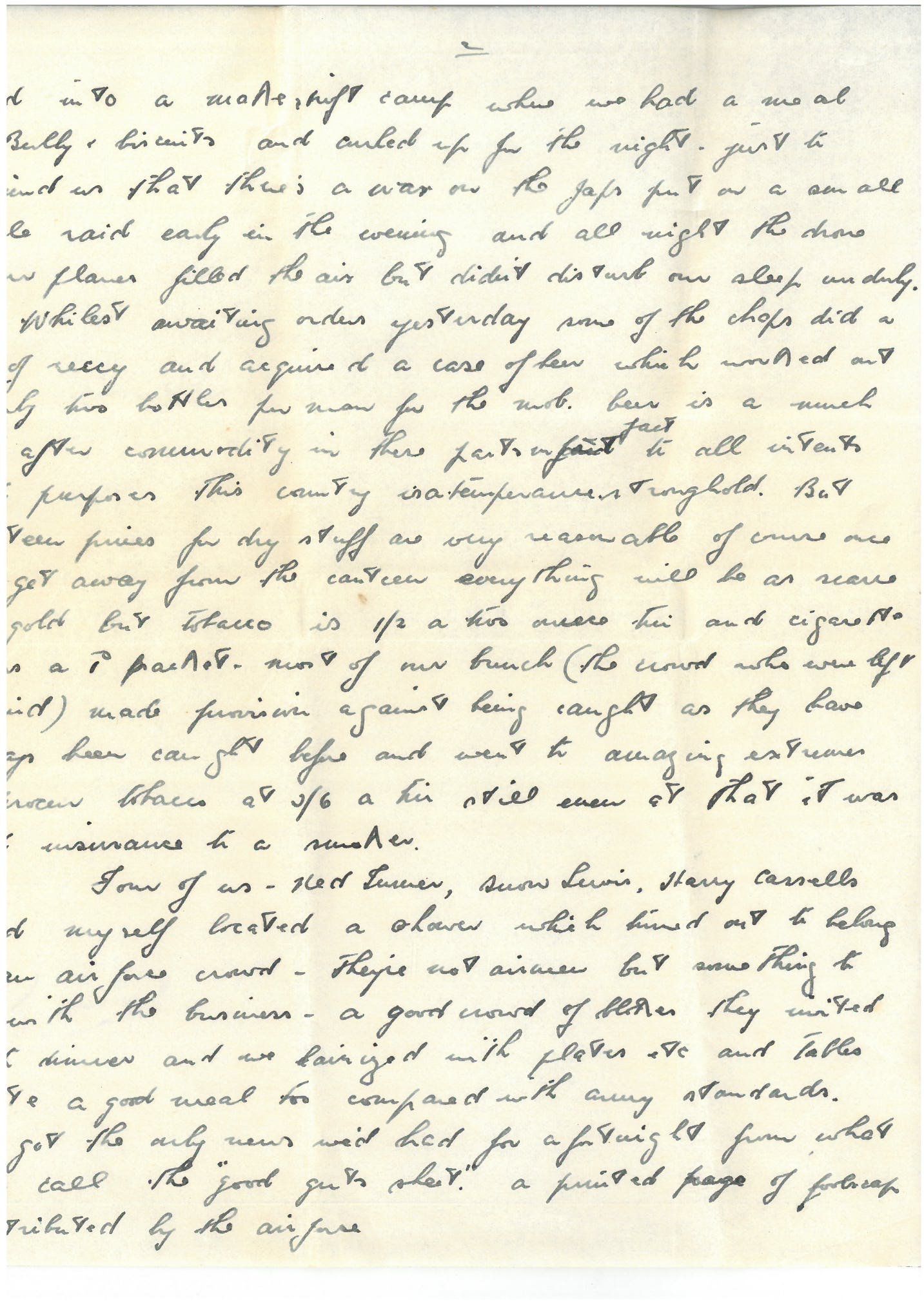
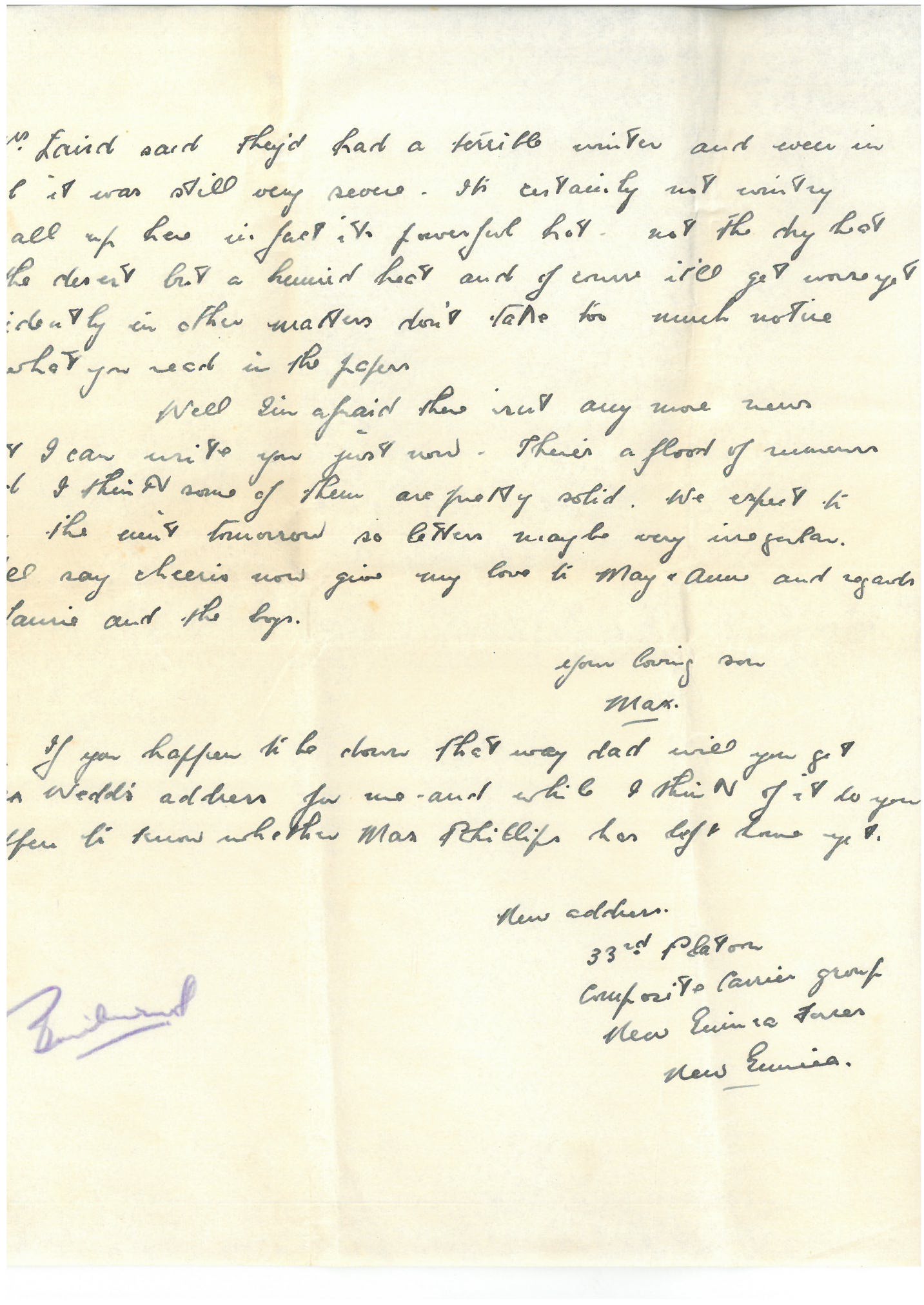
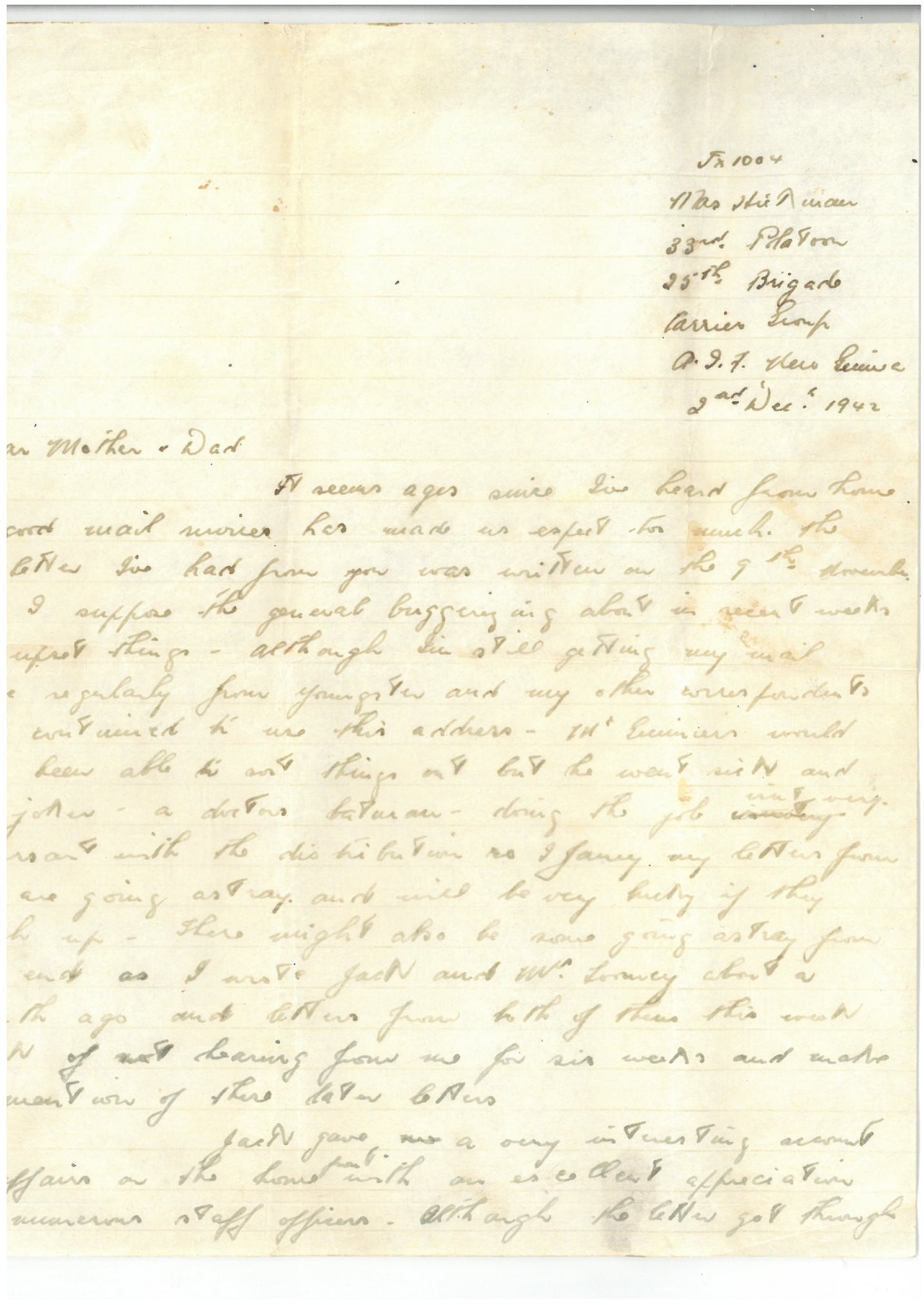
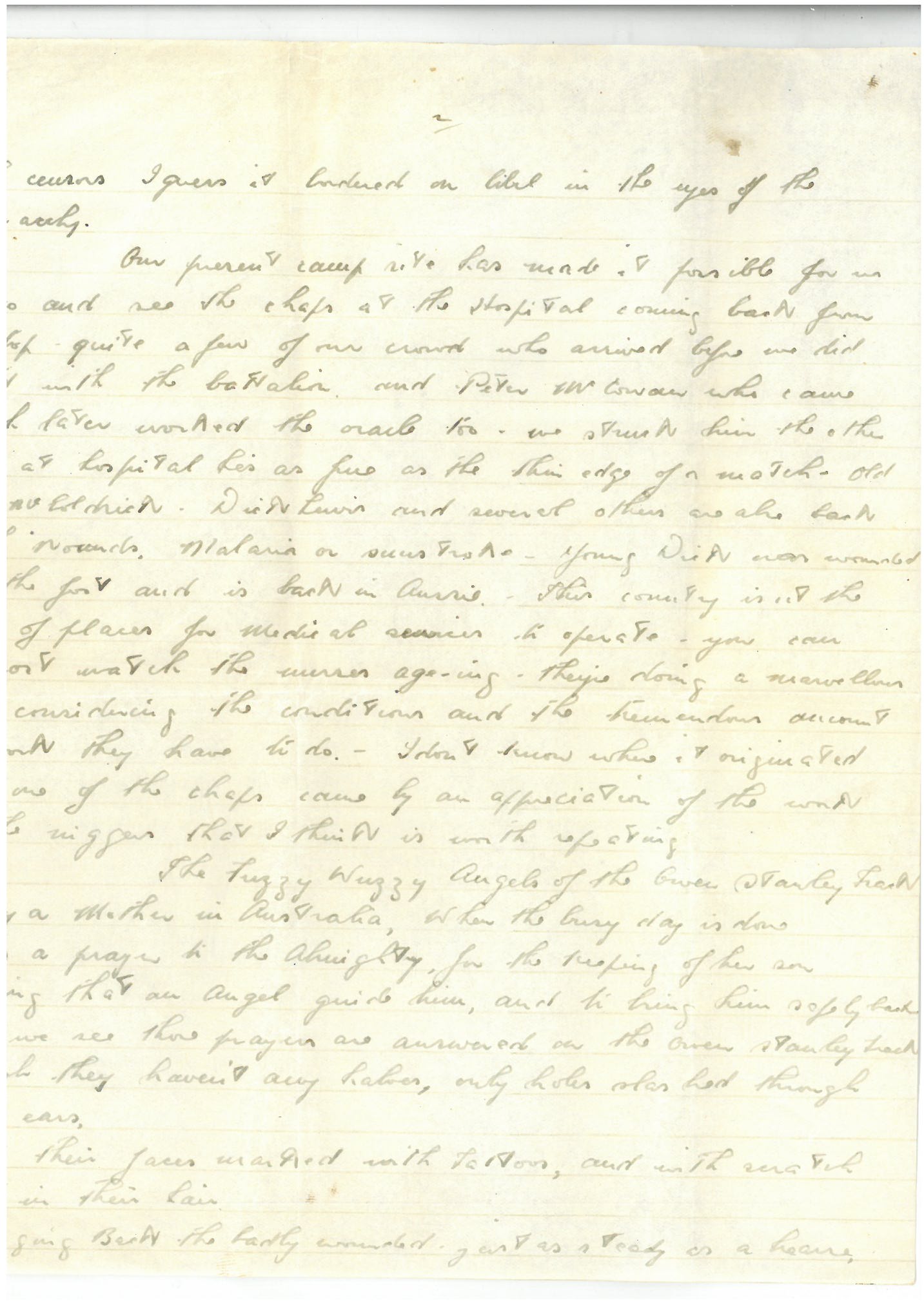
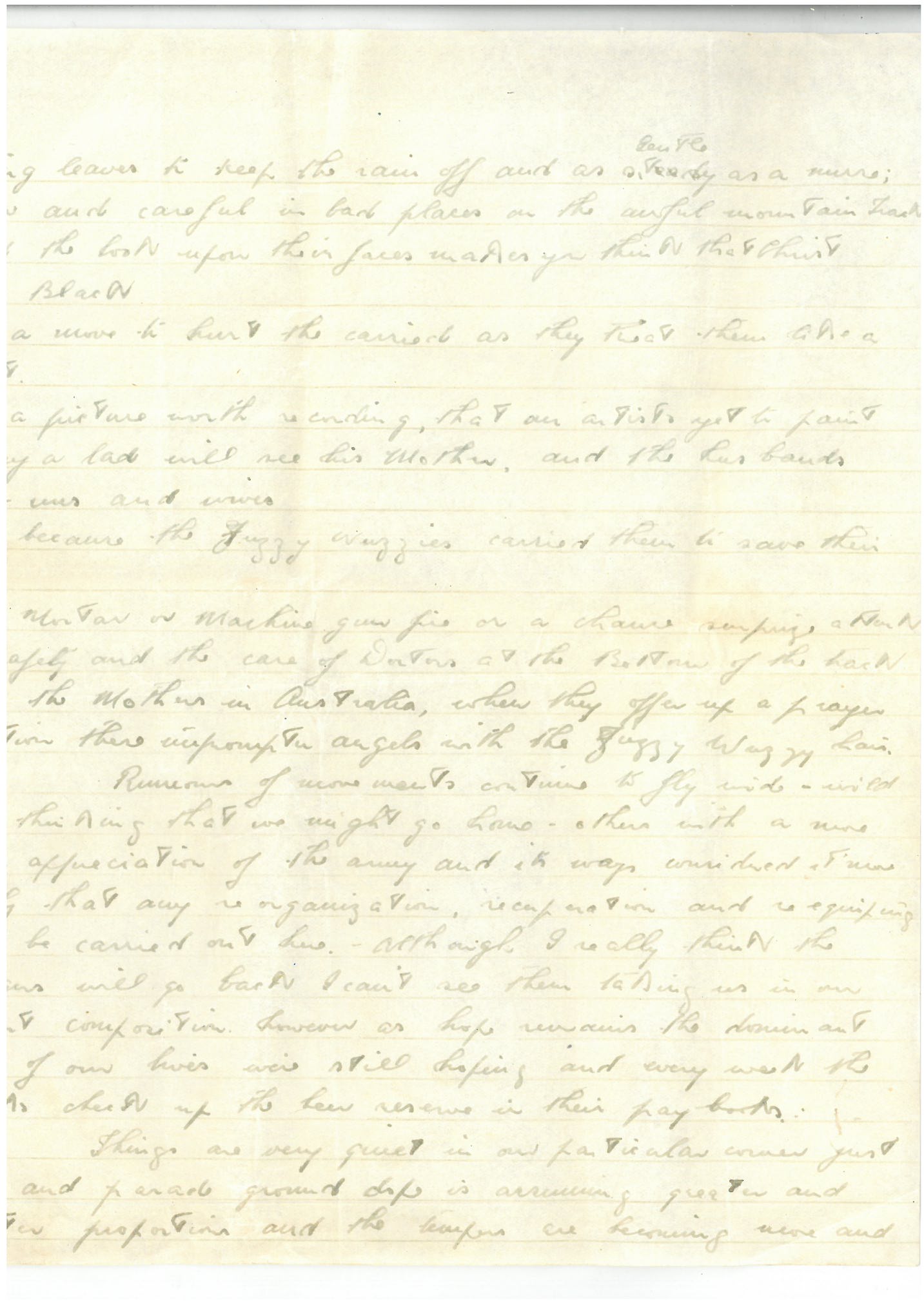
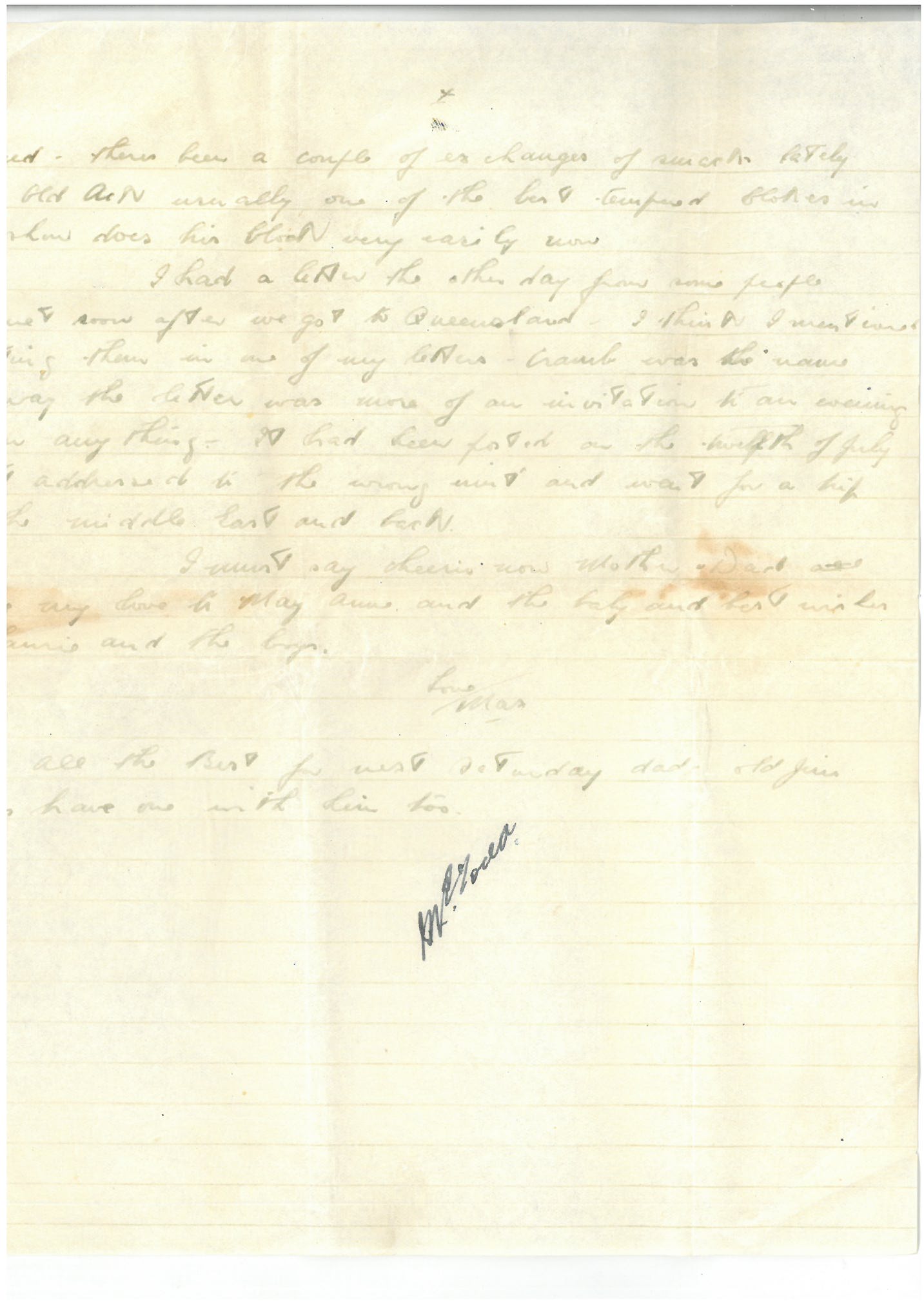
2 dec 42 p1_0001

2 dec 42 p2_0001

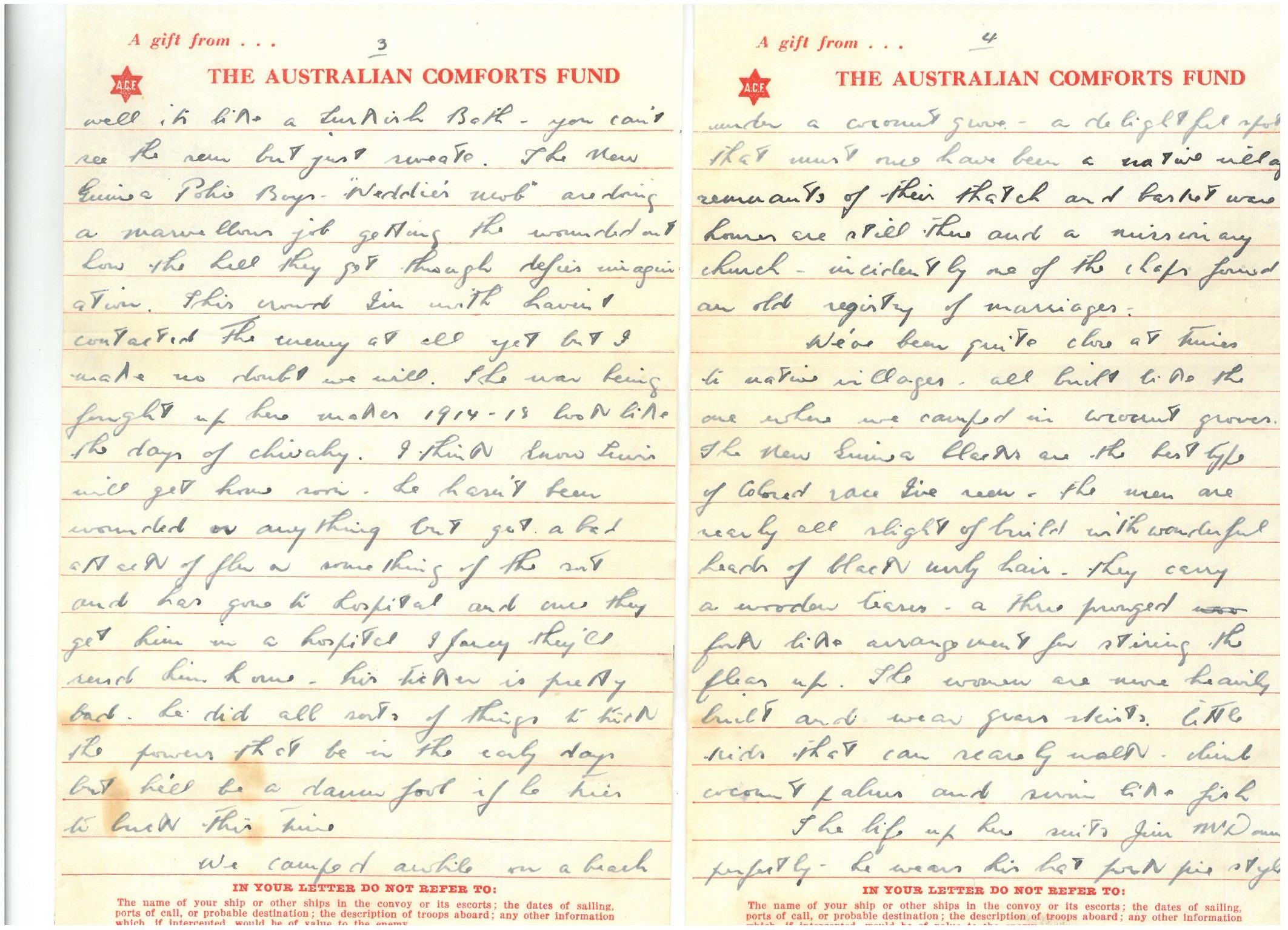
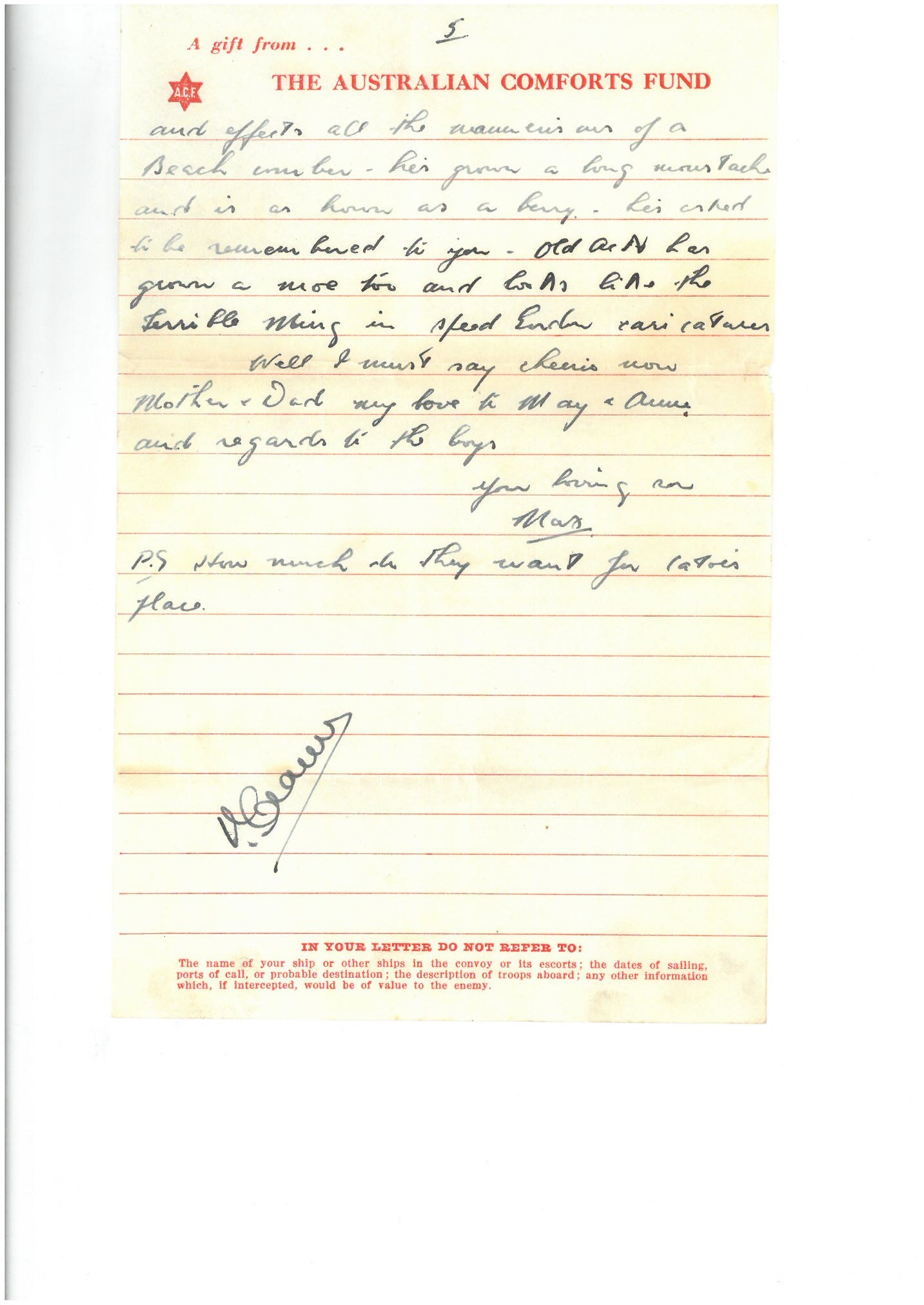
2 dec 42 p3_0001


2 dec 42 p4_0001


TX 1004

Max Hickman

33rd Platoon

25th Brigade

Carrier Group

AIF New Guinea

2nd Dec 1942

Dear Mother & Dad

It seems ages since I’ve heard from home.  The good mail has made us expect too much.  The last letter I’ve had from you was written on the 9th November.  But I suppose the general buggerizing about in recent weeks has upset things – although I’m still getting my mail quite regularly from Youngster and my other correspondents who continued to use this address.  McGuinness would have been able to sort things out but he went sick and the joker – a doctors batman – doing the job isn’t very conversant with the distribution, so I fancy my letters from home are going astray and will be very lucky if they catch up.  There might also be some going astray from this end as I wrote Jack and Mrs Toomey about a month ago and letters from both of them this week speak of not hearing from me for six weeks and make no mention of the later letters.

Jack gave me a very interesting account of affairs on the home front with an excellent appreciation of numerous staff officers.  Although the letter got through the censors I guess it [would have] bordered on libel in the eyes of the hierarchy.

Our present camp site has made it possible for us to go and see the chaps at the Hospital coming back from up top.  Quite a few of our crowd who arrived before we did went with the battalion and Peter McCowan who came much later worked the oracle too – we struck him the other day at hospital.  He’s as fine as the thin edge of a match.  Old McGoldrick, Dick Lewis and several others are also back with wounds, malaria or sunstroke.   Young Dick was wounded in the foot and is back in Aussie.  This country isn’t the best of places for medical services to operate.  You can almost watch the nurses ageing – they’re doing a marvellous job considering the conditions and the tremendous amount of work they have to do.  I don’t know where it originated but one of the chaps came by an appreciation of the work of the niggers that i think is worth repeating: The Fuzzy Wuzzy Angels of the Owen Stanley Track

Many a mother in Australia when the busy day is done

Sends a Prayer to the Almighty for the keeping of her Son.

Asking that an Angel guide him and bring him safely back

Now we see those prayers are answered on the Owen Stanley track.

Though they haven’t any haloes only holes slashed through the ear

Their faces marked with tattoo’s and scratch pins in their hair.

Bringing back the badly wounded just as steady as a hearse

Using leaves to keep the rain off and as gentle as a nurse.

Slow and careful in bad places on that awful mountain track

And the look upon their faces made us think that Christ was black.

Not a move to hurt the carried as they treat him like a saint

It’s a picture worth recording that an artist’s yet to paint.

Many a lad will see his mother and the husbands, wee-uns and wives

Just because the Fuzzy Wuzzies carried them to save their lives.

From mortar or machine gun fire or a chance surprise attack

To safety and the care of doctors at the bottom of the track.

May the mothers of Australia when they offer up a prayer

Mention these impromptu Angels with the Fuzzy Wuzzy hair.

Rumours of movements continue to fly wide & wild, some thinking that we might go home & others with a more keen appreciation of the army and its ways considered it more likely that any reorganisation, recuperation and re-equipping will be carried out here.  Although I really think the sloggers will go back I can’t see them taking us in our present composition.  However as hope remains the dominant force of our lives we’re still hoping and every week the soaks check up the beer reserve in their paybooks.

Things are very quiet in our particular corner just now and parade ground dope is assuming greater and greater proportions and the tempers are becoming more and more frayed.  There’s been a couple of exchanges of smacks lately – even old Ack, usually one of the best tempered blokes in the show, does his block very easily now.

I had a letter the other day from some people we met soon after we got to Queensland.  I think I mentioned meeting them in one of my letters.  Cramp was the name.  Anyway the letter was more of an invitation to an evening than anything.  It had been posted on the twelfth of July but addressed to the wrong unit and went for a trip to the Middle East and back.

I must say cheerio now Mother & Dad.  Give my love to May, Anne and the baby and best wishes to Laurie and the boys.

Love

Max

PS All the best for next Saturday Dad.  Old Jim says have one with [for?] him too.


Our Present camp site… near the hospital

They were clearly back in the vicinity of ‘Seventeen Mile’, and not at Brown River as suggested in the previous letter.

The Fuzzy Wuzzy Angels

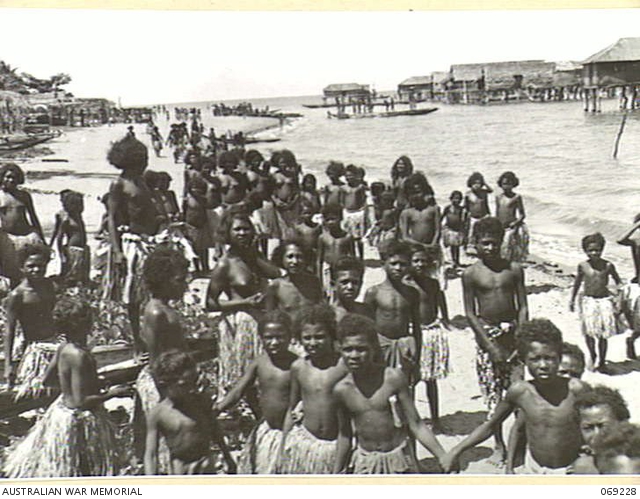
The poem had only been written a few weeks earlier, by by NX6925 Sapper H “Bert” Beros while on the Kokoda Track.  Evacuation of patients had to be conducted on foot, often stumbling or crawling along, as the mountainous terrain made the use of planes impossible.  All stores and equipment had to be carried, and the sick and wounded either walked or were carried on stretchers by native carriers, called affectionately the ‘fuzzy fuzzy angels’ by the troops.  (A Special Kind of Service, p65)

Fuzzy Wuzzy Angels : Photos from the AWM collection 
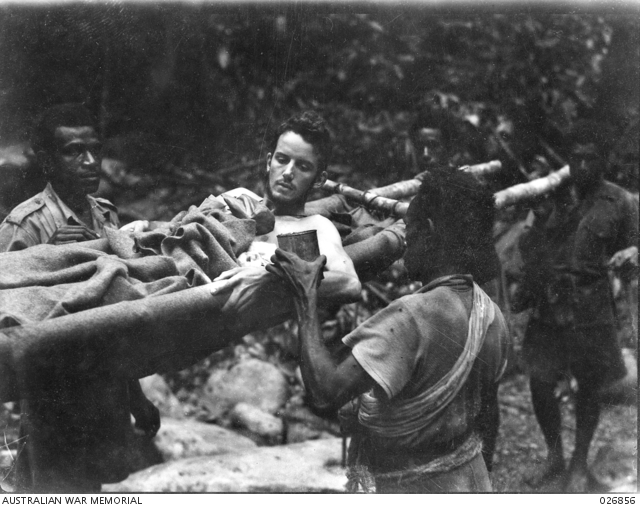
026856AWM 026856  September 1942.  Native stretcher bearers stop at a river to give a drink to their patient, Private A Baldwin (NX 7103) of the 2/33rd Battalion
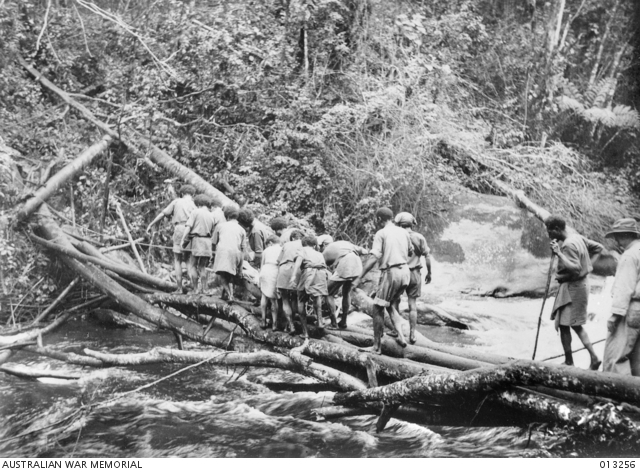


013256AWM 013256 New Guinea 2 September 1942  An indication of the primitive line of communication and of the difficulties encountered in the movement of troops is shown here.  Native porters (known as Fuzzy Wuzzy Angels) are carrying wounded Australian soldiers on stretchers from the jungle battlefield through a mountain stream to the hospital behind the lines, following a sharp clash with the Japanese forces.  All Australians in New Guinea pay a high tribute to the courage, endurance and comradeship the New Guinea natives who are playing a very important part int he Allied efforts to drive the Japanese from the country.
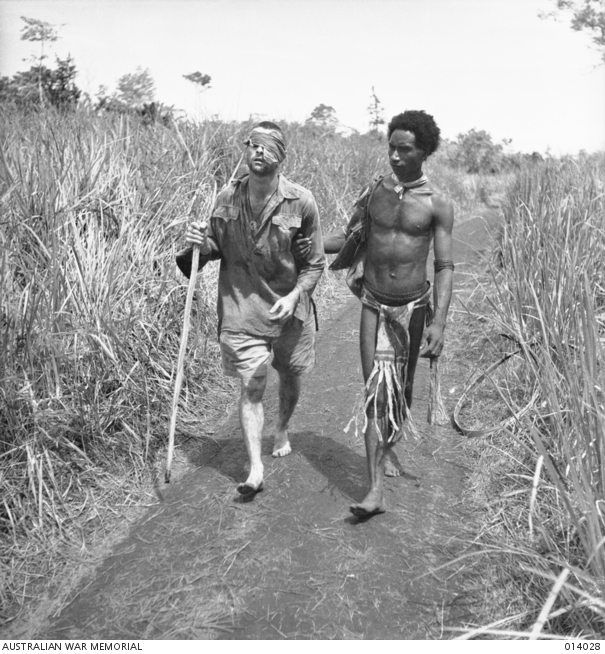
014028AWM 014028  Buna, Papua 25 December 1942.  QX23902 Private George ‘Dick’ Whittington being helped along a track through the kunai grass towards a field hospital at Dobodura.  The Papuan native helping him is Raphael Oimbari.  Whittington was with the 2/10th battalion at the time and had been wounded the previous day int he battle for Buna airstrip.  He recovered from his wounds but later died of scrub typhus.


Pete McCowan at the Hospital

Pete’s service record makes no mention of an injury or illness at this time.  However, the more surprising thing is that there were any records at all – let alone comprehensive ones!  This extract from A Special Kind of Service  (Joan Crouch) highlights some of the difficulties:

The staff worked long hours.  The Unit War Diary of December 1942 records that Orderly Room and Medical Records staff remained on duty twenty four hours a day, with snatches of sleep.  It was ,most important that accuracy was maintained in the recording of admissions, discharges, transfers, evacuations, notification of very dangerously and seriously ill patients and deaths, as well as staff movements, statistics and returns.  The ward staff worked broken shifts, but if necessary worked all day and into the night and in the first months there were no days off.  Most wards of sixty beds and over had three or four sisters on day shift and one on night duty.  As the establishment increased, reinforcements of sisters and orderlies arrived.

Dick’s injury

The Footsoldiers account of this incident on 22 November during the attack on Gona is different from Dick’s own recollection.  According to the former, Captain Clowes ordered forward the one battalion Vickers gun, by the telephone that had been laid…. Captain Clowes was outlining the position to the CO when he was killed….His crewmen, assisting in setting up the gun, Privates Dick Lewis and Bill Green, were both wounded.

According to Dick, he had been sent forward with Bill to ask Captain Clowes if he wanted the Vickers gun.  Clowes did not want it: the Vickers being water-cooled, ‘steams a lot’ when firing, thus revealing its position in the open kunai grass.  Dick says that Captain Clowes was asking him to give a message to one of the platoons when he was killed.  Dick, standing next to him, was injured in the foot.

Hope remains the dominant force…soaks track the beer reserve

I haven’t been able to work out how the allocation of beer was related to the pay book, but whenever an allocation was made, it was clearly welcome!
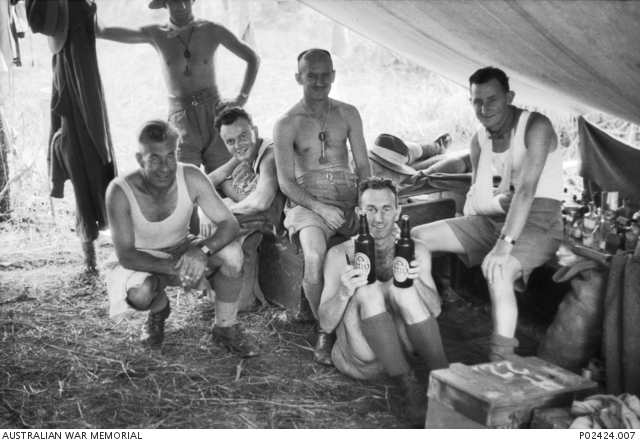
P02424.007AWM P02424.007 Informal group portrait of a some members of the 2/4th Field Ambulance who are obviously pleased at the arrival and distribution at the unit’s camp of the soldiers’ beer ration…. The men are gathered inside a tent that may be the Regimental Aid Post. One of the soldiers (extreme right) has his arm in a sling, while set up on a table behind him is an array of bottles containing various medicaments.


Managing the mail

McGuinness would have been able to sort things out….

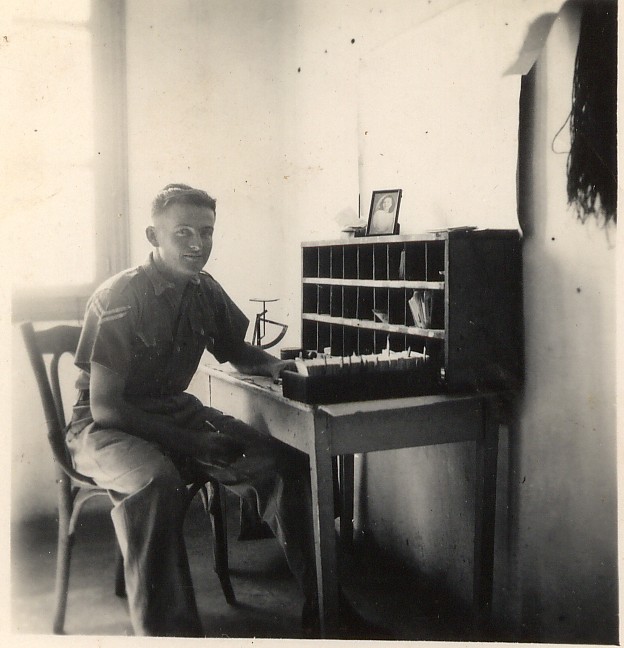
Charlie McGinnes (NX6513) was a ‘battalion original’ and his role as postmaster was definitely an essential one.   His son Peter has posted photos and some of Charlie’s memories of his time with the Battalion on the 2/33 Australian Infantry Battalion AIF Facebook page.  This photo shows Charlie in one of his Post Offices – location unknown.
Posted in organisation, The course of the war | Tagged , , | 2 Comments

Forty million mosquitoes to the acre… but it seems the tide is turning


23 nov 42 pp 1 2_0001

23 nov 42 pp 3 4_0001

23rd Nov 1942

TX 1004

Max Hickman

33rd platoon

25th Brigade Carrier Group

AIF   NG

Dear Mother & Dad

As you’ll see from the address I’m back with the mob – the uncertain state of flux – of not knowing where or what came to an end on Friday when orders came through to return to this show.  The outfit has moved from the comparatively pleasant spot they formerly occupied to the uncongenial surroundings of a rain sodden swampy area with an estimated population of forty million mosquitoes to the acre.  Before leaving we’d handed in our nets which had been distributed to new chaps who came to the show and so we found ourselves denied these essentials for the first night and did those bludgers go to work on me.  Even with nets it’s practically impossible to keep them out but without a net it was a fair cow and though I tried to cover myself with the blanket their attacks were too solid: they seemed to lift the blanket right off.  I tried putting up a smoke screen by burning some oily cotton waste but all to no avail – a heap of cow dung would have been worth its weight in gold but to all intents and purposes it’s far more scarce in this country than that most desirable mineral.  However yesterday I got me a net and last night in the short spasms I was awake I was able to listen to the hordes raging and dive bombing without much effect – a very satisfying position I can tell you.

I received your welcome letter of the 9th on Thursday and am glad to know everyone seems so happy although it’s bad luck the wind is playing up with the garden – there’s always something to discourage one’s efforts in everything.

As you say the news from all quarters seems very bright at present.  We’ve waited a long time for the tide to turn and up till now the end could not be visualised but it seems that the various elements are at last combining for the spin we’ve been waiting for.  The allies have had a long run of outs but it looks like them getting a bat (?) now and although I suppose there’ll still be a lot of ups and downs the outlook is the brightest it’s been since the fall of France.  We listened to a couple of broadcasts last week that echoed the good news but I didn’t like the note of servile humility that marked Curtin’s speech, lauding the Americans.  Whilst they’ve certainly done a great job Australians have more than pulled their weight in every sphere and a little boost to them wouldn’t do any harm.  I suppose when the history of this particular phase is written it will rank among the epics of history.  The conditions under which the AIF fought their way over what Blamey said was an impassable barrier against an enemy who probably has no equal in cunning or barbarism is an achievement to be proud of.

The rumour about us going back to Australia for reforming seems to have extended home although it’s probably just wishful thinking sentiments expressed in their letters home taking effect on the people at home and boomeranging back here but there’ll be a hell of a lot of disappointed people if it doesn’t eventuate and it really seems too good to be true but as hope is still the dominant force of life we’re hoping like hell.  There’s also a tale going round that there’s to be a referendum as to whether the AIF and Militia should be merged into one force.  If it does come to a vote I don’t think there’s much doubt as to the result – I think it is almost certain to be wiped – compulsory training should have been brought in two years ago but feeling between the two services and their connections has become too divergent now and it will be the last word of insult to the AIF to lose their identity now.

Another outsider got home in the Melbourne Cup.  It doesn’t pay to pick the favourites these days.  We had a sweep here and I drew ‘Hearts Desire’ and got quite a good run for my money.

Well as there’s no news, I must say cheerio.  Give my love to May, Anne & the baby and best wishes to Laurie & the boys.

Love

Max

A Rain Sodden Swampy Area

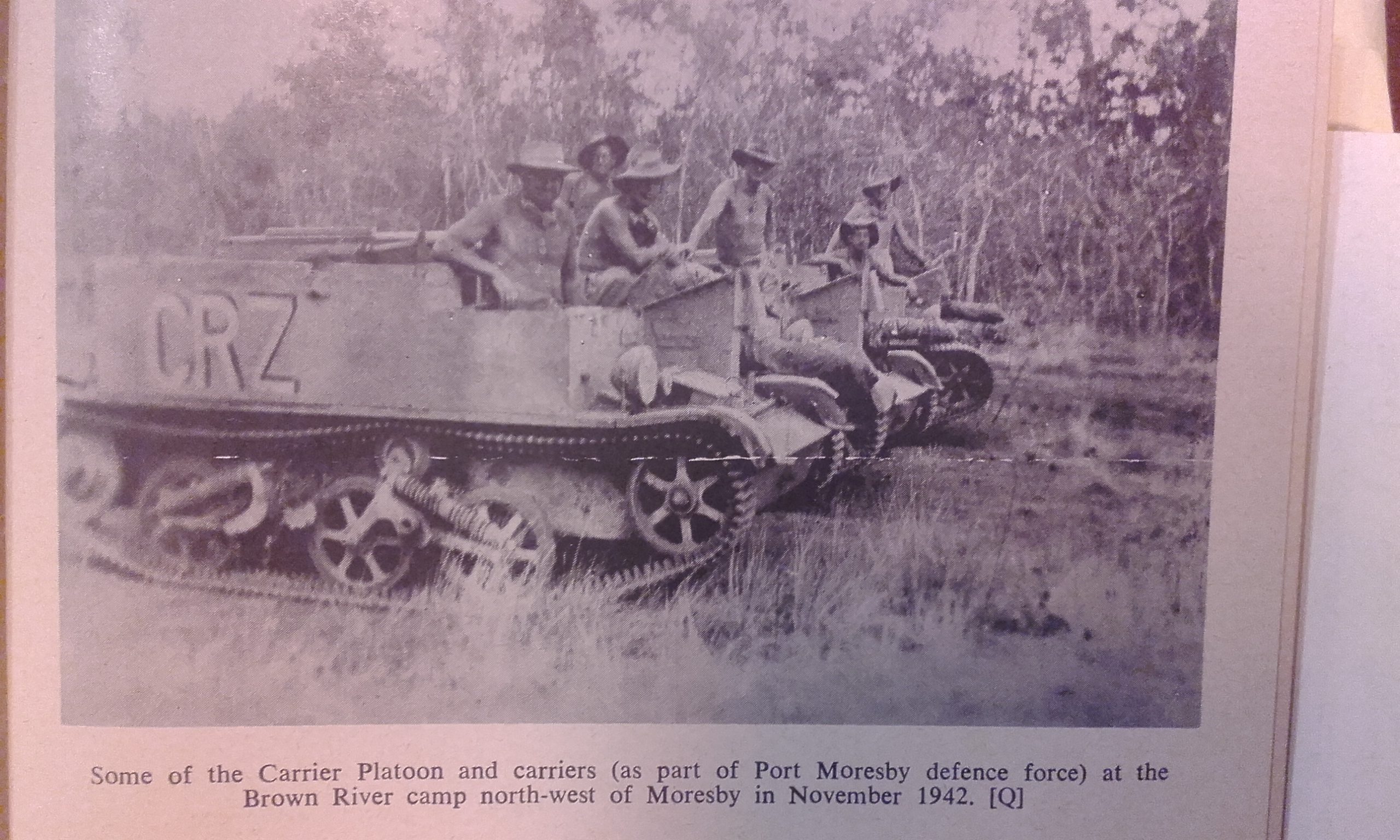
This photo from The Footsoldiers is captioned: Some of the Carrier Platoon and carriers (as part of Port Moresby Defence force) at the Brown River camp north-west of Port Moresby in November 1942.  Dad is second from the left.  I can find no information about this camp site or the reason for its location – however if it was indeed on the Brown River, it was well away from the airfields he was previously defending.

20160519_173432


Forty million mosquitoes
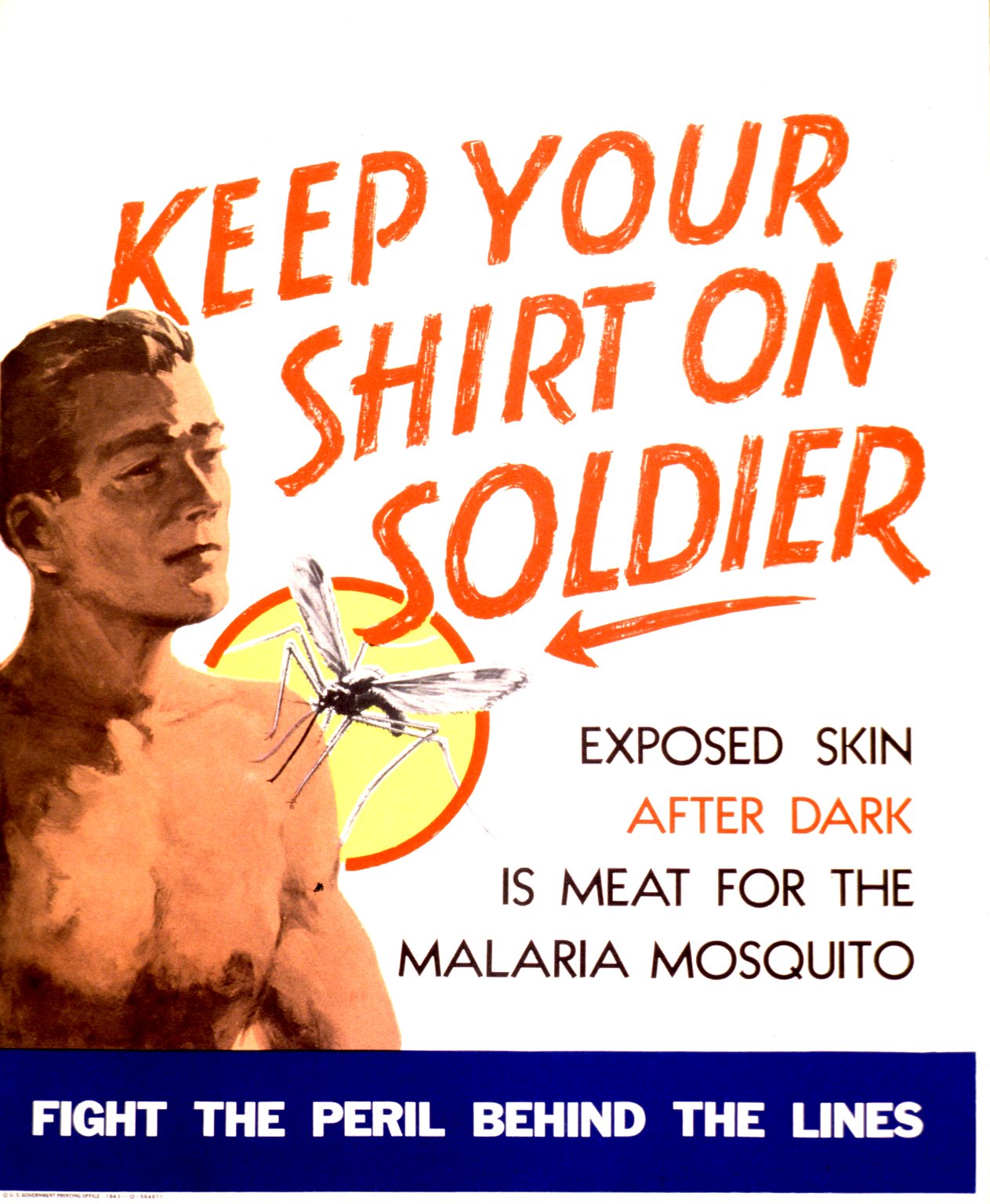
c-00466One of a number of US army posters re malaria prevention : others can be found at http://flashbak.com/japs-japes-and-dr-seus-us-anti-malaria-warning-posters-from-world-war-2-36536/

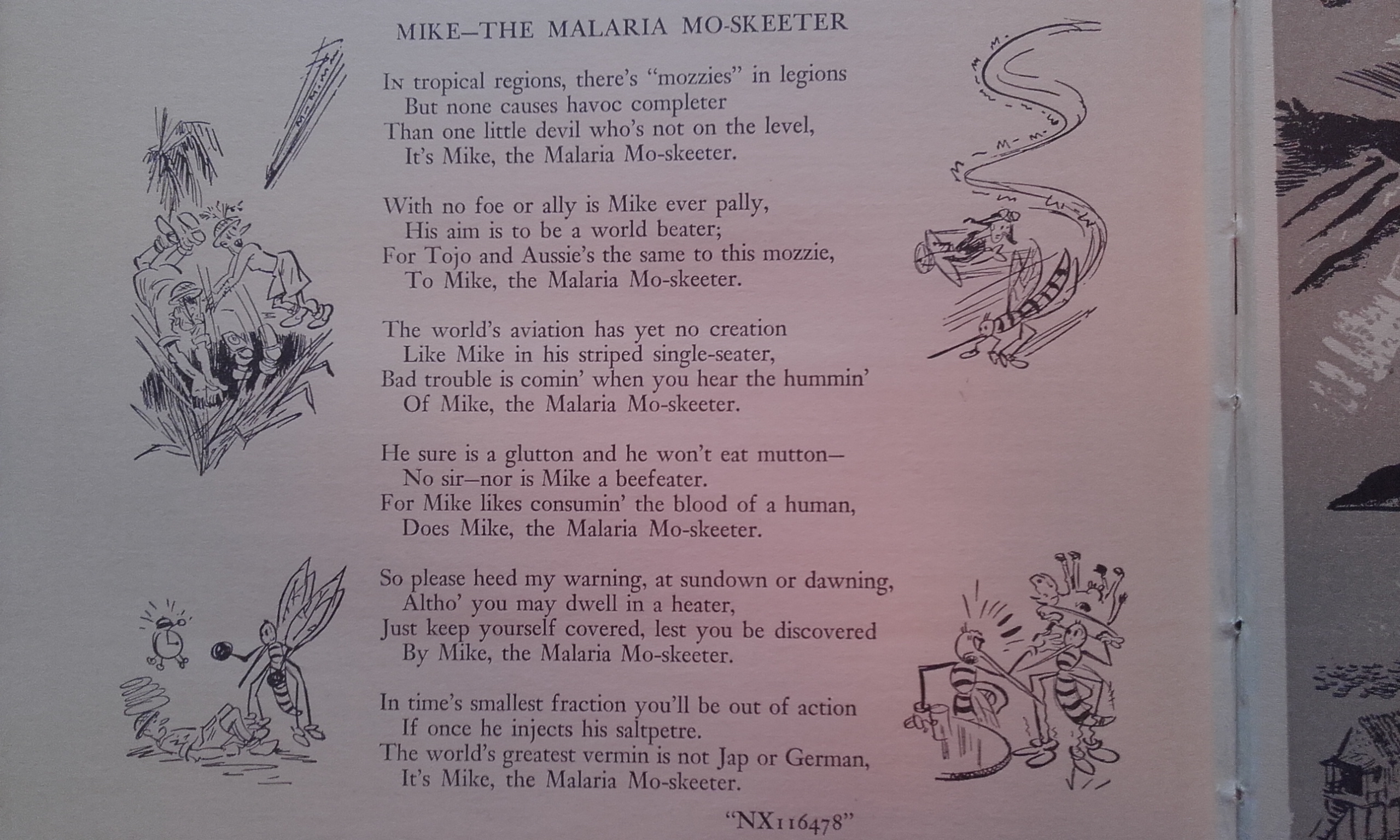
And below, the poem Mike the Malaria Moskeeter  appeared in the AWM Christmas Book for 1943 – Khaki and Green.

20160519_160805


The news from all quarters seems very bright…

Kokoda had been re-taken from the Japanese on November 2 and two days later, the Australian 9th Division contributed to the Allied 8th Army’s defeat of Rommel’s forces at El Alamein. The tide had also turned in Russia with the Germans no longer holding the upper hand in Stalingrad.

The Prime Minister’s speeches (such as this one reported in the Melbourne Argus – http://trove.nla.gov.au/newspaper/article/12005419)  were up-beat about the situation in the South West Pacific in particular: The enemy has had a battering in the Solomons. Nowhere can I see the enemy in the ascendant. On the contrary, I see plans long matured being carried into effect, problems of organisation being overcome, and events all combining today to give us a greater measure of hope than at any previous time since the war began….One makes no prophecies, but I feel confident that the gallant men fighting for us there will stick it out, and that, as in North Africa, the tide of battle will go increasingly the way we would like it to go.

Apart from saying that he had ‘absolute confidence’ in General MacArthur as the Supreme Commander of Allied forces in the SW Pacific, I can find no general ‘lauding of the Americans’ in the speeches I have read.  MacArthur himself however is known to have made derogatory remarks about Australian troops – saying they were poor fighters who lacked aggression.  Of course, he was blissfully ignorant of the conditions the troops had faced and were facing.  He carried out his leadership from Brisbane and Melbourne.

It’s interesting to me to see Dad’s report of Blamey’s comments.  Maybe he was making amends for his infamous ‘rabbit’ speech to the 21st Brigade earlier in the month when he is also reported to have said that the Australians had been defeated by ‘inferior troops in inferior numbers’ (ref Andrew James – Kokoda Wallaby – Allen & Unwin 2011 p 220).

Proposed Merger of Militia with AIF

The Prime Minister’s motion seeking to create a single Australian fighting force for the South West Pacific area was debated at a national ALP conference on November 18.  Conference decided that the question should be referred to the state branches.  According to the report in the West Australian, November 19 (http://trove.nla.gov.au/newspaper/article/47355314) delegates were divided on the Prime Minister’s proposal:

Votes taken today showed that the Tasmanian delegates were unitedly against the proposal and the West Australians were in favour. The Victorian delegation were divided, the majority being against the proposal, Queensland and South Australian delegations were also divided…

The Austerity Melbourne Cup

A lovely personal story about this particular Melbourne Cup, unusually run on a Saturday :

http://localhistory.kingston.vic.gov.au/htm/article/473.htm

The race was won by Colonus, ridden by 18 year old apprentice jockey Harry McCloud.  The odds were 33/1.   Dad’s horse (Heart’s Desire) came in third.

Posted in Australian, Carrier platoon, Papua New Guinea, The course of the war | Tagged , , | Leave a comment

Comings and goings (2 letters): don’t quite know whether I’m detached, attached or ex-list

8 nov 42pp1 2_0001

8 nov 42 pp 3 4_0001


8nov 42 pp 5 6_0001

TX 1004

Max Hickman

2/33rd Battalion

AIF

8th Nov 1942

Dear Mother & Dad

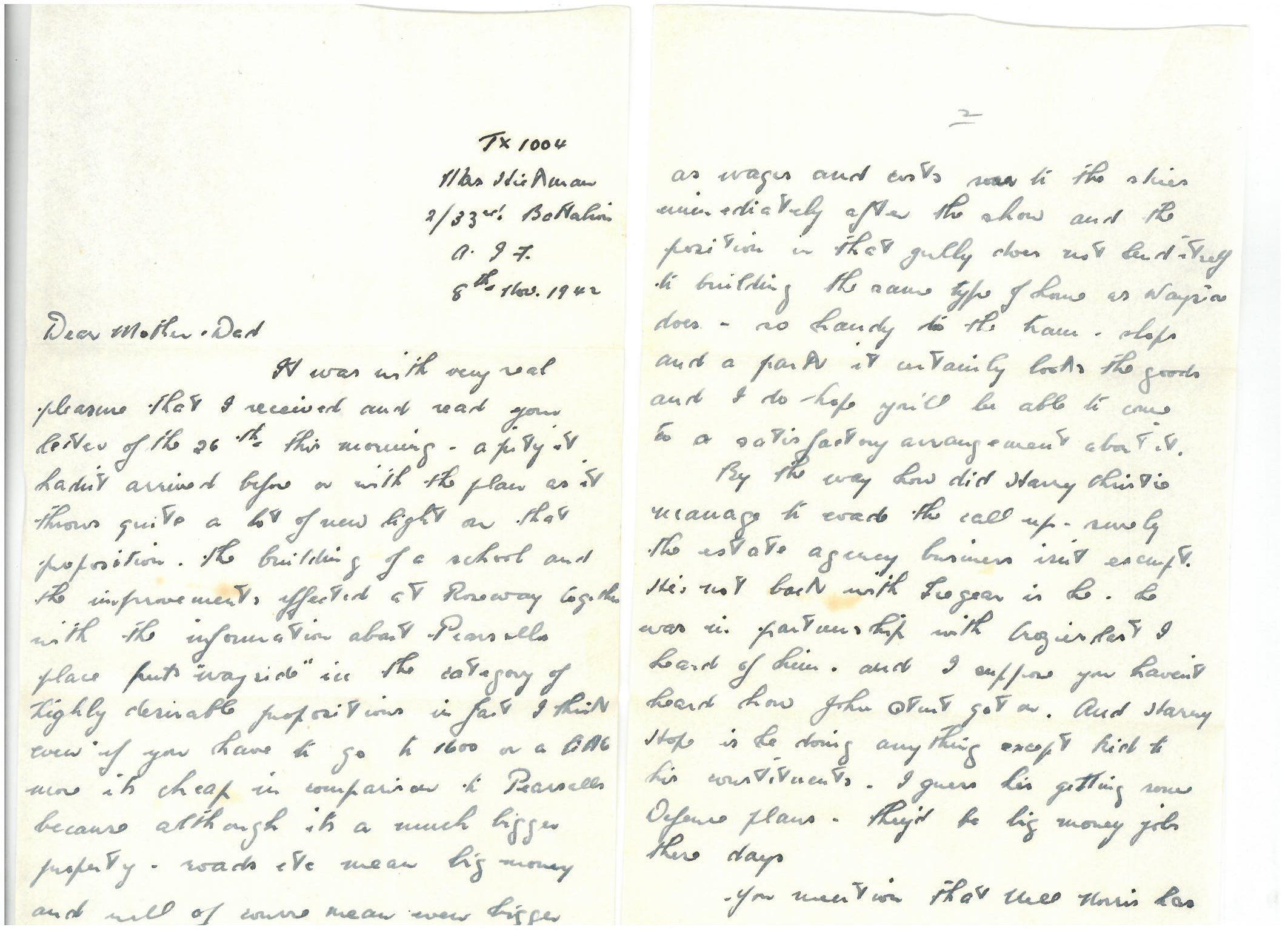
It was with very real pleasure that I received and read your letter of the 26th this morning.  A pity it hadn’t arrived before or with the plan as it throws quite a lot of new light on that proposition.  The building of a school and the improvements effected at Roseway together with the information about Pearsalls place puts ‘Wayside’ in the category of highly desirable propositions.  In fact I think even if you have to go to 1600 or a little more it’s cheap in comparison to Pearsalls because although it’s a much bigger property, roads etc mean big money and will of course mean even bigger as wages and costs soar to the skies immediately after the show and the position in that gully does not lend itself to building the same type of home as Wayside does – so handy to the tram, shops and a park it certainly looks the goods and I do hope you’ll be able to come to a satisfactory arrangement about it.

By the way how did Henry Christie manage to evade the call-up?  Surely the estate agency business isn’t exempt.  He’s not back with Tregear is he?  He was in partnership with Croziers last I heard of him and I suppose you haven’t heard how John Sturt got on.  And Harry Hope – is he doing anything except tied (?) to his constituents?  I guess he’s getting some Defence plans – they’d be being money jobs these days.

You mention that Nell Norris has been bridesmaid at a wedding.  Has anything developed between she and Maurie O’Herne?  I suppose she’s in one of the womens’ services now.  She was pretty keen to join the WAAFs when I saw her and now that girls are being called up I suppose she’s in it.

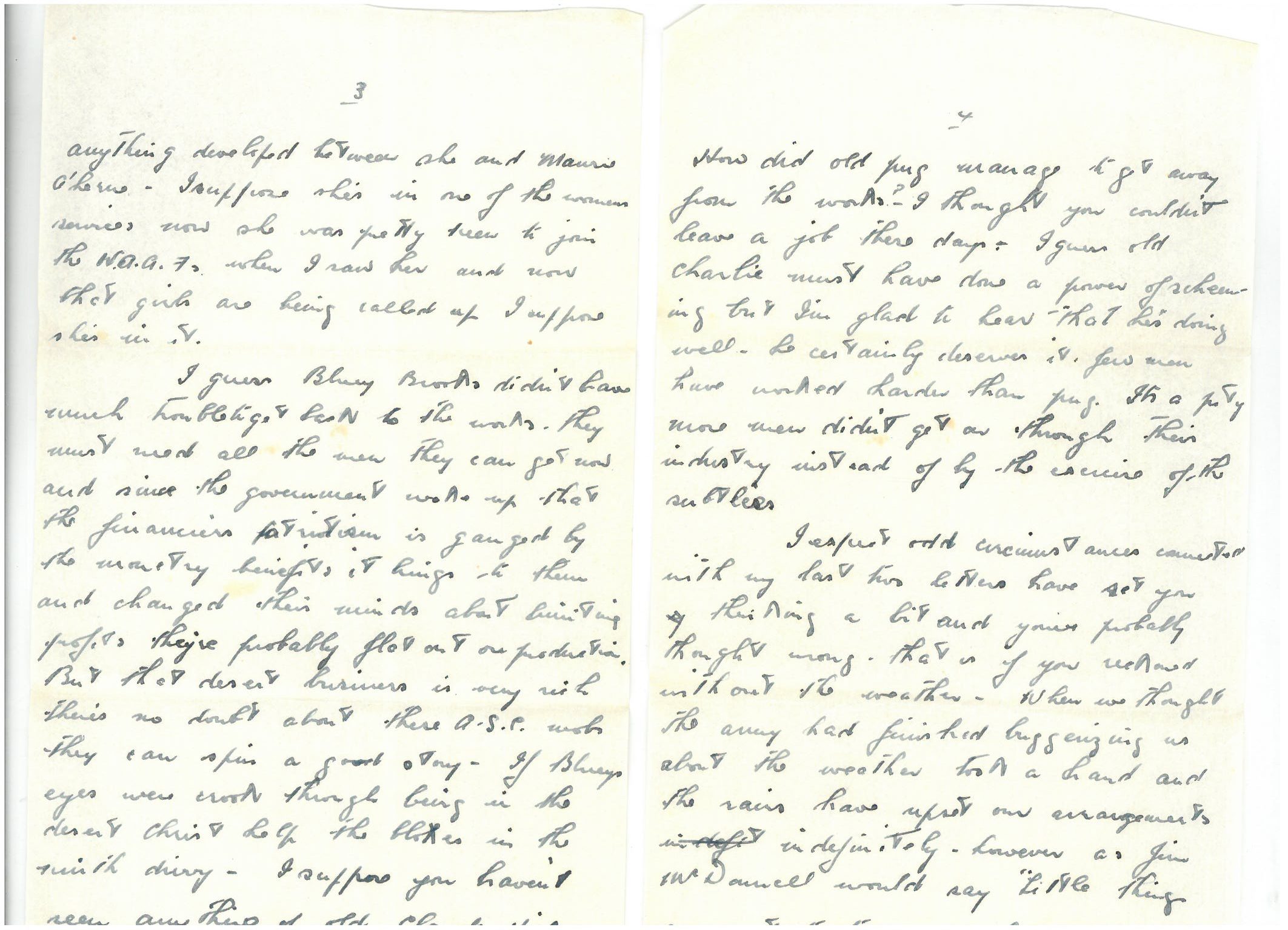
I guess Bluey Brooks didn’t have much trouble to get back to the works.  They must need all the men they can get now and since the government woke up that the financiers’ patriotism is gauged by the monetary benefits it brings to them and changed their minds about limiting profits they’re probably flat out on production.  But that desert business is very rich.  There’s no doubt about it these ASC mobs can spin a good story.  If Bluey’s eyes were crook through being in the desert Christ help the blokes in the ninth divvy – I suppose you haven’t seen anything of old Claude Hill?  How did old Pug manage to get away from the works?  I thought you couldn’t leave a job these days.  I guess old Charlie must have done a power of scheming but I’m glad to hear the he’s doing well.  He certainly deserves it.  Few men have worked harder than Pug.  It’s a pity more men didn’t get on through their industry instead of by the exercise of the subtles(?)

I expect odd circumstances connected with my last two letters have set you thinking a bit and you’ve probably thought wrong.  That is if you reckoned without the weather.  When we thought the army had finished buggerizing us about the weather took a hand and the rains have upset our arrangements indefinitely.  However as Jim McDonnell would say ‘little things are sent to try us, to build us up for a better world’.  Anyway having reduced our wardrobe and personal effects to a mere handful even to the extent of leaving fountain pens and ink behind and lots of other things as well we’re now infinitely worse off than we were a week ago.  And I pretty definitely sacrificed a temporary third stripe in the arrangement – I hadn’t got the stripe but was odds on to do so – I think the weather gods have sold me a pup.

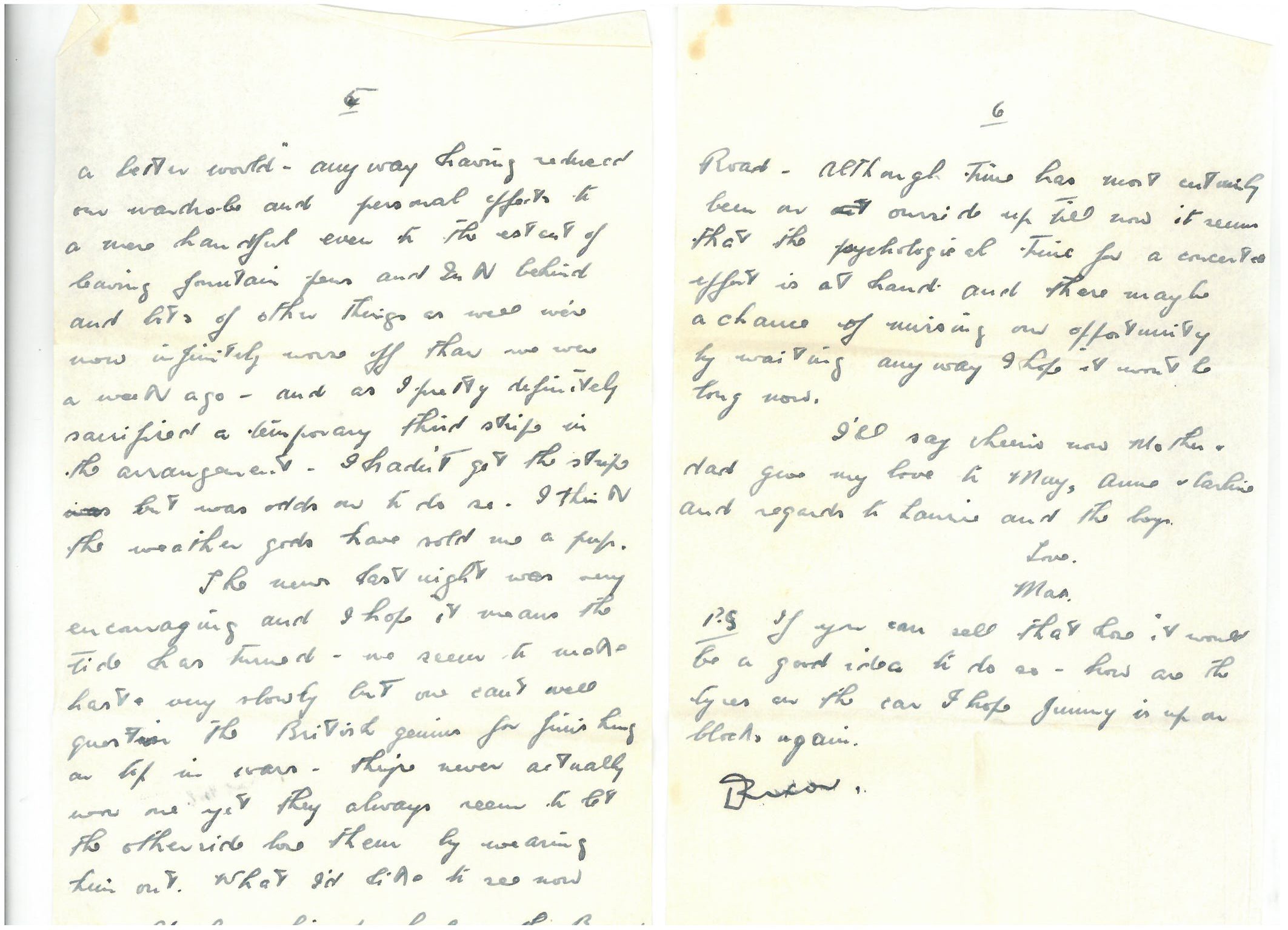
The news last night was very encouraging and I hope it means the tide has turned – we seem to make haste very slowly but one can’t well question the British genius for finishing on top in wars – they’ve never actually won one yet, they always seem to let the other side lose them, by wearing him out.  What I’d like to see now would be a big push from the Burma Road – although time has most certainly been on our side up till now it seems that the psychological time for a concerted effort is at hand and there may be a chance of missing our opportunity by waiting.  Anyway I hope it won’t be long now.

I’ll say cheerio now Mother & Dad.  Give my love to May, Anne & Carline and regards to Laurie and the boys

Love

Max

PS If you can sell that house (?) it would be a good idea to do so.  How are the tyres on the car?  I hope Jimmy is up on blocks again.

Wayside

This was a property in Lenah Valley Road previously known as Malvern, which had been owned by William Cato (a distant relative). Cato died in 1936 and his wife in 1939.    Dad spoke about the property in other letters ( e.g.  Sept 19 – Catoes is certainly a good property but it would be out of my reach  Sept 25 – How much do they want for Catoes place?    Oct 11 – more comment on the property, in connection with wanting to have something ready to jump into when the show is over  ) The house still exists, in Lenah Valley Road, but the land around it has been subdivided into ‘quarter acre blocks’ – this may well have happened soon after the war, when the suburb developed rapidly.  Perhaps the land sale referred to here was the start of that process.

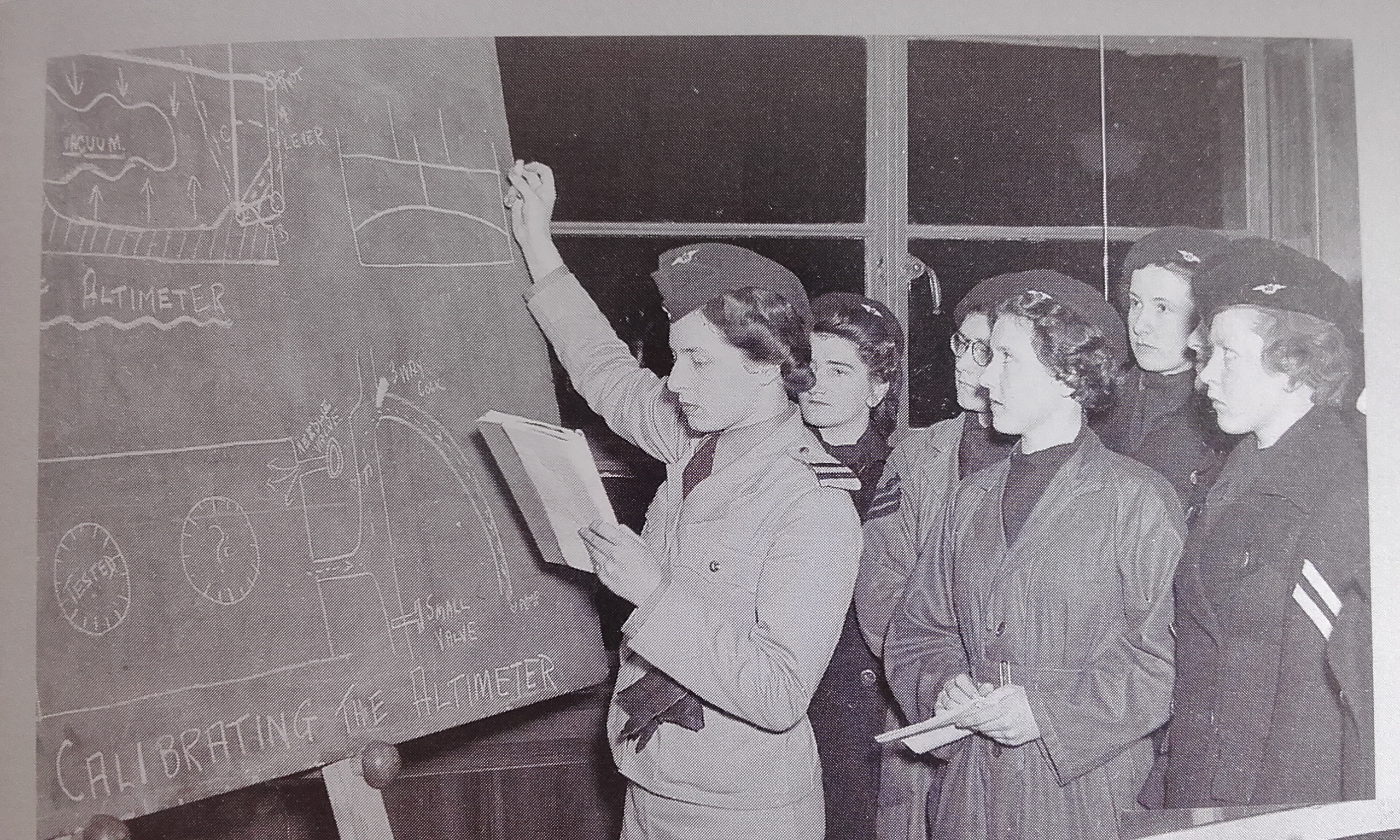
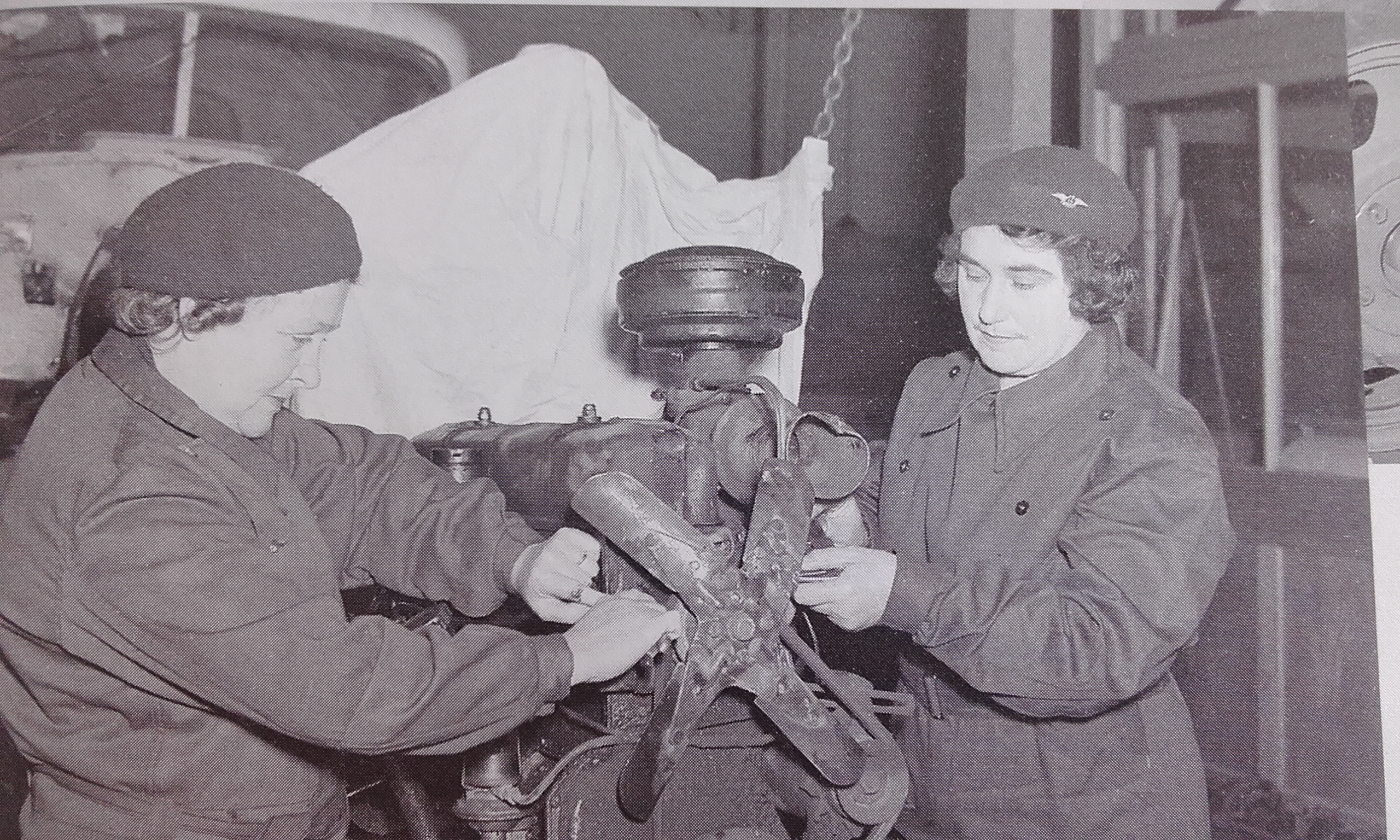
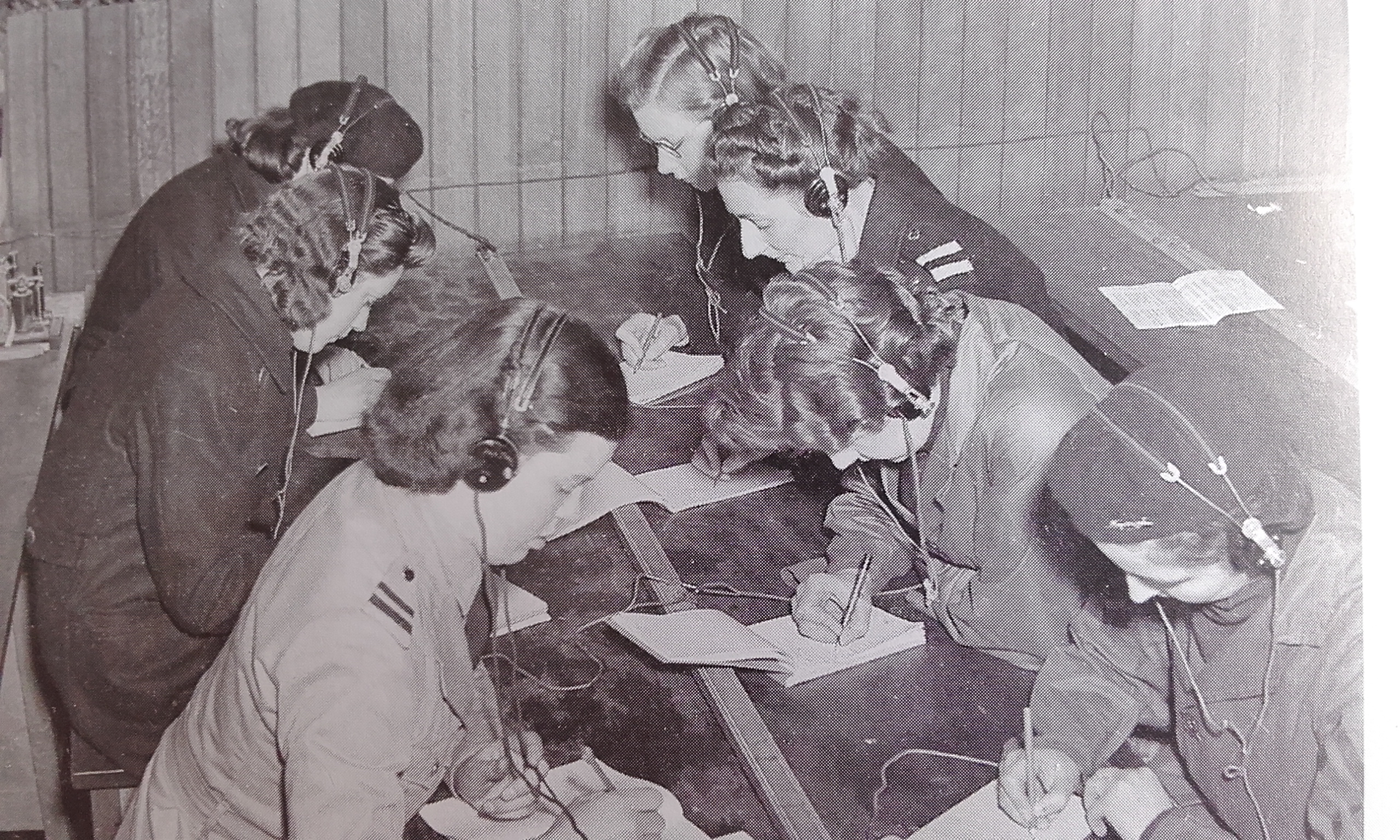
The Womens’ Services

These photos, from Hobart at War 1939 – 45 ( C J Dennison 2008), show members of the Women’s Air Training Corps learning to read an altimeter, doing maintenance on RAAF vehicles and learning to read morse code.

Hobart at War 47


Hobart at War 49


Hobart at War 52


You’ve probably thought wrong

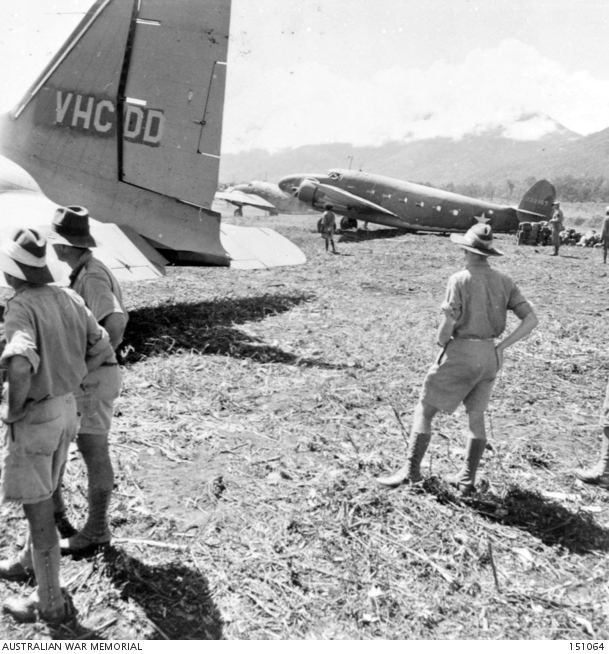
Dad’s previous two letters certainly gave the impression that he was about to be deployed to the front line.  The Brigade Diary notes on November 4 that ‘Mortar and MMG dets from 16 and 25 Bdes will arrive by air at Kokoda’, and on 5 November – 25 Bde will assume responsibility for protection of Kokoda drone against hostile air and ground attack’.  Given that airfield defence was what he was engaged in at Moresby, but that the Japanese were now retreating, it’s possible Dad and his group were to move to Kokoda.   I can find no record of orders relating to his carrier group at this time, however carriers WERE deployed to the Buna area in early December. (That deployment was not a success : on December 5 the 5 carriers attempted an assault at Cape Endaiadere – all were destroyed, with the loss of 6 lives)

This photo shows the landing strip at Kokoda in November 1942. (AWM 151064)

151064


The Burma Road

From britannica.com: The Burma Road- highway linking Lashio, in eastern Burma (now Myanmar), with Kunming, in Yunnan province, China, a distance of 1,154 km (717 miles). The Chinese began construction of the road after the outbreak of the Sino-Japanese War in 1937 and the occupation of the seacoast of China by the Japanese. Completed in 1939, it functioned for three years as a vital supply route to the interior of China from the outside world, carrying war goods transported by sea to Rangoon (Yangon) and then by train to the Lashio railhead. In April 1942, however, the Japanese overran Burma, seized Lashio, and thus closed the road at its source.

Chinese, American and British Commonwealth troops fought as allies in Burma.  After the Japanese closed the road, Chinese units were re-supplied by air, from northeastern India.  In late 1942 there were many reports such as this one, about allied bombing raids on Japanese targets. http://trove.nla.gov.au/newspaper/article/47355972


14 nov 42 pp1 2_0001


14 nov 42 pp 3 4_0001


14 nov 42 p5_0001


TX 1004

Max Hickman

2/33rd Battalion

AIF  14th Nov


Dear Mother & Dad

I really don’t know what address to put on my letters.  Although it’s probably OK with the powers that be, events during the last three weeks have been a little confusing and I don’t quite know whether I’m detached, attached or ex-list.  However McGuiness will sort it out so I think it will be OK to address it that way.

Your welcome letter of the 1st November arrived Thursday.  Another old identity of the district has gone on.  Mrs Charlie must have been pretty old though – there’s no doubt about the old clan they make a wake of a funeral.  It’s always an occasion for a celebration with them.  One of the funniest things I remember was the gathering at old Charlie’s funeral – while the Salvo bloke was saying his piece inside, the crowd were discussing his crop and the amount of black spot he had.

As I haven’t had a letter from Ivy for a fortnight or more I didn’t know of the likelihood of Bill’s move.  It would certainly be a bad job at present although if he was to be on the same work as in Melbourne the only chance he’d have of getting hurt would be in a road accident but it would be very hard for Ivy.

I had a letter from Jack yesterday and he mentioned that Max Phillips has a son.  I guess there’s great rejoicing among the clan.

Whilst waiting for a plane the other day a chap came over and made himself known.  Max Mann – a chap I knew in Hobart (you may remember his brother being drowned with three others from the YMCA one Good Friday) he’s been in these parts for several years – had an administrative job at Bougainville in the Solomons and when the Japs took it he got away with some other fellows in a small boat and had fifteen days at sea.  Quite an experience.  His plane was going the opposite way to us and he’s probably in Brisbane now or perhaps ever farther south.  It was rather neat the way he let his wife know he was coming south – he told her that (whatever her second Christian and maiden surnames were)’s husband was coming south and if she’d like a trip to Brisbane with her it would do her good.  Quite a good strategy don’t you think?
The prospects of a good season seems to be in keeping with the prospects of better times for our side.  Mrs Toomey has great confidence in the season.  Incidentally the told me in her letter that Claude Hill has been back in Sydney for twenty one days’ leave.  He’s a cunning old bugger that.  The army has certainly been a good thing to him.  Still good luck to him.  There’s a persistent rumour that we’ll be pulled out and reformed and of course a lot of fellows think they’ll get home again before the next move.  If that should happen I don’t think I’ll be too keen on going away again although of course I’ll probably think differently when the time comes.
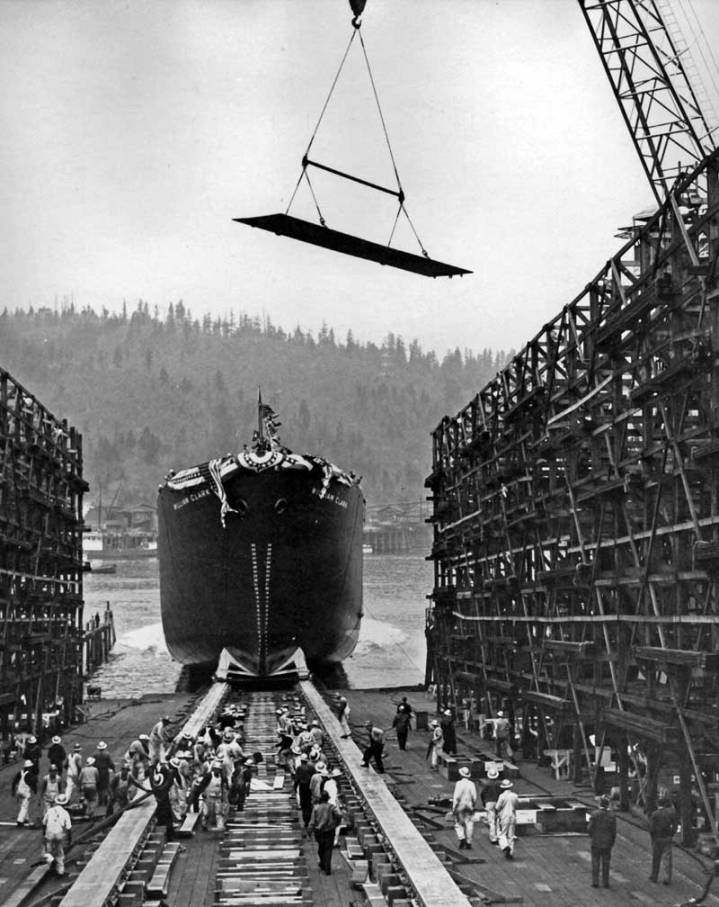
There’s no doubt about the Yanks when they go into production they can turn out the stuff.  That Kaiser bloke has revolutionised ship building – fancy building a ship in a week.  I guess those big industrialists are coining the dough over there the same as they are in Australia.  I saw in one paper where some firms were making two hundred and fifty percent profit.  Pre-war fortunes will look like small change after this war.  One of the chaps asked a Yank if there weren’t a lot of people who would like to shoot Roosevelt and the Yank put the situation in a nutshell when he said – Who wants to shoot Father Christmas?

I was pleased to hear that my account has been returned from London.  You didn’t mention the amount though but I suppose it’s OK.

As usual there’s no news from this end so with love to May, Anne & Carline and best wishes to the boys I’ll say Cheerio.

Love

Max

Mrs Charlie, and Charlie’s wake

‘Mrs Charlie’ rather than ‘Aunt Margaret’ – no idea why!  Charlie Hickman had died in 1938.  Margaret died at the ripe old age of 82.  Black spot is a disease of apple and pear trees, caused by a fungal infection.

Waiting for a plane

Dad doesn’t know if he’s attached, detached or ex-list, but he was ‘waiting for a plane’.  He says Max Mann was ‘going the opposite way to us’…and as Mann was heading to Brisbane, Dad was clearly heading north – maybe he was helping on supply drops?  There is no indication on his service record of what he might have been doing at this time.

Beating the censors

Max Mann’s ‘coded’ communication was a good trick – another was shared recently (6 May 2016) via the 2/33 Bn Facebook page: Fiona Patterson, granddaughter of 2/33 veteran William Erskine Bailey NX 97019 says My grandmother and him had a map each and some tracing paper and he would put pin pricks in the tracing paper for her to check and see where he was without giving anything away in his letters. 

Ship building records

In fact, the Liberty ship SS Robert E Peary was assembled in less than five days as part of a special competition among shipyards and was lunched on November 12, 1942 at the Richmond shipyards (California) owned by Henry J Kaiser. Another of Kaiser’s shipyards in Oregon had built a similar ship in ten days in September 1942.   The four Kaiser shipyards at Richmond produced 747 ships over the course of the war and the Oregon yards 455 ships.

Photo from http://www.defensemedianetwork.com/stories/henry-j-kaiser-and-the-liberty-ships/

Launching-of-SS-William-Clark

Posted in organisation, The course of the war, Uncategorized | Tagged , | Leave a comment

The last place on God’s earth to send women


2 nov 42 p1_0001

2 nov 42 p2_0001


2 nov 42 p3_0001


TX 1004

Max Hickman

2/33rd Battalion AIF

2nd Nov 42

Dear Mother & Dad

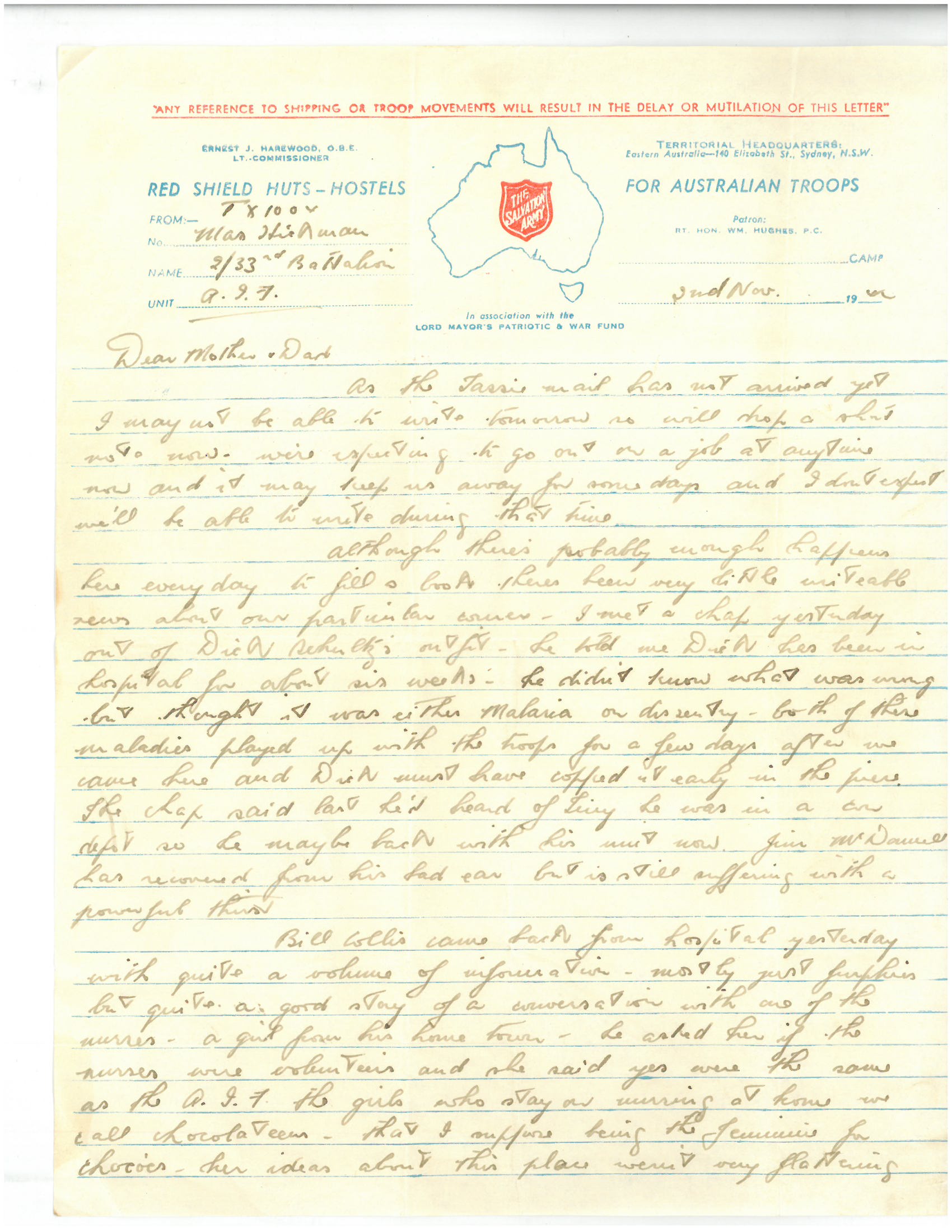
As the Tassie mail has not arrived yet I may not be able to write tomorrow so will drop a short note now.  We’re expecting to go out on a job at any time now and it may keep us away for some days and I don’t expect we’ll be able to write anything during that time.

Although there’s probably enough happens here every day to fill a book there’s been very little writeable news about our particular corner.  I met a chap yesterday out of Dick Schultz’s outfit. He told me Dick has been in hospital for about six weeks.  He didn’t know what was wrong but thought it was either malaria or dysentery – both of these maladies played up with the troops for a few days after we came here and Dick must have copped it early in the piece.  The chap said last he’d heard of Tiny he was in a con depot so he may be back with his unit now.  Jim McDonnell has recovered from his bad ear but is still suffering with a powerful thirst.

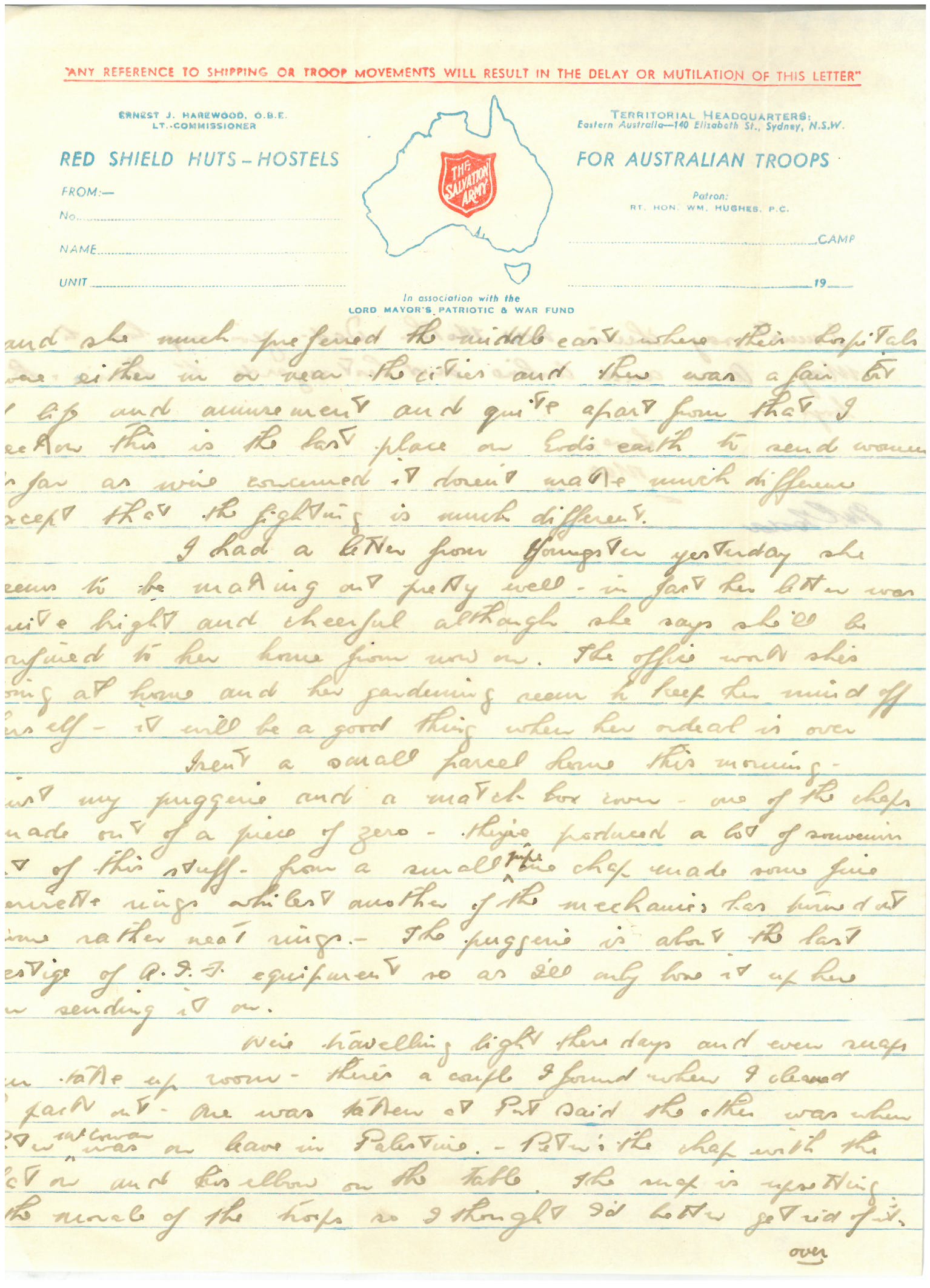
Bill Collis came back from hospital yesterday with quite a volume of information – mostly just furphies but quite a good story of a conversation with one of the nurses – a girl from his home town – he asked her if the nurses were volunteers and she said yes we’re the same as the AIF.  The girls who stay on nursing at home we call chocolateens – that I suppose being the feminine of choco’es – her ideas about this place weren’t very flattering and she much preferred the Middle East where their hospitals were either in or near the cities and there was a fair bit of life and amusement and quite apart from that I reckon this is the last place on God’s earth to send women.  As far as we’re concerned it doesn’t make much difference except that the fighting is much different.

I had a letter from Youngster yesterday.  She seems quite bright and cheerful although she says she’ll be confined to her home from now on.  The office work she’s doing at home and her gardening seem to keep her mind off herself.  It will be a good ting when her ordeal is over.

I sent a small parcel home this morning.  Just my puggaree and a match box cover one of the chaps made out of a piece of zero.  They’ve produced a lot of souvenirs out of this stuff – from a small pipe the chap made some tiny serviette rings whilst another of the mechanics has turned out some rather neat rings.  The puggaree is about the last vestige of AIF equipment so as I’ll only lose it up here am sending it on.

We’re travelling light these days and even snaps can take up room.  There’s a couple I found when I cleaned the pack out.  One was taken at Port Said the other was when Peter McCowan was on leave in Palestine.  Peter’s the chap with the hat on and his elbow on the table.  The snap is upsetting the morale of the troops so I thought I’d better get rid of it.

I must say cheerio now Mother & Dad.  Give my love to May, Anne and Carline and best regards to Laurie and the boys.

Love

Max


Expecting to go out on a job…sending my puggaree

The puggaree is the hatband which includes the battalion colour patch – it is clear Dad was expecting to be sent to the front line.


The last place on God’s earth to send women

Extracts from Joan Crouch’s book, A Special Kind of Service (pp 64 – 67) :

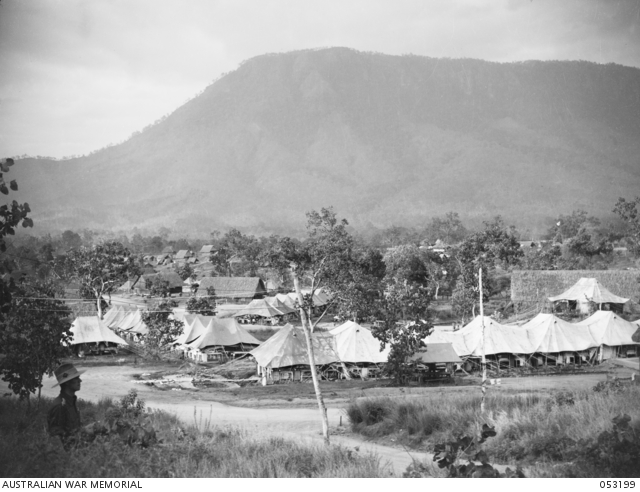
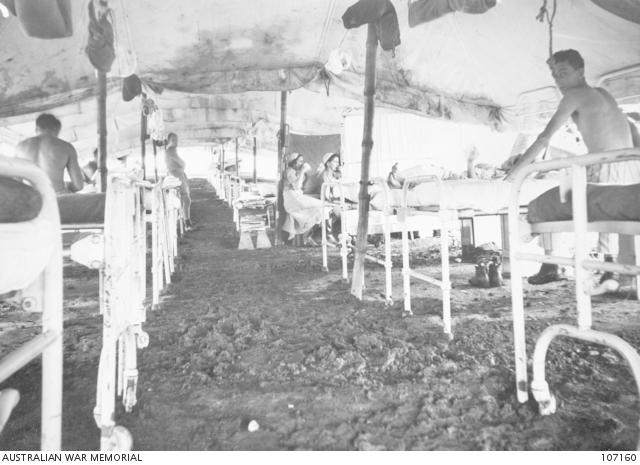
On 23 August the 2/9 AGH (which was the only General Hospital in New Guinea at the time) arrived (at ‘The Seventeen Mile’) as a 600-bed hospital and on 25 September they had 560 patients (mainly with fevers and dysentery) …Two days later the hospital was expanded to 800 beds, including a fly-proof ward for dysentery patients.  ….On 6 October 800 beds were equipped and 732 occupied, and a week later the establishment was increased to 1200 beds….The sisters arrived on 29 October…taking over the wards from the orderlies who had, with very little training or experience, conscientiously carried out their work with quite a degree of skill….The ward staff work broken shifts, but if necessary worked all day and into the night, and in the first months there were no days off.  Most wards of sixty beds and over had three or four sisters on day shift and one on night duty….Shortly after the arrival of the sisters, the wet season with its daily deluges of heavy rain, arrived….The daily deluges soon made the drainage throughout the hospital ineffective against the floods of water which ran off the surrounding hills, and the black volcanic soil quickly became bogs of heavy, sticky, thick mud.  Many of the tents, both in the staff lines and wards, were mouldy and leaked.  beds had to be moved in limited space to avoid drips, and they sank in the mud at all angles.  It was difficult to keep patients dry, and there was nowhere to hang wet blankets out to dry.  The situation became critical as increased numbers of sick and very fatigued men from the Kokoda Trail and later the Buna campaign, were admitted.  The increased number of troops in the area, and the conditions in which they were fighting, only worsened the situation…..Owing to the lack of open ground, and the floods of water and mud, the hospital faced a critical situation….

053199

AWM 053199

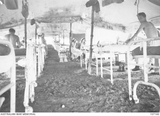
The 2/9 AGH, Port Moresby – wards were tents with earthen floors – see following photo


107160

AWM 107160 : Interior of a tent ward, 2/9th AGH Port Moresby.  Nurses take a tea break.


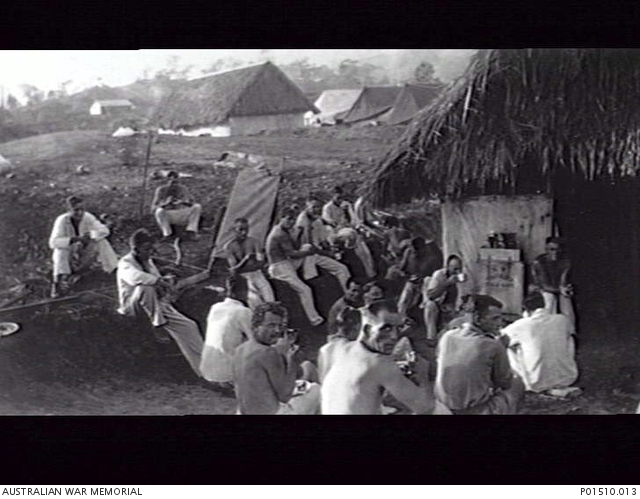
P01510.013

AWM photo – P01510.013   Patients eat breakfast outside ward 21, 2/9 AGH Port Moresby


Souvenirs from pieces of Zero

REL49028I can remember seeing the matchbox cover Dad mentions.  The AWM collection doesn’t include any serviette rings, but it does include this memento (REL49028) which is inscribed on the reverse side with the words ‘Zero Metal’.

Posted in Papua New Guinea | Tagged , , , , | Leave a comment

More or less grounded; rumours emanating from the top, a dire shortage of paper and a bolt disappears into chest hair.


21 oct 42 pp 1 2_0001

21 oct 42 pp 3 4_0001


21 oct 42 p5_0001


TX 1004

Max Hickman

33rd Platoon

25th Brigade

Carrier Group

AIF NG

21st Oct 42

Dear Mother & Dad

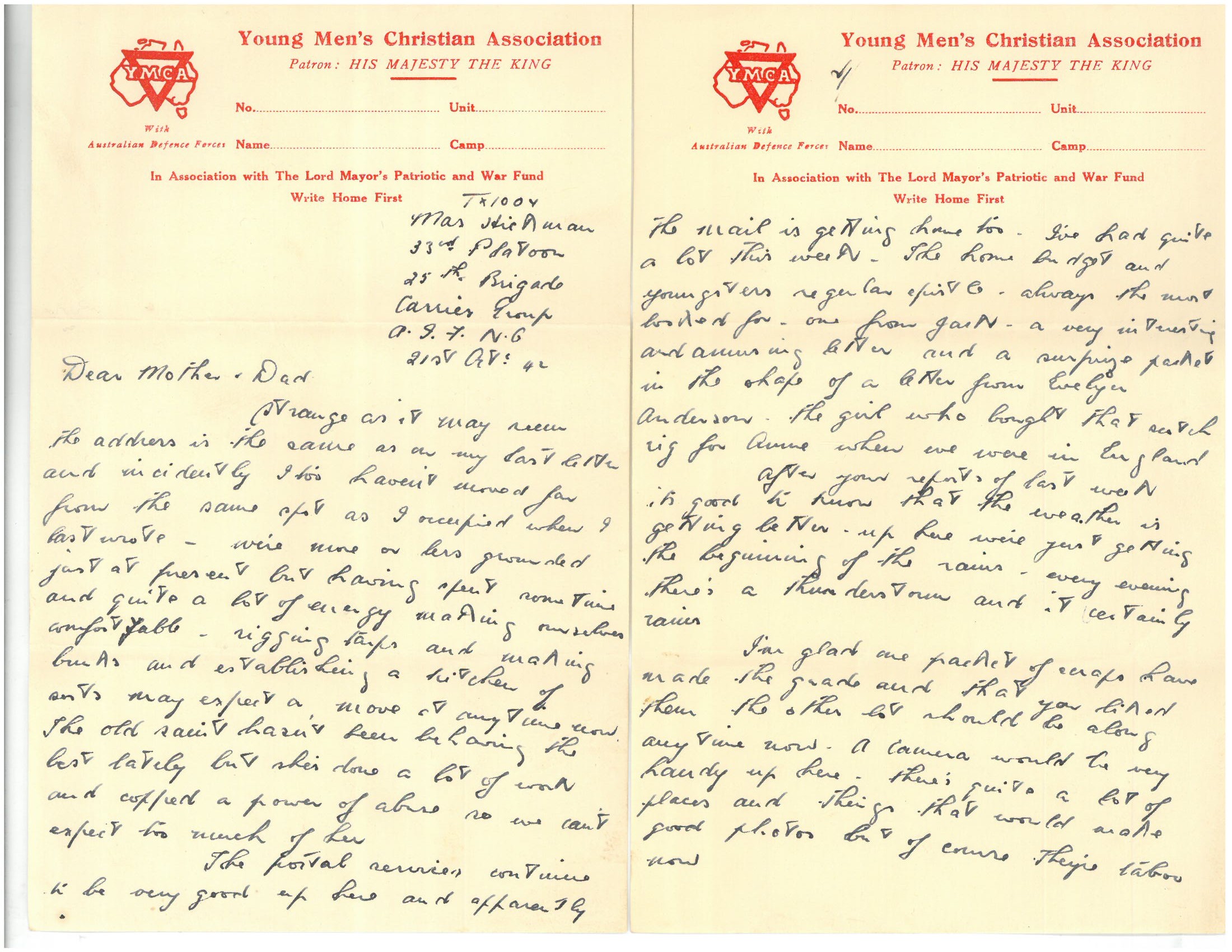
Strange as it may seem the address is the same as on my last letter and incidentally I too haven’t moved far from the same spot as I occupied when I last wrote – we’re more or less grounded just at present but having spent some time and quite a lot of energy making ourselves comfortable – rigging tarps and making bunks and establishing a kitchen of sorts – may expect a move at any time now.  The old saint hasn’t been behaving the best lately but she’s done a lot of work and copped a power of abuse so we can’t expect too much of her.

The postal services continue to be very good up here and apparently the mail is getting home too.  I’ve had quite a lot this week – the home budget and youngster’s regular epistle – always the most looked for – one from Jack – a very interesting and amusing letter – and a surprise packet in the shape of a letter from Evelyn Anderson – the girl who bought that scotch rig for Anne when we were in England.

After your reports of last week it’s good to know that the weather is getting better.  Up here we’re just getting the beginning of the rains.  Every evening there’s a thunderstorm and it certainly rains.

I’m glad one packet of snaps have made the grade and that you liked them.  The other lot should be along any time now.  A camera would be very handy up here – there’s quite a lot of places and things that would make good photos but of course they’re taboo now.

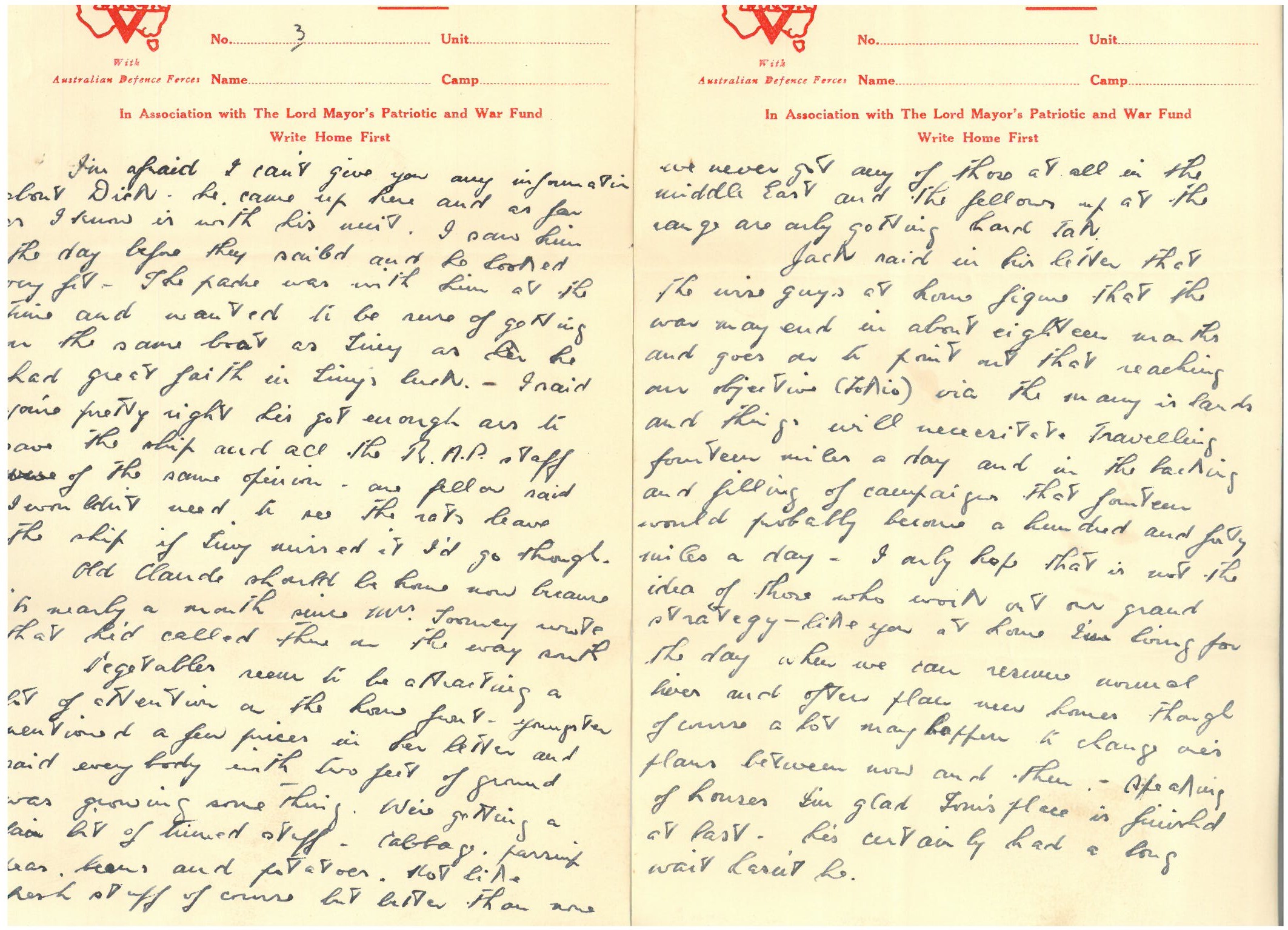
I’m afraid I can’t give you any information about Dick.  He came up here and as far as I know is with his unit.  I saw him the day before they sailed and he looked very fit.  The padre was with him at the time and wanted to be sure of getting on the same boat as Tiny as he had great faith in Tiny’s luck.  I said you’re pretty right he’s got enough arse to save the ship and all the RAP staff were of the same opinion.  One fellow said I wouldn’t need to see the rats leave the ship – if Tiny missed it I’d go through.

Old Claude should be home now because it’s nearly a month since Mrs Toomey wrote that he’d called there on the way south.

Vegetables seem to be attracting a lot of attention on the home front – Youngster mentioned a few prices in her letter and said everybody with two feet of ground was growing something. We’re getting a fair bit of tinned stuff – cabbage, parsnip, peas, beans and potatoes.  Not like fresh stuff of course but better than none.  We never got any of those at all in the Middle East and the fellows up at the range are only getting hard tack.

Jack said in his letter that the wise guys at home figure that the war may end in about eighteen months and goes on to point out that reaching our objective (Tokio) via the many islands and things will necessitate travelling fourteen miles a day and in the backing and filling of campaigns that fourteen would probably become a hundred and forty miles a day.  I only hope that is not the idea of those who work out our grand strategy – like you at home I’m living for the day when we can resume normal lives and often plan new homes though of course a lot may happen to change one’s plans between now and then.  Speaking of houses I’m glad Tom’s place is finished at last – he’s certainly had a long wait, hasn’t he?

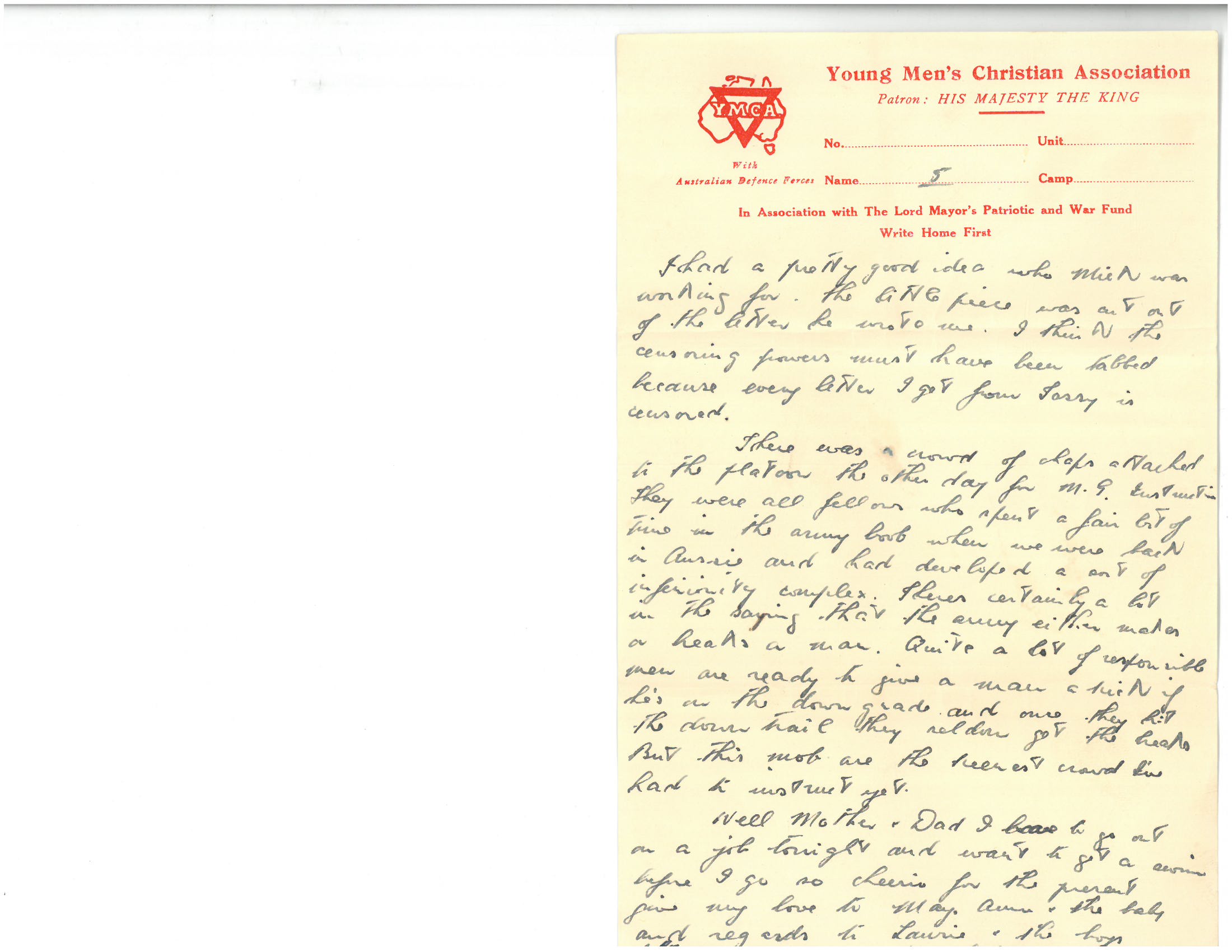
I had a pretty good idea who Mick was working for.  The little piece was cut out of the letter he wrote me.  I think the censoring powers must have been tabbed (?) because every letter I got from Tassy is censored.

There was a crowd of chaps attached to the platoon the other day for MG Instruction.  They were all fellows who spent a fair bit of time in the army boob (?) when we were back in Aussie and had developed a sort of inferiority complex.  There’s certainly a lot in the saying that the army either makes or breaks a man.  Quite a lot of responsible men are ready to give a man a kick if he’s on the down grade and once they hit the down trail they seldom get the breaks.  But this mob are the keenest crowd I’ve had to instruct yet.

Well Mother & Dad I have to go out on a job tonight and want to get a swim before I go so cheerio for the present.  Give my love to May, Anne & the baby and regards to Laurie & the boys.
Your loving son

Max

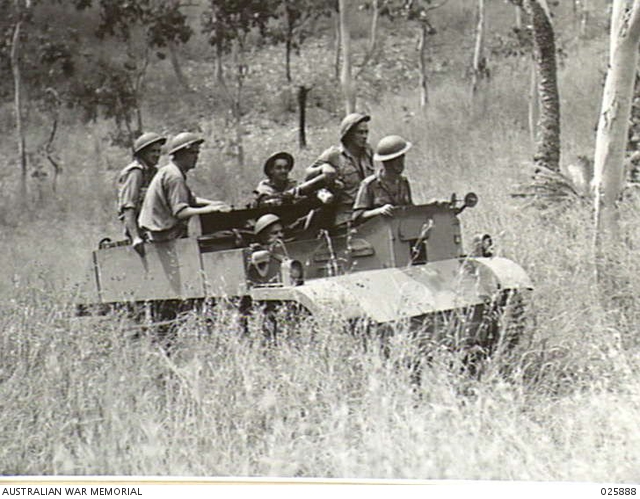
The old saint – has done a lot of work.

025888

AWM 025888

A carrier in thick bush during manoeuvres in New Guinea.


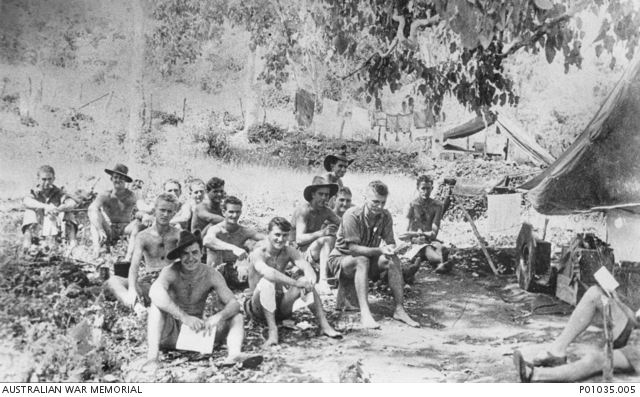
Postal services continue to be very good

P01035.005

AWM P01035.005

Spotters from the New Guinea Air Warning Wireless company read their mail, sitting in a clearing.

Cameras…are taboo !

Many of the photographs in the AWM collection were taken by members of the forces, so clearly not everyone complied with the ‘taboo’.


25th oct 42 p1,2_0001


25th oct 42 p 3,4_0001


25th oct 42 p 5,6_0001


25th Oct 1942

TX 1004

Max Hickman

33rd Platoon

25th Brigade

Carrier Group

AIF

NG

Dear Mother & Dad

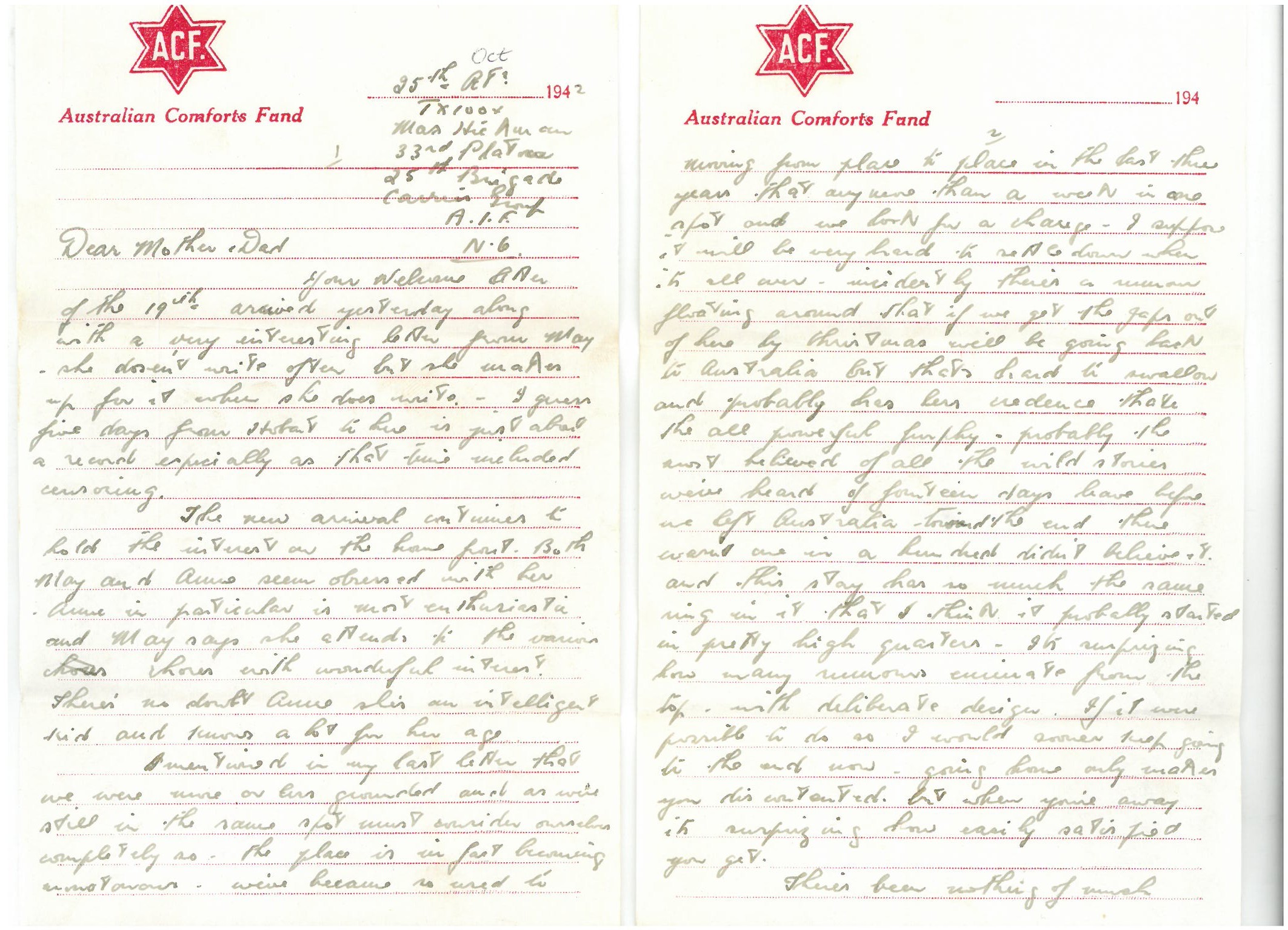
Your welcome letter of the 19th arrived yesterday along with a very interesting letter from May.  She doesn’t write often but she makes up for it  when she does write.  I guess five days from Hobart to here is just about a record especially as that time included censoring.

The new arrival continues to hold the interest on the home front.  Both May and Anne seem obsessed with her – Anne in particular is most enthusiastic and May says she attends to the various chores with wonderful interest.  There’s no doubt (about) Anne she’s an intelligent kid and knows a lot for her age.

I mentioned in my last letter that we were more or less grounded and as we’re still in the same spot must consider ourselves completely so.  The place is fast becoming monotonous.  We’ve become so used to moving from place to place in the last three years that any more than a week in one spot and we look for a change.  I suppose it will be very hard to settle down when it’s all over.  Incidentally there’s a rumour floating around that it we get the Japs out of here by Christmas we’ll be going back to Australia but that’s hard to swallow and probably has less credence than the all powerful furphy – probably the most believed of all the wild stories we’ve heard – of fourteen days’ leave before we left Australia.  Toward the end there wasn’t one in a hundred didn’t believe it and this story has so much the same ring in it that I think it probably started in pretty high quarters.  It’s surprising how many rumours emanate from the top – with deliberate design.  If it were possible to do so I would sooner keep going to the end now.  Going home only makes you discontented, but when you’re away it’s surprising how easily satisfied you get.

There’s been nothing of much interest happen here.  Jim Mc’s ear is nearly better but it’s left him a bit  deaf although I don’t suppose that will affect his swallow.  I guess if anything happened in that way it would just about kill the Hon James J as he styles himself.  Peter McCowan has caught up with the show – full of beans of course – but Ray Ross is till back in Aussie.  I think Rossy must have clicked an ITB job – he’s a good instructor and since getting married has been keen in that direction.  I wouldn’t fancy that game at all although I’ve had to do a fair bit of it.

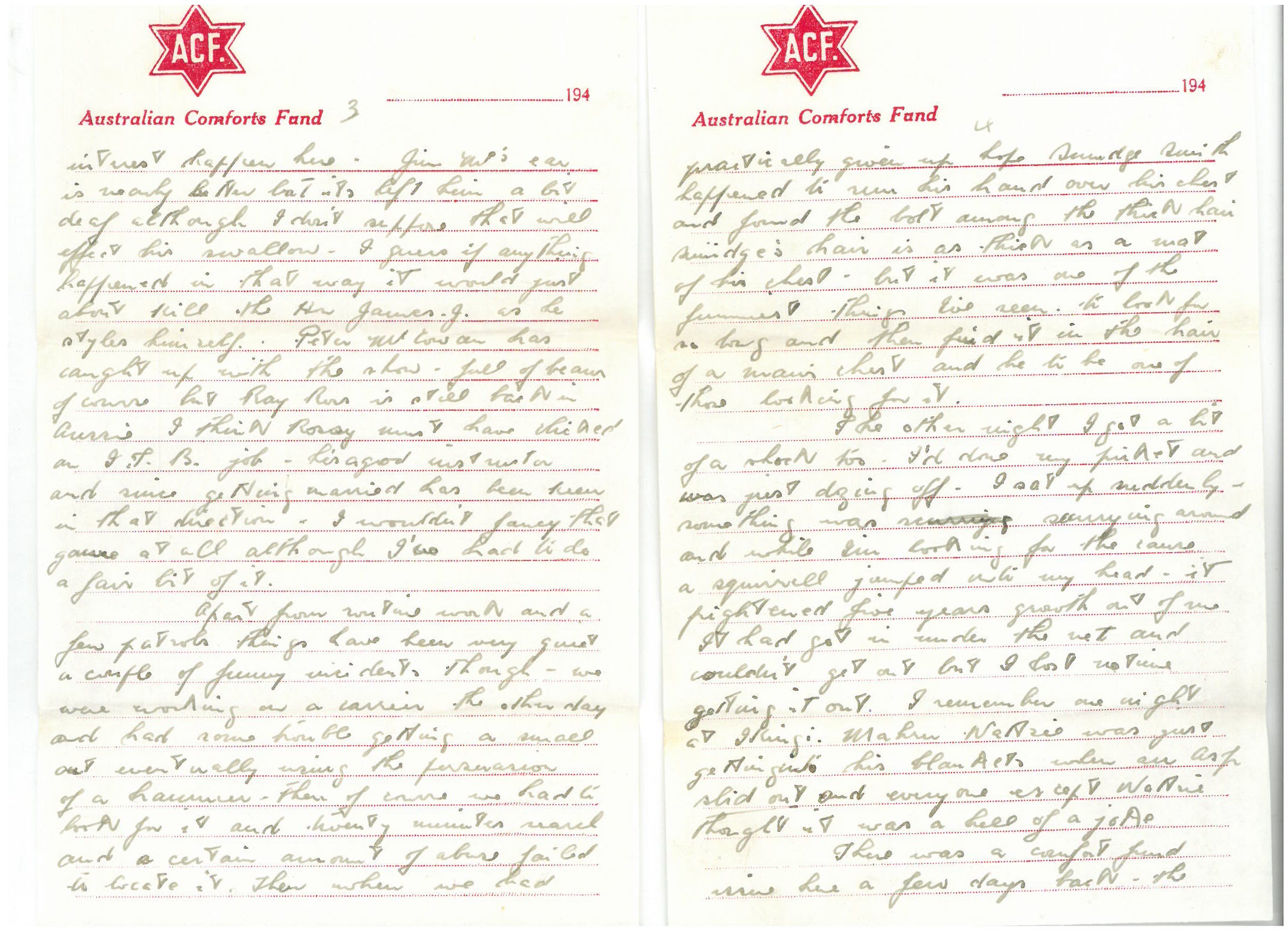
Apart from routine work and a few patrols things have been very quiet.  A couple of funny incidents though – we were working on a carrier the other day and had some trouble getting a small (bolt) out, eventually using the persuasion of a hammer.  Then of course we had to look for it and twenty minutes search and a certain amount of abuse failed to locate it.  Then when we had practically given up hope Smudge Smith happened to run his hand over his chest and found the bolt among the thick hair.  Smudge’s hair is as thick as a mat on his chest – but it was one of the funniest things I’ve seen, to look for so long and then find it in the hair of a man’s chest and he to be one of those looking for it.

The other night I got a bit of a shock too.  I’d done my picket and was just dozing off.  I sat up suddenly – something was scurrying around and while I’m looking for the cause a squirrel jumped onto my head.  It frightened five years’ growth out of me.  It had got in under the net and couldn’t get out, but I lost no time getting it out.  I remember one night in Ikingi Matru, Wattsie was just getting into his blankets when an asp slid out and everyone except Wattsie thought it was a hell of a joke.

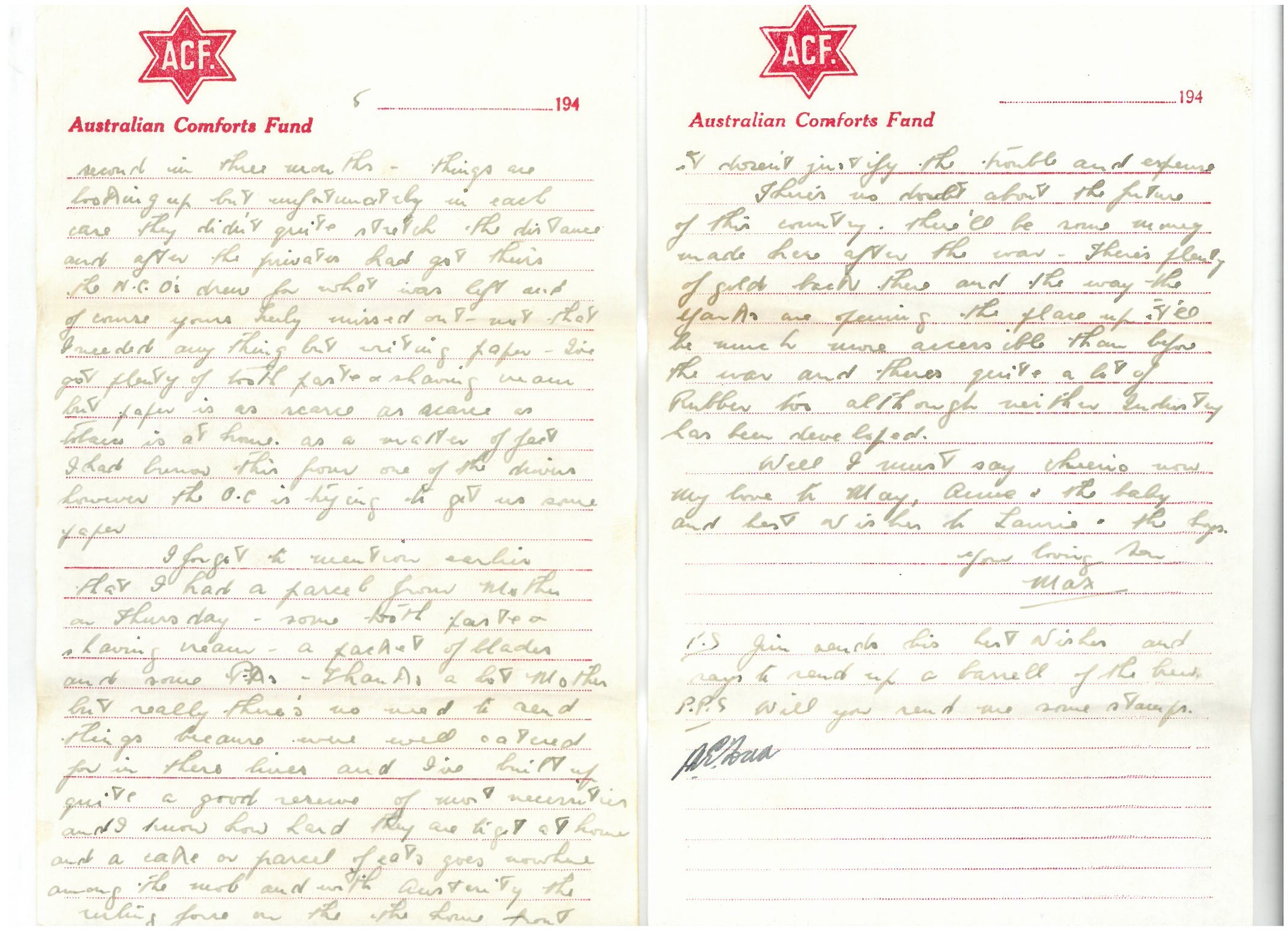
There was a comfort fund issue here a few days back – the second in three months – things are looking up – but unfortunately in each case they didn’t quite stretch the distance and after the privates had got theirs the NCO’s drew for what was left and of course yours truly missed out.  Not that I needed anything but writing paper.  I’ve got plenty of toothpaste and shaving cream but paper is as scarce as scarce, as tobacco is at home.  As a matter of fact I had (to) borrow this from one of the drivers – however the OC is trying to get us some paper.

I forgot to mention earlier that I had a parcel from Mother on Thursday – some toothpaste and shaving cream, a packet of blades and some PK’s.  Thanks a lot Mother but really there’s no need to send things because we’re well catered for in those lines and I’ve built up quite a good reserve of most necessities and I know how hard they are to get at home and a cake or parcel of eats goes nowhere among the mob and with Austerity the ruling force on the home front it doesn’t justify the trouble and expense.

There’s no doubt about the future of this country.  There’ll be some money made here after the war.  There’s plenty of gold back there and the way the Yanks are opening the place up it’ll be much more accessible than before the war and there’s quite a lot of rubber too although neither industry has been developed.

Well I must say cheerio now.  My love to May, Anne & the baby and best withes to Laurie & the boys.

Your loving son

Max

PS Jim sends his best wishes and says to send up a barrel of the brew.

PPS Will you send me some stamps.

Peter McCowan has caught up with the show

McCowan had been in hospital in Brisbane but the fact that he has just ‘caught up’  confirms that the person in the foreground of the photo at Ioribaiwa (blog post dated 5 October 1942) was certainly not McCowan.

A squirrel in the tent!?

Certainly not an actual squirrel, but there are several possibilities for what this intruder might have been, including the sugar glider, although the glider only rarely descends to the ground.

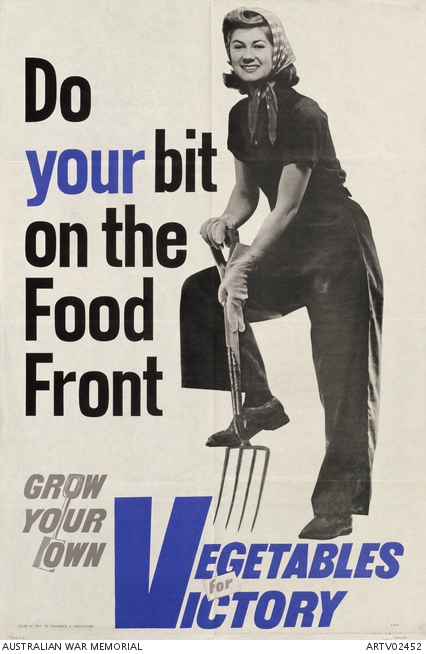
Austerity at home

Prime Minister John Curtin’s “maximum effort” required that most of the resources and means of production be directed towards winning the war: “Austerity calls for a pledge by the Australian people to strip every selfish comfortable habit, every luxurious impulse, every act, word and deed that retards the victory march.” Australians had to adjust to life in which even the most common commodities in peacetime became rationed or simply unavailable. Most Australians embraced recycling and made do with what they could buy, find or scrounge. The austerity campaigns encouraged Australians to work longer hours and consume less, reuse rather than discard, and invest any spare cash in war savings certificates. (source https://www.awm.gov.au/exhibitions/underattack/mobilise/austerity.asp )

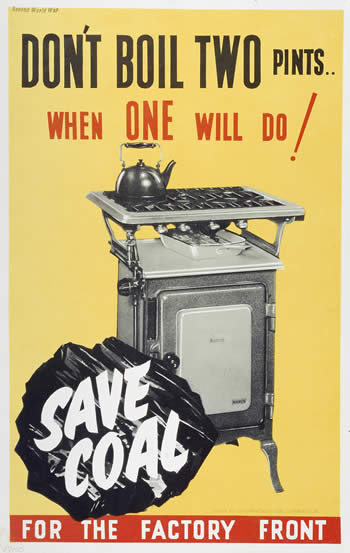
Two of the posters that were part of this campaign:

AWM ARTV02452                        AWM ARTV07860

ARTV02452

ARTV07860


Posted in Carrier platoon, escapades, relaxation, fun and games, Food and Drink, organisation, Papua New Guinea, parcels, The course of the war | Tagged , , , , , , , | 1 Comment

One step removed from a base job… two letters

11 oct 42 p1_0001

11 oct 42 p2_0001

11 oct 42 p3_0001

TX 1004

Max Hickman

33rd platoon

Composite Carrier Group

New Guinea Forces

New Guinea

11th Oct 1942

Dear Mother & Dad

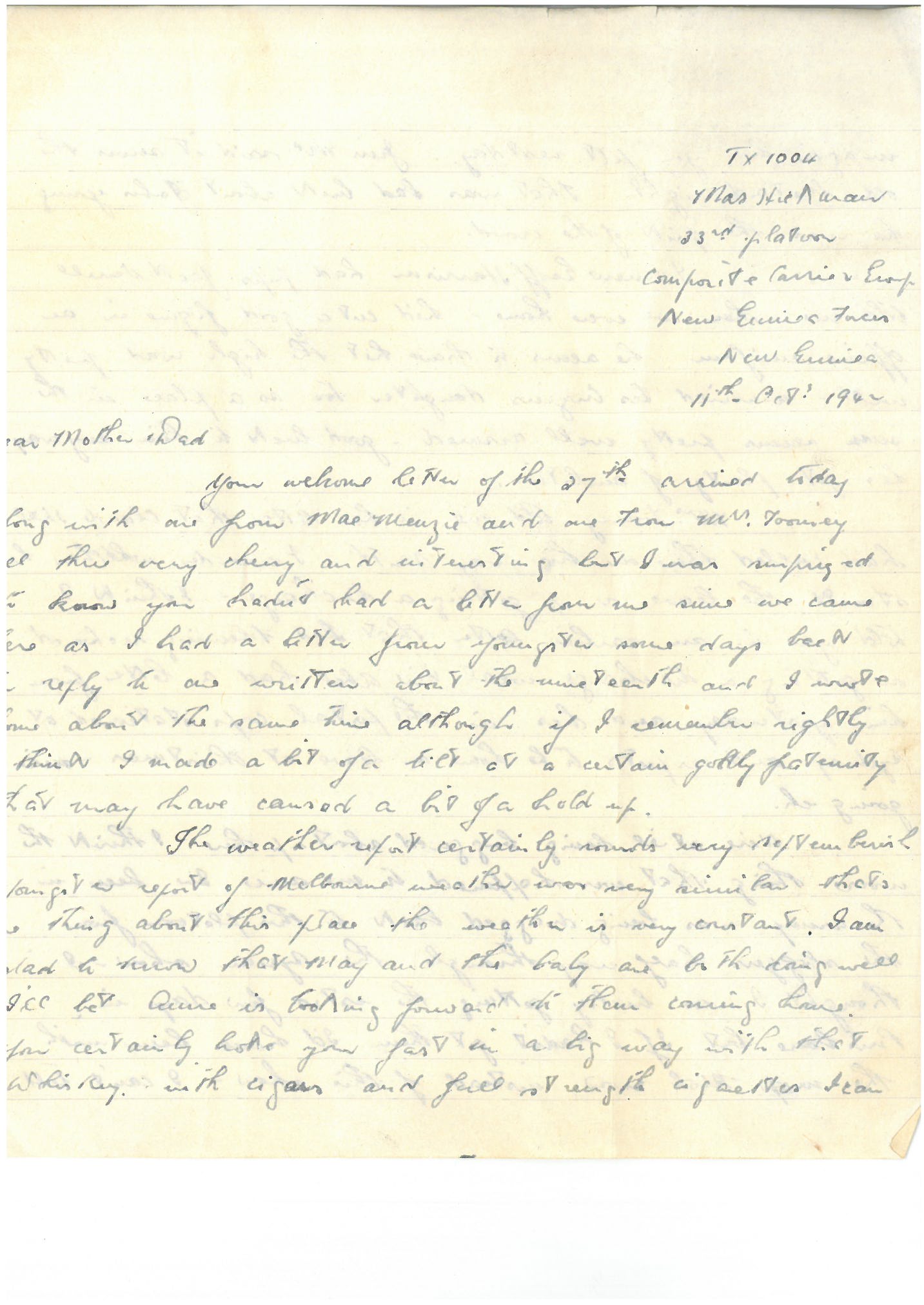
Your welcome letter of the 27th arrived today along with one from Mae Menzie and one from Mrs Toomey.  All three very cheery and interesting but I was surprised to know you hadn’t had a letter from me since we came here as I had a letter from Youngster some days back in reply to one written about the nineteenth and I wrote home about the same time.  Although if I remember rightly I think I made a bit of a tilt at a certain godly fraternity that may have caused a bit of a hold up.

The weather report certainly sounds very Septemberish.  Youngster’s report of Melbourne weather was very similar.  That’s one thing about this place – the weather is very constant.  I am glad to know that May and the baby are both doing well.  I’ll bet Anne is looking forward to them coming home.  You certainly broke your fast in a big way with that  whisky, with cigars and full strength cigarettes I can imagine how you felt next day.  Jim Mc said it serves the old bastard right.  That was bad luck about John (?) Young – he was the pick of the crowd.

I knew Geoff Harrison had pips – Jack Verrell told me when we were home.  He’d cut a good figure in an officer’s uniform.  He seems to have hit the high road pretty well – married Les Crozier’s daughter too, so a place in the sun seems pretty well assured – good luck to him anyway, he’s got plenty of ambition.

Mrs Toomey told me in her letter that Claude Hill had  called there on his way south.  I wonder whether he struck the leave or is getting a discharge.  I think I told you in an earlier letter that Ted Fleming reckoned on getting a discharge – well, Viv Abel had a letter from him yesterday and he’s in the postal corps stationed at Sydney and expects to be home on leave at Christmas – nice going eh.

We’re still being buggered about up here.  I think the worst thing that ever happened to me since I’ve been in the army was being dragged back to this platoon from the sloggers halfway through the Syrian show.  I thought I was lucky getting the extra few days in Brisbane but if I hadn’t got them I’d have been with the mob now, instead of this show – I can’t tell you much about it except that it’s only one step removed from a base show and although generally speaking conditions are good – plenty to do and good tucker and not much regimental baloney and there’s no doubt they’re doing a necessary job – it doesn’t suit me at all.

I thought you might have mentioned in your letter what price they want for Catoes.  It should be a good proposition, although not comparable with Ashton Jones’ place but I want to have something ready to jump into when the show is over and at present we look to be holding a good betting hand – unless something very unexpected happens another year should finish it.

Well Mother & Dad I’m afraid there’s absolutely no writeable news so with love to May, Anne & the baby and best regards to the boys I’ll say cheerio.

Your loving son

Max

PS  Can you send me some writing paper and stamps – stamps are particularly hard to get.


16 oct 42 p1_0001

16 oct 42 p2_0001

16 oct 42 p3_0001

TX 1004

Max Hickman

33rd Platoon

25th Inf Brigade

Carrier Group

AIF New Guinea

16-10-1942

Dear Mother & Dad

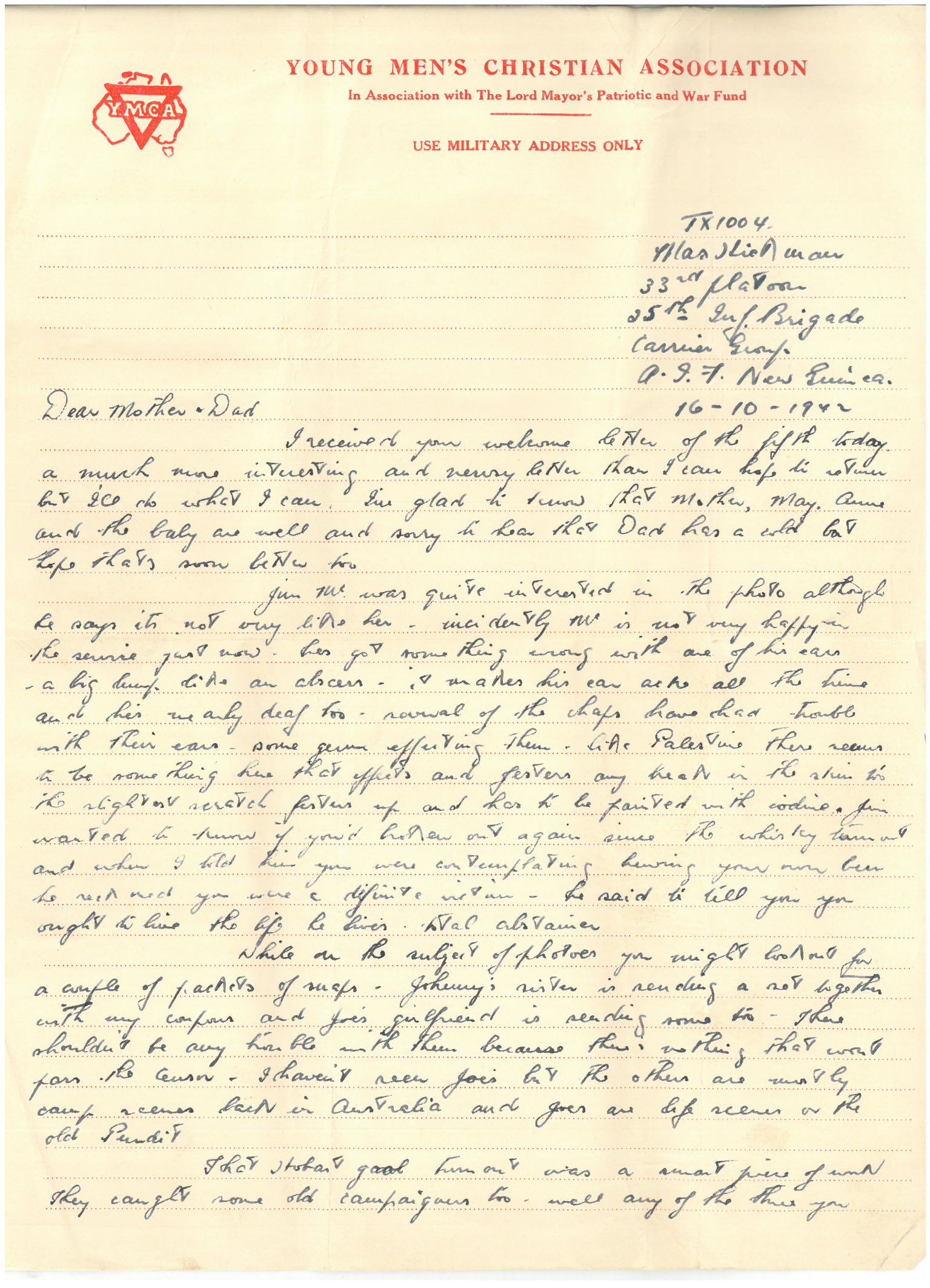
I received your welcome letter of the fifth today – a much more interesting and newsy letter than I can hope to return but I’ll do what I can.  I’m glad to know that mother, May, Anne and the baby are well and sorry to hear that Dad has a cold but hope that’s soon better too.

Jim Mc was quite interested in the photo although he says it’s not very like her.  Incidentally Mc is not very happy in the service just now.  He’s got something wrong with one of his ears – a big lump like an abscess – it makes his ear ache all the time and he’s nearly deaf too.  Several of the chaps have had trouble with their ears – some germ affecting them – like Palestine there seems to be something here that affects and festers any break in the skin so the slightest scratch festers up and has to be painted with iodine.  Jim wanted to know if you’d broken out again since the whisky turnout and when I told him you were a definite victim he said to tell you, you ought to live the life he lives – total abstainer.

While on the subject of photos you might look out for a couple of packets of snaps.  Johnny’s sister is sending a set together with my coupons and Joe’s girlfriend is sending some too – there shouldn’t be any trouble with them because there’s nothing that won’t pass the censor.  I haven’t seen Joe’s but the others are mostly camp scenes back in Australia and Joe’s are life scenes on the old Pundit.

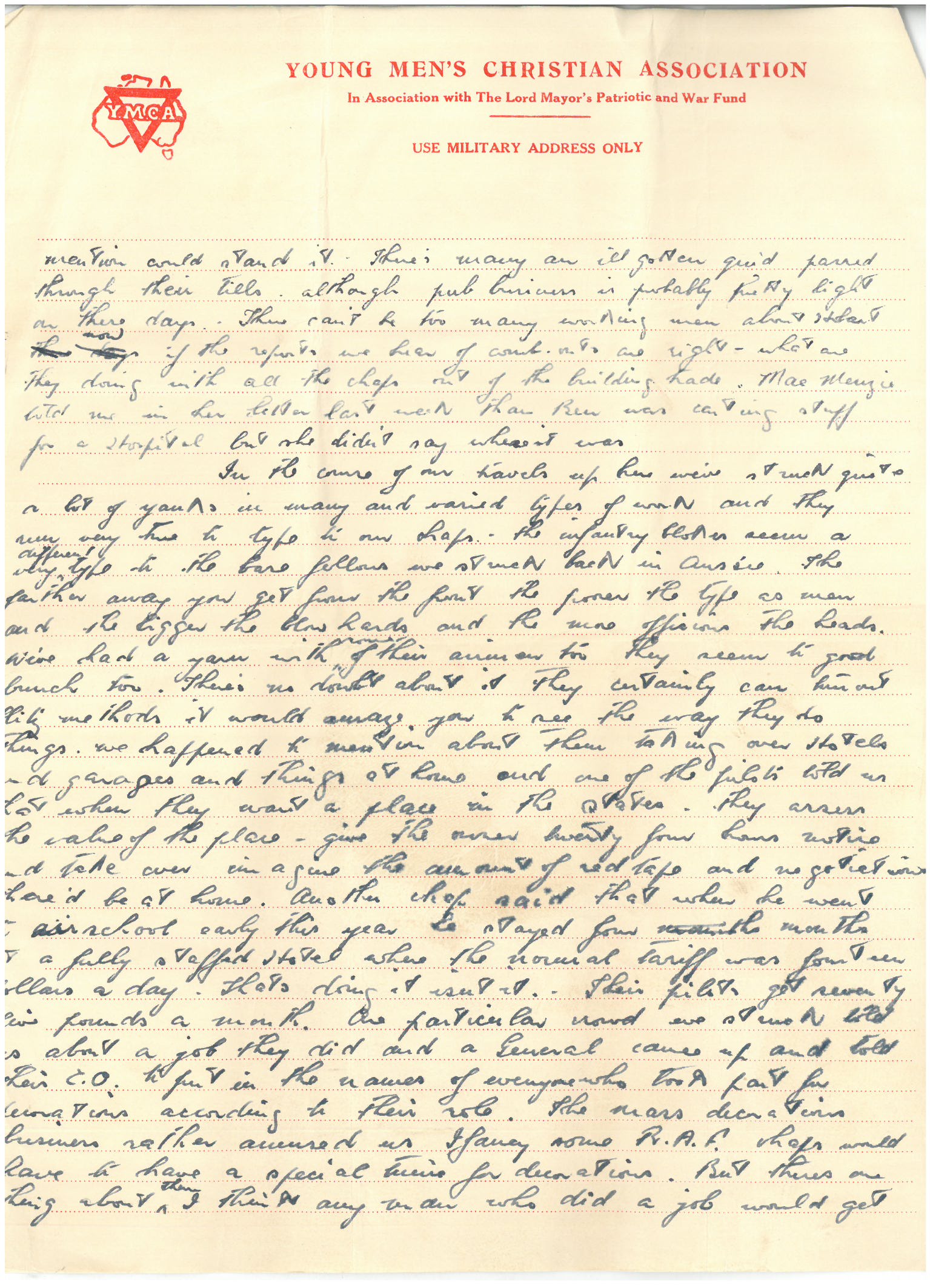
That Hobart Gaol turnout was a smart piece of work.  They caught some old campaigners too – well any of the three you mention could stand it.  There’s many an ill gotten quid passed through their tills, although pub business is probably pretty light on these days.  There can’t be too many working men about Hobart now if the reports we hear of comb-outs are right – what are they doing with all the chaps out of the building trade?  Mae Menzie told me in her letter last week that Ben was carting stuff for a hospital but she didn’t say where it was.

In the course of our travels up here we’ve struck quite a lot of Yanks in many and varied types of work and they seem very true to type to our chaps.  The infantry blokes seem a very different type to the base fellows we struck back in Aussie.  The farther away you get from the front, the poorer the type as men and the bigger the blow hards and the more officious the heads.  We’ve had a yarn with some of their airmen- they seem a good bunch too.  There’s no doubt abut it they certainly can turn out blitz (?) methods.  It would amaze you to see the way they do things.  We happened to mention about them taking over hotels and garages and things at home, and one of the pilots told us that when they want a place in the states they assess the value of the place, give the owner twenty four hours notice and take over.  Imagine the amount of red tape and negotiations there’d be at home.  Another chap said that when he went to school early this year he stayed four months at a fully staffed hotel where the normal tariff was  fourteen dollars a day.  That’s doing it, isn’t it.  Their pilots get seventy five pounds (dollars?) a month. One particular crowd we struck told us about a job they did and a General came up and told their CO to put in the names of everyone who took part for decorations according to their role.  The mass decorations business rather amused us.  I fancy some RAF chaps would have to have a special tunic for decorations.  But there’s one thing about them I think any man who did a job would get recognition.

You’ve probably noticed the change of address and although it conveys little but confusion to you we’re hoping it means a lot to us – at least most of us are.  Of course it may be only a compromising gesture, a play of words, but it’s like a bright star in a clouded sky at present.

I received a very nice parcel from Ivy this evening – crystallised fruits – very tasty too, but I know it’s damn dear and Youngster can’t afford it.

It’s amazing how rumours get about.  There’s a wave of them at present, each vying with the others and I suppose if I wrote half of them they wouldn’t pass the censor.

Well Mother & Dad I must say cheerio.  there’s tons of news but you’ll have to read about it in the newspapers.  Give my love to May, Anne & the baby and best regards to the boys.

Your loving son

Max

‘One step removed from a base job’

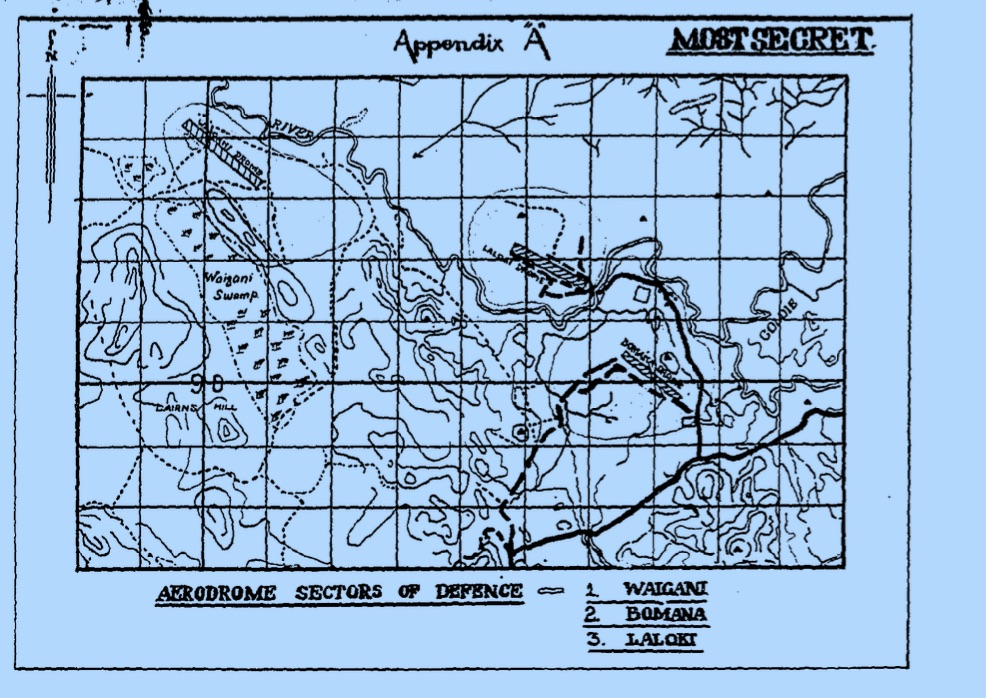
At some point during the second half of October, the carriers of the 2/33rd were transferred from NGF Composite Carrier Group to the 25 Brigade Carrier Group.  Dad was clearly hoping that being under Brigade command rather than NGF might make some difference to the sense of ‘being buggered about’!  The Brigade Carrier group was tasked with airfield defence – of the Bomana, Laloki and Waigani aerodromes.

https://www.awm.gov.au/collection/RCDIG1026042/  Area Command Moresby 6 Base Sub Area   October 1942 – June 1943: Defence scheme, defence aerodromes, work and progress reports

The Army hierarchy were clearly concerned that there might be an attack on Port Moresby carried out by paratroopers, as the Germans had done on Crete.  This (Defence scheme…) diary details the anticipated phases of such an attack, and instructs commanders on preferred methods for ‘preventing enemy penetration into aerodrome area.’   Carrier platoons were specifically tasked with providing security patrols in specified areas, dealing with enemy troops landing in specified areas,  harassing fire as directed, and preventing the enemy approaching the dromes

Airfield defenceAerodrome sectors of defence – see diary above p.144

The Waigani drome was also known as 17 Mile and later Durand.    Bomana (12 Mile) was later known as Berry Drome, and Laloki (14 mile) later became Schwimmer Drome.


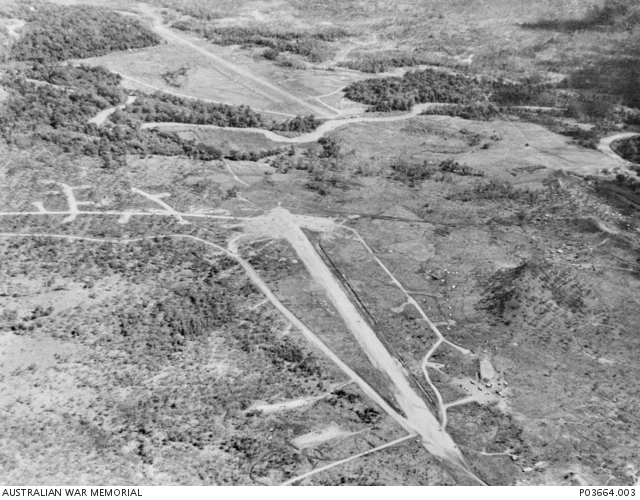
Bomana P03664.003AWM P03664.003   Aerial view of Berry Drome (previously named Bomana Aerodrome) with the Laloki River winding through the background. The airstrip, situated approximately 20 kilometres north-east of Port Moresby, was used mainly by fighter and medium bomber aircraft.

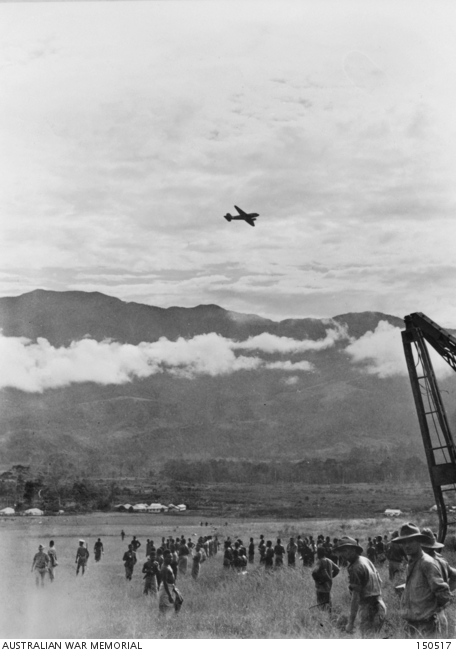
150517AWM 150517   Port Moresby New Guinea. August 1942. Ground troops and natives prepare to unload another Douglas C47 Dakota transport aircraft bringing urgent supplies from the Australian mainland. Note the low cloud over the airstrip.


Japanese air supremacy

Gunner Laurie Ward who later joined the 2/33rd made the following remarks in an interview (http://indicatorloops.com/pm_ackack.htm)

There were quite a few air raids because the Japanese had complete control of the air.  We had no fighters and very very few bombers, our fighters having been shot down in the Darwin region in the early part of the New Guinea campaign, and up around Rabaul.  The Japanese having air supremacy just came and went at will.  Our job was to protect both the harbour of Port Moresby and the airfields, which were Ward’s and Jackson’s airstrips.

That Hobart Gaol turnout

I can’t be certain, but this might have been the ‘turnout’ referred to ….can’t help laughing!

http://trove.nla.gov.au/ndp/del/article/91506249

We’ve struck quite a lot of Yanks

Many US Air Force units were based at the Port Moresby dromes. This is a link to a film – A Day in the life of a GI at 7 Mile Drome https://www.awm.gov.au/collection/F03478/

Posted in organisation, pay and conditions | Tagged , , , , , , , , | Leave a comment

Dick’s kept pretty busy; we find a marvellous swimming spot

5 oct 42 p1_0001

5 oct 42 p2_0001

5 oct 42 p3_0001

5 oct 42 p4_0001

TX 1004

Cpl M L Hickman

33rd Platoon

Composite Carrier Group

NGF New Guinea

5/10/42

Dear Mother & Dad

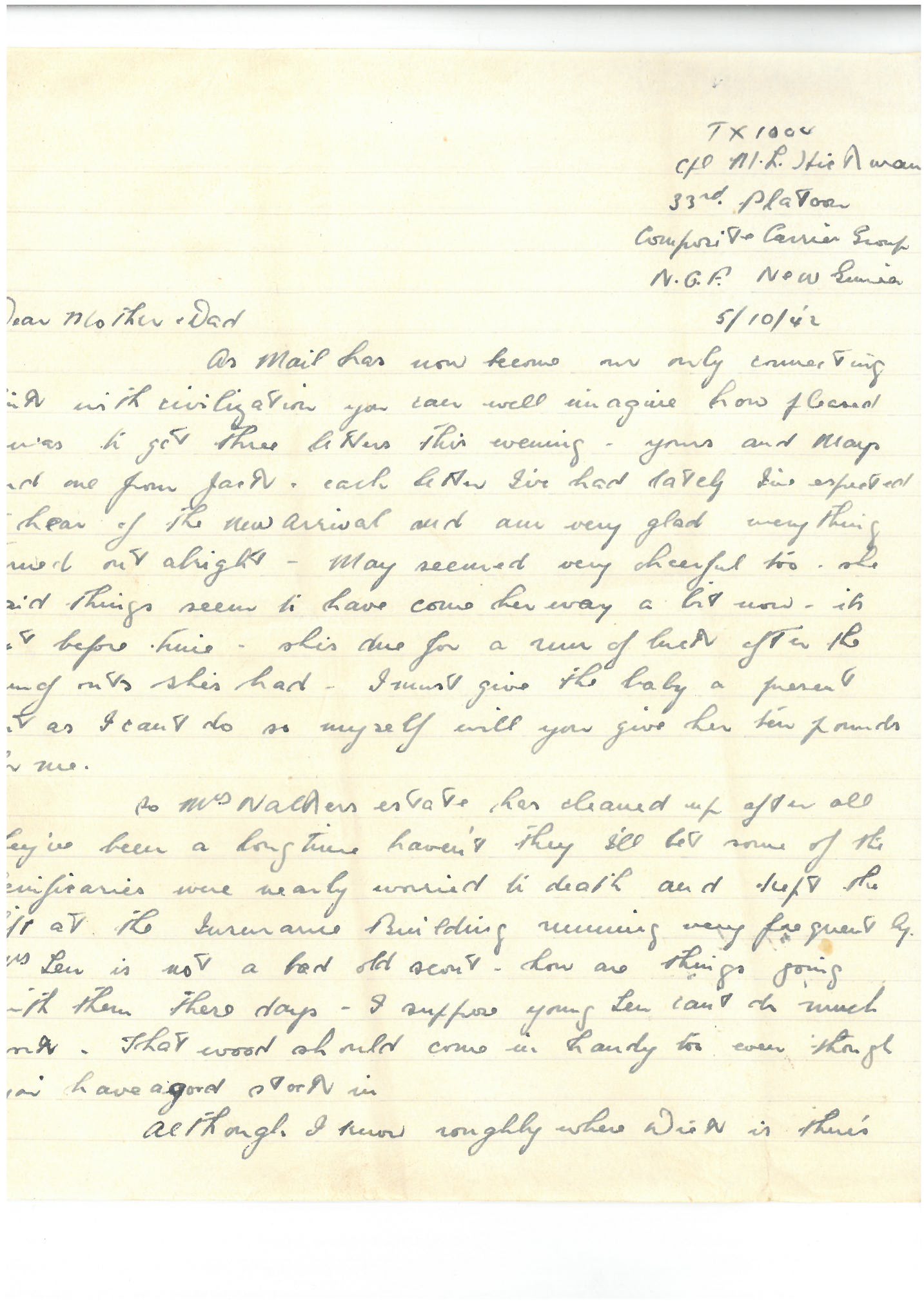
As Mail has now become our only connecting link with civilisation you can well imagine how pleased I was to get three letters this evening – yours and May’s and one from Jack.  Each letter I’ve had lately I’ve expected to hear of the new arrival and am very glad everything turned out alright.  May seemed very cheerful too.  It’s not before time – she’s due for a run of luck after the run of outs she’s had.  I must give the baby a present but as I can’t do so myself will you give her ten pounds for me.

So Mrs Walker’s estate has cleaned up after all. They’ve been a long time haven’t they.  I’ll bet some of the beneficiaries were nearly worried to death and kept the lift at the Insurance building running very frequently.  Mrs Len is not a bad old scout.  How are things going with them these days?  I suppose young Len can’t do much work.  That wood should come in handy too even though you have a good stock in.

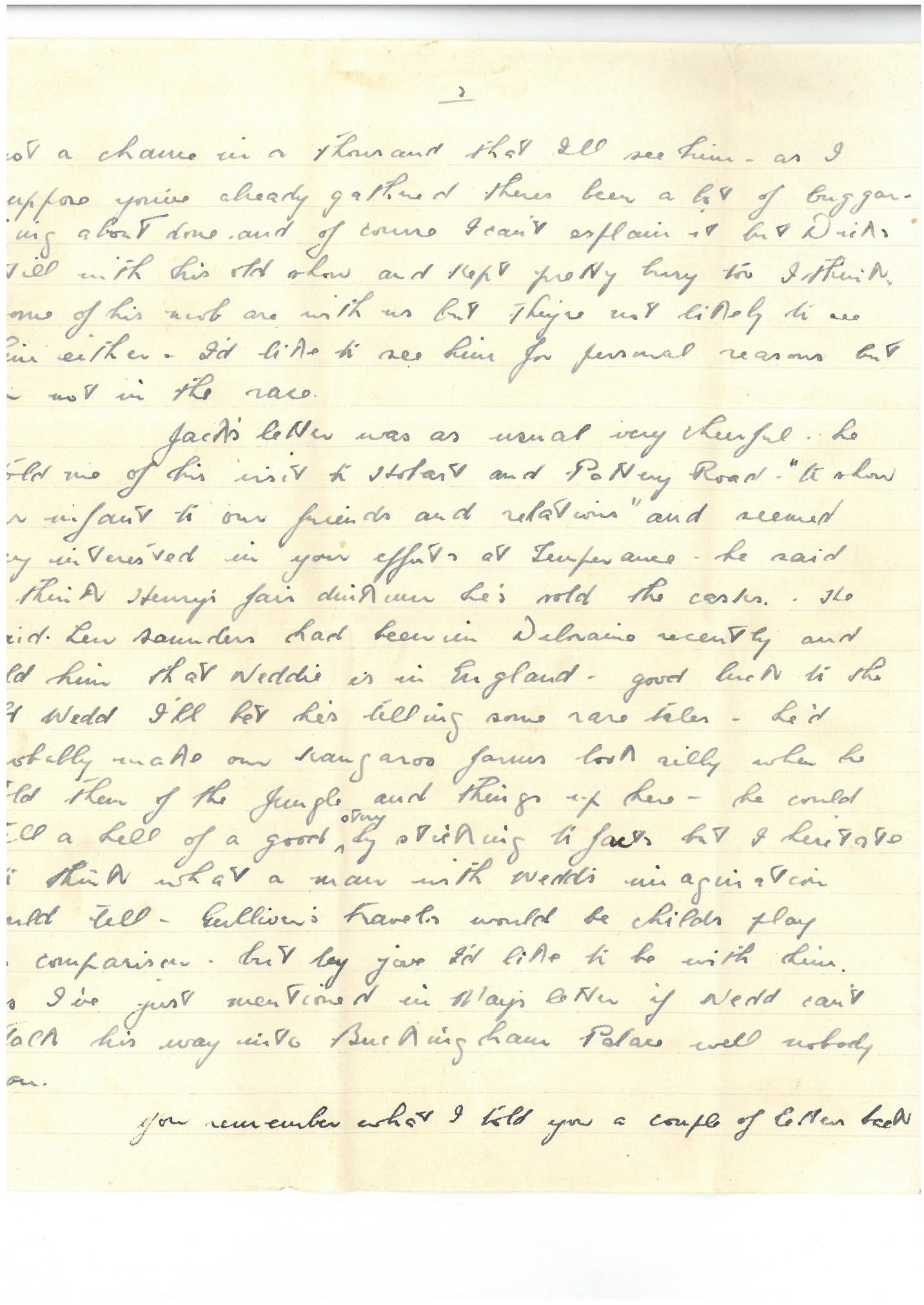
Although I know roughly where Dick is there’s not a chance in a thousand I’ll see him.  As I suppose you’ve already gathered there’s been a lot of buggarising about done, and of course I can’t explain it but Dick’s still with his old show and kept pretty busy too I think.  Some of his mob are with us but they’re not likely to see him either.  I’d like to see him for personal reasons but am not in the race.  Jack’s letter was as usual very cheerful.  He told me of his visit to Hobart and Pottery Road ‘to show our infant to our friends and relations’ and seemed very interested in your efforts at temperance.  He said ‘I think Henry’s fair dinkum – he’s sold the casks’.  He said Len Saunders had been in Deloraine recently and told him that Weddie is in England.  Good luck to the old Wedd I’ll bet he’s telling some rare tales.  He’d probably make our kangaroo forces look silly when he told them of the jungle and things up here – he could tell a hell of a good story by sticking to facts but I hesitate to think what a man with Wedd’s imagination could tell – Gulliver’s travels would be child’s play in comparison.  But by jove I’d like to be with him.  As I’ve just mentioned in May’s letter, if Wedd can’t talk his way into Buckingham Palace, well nobody can.

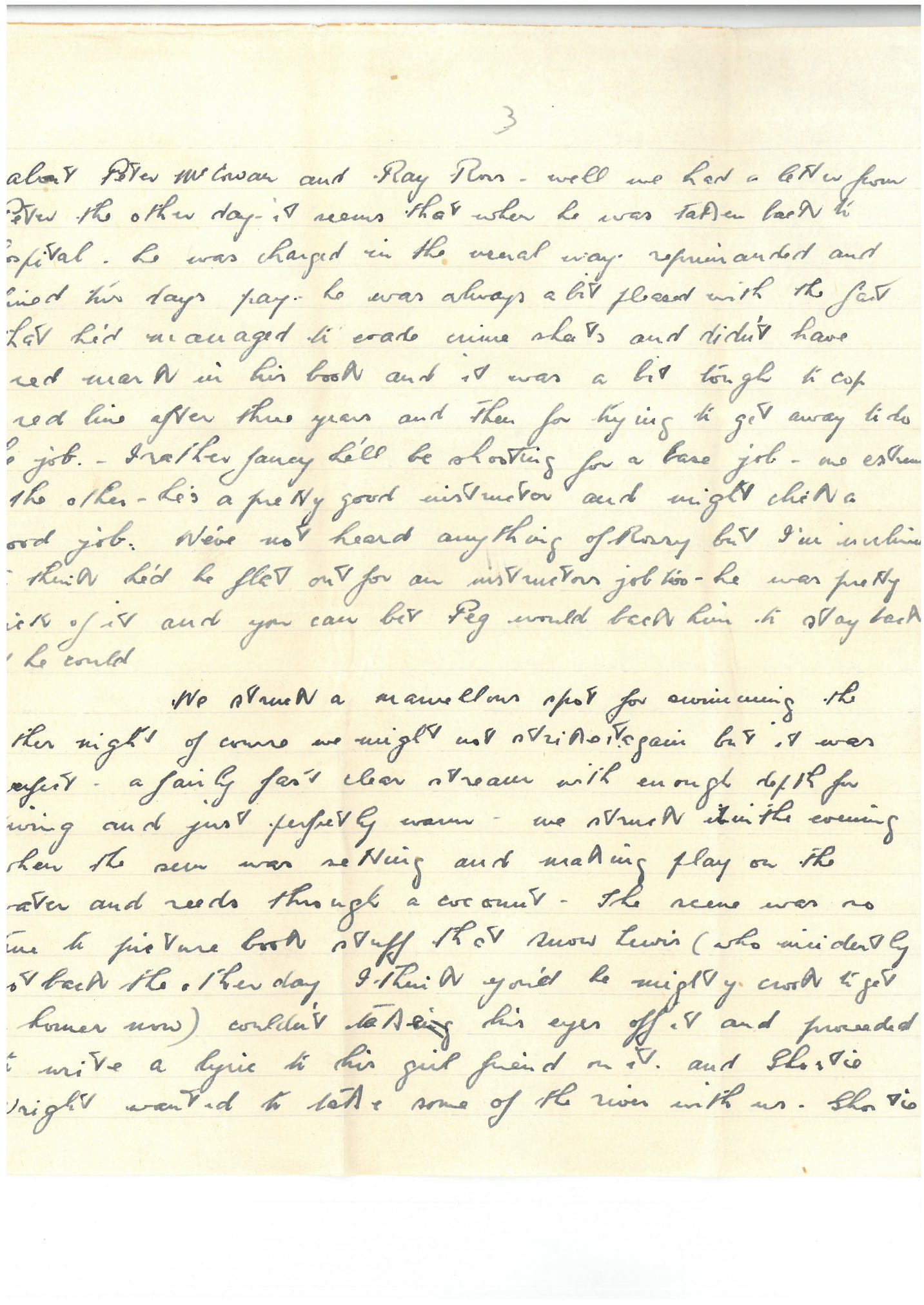
You remember what I told you a couple of letters back about Peter McCowan and Ray Ross.  Well we had a letter from Peter the other day.  It seems that when he was taken back to hospital he was charged in the usual way, reprimanded and fined two days’ pay.  He was always a bit pleased with the fact that he’d managed to evade crime sheets and didn’t have a red mark in his book and it was a bit tough to cop a red line after three years and then for trying to get away to do the job.  I rather fancy he’ll be shooting for a base job – one extreme to the other – he’s a pretty good instructor and might click a good job.  We’ve not heard anything of Rossy but I’m inclined to think he’d be flat out for an instructors job too – he was pretty sick of it and you can bet Peg would back him to stay back if he could.

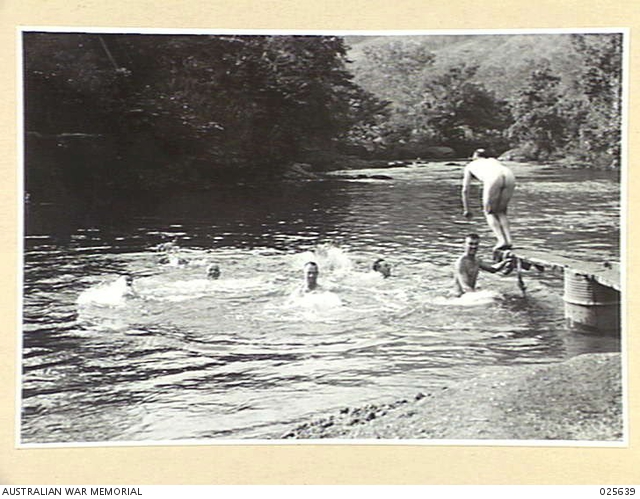
We struck a marvellous spot for swimming the other night.  Of course we might not strike it again but it was perfect – a fairly fast clear stream with enough depth for diving and just perfectly warm.  We struck it in the evening when the sun was setting and making play on the water and reeds through a coconut.  The scene was so true to picture book that Snow Lewis (who incidentally got back the other day – I think you’d be mighty crook to get a homer now) couldn’t take his eyes off it and proceeded to write a lyric to his girl friend on it, and Shortie Wright wanted to take some the river with us.  Shortie is already carrying enough junk his struggle to fill a good sized trailer.  There’s no doubt about them, there’s some rum ‘ens in this outfit.

Well I must say cheerio now – give my regards to Tom if you see him and the boys – I hope they’re well.

Your loving son

Max

PS Jim Mc sends his regards

Censor – Todd

Dick’s still with his old show…and kept pretty busy

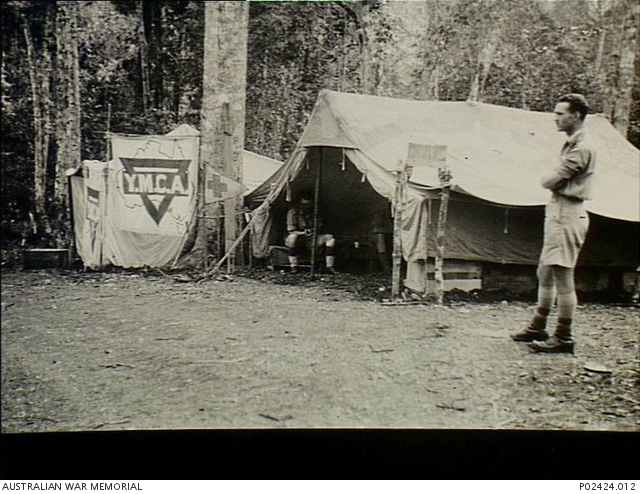
Dick’s old show was the RAP for the 2/31 Bn so at the time of this letter, he would have been ‘up on the track’…. This photo shows the RAP of an unidentified Battalion at Owers’ Corner – P02424.012AWM P02424.012 September 1942.  NX70195 Captain Alan Victor Day (right), a Medical Officer (MO), stands in front of the Regimental Aid Post (RAP) that he runs. Two soldiers (centre) who may be receiving first aid treatment are sitting inside the RAP tent. A rough sign mounted on two poles (centre, right) identifies the tent as the RAP, while its medical function is more generally indicated by a small Red Cross flag or pennant attached to a pole standing outside it in front of the large tree (centre, left). A rolled-up stretcher leans against the trunk of the tree behind the pennant. A large YMCA sign emblazoned on an outline map of Australia (left) distinguishes the tent used by the philanthropic organisation’s representative. Owers’ Corner marks the limit of the motor road from Port Moresby on the southern section of the Kokoda Trail.

Some of his mob are with us: Carriers from the 2/31 were also part of the Composite Carrier Group and later the 25th Brigade Carrier Group.

Pete McCowan : in two places at once!?

Pete McCowan was in hospital in Brisbane when Dad and the carrier platoon embarked September 6.  Somehow, between writing the letter mentioned here and that letter being received by Dad, McCowan seems to have travelled to Papua and joined the Battalion at Ioribaiwa: see this photo taken there on October 1.

026829

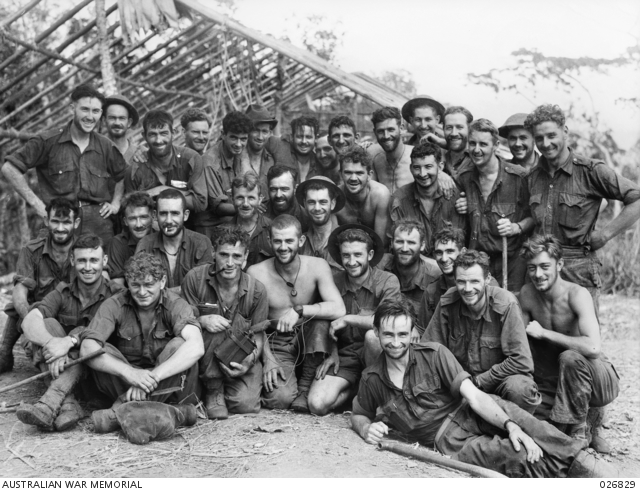
AWM026829 : Tired but happy Australian soldiers of the 2/33rd Battalion at Ioribaiwa Ridge.  October 1, 1942…(many others identified)….Peter McCowan (front)


Weddie is in England

Dad’s friend Rex Wedd (408200) had joined the Air Force and trained in Canada.  All his missions were subsequently flown out of England.

A marvellous swimming spot – with enough depth for diving

025639AWM 025639  Relaxing after a long route march, Australian troops enjoy the freshness of a New Guinea mountain stream.

Posted in Papua New Guinea, The course of the war | Tagged , , , , , , , | Leave a comment

Meeting fearsome mosquitoes and Yanks with Frigidaires

1 oct 42 pp1 2_0001

1 oct42 pp 3 4_0001

1 oct 42 p5_0001

1st October 42

Dear Mother & Dad

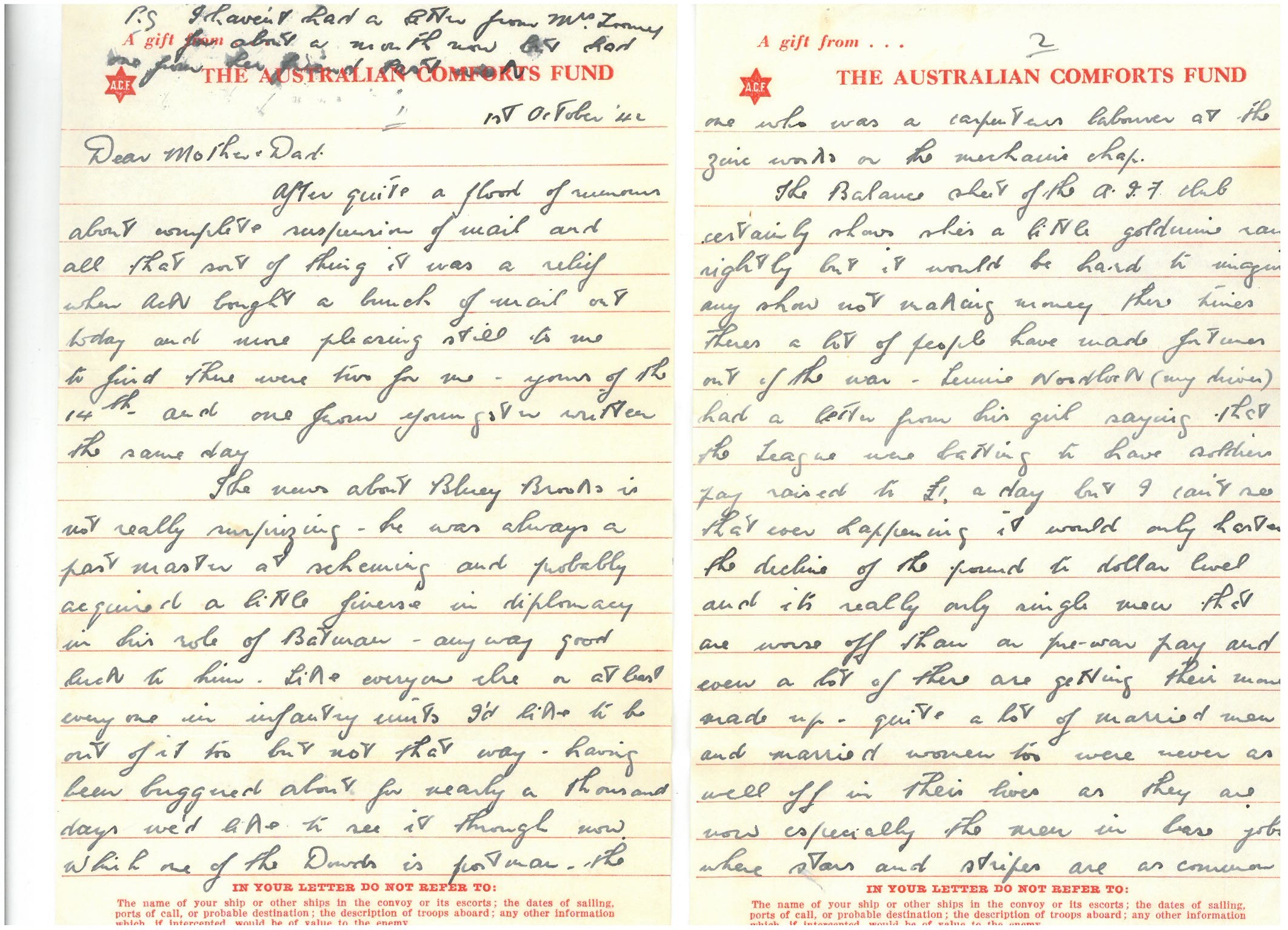
After quite a flood of rumours about complete suspension of mail and all that sort of thing it was a relief when Ack brought a bunch of mail out today and more pleasing still to me to find there were two for me – yours of the 14th and one from Youngster written the same day.

The news about Bluey Brooks is not really surprising.  He was always a past master at scheming and probably acquired a little finesse in diplomacy in his role of Batman – anyway good luck to him.  Like everyone else or at least everyone in infantry units I’d like to be out of it too but not that way – having been buggered about for nearly a thousand days we’d like to see it through now.  Which one of the Dowds is a postman – the one who was a carpenters labourer at the zinc works or the mechanic chap?

The balance sheet of the AIF Club certainly shows she’s a little goldmine run rightly but it would be hard to imagine any show not making money these times.  There’s a lot of people have made fortunes out of the war – Lennie Woodlock (my driver) had a letter from his girl saying that the League were batting to have soldiers’ pay raised to £1 a day but I can’t see that ever happening.  It would only hasten the decline of the pound to dollar level and it’s really only single men that are worse off than on pre-war pay and even a lot of these are getting their money made up – quite a lot of married men and married women too were never as well off in their lives as they are now especially the men in base jobs where stars and stripes are as common as dirt.

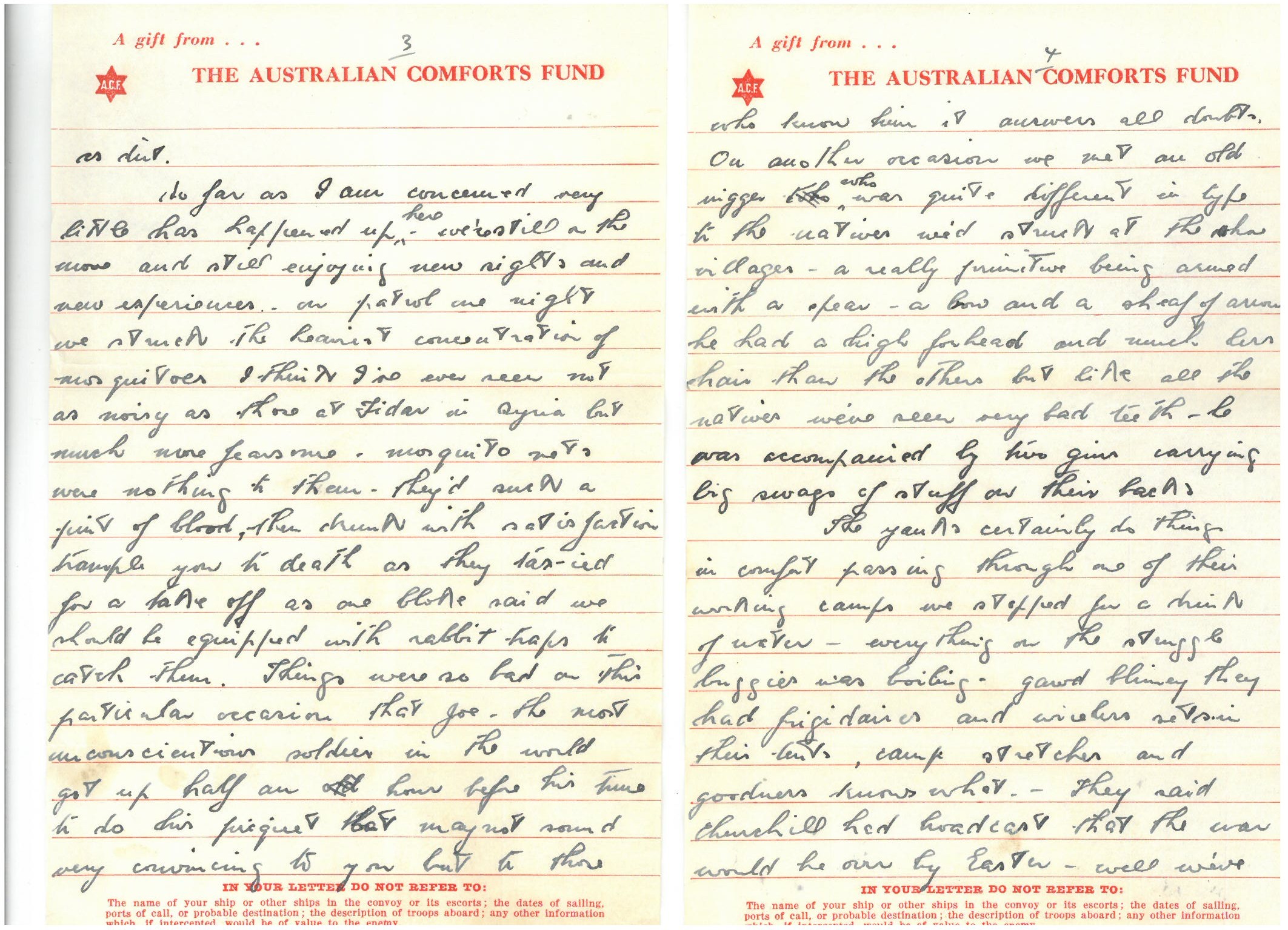
So far as I am concerned very little has happened up here.  We’re still on the move and still enjoying new sights and new experiences.   On patrol one night we struck the heaviest concentration of mosquitoes I think I’ve ever seen.  Not as noisy as those at Fidar in Syria but much more fearsome – mosquito nets were nothing to them – they’d suck a pint of blood, then drunk with satisfaction trample you to death as they taxied for a take off.  As one bloke said we should be equipped with rabbit traps to catch them.  Things were so bad on this particular occasion that Joe – the most unconscientious soldier in the world – got up half an hour before his time to do his piquet.  May not sound very convincing to you but to those who know him it answers all doubts.  On another occasion we met an old nigger who was quite different in type to the natives we’d struck at the shore villages – a really primitive being armed with a spear, a bow and a sheaf of arrows.  He had a high forehead and much less hair than the others but like all the natives we’ve seen very bad teeth.  He was accompanied by two gins carrying big swags of stuff on their backs.

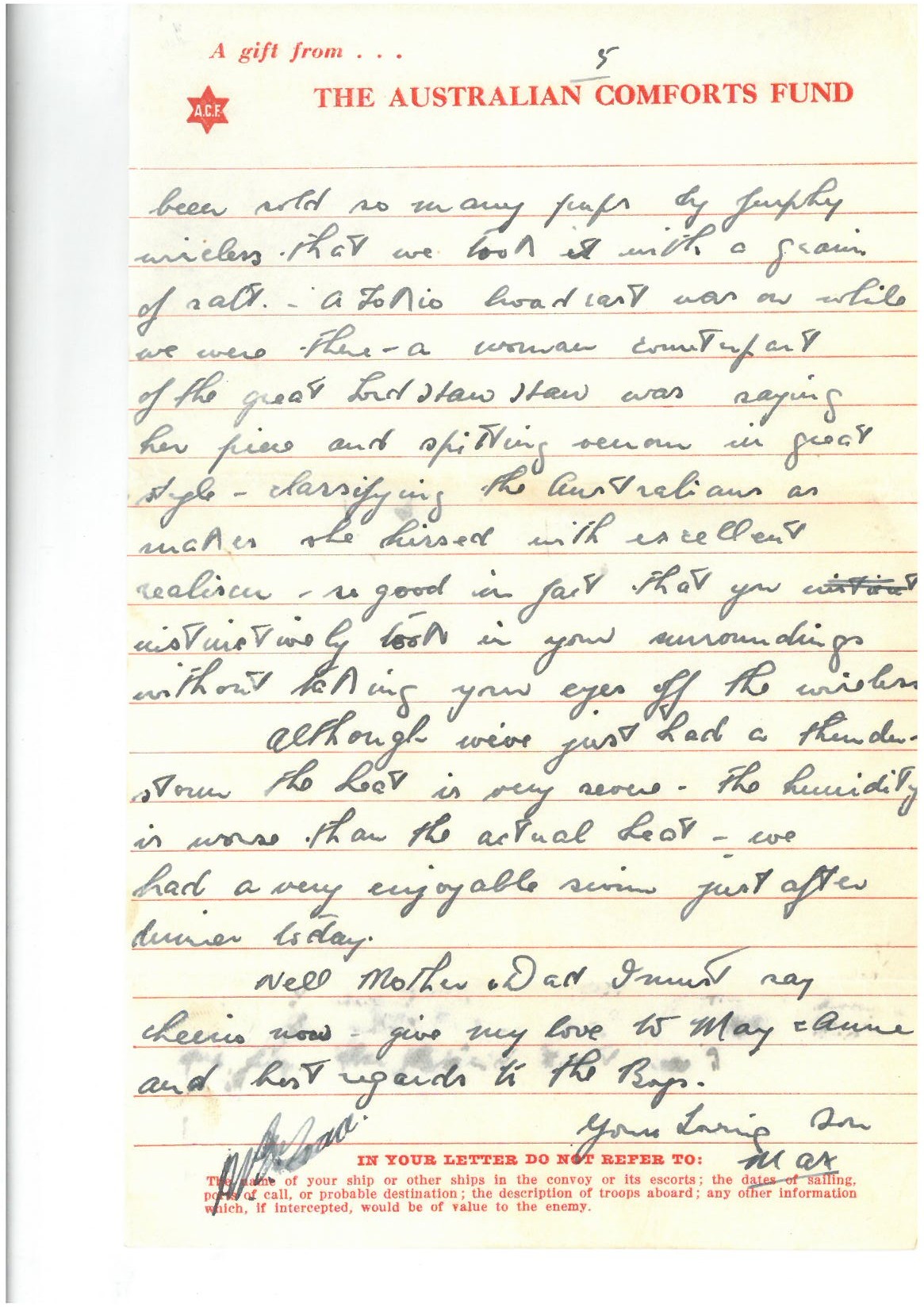
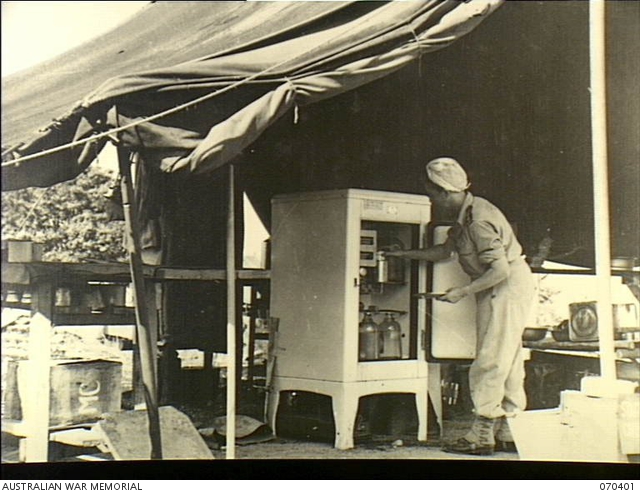
The Yanks certainly do things in comfort.  Passing through one of their working camps we stopped for a drink of water – everything on the struggle buggies was boiling – gawd blimey they had frigidaires and wireless sets in their tents, camp stretchers and goodness knows what.  They said Churchill had broadcast that the war would be over by Easter – well we’ve been sold so many pups by furphy wireless that we took it with a grain of salt.  A Tokyo broadcast was on while we were there – a woman counterpart of the great Lord Haw Haw was saying her piece and spitting venom in great style – classifying the Australians as snakes she hissed with excellent realism – so good in fact that you instinctively took in your surroundings without taking your eyes off the wireless.

Although we’ve just had a thunderstorm the heat is very severe.  The humidity is worse than the actual heat – we had a very enjoyable swim just after dinner today.

Well Mother & Dad I must say cheerio now.  Give my love to May & Anne and best regards to the Boys.

Your loving son

Max

PS I haven’t had a letter from Mrs Toomey for about a month now but had one from her friend last week.

Censor – M Todd 

It seems that Dad’s section had at last caught up with the others of the Battalion who had been ‘Left out of Battle’ under Lieutenant Todd when the bulk of the unit moved up to the Owen Stanleys on September 10.  (see blog entry of Sept 19)

Monster Mosquitoes

Dad didn’t ever contract malaria, so presumably these were not ‘malaria mosquitoes’.  It is clear however from this letter and others that orders regarding covering arms and legs between dusk and dawn were not necessarily followed.

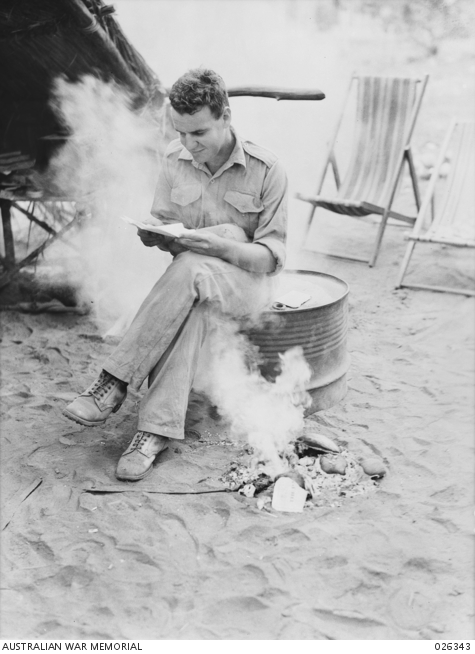
026343 AWM 026343   One way to combat the mosquito menace in New Guinea: This Australian soldier reads mail from home over a fire of dried coconut shells which gives off a very pungent smoke.  (The caption does not identify the soldier or his unit)

Despite the experience with malaria in Palestine, the potential impact of this disease in New Guinea was initially underestimated.  An irregular supply of quinine contributed to high infection rates among Australian troops. In Jungle Warriors, Adrian Threlfall speaks of the ‘disastrous delay in  issuing quinine tablets to the militia units – 30th Brigade at Port Moresby and 7th Brigade at Milne Bay’. 

By November 1942, an epidemic of malaria had broken out, with rates of incidence increasing from 33 men per 1000 per week to 82 men per 100 per week by December of that year.  A recognition of the importance of reducing the rate of malarial infection led to the establishment in June 1943 of the Land Headquarters Medical research Unit in Cairns.  (ref https://www.mja.com.au/journal/2011/194/8/war-malaria-and-nora-heysen-s-documentation-australian-medical-research-through)

c-00466One of a number of US army posters re malaria prevention : others can be found at http://flashbak.com/japs-japes-and-dr-seus-us-anti-malaria-warning-posters-from-world-war-2-36536/


Yanks – doing it in comfort

070401Image…not a US army tent – but an example of a kerosene refrigerator.   AWM 070401: Sister L Rae (AANS) 2/3rd Casualty Clearing Station, examining the contents of a kerosene refrigerator….


The Yanks in question were presumably officers.  This extract is from a personal account by Major Bernhardt L Morternson of the US Fifth Bomber Command, in particular in PNG – see  http://www.ozatwar.com/ozatwar/morternson.htm  The officer’s area was being given first consideration on much of the detail program. Many of the tents were pitched high on the bluffs near the office quarters. Paths were constructed to these lofty points. It was a tremendous physical effort to help carry the large-size electric refrigerators up the steep bluffs in order that some of the “wheels” may enjoy a cool, refreshing drink of water or a suitable wash for a highball while the rest of the proletariat struggled on in thru chain-gang fashion earning the full and appropriate right to chant the lusty strains of  the “Volga Boatman” had they enough strength to do so.

The first mention of refrigerators in an Australian Army facility in New Guinea that I can find, is in Colonel Joan Crouch’s account of the 2/9 Australian General Hospital at ’17 Mile’. http://userweb.eftel.com/~cantwell/files/9thAustGenHospDFJ.pdf  From August 1942 – January 1943 this was the only General Hospital in the territory dealing with huge numbers of both medical and surgical cases.  It was a great relief when, in January 1943, the 2/5th AGH arrived to set up a hospital at Bootless Inlet near Port Moresby…..A general all round improvement occurred ….Grass roofs and floor boards were installed in the acute wards, and the dysentery ward was flyscreened.  Best of all, kerosene refrigerators were installed in every ward…..

Japanese propaganda

T4EDMycAs well as broadcasts claiming sweeping victories, the Japanese produced propaganda leaflets such as this one, which were dropped in areas where Australian troops were fighting or based.  Other examples can be found at –

http://www.psywarrior.com/JapanPSYOPWW2b.html

Posted in Papua New Guinea, pay and conditions, The course of the war | Tagged , , , | 1 Comment

Moresby not a bad little place but the jungle an incarnation of hell


25 sept 42 pp1 2_0001


25 sept 42 pp 3 4_0001

25 sept 42 p5_0001

TX 1004

Max Hickman

33rd platoon

Composite Carrier Group

NGF

New Guinea

25/9/42

Dear Mother & Dad

Just a few lines to let you know I’m still happy in the service and quite fit and well and hoping this letter finds you both in the pink and May & Anne too.

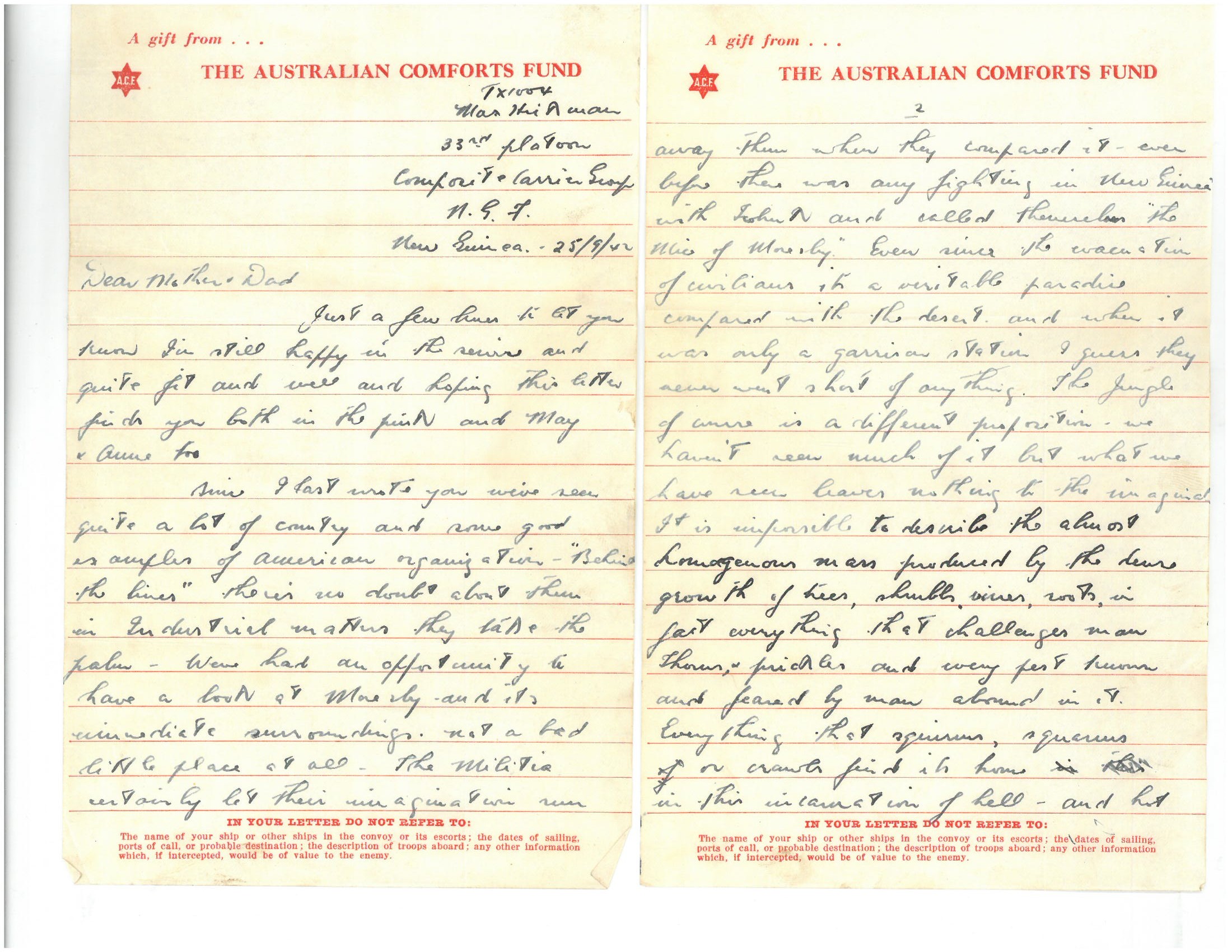
Since I last wrote you we’ve seen quite a lot of country and some good examples of American organisation – ‘behind the lines’.  There’s no doubt about them in industrial matters they take the palm.  We’ve had an opportunity to have a look at Moresby and its immediate surroundings – not a bad little place at all.  The Militia certainly let their imagination run away with them when they compared it – even before there was any fighting in New Guinea – with Tobruk and called themselves ‘The Mice of Moresby’. Even since the evacuation of civilians it’s a veritable paradise compared with the desert and when it was only a garrison station I guess they never went short of anything.

The jungle of course is a different proposition – we haven’t seen much of it but what we have seen leaves nothing to the imagination.  It is impossible to describe the almost homogeneous mass produced by the dense growth of trees, shrubs, vines, roots, in fact everything that challenges man.  Thorns and prickles and every pest known and feared by man abound in it.  Everything that squirms, swarms or crawls finds its home in this incarnation of hell – and hot – well it’s like a Turkish bath – you can’t see the sun but just sweat.  The New Guinea Police Boys  – ‘Weddies mob’ – are doing a marvellous job getting the wounded out.  How the hell they get through defies imagination.  This crowd I’m with haven’t contacted the enemy at all yet but I have no doubt we will.  The war being fought up here makes 1914 – 18 look like the days of chivalry.

I think Snow Lewis will get home soon – he hasn’t been wounded or anything but got a bad attack of flu or something of the sort and has gone to hospital and once they get him in a hospital I fancy they’ll send him home.  His ticker is pretty bad.  He did all sorts of things to trick the powers that be in the early days but he’ll be a damn fool if he tries to buck this time.

We camped a while on a beach under a coconut grove – a delightful spot that must once have been a native village.  Remnants of their thatch and basket ware houses are still there and a missionary church – incidentally one of the chaps found an old registry of marriages.

We’ve been quite close at times to native villages – all built like the one where we camped – in coconut groves.  The New Guinea blacks are the best type of coloured race I’ve seen.  The men are nearly all slight of build with wonderful heads of black unruly hair.  They carry a wooden teaser – a three pronged fork like arrangement for stirring the fleas up.  The women are more heavily built and wear grass skirts.  Little kids that can scarcely walk climb coconut palms and swim like fish.

The life up here suits Jim McDonnell perfectly.  He wears his hat pork pie style and affects all the mannerisms of a beachcomber.  He’s grown a long moustache and is as brown as a berry.  He’s asked to be remembered to you.  Old Ack has grown a moe too and looks like the Terrible Ming in Speed Gordon caricatures.

Well I must say cheerio now Mother & Dad.  My love to May & Anne and regards to the boys.

Your loving son

Max

PS How much do they want for Catoes place

Censor unknown  (signature indecipherable)


The Militia

Much has been written in recent years about the lack of training and equipment provided to the Militia forces sent to New Guinea.  At the time this letter was written, Dad was probably typical of many in the AIF who looked down on the Militia as men who didn’t have the courage to volunteer to fight overseas, but as we now know this was a very long way from the truth.

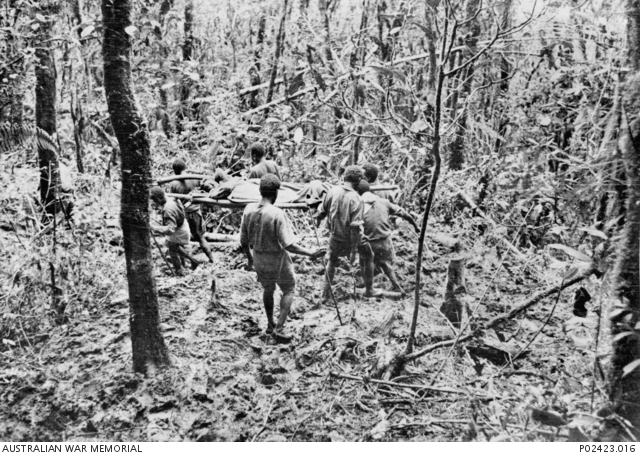
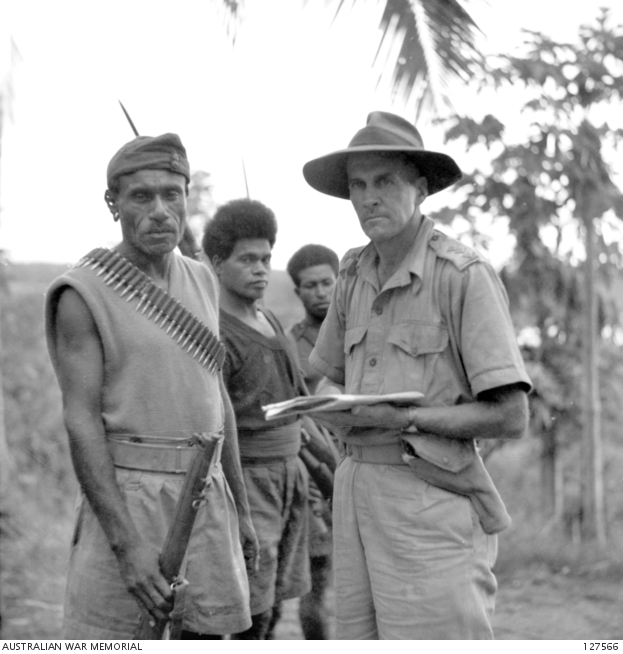
The New Guinea Police Boys – how they get through defies imagination

P02423.016The indigenous people who acted as carriers, guides and stretcher bearers were later to become known as the Fuzzy Wuzzy Angels.  See for example this image from the Australian War Memorial  P02423.016

This is a great article about a ‘former police boy’ who was waging a very successful one man war against the Japanese: http://trove.nla.gov.au/ndp/del/article/11999437  This photo depicts a man of the same name: 127566AWM 127566


Port Moresby: Not a bad little place

025876Image –    AWM 025876

From the website – indicatorloops.com/portmoresby.htm  – The following is an extract from  a Japanese intelligence report made by Major Tetsuo Toyofuku on the basis of personal observation in March 1941. The study known as “Military Data on British New Guinea” was reproduced by (Japanese) General Headquarters, Southern Army, in 1942 for use in the New Guinea operations. The assessment of Port Moresby’s harbour was very accurate:

  1. General Condition of Harbor and City: Port Moresby has a good, wide harbor, and the bay is entered by passing between Hanudamava Island (at the mouth of the harbor) and Bogirohodobi Point, approximately 1.5 miles (2400m) to the east. At the beginning of 1940 there were approximately 800 Europeans, approximately 20 Chinese, and no Japanese residents. The natives (approximately 2000) have built their village over the water and live apart from the white residents. The city is situated between Tuaguba Hill and Ela Hill on the eastern shore of the harbor, and is the center of the government, military affairs, economics, transportation, communications, etc. of Australian-controlled New Guinea. There are various offices, including government offices and branch offices, a radio station, a government-managed electric power plant, church, school, European and native hospitals, an ice plant, bank, hotels, etc.


We’ve been quite close at times to native villages

As he gives the impression of travelling around, it seems Dad may well have been accompanying Major General Morris.  (see photo in post of Sept 19)

069228The first image shows indigenous children and their homes (AWM 069228),   and the second, the 7th Brigade command post built in ‘traditional native style’ surrounded by coconut palms (AWM 148994)


148944


Snow Lewis…has gone to hospital.

107160

AWM 107160     Interior of a tent ward at the 2/9th Australian General Hospital. Nurses stop for a tea break. Note the earth floor.

This was the only General Hospital in the territory at the time so is probably where Snow Lewis was sent  for treatment.


The Terrible Ming

The character was actually known as Ming the Merciless…image from Flash Gordon Conquers the Universe (ref Wikipedia) film made in 1940.

Ming as portrayed by Charles Middleton in Flash Gordon Conquers the Universe


Posted in Carrier platoon, Geography and Culture, Papua New Guinea | Tagged , , , , , , | 1 Comment

Don’t take too much notice of what you read in the papers

19 sept 42 p1_0001

19 sept 42 p2_0001


19 sept 42 p3_0001

19th September 42

Dear Mother & Dad

After nearly a month without news it was good to get the mail today.  Your letters of the 31st and seventh and two from Youngster written on the 1st and 8th of the month and surprisingly enough one from Mrs Laird written on the eleventh of April.  They were all very cheerful epistles and particularly welcome just now. The time Mrs Laird’s letter took probably accounts for the fact that you haven’t heard from the Bank although I suppose they would write air mail.

By jove that property was certainly cheap wasn’t it.  From twenty five I never dreamt it would go that cheaply or I’d have had a go for it when I was home.  Catoes is certainly a good property but it would be out of my reach.  Still there may be other land about.

I wrote you last week when we were anchored off a northern port but as I haven’t much confidence in the mail arrangements under such circumstances have no idea whether it would make the grade and as there’s a very consistent rumour that the airmail service has been suspended it will probably be some time before this one makes the grade.

When we got within sight of this dump we were quite surprised at the number of aircraft in the air.  It was quite a bright spot.  They lost no time getting us ashore and into a makeshift camp where we had a meal of bully & biscuits and curled up for the night.  Just to remind us that there’s a war on, the Japs put on a small scale raid early in the evening and all night the drone of our planes filled the air but didn’t disturb our sleep unduly.

Whilst awaiting orders yesterday some of the chaps did a bit of reccy and acquired a case of beer which worked out nearly two bottles per man for the mob.  Beer is a much sought after commodity in these parts, in fact to all intents and purposes this country is a temperance stronghold.  But canteen prices for dry stuff are very reasonable.  Of course once we get away from the canteen everything will be as scarce as gold but tobacco is 1/2 a two ounce tin and cigarette papers a penny a packet.  Most of our bunch (the crowd who were left behind) made provision against being caught as they have always been caught before and went to amazing extremes to procure tobacco at 2/6 a tin.  Still even at that it was good insurance to a smoker.

Four of us – Ned Turner, Snow Lewis, Harry Cassells and myself – located a shower which turned out to belong to an airforce crowd.  They’re not airmen but something to do with the business – a good crowd of blokes – they invited us to dinner and we lairized with plates etc and tables.  Quite a good meal too compared with army standards.  We got the only news we’d had for a fortnight from what they call the ‘good guts sheet’, a printed page of foolscap distributed by the airforce.

Mrs Laird said they’d had a terrible winter and even in April it was still very severe.  It’s certainly not wintery at all up here.  In fact it’s powerful hot.  Not the dry heat of the desert but a humid heat and of course it’ll get worse yet.  Incidentally in other matters don’t take too much notice of what you read in the papers.

Well I’m afraid there isn’t any more news that I can write you just now.  There’s a flood of rumours and I think some of them are pretty solid.  We expect to join the unit tomorrow so letters may be very irregular.  I’ll say cheerio now.  Give my love to May & Anne and regards to Laurie and the boys.

Your loving son

Max

PS If you happen to be down that way Dad will you get Rex Wedd’s address for me, and while I think of it do you happen to know whether Max Phillips has left home yet?

New address:

33rd Platoon

Composite Carrier group

New Guinea Forces

New Guinea


Anchored off a northern port

This comment seems to confirm my suspicion that the convoy stopped at Townsville, en route to Port Moresby.   On the day he wrote that letter – September 10 – the rest of the Battalion was starting to move onto what has become known as the Kokoda Track (or trail).    From The Footsoldiers:   Initially 25th Brigade had been alerted to land, opposed or unopposed, at Milne Bay and assist in destroying the Japanese. By the time we were at sea Milne Bay force had gradually gained control of the situation.  The Kokoda trail, on the other hand, was being lost to us, and the Japanese were in fact well down to the south-west slopes of the mountains and presenting a grave danger to Moresby.  As a result our 25th Brigade was diverted to either attack or stem this Japanese onrush – as it turned out, none too soon.  (p147)

Convoys to New Guinea

Laurie Ward (NX 113404) was with the 32 A/A Bty for about 15 months before joining the 2/33 in the Lae campaign.  He sailed from Townsville to Port Moresby in early September on the Katoomba – so may well have been in the same convoy as Dad.  Some of his wartime recollections are shared on http://indicatorloops.com/pm_ackack.htm  and include the following:

I have no idea how many men were on the ship, but it was very crowded.  They had quite a few decks and we were right down on a lower deck and you just slept on the bare floor or on the hammocks.  You were allocated a place to sleep and swinging above you was a hammock to accommodate double the quantity of men.  As we went down the stairs to that deck it had a sign above our heads at the bottom of the stairs ‘Cattle Deck’.

We were on  the ship for three days in a convoy of 7 ships.  The journey doesn’t normally take that long but in convoys during wartime their speed is governed by the slowest ship in the convoy and we had one that could only do 4 knots.  We were guarded by a warship called a corvette and overhead from daylight to dark, a Catalina aircraft flew over, for spotting enemy submarines.  During the voyage there was a submarine scare.  The Catalina circled the warship and waggled its wings.  The Corvette turned around very sharply and raced slightly to the rear and both the Catalina and the warship fired many depth charges.  The result of this we will never know.  We were never told any results of this action.


No time lost, getting us ashore

026703-1Image – AWM 026703 – Troops of the 25th Australian Infantry Brigade disembarking at the wharf from naval corvettes, having been ferried by those from troopships anchored in the harbour.


On arrival in Port Moresby things were very grim and serious because of enemy aircraft and the Katoomba pulled into the small jetty but before our arrival there we had been drilled on how quickly to evacuate the ship.  Before entering the harbour all troops were lined up with their full equipment on and we all doubled very smartly, which was a run, off the ship, down the gangplank, clear of the wharves, mounted what few trucks there were and we were very quickly removed from he harbour area because of the danger of Japanese aircraft coming over.  (reported by Laurie Ward – see http://indicatorloops.com/pm_ackack.htm)


Surprised at the number of planes in the air

From The Footsoldiers – Since February, Port Moresby had been bombed by up to eighty Jap bombers, and nearly every other day and on many nights, raids had taken place.  Vessels were sunk in the harbour and some days before our arrival seven of the only ten Douglas transport planes had been destroyed on the strip at Ward’s Field at the Seven Mile.  Two squadrons – the RAAF’s 75 squadron and an American Kittyhawk squadron – were all that constituted the air defences of Moresby (p 147)

The destruction at the Seven Mile airstrip was a disaster for the men of the 2/14th Battalion who had set off along the track in mid August and first engaged the Japanese at Isurava on August 26.  They were relying on supplies being dropped at Myola – but the bombing of the transport planes at Seven Mile meant none arrived.

026271Image AWM 026271.  Papua 18 August 1942  View of Seven Mile aerodrome near Port Moresby after a raid by 24 Japanese bombers.  The casualties were one killed and thirteen injured.  Four planes were destroyed and several damaged.  In the picture are several transport planes which should have been dispersed.

P05876.001


Image AWM    P05876.001

Bomb damage at Seven Mile Aerodrome near Port Moresby following a Japanese air raid.


Left out of Battle

The following extract from The Footsoldiers suggests that on arrival in Port Moresby, Dad’s section may have joined the others of the Battalion who had been Left out of  Battle (LOB):  Following 25th Brigade orders, the CO ordered that one warrant officer (the CSM, HQ Company) and twenty nine men were to be left out of battle, plus all the Carrier Platoon (less one Vickers gun) and all the Mortar Platoon (less one detachment) – a total of fifty six men under Lieutenant Matt Todd, all to be used for Port Moresby defence.  (p145)

However, dad’s letters were not censored by Lieutenant Todd until October, so it is possible his section was otherwise engaged until then …perhaps they were accompanying Major General Morris on his tour of areas under his control –

069227Image   AWM 069227

Native children taking a keen interest in a Bren gun carrier, manned by Australian troops who were present as a cover patrol during the visit of Major General B M Morris, DSO….


The ‘good guts sheet’

Most likely the Moresby Army News Sheet (MANS) -which evolved into a 4 page news sheet called Guinea Gold : see http://www.ozatwar.com/raaf/whisperer/september2003.pdf


Don’t take too much notice of what you read in the papers

His parents were probably reading reports such as these :

‘The most serious threat to Australia since Japan entered the war’  – Hobart Mercury Sept 11, 1942 http://trove.nla.gov.au/ndp/del/article/25931981

‘World’s Worst Battleground’  – Hobart Mercury Sept 18, 1942   http://trove.nla.gov.au/ndp/del/article/25893574    ….Australians are fighting in these appalling conditions because if they do not fight in front of Port Moresby there will be no positions to fight the battle for Australia outside of Australia itself.  The battle for New Guinea is on, and everybody knows it……


Posted in Carrier platoon, escapades, relaxation, fun and games, Food and Drink | Tagged | Leave a comment