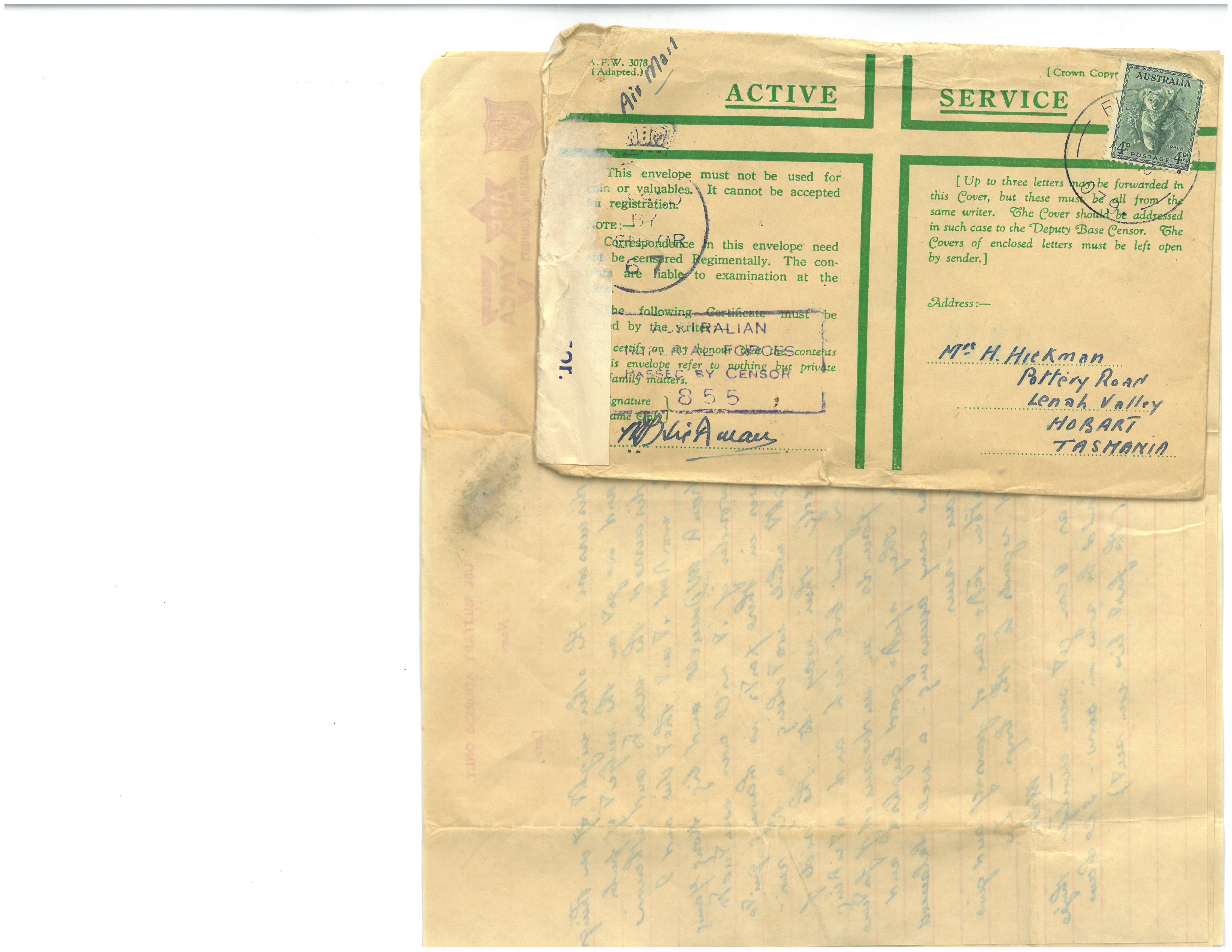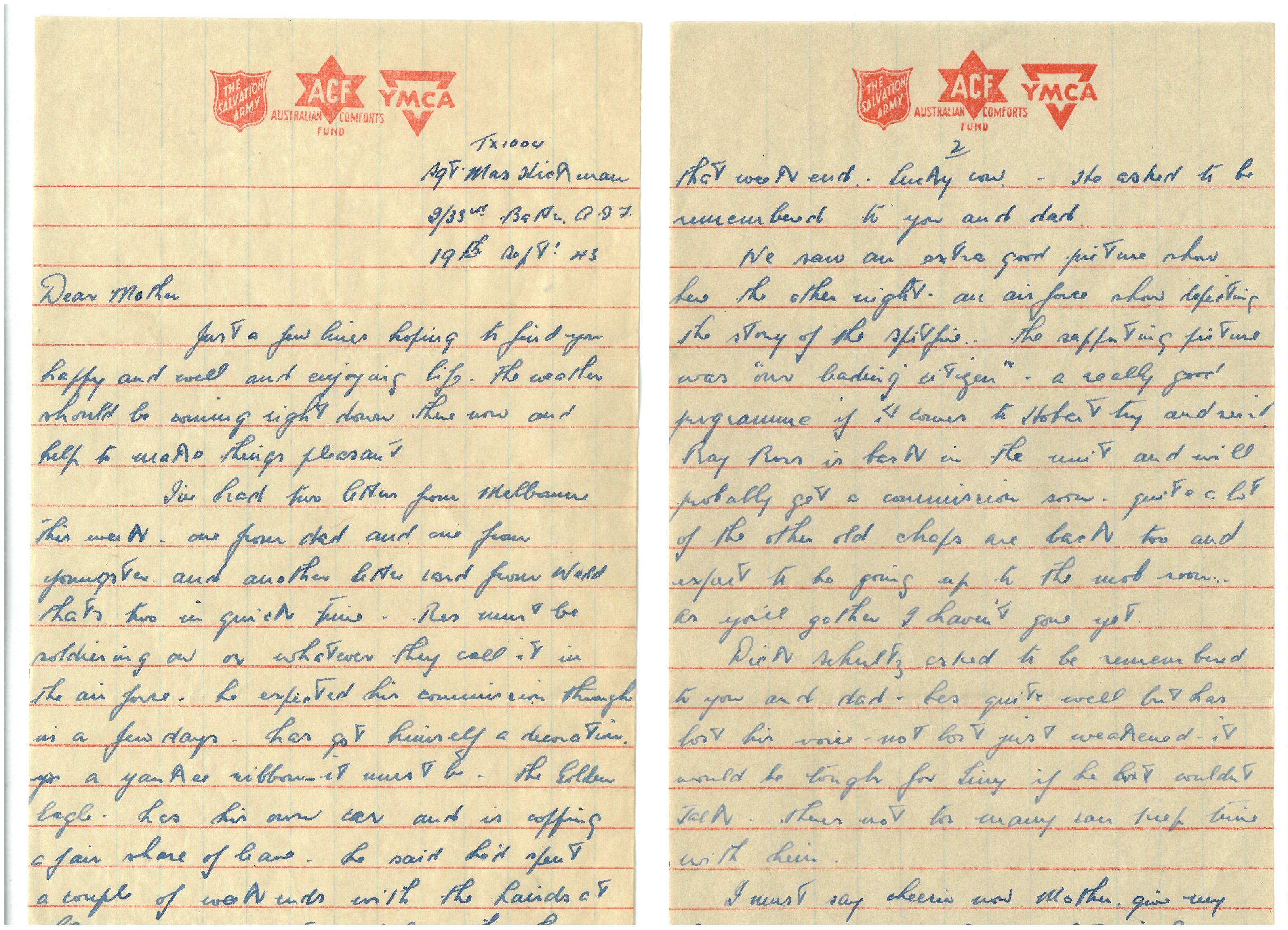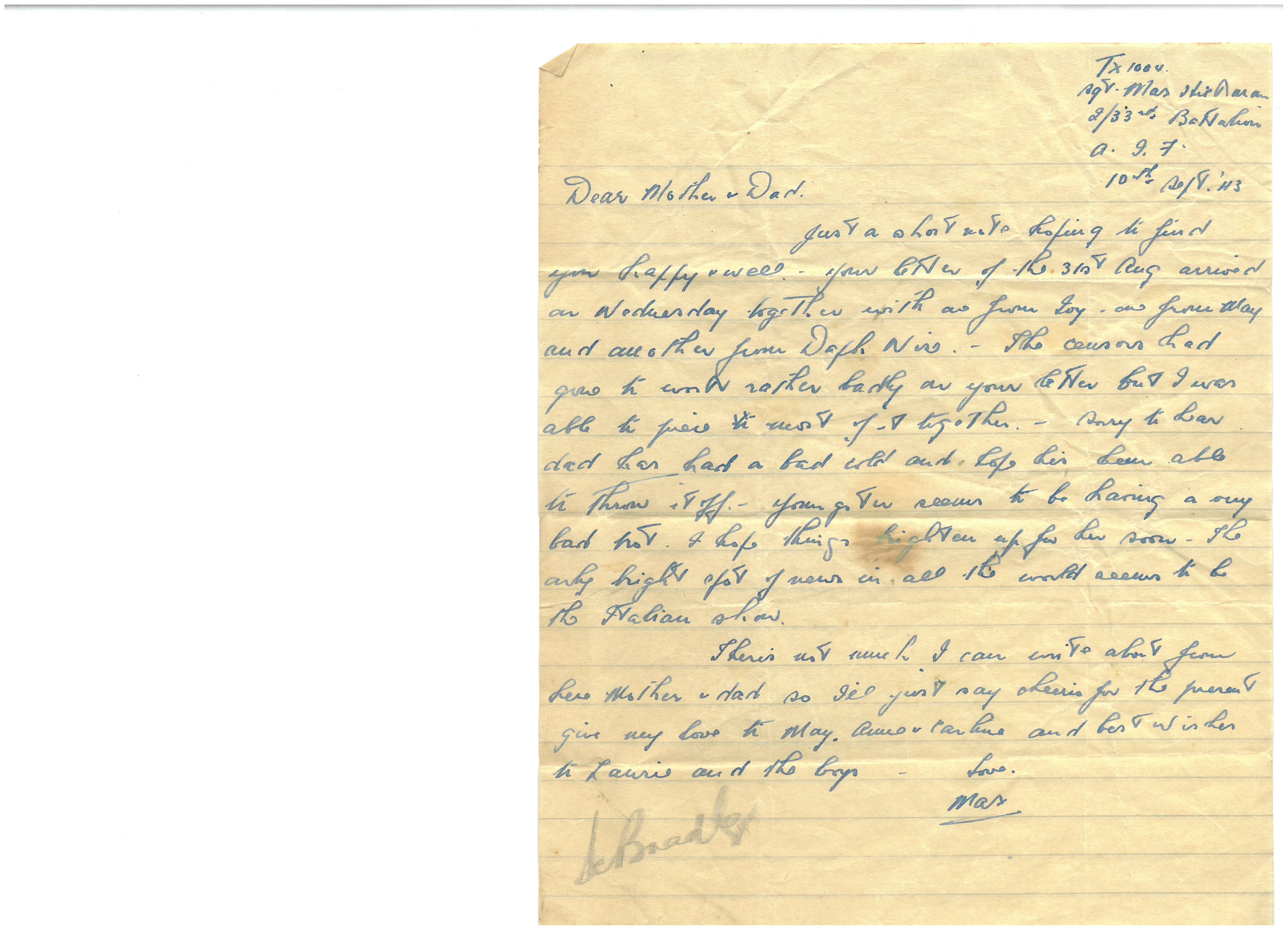
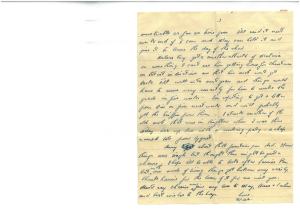
The lads say “It’s a pity old Hick’s not here”… a letter from Jim the Joker


TX 1024

First Class Pte McDonnell J Div Mech Group

2/33 Battn.

2/12/43

Dear “Hick”

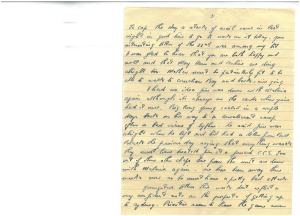
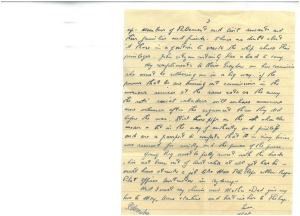
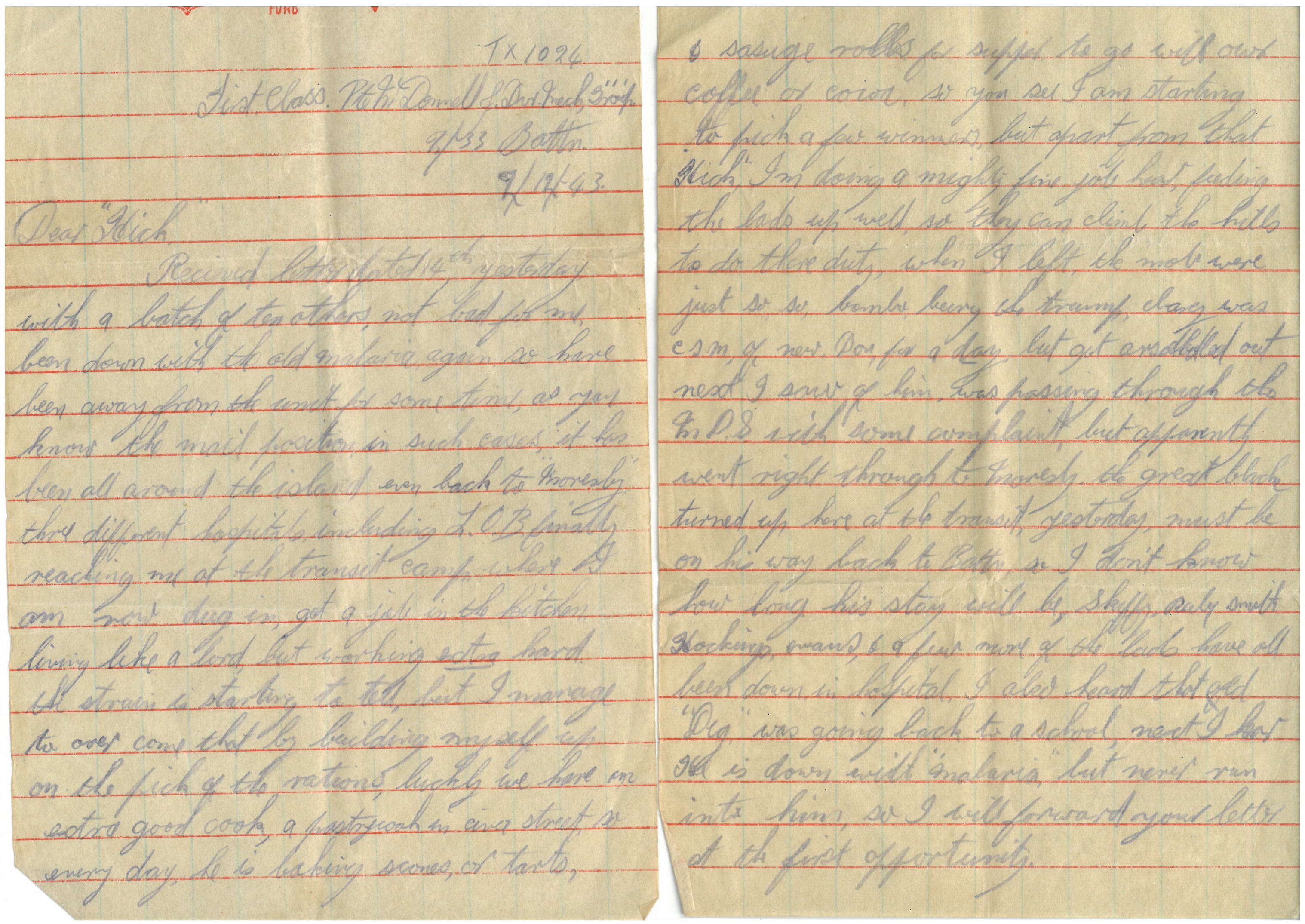
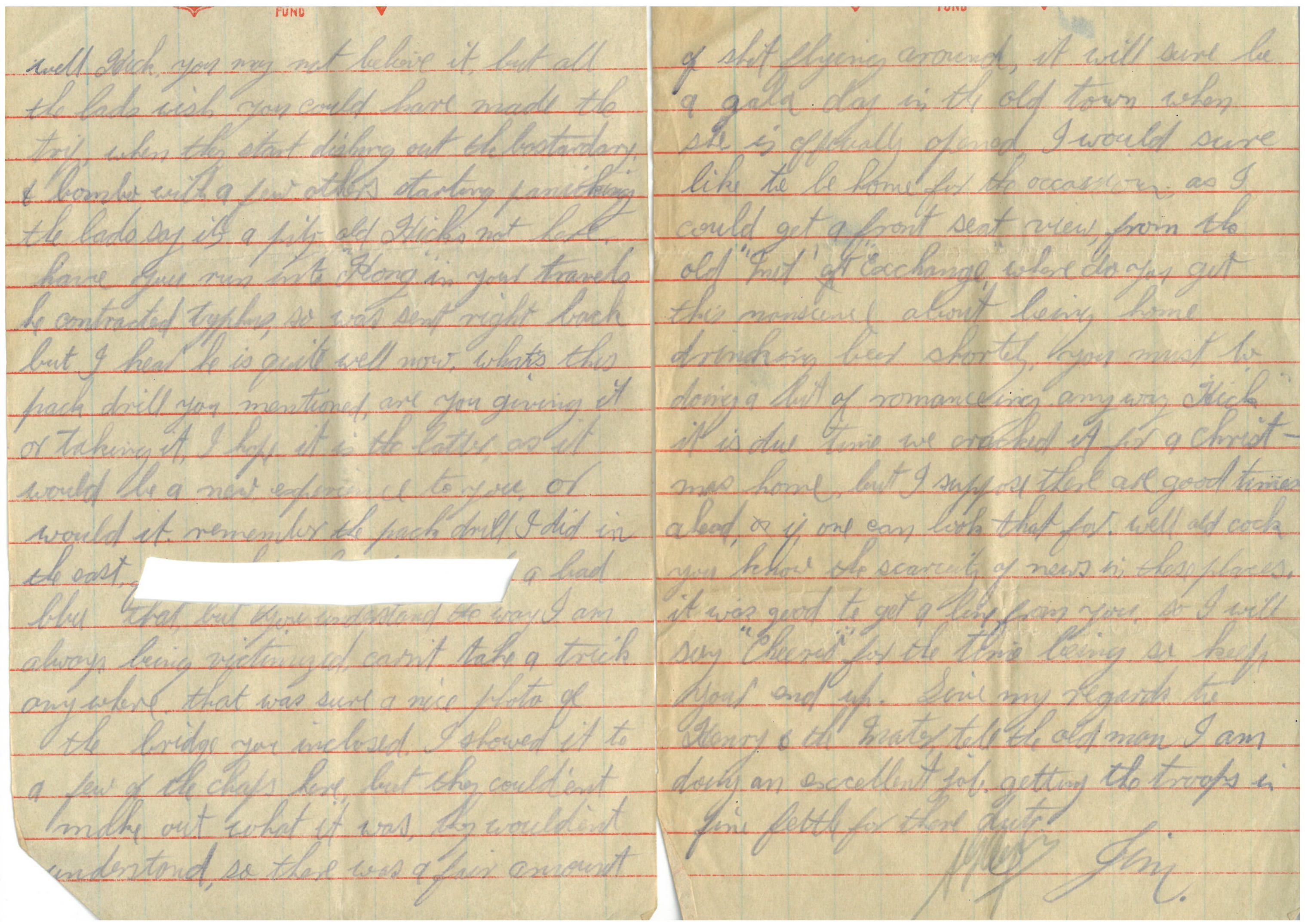
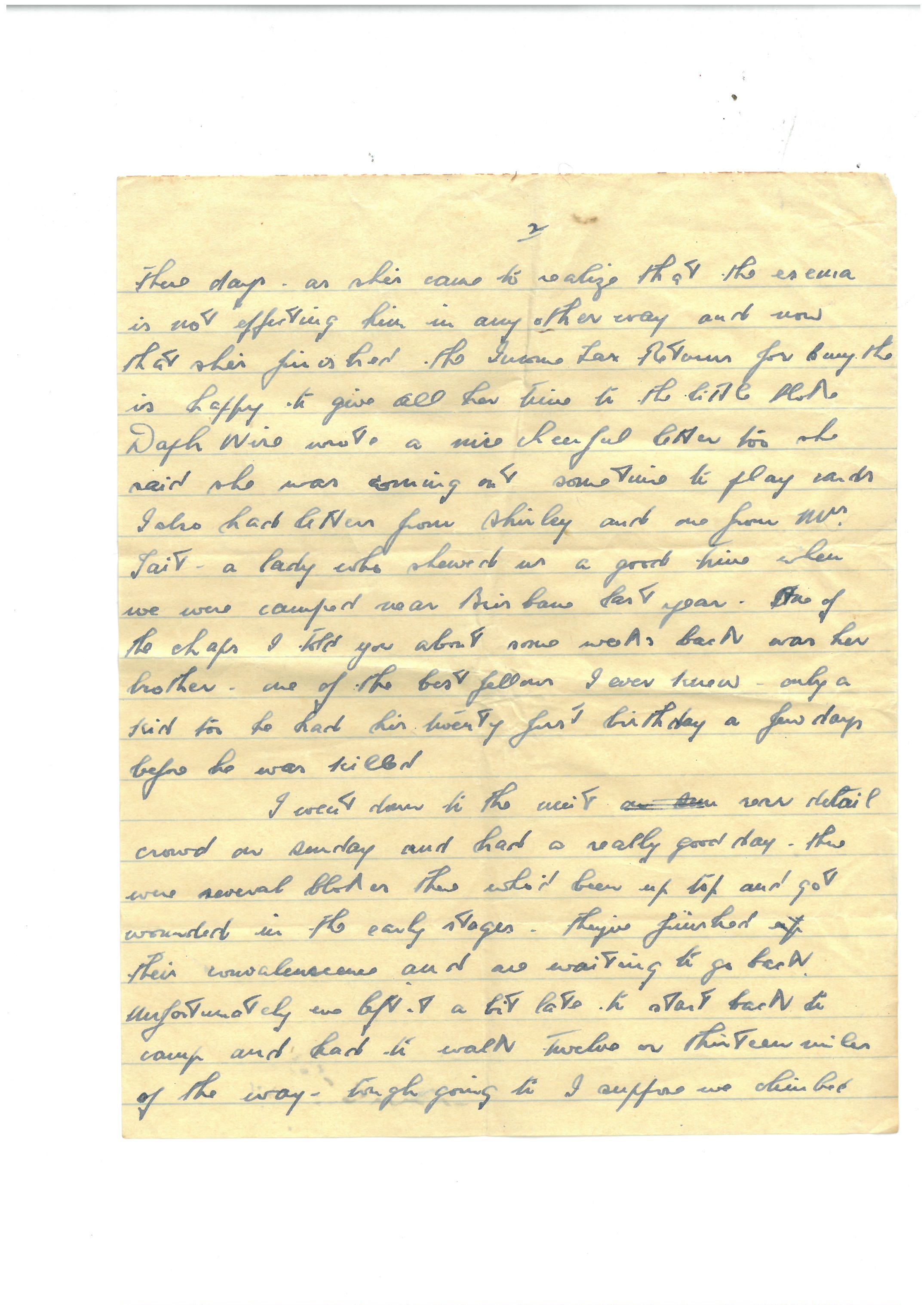
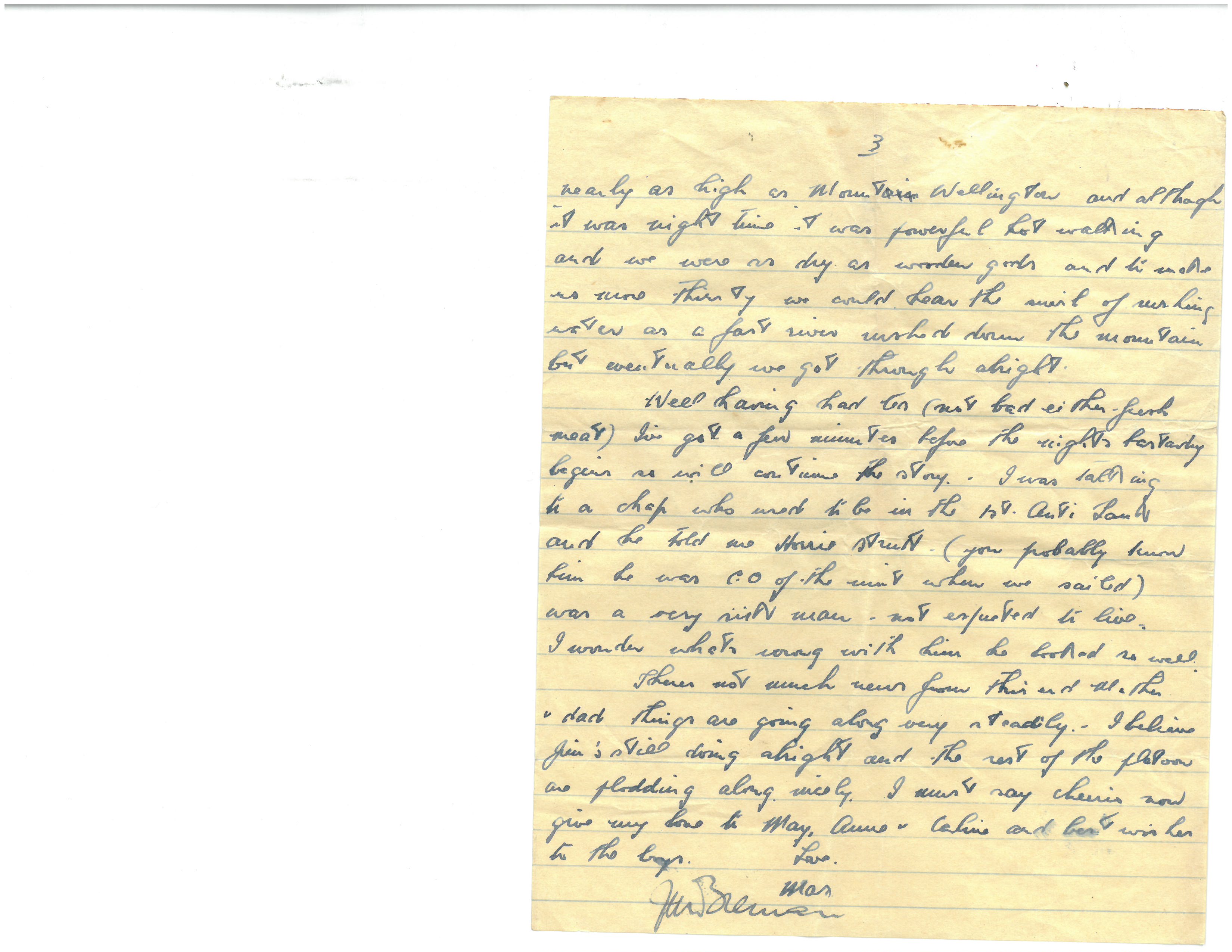
Received letter dated 14th yesterday with a batch of ten others, not bad for me.  Been down with the old malaria again so have been away from the unit for some time.  As you know the mail position in such cases, it has been all around the island even back to Pt Moresby – three different hospitals, including LOB, finally reaching me at the transit camp where I am now dug in.  Got a job in the kitchen, living like a lord, but working extra hard.  The strain is starting to tell, but I manage to overcome that by building myself up on the pick of the rations.  Luckily we have an extra good cook, a pastry cook in civvy street, so every day he is baking scones or tarts, & sausage rolls for supper to go with our coffee or cocoa.  So you see I am starting to pick a few winners, but apart from that Hick, I’m doing a mighty fine job here, feeding the lads up well, so they can climb the hills to do their duty.  When I left, the mob were just so so, bombs, Bury (?) the Trump, Clarey was CSM of new Don for a day, but got ars….. out.  Next I saw of him was passing through the MDS with some complaint, but apparently went right through to Moresby.  The great Black turned up here at the transit yesterday, must be on his way back to Battn. so I don’t know how long his stay will be.  Skiffy, Ruby Smith, Hocking, Evans & a few more of the lads have all been down in hospital.  I also heard that old ‘Dig’ was going  back to a school, next I hear       he is down with malaria, but never ran into him, so I will forward your letter at the first opportunity.

Well Hick you may not believe it, but all the lads wish you could have made the trip.  When they start dishing out the bastardry & bombs with a few others starting panicking the lads say its a pity old Hick’s not here.  Have you run into ‘Kong’ in your travels?   He contracted typhus so was sent right back but I hear he is quite well now.  What’s this pack drill you mentioned?  Are you giving it or taking it?  I hope it is the latter, as it would be a new experience to you or would it.  Remember the pack drill I did in the east…[section cut out by censor]….a bad blue that, but you understand the way I am always being victimised, can’t take a trick anywhere.  That was such a nice photo of the bridge you enclosed.  I showed it to a few of the chaps here but they couldn’t make out what it was.  They couldn’t understand, so there was a fair amount of shit flying around.  It will sure be a gala day in the old town when she is officially opened.  I would sure like to be home for the occasion, as I could get a front seat view from the old ‘Met’ or ‘Exchange’.  Where do you get this nonsense about being home drinking beer shortly?  You must be doing a bit of romanticising.  Anyway Hick it is due time we cracked it for a Christmas home, but I suppose there are good times ahead if you can look that fat.  Well old cock you know the scarcity of news in these places.  It was good to get a line from you so I will say “Cheerio” for the time being so keep your end up.  Give my regards to Henry & the Mater, tell the old man I am doing an excellent job getting the the troops in fine fettle for their duty.

Jim


First class pte…working extra hard, getting the troops in fine fettle

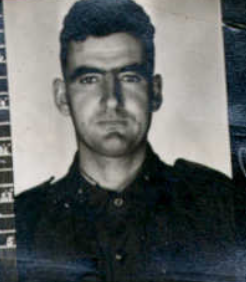
Jim McDonnell (James Jospeh McDonnell  TX 1024) was always a joker, and always in trouble – but having the Irish ‘gift of the gab’, at least in Dad’s eyes Jim generally got off lightly (so his comment about being victimised, being unable to take a trick would have prompted a great chuckle from Dad).  His sense of humour is evident in the designation of himself as ‘first class private’ and it’s impossible to tell how much of his description of life int eh transit camp is accurate.  Jim’s service record does list several AWL’s, and the fact that at different times he was promoted to acting corporal or acting sergeant.  There were also many instances of hospitalisation for both injury and illness, in the Middle East, New Guinea and while in Australia.

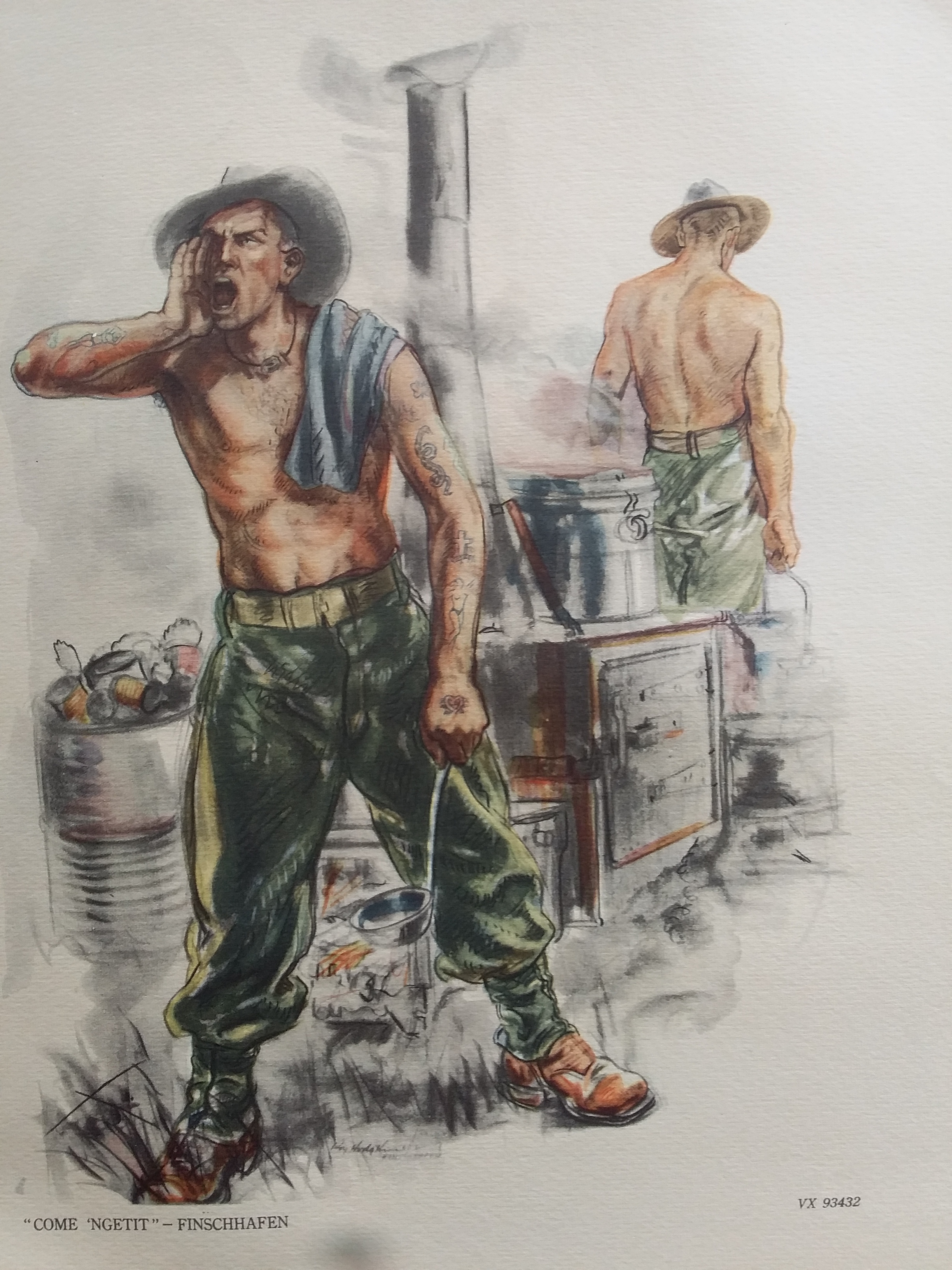
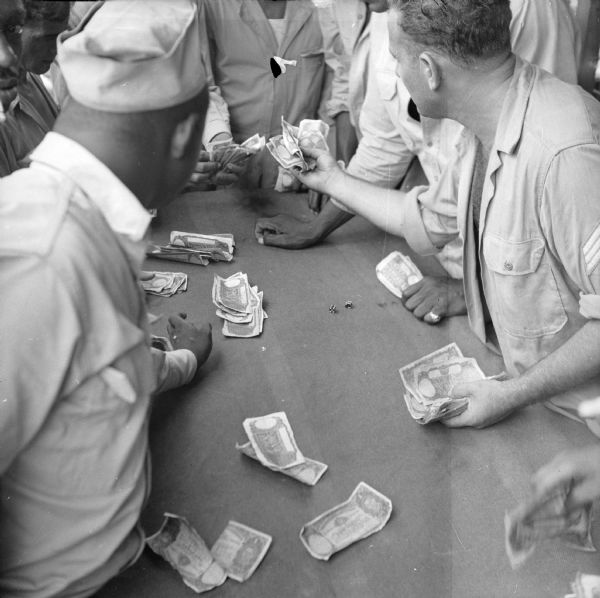
Image : “COME NGETIT ” from the AWM’s 1944 ‘Christmas Book’, Jungle Warfare p145

Changing personnel in the Unit

Bill Crooks (The Footsoldiers p 363) reports that during November many new officers had joined the unit – mainly from other ‘broken-up’ units – but none of those mentioned coincide with the names Jim mentions which were probably all connected with the Tank-Attack platoon.

Names and nicknames

Of the men named, I can identify four:

Bull Black : Regularly mentioned in Dad’s letters.  I assume he was also a member of the Carrier Platoon, in which case he was John Black  QX 2757.  His record has not yet been digitised.

Ruby Smith : I assume this was Rupert Smith SX2394 who has been mentioned in Dad’s letters as one of the ‘hard men’ of the carrier platoon (eg in the letter of 1 March 1943 : …if it wasn’t for the hard citizens it’d be a drab show.  There’s Viv, Len Woodlock, Mick Williams and Rup Smith.  They’re more worry than a battalion of other blokes but they keep the show alive…)

Kong Young : Kenneth William Young  WX185  His service record shows he was an even bigger ‘scallywag’ than Jim – or maybe not so lucky!  Many AWL’s, failing to appear for Parade, etc…  also many hospital visits.  He was evacuated on 14/10/43 with malaria, to 2/11 AGH, then on 1/11/43 to 2/1 AGH with scrub typhus


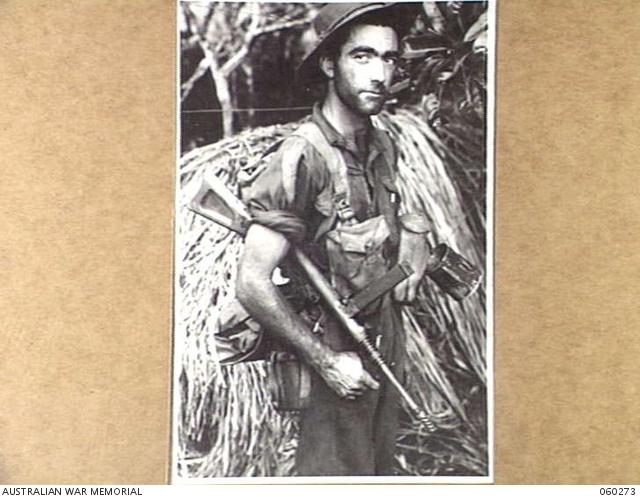
Skiffy – AWM 060273

Corporal Les Skiffington (NX 13159) of the Tank-Attack Platoon about to begin his climb up to Shaggy Ridge  November 1943


Down with malaria

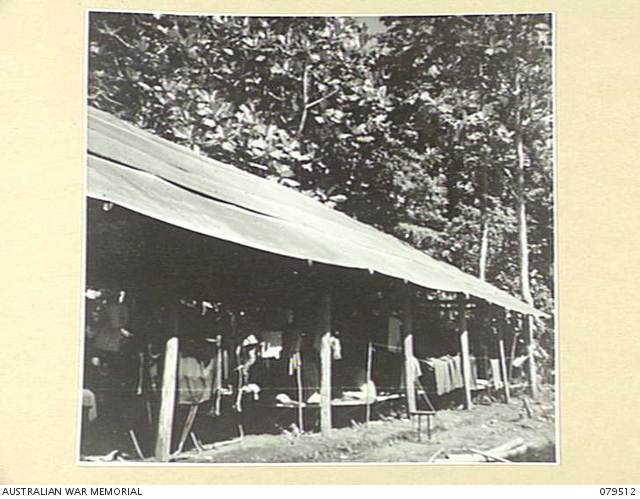
Photo :  CCS Kamkambun AWM079512

Bill Crooks reports in The Footsoldiers (p353) that there were still worrying numbers of men contracting malaria, which was ‘rampant’ – by mid-December evacuations numbered 9 officers and 178 OR’s – with scrub typhus a further cause of sickness and even death.  However, no malaria cases went beyond the CCSs at Nadzab (just outside Lae) until late December, when they were flown to Moresby. (Footsoldiers p363)

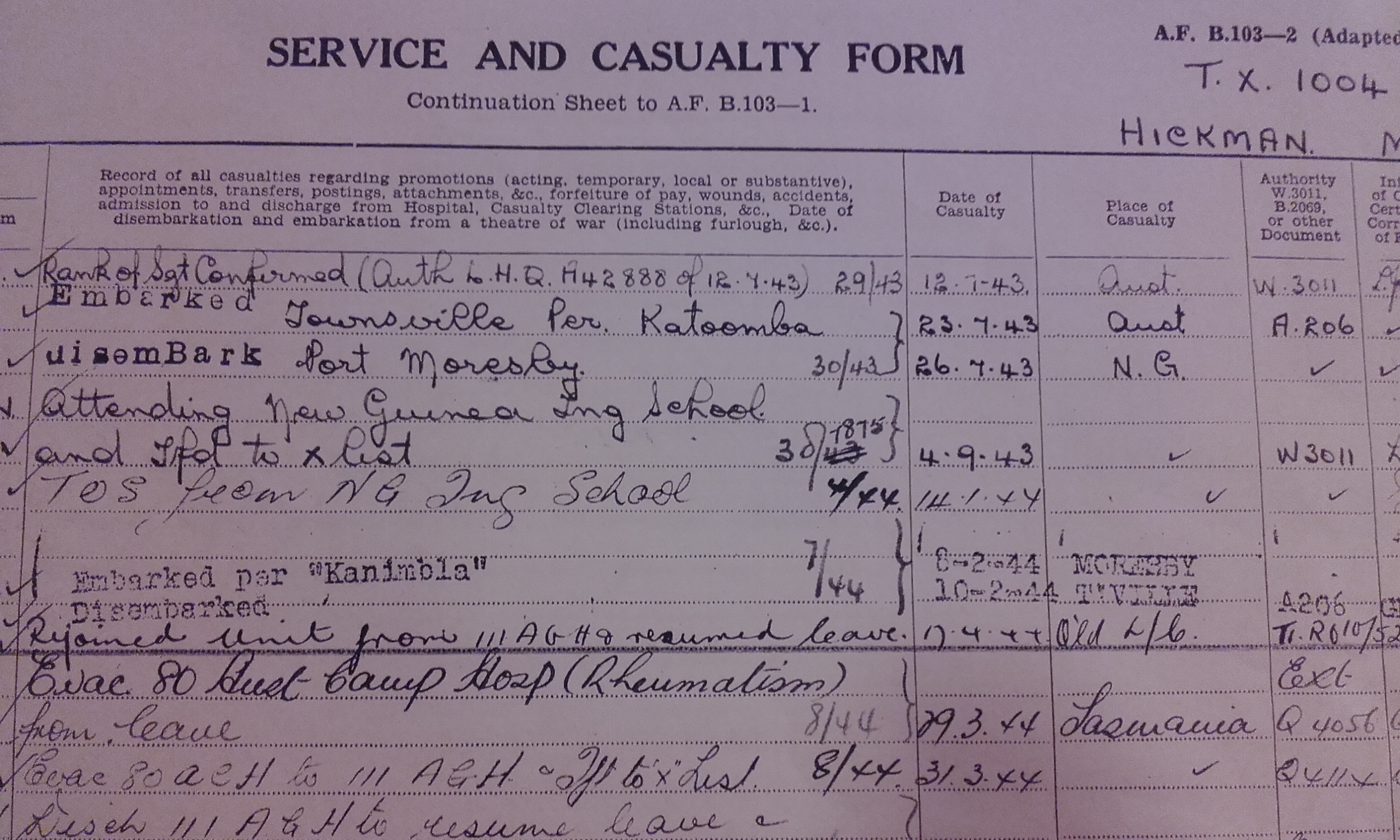
According to his service record, Jim was evacuated to 2/6 Field Ambulance and transferred to X list on October 20, then ‘discharged to unit’ on November 15 – but wasn’t actually TOS (transferred on strength) until December 8 – ie a week after this letter was written.


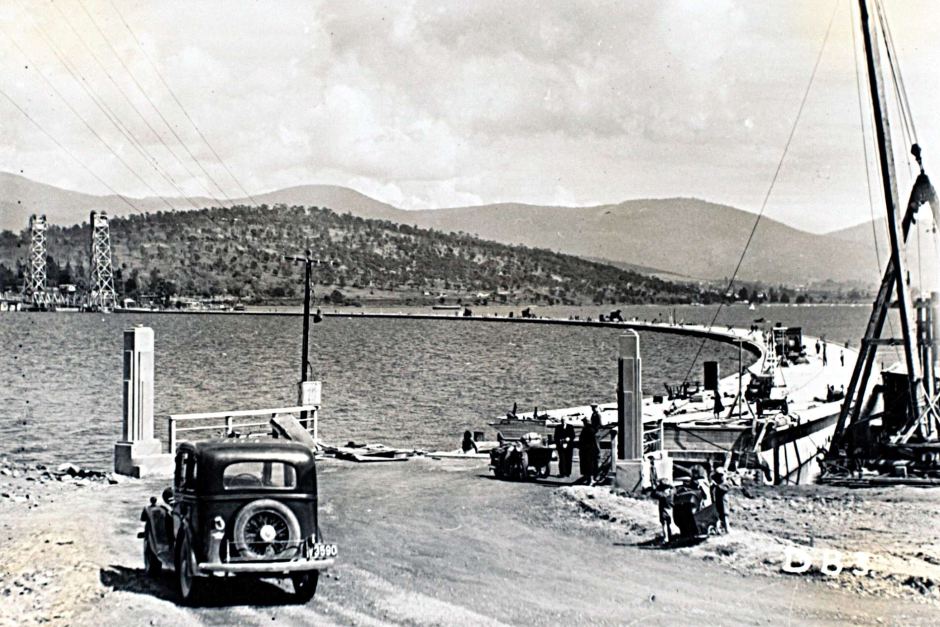
Photo – the bridge

Hobart’s floating bridge was to be opened officially on New Year’s Day 1944.  This photo could be the one Dad had sent on to Jim – held in the Tasmanian Archives and Heritage Office collection, it was re-printed in this article when the bridge was added to the national engineering heritage list.  I can see how it would have been hard for some of the men to relate to it as a bridge.

http://www.abc.net.au/news/2015-05-05/hobart-floating-bridge-declared-national-heritage-marker/6446520

Posted in Food and Drink, Letters to/ from others | Leave a comment

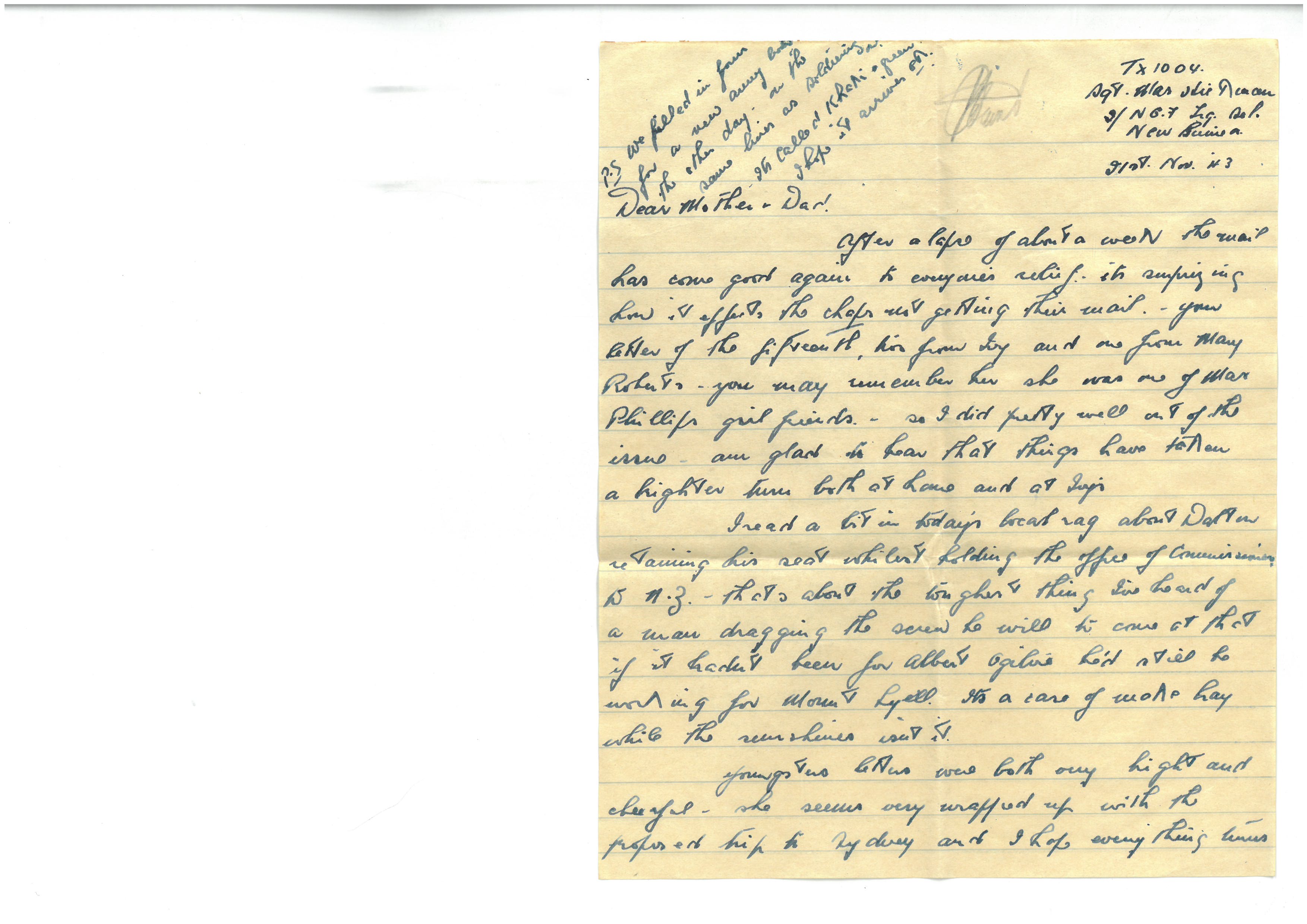
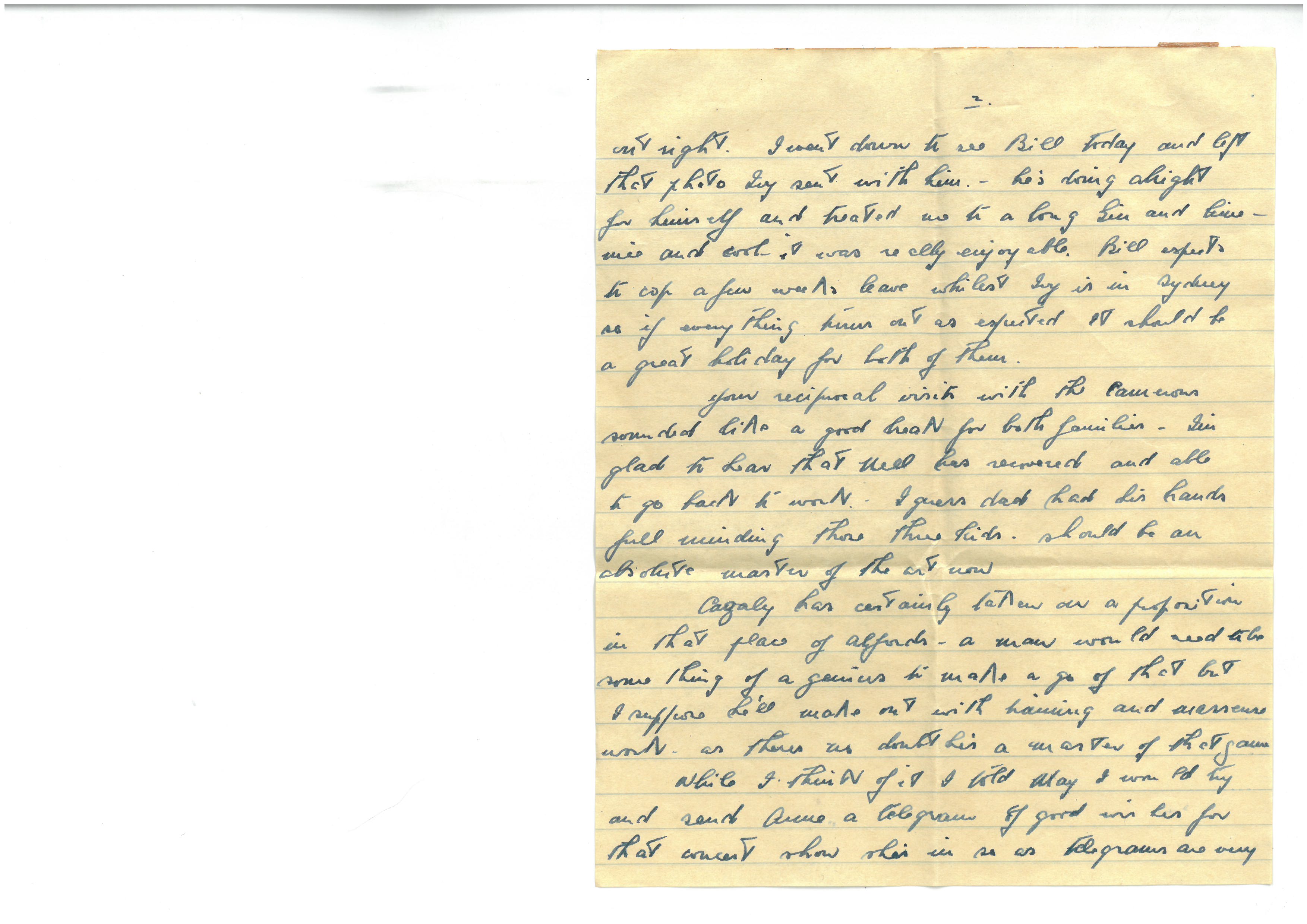
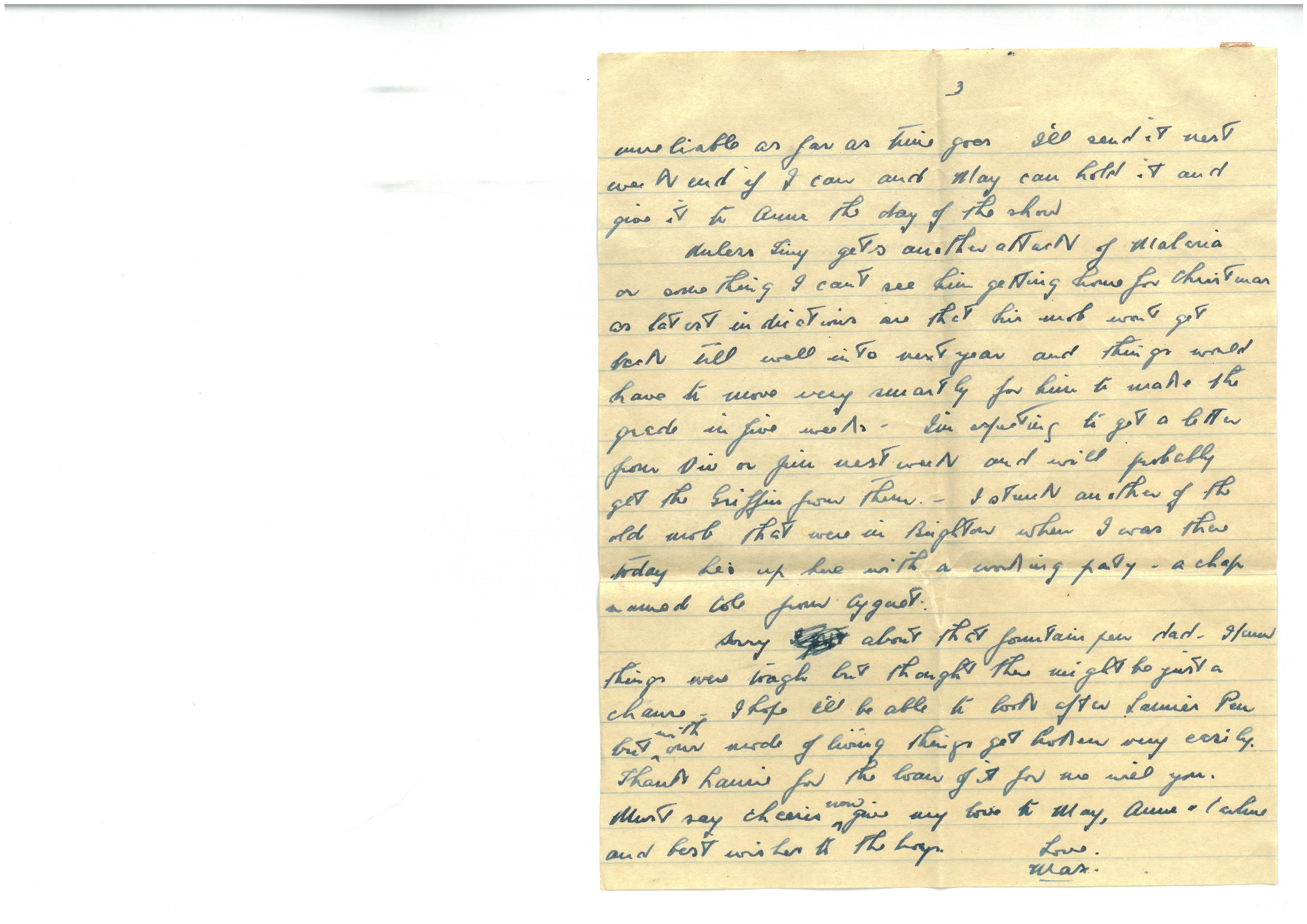
Late November: Cazaly moves to Lenah Valley and a sports day includes diving


TX 1004

Sgt Max Hickman

2/ NGF Tng Sch

New Guinea

21st Nov 43

Dear Mother & Dad

After a lapse of about a week the mail has come good again to everyone’s relief.  It’s surprising how it affects the chaps not getting their mail.  Your letter of the fifteenth, two from Ivy and one from May Roberts – you may remember her, she was one of Max Phillips’ girl friends – so I did pretty well out of the issue.  Am glad to hear that things have taken a brighter turn, both at home and at Ivy’s.

I read a bit in today’s local rag about Dalton retaining his seat whilst holding the office of Commissioner to NZ.  That’s about the toughest thing I’ve heard of, a man dragging the screw he will to come at that.  If it hadn’t been for Albert Ogilvie he’d still be working for Mount Lyell.  It’s a case of make hay while the sun shines, isn’t it.

Youngster’s letters were both very bright and cheerful.  She seems very wrapped up with the proposed trip to Sydney and I hope everything turns out right.  I went down to see Bill today and left that photo Ivy sent with him.  He’s doing alright for himself and treated me to a long Gin and lime – nice and cool, it was really enjoyable.  Bill expects to cop a few weeks leave whilst Ivy is in Sydney so if everything turns out as expected it should be a great holiday for both of them.

Your reciprocal visits with the Camerons sounded like a good break for both families.  I’m glad to hear that Nell has recovered and is able to go back to work.  I guess dad had his hands full minding those three kids.  Should be an absolute master of the act now.

Cazaly has certainly taken on a proposition in that place of Alfords – a man would need to be something of a genius to make a go of that but I suppose he’ll make out with training and masseur work as there’s no doubt he’s a master of that game.

While I think of it, I told May I would try and send Anne a telegram of good wishes for that concert show she’s in so as telegrams are very unreliable as far as time goes I’ll send it next weekend if I can, and May can hold it and give it to Anne the day of the show.

Unless Tiny gets another attack of Malaria or something I can’t see him getting home for Christmas as latest indications are that his mob won’t get back till well into next year and things would have to move very smartly for him to make the grade in five weeks.  I’m expecting to get a letter from Viv or Jim next week and will probably get the Griffin from them.  I struck another of the old mob that were in Brighton when I was there today – he’s up here with a working party – a chap named Cole from Cygnet.

Sorry about that fountain pen dad.  I knew things were tough but thought there might be just a chance.  I hope I’ll be able to look after Laurie’s pen but with our mode of living things get broken very easily.  Thank Laurie for the loan of it for me will you.

Must say cheerio now.  Give my love to May, Anne & Carline and best wishes to the boys.

Love

Max.

PS  We filled in forms for a new army book the other day – on the same lines as Soldiering On.  It’s called Khaki & Green.  I hope it arrives OK.


I went down to see Bill today

Bill Drysdale was Dad’s brother in law, married to his sister Ivy.  At this point, he was a lieutenant in the Cyphers section of the Navy Office – based at Port Moresby.

In a letter sent by Ivy to their parents, dated 27 November 1943 she says:  I don’t know just exactly how far Max is from Moresby.  According to Bill it’s a hell of a long way – further than their transports are allowed to go.  


Tom D’Alton:  holding his seat while High Commissioner in New Zealand

Tom D’Alton had worked for Mt Lyell Mines at Queenstown as a boilermaker before becoming a member of the Tasmanian House of Assembly.  He was a the president of the Queenstown branch of the Amalgamated Engineering Union and became the local candidate for the state seat of Darwin (which later became Braddon).  He was elected in 1931 and in 1934 became minister for agriculture and railways in A G Ogilvie’s Labor government.  In 1939 Ogilvie died, and Robert Cosgrove became premier.  D’Alton was given the ministries of forestry, commerce and agriculture.  This article and letter to the editor of the Launceston Examiner give a sense of the public disquiet at D’Alton’s decision to take up the appointment as Australia’s High Commissioner to New Zealand without resigning his seat in state parliament:  https://trove.nla.gov.au/newspaper/article/92612065/7627509

However, the situation was not unique : Britain’s High Commissioner to Australia at this time was Sir Ronald Cross who continued to hold his seat in the House of Commons.


‘Making a go of Alfords’….Cazaly comes to Lenah Valley

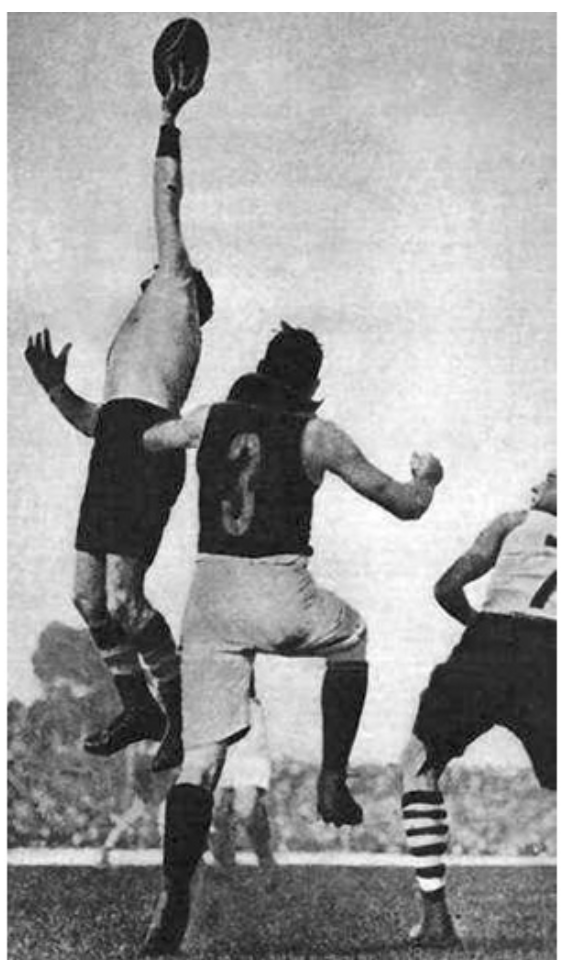
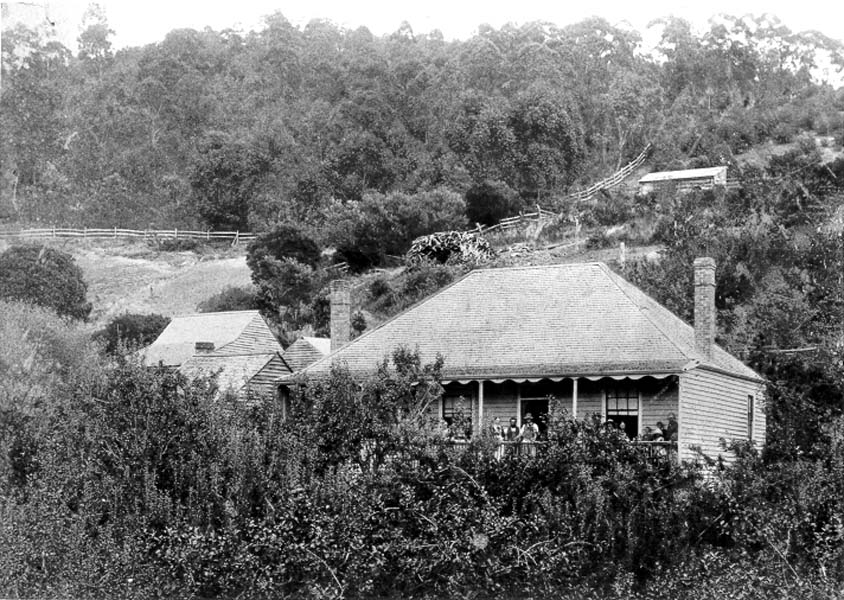
Roy Cazaly was an Australian Football legend – having achieved widespread admiration as a player and coach, both in Tasmania and Victoria.  His high marking was the origin of the cry – Up There, Cazaly!   He and his family had lived in Tasmania on two previous occasions, but in late 1943 they moved permanently to Lenah Valley – in fact, to part of the Normanville property originally owned by the Hickman family in Brushy Creek Road.   A description of the area, including mention of the Alford property, appeared in this 1922 article, when the tram line was extended to the corner of Augusta and Pottery Rd.  https://trove.nla.gov.au/newspaper/article/23619482#


Photo : Normanville, Brushy Creek Rd  (Libraries Tasmania PH30-1-7404)

Roy continued to coach and play, and also established a therapeutic massage business in which his whole family was involved. He became very well known for his approach to treating polio.  His public profile was further expanded when he became involved in greyhound racing and harness racing.  His son, also named Roy, served in the RAN during the war.  (Information from Cazaly the Legend – Robert Allen – the Slattery Media Group 2017 )
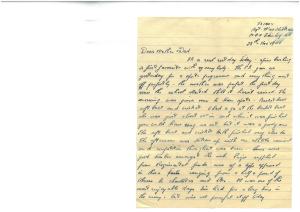
 

  • * * * * * * * * * * * *


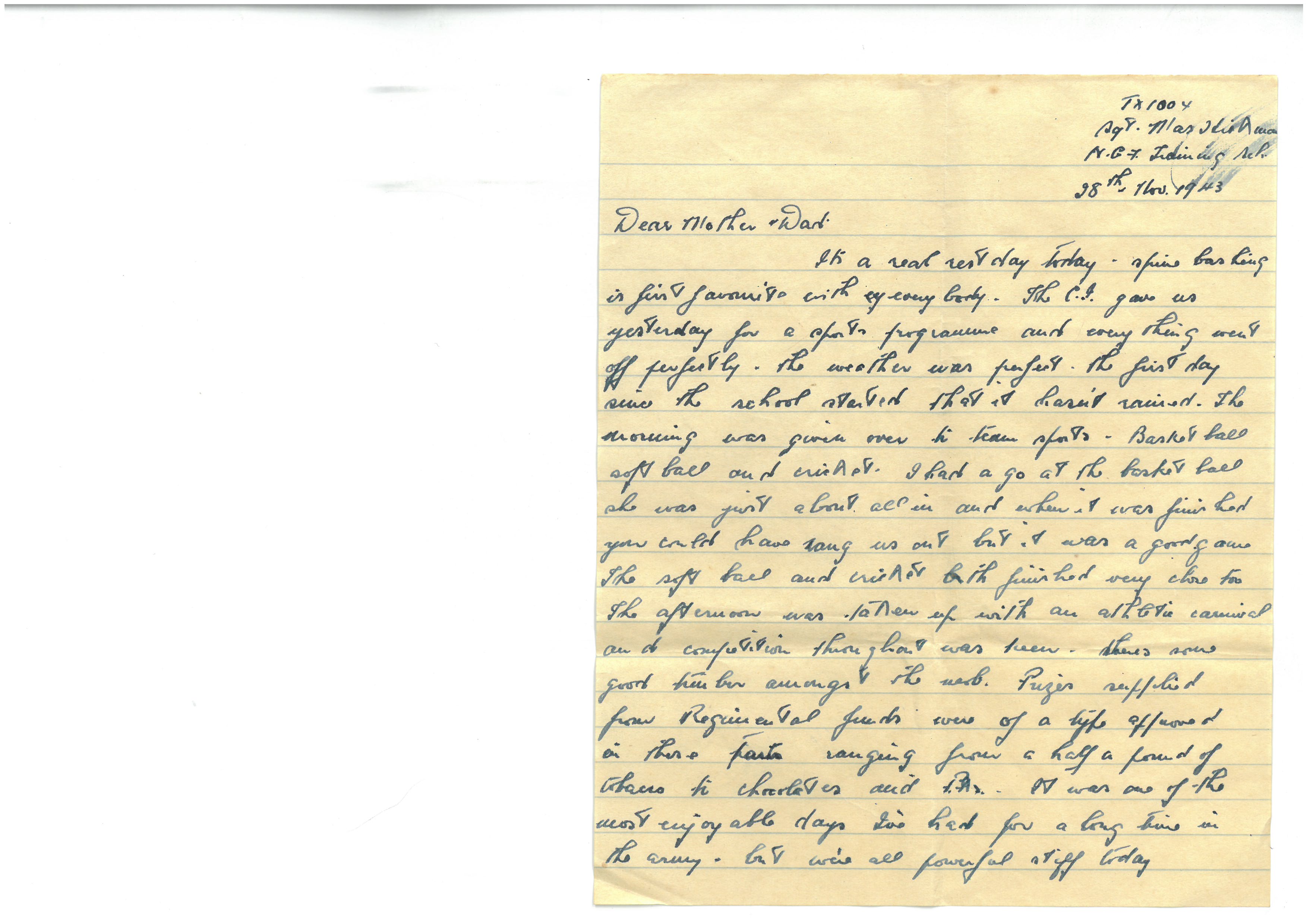
TX 1004

Sgt Max Hickman

NGF Training Sch

28th Nov 1943

Dear Mother & Dad

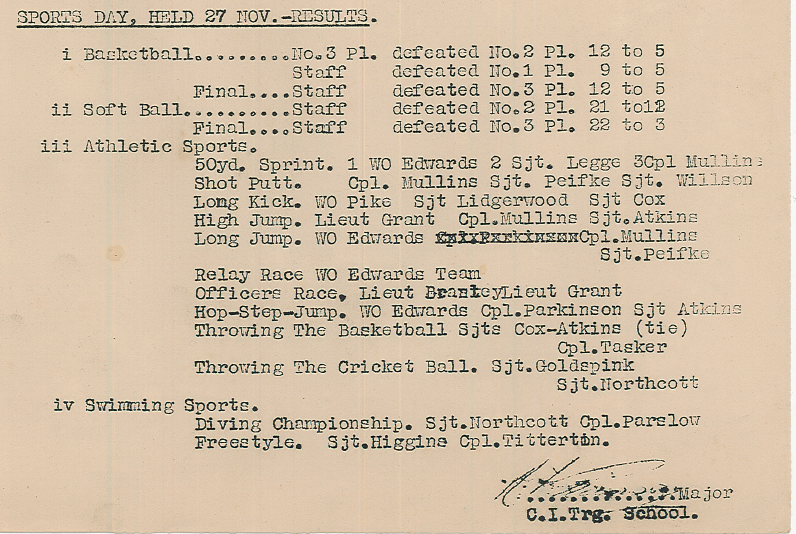
It’s a real rest day today – spine bashing is first favourite with every body.  The CI gave us yesterday for a sports programme and everything went off perfectly.  The weather was perfect – the first day since the school started that it hasn’t rained.  The morning was given over to team sports – basketball, softball and cricket.  I had a go at the basketball.  She was just about all in and when it was finished you could have wrung us out but it was a good game.  The softball and cricket both finished very close too.  The afternoon was taken up with an athletic carnival and competition throughout was keen- there’s some good timber amongst the mob.  Prizes supplied from Regimental funds were of a type approved in these parts, ranging from a half a pound of tobacco to chocolates and PK’s.  It was one of the most enjoyable days I’ve had for a long time in the army, but we’re all powerful stiff today.

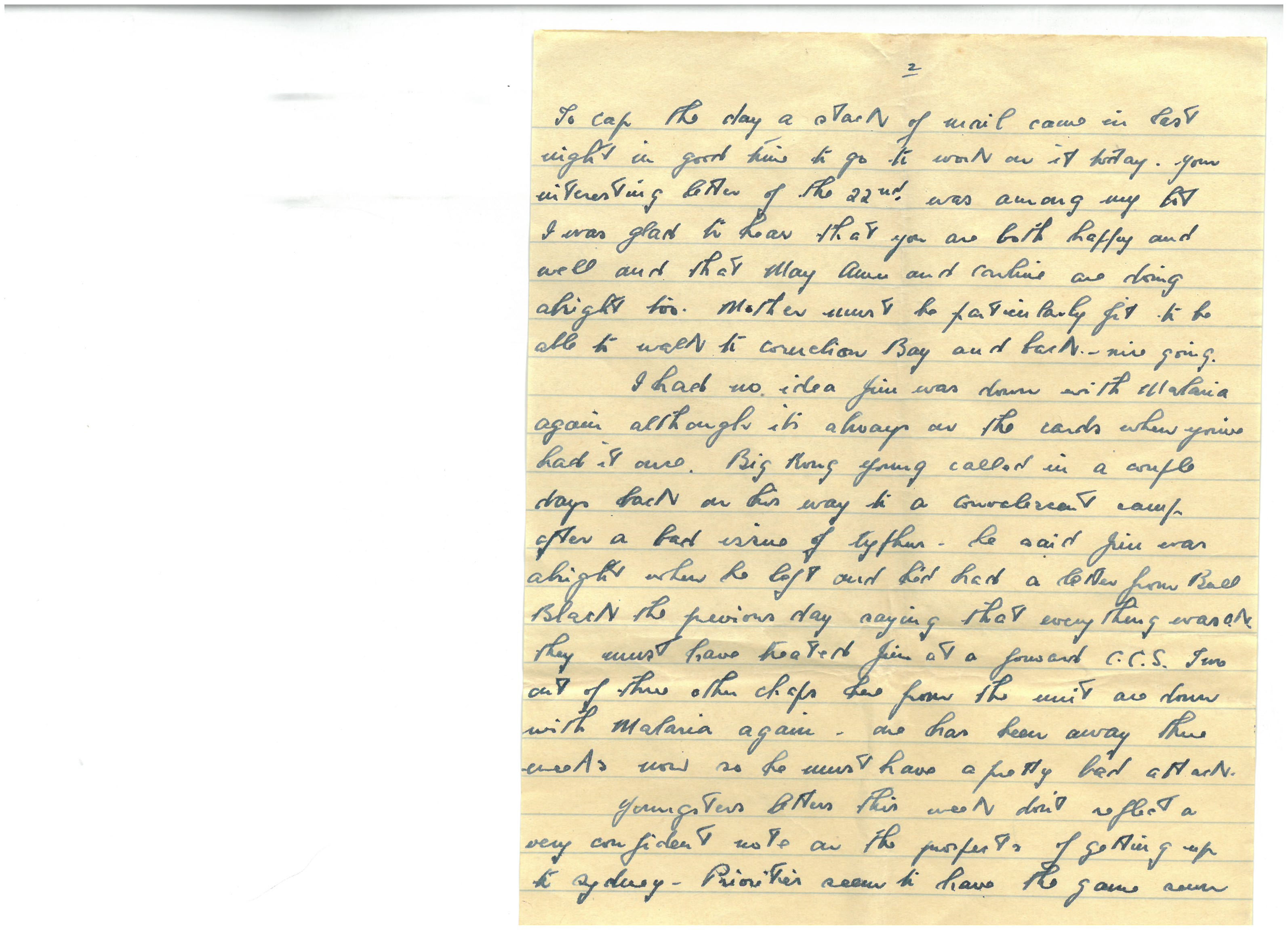
To cap the day a stack of mail came in last night in good time to go to work on it today.  Your interesting letter of the 22nd was among my lot.  I was glad to hear that you are both happy and well and that May, Anne and Carline are doing alright too.  Mother must be particularly fit to be able to walk to Cornelian Bay and back – nice going.

I had no idea Jim was down with Malaria again, although it’s always on the cards when you’ve had it once.  Big Kong Young called in a couple of days back on his way to a convalescent camp after a bad issue of typhus.   He said Jim was alright when he left and he’d had a letter from Bull Black the previous day saying that everything was OK.  They must have treated Jim at a forward CCS.  Two out of three other chaps here from the unit are down with Malaria again.  One had been away three weeks now so he must have a pretty bad attack.

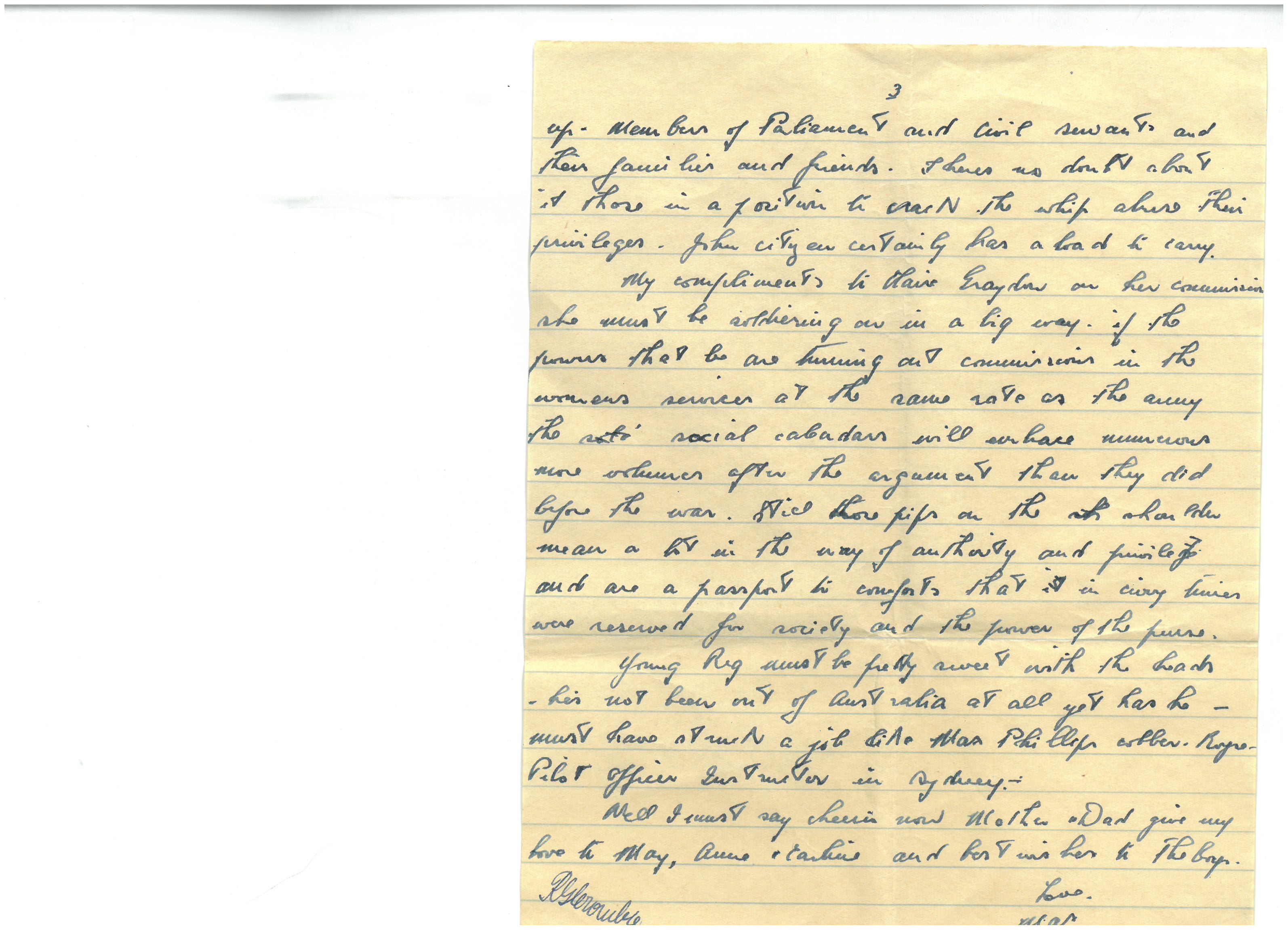
Youngster’s letters this week don’t reflect a very confident note on the prospects of getting up to Sydney.  Priorities seem to have the game sewn up – Members of Parliament and civil servants and their families and friends.  There’s no doubt about it: those in a position to crack the whip abuse their privileges.  John Citizen certainly has a load to carry.

My compliments to Claire Graydon on her commission – she must be soldiering on in a big way.  If the powers that be are turning out commissions in the womens services at the same rate as the army, the social calendars will  [embrace??]  numerous more volumes after the argument than they did before the war.   Still those pips on the shoulder mean a bit in the way of authority and privilege and are a passport to comforts that in civvy times were reserved for society and the power of the purse.

Young Reg must be pretty sweet with the heads – he’s not been out of Australia at all yet, has he – must have struck a job like Max Phillips’ cobber Royce – Pilot Officer Instructor in Sydney.’Well I must say cheerio now Mother & Dad.  Give my love to May, Anne & Carline and best wishes to the boys.

Love

Max.

The Sports Programme
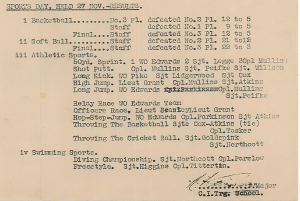
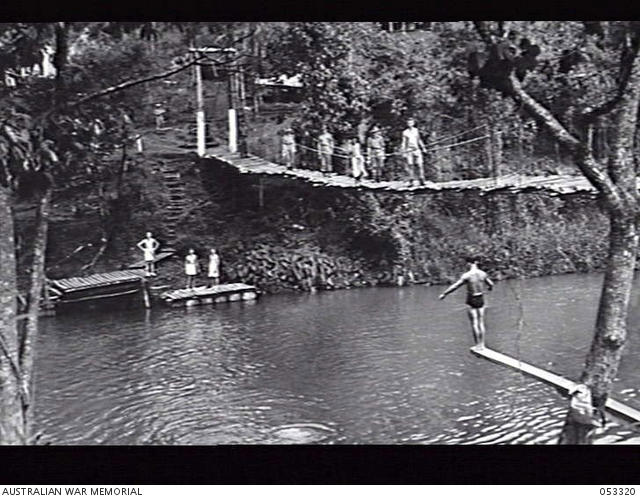
The published results (shared in this image)  included all the sports mentioned in this letter – and also swimming and diving!  This seemed incredible, until I found the photo of a diving board over the river, and a note in later Routine Orders, detailing a group to carry out maintenance on the swimming pool.
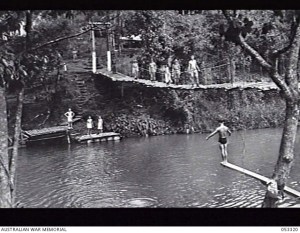
 

AWM 053320

Sogeri Valley, New Guinea 26/6/43  Midday mess parade of the New Guinea Force School of Signals crossing bridge.  Below the bridge can be seen diving boards and pontoons constructed by the troops.


Malaria 

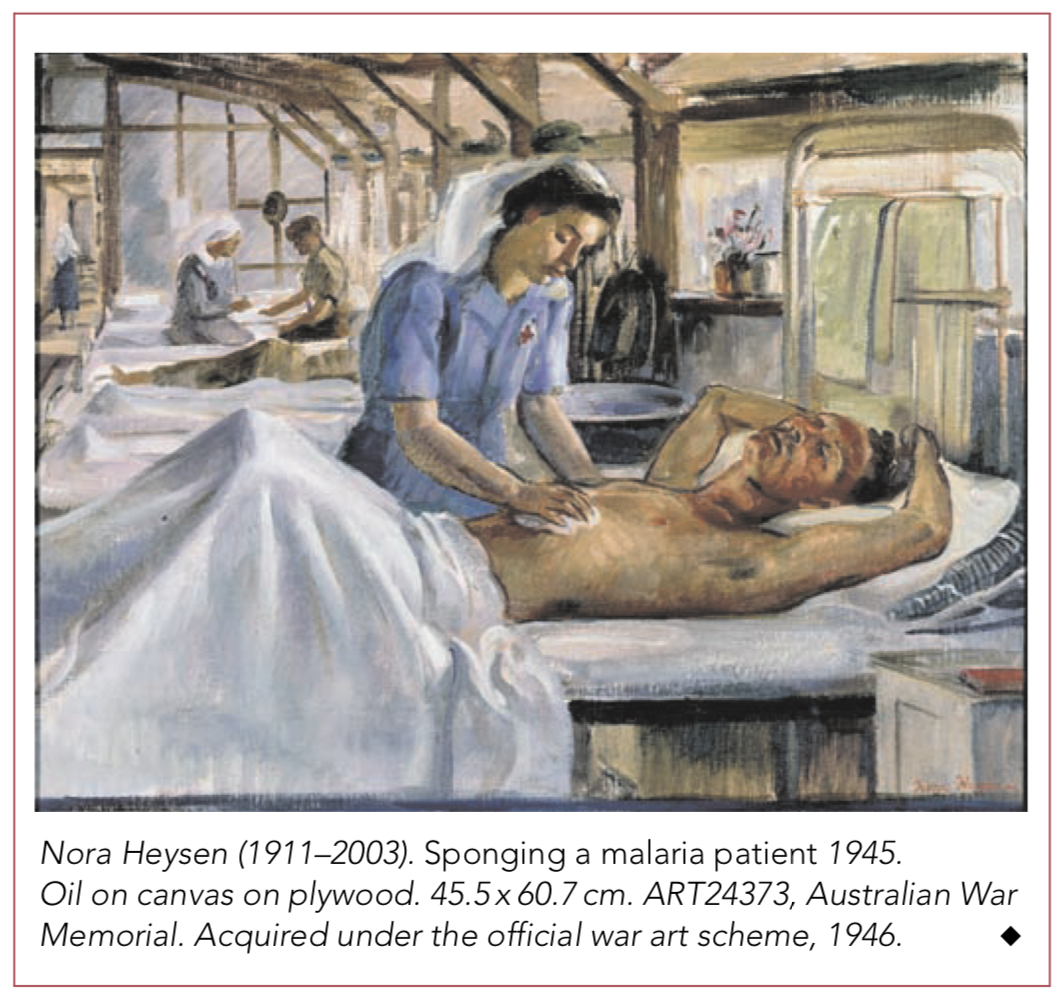
Because Port Moresby is in a relatively dry coastal area, the potential impact of malaria on the war in the Pacific was initially underestimated.  In the first 6 months of 1942, 1184 cases of malaria were recorded among the 6500 Australians serving in Port Moresby. … By November 1942, an epidemic of malaria had broken out, with rates of incidence increasing from 33 men per 1000 per week to 82 men per 1000 per week by December that year.  ….Thanks largely to the efforts of the Army’s Director of Medicine, Colonel Neil Fairley, the Land Headquarters Medical Research Unit was established at the 5 Australian Camp Hospital in Cairns, in June 1943. Testing of the new antimalarial drug atebrin was conducted under diverse conditions and it was reported in June 1944 that administration of 0.1 g (equivalent to one atebrin tablet daily) cured P. falciparum malaria and suppressed the onset of P. vivax malaria.   https://www.mja.com.au/system/files/issues/194_08_180411/pro10266_fm.pdf   
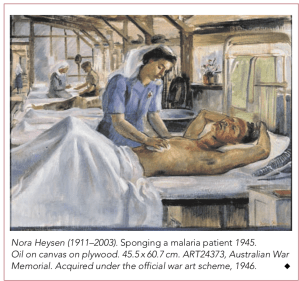
(Image – painting by Nora Heysen – same source)


Malaria: Personal Protection Measures

As well as these research efforts, unit commanders were required to enforce personal protection measures including the taking of suppressive drugs (chiefly quinine at this point), use of nets and restrictions on hours for bathing.  At the time of this letter, soldiers were still permitted to wear shorts when not on parade, between the hours of 0630 and 1800.  However, soon afterwards it became an offence to wear shorts, and shirts had to be worn with long sleeves fastened at the wrist. ( Routine Orders December 16:  AWM 52/34/13/4  p 53) – 3 pairs of slacks were issued to each soldier.  CO’s were however permitted to allow men engaged in hard physical work to roll up their sleeves or even work bare-chested, between the hours of sunrise and sunset.

Scrub Typhus

The first sign of this mite-borne disease was an ulcer-like sore.  If found, the soldier immediately reported to the medical officer and was ideally transported to hospital on a stretcher as he rapidly became very ill with fever and often lapsed into unconsciousness.  The fever rose to 40 degrees in a few days – even 40.4 was recorded – and a high swinging temperature was recorded for twelve to eight days.   There was no known drug for treatment, and the administration of adequate fluid and complete rest were essential.   Patient behaviour was also challenging.  Men often exhibited confusion, delirium and restless irritability, and could be demanding and petulant or depressed and drowsy.   The severity of the illness varied considerably.  For men with a severe infection, some were recovered and fit for duty in twelve weeks, but others lapsed into a coma after twelve to sixteen days, and died.  The men were exhausted after campaigning over the mountains and were often debilitated with malaria and dysentery.  Their lower resistance appeared to be a factor in the high mortality rate – of the 626 cases studied over one twelve month period, the death rate was almost 10 percent.   (ref – A Special Kind of Service: the story of the 2/9 Australian General Hospital 1940 – 46  pp 80 – 81)


Priorities seem to have the game sewn up

Note re Ivy’s hopes of spending time in Sydney with her mother in law, and hopefully also her husband : In her letter to their parents dated Nov 27 she said she had managed to book a flight from Melbourne for the next day (Sunday) however “ Airways warned me that I am likely to be taken off at the last minute to make room for a Government Priority – wouldn’t it be awful”


A letter from Bull Black…. everything is OK

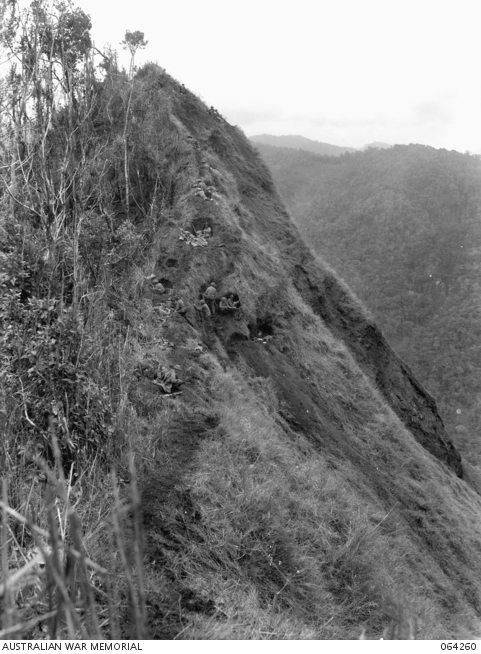
The battalion was based ‘around Shaggy Ridge’ where the Japanese were well dug in. “On many nights Japanese aircraft flew over, combing the bases around Gusap and Dumpu but doing little damage.  Only A and C companies really suffered any operational hardship.  Each spent 11 days on the 5000-foot high four-foot wide slope that led up to Green Sniper’s Pimple.  Each platoon spent about five days as forward platoon and each section would spend two days and one night on forward section – the actual front being a one-man affair.  The most forward post was the section Bren pit manned always by two men, and connected by telephone back to CHQ.nnWith only 40 yards to the foremost single Jap pit it was with the usual nervous apprehension that sentry-go was done when in the forward post.”  (The Footsoldiers, pp 361-362)
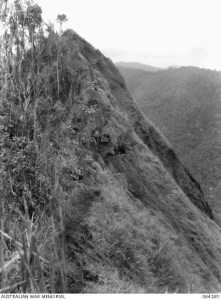
  

A clear indication of the terrain referred to in the extract above.    

AWM 064260    Finisterre Ranges, New Guinea 23/1/44  Members of the 2/9 Infantry Battalion digging in at ‘Green Snipers Pimple’ after the Japanese forces had been driven back during battle


Claire Graydon’s commission

I haven’t been able to find anything about Claire Graydon but found this piece about the women’s army service (AWAS) interesting:   https://trove.nla.gov.au/people/620601?c=people

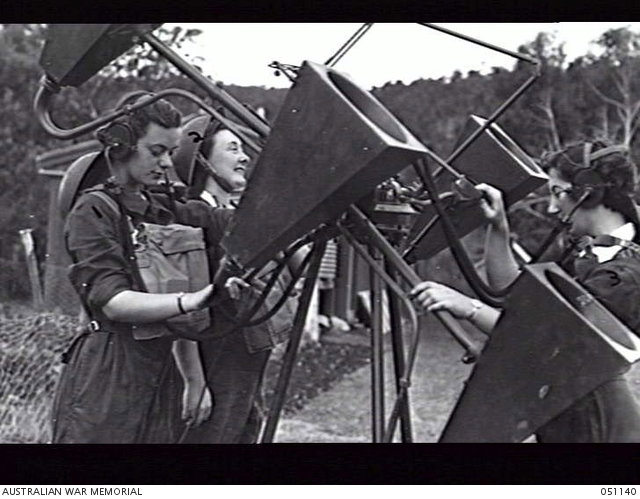
The first Officer’s Training School was held in Victoria in November-December 1941. During this time Japan entered the war and the need for womanpower in the Army was accentuated, recruiting and training commenced as soon as AWAS Officers returned to their areas. The types of recruits were quite splendid, alert, responsible and invariably inspired to volunteer by strong personal motives.  Initially the Army only envisaged that women would be employed as clerks, typists, cooks and motor transport drivers, and in small numbers, however, the demand grew very quickly and by the end of 1942 12,000 recruits had been enlisted and trained.   While at first AWAS were posted only to Headquarters, and Base Installations, they later took up duty, after specialist training in almost all Army Services. It is of interest to note that 3,618 served with the Royal Australian Artillery and they manned the Fixed Defences of Australia from Hobart in the South and Cairns in the North, and Perth in the West. And again 3,600 served in the Australian Corps of Signals, where they proved themselves well adapted for the type of work required of them.
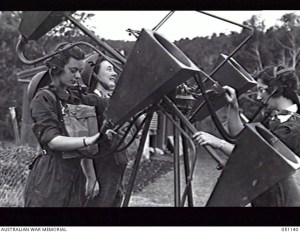
AWM 051140

East Risdon TAS 20/4/43  The sound locator of the 115th section, 59th anti-aircraft searchlight company ready for action.  This section is manned [sic] entirely of members of the AWAS…


Young Reg….must have struck an instructor job in Sydney

Reginald Hickman was a relative:  his father John was the brother of Dad’s grandfather- ie John was Dad’s great uncle.  I’m not sure what that makes Reg – I guess they would have called each other cousins.  Reg enlisted in the airforce in 1941 and rose to the rank of Flight Lieutenant.  At dischargee in 1945 he was posted to the Aircraft Repair Depot.


Posted in escapades, relaxation, fun and games, Papua New Guinea, Tasmanian, training, Uncategorized | Leave a comment

Culinary adventures, the Melbourne Cup and Lenah Valley in the news.


TX 1004

Sgt Max Hickman

NGF Training Sch

New Guinea

14th Nov 43

Dear Mother & Dad

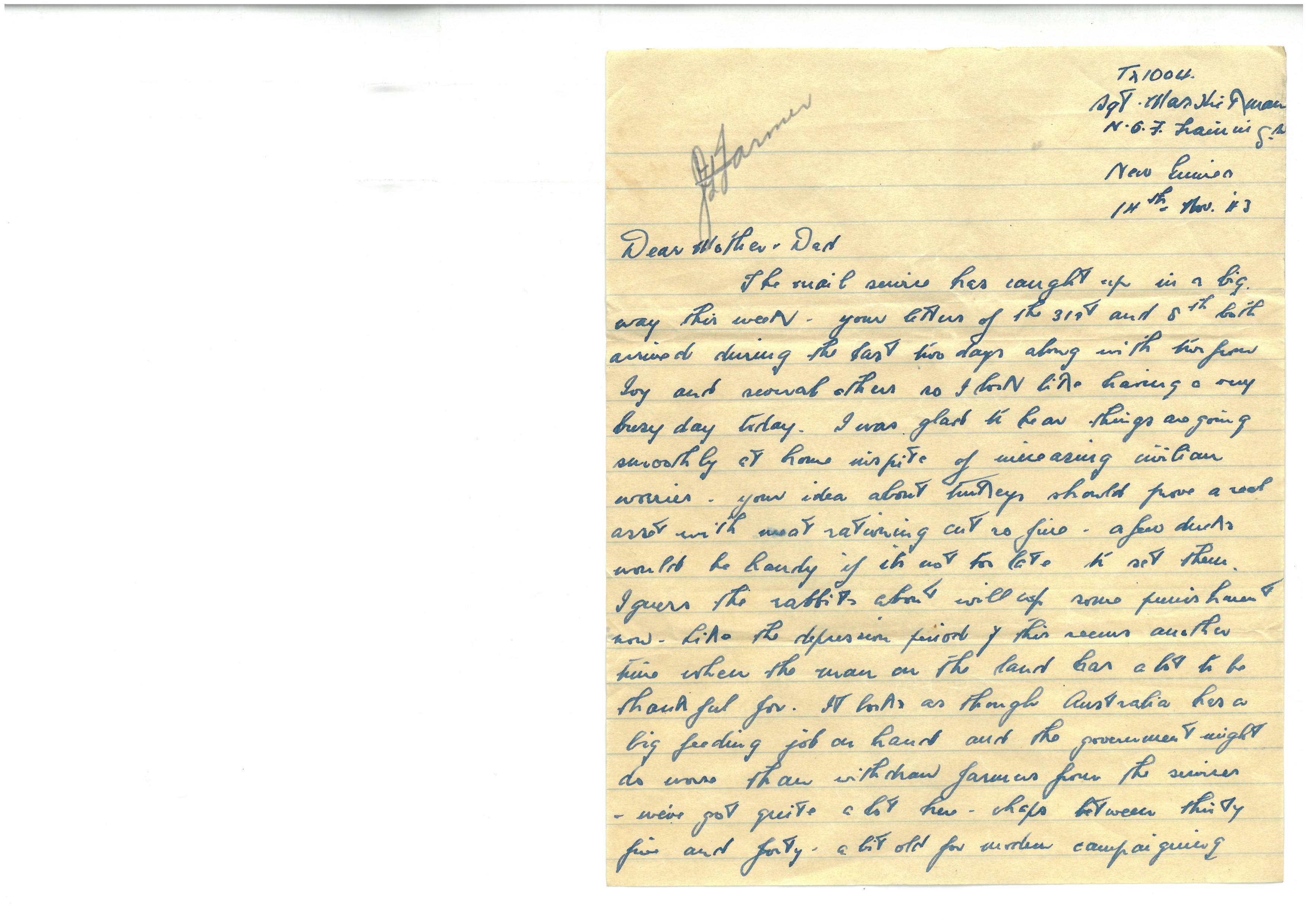
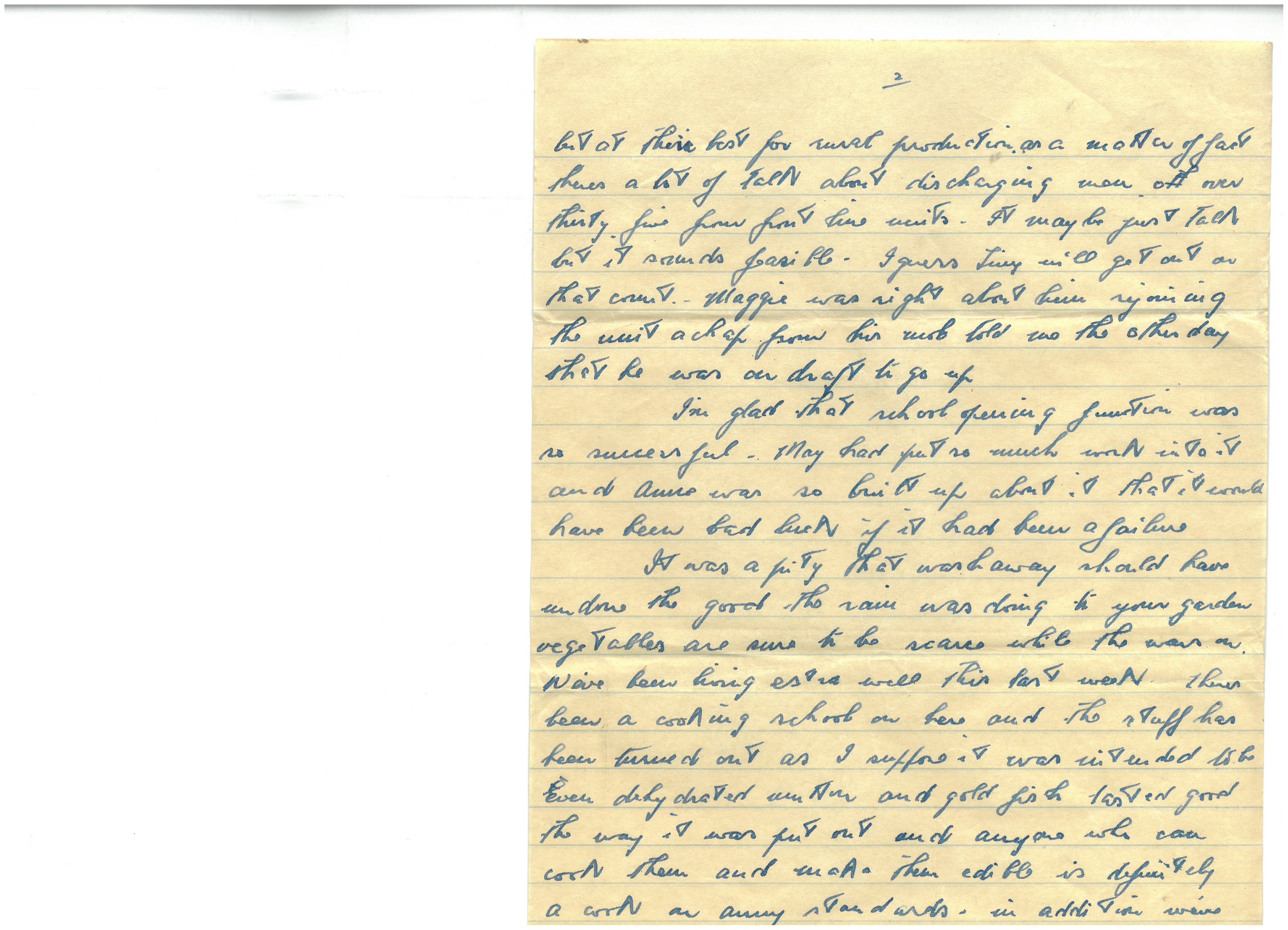
The mail service has caught up in a big way this week – your letters of the 31st and 8th both arrived during the last two days along with two from Ivy and several others so I look like having a very busy day today.  I was glad to hear things are going smoothly at home in spite of increasing civilian worries – your idea about turkeys should prove a real asset with meat rationing cut so fine – a few ducks would be handy if it’s not too late to set them.  I guess the rabbits about will cop some punishment now: like the depression period this seems another time when the man on the land has a lot to be thankful for.  It looks as though Australia has a big feeding job on hand and the government might do worse than withdraw farmers from the services – we’ve got quite a lot of them here – chaps between thirty five and forty – a bit old for modern campaigning, but at their best for rural production.  As a matter of fact there’s a lot of talk about discharging men over thirty five from front line units.  It may  be just talk but it sounds feasible.  I guess Tiny will get out on that count.  Maggie was right about him rejoining the unit – a chap from his mob told me the other day that he was on draft to go up.

I’m glad that school opening function was so successful.  May had put so much work into it and Anne was so built up about it that it would have been bad luck if it had been a failure.

It was a pity that wash away should have undone the good the rain was doing to your garden.  Vegetables are sure to be scarce while the war’s on.  We’ve been living extra well this last week.  There’s been a cooking school on here and the stuff has been turned out as I suppose it was intended to be.  Even dehydrated mutton and gold fish tasted good the way it was put out and anyone who can cook them and make them edible is definitely a cook on army standards.  In addition we’ve had two vegetables at one meal sometimes, and two or three times they even put on scones so gastronomically we’ve done pretty well.

I suppose new record high attendance records were put up at Flemington yesterday – everyone who could possibly make it would be there and I suppose all the yanks within a thousand miles would come along with their jeeps.  They got a wireless from somewhere and set it up in one of the lecture huts and training was stopped for ten minutes but they couldn’t tune in so we didn’t know the result till tea time.  Several sweeps were run.  I had Saul in one and Illyrian in another but I gather that they also ran.

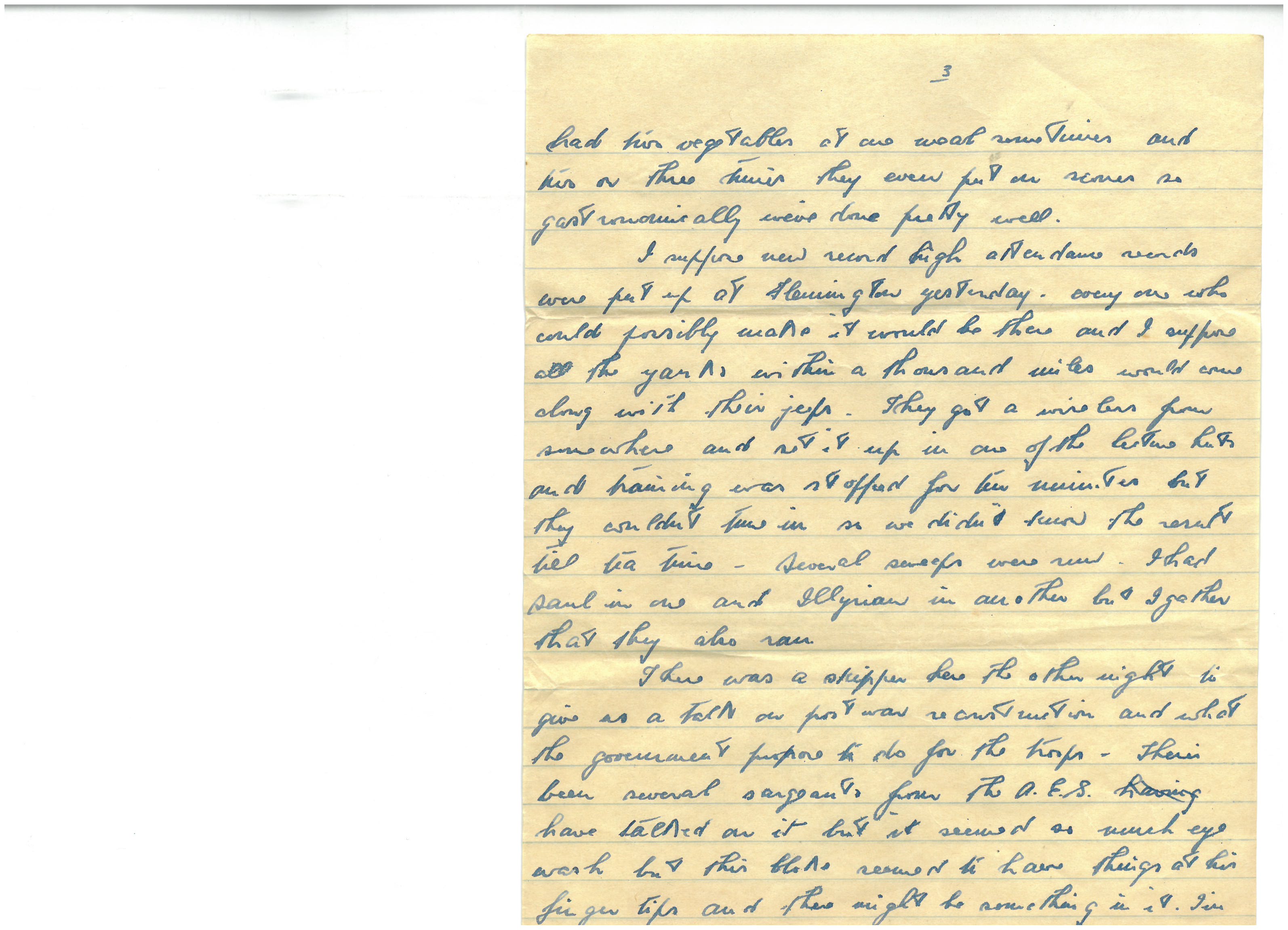
There was a skipper here the other night to give us a talk  on post war reconstruction and what the government propose to do for the troops.  There’s been several sergeants from the AES have talked on it but it seemed so much eye wash, but this bloke seemed to have things at his fingertips and there might be something in it.  I’m going up to the camp where he’s staying this afternoon to have a bit of a yarn to him about it.  

I haven’t had any word from up top lately so don’t know how the mob are going.  We don’t get much of the Griffin here unless someone happens to get down to the base area on Sunday.  I hope to go down next weekend as we’re due for a day off then.  If I get time I’ll write to Viv or Jim this afternoon.

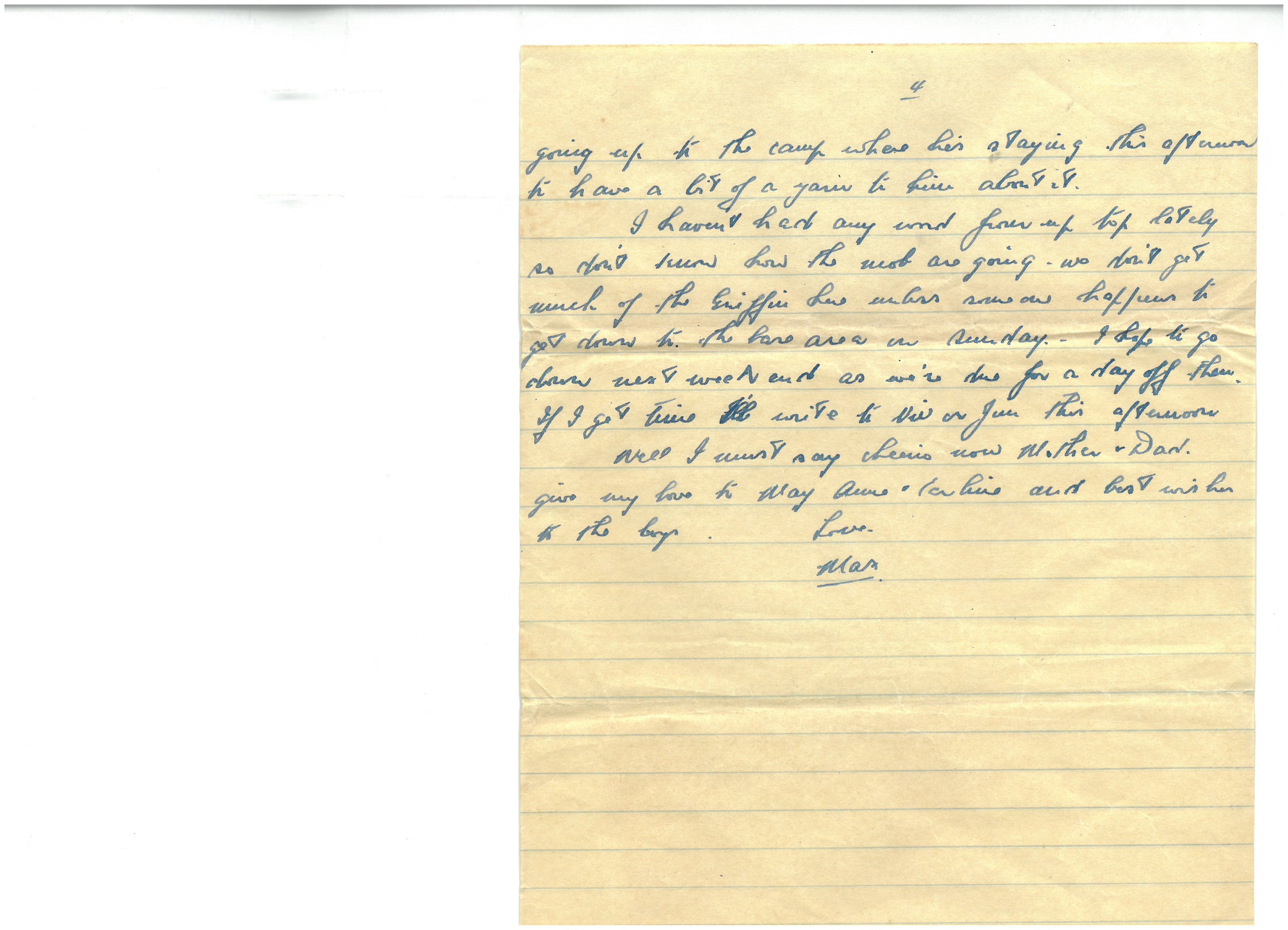
Well I must say cheerio now Mother & Dad.  Give my love to May, Anne & Carline and best sighs to the boys.

Love

Max.

Meat rationing

See for example https://trove.nla.gov.au/newspaper/page/7627314  Three articles in the Launceston Examiner of 5 October 1943 reported on a state government proposal to increase the number of fowls that could be kept without needing a licence; a compulsory reduction of 20 percent in supplies of meat outside Launceston and Hobart (where such limits already applied); and an inter-departmental conference in Melbourne about the difficulties inherent in the introduction of any form of meat rationing in Australia.  The last of these mentioned in particular, concern about ‘the large amount of meat now being consumed by domestic dogs and cats and also by greyhounds kept for coursing.  It was reported that there were more than 100,000 greyhounds in Australia and they consumed an average of 10lb of butchers’ meat every week….an exceedingly large amount…when increasing quantities of meat were needed for the fighting services and for export to the United Kingdom.’

On December 10 the Burnie Advocate reported that ‘when meat rationing was introduced it would be a Commonwealth-wide scheme…..The Master Butchers’ Association had urged that Tasmania be excluded from coupon rationing, and suggested the continuation of the present quota system which was working satisfactorily.’  https://trove.nla.gov.au/newspaper/page/5768480 

Meat rationing was however introduced, Australia-wide in January 1944.  

(ref   https://collections.museumvictoria.com.au/articles/15790)


Post war reconstruction

The Department of Post-War Reconstruction was established in December 1942 with JB Chifley as Minister.  In January 1943 HC (Nugget) Coombs was appointed as its first Director-General.  Three commissions were established within the Department in 1943 – the Rural Reconstruction Commission, the Commonwealth Housing Commission and the Secondary Industries Commission.  Staff included economists, architects, a journalist and a trade unionist.  They provided administrative and research assistance to the commissions and the Co-ordinator General of Works.  Coombs, in particular, was a member of numerous committees, as well as chairing Commonwealth–state meetings on town and regional planning, housing, employment, re-establishment and soldier settlement.  (http://guides.naa.gov.au/land-of-opportunity/chapter2/)

By late 1943 newspapers around the country were reporting on public meetings held to enable people to hear about and comment on the Government’s plans.  The following year, a referendum would be held on increasing Commonwealth powers for the 5 years after the war ended..Dad will surely have views on this!


Even dehydrated mutton and goldfish tasted good…

Presumably the ‘goldfish’ were in fact whitebait which I was surprised to learn had been among the varieties canned in Tasmania for the AMF.

On 10 January 1945, the Launceston Examiner reported that the cannery recently established by Fish Canneries of Tasmania Pty Ltd would be turning out 10,000 tins of canned fish a day: a larger output than any other cannery in Australia.   At present the whole output is under contract to the Government and in the near future it may have to be very greatly increased to meet the requirements of the services…   The bulk of the fish being canned at present comprises barracuda, Australian salmon and mackerel, but whitebait has also been canned on a big scale, 200,000 cans having been supplied to the Army Hospital Services.  It proved so successful that the company is looking forward to making it one of its special lines after the war.  https://trove.nla.gov.au/newspaper/article/91488322


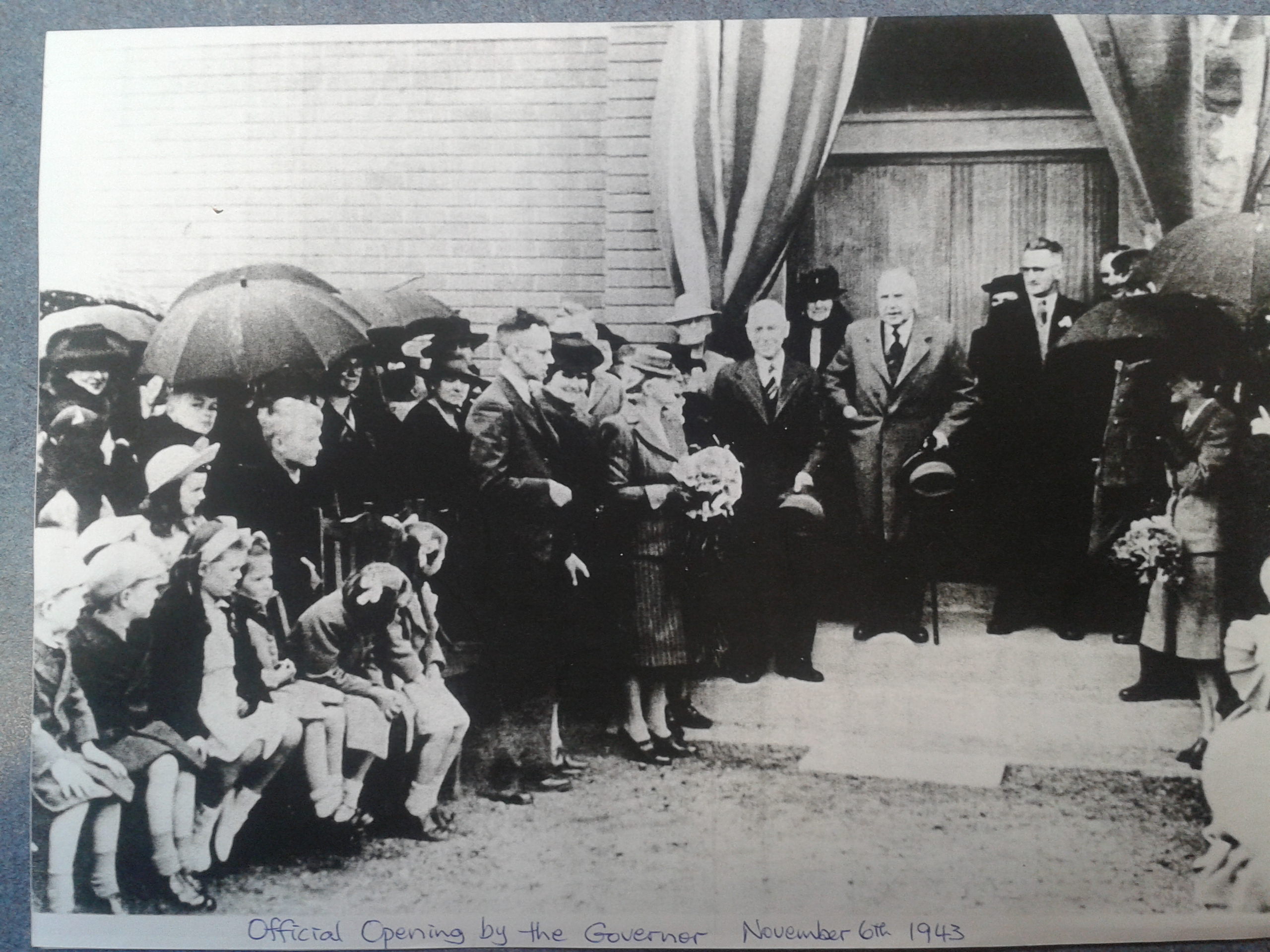
That school opening function

On Monday 8th November the Hobart Mercury published this photo with a report on the official opening of the Lenah Valley School which had taken place the previous Saturday.    (https://trove.nla.gov.au/newspaper/article/26000544/1866101)   The school building was described as a modern brick building, containing two spacious classrooms.   VIP’s present included the Governor and Lady Clark, the Chief Secretary (Mr Brooker) representing the Minister for Education (Mr Cosgrove) and the Director of Education (Mr G V Brooks) who paid tribute to the work of the head teacher (Miss S Craike). 

On Tuesday 9th a small supplementary item was published, including the statement that ‘The secretarial arrangements of the function were handled by Mrs L Fisher.  (https://trove.nla.gov.au/newspaper/page/1866113) Mrs Fisher was Dad’s sister May (wife of Laurie), and her daughter – my cousin Anne – was one of the founding group of students who had begun their schooling at Haig Street hall.


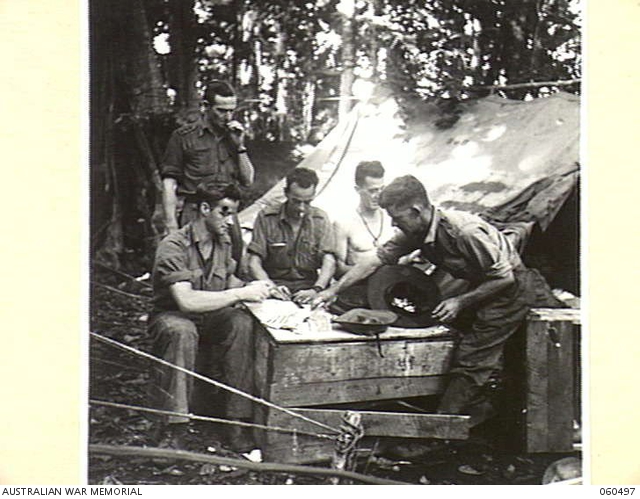
The Melbourne Cup

AWM 060497

Conducting a sweep on the Melbourne Cup at Headquarters, 9th Australian Division Finschafen 13/ 11/ 43


AWM 060488

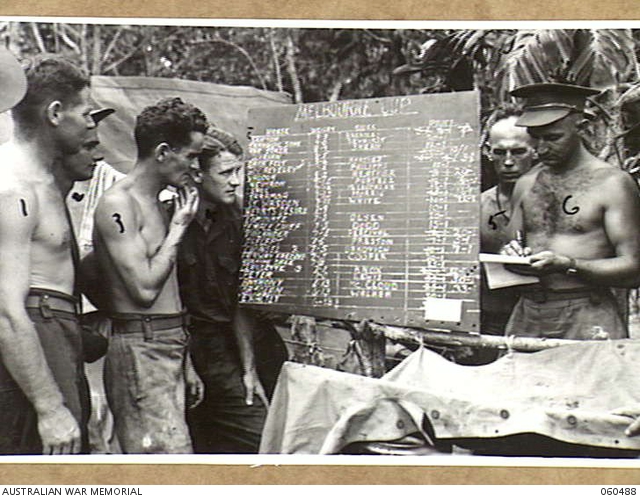
Trooops of Headquarters, 7th Australian Division, study the betting board for the Melbourne Cup.   Dumpu, 13 / 11 / 43


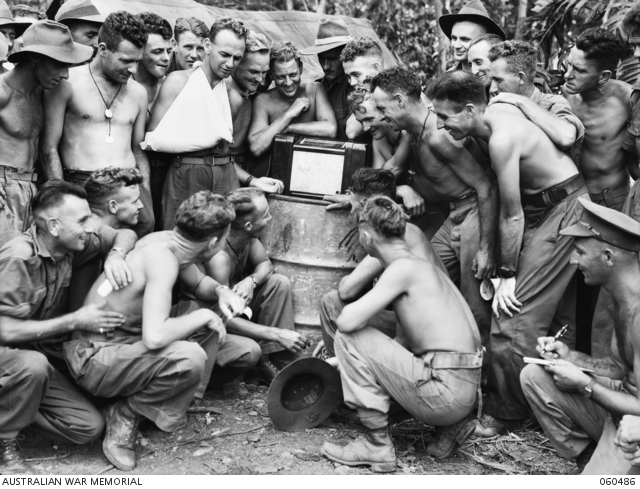
Dad was right about the record crowd.  According to the Melbourne Argus (https://trove.nla.gov.au/newspaper/article/11797793) more than 90,000 people attended – the largest of any of the 5 cups run during the war.  ‘Army khaki and Navy and Air Force blues dominated the colour scheme, but those who accepted those colours for tips in the Cup were disappointed.…Turnover on the tote was an Australian record £177,733.

There is a British Pathe film of the race… http://www.britishpathe.com/video/1943-melbourne-cup   . The crowd is indeed enormous!   The War Memorial also holds a newsreel of the event, produced specifically to share with troops overseas. https://www.awm.gov.au/collection/F00793/ as well as a silent film showing troops listening to the radio broadcast. https://www.awm.gov.au/index.php/collection/C190178   Although it’s not possible to view these online, the caption for the latter is interesting:  Time off was taken to hear the broadcast of the Melbourne Cup.  Although no money passed through any hands, it was quite common to see 4 pawpaws to 1, or 6 ounces of tobacco to 1.  Everyone showed a keen interest just the same although the race was barely audible owing to static.  The bookmaker had a worried look on his face after the race as he lost thirty ounces of tobacco and forty pawpaws. 

AWM 060486

Troops of the 7th Australian Division, headquarters company, listening to the running of the Melbourne Cup.

Dumpu   13/ 11/ 43  

Posted in Americans, Australian, Food and Drink, Papua New Guinea | Tagged , | Leave a comment

Frank Bethune’s famous orders


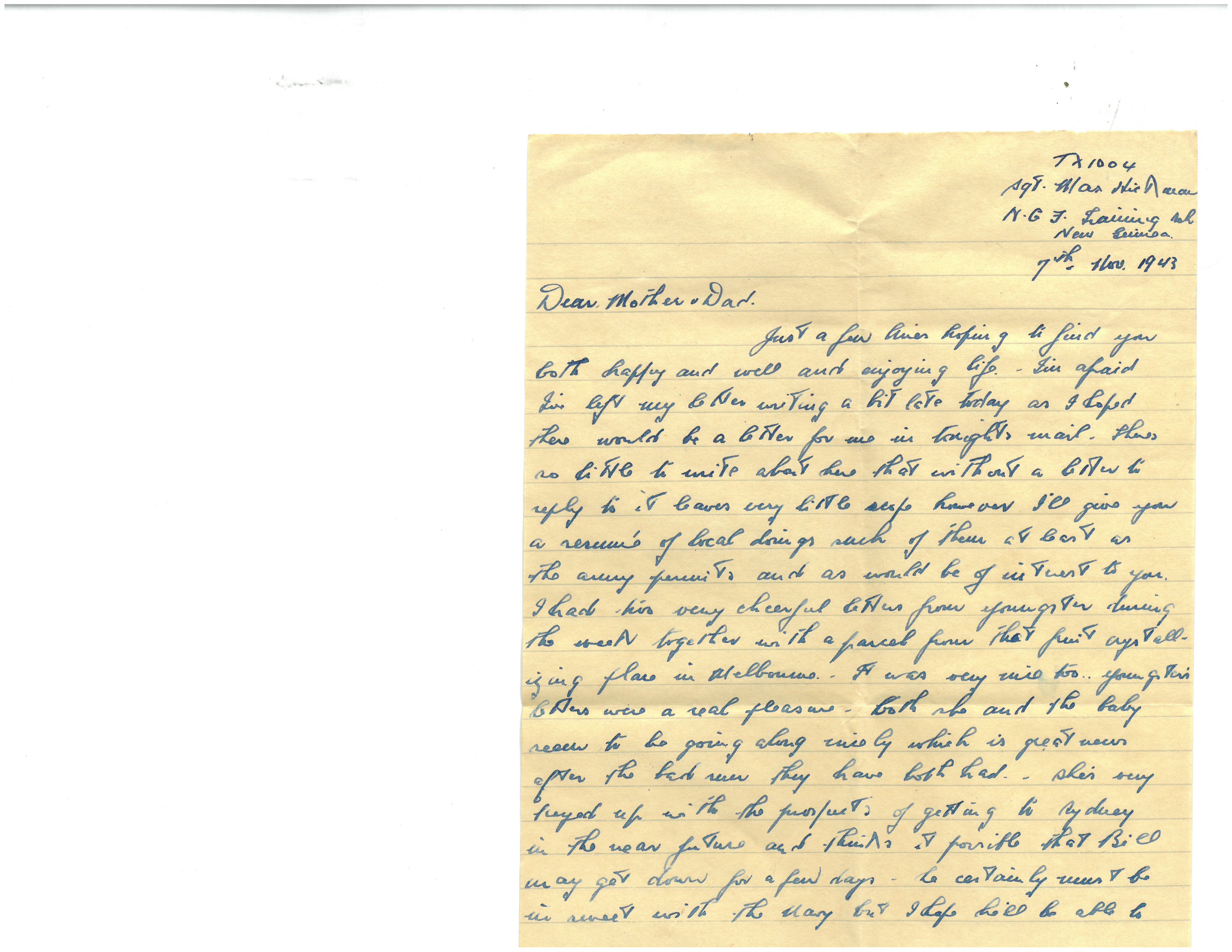
TX 1004

Sgt Max Hickman

NGF Training Sch

New Guinea

7th Nov 1943

Dear Mother & Dad

Just a few lines hoping to find you both happy and well and enjoying life.  I’m afraid I’ve left my letter writing a bit late today as I hoped there would be a letter for me in tonight’s mail.  There’s so little to write about here that without a letter to reply to, it leaves very little scope however I’ll give you a resume of local doings, such of them at least as the army permits and as would be of interest to you.

I had two very cheerful letters from Youngster during the week together with a parcel from that fruit crystallising place in Melbourne.  It was very nice too.  Youngster’s letters were a real pleasure – both she and the baby seem to be going along nicely which is great news after the bad run they have both had.  She’s very keyed up with the prospect of getting to Sydney in the near future and thinks it possible that Bill may get down for a few days.  He certainly must be in sweet with the Navy, but I hope he’ll be able to make it as I’d like the trip to be a success.  Bill’s brother must be in right too, to be stationed in Sydney so long.

Another of the old hands came back to the school yesterday and gave us the Griffin on affairs in the forward area.  The unit seem to be sitting pretty at present and living quite well, all things considered.  It seems there are wild cattle there and fresh meat is reasonably plentiful – three or four times a week anyway.  Jim & Viv are going along nicely but Kong Young has been evacuated to hospital.  Ray has been a platoon commander for some time so I expect to hear of him going back to an officers school anytime.  He’s well within the age limit and as an original member of the unit must be well in the running.  He’s an extra good fellow and will make a good officer.

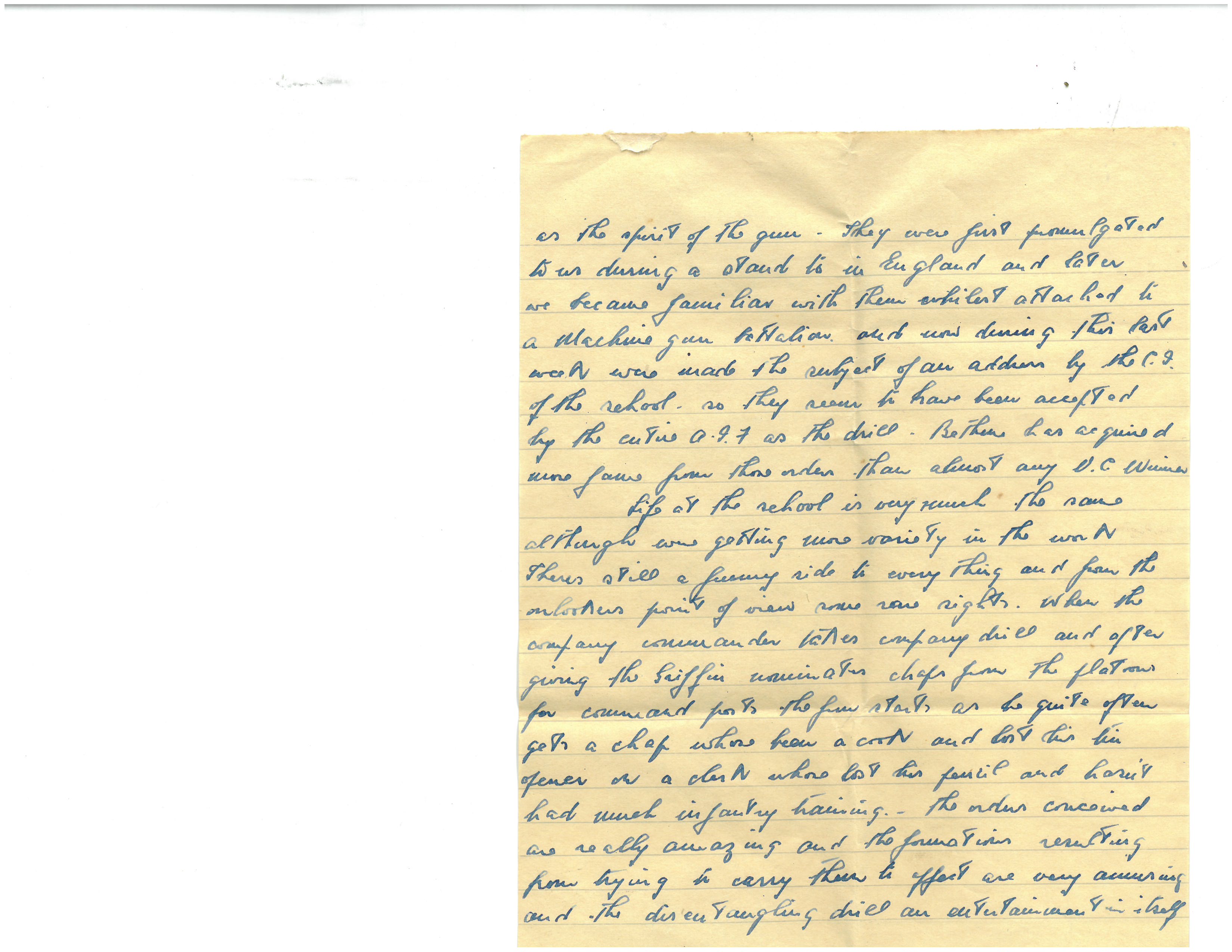
Do you happen to know Captain Bethune Dad?  He lives in Hobart.  I don’t know whether he belongs to the Club or not but he has become quite famous as the result of orders issued to a gun crew during the last argument.  The orders have become known as the Spirit of the Gun – they were first promulgated to us during a stand to in England and later we became familiar with them whilst attached to a machine gun battalion and now during this last week were made the subject of an address by the CO of the school.  So they seem to have been accepted by the entire AIF as the drill.  Bethune has acquired more fame from those orders than almost any VC winner.

Life at the school is very much the same although we’re getting more variety in the work.  There’s still a funny side to everything and from the onlookers’ point of view some rare sights.  When the company commander takes company drill and after giving the Griffin nominates chaps from the platoons for command posts, the fun starts as he quite often gets a chap who’s been a cook and lost his tin opener or a clerk who’s lost his pencil and hasn’t had much infantry training.  The orders conceived are really amazing and the formations resulting from trying to carry them to effect are very amusing and the disentangling drill an entertainment in itself.

Tommy D’Alton has taken a bit of a step along hasn’t he – Commissioner to New Zealand – quite a jump up the social ladder – but I don’t suppose the job will call for much beyond a few speeches at dinners and political turnouts.  Who’ll get the job at home Dad?  Do you know who’s next on the list for Darwin?  I don’t suppose it will involve a by-election.  There’s not a state election due till 46, is there?

And now Mother & Dad I guess I’ve about said my piece so will say cheerio.  Give my love to May, Anne & Carline and regards to the boys.

Love

Max

… gave us the Griffin

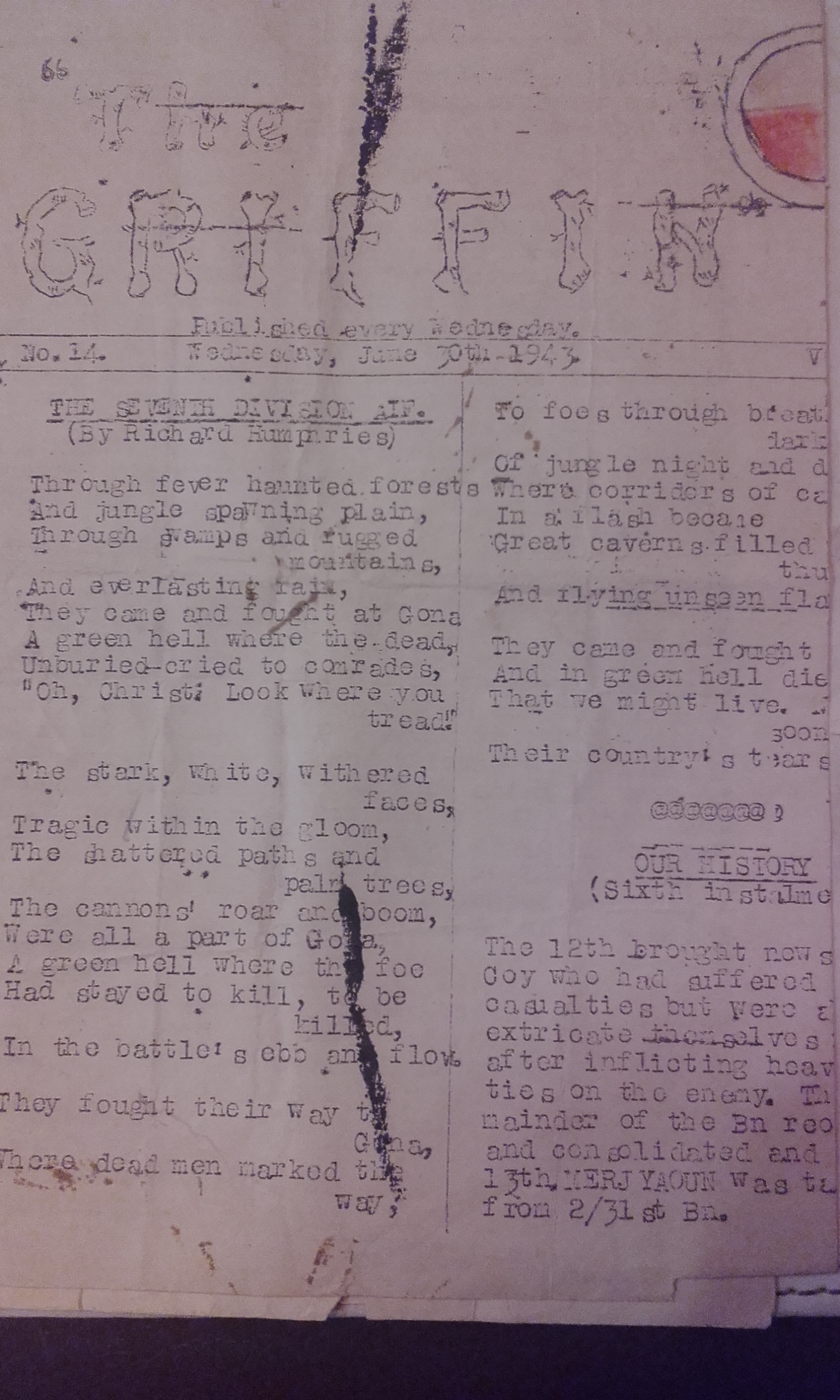
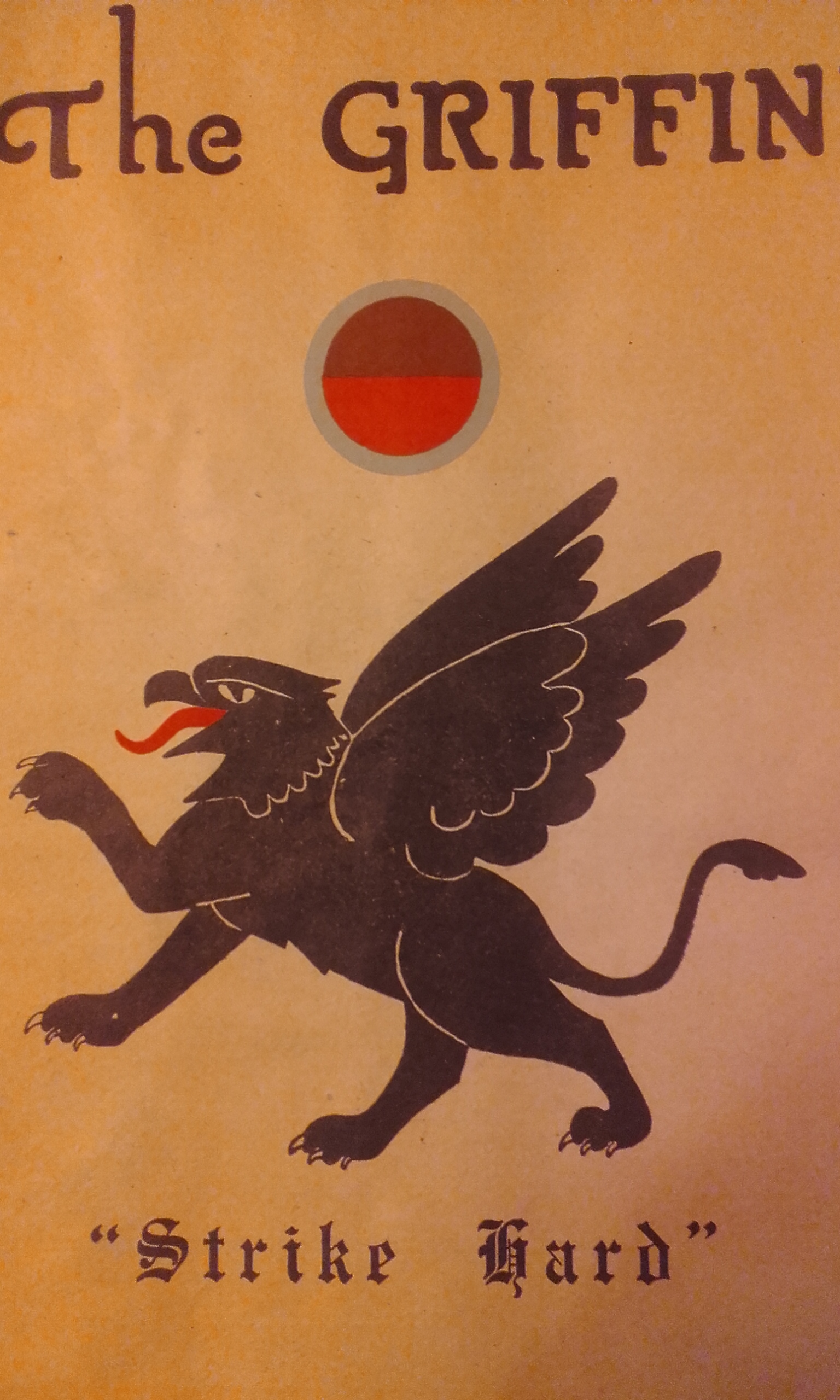
In The Footsoldiers (p431) , a list of expressions described as ‘Quips and Howlers’ includes The Griffin: What’s cooking’, the good oil, what do you know? and the great ‘They say’.   The Griffin was also the name chosen for the unit newsletter which was published ‘nearly every week when out of action’ by the Intelligence Section.  The first edition was dated 31 March 1943.  Generally, these were very modest affairs, but occasionally a ‘special edition’ was produced more professionally, with a strong cover emblazoned with the crest adopted as the unit emblem – and the motto ‘Strike Hard’.


The Unit… Living quite well, all things considered

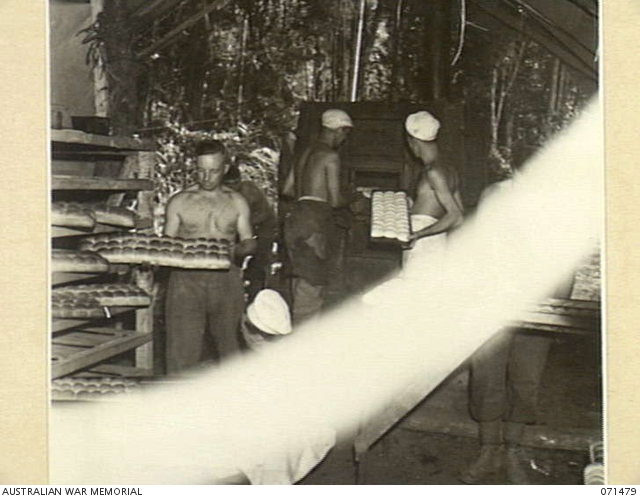
After being relieved by the 2/31st, the unit established a base close to the Mene River.  This position “was to remain our permanent base in the valley until we were relieved on 1 January 1944…. Huts could be built, beds erected, etc, just like any training site.  Fighting and reconnaissance patrols would continue every day, but stand-tis would be dispensed with until further notice…  The Battalion – like all other units of the 7th Division in the valley – fared very well.  Apart from one or two days during moves or patrols, ….two hot meals every day.  Twice a week fresh packed beef was brought up, and the cooks baked bread almost every other day.  Fresh vegetables and fruit were served at least three times a week.  By the end of October mobile cinemas were operating once a week in unit lines, the Pioneer Platoon providing logged seats for the troops’ greater comfort…..”  (The Footsoldiers  pp351 – 353).

However, having a designated ‘permanent base’ did not preclude other activity : ” it had been decided that the 25th Brigade would relieve the 21st Brigade in the Faria-Uria valley……On 9 November the 25th Brigade formally relieved the 21st Brigade, 2/33rd relieving the 2/27th around Don’s Post, Bert’s Post and Guy’s Post….Until the morning of 29 November, when it was relieved by 2/16th Battalion, the unit remained in the Shaggy Ridge area….For most it was a period of improving tracks or their own posts.…(The Footsoldiers pp 356 – 359)


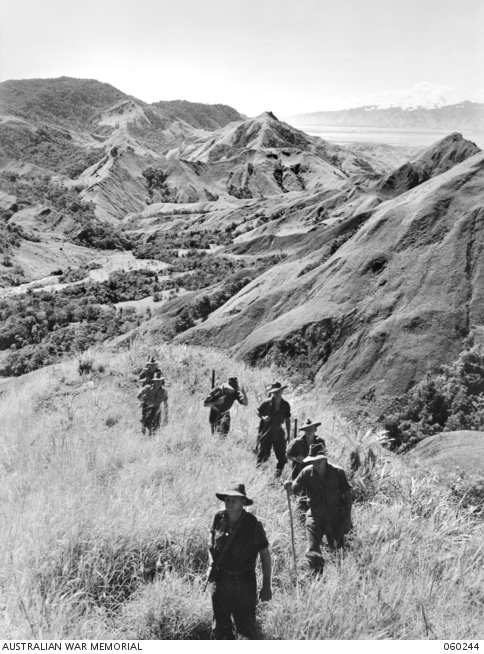
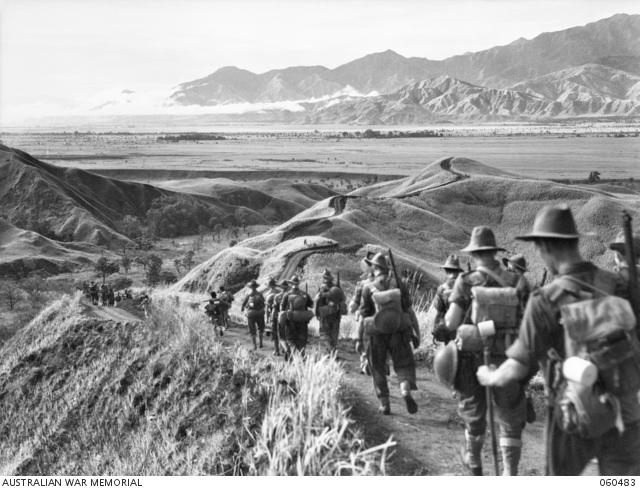
AWM 060244  

Ramu Valley, New Guinea  5 . 11 . 43

Troops of B company 2/27th Australian Infantry Battalion walking along the ridge at Guy’s Post, overlooking the Faria River…


AWM 071479

Guy’s Post, Ramu Valley  27. 3. 44

An Australian Field Bakery working at Guy’s Post.   (Not the bakers referred to in the extract above, but I imagine that like these bakers, those attached to the 25th Brigade also turned out some 6000 buns per day)


AWM 060483

Ramu Valley  9 / 11 / 43

Units of the 21st Australian Infantry Brigade  marching along a winding track in the foothills of the Finisterre Ranges one their way to the Ramu Valley after being relieved at the forward position by troops of the 25th Australian Infantry Brigade.


News of Friends in the Battalion

Those mentioned are Jim McDonnell (TX1024) and Viv Abel (TX797).  Jim and Dad enlisted together at  Brighton on March 4 1940.  Viv who came from Deloraine in the north, enlisted three months earlier.  All were ‘originals’ of the 2/33rd.  Kong Young (real name Kenneth) had also enlisted the previous year – in December 1939 – in Subiaco, WA, and had been a member of the Carrier platoon with the others in England and Syria.  Ray Ross (QX1146) had also been a member of the platoon, and Dad often mentions him both as a friend/ ‘partner in crime’ and as a potential officer.  He rose to the rank of WO2.


Kong Young has been evacuated to hospital

Bill Crooks reports in The Footsoldiers (p353) that there were still worrying numbers of men contracting malaria, which was ‘rampant’ – by mid-December evacuations numbered 9 officers and 178 OR’s – with scrub typhus a further cause of sickness and even death.

By now it had been acknowledged by the ‘powers that be’, that the rate of malaria infection was such that it could preclude victory over the Japanese. (It subsequently emerged that the enemy’s rate of infection was probably even higher than that of the Allied troops – see jmvh article link below).  By early 1943, malaria hospitalisation rates were so high that drastic action became necessary. The form this took… was the creation of an extraordinary Army malariological research institute — the Land Headquarters Medical Research Unit (LHQMRU) at Cairns. …Applied in the field in Papua New Guinea, the findings flowing from the LHQMRU radically reduced malarial infection rates among the Allies. That in turn enabled the Allies to turn the tide of war and eventually to defeat the Japanese.  (https://jmvh.org/article/australian-malariology-during-world-war-ii-part-3-of-pioneers-of-australian-military-malariology/)


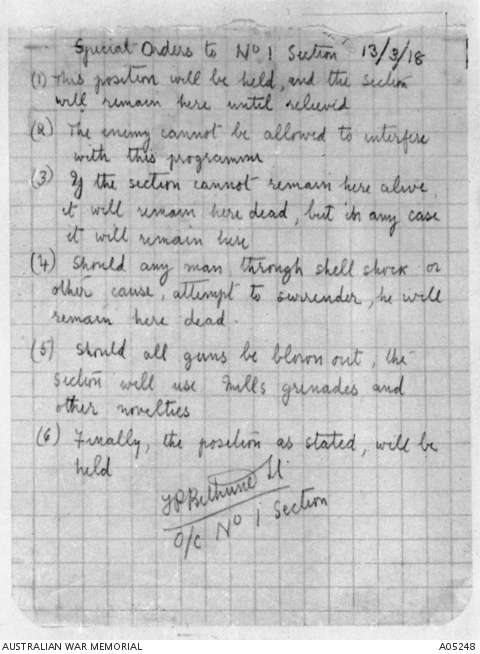
The famous orders of Frank Bethune

In fact, Frank Bethune had died in Hobart in December the previous year.  The orders that made him famous were issued at Passchendale in March 1918. Bethune’s group (no. 1 section, 3rd Machine Gun Company) survived in their position until relieved. The orders passed into military history, were circulated throughout the allied armies in France and embodied in British Army Orders until 1940. After the fall of Dunkirk, they were reproduced as posters under the caption ‘The spirit which won the last war’ and displayed throughout England.  (http://adb.anu.edu.au/biography/bethune-frank-pogson-5226)  I can find no reference to them as ‘the spirit of the gun’ but of course this terminology may have been used in training courses.

According to a tribute in the Sydney Morning Herald, 5 December 1942 (https://monumentaustralia.org.au/themes/people/military/display/102121-captain-frank-bethune)      Captain Frank Pogson Bethune, who died yesterday, was the author of a famous order to his troops in France in the last war. He was a Church of England minister when he enlisted as a private in 1915. His order is quoted in Dr. Bean’s Official History of the A.I.F.  The position that Captain Bethune, then a lieutenant, was told to hold was regarded by him as a “useless deathtrap.” Unable to convince his superior officer, he demanded that he should be allowed to justify his opinion by holding the post himself. This was agreed to. He told his section what he thought of the place, and the circumstances, and asked for volunteers. Every man volunteered, and he issued the following order:

AWM item : AO52

Frank Bethune’s order : Basically, this position will be held at all costs: there will be no surrender.

Even though Bethune may not have expected his orders to have been obeyed to the letter, he had enough knowledge of and confidence in his men to be able to write such an order.

(http://www.awm.gov.au/visit/exhibitions/1918/soldier/diggers)

Life at the School…. more variety in the work


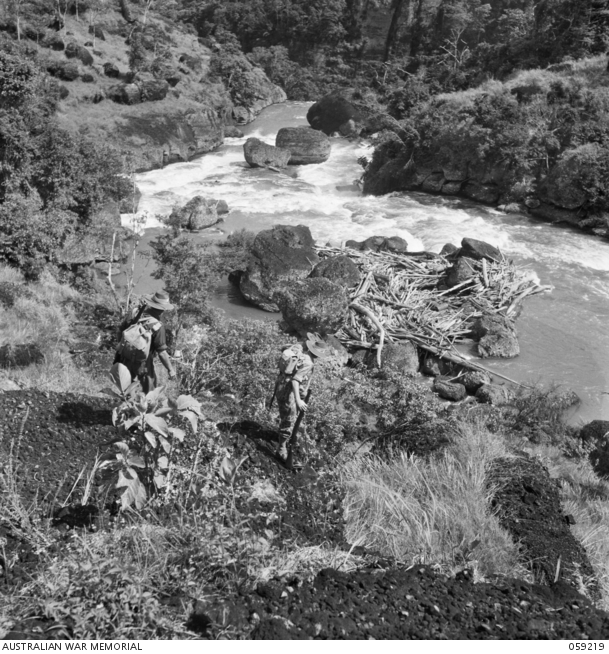
AWM 059219

Laloki Valley New Guinea  5 . 11 . 43

A patrol of the NGF Training School (Jungle Wing) at the edge of the Laloki River near the Rouna Falls.


Posted in Food and Drink, organisation, Tasmanian, training, Uncategorized | Tagged , | Leave a comment

A long hot walk back from the rear details camp


TX 1004

Sgt Max Hickman

NGF Training Sch

New Guinea

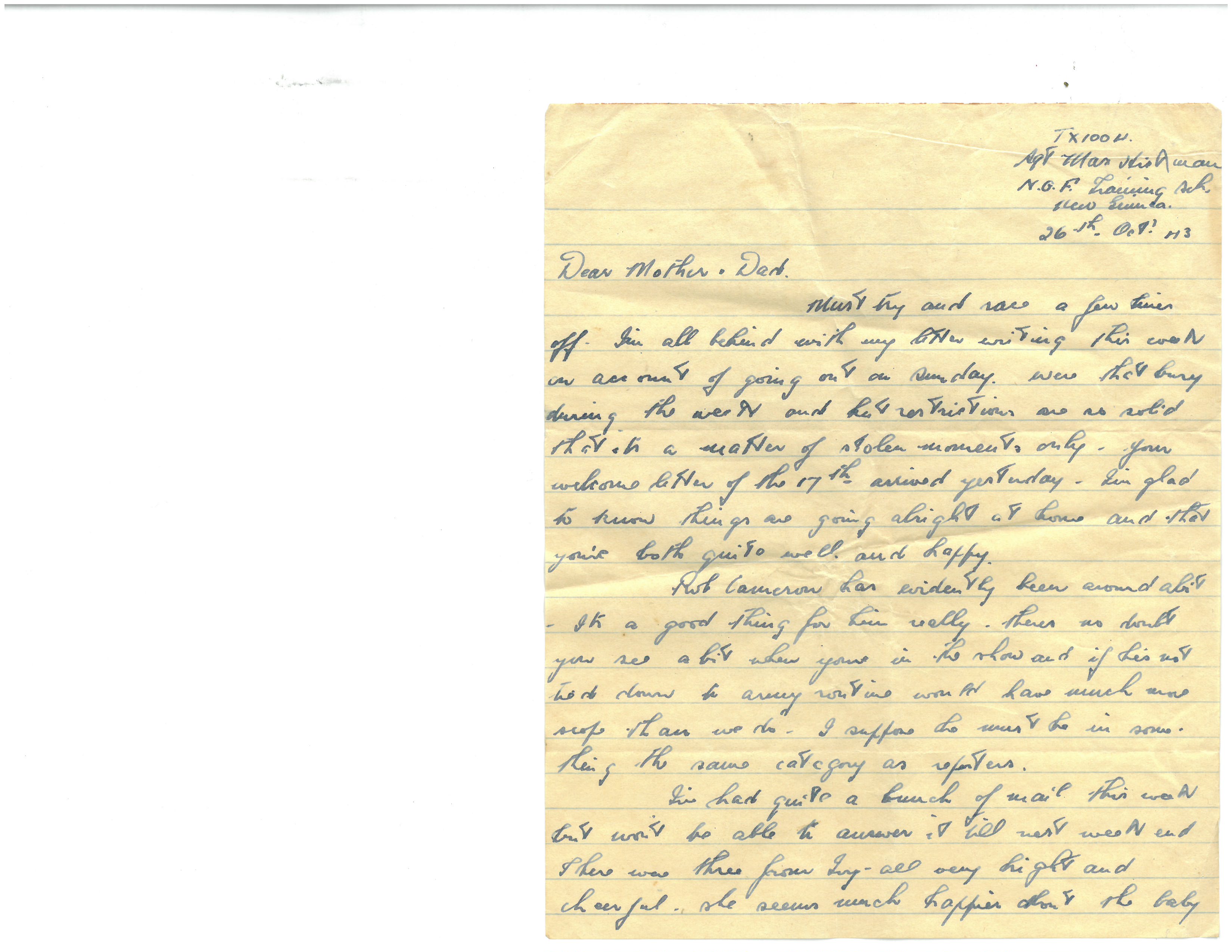
26th Oct 43

Dear Mother & Dad

Must try and race a few lines off.  I’m all behind with my letter writing this week on account of going out on Sunday.  We’re that busy during the week and hut restrictions are so solid that it’s a matter of stolen moments only.  Your welcome letter of the 17th arrived yesterday.  I’m glad to know things are going alright at home and that you’re both quite well and happy.

Rob Cameron has evidently been around a bit.  It’s a good thing for him really.  There’s no doubt you see a bit when you’re in the show and if he’s not tied down to army routine would have much more scope than we do.  I suppose he must be in something the same category as reporters.

I’ve had quite a bunch of mail this week but won’t be able to answer it till next weekend.  There were three from Ivy – all very light and cheerful – she seems much happier about the baby these days as she’s come to realise that the excema is not affecting him in any other way and now that she’s finished the income tax returns for …. she is happy to give all her time to the little bloke.  Daph Wise wrote a nice cheerful letter too.  She said she was coming out some time to play cards.  I also had letters from Shirley and one from Mrs Tait – a lady who showed us a good time when we were camped near Brisbane last year.  One of the chaps I told you about some weeks back was her brother – one of the best fellows I ever knew – only a kid too – he had his twenty first birthday a few days before he was killed.

I went down to the unit rear detail crowd on Sunday and had a really good day.  There were several blokes there who’d been up top and got wounded in the early stages.  They’ve finished their convalescence and are waiting to go back.  Unfortunately we left a bit late to start back to camp and had to walk twelve or thirteen miles of the way – tough going too.  I suppose we climbed nearly as high as Mount Wellington and although it was night time it was powerful hot walking and we were as dry as wooden gods and to make us more thirsty we could hear the swirl of rushing water as a fast river rushed down the mountain but eventually we got through alright.

Well having had tea (not bad either – fresh meat) I’ve got a few minutes before the night’s bastardry begins, so will continue the story.  I was talking to a chap who used to be in the 1st Anti-Tank and he told me Horrie Strutt (you probably know him – he was CO of the unit when we sailed) was a very sick man – not expected to live.  I wonder what’s wrong with him – he looked so well.

There’s not much news from this end Mother & Dad – things are going along very steadily.  I believe Jim’s still doing alright and the rest of the platoon are plodding along nicely.  I must say cheerio now.  Give my love to May, Anne & Carline and best wishes to the boys.

Love

Max


We’re that busy during the week….

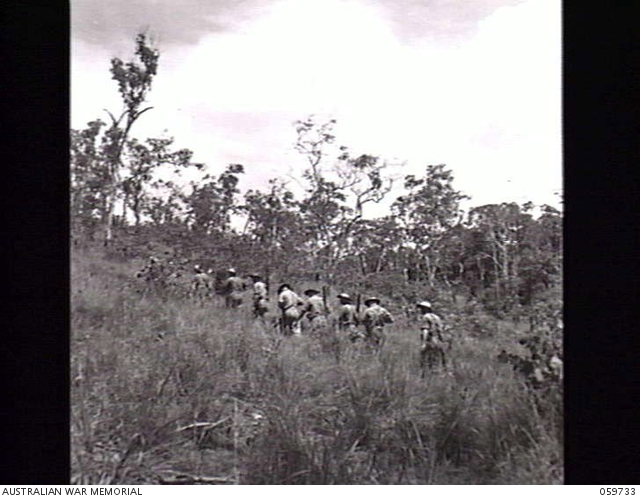
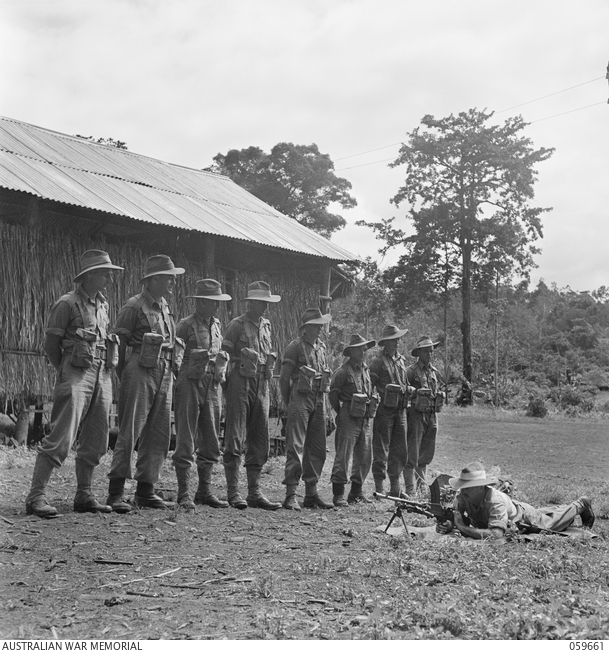
These photos may have been taken during the course in which Dad was participating :

AWM 059733

Sogeri New Guinea 4/11/43  

NCO’s undergoing the junior leaders course at the NGF Training School setting out over the hills during one of their training periods


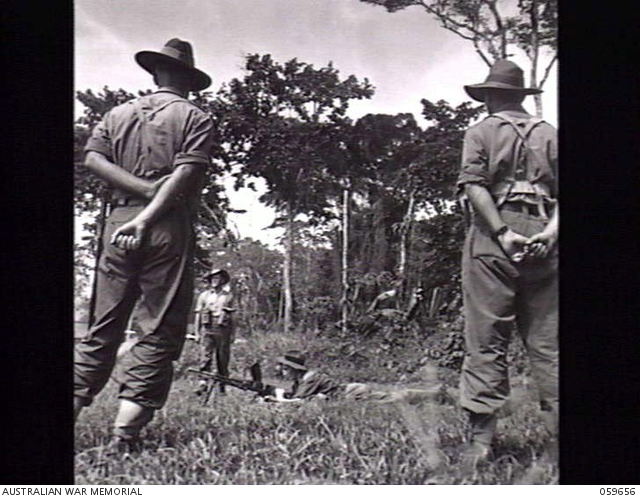
AWM 059656

Sogeri New Guinea  4/11/43 

SX Sgt JA Curlis, an instructor of the NGF Training School, lecturing junior leaders on the operation of a Bren gun


Rob Cameron

There is no Tasmanian of this name on the world war II nominal roll.  (http://www.ww2roll.gov.au)  It seems he had an interesting role – ‘not tied down to army routine’, ‘something the same category as reporters’… so maybe PR?   It will have to remain a mystery to me!

Letters from Shirley and Mrs Tait

Shirley is the Scottish nurse to whom Dad became engaged while based in England.  By 1943 she had married a local man, but she and Dad were clearly still on friendly terms.  Mrs Tait’s young brother was John McGrow (QX 7355)  who had died on September 9 from injuries sustained in the Liberator crash on September 7.(see post dated Sept 22)

Visiting the unit rear detail crowd

I’m not sure exactly where this camp was, but it’s possible the reference relates to the ‘details camp’ on the site of the old Murray Barracks in Port Moresby.

AWM 073526

Port Moresby, New Guinea 31/5/44  The New Guinea Details Depot located at the site of the old Murray Barracks area.  A majority of the 1,000 men in the camp are from New Guinea hospitals and convalescent camps and are awaiting return to their former units


It seems the ‘twelve or thirteen miles’ they walked was not the whole distance from the camp back to the Training School at Sogeri, but the last part would certainly have been along the ‘Rouna Road’:

State Library of South Australia photo PRG 691/12/48

View of two army trucks on a steep road en route to Rouna from Port Moresby (1943)


Powerful hot walking…  we could hear the swirl of rushing water

They would certainly have been able to hear the Rouna Falls on the Laloki River… now a major tourist attraction in the area.

Rouna Falls – image from

Top 10 most famous places to visit in Papua New Guinea


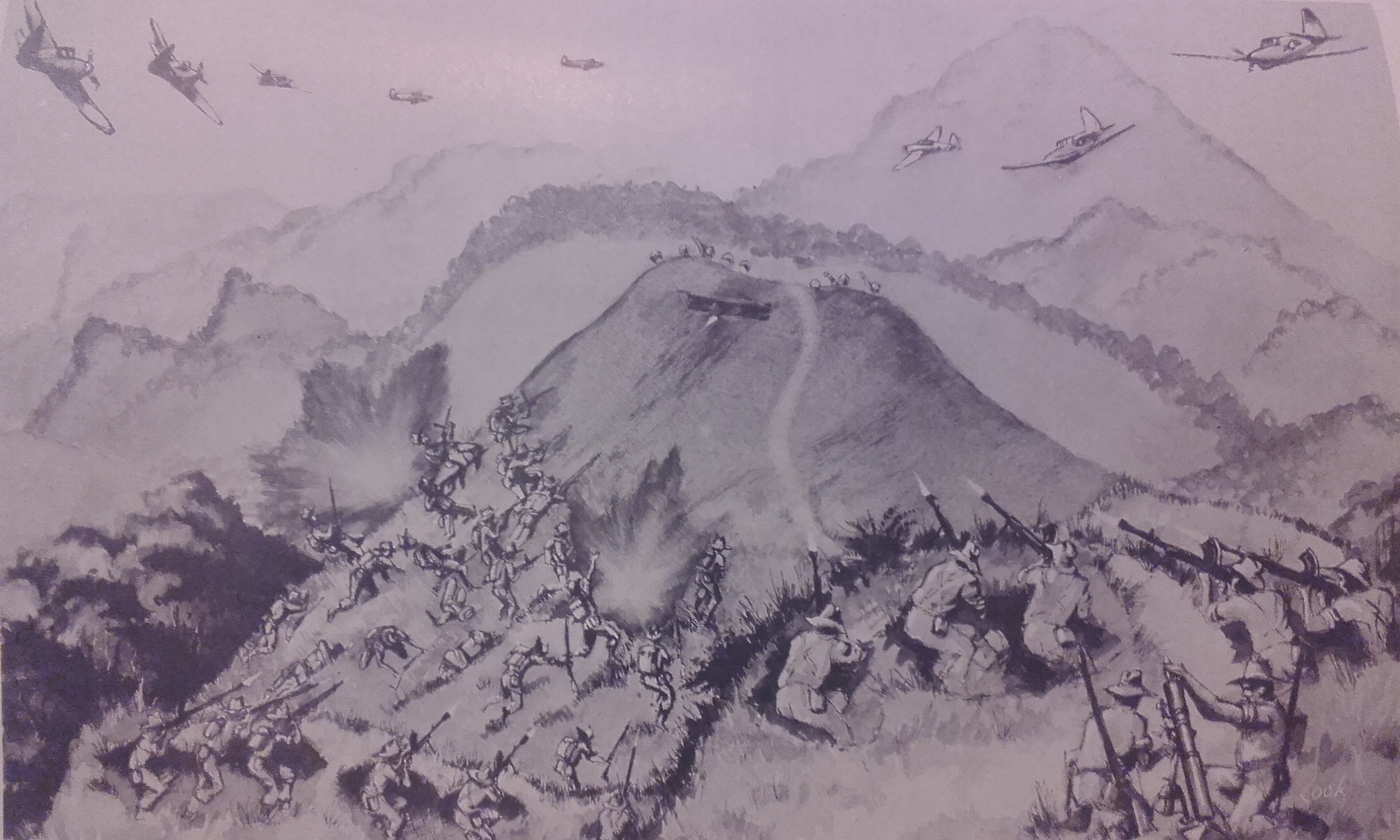
The Battalion

On October 13, the Battalion was involved in action against Japanese positions on ‘the Knoll’ in the valley of the Surinam.  It was a costly encounter, and when added to the previous 3 days, the losses were : A Company – 5 killed or died of wounds, and four wounded; B Company one and three; C company one and two; D company four and 30.  At 1600 hours Brigadier Eather advised the CO his unit would be relieved by the 2/31st battalion that night…  The advance party of the 2/31st, led by Lt-Col Murray Robson, arrived at the unit below the first knoll at 1800 hours.  On until 2300 hours the difficult business of ‘relief in the line’ was carried through….. The relief was without incident…. On the 15th, with 2/31st reporting no sightings or movements of Japanese, and 21st Brigade and the Independent Companies clambering a bout the lower jungle slopes of Shaggy Ridge and Mt Prothero – as well as no contact north-west beyond Kesawai – it was apparent that the Japanese had withdrawn from the Ramu foothills back up into the 500-feet Shaggy/ Prothero/ Kanmiryo complex.   (Foot soldiers p348 – 350)


16 platoon, D Company, attack on the Knoll at Surinam New Guinea, 13 October 1943 : a sketch by Terry Cook from a field sketch drawn by Sergeant W Crooks just after the attack.  (Foot soldiers p 350)


Posted in Papua New Guinea, training, Uncategorized | Tagged | Leave a comment

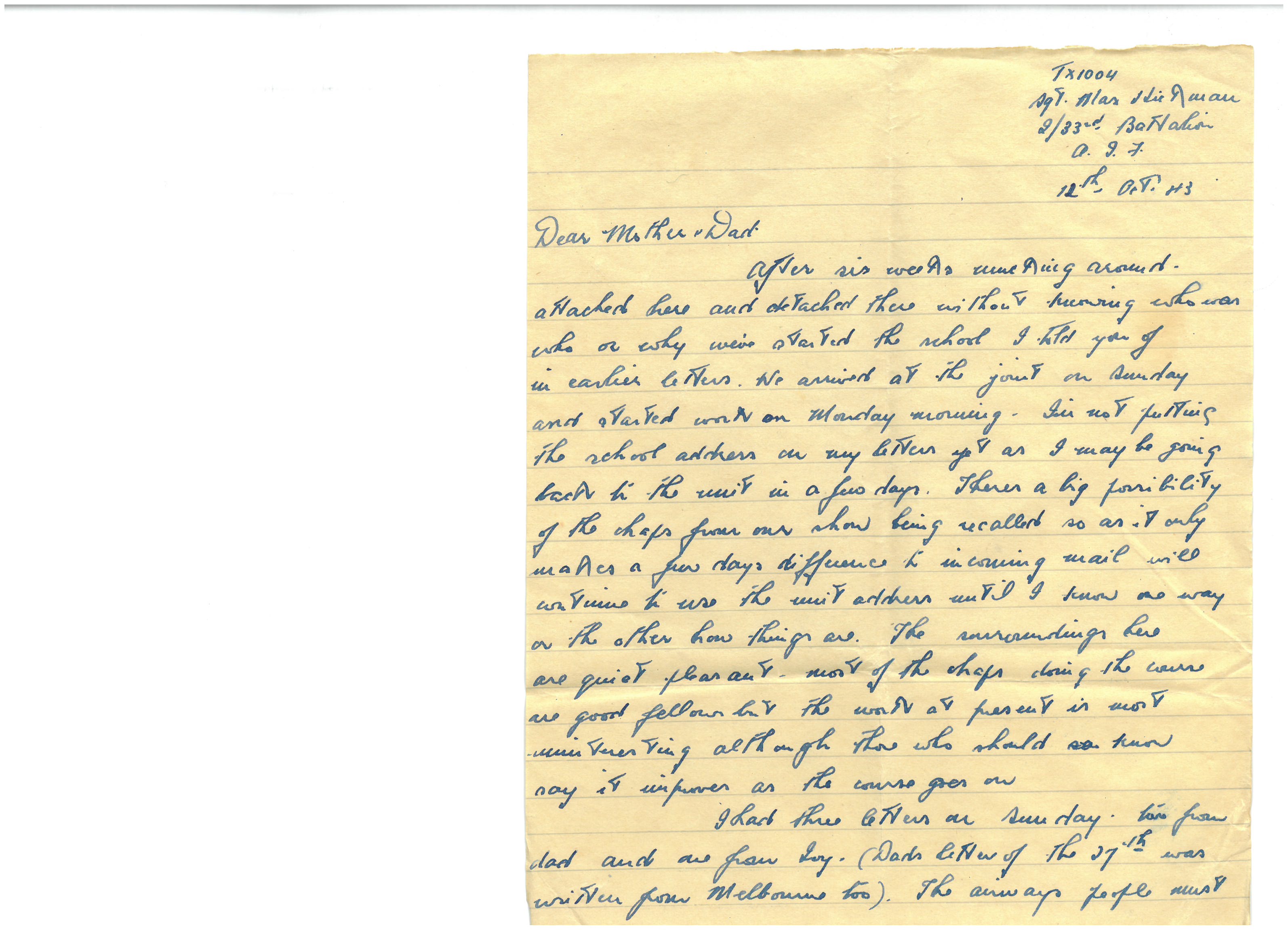
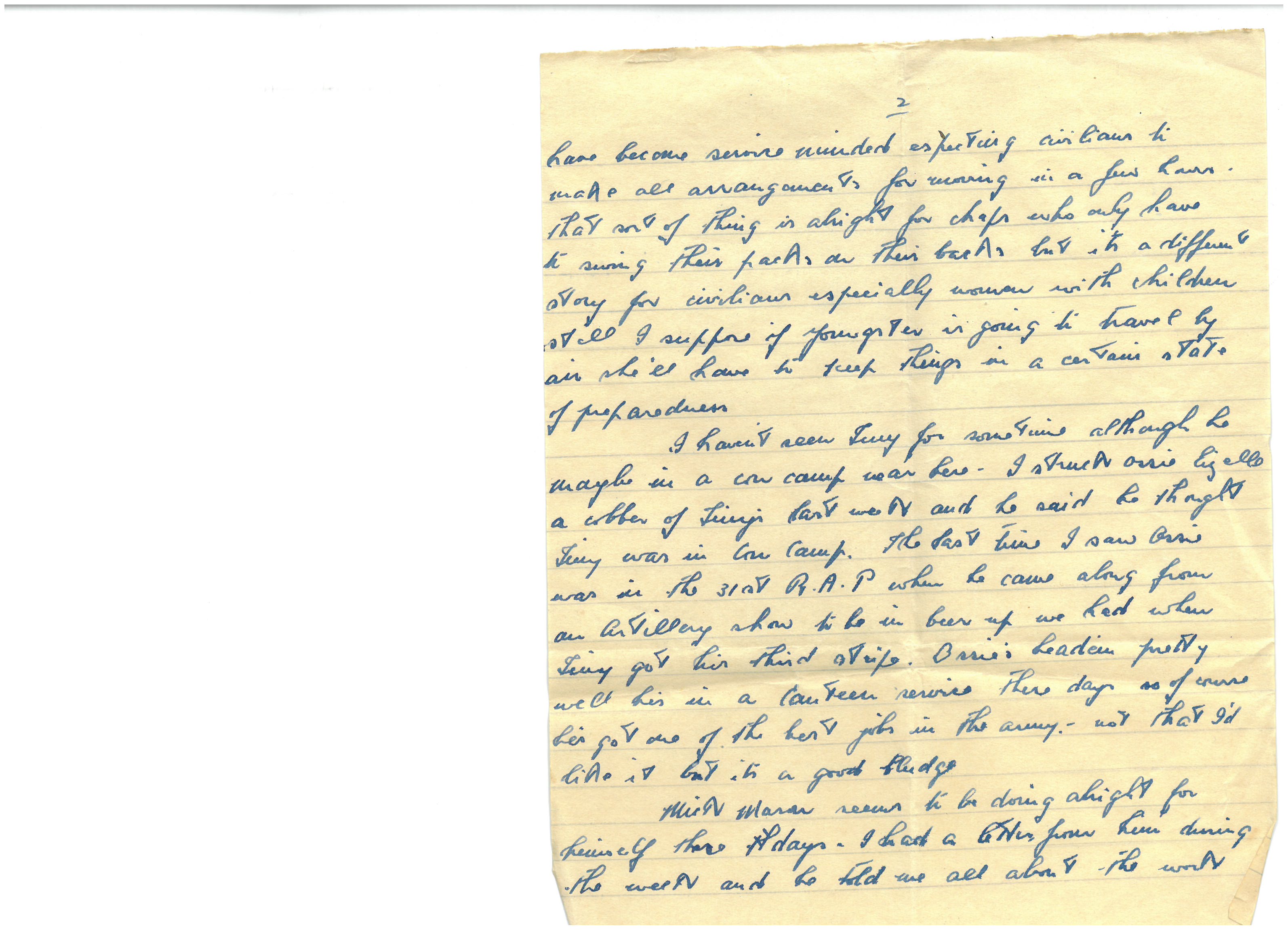
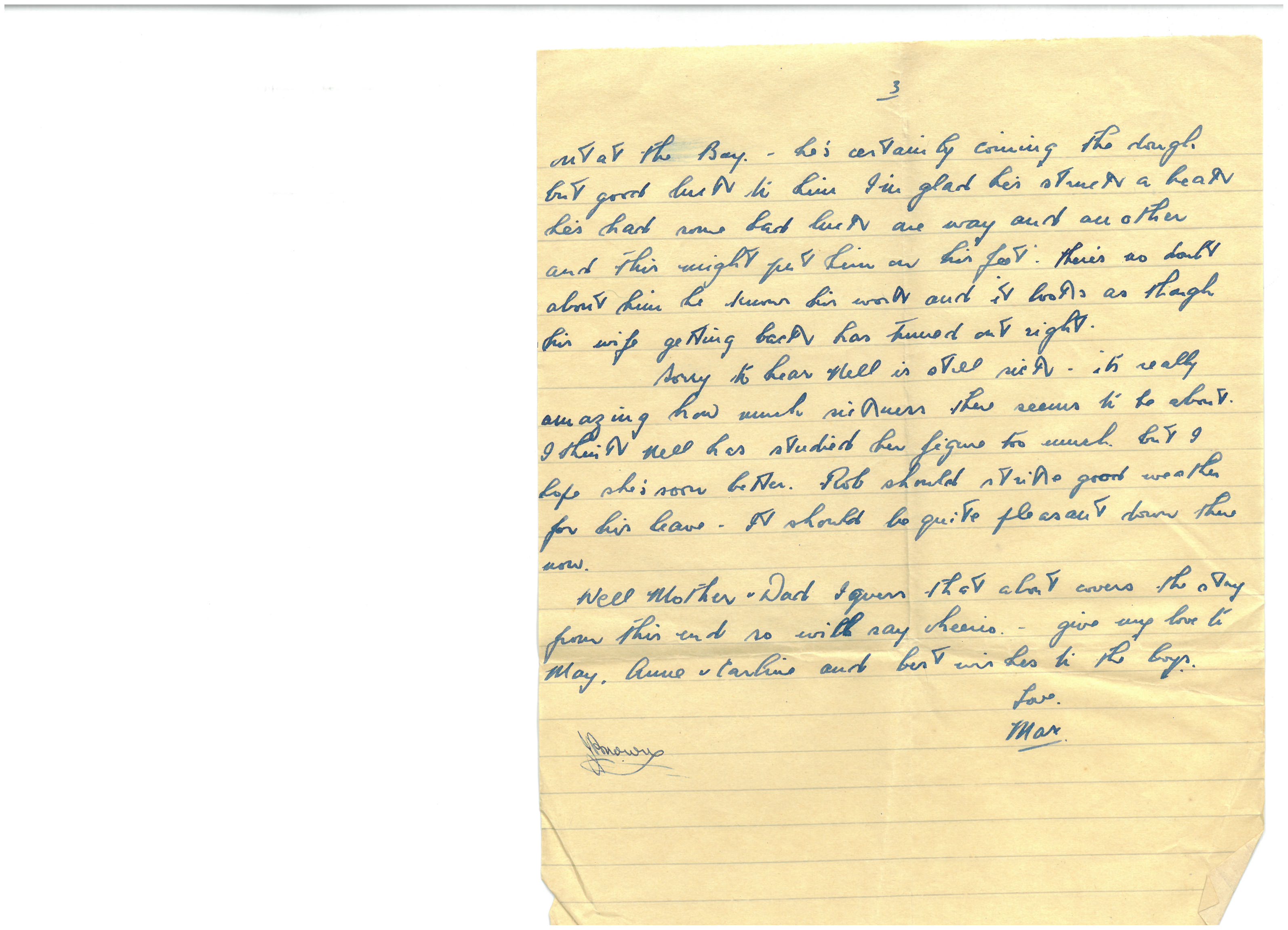
Some higher authority…controlling this show


TX 1004

Sgt Max Hickman

2/33rd Battalion

AIF

11th Oct 43

Dear Mother & Dad

After six weeks mucking around – attached here and detached there without knowing who was who or why, we’ve started the school I told you of in earlier letters.  We arrived at the joint on Sunday and started work on Monday morning..  I’m not putting the school address on my letters just yet as I may be going back up to the unit in a few days.  There’s a big possibility of the chaps from our show being recalled so as it only makes a few days’ difference to incoming mail will continue to use the unit address until I know one way or the other how things are.  The surroundings here are quite pleasant.  Most of the chaps doing the course are good fellows but the work at present is most uninteresting although those who should know say it improves as the course goes on.

I had three letters on Sunday – two from Dad and one from Ivy.  (Dad’s letter of the 27th was written from Melbourne too).  The airways people must have become service minded, expecting civilians to make all arrangements for moving in a few hours.  That sort of thing is alright for chaps who only have to swing their packs on their back but it’s a different story for civilians especially women with children.  Still I suppose if Youngster is going to travel by air she’ll have to keep things in a certain state of preparedness. 
I haven’t seen Tiny for some time although he maybe in a con camp near here.  I struck Ossie Eizelle a cobber of Tiny’s last week and he said he thought Tiny was in con camp.  The last time I saw Ossie was in the 31st RAP when he came along from an artillery show to be in a beer up we had when Tiny got his third stripe.  Ossie headed ‘em pretty well – he’s in a canteen service these days so of course he’s got one of the best jobs in the army.  Not that I’d like it, but it’s a good bludge.
Mick Mason seems to be doing alright for himself these days.  I had a letter from him during the week and he told me all about the work out at the  Bay.  He’s certainly coining the dough but good luck to him.  I’m glad he’s struck a break.  He’s had some bad luck one way and another and this might put him on his feet.  There’s no doubt about him he knows his work and it looks as though his wife getting back has turned out right.

Sorry to hear Nell is still sick.  It’s really amazing how much sickness there seems to be about.  I think Nell has studied her figure too much but I hope she’s soon better.  Rob should strike good weather for his leave.  It should be quite pleasant down there now.

Well Mother & Dad I guess that about covers the story from this end so will say cheerio.  Give my love to May, Anne & Carline and best wishes to the boys.

Love

Max

…A big possibility of the chaps from our show being recalled …!?

This comment indicates just how far out of the loop Dad was, and/or how easily rumours were spread.  There’s nothing in unit diaries or histories to suggest the men of the 25th Brigade (2/25th, 2/31st and 2/33rd Bns) who were at that time involved in action in the Ramu Valley might be recalled.  In fact on the night of October 10, the 2/33’s B Company carried out a successful night attack on the Japanese company dug in on the summit of ‘feature 4100’ – an attack which Bill Crooks says ‘should have been ranked after that of the later attack and capture of Shaggy Ridge and Pallier’s Hill (but which is) rarely, if at all, mentioned outside the battalion.’ (The Footsoldiers p 332)

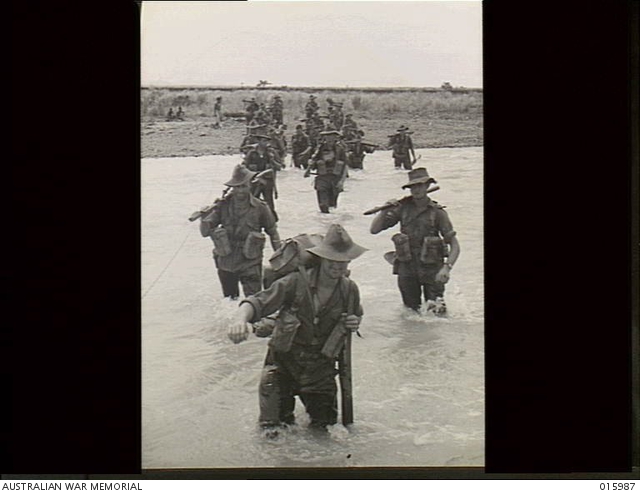
AWM 015987

Ramu Valley, New Guinea. 21 October 1943. In their victorious advance along the Markham and Ramu valleys Australian troops marched for seventy miles fording creeks and rivers.


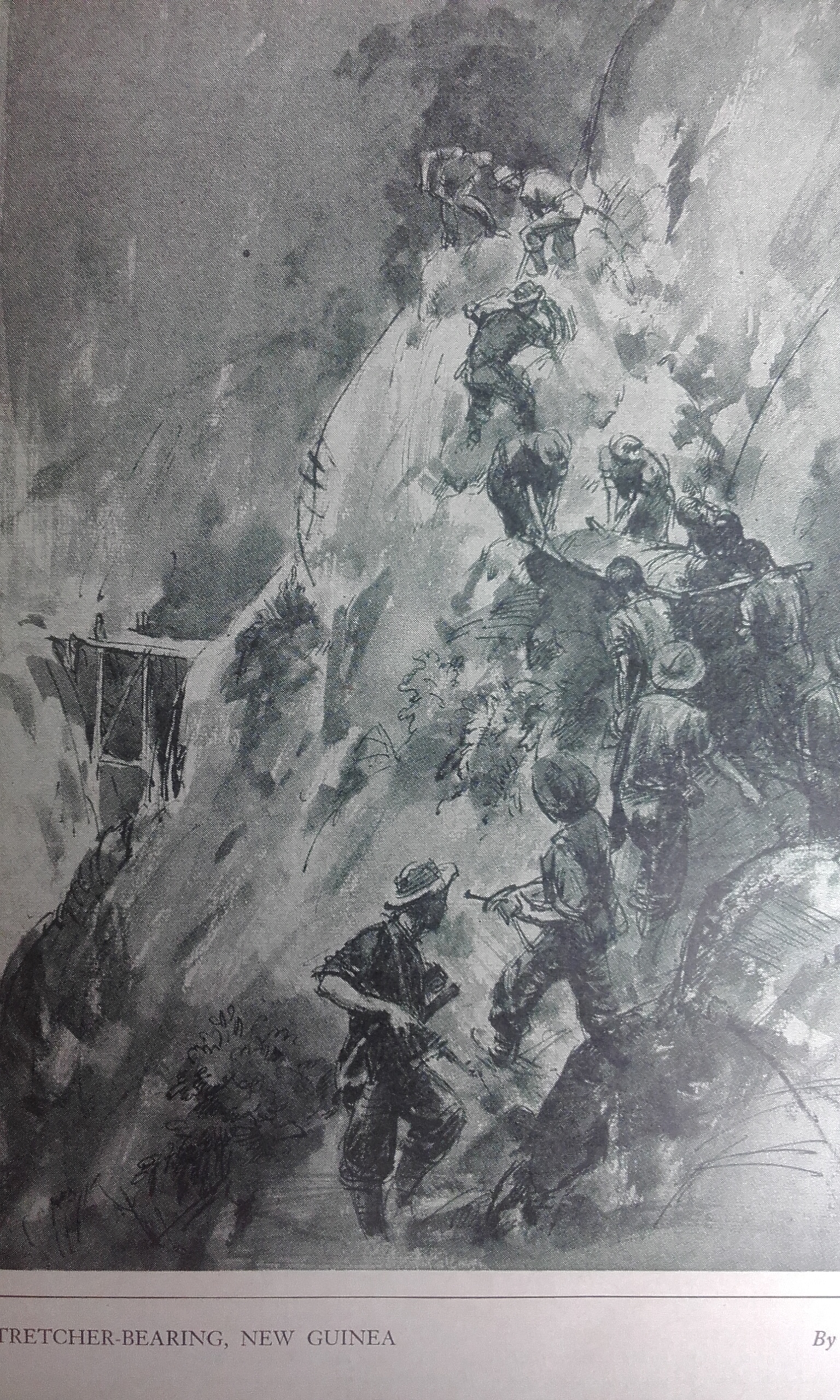
Stretcher-bearing, New Guinea

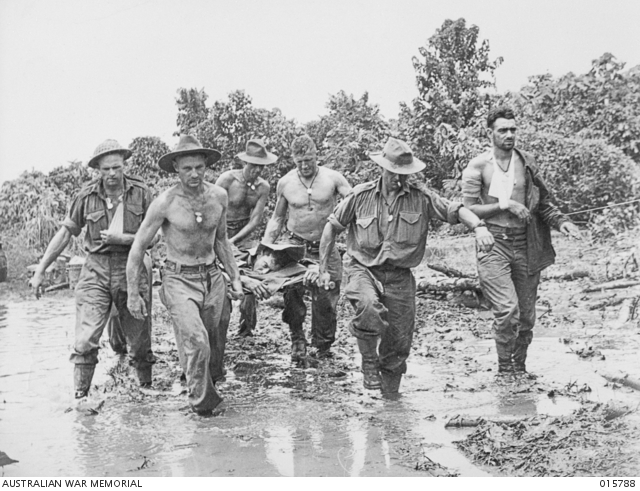
from Jungle Warfare – AWM 1944

According to The Footsoldiers (p331)- in the morning light, ‘it was obvious the Japs had thought it impossible for anyone to attempt climbing the near vertical eastern lip and must have been dumbfounded when it was done at night.’


Junior Leaders School no. 12

The NGF Training School Diary shows that on 10 October, 61 NCO’s were marched in for Junior Leaders School no. 12, and that this school commenced on October 11.   This school lasted 4 weeks but Dad’s record shows he was not transferred back to the unit until 14 January 1944.  I assume this means he was participating in other schools and/ or taking on the role of instructor.  Being very familiar with the operation of the Bren gun, for example (having been part of the Bren Gun Carrier platoon since Syria) he could have instructed others, as this sergeant is doing:

AWM 6227840 4 November 1943  No. 9 section, 3rd platoon of Junior Leaders course being instructed in the operation of the Bren Gun at the NGF Training School.  Sgt A T Hill Instructor.


TX 1004

Sgt Max Hickman

NGF Training Sch

New Guinea

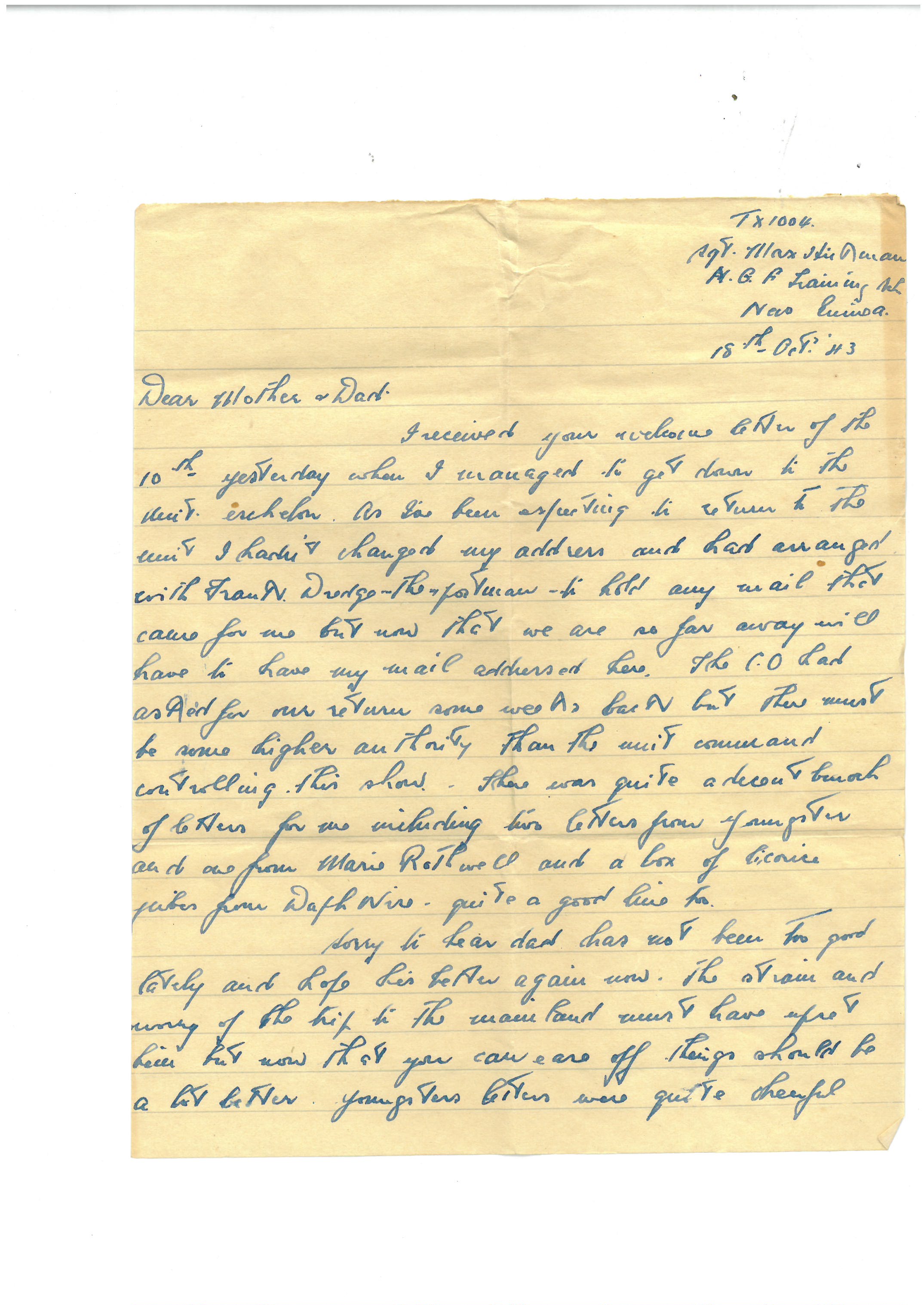
18th Oct 43

Dear Mother & Dad

I received your welcome letter of the 10th yesterday when I managed to get down to the unit echelon.  As I’ve been expecting to return to the unit I hadn’t changed my address and had arranged with Frank Dredge – the postman – to hold any mail that came for me but now that we are so far away will have to have my mail addressed here.  The CO had asked for our return some weeks back but there must be some higher authority than the unit command controlling this show.  There was quite a decent bunch of letters for me including two letters from Youngster and one from Marie Rothwell and a box of liquorice tubes from Daph Wise – quite a good line too.

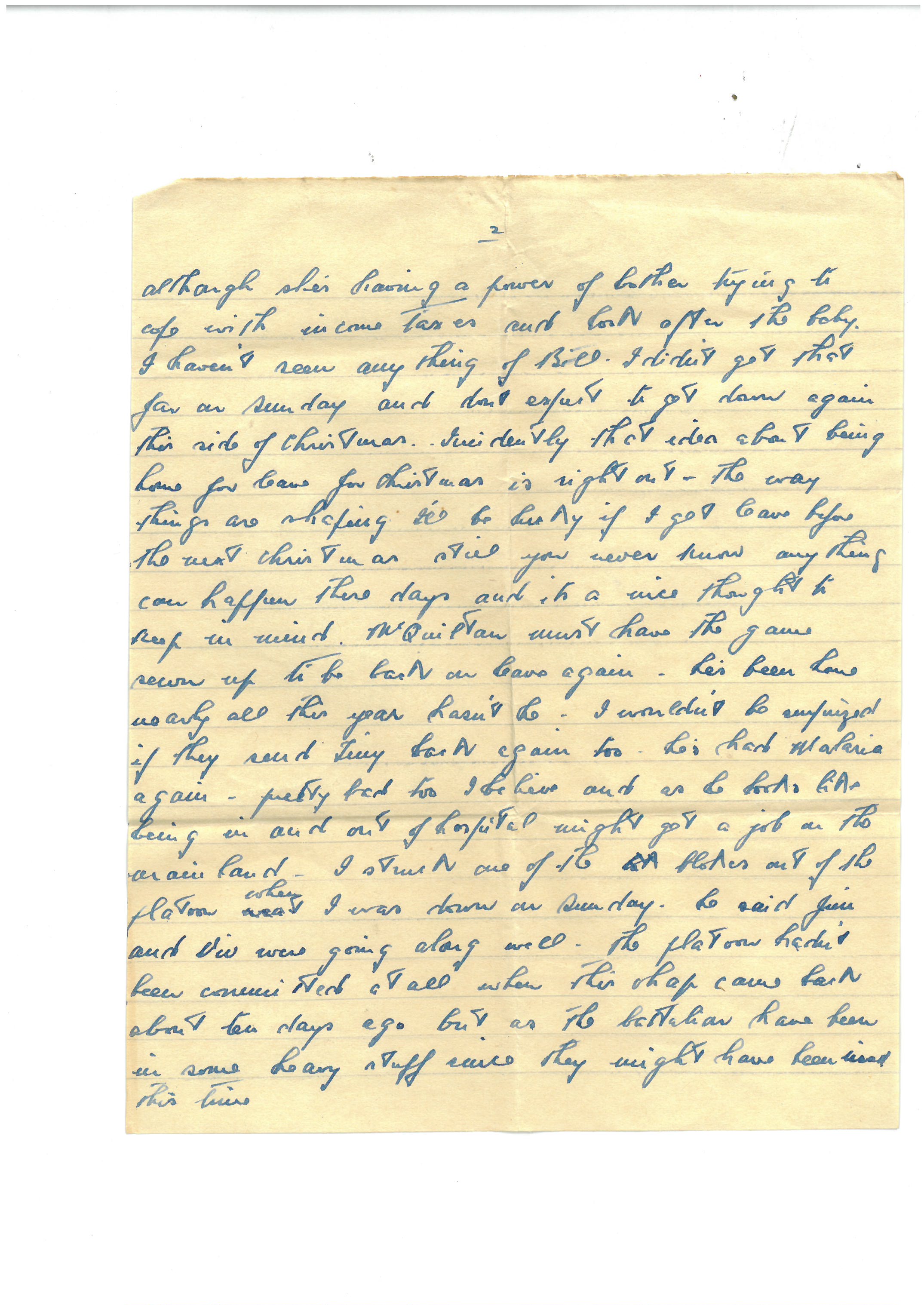
Sorry to hear dad has not been too good lately and hope he’s better again now.  The strain and worry of the trip to the mainland must have upset him but how that you can ease off things should be a lot better.  Youngster’s letters were quite cheerful although she’s having a power of bother trying to cope with income taxes and look after the baby.  I haven’t seen anything of Bill.  I didn’t get that far on Sunday and don’t expect to get down again this side of Christmas.  Incidentally that idea about being home for leave for Christmas is right out.  The way things are shaping I’ll be lucky if I get leave before next Christmas.  Still you never know: anything can happen these days and it’s a nice thought to keep in mind.  McQuiltan must have the game sewn up to be back on leave again.  He’s been home nearly all this year hasn’t he?  I wouldn’t be surprised if they send Tiny back again too – he’s had Malaria again – pretty bad too I believe and as he looks like being in and out of hospital might get a job on the mainland.  I struck one of the blokes out of the platoon when I was down on Sunday.  He said Jim and Viv were going along well.  The platoon hadn’t been committed at all when this chap came back about ten days ago but as the battalion have been in some heavy stuff since they might have been used this time.

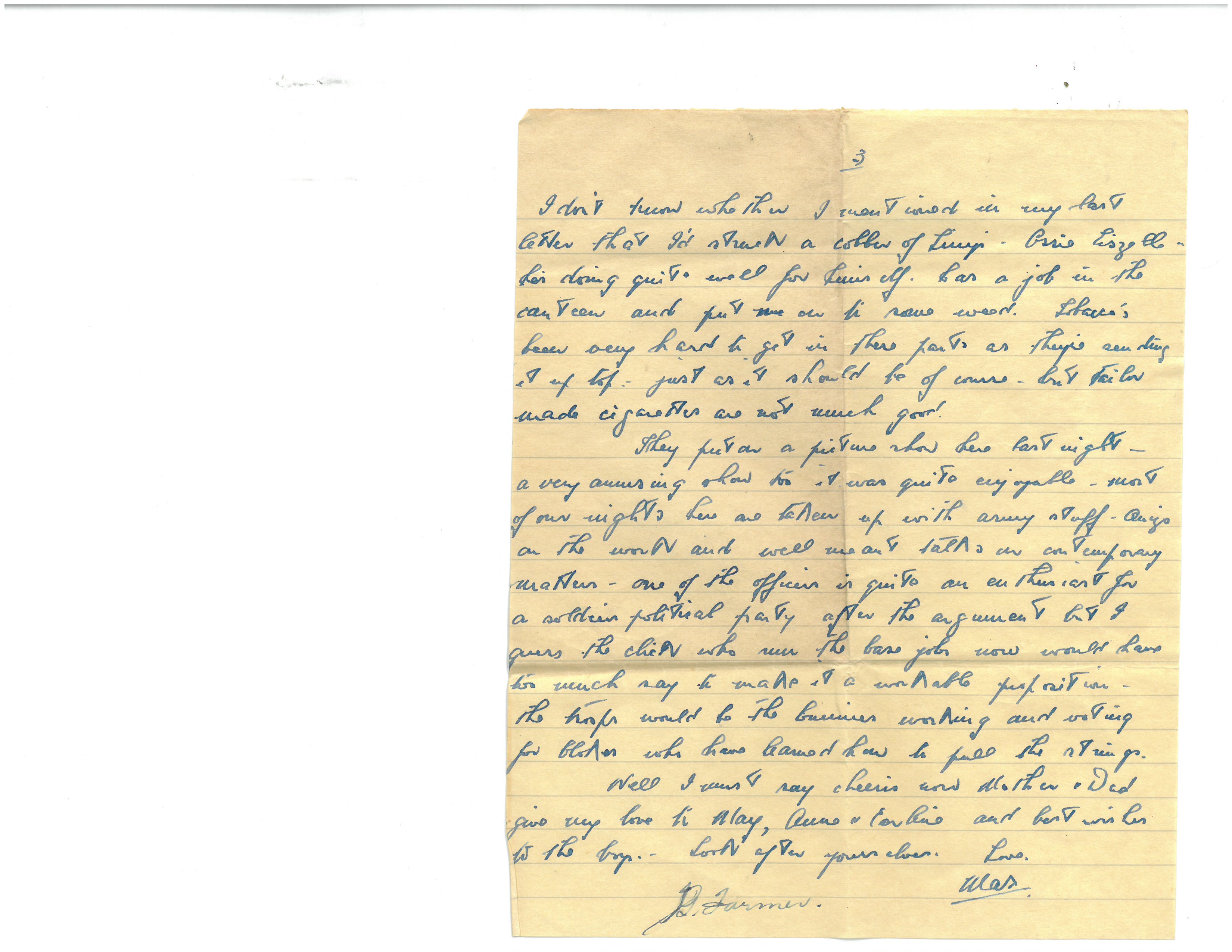
I don’t know whether I mentioned in my last letter that I’d struck a cobber of Tiny’s – Ossie Eizelle – he’s doing quite well for himself – has a job in the canteen and put me on to some weed.  Tobacco’s been very hard to get in these parts as they’re sending it up top – just as it should be of course – but tailor made cigarettes are not much good.

They put on a picture show here last night – a very amusing show too – it was quite enjoyable.  Most of our nights here are taken up with army stuff – quizzes on the work and well meant talks on contemporary matters – one of the officers is quite an enthusiast for a soldiers’ political party after the argument, but I guess the clique who run the base jobs now would have too much say to make it a workable proposition – the troops would be the bunnies working and voting for blokes who have learned how to pull the strings.

Well I must say cheerio now Mother & Dad.  Give my love to May, Anne & Carline and best wishes to the boys.  Look after yourselves.  Love

Max

(censor – B Farmer)

The CO asked for our return some weeks back

According to The Footsoldiers, in the days following the Liberator disaster (see post dated   10 September 1943), orders were issued that another D company was to be raised as soon as possible.  The men were to be trained as a company and were to be ready to move forward by September 25th.  All men who could be spared from essential duties at LOB…plus any of those with minor injuries who could leave hospital, and any volunteers of the 2/33rd been of the old carrier platoon who had been detailed to the 7th Division Carrier Company when at Ravenshoe, would constitute the new company.

Dad had already been transferred to the Training School when the disaster occurred, but I’m sure he would have wanted to join this company.  He still (in this letter) believes the CO has ‘asked for our return’ and wonders what other powers are at work.  As his Carrier platoon mates Jim and Viv were clearly with the unit, I’m not sure who else is included in the comment ‘OUR return’.

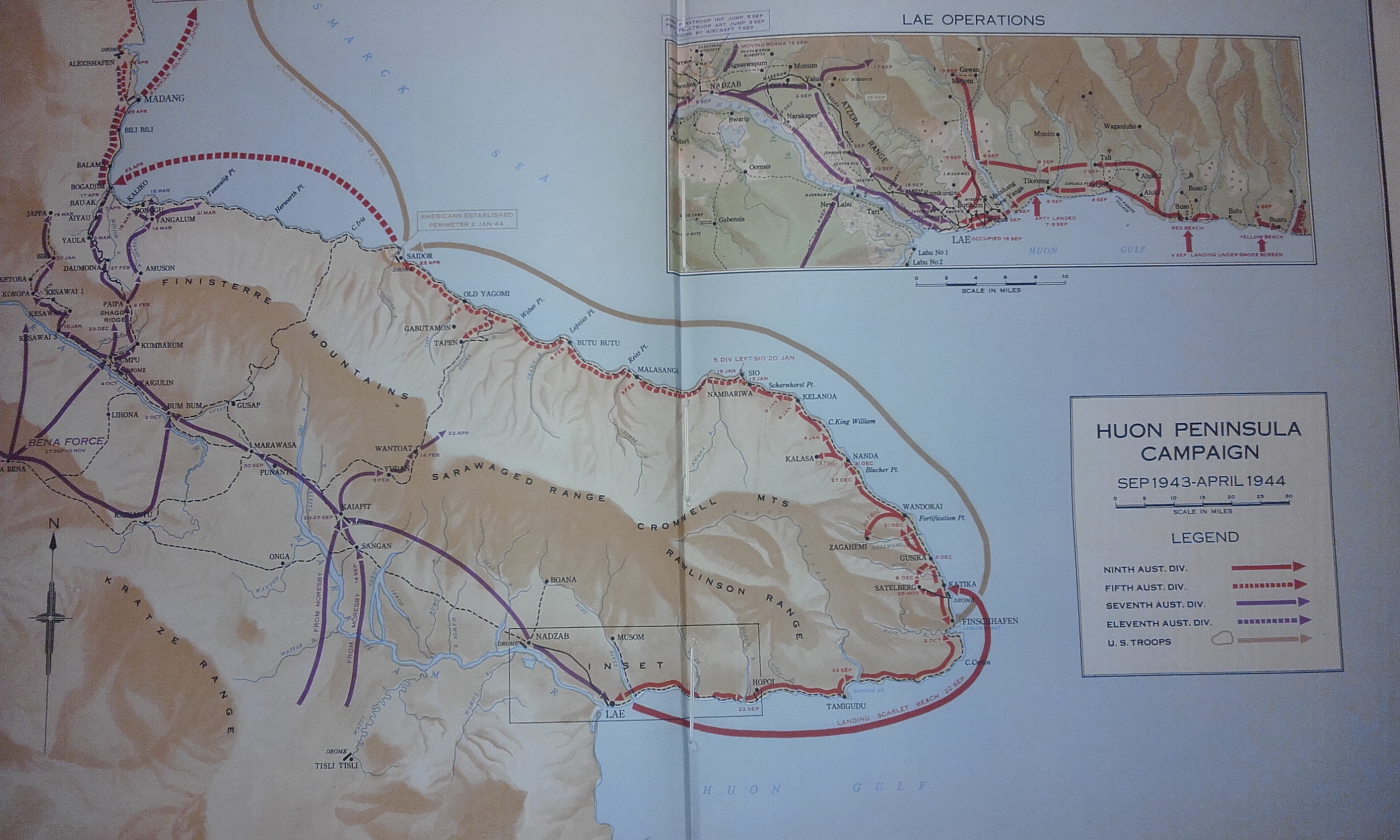
The Battalion have been in some heavy stuff

It seems he has now caught up with what’s been happening in the north (see photos etc above).  This map is from the 1944 AWM publication Jungle Warfare.

from Jungle Warfare


Posted in Australian, organisation, The course of the war, training, Uncategorized | Tagged , , , , | Leave a comment

Still in Limbo – but no cause for complaint – 3 letters


TX 1004

Sgt M Hickman

2/33rd Battn

AIF

28th Sept 43

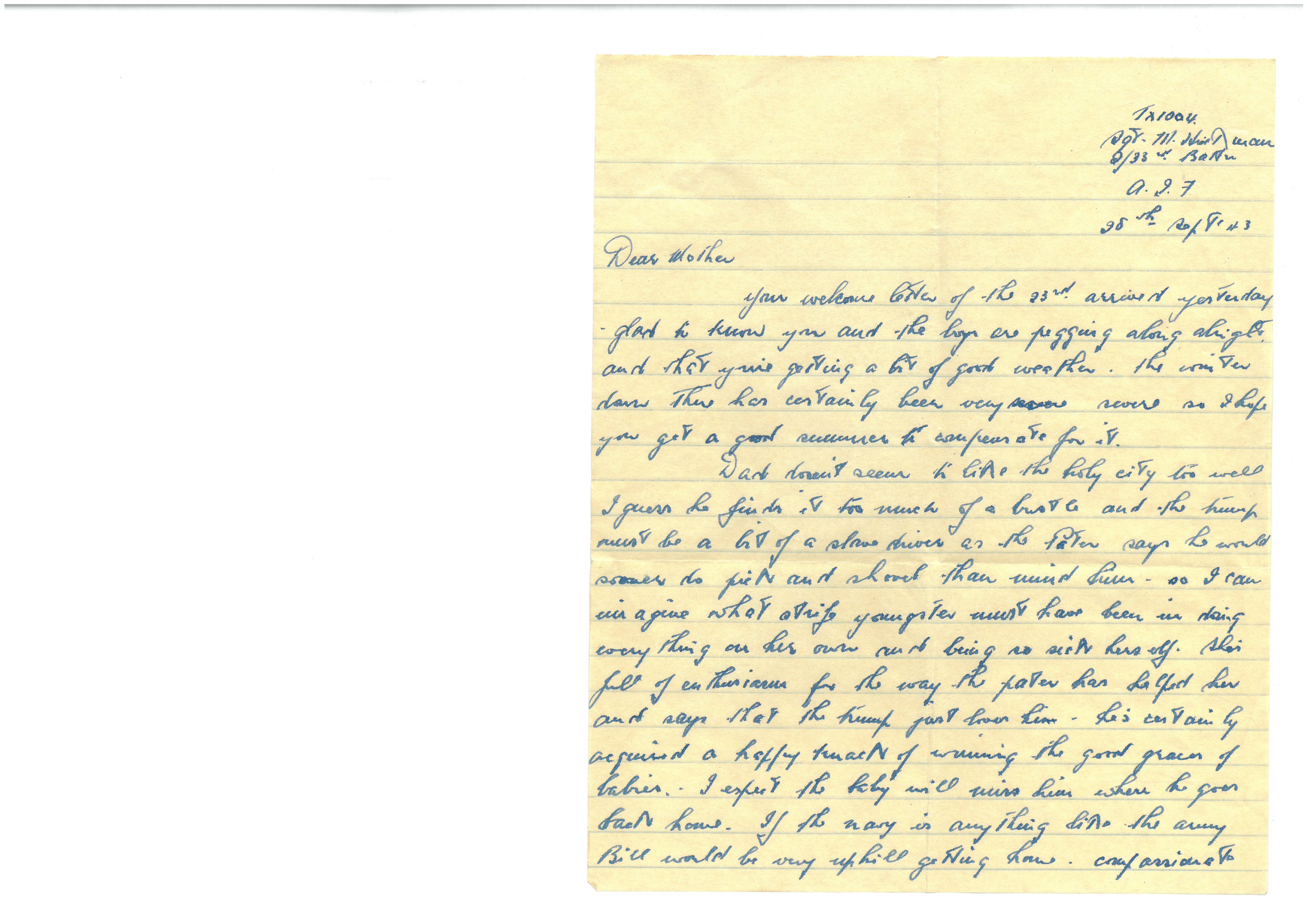
Dear Mother

Your welcome letter of the 23rd arrived yesterday – glad to know you and the boys are pegging along alright and that you’re getting a bit of good weather.  The winter down there has certainly been very severe so I hope you get a good summer to compensate for it.

Dad doesn’t seem to like the holy city too well.  I guess he finds it too much of a bustle and the trump must be a bit of a slave driver, as the Pater says he would sooner do pick and shovel than mind him – so I can imagine what strife youngster must have been in, doing everything on her own and being so sick herself.  She’s full of enthusiasm for the way the pater has helped her and says that the trump just loves him.  He’s certainly acquired a happy knack of winning the good graces of babies.  I expect the baby will miss him when he goes back home.  If the navy is anything like the army Bill would be very uphill getting home – compassionate leave in the army is like winning the fifty thousand Melbourne Cup sweep, and happens about as often.  But of course in Bill’s line he might be just as useful to the service in Melbourne as where he is – although I think it would be an absolute last resort with Ivy especially knowing how she feels about other people.

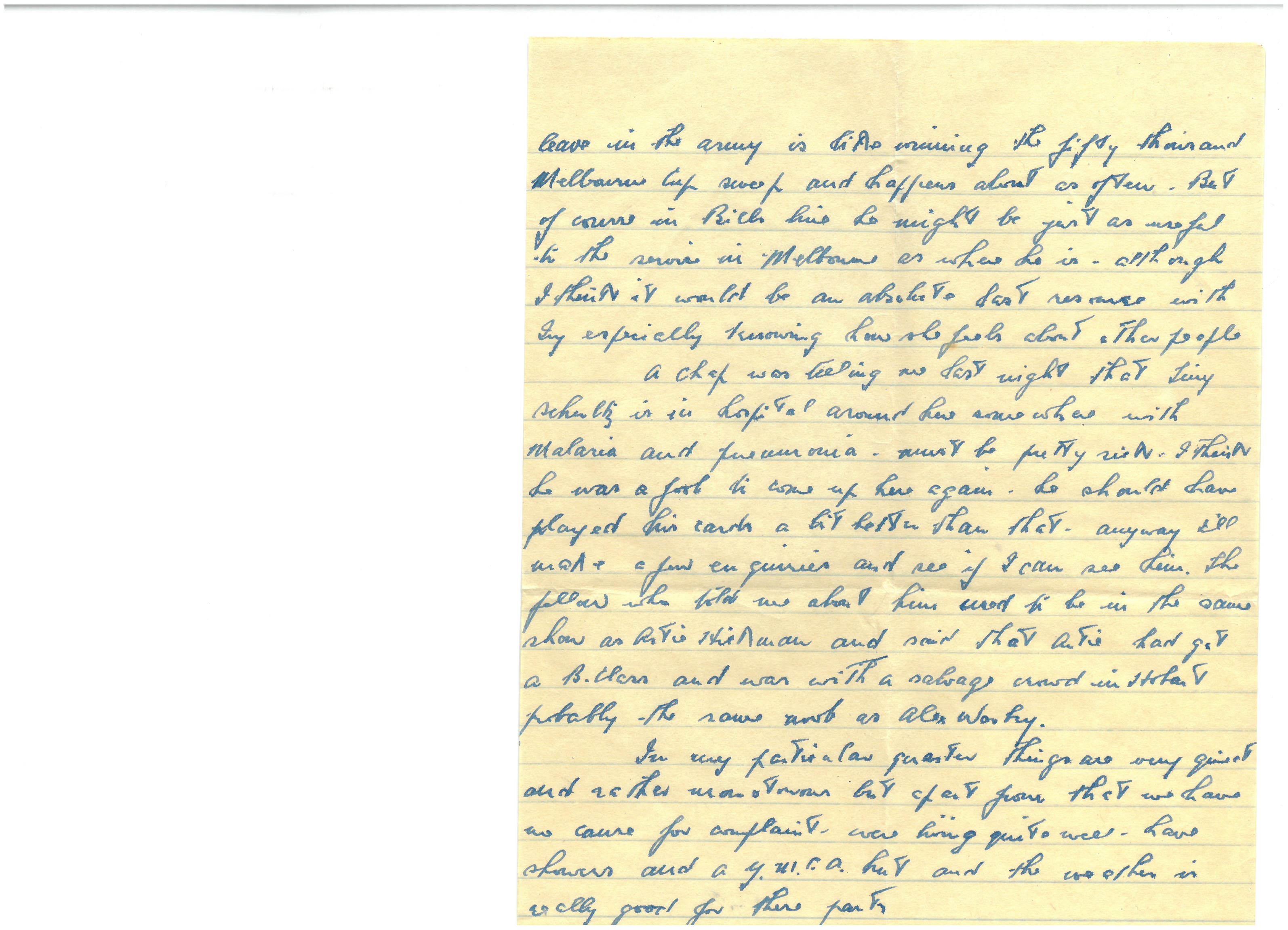
A chap was telling me last night that Tiny Schultz is in hospital around here somewhere with Malaria and pneumonia – must be pretty sick.  I think he was a fool to come up here again.  He should have played his cards a bit better than that.  Anyway I’ll make a few enquiries and see if I can see him.  The fellow who told me about him used to be in the same show as Artie Hickman and said that Artie had got a B class and was with a salvage crowd in Hobart – probably the same mob as Alec Worbey.

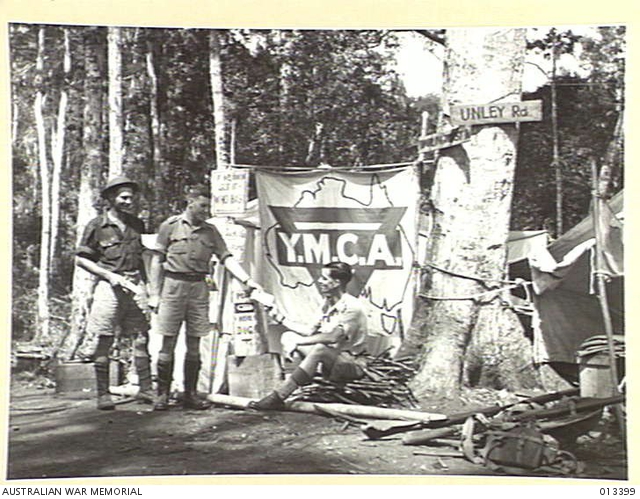
In my particular quarter things are very quiet and rather monotonous but apart from that we have no cause for complaint – we’re living quite well, have showers and a YMCA hut and the weather is really good for these parts.

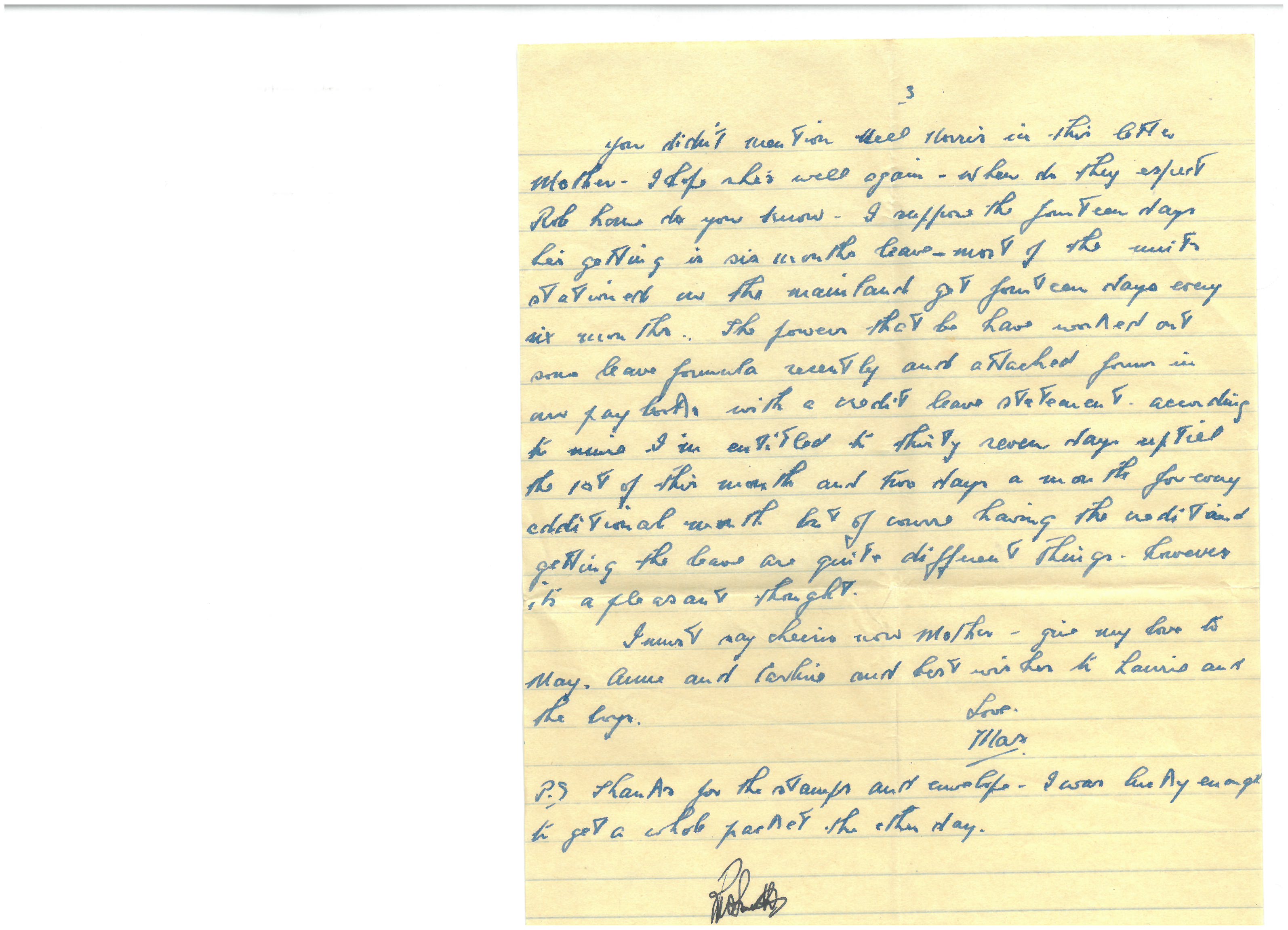
You didn’t mention Nell Norris in this letter Mother – I hope she’s well again.  When do they expect Rob home, do you know?  I suppose the fourteen days he’s getting is six months’ leave – most of the units stationed on the mainland get fourteen days every six months.  The powers that be have worked out some leave formula recently and attached forms in our pay books with a credit leave statement.  According to mine I’m entitled to thirty seven days up till the 1st of this month and two days a month for every additional month but of course having the credit and getting the leave are quite different things. However it’s a pleasant thought.

I must say cheerio now Mother – give my love to May, Anne and Carline and best wishes to Laurie and the boys.

Love

Max

PS Thanks for the stamps and envelope – I was lucky enough to get a whole packet the other day.


The YMCA

The YMCA and the Salvation Army, in conjunction with the Australian Comforts Fund (ACF) established refreshment posts in forward areas as well as near the various staging camps.  This article describes the enthusiasm of the troops for both entertaining and being entertained, and their willingness to travel considerable distances to participate in sports.  http://trove.nla.gov.au/newspaper/article/67351273

AWM 013399    An advanced YMCA post just behind the forward lines in the New Guinea jungle.  The value of these unpretentious outposts is inestimable and the work of the men who maintain them cannot be too highly praised.


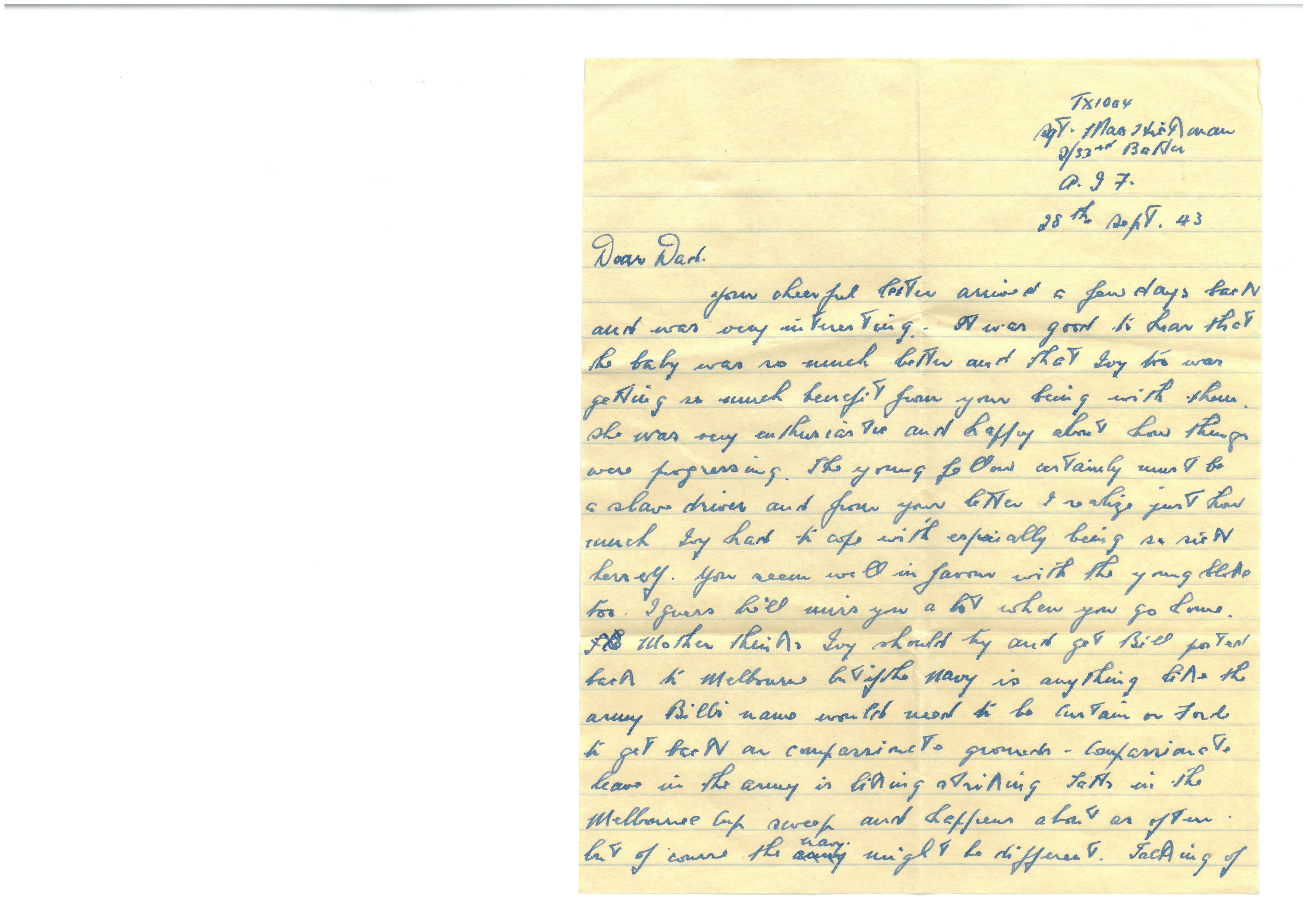
TX1004

Sgt Max Hickman

2/33rd Battn

AIF

28th Sept 43

Dear Dad

Your cheerful letter arrived a few days back and was very interesting.  It was good to hear that the baby was so much better and that Ivy too was getting so much benefit from your being with them.  She was very enthusiastic and happy about how things were progressing.  The young fellow certainly must be a slave driver and from your letter I realise just how much Ivy had to cope with especially being so sick herself.  You seem well in favour with the young bloke too.   I guess he’ll miss you a lot when you go home.

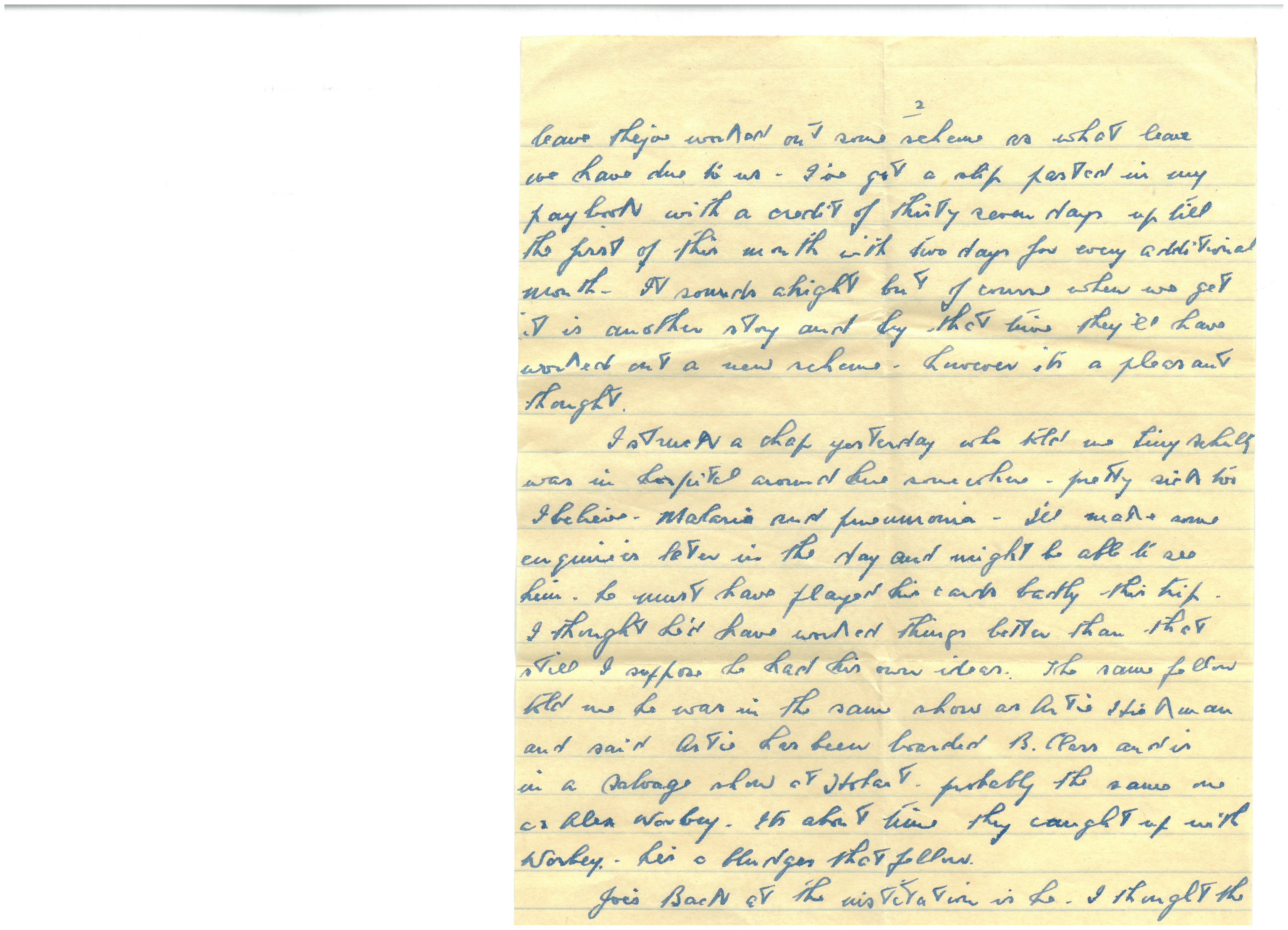
Mother thinks Ivy should try and get Bill posted back to Melbourne but if the Navy is anything like the army Bill’s name would need to be Curtin or Forde to get back on compassionate grounds.  Compassionate leave in the army is like striking Tatts or the Melbourne Cup sweep and happens about as often – but of course the Navy might be different.  Talking of leave – they’ve worked out some scheme as to what leave we have due to us. I’ve got a slip pasted in my pay book with a credit of thirty seven days up till the first of this month with two days for every additional month.  It sounds alright but of course when we get it is another story and by that time they’ll have worked out a new scheme.  However it’s a pleasant thought.

I struck a chap yesterday who told me Tiny Schultz was in hospital around here somewhere – pretty sick too I believe – Malaria and pneumonia.  I’ll make some enquiries later in the day and might be able to see him.  He must have played his cards badly this trip.  I thought he’d have worked things better than that – still I suppose he had his own ideas.  The same fellow told me he was in the same show as Artie Hickman and said Artie has been boarded B Class and is in a salvage show at Hobart – probably the same one as Alec Worbey.  It’s about time they caught up with Worbey – he’s a bludger that fellow.

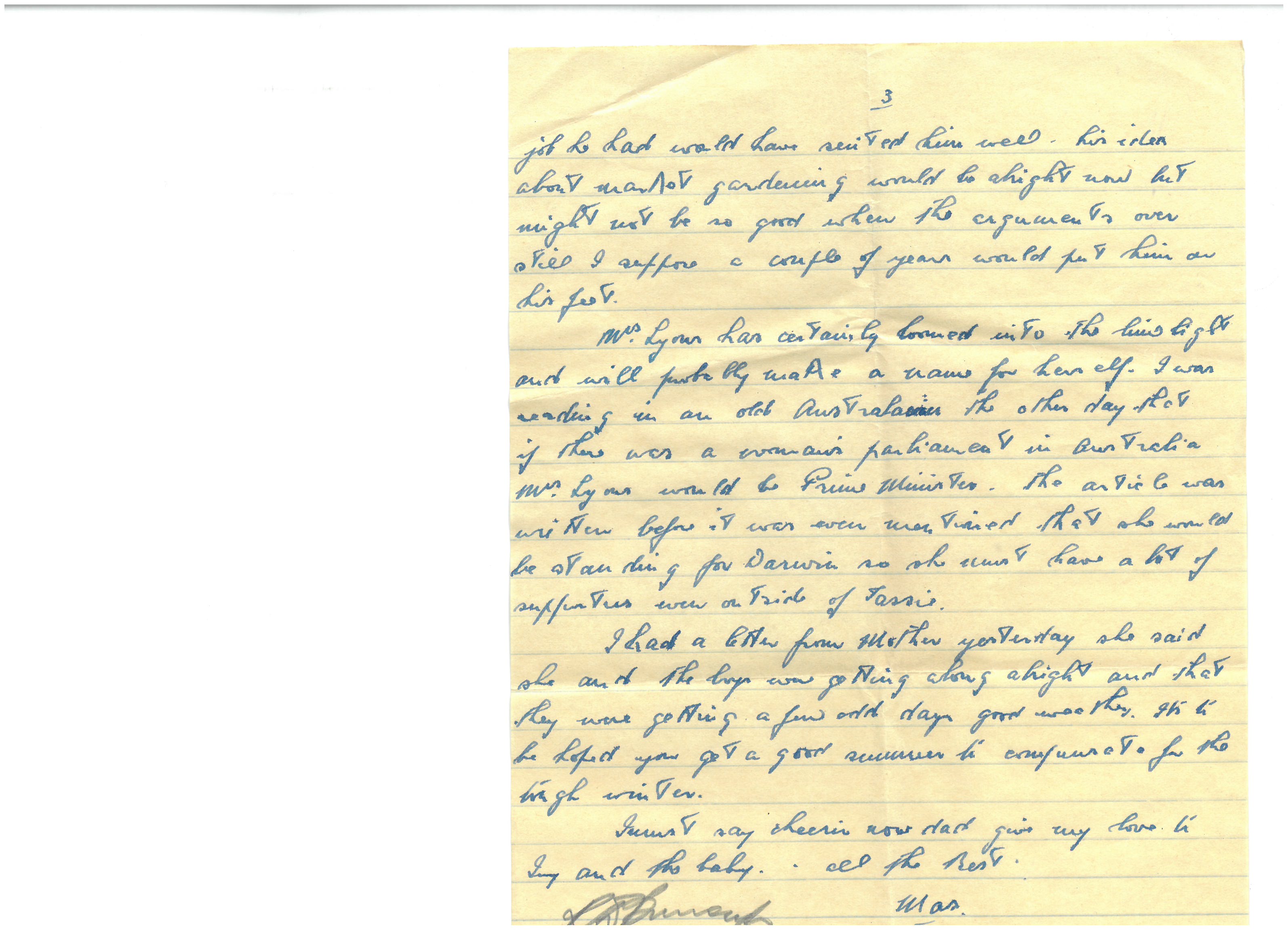
Joe’s back at the institution is he – I thought the job he had would have suited him well.  His ideas about market gardening would be alright now but might not be so good when the argument’s over.  Still I suppose a couple of years would  put him on his feet.

Mrs Lyons has certainly loomed into the limelight and will probably make a name for herself.  I was reading in an old Australasian the other day that if there was a women’s parliament in Australia, Mrs Lyons would be the Prime Minister.  The article was written before it was even mentioned that she would be standing for Darwin so she must have a lot of supporters even outside of Tassie.

I had a letter from Mother yesterday.  She said she and the boys were getting along alright and that they were getting a few odd days good weather.  It’s to be hoped you get a good summer to compensate for the tough winter.

I must say cheerio now dad.  Give my love to Ivy and the baby.  All the best.

Max.

(censor – R Burrough?)

Mrs Lyons has loomed into the limelight

Dame Enid Lyons, widow of the former Prime Minister Joseph Lyons was the first woman elected to a seat in the House of Representatives when she was returned as the member for Darwin (now Braddon) in the 1943 election.  Her seat was the last in the country to be decided, on preferences.  Around the country – as for example in the Courier Mail in Brisbane – her election made headlines http://trove.nla.gov.au/newspaper/article/42013323


TX 1004

Sgt Max Hickman

2/33rd Battn

AIF

7th Oct 43

Dear Mother

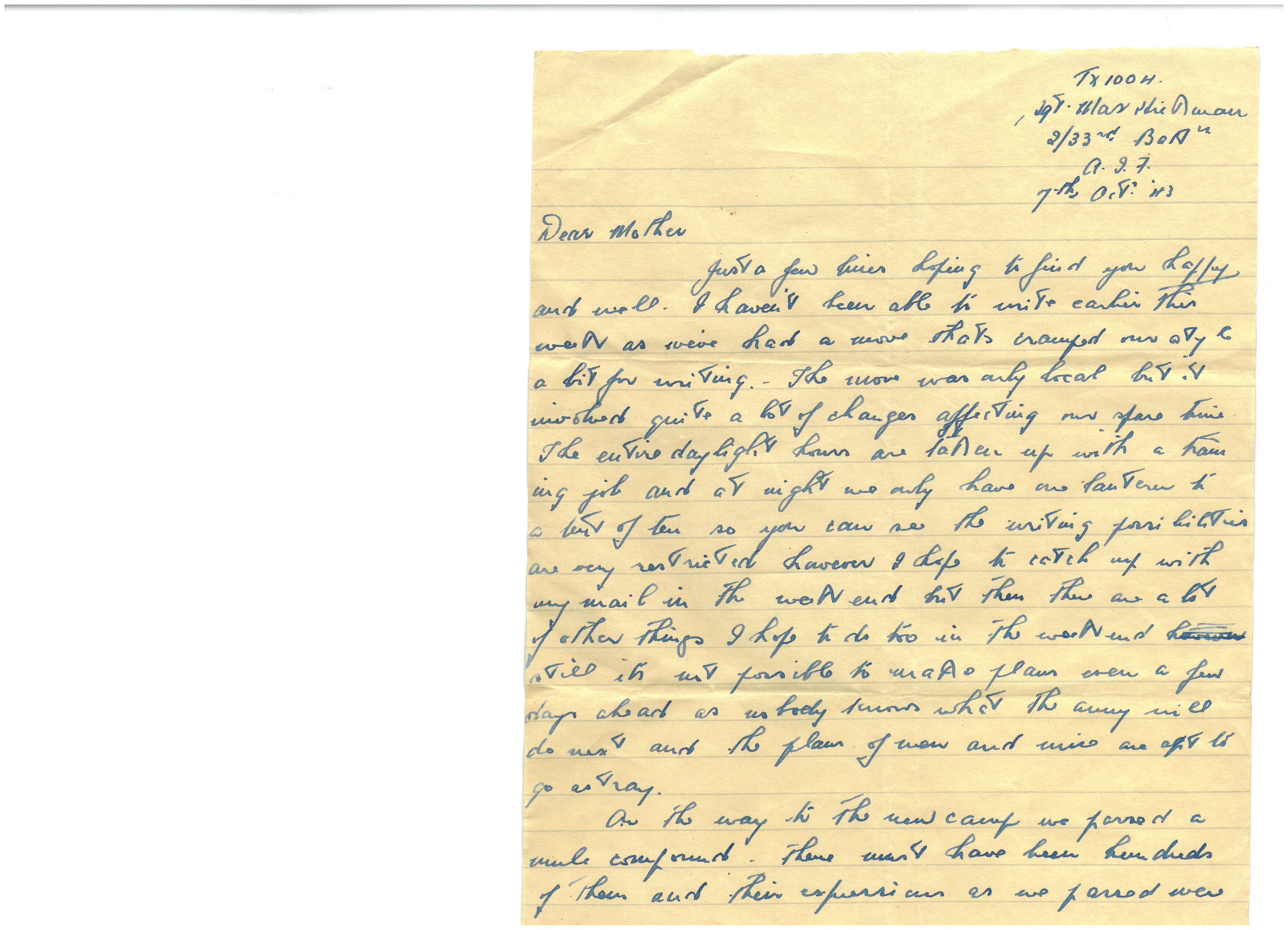
Just a few lines hoping to find you happy and well.  I haven’t been able to write earlier this week as we’ve had a move that’s cramped our style a bit for writing.  The move was only local but it involved quite a lot of changes affecting our spare time.  The entire daylight hours are taken up with a training job and at night we only have one lantern to a tent of ten so you can see the writing possibilities are very restricted.  However I hope to catch up with my mail in the weekend but then there are a lot of other things I hope to do too in the weekend.  Still it’s not possible to make plans even a few days ahead as nobody knows what the army will so next and the plans of men and mice are apt to go astray.

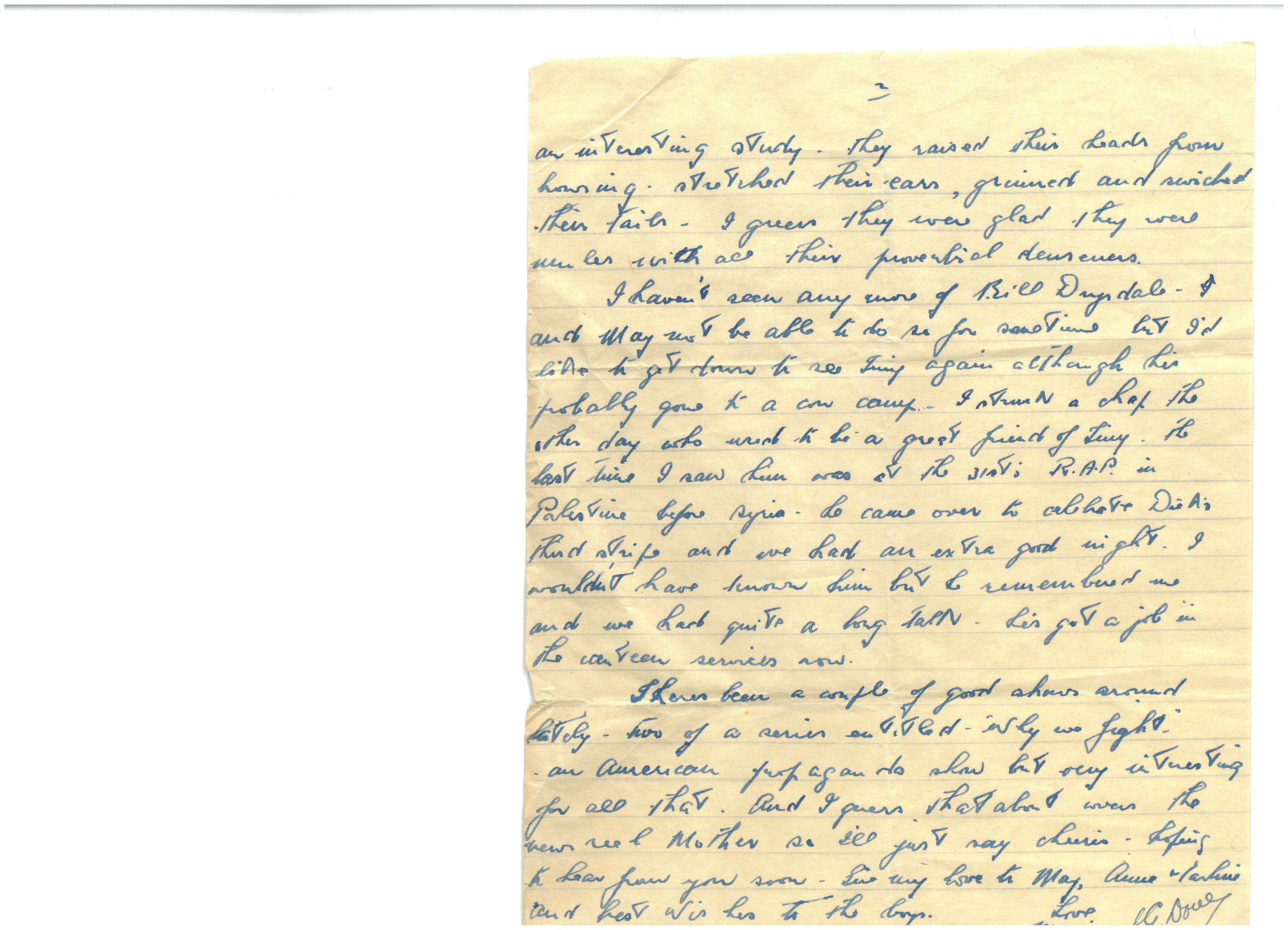
On the way to the new camp we passed a mule compound.  There must have been hundreds of them and their expressions as we passed were an interesting study.  They raised their heads from browsing, stretched their ears, grinned and swished their tails.  I guess they were glad they were mules with all their proverbial denseness.

I haven’t seen any more of Bill Drysdale and may not be able to do so for some time, but I’d like to get down to see Tiny again although he’s probably gone to a con camp.  I struck a chap the other day who used to be a great friend of Tiny – the last time I saw him was at the 31st’s RAP in Palestine before Syria.  He came over to celebrate Dick’s third stripe and we had an extra good night.  I wouldn’t have known him but he remembered me and we had quite a long talk.  He’s got a job in the canteen services now.

There’s been a couple of good shows around lately – two of a series entitled – Why We Fight. – an American propaganda show but very interesting for all that.  And I guess that about covers the newsreel Mother so I’ll just say cheerio – hoping to hear from you soon.  Give my love to May,Anne & Carline and best wishes to the boys.

Love

Max

The entire daylight hours are taken up with a training job

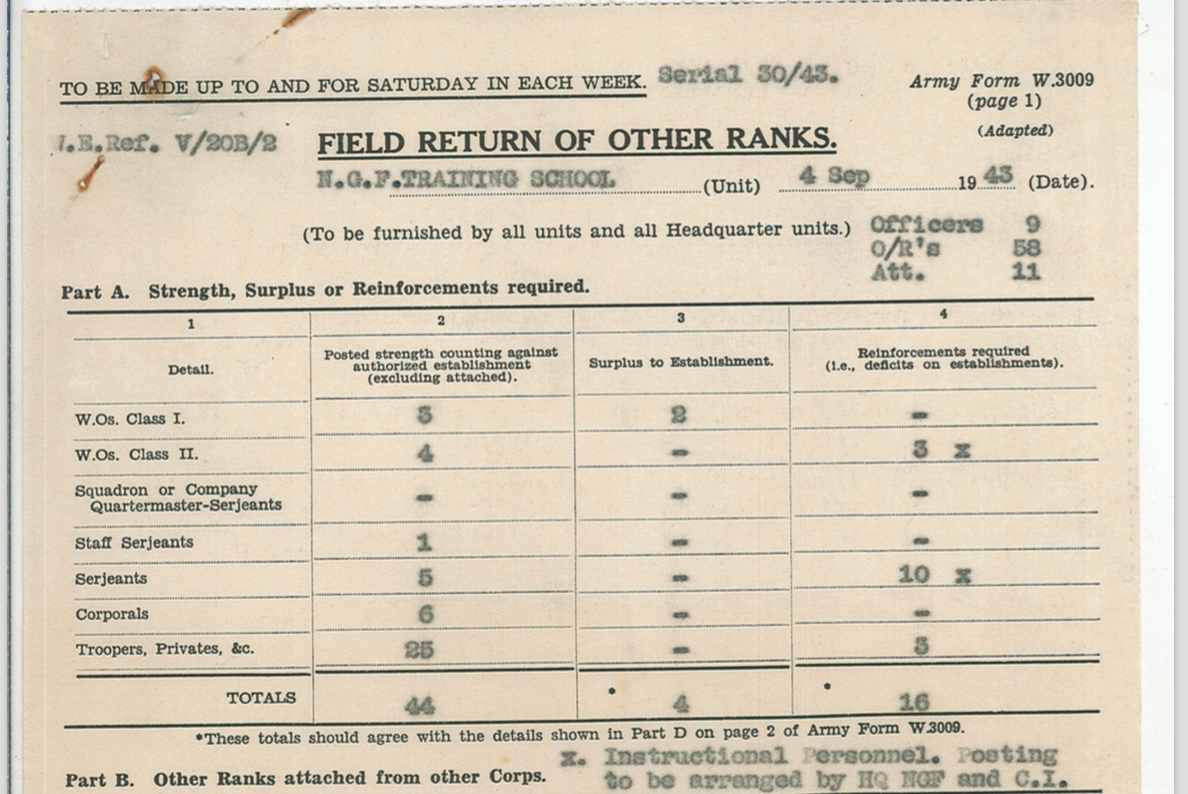
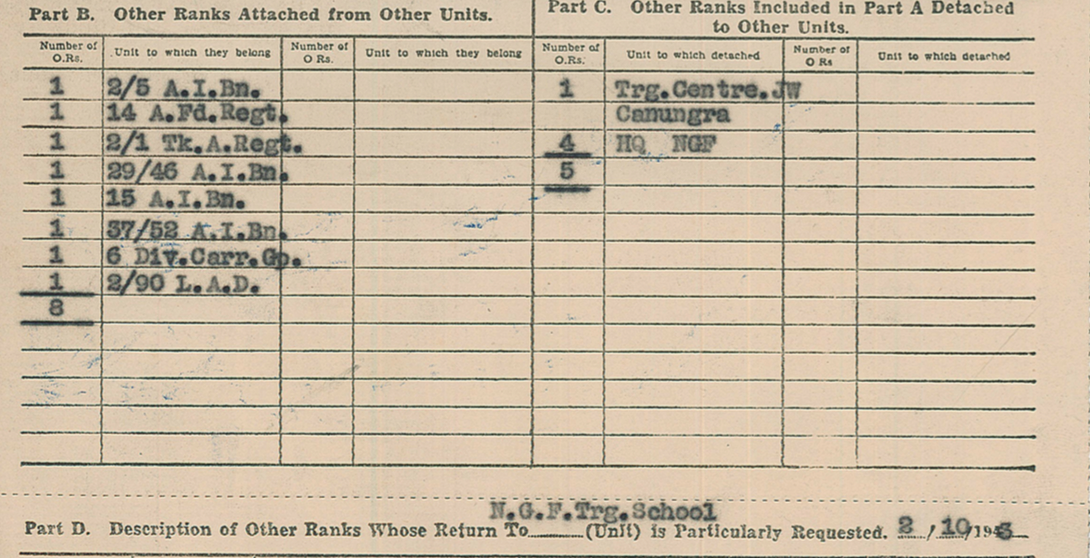
Searching for clues about what Dad was doing…  The NGF Training School war diary includes the following:  Each of the weekly Field Return of Other Ranks during September noted a need for 10 Sergeants – ‘Instructional Personnel’ – so I’m guessing Dad was one of those who fulfilled this requirement.  The Field Return of Other Ranks in October consistently shows one man from the 6 Div Carrier Gp – but no-one from the 2/33rd, so I’m assuming that somehow Dad had been attached first to this Carrier Group and then to the Training School. An entry dated 4 October indicates that 13 NCO instructors marched in from NGF.  This date fits with the timeline in the letter above.


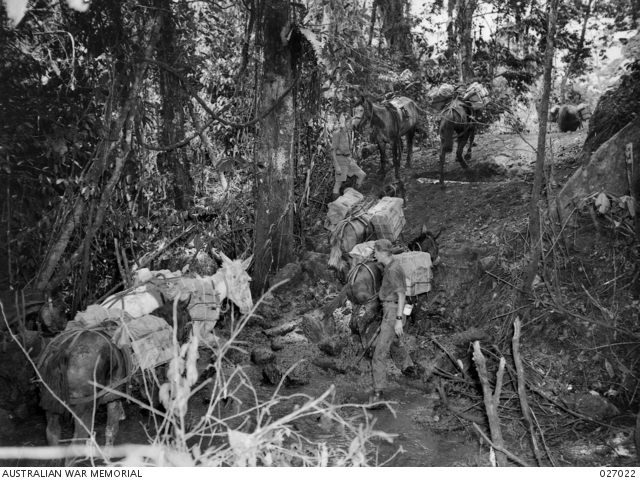
A mule compound

An amusing account of the behaviour of mules confronted by difficult terrain : http://trove.nla.gov.au/newspaper/page/7812580    and from this article http://trove.nla.gov.au/newspaper/article/2645113  come the following extracts –

Several hundred horses and mules  have been and are still being used in
New Guinea by two Army pack transport units…..The medium-sized mule is said to
be better at picking his way than a horse, and is more sure-footed
Image : AWM 027022    Men leading pack horses and mules loaded with supplies up the precipitous curving track from the end of the road down to Uberi Valley over which troops and supplies were taken to our forward positions in the Owen Stanley Ranges


Posted in organisation, Uncategorized | Tagged , , | Leave a comment

You got the wrong impression… I wasn’t at Lae


TX 1004

Sgt Max Hickman

2/33rd Battn AIF

22nd Sept 43

Dear Mother

Your welcome letter of the 15th arrived today.  Sorry to hear you’ve been sick Mother and hope you’re alright again now.  The weather seems just as bad as ever in the south, but it should soon pick up.

I’m afraid you got a very wrong impression from my letter.  The only reason I wrote at that particular time was because I thought you might be worried.  I wasn’t very happy at the time – two of my best mates had been killed.  I wasn’t at Lae at all and am still in back areas Mother so you have nothing to worry about on my account.  I guess you’ve got quite enough worries about Ivy and the baby as well as at home without unnecessary worry about me.

I’ve seen Bill a couple of times.  He’s put on weight – must be a stone heavier and seems quite comfortable.  I was up at the ward room for tea last night and they do themselves quite well – good quarters and a good mess.  If it wasn’t for worrying about Youngster and the baby Bill wouldn’t have a care in the world.

Nell Norris must be very sick if she’s not even allowed visitors.  I shouldn’t have thought she’d have been subject to nerve strain working at a broadcasting station but of course you never know from the outside what the jobs entail and I suppose they work long hours too.  If you do see her Mother give her very best wishes for a speedy recovery will you.

I made a bad miscalculation about Carline’s birthday.  I thought it was the 16th October and planned to write May and send her a couple of pounds for the occasion.  My memory must be playing tricks on me.  Anyway Mother wish her many happy returns for me will you and give May two pounds to put in her book.  I guess it’d be just about impossible to buy anything for her these days.

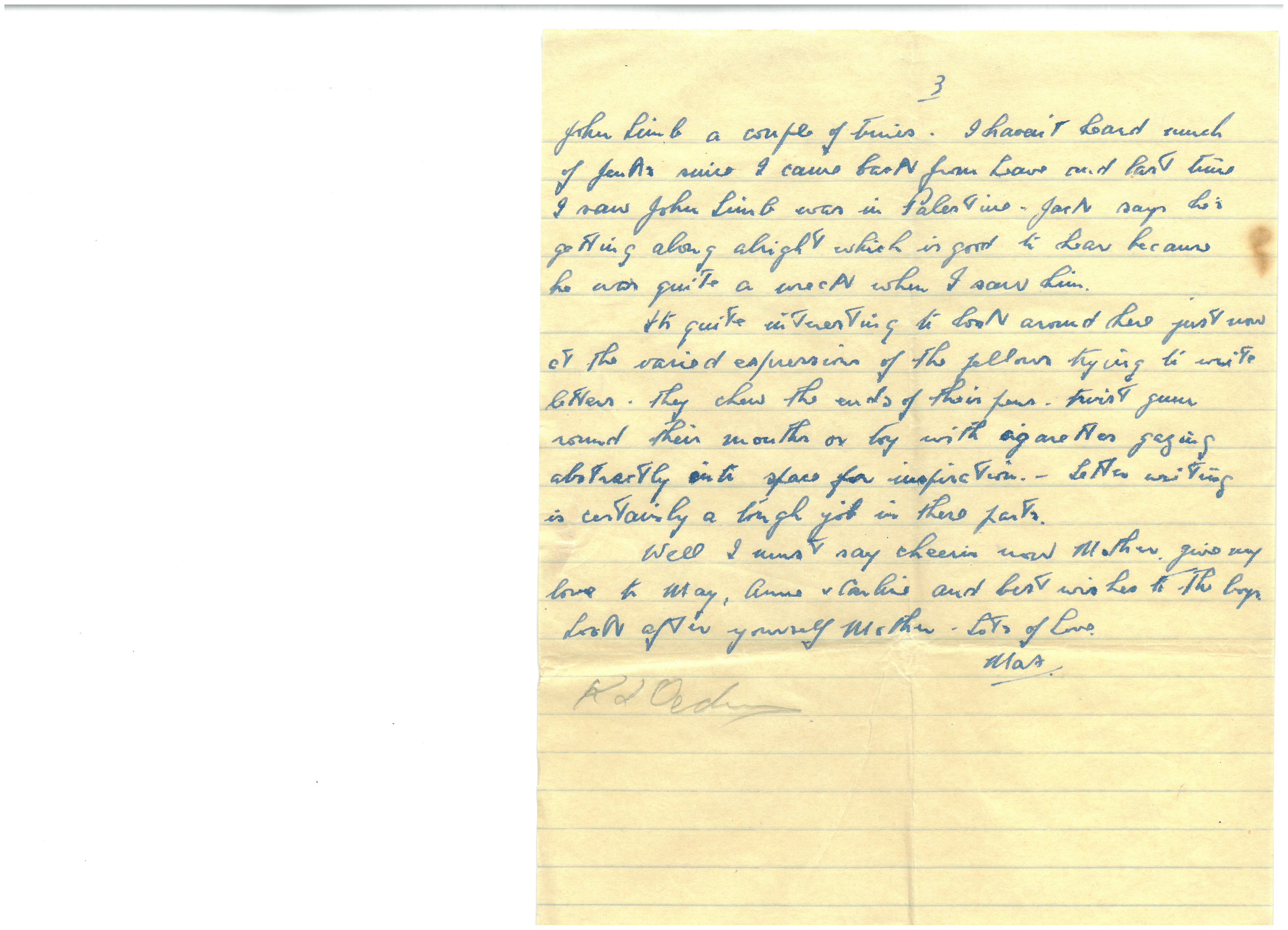
Jack wrote me quite a nice letter the other day – told me all about his trip to the South and his visit home.  He mentioned meeting Jenks and John Limb a couple of times.  I haven’t heard much of Jenks since I came back from leave and last time I saw John Limb was in Palestine.  Jack says he’s getting a long alright which is good to hear because he was quite a wreck when I saw him.

It’s quite interesting to look around here just now at the varied expressions of the fellows trying to write letters.  They chew the ends of their pens, twist gum round their mouths or toy with cigarettes gazing abstractly into space for inspiration.  Letter writing is certainly a tough job in these parts.

Well I must say cheerio now Mother – give my love to May, Anne & Carline and best wishes to the boys.  Look after yourself Mother.

Lots of love

Max


I wasn’t at Lae… thought you might be worried

Dad’s mother had presumably been reading articles such as these in the Hobart Mercury:

September 7 : front page article – Veterans of AIF land on New Guinea coast : Jap Bases Threatened  http://trove.nla.gov.au/newspaper/article/25983985   The article begins – Advances of 8 to 10 miles towards the Japanese stronghold of Lae have been made by Australian troops who landed in force not he shores of Huon Gulf east of Lae on Saturday.  The Australians, who were strongly supported by Allied air and naval forces, included elements of a famous AIF division with wide experience in the Middle East.  It was announced late tonight that the allied bridgehead is strongly protected and that reinforcements are moving in.

(The division mentioned was in fact the 9th, not the 7th – but his mother’s assumption is understandable, and of course the 7th was to follow shortly after the 9th)

September 9  Allies Converging on Lae  http://trove.nla.gov.au/newspaper/article/25986103  This article once again mentions ‘strong AIF reinforcements – elements of a division with wide experience in the Middle East – were flown into Nadzab aerodrome….’  which in this case were indeed from the 7th Division

This article from September 14 http://trove.nla.gov.au/newspaper/article/92628251 includes the sentence – Reinforcements are still being flown to Nadzab airfield in the Markham Valley, in preparation for the final and decisive push on Lae.


Two of my best mates had been killed

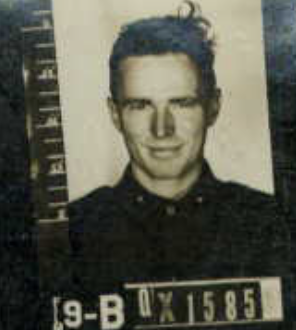
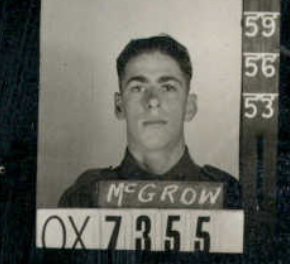
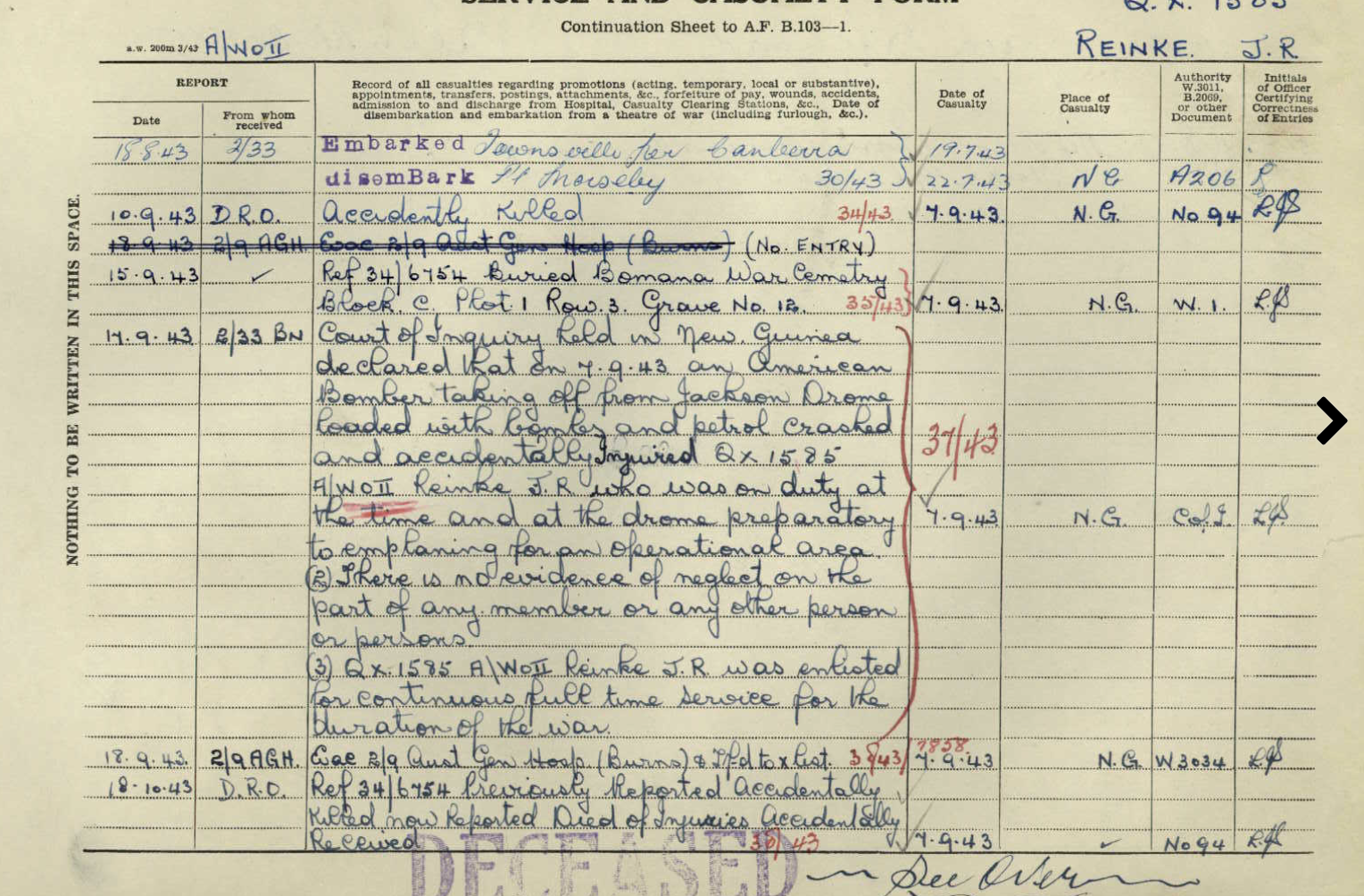
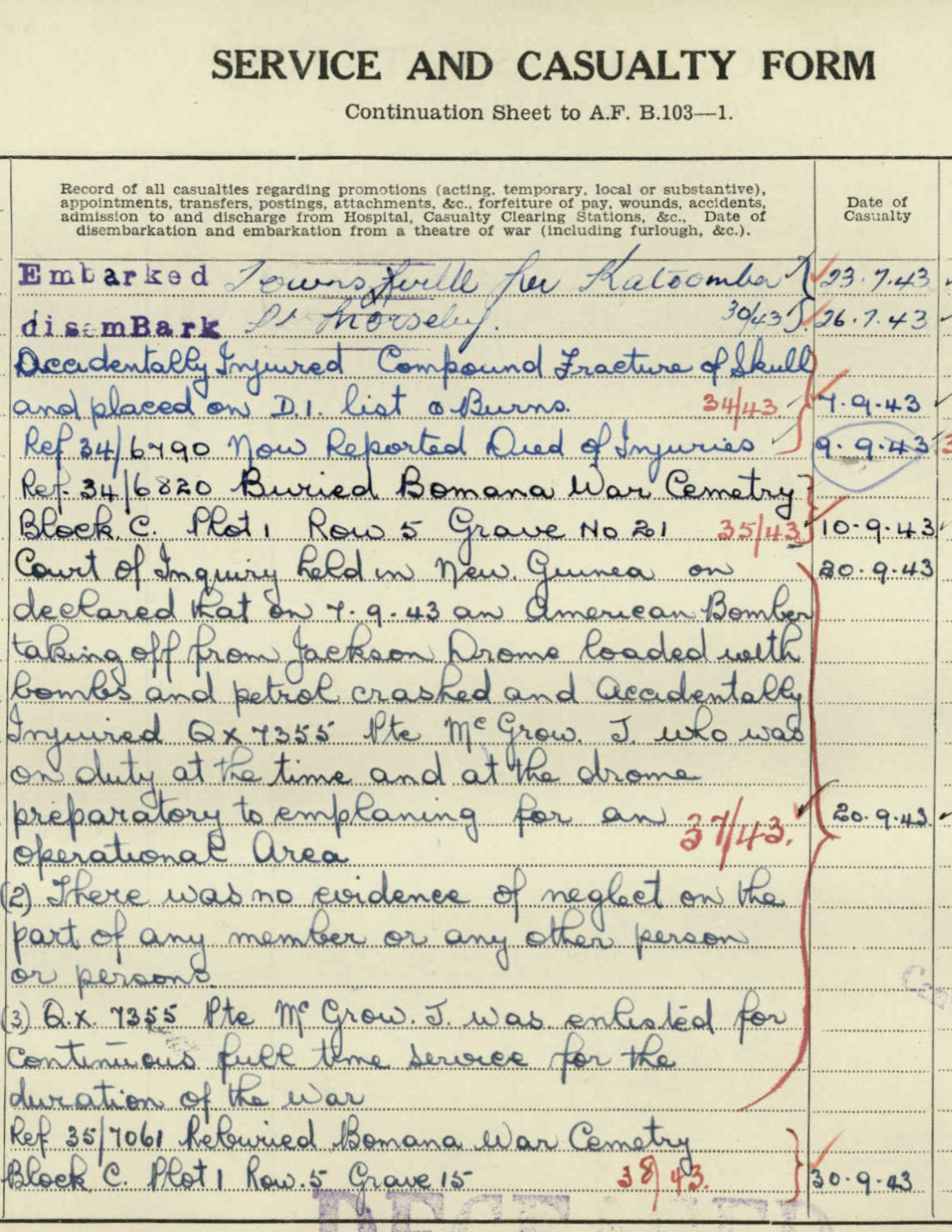
The two mates Dad refers to were Jack Reinke (QX 1585 ) and John McGrow (QX 7355 )

John died on September 9 of wounds sustained in the Liberator crash.   Jack’s record first shows he was ‘accidentally killed’ on September 7 but this was later amended to ‘died of injuries accidentally received’.

Jack Reinke (photo on enlistment)


John McGrow (photo on enlistment)


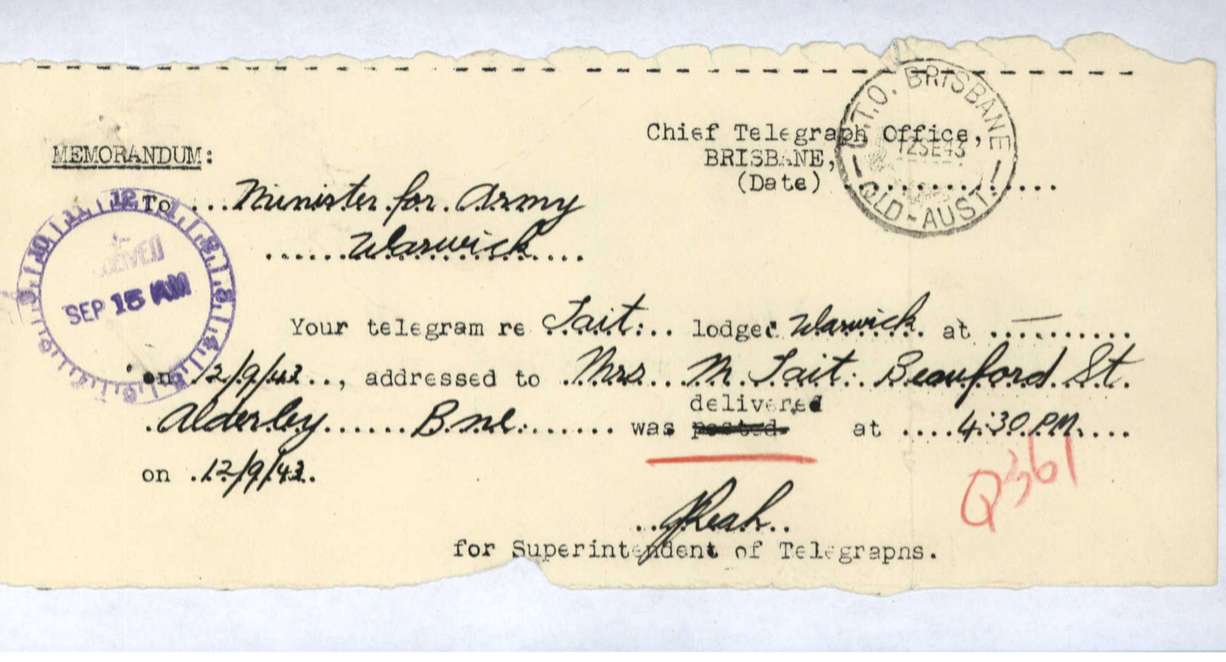
At the time of enlisting in May 1940, John’s next of kin was his father, but by the end of 1941 that had been amended to his sister, Mrs Tait.   Dad and others of the Carrier platoon enjoyed some memorable social occasions at Bob and ‘Bunty’ Tait’s home in Brisbane when moving through or on leave, both before and after John’s death.   I believe Dad kept in touch with the Taits until his death in 1990.

I feel for the clerk who had to complete the record of each of the men injured or killed as a result of the crash – that person had to transcribe the same text shown here, some 150 times.  Similarly, I would hate to have been the person responsible for sending all those awful telegrams.


Jack Reinke and John McGrow  – service record extracts , showing text re the Liberator crash Court of Inquiry findings


A receipt for the telegram delivered to John McGrow’s sister – from his Army records file at the National Archives.

The Footsoldiers records that it was the officers who took on the task of writing to the parents or next-of-kin.  News of the crash was never to be released to the press, however the awful details were spreading to other units: …messages began arriving at the battalion at the rate of ten a day telling of the injured and the dying.  Many messages of sympathy were reaching the unit….It was now known 13 of our unit had been killed outright and 133 injured.  By the night of the 11th….the CO had been advised that 47 of the 133 had died, some within hours….


The rest of the unit

Summary from the AWM publication Jungle Warfare (1944) –

Lae was captured by a simultaneous air-borne and sea-borne operation.  On the 4th of September the Ninth Australian Division embarked from Milne Bay and landed on a narrow beach fifteen miles east of Lae.  The division immediately began to advance westward along the coast.  Next day a regiment of American artillery were dropped in the Markham Valley at Nadzab, twenty-five miles north-west of Lae.  A landing strip was cleared quickly and with the arrival by air of the leading troops of the Seventh Australian Division, an advance on Lae was begun.  Both forces met with opposition from the Japanese, but the converging thrusts were pushed with vigour and Lae was occupied on the 16th of September……(p70 in the section The Battle for New Guinea)

The airborne phase…

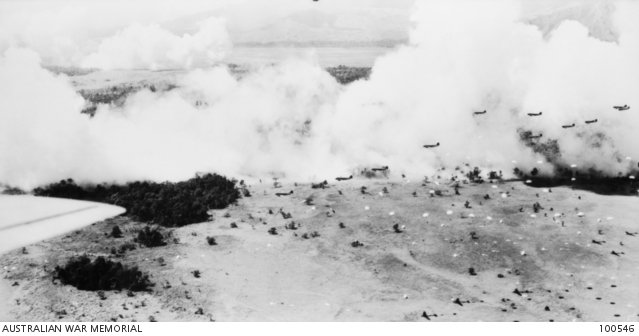
AWM 100546 Markham Valley, New Guinea. 1943-09-05. Screened by dense smoke, paratroopers of 503 US Paratroop Infantry Regiment and Gunners of 2/4th Australian Field Regiment with their 25 pounders land unopposed at Nadzab, during the advance of 7th Australian Division on Lae.

The Footsoldiers provides a great deal of detail about the advance on Lae, through the many coffee and copra (coconut) plantations along the Markham Road (see map).- ‘The country here although flat was covered with a tangled mass of ten-foot high bushes, trees and vines interspersed with patches of kunai and pit-pit grass.  As the men of the patrol proceeded south-east they struck the black ooze swamp and slime that abounded in the low areas of the sub-tropical flatlands.  In this type of country the heat and humidity were intensely uncomfortable (p 283)  Heath’s plantation had been occupied by the Japanese and was described as ‘a fortified position of some considerable extent’ (p279) but had been deserted before the Battalion arrived on the scene.  At the same time, the 2/25th Battalion (also part of the 25th Brigade) had experienced some hard and bitter fighting in and around Jenyn’s and Whittaker’s plantations.  The Japanese had established many positions around the road to Lae, and the 2/33rd  battled the enemy at close quarters on a number of occasions before arriving at the port which by then (September 16) was little more than a pile of ruins.

map – The Road to Lae  from The Footsoldiers (p282)


Footsoldiers p309 – on the road to Lae


AWM 015788  Image dated September 22, but may have been taken the previous week.  (ref Footsoldiers p 312 – they were back at Nadzab by Sept 19 and waited there for 8 days)  Official caption : 1943-09-22.   Wounded being taken to an Advanced Dressing Station outside Lae.  Identified personnel – far right – VX68745 Private Ian Douglas Clutterbuck  2/33rd Bn

AWM057040  Nadzab, New Guinea  1943-09-19  Master Sergeant Ushiro, Japanese American interrogator of the US Army, attached to HQ 7th Australian Division, translates Japanese markings on a captured officer’s sword for NX20430 Private O Nagel 2/33rd Australian Infantry Battalion


Bill Drysdale

Dad’s brother in law Bill Drysdale (married to Ivy, known as ‘the youngster’) was an officer in the RANVR – in the Cyphers section.  There was quite a different relationship between the Navy’s Volunteer Reserve and the RAN, than between the Army Militia and the AIF :    all new entry personnel were entered through the RANR and they signed an agreement for the duration of hostilities instead of the customary 12 years engagement. Officers and potential officers, meanwhile, were entered as members of the RANR (S) or the RANVR.  (http://www.navy.gov.au/join-navy/reserves/brief-history-royal-australian-naval-reserve)


Fellows trying to write letters

I have read in other places, how difficult some men found it to find something to say in their letters, and about the chewing of pens, staring into space etc.  This image conveys something of that sense…  AWM054268

Posted in The course of the war | Tagged , | Leave a comment

Attending a school…or not? – two letters


TX 1004

Max Hickman

2/33rd Btn AIF

13th Sept 43

envelope – ‘Opened by Censor’

Dear Mother

Just a few lines hoping to find you happy and well.  I’ve had two letters from Hollsmoor Road in the week, telling of Dad’s arrival in the holy city so I guess you’re all on your lonesome with the boys but I hope May and Anne are keeping you company.

Things are very quiet as far as I’m concerned at present and although rather windy and dusty the weather is not unpleasant and as there’s been a few picture shows around lately time is not weighing heavily.

I went for a bus ride out to where Ray’s show are camped .  The powers that be run a sort of official unscheduled bus service.  There’s no specified stops.  You just tap on top of the cabin when you want to get off.  I put in a couple of good hours there – stayed to lunch – they have things well arranged – a sergeants’ mess complete with waiters, tablecloths and chinaware – very lairy for these parts.

Since I started this letter a bunch of mail has arrived.  Robby’s just handing it out and as I hear my name mentioned will see what it’s all about.  It’s right there’s three for me so in a minute or so I’ll tell you all about them.  Yours of the sixth Mother – glad to know you’re well and that the weather has taken up – it should be very nice down there now.  Sorry to hear the boys are not too happy in the service – they probably won’t appreciate the fact that there’s a war on especially when their patriotism means short rations.  I don’t suppose you can even get dog biscuits for them with he biscuit makers flat out keeping us supplied – looks like the boys will be on the bread line.

So May has another daughter – that’s the first girl I’ve heard of among new arrivals for some time.  Daph said in her letter that they expected two.  If you see May give her my best wishes will you and my compliments to Ben.  It’s not much good sending parcels Mother – you can only send tinned stuff and we’re living on that all the time as it is.  Daph said she’d sent a bundle of papers but they never made the grade or at least they could have done without my knowing as any papers that happen to be thrown in the tent are opened by anyone who happens to be around.

My other two letters are from Ivy and Rex Wedd.  Youngster is still having an awful tough trot and although it’s a great relief to her having Dad there the cards are still stacked against her – even the good weather seems to be against her.  I’ve never heard of a rash like that before.  Rex is very happy in the service as of course he should be.  He gets quite a bit of leave, had seen the Lairds several times, has his own car and generally speaking is heading them all along the lien.  There’s no doubt about it I joined the wrong service – the air service is the job alright.

We had quite an interesting discussion the other night on things to do when the argument’s over and we got on the subject of pubs, and before we turned in had discussed the merits and otherwise of every pub in Tasmania – We worked it out that Viv and I would keep the Pub and Jim & Frank McDonnell and big Kong Young would be out star boarders.  I wonder if it will ever eventuate.

Our influence on the natives in these parts is having quite a civilising effect.  The other night while watching a big … game I saw a couple of them edge their way to the side of the ring.  They had three or four bob each and striking a lucky roll built it into ten pounds – an undreamed-of fortune to any of them before the war.  They spoke good English and their remarks during the game were very amusing – a well balanced mixture of Australian and American-isms.

I must say cheerio now Mother.  Take care of yourself and give my love to May, Anne & Carline and regards to the boys.

Love

Max

PS Tell Anne I’ll write as soon as I can get some envelopes. They’re very scarce just now but there should be some in soon.  I’ll have to send this in a green envelope (the first I’ve ever sent)


The Holy City

Dad’s father was visiting ‘youngster’ – Ivy Drysdale (Max’s sister) – and her baby son in Melbourne.  His mother was at home in Hobart with ‘the boys’ – i.e. the dogs.


What in the world was he doing?

I don’t have a copy of Ray Ross’ service record, so don’t know who he was attached to at this point…. presumably not the 2/33rd.   Dad’s record as previously mentioned shows him attending NGF training school, but this is not evident in the address on his letters.  Then there’s the reference later in this letter to the discussion about Tassie pubs: he was clearly still with some of his 2/33 Bn ex-Carrier platoon mates.

This extract from The Footsoldiers suggests Ray was with the 7th Div Carrier Company, but offers no clarity re Dad’s situation:

On September 10 orders were issued ….that another D Company was to be raised as soon as possible.  The men were to be trained as a company and were to be ready to move forward by the 25th.  All men… who could be spared from essential duties at LOB….plus those with minor injuries who could leave hospital, and any volunteers of the 2/33rd men of the old carrier platoon who had been detailed to the 7th Division Carrier Company when at Ravenshoe, would constitute the new company….HQ’s NGF would build the group up to a rifle company strength…..From the original LOB of 45 – constituting five percent of the unit – all were detailed for the company.  In fact all demanded they be included.  When Captain Power visited the Carrier Company all of the old 2/33rd men – 14 of them –  volunteered, as did 32 others of that company.  The volunteers included Captain George Connor and Sergeant Ray Ross who were delighted at the opportunity of getting back to a unit again….. (pp318-19)


May and Ben Menzie

The Menzie’s were a farming family who lived in Franklin south of Hobart.   After the war they mainly grew apples, but at this time they may also have had a dairy herd, and dairy farming was a reserved occupation.  Ben was the same age as Dad – it’s possible they were at High School together.


Green envelope: ‘Privilege Envelopes’

Information from http://www.postalstationeryaustralia.com/members/psc79aug14.pdf

Privilege Envelopes were introduced to Australian troops while serving in the Middle East during World War II. Australian troops in the field were issued with the Privilege Envelopes for transmission of their correspondence. When the AIF reached the Middle East it did not carry a stock of envelopes for the troops and therefore drew its requirements from the British Army stationery depot in Palestine. The troops were first supplied with Privilege Envelopes, known as stationery item A.F. W3078, ‘On Active Service’ (O.A.S.) envelopes or Green envelopes, which had been printed for the British military.

Similar in style to envelopes used during World War I, up to three addressed and open letters could be enclosed. The envelopes were normally distributed to the troops once each month. However, supplies were frequently unavailable so when they did arrive, were sometimes distributed two or three per individual to make up for the delay.

That particular type of Privilege Envelope used an ‘honour’ system because it was not subject to Unit censorship (but was not immune to Base censorship). Users were required to sign the envelope as abiding by censorship guidelines….By late 1940 an Australian-printed form for Privilege Envelopes became available. Those are immediately identifiable by the different form reference: “A.F. W 3078” with “(Adapted)” immediately below. 

So – as per these images, Dad certified on his honour that the contents referred to nothing but private and family matters…. but it was still opened by the censor.


A civilising effect on the natives!?

I’m at a loss to understand what element of this incident demonstrates increased ‘civilising’ of the local population.

The only image I could find of a dice game in Port Moresby – http://www.wisconsinhistory.org/   Soldiers play a crap game at an air base near Port Moresby  January 1944 – Photographer – Robert Doyle – a civilian war correspondent for the Milwaukee Journal during World War II, covering the experiences of Wisconsin troops in the 32nd “Red Arrow” Division, an infantry division of the United States Army National Guard


TX 1004

Sgt Max Hickman

2/33rd Battn AIF

19th Sept 43

Dear Mother

Just a few lines hoping to find you happy and well and enjoying life.  The weather should be coming right down there now and help to make things pleasant.

I’ve had two letters from Melbourne this week.  One from Dad and one from Youngster and another letter card from Wedd – that’s two in quick time.  Rex must be soldiering on or whatever they call it in the airforce.  He expected his commission through in a few days – has got himself a decoration – a Yankee ribbon it must be – the Golden Eagle – has his own car and is copping a fair share of leave.  He said he’d spent a couple of weekends with the Lairds at Glasgow and expected to be with them that weekend – lucky cow.  He asked to be remembered to you and dad.

We saw an extra good picture show here the other night – an airforce show depicting the story of the Spitfire.  The supporting picture was”Our Leading Citizen” – a really good programme.  If it comes to Hobart try and see it.

Ray Ross is back in the unit and will probably get a commission soon.  Quite a lot of the other old chaps are back too and expect to be going up to the mob soon.  As you’ll gather I haven’t gone yet.

Dick Schultz asked to be remembered to you and dad – he’s quite well but has lost this voice – not lost just weakened – it would be tough for Tiny if he couldn’t talk.  There’s not too many can keep time with him.

I must say cheerio now Mother.  Give my love to May, Anne & Carline and best wishes to the boys.

Love

Max

Who’s doing what…

Ray Ross (also mentioned in the previous letter) was a WO II on discharge in 1945, and at that time was attached to the 7 Carrier Company (according to ww2roll.gov.au)

Dick Schultz was with the 2/31st Bn.  According to the AWM publication Jungle Warriors, the 2/31st was ‘held back at Moresby by impossible flying weather’ (p76) but had joined the rest of the Brigade in the forward area moving towards Lae by September 15.  But maybe he and Dad were together…wherever that was!

As you’ll gather I haven’t gone yet

He’s clearly assuming he WILL be going.  Service record however shows him attending NGF Training School from 4 Sept 43 till 14 Jan 44.  These letters seem to indicate otherwise.

A page from Max’s service record….


Our Leading Citizen

A tale of a principled lawyer, and unscrupulous political aspirant and workers battling for their right to strike… I can see why it appealed to Dad.

Posted in organisation, Papua New Guinea | Tagged , | Leave a comment

Following disaster, an attempt at reassurance

Following the worst aviation disaster in Australia’s history on September 7 1943, Dad wrote a very short letter to his parents – the shortest ever, in fact – presumably simply to reassure them that he was alive and well.

In fact, Dad was not with the unit on that fateful day, having been transferred to the X list on September 4 to attend the New Guinea Forces Training School.

It seems that censorship relating to reporting of the accident meant that no-one heard about the extent of this disaster, either at the time or in the later years of the war.  Telegrams to families told families the men had been ‘accidentally killed’.    The official note in the AWM publication Jungle Warfare (published Christmas 1944) simply mentions that there were ‘many casualties’ but gives no hint of the full horror of the event.  Sixty infantrymen and two drivers of the 158 General Transport Company lost their lives as a result of the crash – along with the 11 crew of the US bomber involved.


TX 1004

Sgt Max Hickman

2/33rd Battalion

AIF

10th Sept 43

Dear Mother & Dad

Just a short note hoping to find you happy & well.  Your letter of the 31st Aug arrived on Wednesday together with one from Ivy, one from May and another from Daph Wise.  The censors had gone to work rather badly on your letter but I was able to piece most of it together.  Sorry to hear dad has had a bad cold and hope he’s been able to throw it off.  Youngster seems too be having a very bad trot.  I hope things lighten up for her soon.  The only bright spot of news in all the world seems to be the Italian show.

There’s not much I can write about from here Mother & Dad so I’ll just say cheerio for the present.  Give my love to May, Anne & Carlene and best wishes to Laurie and the boys.

Love

Max


The Liberator crash – the worst aviation related disaster in Australia’s history – September 7 1943

Background

– from The Footsoldiers

(On September 4) the unit was told that the great offensive, which was to be the largest single operation yet staged in the southern hemisphere, had commenced with the successful landing of the 9th Division on the Huon Gulf some 15 miles northeast of Lae.  On the following day the 503rd Parachute Regiment had successfully captured Nadzab and we were warned that night we were to emplane for Tsili Tsili at dawn on the 6th…..The first lift of the unit waited until 1130 hours when the message came that the flight was cancelled and troops were to return to camp.  The weather had closed in over the mountains and delayed the move….  By late afternoon the unit learned that operation was going fine and that 9th Division had not yet struck any Japanese and the 503rd had landed unopposed…. The 2/25th Battalion had got away, having been the first to move, and had arrived at Tsili Tsili together with 7th Division Tactical Headquarters…..(pp267-8)

There is a great deal of detail about the crash and its aftermath in The Footsoldiers, but as copies of this – the official Battalion history – are now extremely rare, the following site is recommended:


The disaster unfolds

   ….from liberatorcrash.com

This website provides eye witness accounts, battalion diary entries, reports of US and Australian Army inquiries, many photographs of both the preparations and the aftermath, and commentary on various myths surrounding the Liberator disaster. There are also photographs of the recent re-discovery of the crash site, and of the 70th anniversary commemoration service at the Australian War Memorial in September 2013.

The following are excerpts from the website’s home page:

….For the drivers of the 158 General Transport Company it was just another routine day in the heat and dust of Port Moresby.  Their passengers had already been delayed by 24 hours as a result of bad weather over the Owen Stanley Range.   However today’s conditions looked promising.  Fully loaded up with rifle or machine carbine ammunition and grenades,  the diggers could expect to be in action within a day or so of landing on the other side of the mountains.  Some carried 2” mortars, others stowed spare magazines in their webbing for the Bren guns.    As such, they were fully prepared for what lay ahead.  Or so they thought…..
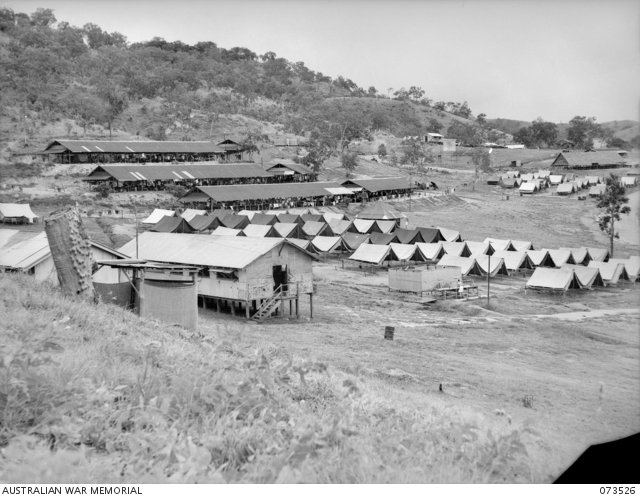
Beyond the end of the runway, the ground was relatively flat and clear for a distance of approximately 1000 yards.  A low ridge, peppered with trees ran perpendicular to the runway.  On the reverse side of this tree line, the ground dropped steadily away to form a small valley through which a creek ambled lazily.   The undulating ground then rose gently to form a second ridge, much lower than the first..…  Capable of housing a large number of vehicles, this rise was designated the marshalling area for troop transport vehicles bound for Durand Airstrip …..

At the opposite end of  7 Mile Drome – known to most as Jackson’s airfield, the Pratt & Whitney engines of  an American bomber turned over in the pre-dawn darkness.  Flight Officer Howard J. Wood busily worked through his pre- take off checks.   Hailing from Nebraska U.S.A, Wood’s mount was christened “Pride of the Cornhuskers” in honour of his home state…This ‘D’ model Liberator, Serial Number 42-40682 could carry a bomb load of 12 x 500 lb bombs when not fitted with supplementary bomb bay fuel tanks.  However on this day, the aircraft would be loaded up with just 4 x 500 pounders – perhaps this decision unwittingly saved many lives. …

For reasons unknown, when the Liberator took off at 4.30am it failed to gain sufficient height and hurtled towards the men on the ground.  Witnesses yelled of the impending danger but there was no time to take evasive action.  The port wing was sheared off when it struck a tree on the downward slope, across the other side of the creek.  Like a wounded bird, the huge bomber came crashing down onto the hillside near the Durand marshalling area – spewing forward a wave of burning aviation fuel.  Five lorries were hit by flying wreckage and engulfed in the resulting fire which turned night into day….

Despite the uncertainty of what caused the accident, what can be proven is the moral fibre of the men who performed their duties during the aftermath of this tragic crash.  The courage of the U.S. fire fighters on a rescue mission, clad in asbestos suits that walked directly into the flames is without question.  And the bravery of diggers who thought of their mates, before themselves is reflected by a quote from the official 7th Division Inquiry:-  “At the time of the crash there was not the slightest degree of panic and everyone who was able to do so, did what they could to assist the injured.  Considerable presence of mind and initiative on the part of members present, no doubt contributed largely to minimising injuries and saving lives.” The men received no honours or awards, because despite the fact they were waiting to emplane to fly into battle, they were not already in battle. The strict censorship at the time of the crash also prevented any honours or awards for the heroic actions of these men.…
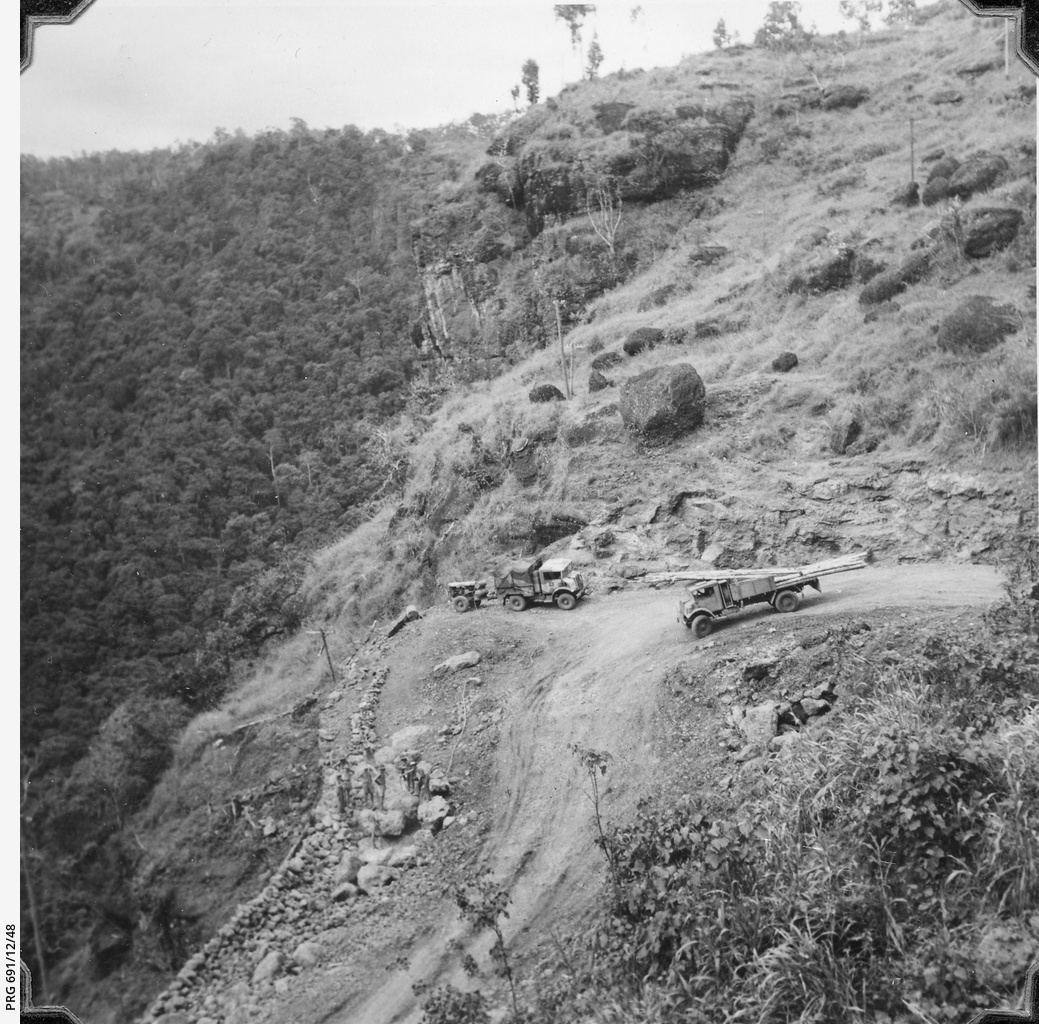
 

AWM 057403

Port Moresby area.  The scene after a crash of a Liberator bomber on the marshalling park at Jackson’s airfield on September 7 1943.  The aircraft hit the tree shown in the left foreground and crashed into trucks carrying members of the 2/33rd Infantry Battalion and the 158th General Transport Company…59 were killed or died of injuries and 92 were injured but survived.  Photograph taken looking SE along line of flight.


AWM 057405

Same information as for previous photo (with the exception of final sentence).


AWM 072911

Two of five trucks carrying members of the 2/33rd Infantry Battalion and the 158th General Transport Company which were destroyed when a Liberator bomber crashed into the marshalling park near Jackson’s airfield on 7-9-1943, causing the death of 59 men and injuries to 92.  The members of the Liberator’s crew also died in the accident.


The medical response 

from A Special Kind of Service – the story of the 2/9 Australian General Hospital 1940 – 46  by Colonel Joan Crouch  (APCOL 1986)    pp95-97

Ninety-six AAWMS  (Australian Army Womens Medical Service)…arrived in Port Moresby on 6 September 1943.  These were the first AAWMS posted to the 2/9 AGH…..(they) were given the first day to settle into their tents and adjust to the tropical heat.  .Their appearance in the wards was eagerly awaited by the patients: …..On… 7 September, a tragic accident occurred at 4.30am at Ward’s Airfield in Moresby.  The 25th Brigade of the 7th Division was ready for the advance from Nadzab, and was waiting to emplane in full battledress, when a Liberator bomber …. crashed on take-off into a Company of the 2/ 33rd Battalion.  The scene was devastating.

All staff of the 2/9 AGH were called on duty, dressed quickly and ran to the operating theatres and a surgical ward which had been hastily cleared of all patients.  One officer and 23 other ranks with serious burns were admitted to the 2/9 AGH.  The remaining survivors went to the 2/5 AGH…

On arrival at the 2/9 AGH, the burn victims were quickly assessed.  Those with 17% burns were sent to the operating theatres for resuscitation and surgery.  There were six with 90% burns and death was rapid.  Some others lived for up to thirteen days, but eventually there were only seven survivors….The AAWMS volunteered to come on duty and the sisters who were ‘specialising’ the surviving burns found the AAWMS most helpful in assisting then with their exacting task…..

Everyone wanted to help.  Ships in port offered fresh food, the Salvation Army and YMCA representatives called at the wards regularly, offering practical help.  The whole area was shocked by this accident.  In spite of this, the movement for the capture of Lae went on as scheduled….


Official comment

– from Jungle Warfare – the AWM Christmas Book of 1944 –

Chapter – The Battle for New Guinea – subsection ‘Seventh in action’ –

The first brigade to be committed was the 25th.  While the troops were waiting to emplane at Ward’s Drome, a Liberator had crashed into a company of the 2/33rd Battalion causing many casualties, but the movement went on as scheduled.  By the 9th of September two battalions of the brigade were moving along the road to Lae….

Posted in Uncategorized | Tagged , | Leave a comment